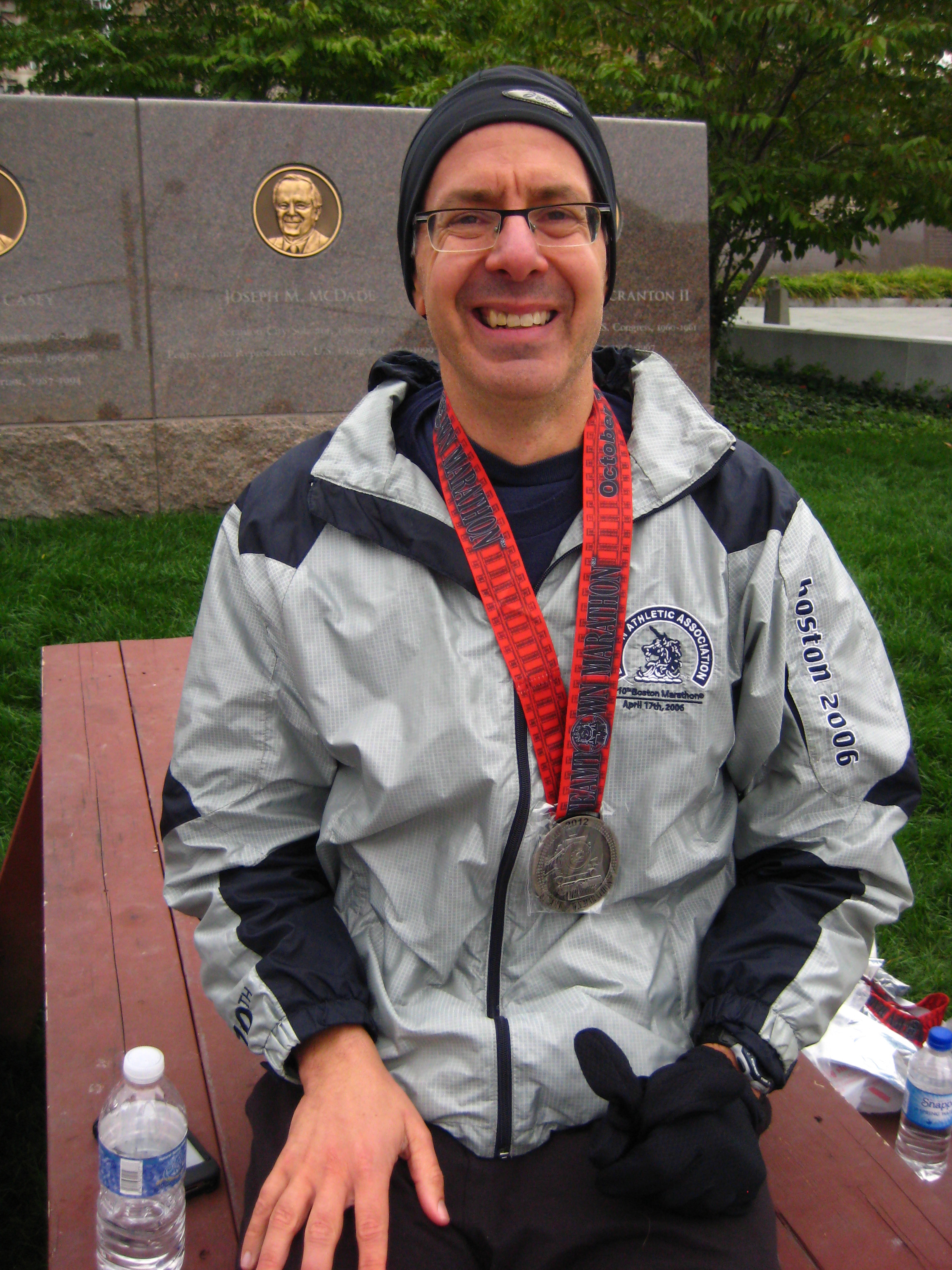
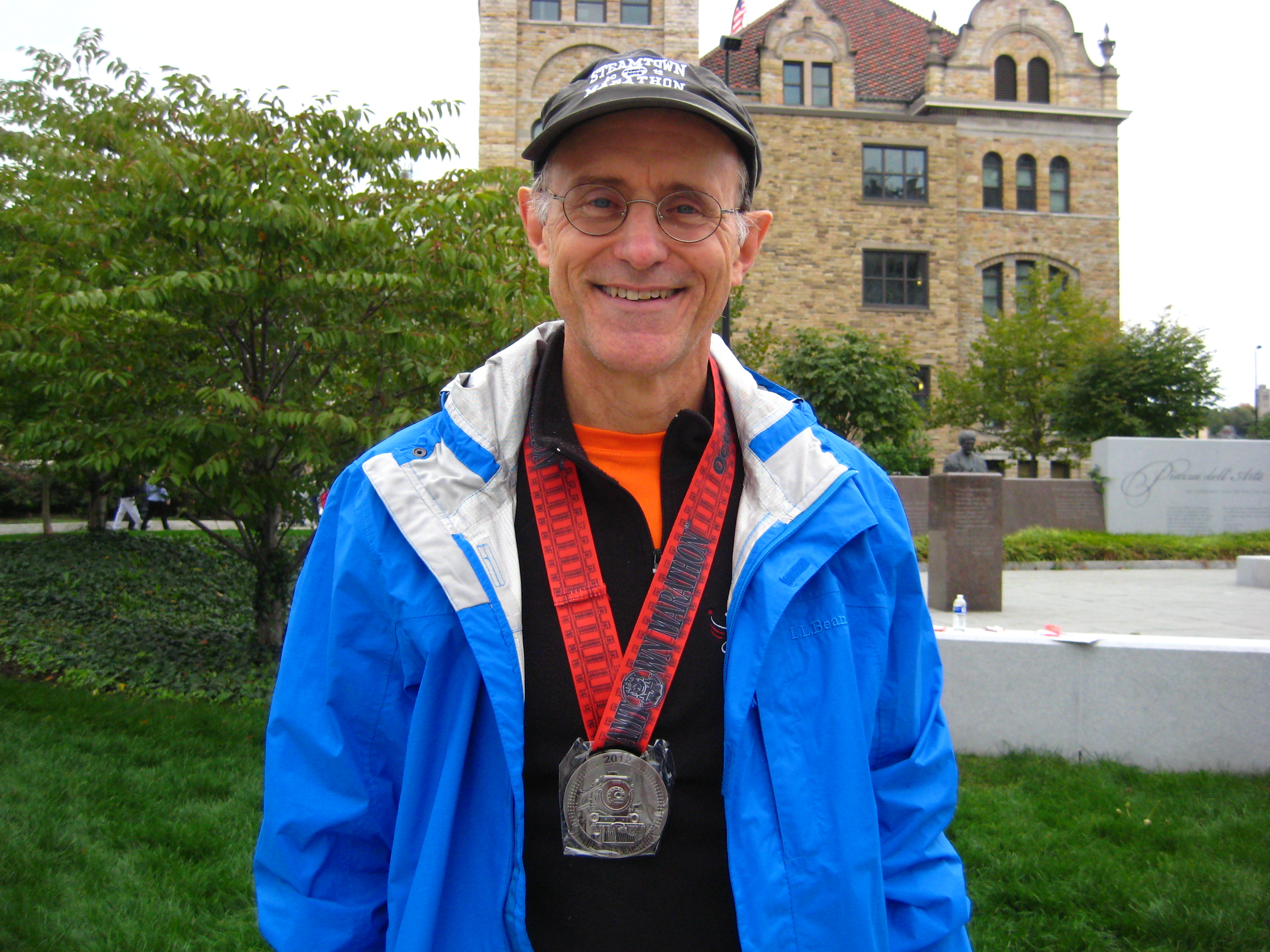
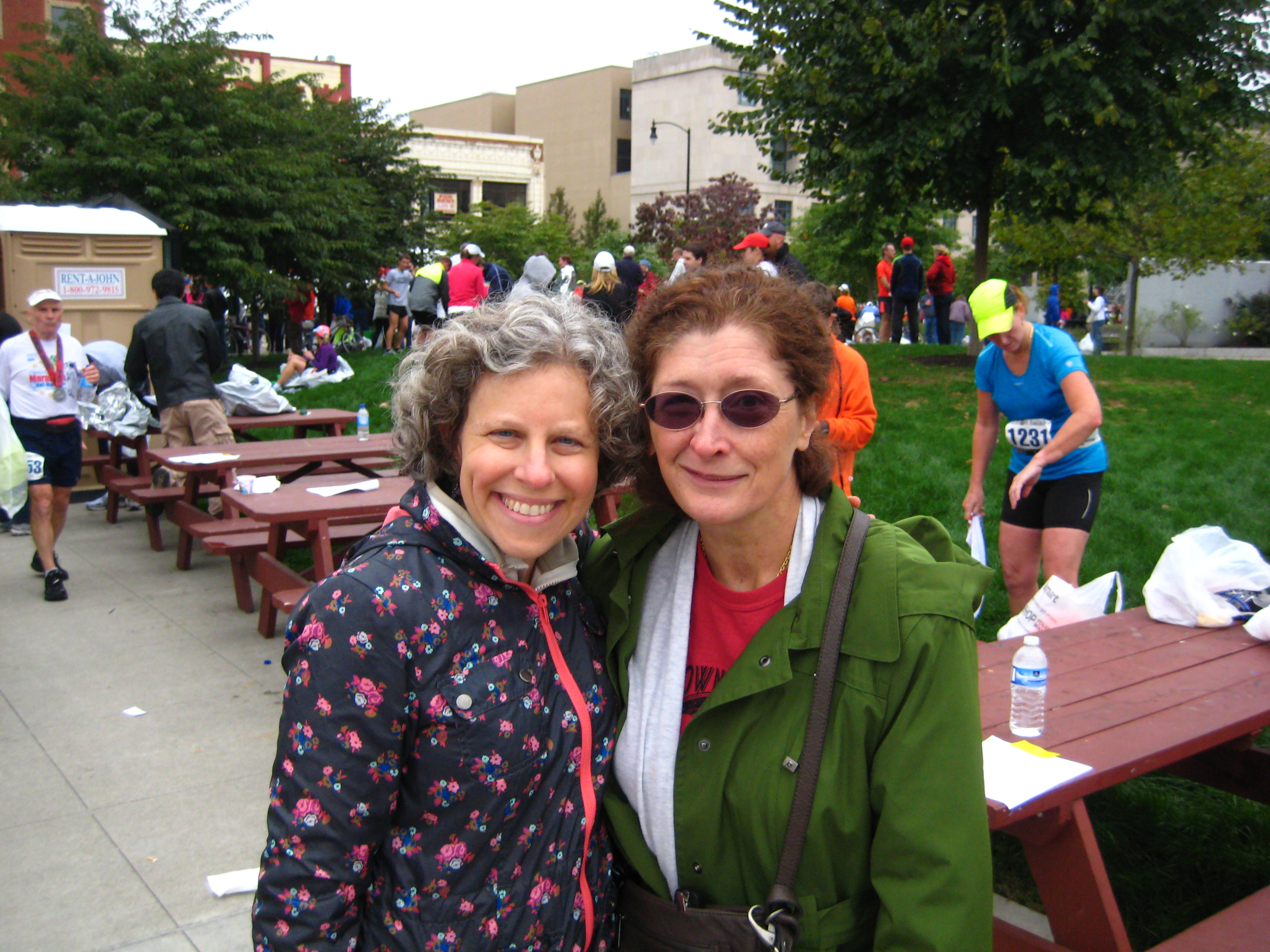
“Experienced” marathoner

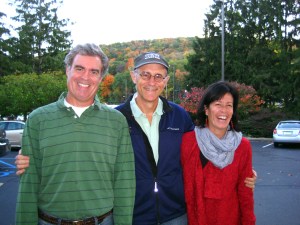
It may be hard to believe, but this summer is nearly gone. This means the next marathon is looming larger in the near future. For me and my training partners, that date is October 6, for the Wineglass Marathon in Corning, New York. Having now run seven marathons, I am more aware of what is coming. Standing out most clearly in my mind is recalling how, at some point in most of the marathons I’ve run, I tell myself how utterly crazy it is to torture myself this way. Why would I willingly choose to go through the muscle pain in my legs, the pains in my shoulders, the bleeding, the chafing, and sometimes the near delirium, just to say I had done it? While many in our club have run many more marathons than I, I am starting to get the gist of it.

We have several new runners in our club who are planning to run their first marathons this fall. Some have been running with us on our long Sunday runs, and a couple run on their own but tell me how they are doing. To a person, they ask for little advice, but mostly are quite fixed on their training plans. They all have that holy grail of the marathon runner in mind, the Boston qualifying time. When we (our Sunday group) hear this, like a chorus we say, “just work on finishing”. There is little one can say that helps the naive runner get through their first marathon. We offer the familiar advice of not going out too fast, sticking to a plan, hydrating, eating appropriate numbers of gels throughout the race, and preparing ahead with BodyGlide and bandages. Much of this is relative. What is appropriate hydration for one person may be way under or over for another. How many gels, how often, something other than gels, is pure guesswork.

Some advice is sound and well grounded. It is a good idea not to wear brand new anything, especially shoes, for your first marathon. Even that, though, I’ve ignored, when I wore brand new knee high support socks for a race last fall, not having worn anything like them before, and loved them. How to dress is a tough call. Personal preferences, temperature at the start, where that temperature is headed, sun, clouds, humidity, all figure in to that guesswork. I think I changed my mind about ten times the night before my first marathon. In a race that starts early and goes several hours, conditions can change dramatically. Or, they can stay the same. For my first marathon, Philadelphia, 2008, the temperature never got above freezing. It started in the low 20’s with a bit of wind. The water stops were sheets of ice, not very safe to run, or walk on. The next year, that same race started in the mid 40’s and rose to the low 60’s, practically perfect.

Another piece of guesswork is what to eat the night before. I doubt any marathoner would consider it a good idea to eat a huge meal, redolent with fat, and washed down with many glasses of wine. No, save that for the afterparty. Pasta is the standard, but anything light and easily digestible makes sense to me. Is beer okay? My feeling is yes, “a” beer is okay, and probably helps one relax and not be too wound up.

The first time on the start line of a marathon, the atmosphere is euphoric. Dropping one’s bag at the right spot, managing to make it to the portable toilet for one last squirt, finding one’s way to the proper corral, squeezing in with the other runners, and sensing the collective anxiousness makes for a unique, numbing experience. Other runners are wearing giant trash bags with holes cut for the arms and head. Some are stretching in their limited space. Some are chatting incessantly with friends, all of whom are wearing earbuds and probably already listening to some inspirational play list they have created. And some are quietly looking ahead, perhaps playing out the course in their minds. All of this is in a swirl around the new marathoner who is unaware of how the race will unfold.

I plunged right in my first time. It takes a while to actually get to the start once the gun goes off in the bigger city marathons. There’s a shuffling start, corrals move up, and then one gets caught a little off-guard when the start line is actually underfoot. I remember starting my Garmin as I crossed that first detection pad, hearing the faint cacophony of beeps as the chips get registered, like the sound of locusts. Then, one’s own personal best for a marathon is underway.

I am very pleased to see new runners in our club taking on this challenge. I think they will have an experience that will change them for a lifetime. If, like me, they wind up getting sucked in, and go back time and again to challenge themselves, they will really change their lives. Each time I head to the start line now, I don’t know how the race will end for me. I know that I don’t know. But I have become aware of the routine at the start, the way I asses my condition as the race progresses, and certainly the warning signs of trouble, like cramps that all too often befall me along the way. I am still experimenting with strategy, modifying my starting pace, the way I drink during the race, and learning to slow down in the first half to be able to go faster in the second. It is quite a commitment to take on the training, typically about sixteen weeks, all for the one day event which may have great conditions, or perhaps awful conditions. I wish our club’s new marathoners, and anyone else tackling this for the first time, a satisfying and fulfilling experience, that will cause them to come back again.

Frank

Summertime, and the livin’ is easy, but the running isn’t!

This feels like the summer of 2012 all over again.  We had a stretch of rainy days which seemed to go on forever, although it was really only about a 10 days or so.  I had two rather interesting rain-related experiences during this time.  Both were during my Monday run from my hospital in Camden, NJ, over the Ben Franklin bridge to Philadelphia, a loop down to the Race Street pier, then back over the bridge and back to the hospital.  It is a very nice six mile round trip, with the challenge of the bridge, but also with a pleasant breeze on the bridge and very nice views.

The first interesting experience occurred on my way back through Camden.  Dark rain clouds and the rain coming down to the east were illuminated by the setting sun to the west, and a beautiful, full-arc, sharply colored double rainbow could be seen as I was crossing Market Street.  I stopped a local man crossing the street who hadn’t noticed this wonder of nature and pointed it out.  He smiled broadly, and said “yeah, cool.”

The other incident was a little more worrisome.  I was doing the same run again.  It was overcast, but the rain seemed to be off to the east, and usually the direction of travel of the rain clouds is west to east.  As I was cresting the high point on the bridge, large raindrops started to splat the walkway.  I still felt this didn’t seem like much of a problem.  In fact, I was marveling at how the rain on the walkway created an outline of the old-fashioned style lamps along the railing.  My reverie was short lived.  Instead of moving east, the storm was heading right towards me.  I still had about a quarter of the bridge to go as the rain picked up and became torrential.  Worse, lightening was flashing around me.  I don’t know the risk of being on an enormous steel structure during a lightening storm, but my gut feeling was that it was not safe.  I scurried down the ending stairway of the bridge, three sets of wet stairs, to the street.  I made it shortly to a loading dock area on the Rutgers campus, and got out of the storm.  As I waited out the storm, several other runners behind me on the bridge kept running in the storm, and I watched them go by.  I felt a little wimpy, as if I should shake my fear and continue running.  But then, reason took hold and I waited a bit more.  Looking up at the sky, I could see swirling clouds which looked like they were attempting to make a tornado.  Fortunately, it never go to that.  With the storm, and the lightening, having moved on, the thunder now coming more than 10 seconds from the lightening, I ventured out and ran the last mile or so back.  It was still raining, and when I got to the hospital I made sure to allow a little drip time before going back in to change.

Now, though, the rain has been gone for several days and the heat has arrived.  As we all know, running in the heat can be brutal.  One’s body must acclimate to the heat.  This is a complex process, involving changes in the body’s blood volume, hormonal status, immunological changes, sweat composition and response, and other alterations.  All those intricate physiological changes have yet to occur in me.  I ran yesterday for a seven mile run, and today for a 12.5 miler.  While the starting temperatures don’t sound that brutal, around 79 degrees F, the high humidity of 90%, low to non-existent breeze, and sun made for very uncomfortable running.  Both days we started at 7:00 AM.  My friend Brandon, with whom I ran on Saturday, seemed to already have made that jump to summer running, as he was not nearly as affected as I was.  Perhaps it is his incredibly lean, thin body, or the fact that he runs normally more than fifty miles a week, but he cruised without dying.  I, on the other hand, felt like collapsing after a few miles.  Saturday, I mustered on, drinking water from the fountains along our route, and going a very diminished pace.  Sunday, I started out running with two other runners, planning to go 13.5 miles.  I carried a bottle of water with me in one of those handy runner’s bottles, with a strap for my hand, and a protruding enormous nipple-like spigot, allowing a drink on the run.  One of the guys in my group peeled off at four miles, saying he was never going to make the 13.  The other kept with me until his usual turnoff at my six mile mark.  So I was left alone for the rest of the run.  As I steadily, but at a considerably slower pace than normal, made my way around our standard Sunday loop, the sun got higher, cresting the trees and shining down on me.  Other runners came by in the opposite direction, looking pretty bedraggled, with the exception of one young guy.  He had on a gray army-style t-shirt and was running with a backpack.  He looked pretty tough in the heat.  I was drinking steadily to ward off dehydration, and used the amount of sweat on my hands as a guide.  If they were dry, I figured I had stopped sweating from not enough fluid, and took another gulp.  The sweat continued to drench me, and I could feel my feet getting soaked in my shoes.  At around ten miles, I stopped at a water fountain and had the good fortune of meeting a friend running in the other direction.  I hadn’t seen him in a long time, but still we stopped to talk far more than would be normal under milder circumstances.  As I headed for the last leg, I was running now at around a 9’30” to 10 minute per mile pace, not able to go any faster.  I switched sides on the road a few times to take advantage of the bit of shade I could find from the trees.  With two miles left to go, I made the decision to cut this run short, and headed back up the hill for only a one mile return to the start, thinking that lost mile would not be doing me much good anyway.  I made sure to finish strong, though, as I passed my fellow Sunday morning crew who had run shorter and were already hanging out at the Starbucks.  One always should look good at the start and end of a run.  In between, nobody is really watching.  I banged on the sign marking the end of the run, and wobbled over to get my backpack and my extra bottle of sports drink I had stowed for my recovery.  Sitting in the shade, bent over, calf muscles doing their quivering imitation of fireworks going off, I took off my shoes and socks, wrung the sweat from my socks, and slowly felt the heat dissipating.  Once I had cooled to a nearly presentable state, I made my way over to join my friends. I changed to dry clothes, and sitting outside, with a little breeze and in the shade, it didn’t seem so awful.  But, boy, running in the heat can be brutal.  I do look forward to that magical transformation of being acclimated.

Turning 59…

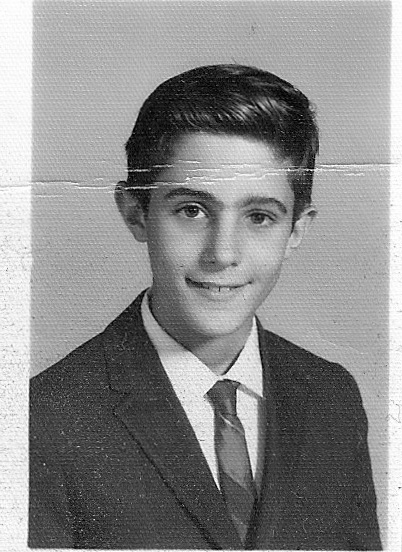
Nov. 66…ain’t that special.  It’s not one of those banner years, like 18, when you get to vote, and can join the army.  Or 21, when you wait until midnight the night before, then whip out your drivers license in the bar showing you are now of legal age to imbibe liquor.  Why it’s okay to kill or be killed for your country at 18, but not have a beer, is one of those mysteries of society I will never understand.  If I stretch my memory way back to the earliest birthday I can remember, I probably was 6.  But, I also probably only remember it from the grainy 8 mm movies my dad took of the birthday party, and along with that, the distinctive sound and smell of the projector.  The flap, flap, flap of the film at the end of the reel is a lost sound, recognized by us older folks, but unheard in the YouTube age.  In the movie version of my birthday, the films of which lasted only about four minutes each, I was dressed in a cowboy costume, chasing other kids around, and sliding down the slide in our backyard.  My cousins posed for the camera like glamorous stars.  There was a nice birthday cake with six candles, far from the fire hazard I’d require today.  The photo at left is me, far more mature, at the age of 12.  Children are  still very naive at that age, especially in the suburban setting in which I grew up.  The worst that would happen was getting into a fight with one of my friends.  A few punches were thrown, we’d go off and lick our wounds, then make up and get back to our usual cordial games.  Not that I had not known grief.  I had already experienced the assassination of President Kennedy.  In fact, I saw him a few days before the fateful event, on a motorcade in Houston, where we lived at the time.  I recall coming home from school to see my mother very upset, but not really understanding the importance.  I was 9 at the time, three years before this photo.  All of my close relatives were still alive, so I had not experienced death and loss.  I did know something about World War II.  My father had been in the Merchant Marine on an oil tanker that provided fuel oil for the battle ships and destroyers in the Atlantic and the Pacific.  He didn’t speak much about the horrors of that war, but he related some stories of harrowing times under attack by German subs, when an escorting destroyer in his convoy was blown up.  The image of sailors being blasted off the deck clearly made an impression on him, and I picked up some of the fear for their lives these men must have felt.

As birthdays passed, I marched on to my 16th.  Living in Arizona at the time, I was able to get a full, unrestricted driver’s license at that age.  I believe the reason they allowed such young kids to get licenses in Arizona was that it was a lightly populated state, with many agricultural communities, and someone needed to be able to drive pops to the liquor store to stock up for the weekend.  It made for an interesting singularity, though.  We moved to California that year, and while the driving age there was officially 18, 17 and a 1/2 for a permit, they recognized my Arizona license and gave me a full license in California.  I was the only kid my age in high school to have a license, which made me pretty special.  While this held me until I was 18, the drinking age was 21 in California, but only 18 in Arizona.  I took a road trip back to visit friends in Scottsdale when I was 19, and the first thing I wanted to do was get a drink in a bar.  My experience with liquor to that point was very limited.  I had sips of my grandfather’s beer from time to time, Rheingold, and my parents drank the cocktails of the day, the martini and manhattan.  As a child and teen, my parents would have parties with the obligatory mixed drink cart, cigarettes in attractive boxes about the room, and fancy lighters which doubled as decorative accents.  So, when I hit the bar with my friends in Arizona, I hardly knew what to order.  I settled on a scotch on the rocks, having heard of that drink in a movie somewhere along the line.  It burned my throat, and I don’t think I was able to finish it.

Around this time, though we were still in the worst of it in Vietnam.  Shocking photos from war journalists were making the cover of Time and Newsweek, and statistics of soldiers killed and wounded were broadcast on the news.  I signed up for the draft as required, although my parents swore that if I was drafted we were headed for Canada.  Oh, Canada, thanks for being there in our time of need.  As it turned out, my birthday was given a high enough number in the draft lottery so I was not called up either year I was eligible.  I’m not sure what I would have done if I was, probably try to join the Navy.  After the second year of the draft, President Nixon ended our role in the “conflict”, and brought the soldiers home on March 27, 1973, forty years ago.  The war between North and South Vietnam continued two more years, until the North, backed by China, had crushed the South.  The Vietnam War was my awakening to the inhumanity possible in man against man.  Women and infants slaughtered, because they might be abetting the enemy, and indiscriminate bombing and exfoliation of the jungle led to massive protests in the U.S., and  many students who took part were injured or killed for doing so.  When I started my college years at UCSD in 1972, the campus was still reeling from the May, 1970, self-immolation of George Winn, Jr, who was a graduate student at UCSD and was protesting the war.  While terrorism hardly started in the 1960’s, it was in the late sixties and early seventies that the term terrorists seemed to become well known.  Bruce Hoffman, a specialist in the study of terrorism at Georgetown University, defines terrorism to include several features including that it is conducted by an organization with an identifiable chain of command.  His definition can be found in this Wikipedia article.

Through college and medical school, birthdays seemed to fly by.  No longer the cause for a gay party with balloons and cone hats, they more marked our stages of development as adults.  At 25, one is considered old enough to be more responsible behind the wheel, and the auto insurance costs go down.  At 29, one is on the verge of losing youth, and everyone seems to want to be 29 for a long, long time.  Come 35, one should be married, have a job, and some kids.  Work becomes an every day responsibility, as we take on the raising of children, the house mortgage and all the other obligations of becoming truly adult.

While things were still happening around the world, some wonderful, like space shuttle trips to the space station, or the invention of the car phone (bit of a double edge sword, that), the world also was getting hotter with extremists and their attacks.  Names such as the IRA, Shining Path, Cuban Hijackers, the Red Army Faction, the Unabomber, the PLO, Islamic Jihad, Armenians, Italians, Sikhs, and many others became front page news items for their atrocities.  Yet, with a family to raise and a very busy work schedule as a young surgeon I was much more interested in my immediate circle.  One slightly ironic note was that, as an attending at the V.A. Hospital, I found myself caring for Vietnam Vets whose lives were destroyed back in the 1960’s and 1970’s.  I also took care of vets from the first Iraq war, Desert Storm.

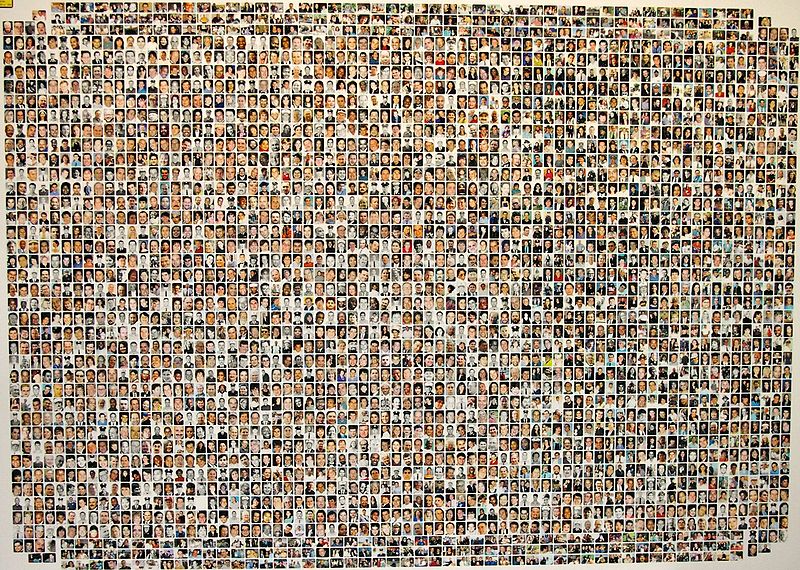
Victims of the 9/11/2001 attack on the World Trade Center Victims of the 9/11/2001 attack on the World Trade Center

We go through stages as adults where we are at first very aware of what is going on in the world, and want to do something about it.  We protest, join the peace corps, and are activists politically.  Then, we knuckle down to raise a family, provide for the family, and deal with the everyday little problems that fill our world.  As the children become independent adults, we again get more involved with what is going on in the world.  The US has been lucky lately, situated where we are between two big oceans and two friendly neighbors north and south.  We have not had the daily threats of violence experienced by those in the middle east, Europe, Asia and even South America.  The attacks of 9/11 woke us up to the fact we are not immune to horrific terrorism, just rather well insulated.  We also have had a large number of senseless home-grown attacks by gun wielding psychotics, or attacks like the Okalahoma City bombing in 1995, politically motivated but not from an organized anti-government force.

Frank at Boston, 2011. Frank at Boston, 2011.

The Boston Marathon occurs a week, or at most almost two weeks, before my birthday.  For me what this means is I will never run it at the peak power of my age group.  I will always have to qualify for a year into that age group.  As I’ve reached my 59th year, I can see that I no longer can run with the speed I had ten years ago.  It doesn’t sound very old, 59, but the legs don’t lie.  I had the humorous experience of seeing one of my patients of many years, perhaps twenty, in the office the other day.  While she still looked fit, I thought to myself, “my, she seems so much older than I remember her when she first came to see me”.  She must have caught wind of that thought, and said out loud, “you are really looking pretty old”.  I laughed out loud, realizing we both must have been thinking the same, that we really have changed as we got into our late fifties.  From inside my body looking out, I don’t feel old.  In fact, I feel the way I perceived myself looking perhaps twenty years ago.  But, take a look in the mirror, and that older individual looking back, the one I don’t recognize, is definitely me.

The bombing at the Boston Marathon was such an awful, unexplainable attack, and when it happened, I found myself in shock.  I was not there this year, but had very close friends there, many of whom would have been crossing the finish line within minutes of the bombs going off.  It took quite some time before we back home found out that all of our friends were alive and had not been injured.  I am so thankful for their sakes and for their worried families.  The attack, though, seems not to have a thought behind it other than to be some kind of copycat attack.  It is one thing for Chechens to want to attack Russians, who have politically dominated them, or for the IRA to lash out at the British.  Inexcusable, and not productive, but the reason behind these attacks, or of myriad other terrorist attacks, is not mysterious.  This incident must have had it’s intended consequence, to make us fear for our lives and limbs on a daily basis.  But it does not carry forward any particular agenda and so becomes just a very awful, desperate and destructive act.  I feel a little sorry for the young man who aided his brother and now has lived to face the punishment.  In the picture that emerged of his pre-bombing life, he does not seem like someone hell-bent to cause pain and death.  Nevertheless, I feel much greater sadness for the victims of his heinous crime, the families of those who died, and the ones whose limbs were blown off them, and who now must learn to live a completely new and more difficult life.  Ultimately, running a marathon is a selfish act, but the outpouring of support one gets at the Boston Marathon shows that we runners have somehow given inspiration to those watching.  I had many a spectator yelling support and cheering me on as I struggled to complete the course and get across the finish line.

So today, on my 59th birthday, not relevant in the list of birthdays, but, for me, a time of reflection, I realize that what we do and say makes a difference.  How we behave and comport ourselves sets an example for others to follow.  If we are mean, and engage in cruel acts and torture, we are setting an example, not declaring some high ground as ours.  While this incident was not the worst attack in recent history on US soil, it is for every individual killed or injured.  I hope we as a country learn from it to be kind, to encourage and to support, not to take revenge and continue a cycle of destruction.

Frank today, with wrinkles. Frank today, with wrinkles.

Tony Runs Boston

Tony Walter, after qualifying at Steamtown, 2012 for Boston.

Tony Walter, after qualifying at Steamtown, 2012 for Boston.

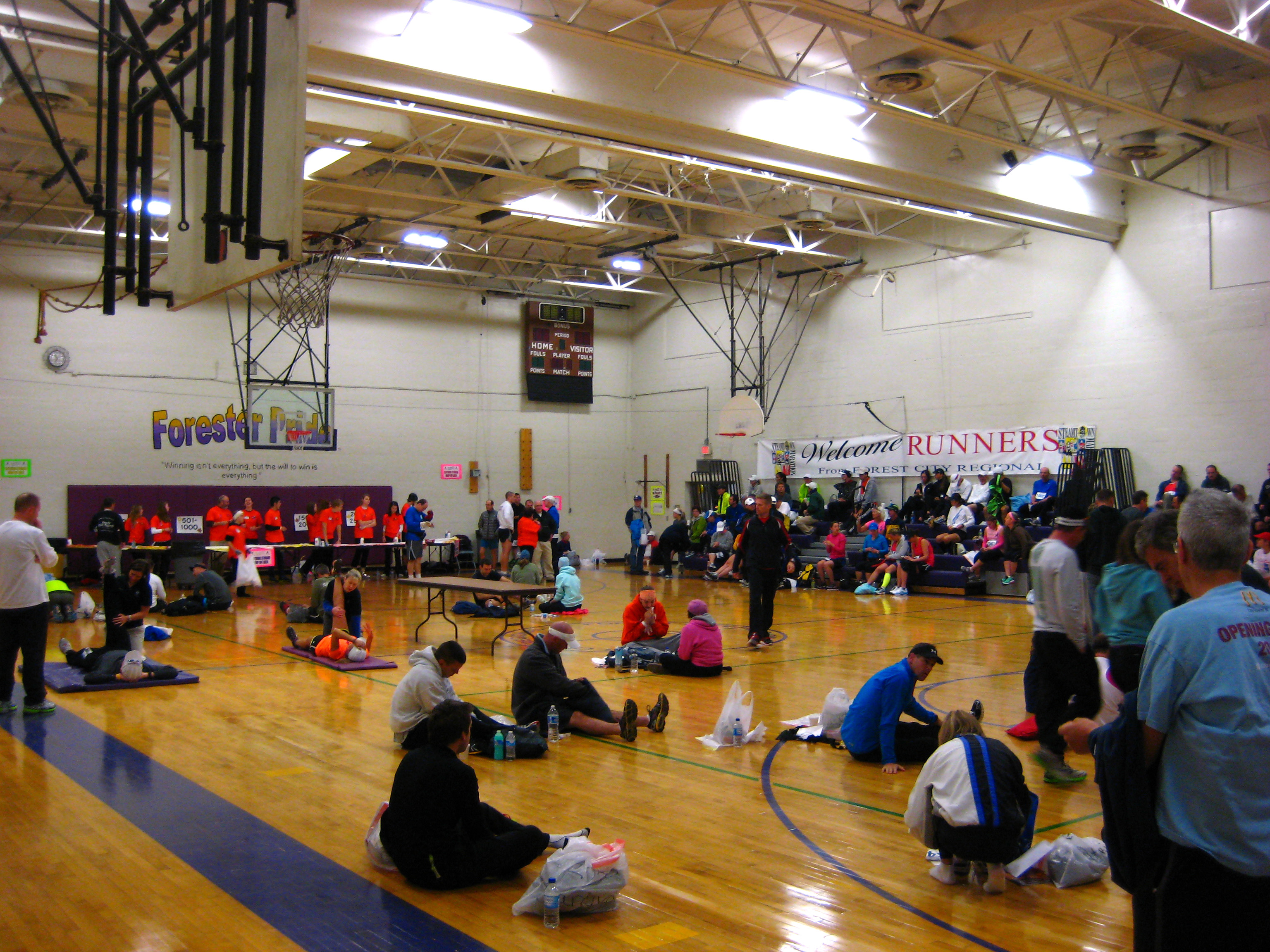
Back in May, 2012, a group of us from the SJAC decided we would head up to Scranton for the Steamtown Marathon in October, 2012.  One of our dedicated group, Brian, suggested we should write a blog about the group preparing for this event.  I happened to be the one who moved forward on this suggestion, and the sjacmarathoners.com was born.  Through the hottest summer on record in the Philadelphia area, we trained as a group, sweating, running, sweating some more, wringing out wet socks and shorts, hydrating, rehydrating, and getting in the miles.  Our experiences were documented in our blog.  After the grueling summer, and a bit cooler September, our group headed up to Scranton to participate in the Steamtown Marathon.  It is small as marathons go.  Three thousand signed up, the maximum allowed, and the event was closed to registration by the end of May, which speaks to it’s desirability.  It is also known as a Boston qualifier, since an average of about 25% of runners in this race qualify for Boston.  What this means, though, as I found out, was that it is an elite runners marathon.  The reason so many qualify for Boston is that so many fast runners run this race.  This was evident when we were gathered in the gym at the Forest City high school, waiting for the start.  I had not seen so many Boston Marathon jackets since I ran Boston in 2011.

Tony ran Steamtown with an eye to qualifying for Boston, although he would have been happy just to put in a decent performance.  He needed to hit under 3:40 to qualify.  He also needed for Boston not to be filled up by the time his race was run.  There were a few factors that made this prospect interesting.  One was that the Boston Athletic Association decided to change the qualifying times the year before.  Two years ago, Tony could have qualified with a 3:45:59.  They decided to drop the time for all entrants by five minutes, and drop the 59 second allowance.  That set the new time at 3:40 flat.  In addition, they decided to allow finishers who beat the time by certain margins, 20 minutes and 10 minutes, to get preferential sign up privileges.  Theoretically, one could make a qualifying time but not be allowed to run because all the places were taken.  This happened the year before, when some runners had hit the qualifying time, but there were no places left.  For 2013, an anomaly occurred.  The 2012 Boston Marathon was run under very hot conditions, with temperatures into the high eighties.  Participants at Boston who normally would have qualified at Boston for the following year had times much slower than normal due to the heat, and some actually decided not to run.  This left a few places available still in October, after the Steamtown Marathon.  So, when Tony hit his qualifier of 3:39:06, he was able to sign up for Boston.

At the end of Steamtown Marathon, Tony was beat.  He could hardly move, and when someone in our group offered to get him a drink, he had the look of a zombie as he answered that he really couldn’t say.  Our group went out to eat lunch at a very nice Mexican restaurant in Clarks Summit.  Tony ordered a delicious tortilla soup, which remained untouched as he stared at his bowl not saying a word.  We got a little worried about him, but he still had a pulse and respiratory rate, so we figured he would be okay.  On the way home to the Philadelphia area, he stopped at a rest stop to get some coffee.   Lisa, one of our group, followed him there, just to check on him.  Seeing he was managing alright, she drove on and Tony eventually made it back home.

The next day, he signed up for Boston.  Good thing he did, too, for it filled up by Thursday of that week.

Tony is a terrific training partner.  He seems like he is always in a good mood, and he always has kind things to say about everyone.  He is very steady in his training, and got through the summer having put in the miles, logged the long runs and done the track work to be well prepared.  He kept the rest of us going strong, and set a good example for us.  In other words, he earned it.

Many of my non-running friends have asked, “what is so special about Boston?”  Anyone who has run a marathon knows about Boston.  It is the oldest modern marathon, run since 1897, with the exception of 1918, during the first world war.  It is also a marathon for which one must qualify in ones age group.  The runners are all elite runners who have achieved a qualifying time which puts them in the top echelon of marathoners world wide.  But the best thing about running Boston is the support of the fans, who turn out in droves on the day of the marathon to cheer on the runners.  It doesn’t hurt that the event is held on Patriot’s Day, commemorating the start of the revolutionary war, and, as it happens, a holiday in Massachusetts.  The crowds that line the route, cheering, giving support, and making a lot of noise, especially in the last few blocks before the finish line, make the race a wonderful experience.  And, to make it all that much sweeter, the students from Wellesley, an all-women’s college, come out to offer kisses and high fives to the runners as they pass the midpoint of the race.

Tony will be running his first Boston Marathon tomorrow.  From his training partners back home, who didn’t make it in to Boston this year, we wish him the very best.  This morning, after our Sunday morning training run, a 13 mile route, the group gathered to offer Tony advice.  “Don’t go out too fast (duh…).”  “Go out easy and then back off.”  “Go get ’em, but take your time at Wellesley.”  And “whatever you do, make it across the finish line.”

I would like to ask any one reading this to offer support for Tony and we will pass on your advice and good wishes.

Best wishes to Tony from the SJAC Marathoners back home.

Best wishes to Tony from the SJAC Marathoners back home.

Wherefore Pasta?

Pasta is known as runners food.  The discovery of the benefits of carbohydrate loading  gave runners the reason to load up on something with a lot of carbs the days before a big race.  What could be better than pasta?  Yes, rice or potatoes could easily fill the role, but pasta is sexy.  It’s delicious.  It’s fun to eat.  Over the last two decades, the benefits of carbohydrate loading have come into question, particularly the traditional method of starving your carbohydrate stores for a few days, then feeding them maximally for three days before a marathon.  This loads up glycogen stores in the muscles and liver, to provide a source of energy for the marathon.

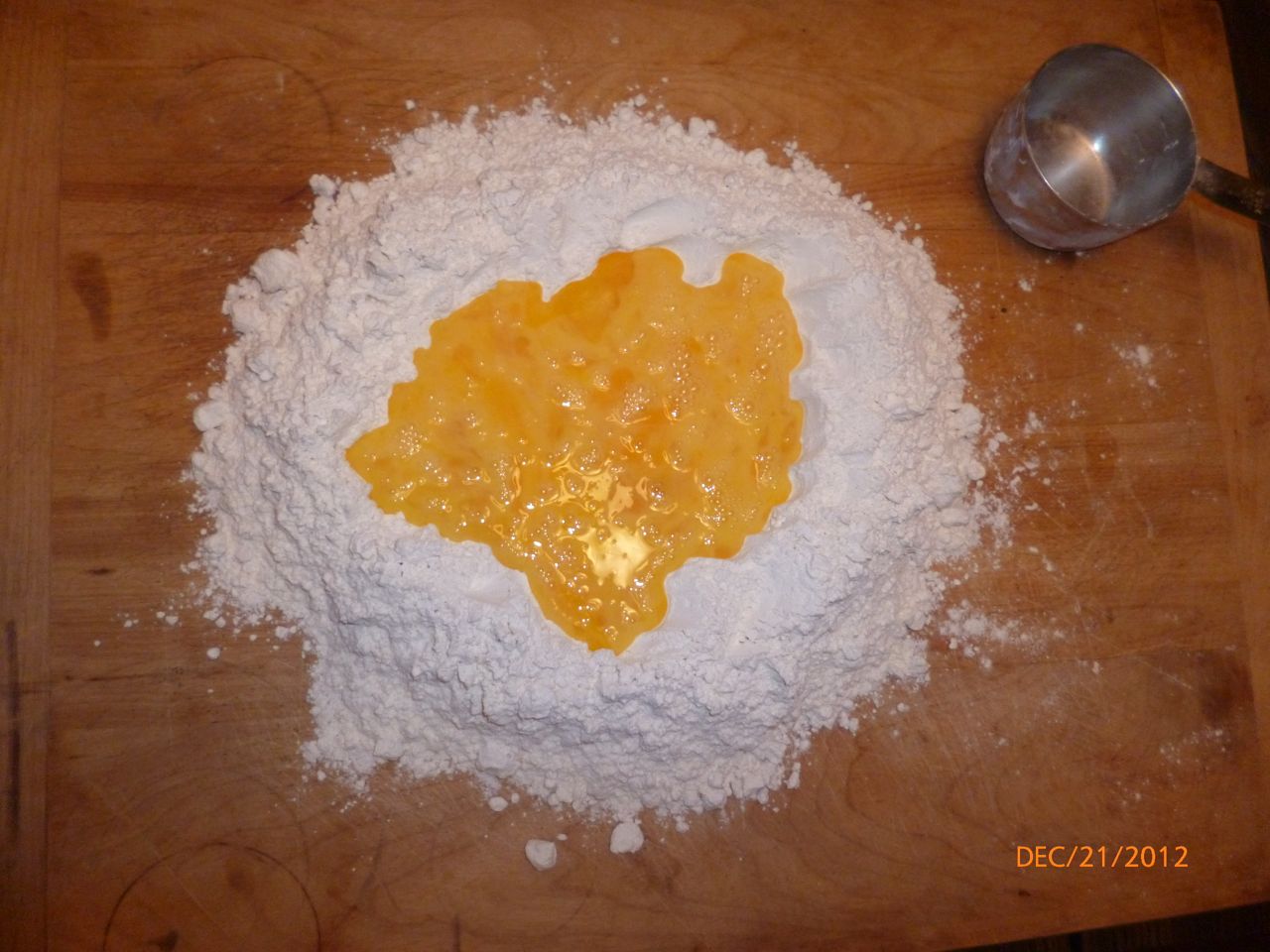
Making pasta is simple, but takes muscles.  It consists of flour with either water or eggs.

Making pasta is simple, but takes muscles. It consists of flour with either water or eggs. Then, blend.

Athletes, ever looking for an edge, were eager to use carbohydrate loading techniques, but were not very happy about starving themselves of carbohydrates for several days during the last week or so before a marathon.  Researchers, seeking ways to keep the benefits of carb loading without the starvation element found it was not as critical to starve the cells as once thought, and that carb loading could still work.

P1000027

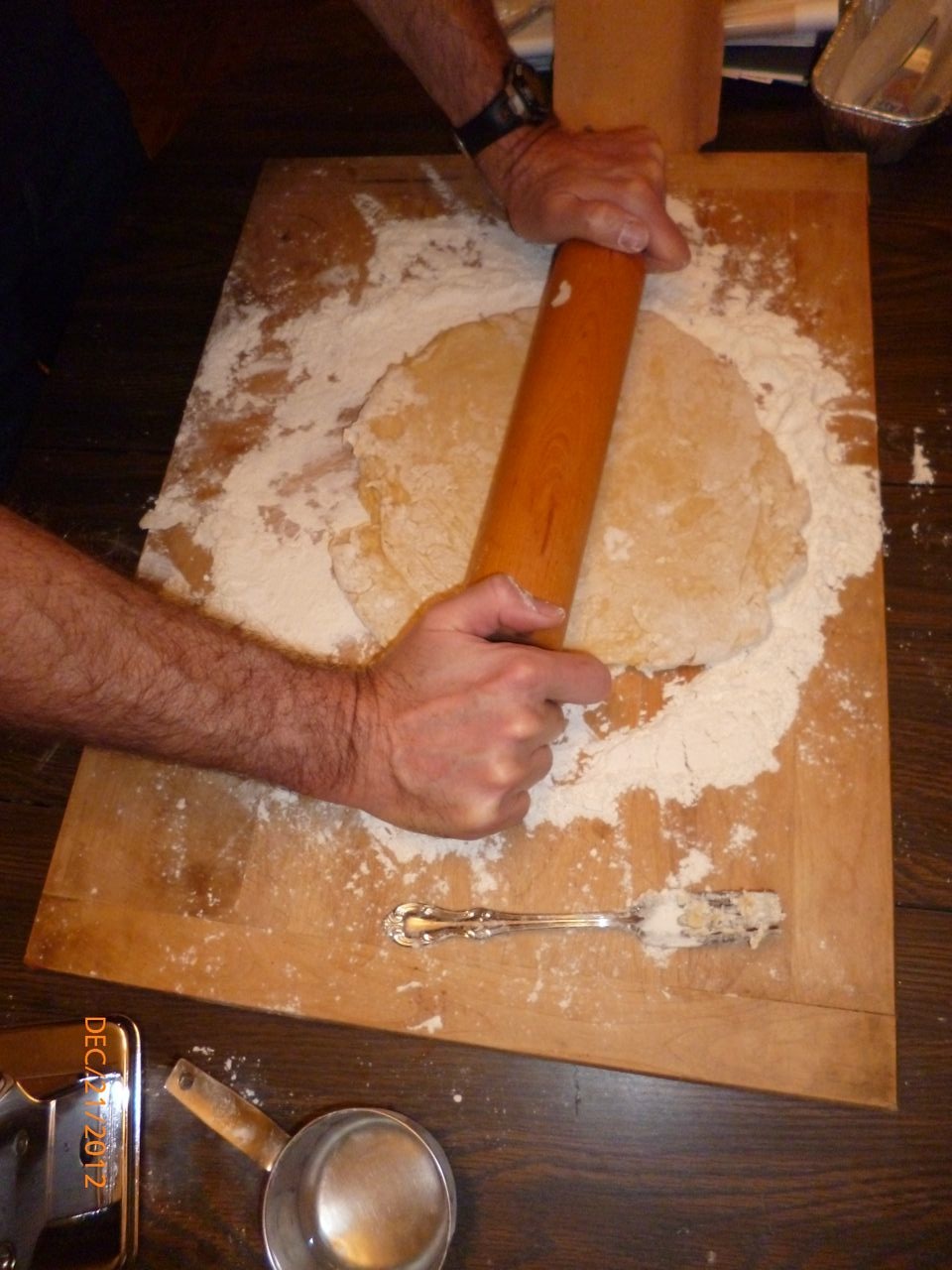
The pasta dough is thick and hard to roll. It may need a bit of water to make it workable.

One paper I studied, “Metabolic Factors Limiting Performance in Marathon Runners”, by Benjamin I. Rapoport, published in PLOS Computational Biology, 10/21/2010, examined and explained some very interesting numbers in marathon running.  He gave a formula for calculating the number of calories used in running a marathon, based on one’s weight in kilograms and the distance of the marathon.  The amount of calories consumed is based on the distance run, and is approximately 1kcal per kilogram per kilometer.  This calculation includes the basal metabolic rate and the energy expenditure from running on top of that.  For me, weighing about 81kg, my total calories consumed during a marathon is 1kcal/kg/km x 81kg x 42.195km, or 3418kcal.  He estimates the available energy for muscle activity to be on average, about 1800 kcal in the leg muscles and about 600 kcal in the liver, assuming one has carbohydrate loaded.  So, that is 2400 kcals available but a need of 3400.  He points out if we could use fat as our energy source, we could do five marathons without a problem, since we have plenty of energy stored as fat.  But, the faster we go, and the harder we push, the more our bodies want to use glycogen, i.e., carbohydrates, and less fat.


The pasta machine works very well.  It can be used to roll the pasta progressively thinner and thinner, and then cut it for the style desired, in this case, fettuccine.

The pasta machine works very well. It can be used to roll the pasta progressively thinner and thinner, and then cut it for the style desired, in this case, fettuccine.

The article mentioned above makes a strong case for average runners running a marathon to carbohydrate load and to take on extra carbohydrate in the form of easily digestible gel during the race, in order to avoid running out of carbs, and therefore hitting the “wall”.  It attempts to show mathematically how to calculate carbohydrate needs during a marathon, according to body build, conditioning and weight.  It gets very technical, though, and should one be interested in studying it, it can be found here.

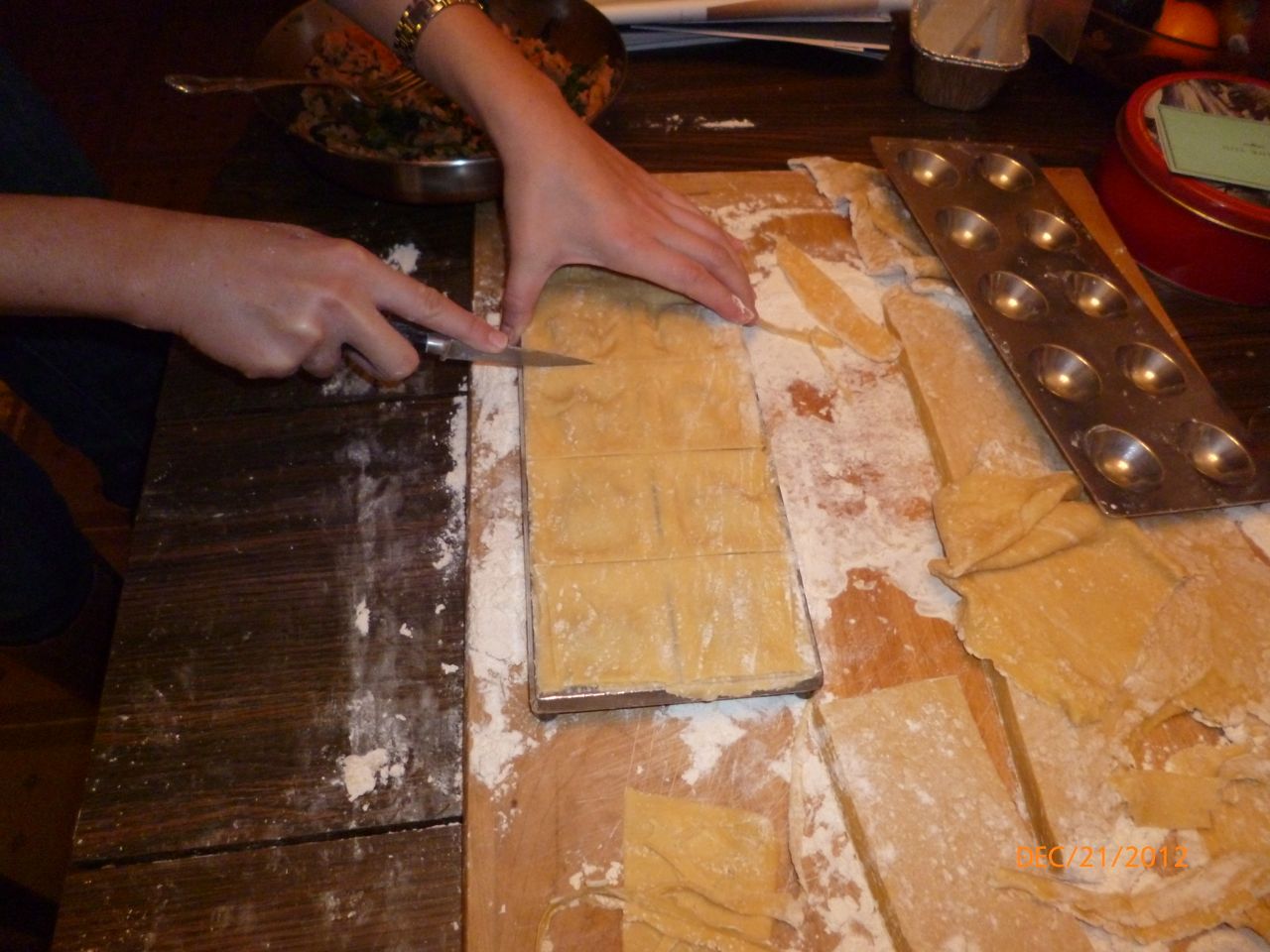
Stamping out ravioli.

Ravioli can be made using a molding form. We took the rolled dough, added a filling of spicy Italian chicken sausage and spinach, and stamped out some delicious ravioli.  Other tools are available for other ways of making ravioli.

I’ve now run seven marathons, and have definitely hit the wall in six.  It is a miserable feeling, when suddenly the legs won’t work, they are in pain, and walking is the only option. I certainly don’t think there is one formula of feeding the muscles that will avoid this.  But, one very helpful point Rapoport makes in his article is that a steady pace, or steady effort, is the most efficient way to run a marathon, and that working harder at the beginning, or pushing harder up hills, is counterproductive.

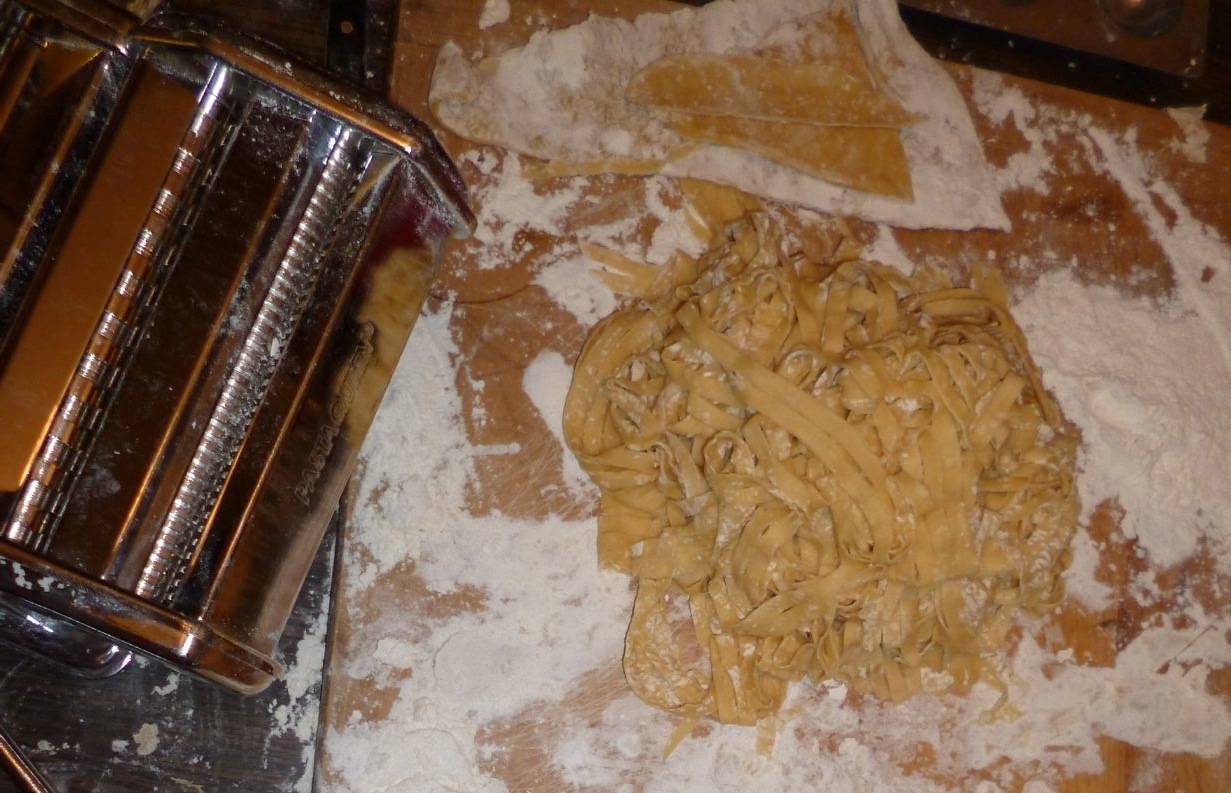
Raw Fettuccine

Fresh, raw fettuccine, ready to drop into boiling water. It cooks very quickly when it is fresh.

In the past, I had my doubts about carbohydrate loading and how and whether to do it.  Most of my running partners know about it, but don’t really know how it is applied.  From what I’ve read, it still makes sense to deprive the muscles of carbohydrates before the three day loading, but this step is not as critical to the overall effect as once thought.  Also, current research suggests that a single short, intense effort the day before a marathon, followed by a high carbohydrate meal, can be almost as effective as the longer plans.  Generally, though, a low carbohydrate meal means about 10% of calories in the form of carbohydrates, and a high carbohydrate meal contains 70%-90% carbohydrates.  Note that the number of calories does not increase.

Cooked ravioli.

Ravioli cooked and ready to eat. A little olive oil and parmigiano, or some simple tomato sauce goes well with this.

Also, if one takes on carbs in the form of gels or glucose-containing sports drink during a race, it makes up for a lack of carbohydrate loading.  Important here is that sufficient glucose is consumed, and able to get into the blood stream, to make a difference to the muscles.  Given that runners may not consume enough during a race, or their systems won’t allow digestion while running, it certainly is a good idea to maximize muscle glycogen before the race.

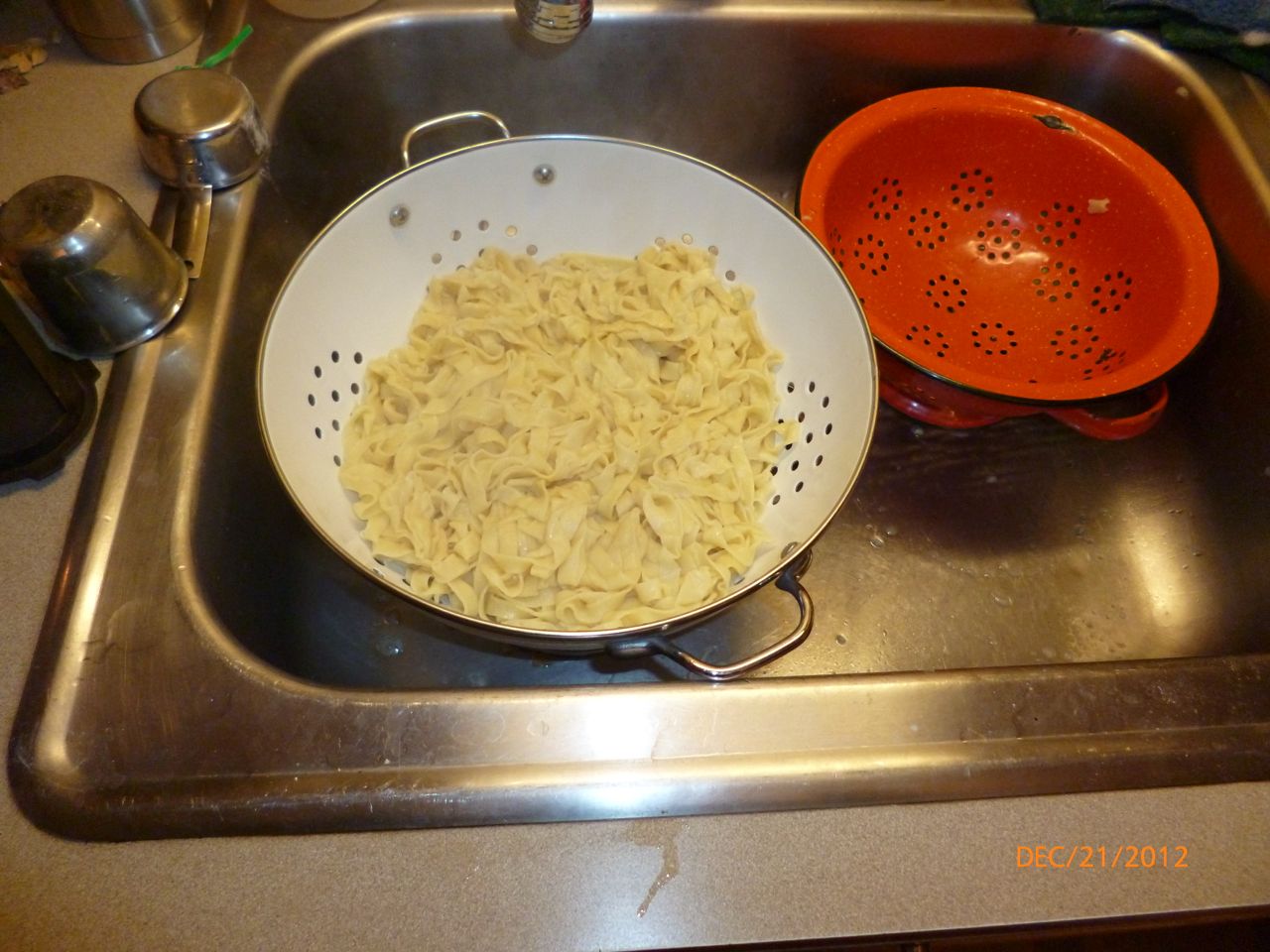
Cooked fettuccine

Fettuccine, cooked and ready to eat. We made a sauce of chopped tomatoes, onions, peppers, mushrooms, tomato paste and spices which tasted great.

Matt Fitzgerald wrote a very nice, short description of carbohydrate loading for Active.com, “The Evolving Art of Carbo-Loading”.  I will be carbohydrate loading for my next marathon, and will write about the experience.  Meanwhile, I intend to revisit pasta making, as it was a lot of fun, tasted great, and was a very nice way to share an experience with my daughter, Audrey, who did at least half the work.

Frank

Sweat

Sweat: it is a natural product of running. In the summer we ran in such warm and humid conditions, the sweat would not dry, but flowed down into our socks and running shoes, causing a squishing noise to emanate with every footfall. At the end of our runs, especially the long Sunday runs, I could wring a cup of sweat out of my socks and shorts.

Sweat has great symbolism. It is the symbol of hard work. Picture a steelworker, sweat dripping from his face and staining his shirt as he moves a plate of steel destined for the side plating on a tanker ship. There is the sweat of the farmer as he runs his tractor up and down rows of sorghum, the sun unobstructed by clouds in the summer in Oklahoma. In the stifling air of a clothing factory in Bangladesh, the sweat of the woman in the tenth hour of a twelve hour day threatens to ruin her work.

Sweat represents fear. This is the sweat fueled by a flood of adrenaline. It is triggered by the flight or fight response which, somewhere in our past got built into our DNA to give us a jolt of strength to fight off an attacker. The alternative, running away, I imagine was an even better survival plan. Now, though, this sweat comes out in awkward ways, discoloring the armpits of a nervous lecturer, or both of a couple out on a first date. It comes from apocrine glands, different from the eccrine glands of the sweat that drips off our foreheads which is mainly water with a bit of salt in it. The sweat of fear is thicker and has in it protein and debris which bacteria seem to like. They are what cause this sweat to smell. Interesting, though, that this odor is thought to have strong pheromone effects for the opposite sex. Makes sense, one’s nervousness about that first date might be just the thing to get her strangely attracted without really knowing why.

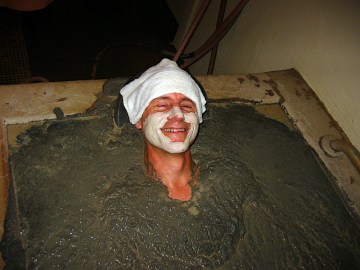
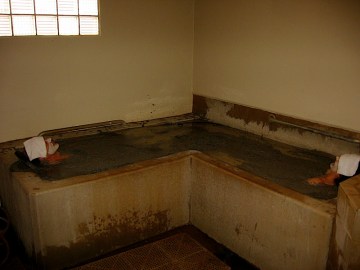
Sweat can be cleansing. Who doesn’t like the idea of sitting in a sauna, allowing the pores to open up and be an exit for stress? For the ultimate experience of sweating out the bad stuff, try a hot mud bath. I had the opportunity to do this with my wife in Calistoga, at the upper end of the Napa Valley.  Water from a natural hot spring, full of minerals, is pumped into a large tub containing a peat-like substance. The tub looks like a relic from ancient Rome. My wife and I got the couple’s room, with two tubs, which I suppose you could share with a stranger, but you would really need to stow your inhibitions in the bag they give you for your clothes.  In an interesting maneuver, we both shimmied ourselves into the peat, with naturally prominent parts still peaking above the level of the mud. It’s hard to get deep into the mud as your body’s buoyancy keeps you close to the surface. Good thing, too, since it gets hotter the deeper you go. You can only take about ten minutes of this immersion before you would start to get cooked like an egg. But, the pores open and the sweat flows. From the tubs, we stepped into a very powerful and hot shower, to get rid of the peat, which clings particularly well to hairy parts. From there, it’s into the Jacuzzi, for another sweat fest. Then, finally, donning striped terry robes we were escorted to the cool-down room, a dark place with cots where we were wrapped in clean white sheets and allowed to recover under the glow of a five watt bulb, listening to “ambient” music.

Frank, in the Hot Mud Bath in Calistoga.

Frank, in the Hot Mud Bath in Calistoga.

Frank and Kat in the couples room at the mud baths.  Note the Romanesque tubs.

Frank and Kat in the couples room at the mud baths. Note the Romanesque tubs.


Now that the cold weather is here, we still sweat. Running just turns up the heat in our bodies, which try to get rid of it by sweating. Starting out in sub-freezing temperatures, we need the warmth of tights and, for me, usually two layers on top, plus gloves and a hat. Soon, the gloves are off and I’m turning up the sides on my knit hat so my ears can radiate away some of the heat. At the end of the run, my face is streaked with salt from the sweat which dried as I ran, and my two shirts are wet. If I don’t change to a dry shirt rather quickly, the sweat starts to cool and I start to shiver. At the finish of the Philly marathon, a friend pointed out that I had a “bit of salt” on my face. When I got to the hotel and looked in the bathroom mirror, I looked like I was being preserved, the salt was so thick.

This is my homage to sweat. I know what it can mean, and I don’t pretend my recreation has the seriousness of what sweat can symbolize. But, I’ve experienced all those types of sweat, from hard work, to fear, to sheer indulgence, (and that pheromone thing, too!). I like the sweat of running. At times, it can be all of these.

Frank K.

Philadelphia Marathon #5

This was an experiment for me, to try to run two marathons in a six week period.  To give away the ending, it worked out okay, and I would do it again.  But, to get back to the details about Philly,  it is a small marathon by big city standards.  There were about 14,500 signed up to run the marathon, which is a sellout number, and also included about 1500 runners signed up for New York City, which was cancelled due to hurricane Sandy.  This compares with NYC, registering 47,000, and Chicago, 51,000.  Even Boston, which has qualifying times, runs 21,500.  Philadelphia runs a half marathon alongside the marathon, starting at the same time, with 12,500 entrants.  So, the start is fairly crowded, totaling 27,000 runners.

I headed over to Philadelphia Saturday, to the expo to pick up my number, and to browse the various booths.  Along the way, I stopped a few times to admire the city, its architecture, public works of art, and general scene.
Dropped off on Broad Street

I was dropped off by my son on Broad Street, and made my way over to the convention center.

I’m always pleased to see what a vibrant city Philadelphia is.  People live all throughout the city, and its businesses and public spaces are always busy.  It’s also a destination city for tourists, with the historical nature of the city, its museums, parks, and local flavor.
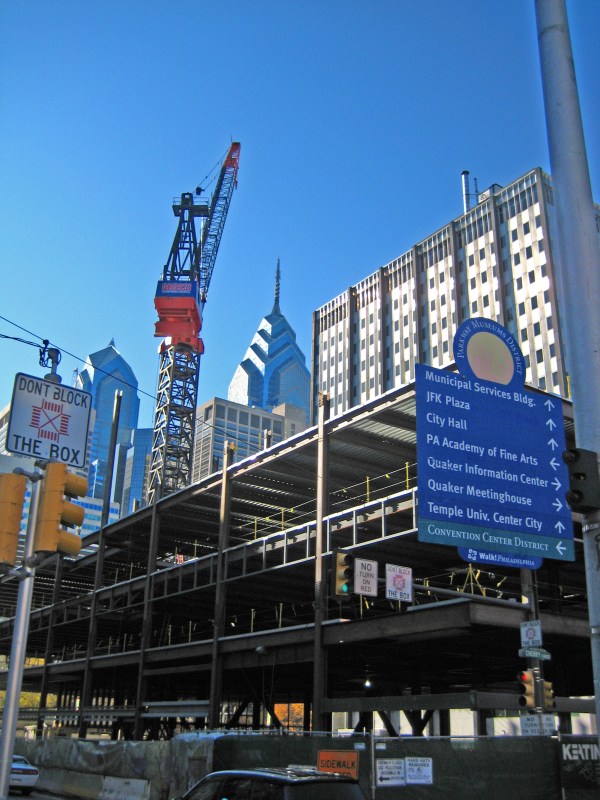
Cunstruction in center city.

Philly is building, and there are many construction sites such as this.

I like the way the old and the new blend together in Philly.  The Quaker Meetinghouse has been around since the city was founded, and is still active today.  The dramatic Chrysler Building-like tower is One Liberty Place, the first building to tower taller than William Penn’s hat atop city hall.  The building to its left is Two Liberty Place, a conglomerate of hotel, condo and commercial space.
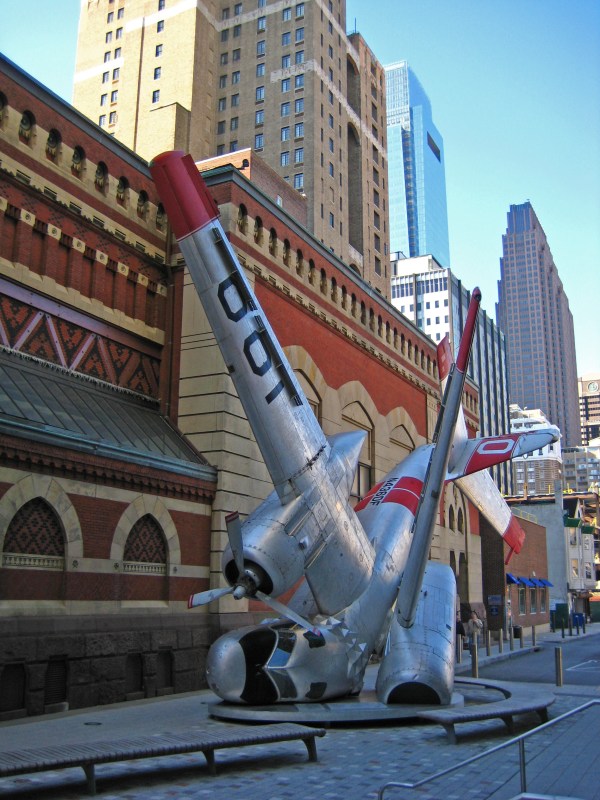
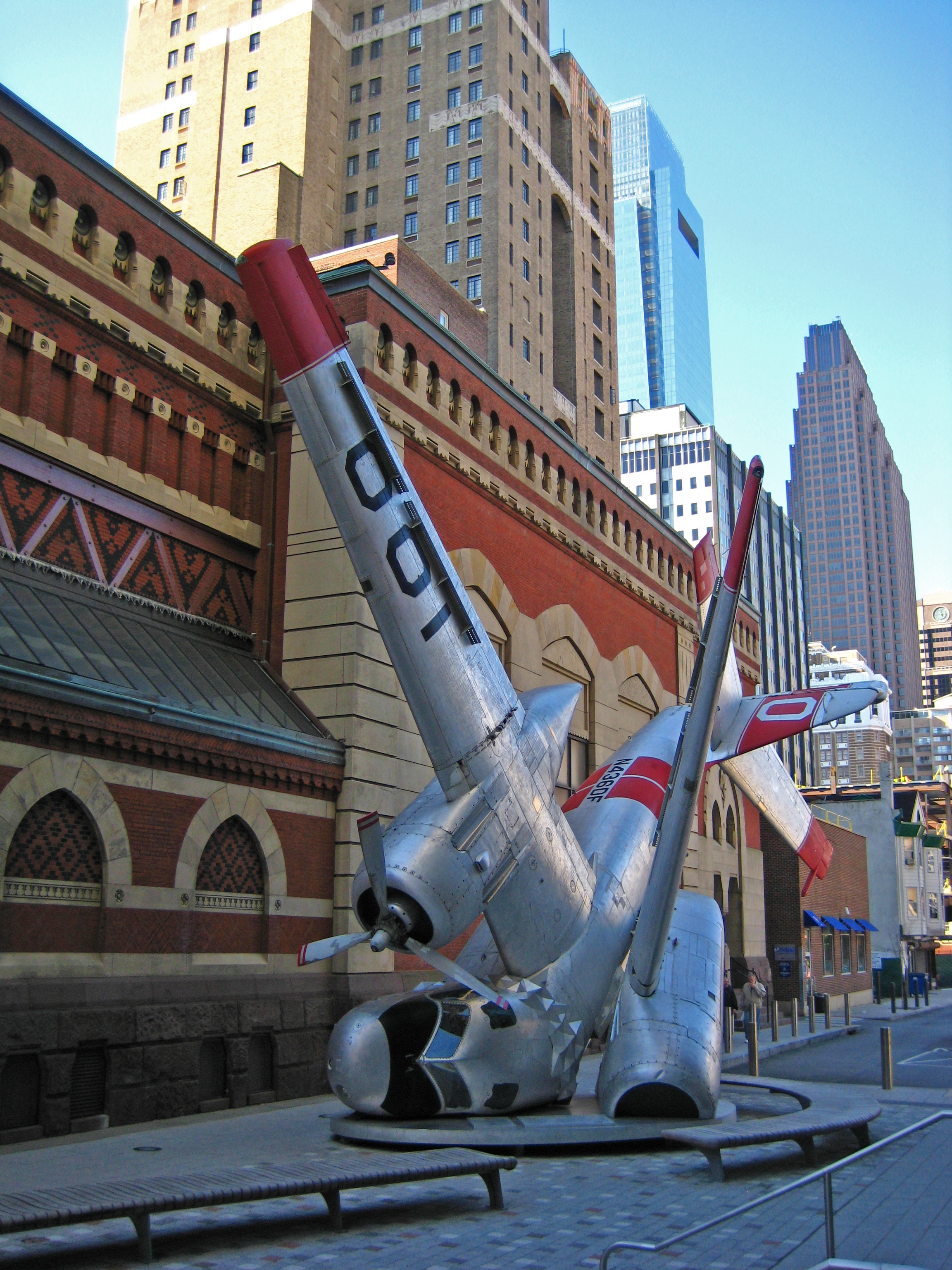
Sculpture in front of the Philadelphia Academy of Fine Arts

The Pennsylvania Academy of Fine Arts public sculpture.

The Pennsylvania Academy of Fine Arts is the oldest art museum and art school in the US, founded in 1805.  It is still teaching budding artists today, allied with the University of Pennsylvania.  This particular public spectacle, a real Grumman SE-2 Tracker, originally on an aircraft carrier, later used to fight fires in California, was installed by artist Jordon Griska, as if the plane hit the ground nose-first.  It is symbolic of swords being turned into plowshares, according to the director of PAFA, and will have a greenhouse built in to the fuselage (from Newsworks.org, a website of WHYY public broadcasting).
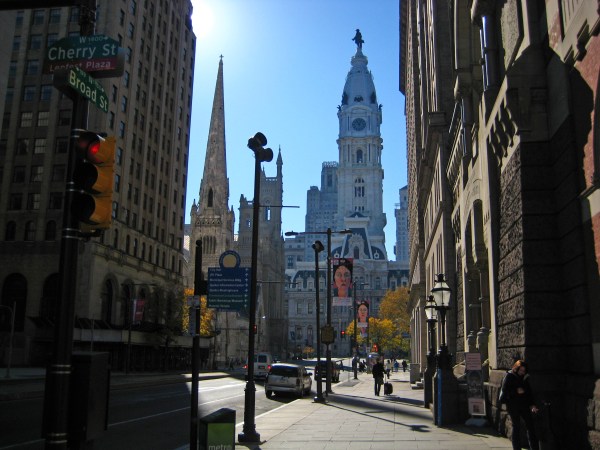
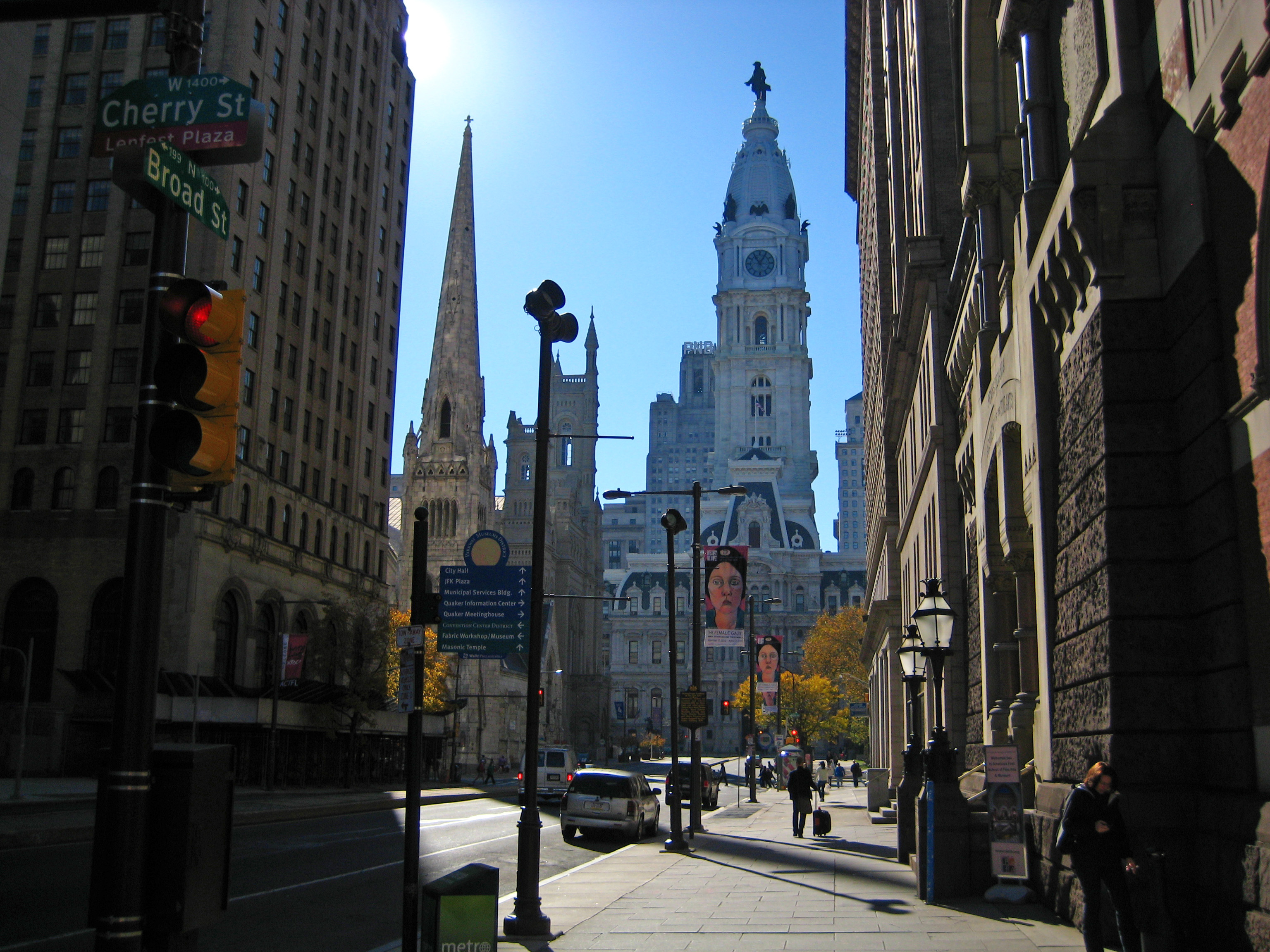
City Hall, Philadelphia

A glimpse of City Hall, with the statue of William (Billy) Penn on high.

The ornate City Hall building in Philadelphia is a much photographed building  Here, it is seen from the darkened byway at Broad  and Cherry.

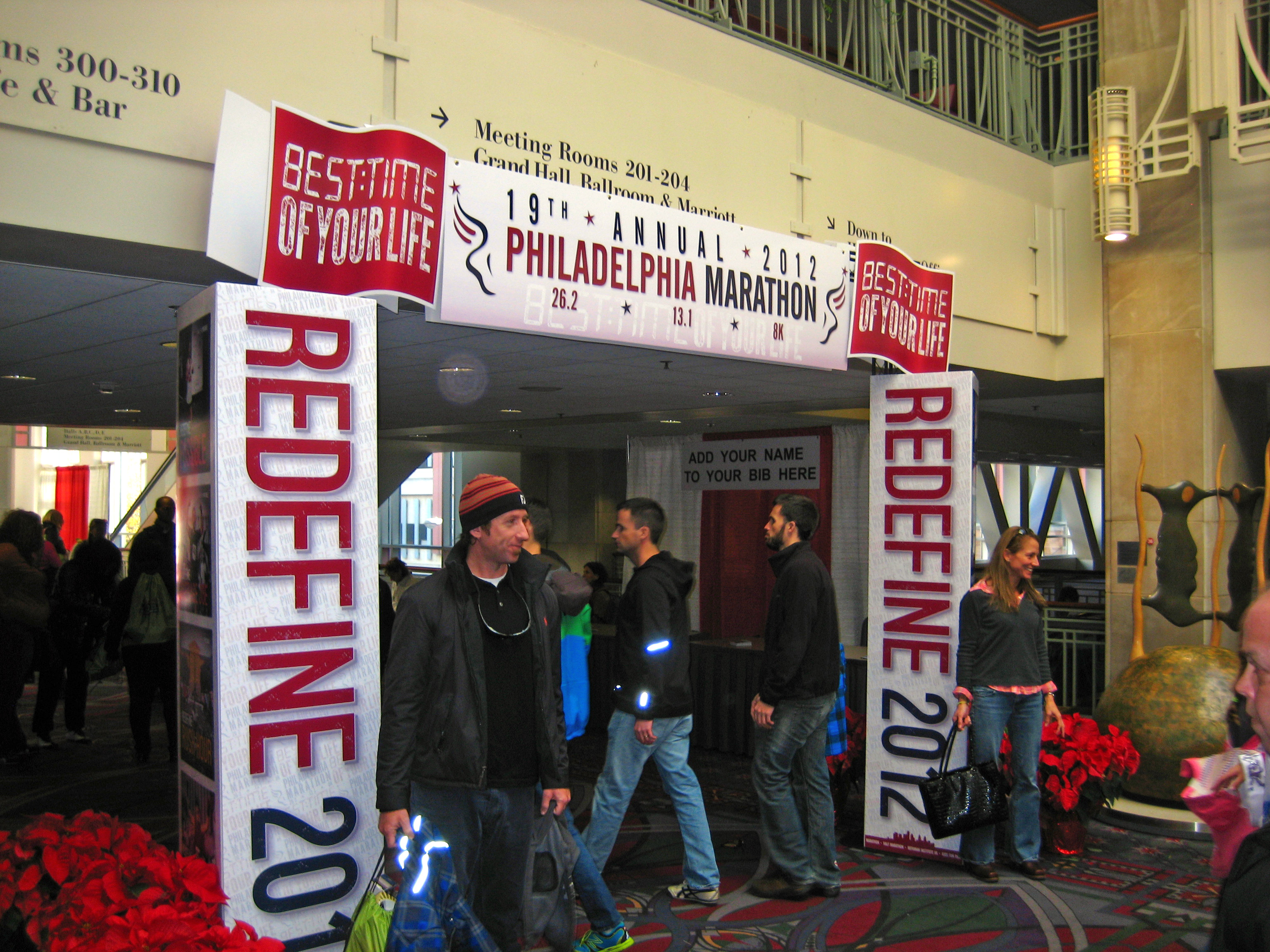
Not much farther, I reached the convention center where the marathon expo was being held.  The clue that you are in the right place is all the thin bodied individuals leaving the building carrying the same minimalist backpack, the kind made of nylon, with shoestrings for straps.  Entering the convention center, one is greeted by this banner.
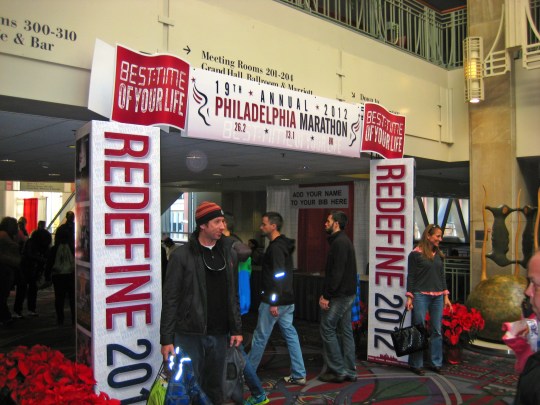
Entrance to the Philadelphia Marathon Expo

A mock-up of the finish line at the entrance to the expo.

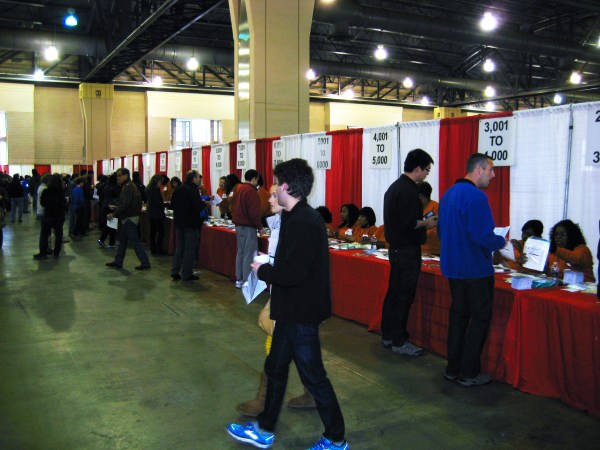
Inside, the first stop is the packet pickup, for your number and your bag with the t-shirt and other little goodies they throw in.  Mine had a refrigerator magnet with clip, a Philadelphia Marathon ball point pen, and a bunch of flyers advertising other marathons as well as a coupon for a complimentary ticket to a Philadelphia 76ers game.
Packet Pickup

Packet pickup, where it all becomes official.

I headed over to the section where official marathon clothing and gear were for sale.  Most of the items were severely picked over, with all the good stuff in the popular sizes taken.  Plus, the check out line looked to be at least an hour wait to pay for your goods.  I had plans to buy a jacket in commemoration of my fifth Philly marathon in a row, but the jacket I wanted was sold out in men’s large.   They had a different jacket with a giant “Philadelphia Marathon” emblazoned on the back, but it lacked the subtlety I was going for.  Leaving the official wear area, I headed out to wander through the aisles of the other booths.

Philadelphia Marathon expo.

Booths at the Philadelphia Marathon Expo.

I came across a booth by Sigvaris, a company which makes compression stockings, mainly for medical use.  I had a nice chat with a saleswoman there, explaining I often wear their stockings at work, having to stand for hours on end.  I was looking for something to run in.

Sigvaris saleswoman who helped me get my compression socks.


Many of the compression garments for runners either don’t have sufficient compression, or cover only part of your leg, or your knee, and act more like a tourniquet than a useful support.  She had just the thing, a knee high sock built for running, 20-30 mm Hg gradient, knee high.  For me, it serves two purposes.  One is to provide compression for my broken down veins, the other is warmth for running in the raw, cooler and windier days of fall and winter.  I bought a pair on the spot.  I was so pleased, I got a photo.


There were many booths selling all sorts of other goods, gels, arm warmers, t-shirts, “The Stick”, ear buds guaranteed to stay in your ears while running, Clif Bars, Power Bars, Snyder’s Pretzels, custom running shoes, and myriad other items.  One display I did not fully explore were the two real buses, one Greyhound, one some other company.  I’m not sure what they were there for, perhaps to take your club to their next big race?

Leaving the expo, I crossed the street to one of my favorite spots in Philadelphia, the Reading Terminal Market.

Reading Terminal Market

Entrance sign for the Reading Terminal Market

This market, which opened in 1892 as part of the Reading Railroad terminal, with tracks over the market space, has survived many economic downturns, and is currently a vibrant, packed, hectic market selling produce, poultry, meats, cheeses, bread, coffees roasted on the spot, cook books, spices, and in short, anything that’s delicious.  The Pennsylvania Dutch have a prominent presence here, and can be identified by their typical garb.  Yes, I dropped a few bucks here, picking up some bread from Metropolitan Bakery (Pain au Levain, and a chocolate cherry loaf), some house-roasted coffee, the Balzac blend, from Old City Coffee, and some fine cheeses from Downtown Cheese.

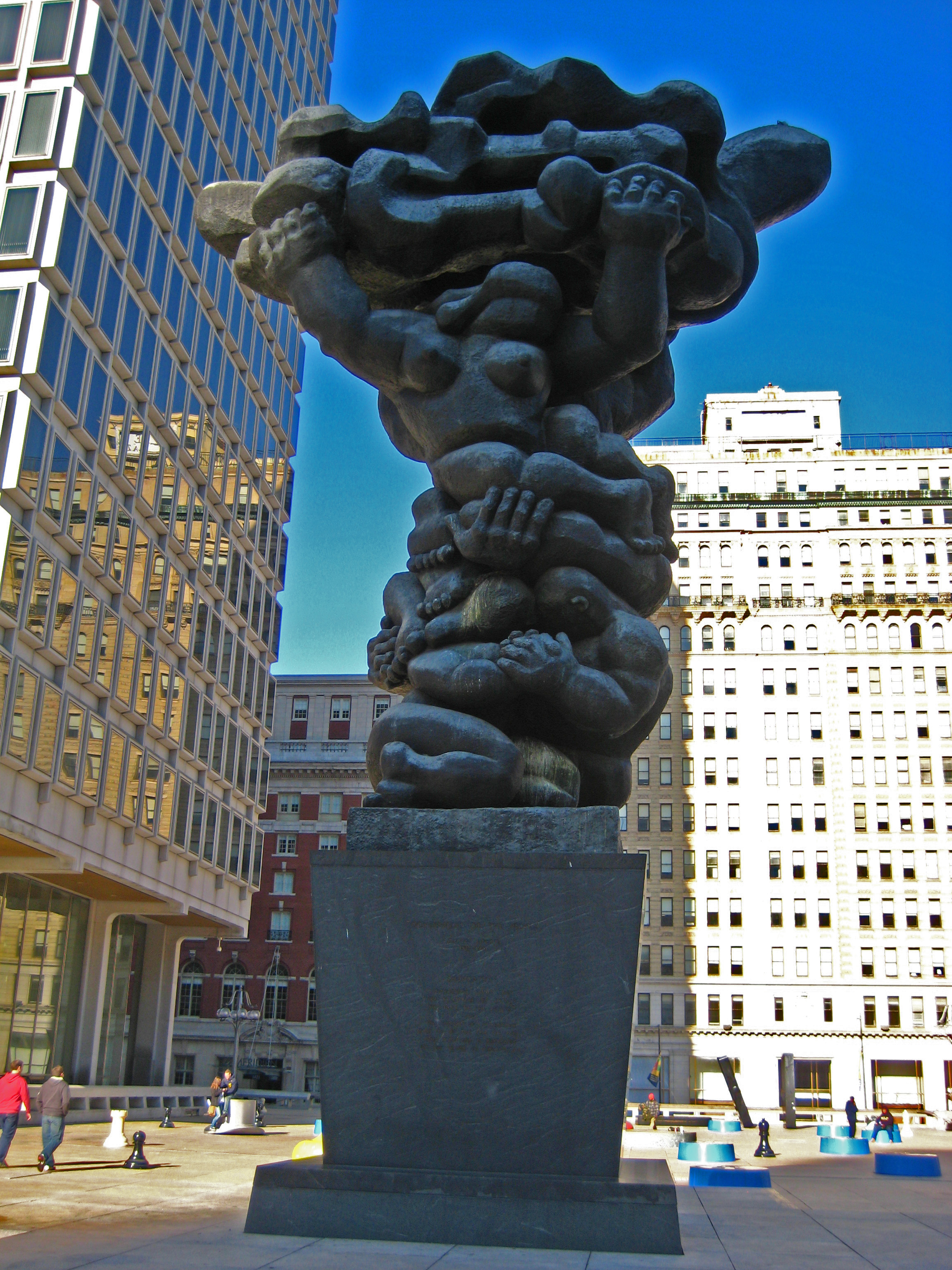
Leaving the market, I walked to the Ben Franklin Parkway, to check in to our hotel room.  Our club rents a room close to the start and finish of the race, to have a spot for our runners to stay warm and stow their bags before the race, and have a comfortable place to change afterwards.  Along the way, I passed some more iconic symbols of Philadelphia.
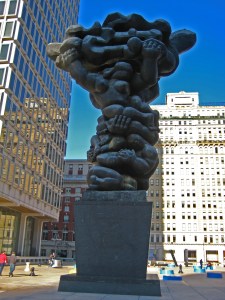
Jacques Lipchitz, artist, Government of the People, in front of the Municipal Services Building
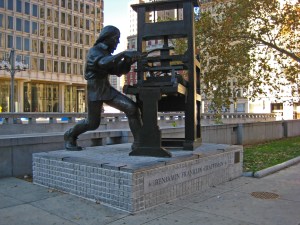
Ben Franklin and the printing press.

Ben Franklin and the printing press.

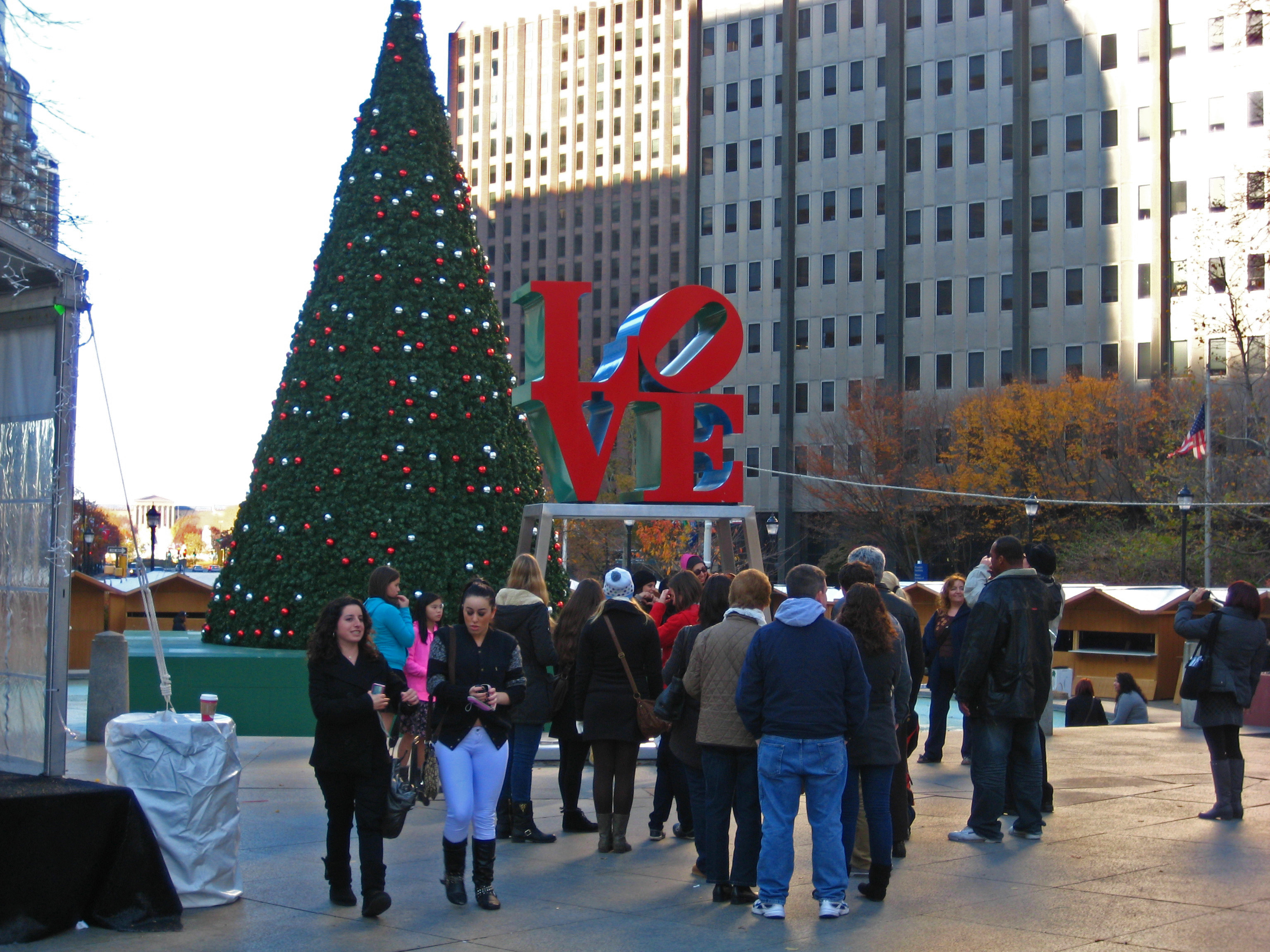
Crossing the street you arrive at the start of the Ben Franklin Parkway, and the nicknamed Love Park, so named for the famous LOVE statue.
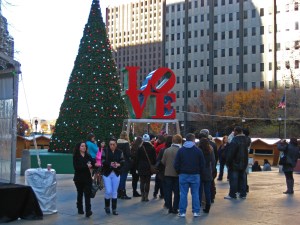
Love Statue

LOVE Statue, famous symbol of Philadelphia, is constantly surrounded by people taking photos.

Love Park

LOVE from behind.

I checked in to the hotel, but wasn’t assigned a room yet.  So, coming back later that evening, I finally got in to our room, which was, coincidentally, room 2012.  I had to argue a bit to get the promised view of the parkway from the balcony, but it was definitely worth it.

Ben Franklin Parkway

View of the Ben Franklin Parkway at night from our hotel balcony.

The large circle is Logan Circle, and the fountain in the center is the Swann Memorial Fountain, named for Wilson Cary Swann, the founder of the Philadelphia Fountain Society.  I suppose that’s one way to get your name on a fountain.  It is an incredibly beautiful fountain, though, representing the three rivers of Philadelphia, the Delaware, Schuykill, and Wissahickon, using native American symbolism to portray them.  The marathon starts at the far end of the parkway, and runs down and around this circle as it heads down to Columbus Boulevard along the Delaware.  Later in the race we cross both the Schuykill and the Wissahickon, so in a way, this fountain is a good representation of the marathon.  I didn’t stay over in the hotel, wanting to sleep in my own bed, and have access to my usual breakfast.

On the morning of the marathon, I met up with a few other club members at the train station at 5 AM.  We took the train in to Philly and got to the hotel in time to do a little stretching.  A good number of other club members showed up, and come 6:20, we headed down to the lobby and walked up to the start line.  The crowds of runners and spectators were busily getting to either their corrals or to prime viewing areas for the start of the race.  As with every marathon, there’s an edgy tension, people adjusting clothing and retying shoes, starting of Garmin’s, stretching in the limited space available in the corral, and nervously chatting.  Then comes the national anthem, and the start of the race.  Throw away t-shirts get pitched to the side, and the corrals move up as first the wheel chair racers, then the elites, then the rest of us make our way to the start.  As we got close to the start, the walk broke into a trot, then a run, and we were over the start line, heading for the first of 26.2 miles.  This year we had a special group in their own corral, the runners from the New York marathon, who started after my green corral.  They were heartily welcomed to the race from the runners and the spectators, and I saw many signs along the route in support.  The route is a great tour of Philly, going through old town, down to South Philly, with onlookers in bathrobes standing on their porches, up Chestnut Street, with the street filled to capacity with cheering fans, over the bridge to the Drexel University area, past the fraternity houses where frat boys were out banging on pots, making noise for us, and looking like they hadn’t gone to bed the night before.   From there we head to the Belmont plateau, past the Zoo and the Please Touch Museum, down on to West River Drive.  A quick switchback along the drive, then we head back along West River Drive to where we started, in front of the Philadelphia Museum of Art, and the halfway point.  Large signs, much more visible than years past, show the way for the half marathoners to peel off to their finish line, and the marathoners to continue on to Kelly Drive.  Then, it’s out along another Philly landmark, boat house row, out to the Falls Bridge, over the bridge and down on to West River Drive again for another (and very annoying) switchback.  I don’t like this part because the road heads down hill and you need, of course, to come back uphill again at a time when the legs are starting to feel the fatigue set in.  The last outward bound stretch is along Main Street in Manayunk, with its young and hip fans lining the streets, offering home baked brownies and cups of beer to the runners.  At the end of Main Street, another switch back for the last 6.5 miles to the finish line.  My legs were pretty well cooked by the time I made the turn in Manayunk, and I lost a lot of time having to slow down.  On the bright side, I didn’t have to stop and walk for leg cramps like I have in my other marathons.  I got a big boost from two club members, Rich and Joy, who were waiting for me around mile 23 and ran with me to mile 25.  Their encouragement helped me speed up the last few miles, and really push to the end.  Fellow Steamtown runners Tony and Brian, watching from the sidelines, said that I looked totally focused the last mile.  It was either that, or I had completely lost the ability to think and could only run on basic instincts.  My final time of 3:57:18 was not what I was shooting for, but it is now in the books.  I was pleased to run under 4 hours, pleased to have done two marathons in 6 weeks, and pleased to have completed my fifth Philadelphia Marathon in five years.
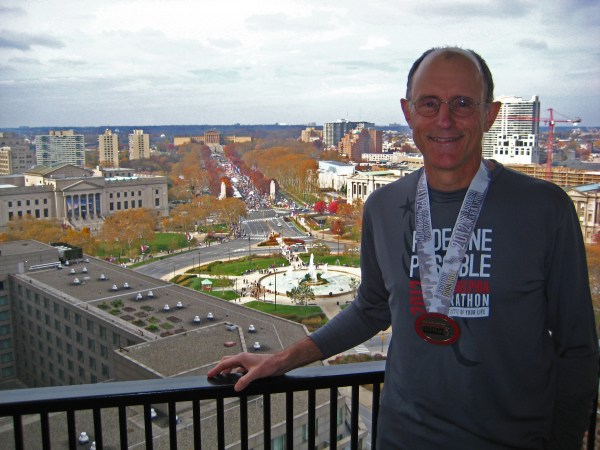
Vies from the balcony, Nov. 18, 2012

Frank finishes his fifth Philly Marathon in five years.

Ben Franklin Parkway and the Philly Marathon

View of the Parkway, with the crowd of runners and spectators, the beautiful trees, and the art museum in the background.

That’s how it went, Sunday, November 18, 2012.  Of note, our club, the South Jersey Athletic Club had many runners in the marathon and half marathon, and they all put in great performances.

Frank


iambic pentameter

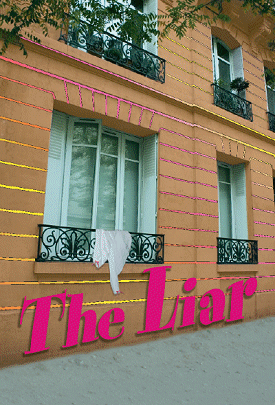
Cover for "The Liar"

The Lantern Theater Company’s production of “The Liar”.

Is this not a blog ’bout running a race,

not a mere review of timing and pace?

Does inclusion of such other affection

demand an answer to this reflection?

To race or not to race, is that the question?

Nay, said Armstrong, not about the bike, then

what for the road runner would be the like?

For me and Kathleen, a night on the town!

It’s PATCO to Philly, with that we’re down.

Met with some friends at the Westmont station,

Then on to the Lantern, first, a conversation.

Sat with the director, down in “the lab”

of this tiny theater, for, (you guessed it), a confab.

Kate MacMillan, resident director,

there explained iambic pentameter.

She then went on, yawn in voice,

(must I put on a good face for this bunch)

no, she really was full of spice.

(The well hid strain to explain, just a hunch).

We then ascended the metal stairs

in this theater posterior to the

large cathedral, St. Stephen’s Basilica,

but, of faith, Episcopilica,

to find our way to unassigned chairs.

A bit like boarding a Southwest Airline,

One sits in any seat that one can find.

I like this form of letting patrons choose,

it lets us join together with our group,

worry not ’bout the ticket’s assigned spot,

select the seats that work best for our lot.

We settled in awaiting expectantly

a “translapted” Corneille French comedy.

Translapted, David Ives, the translaptor

created this word, a portmanteau (look it up)

of how he changed this play from long ago

about the time of Louis XIII and Richelieu,

a clever farce with parts a bit taboo.

David Ives adapted the translation,

changed the text to match our generation.

Hence the cunning linguist term, translaptation.

The actors all were brilliant in their parts;

timing’s crucial when throwing verbal darts.

The play’s about a liar, bet you guessed,

a young lawyer who seeks the fairer sex,

but is convinced the only way to score

is to lie, and lie, and to lie some more.

He takes on a servant, who can naught but tell the truth,

the plot, based on mistaken names, forsooth.

Dorante, the lead, relies on his glib gift

to prevent a nearly deadly rift,

while he woos a willing young coquette,

but whose name he misses on a bet.

Clarice, Lucrece, Isabelle, Sabine are

randy and ready for a love affair.

Or rather, seeking marriage, they are looking

for a soldier worth their hand they’re hoping.

Swords come out and in, a bit provoking.

Scenes change quickly, stage hands work like lightning.

The upshot this, a play most entertaining,

Well done by cast and crew, really, outstanding!

Borrowed photo of Caribou Cafe, from the internet.

The six in our party, (you thought four?)

departed Lantern Theater, heading for

Caribou Cafe, 12th and Walnut,

for a late dinner, beer, wine and more.

We were delighted to find music, live

sax and guitar, a jazz duo, good vibes.

A bit of dawdle, headed home late

At that hour, certainly a wait.

On to the PATCO concourse headed we

back to our beds, at home, ’twas two, not three.
But hark, what cry is that, what run did I?

Okay, eleven miles, marathon pace, feeling strong for Philly in one week.

Does this destroy the rhyming scheme I wrote?

Even Shakespeare sometimes got off note.
Frank K.

The Heart of Fall

Golden leaves.

The bright golden colors of fall.

Here we are in the middle of fall, with the bright but fleeting colors of the leaves creating a beautiful backdrop for  our runs.  Right now, the weather doesn’t quite know if 75 or 45 is the correct temperature.  One day it’s tights, long sleeve shirt, and light gloves, then its back to shorts and short sleeves.  One thing is constant, though, evening runs are in the dark.  I equip myself with a headlamp and reflectors for these runs.  The headlamp is annoying, but necessary.  Some areas are well lit by streetlights, but our town is notorious for potholes, especially in areas where the streets are dark.  Potholes seem to congregate in the dark.

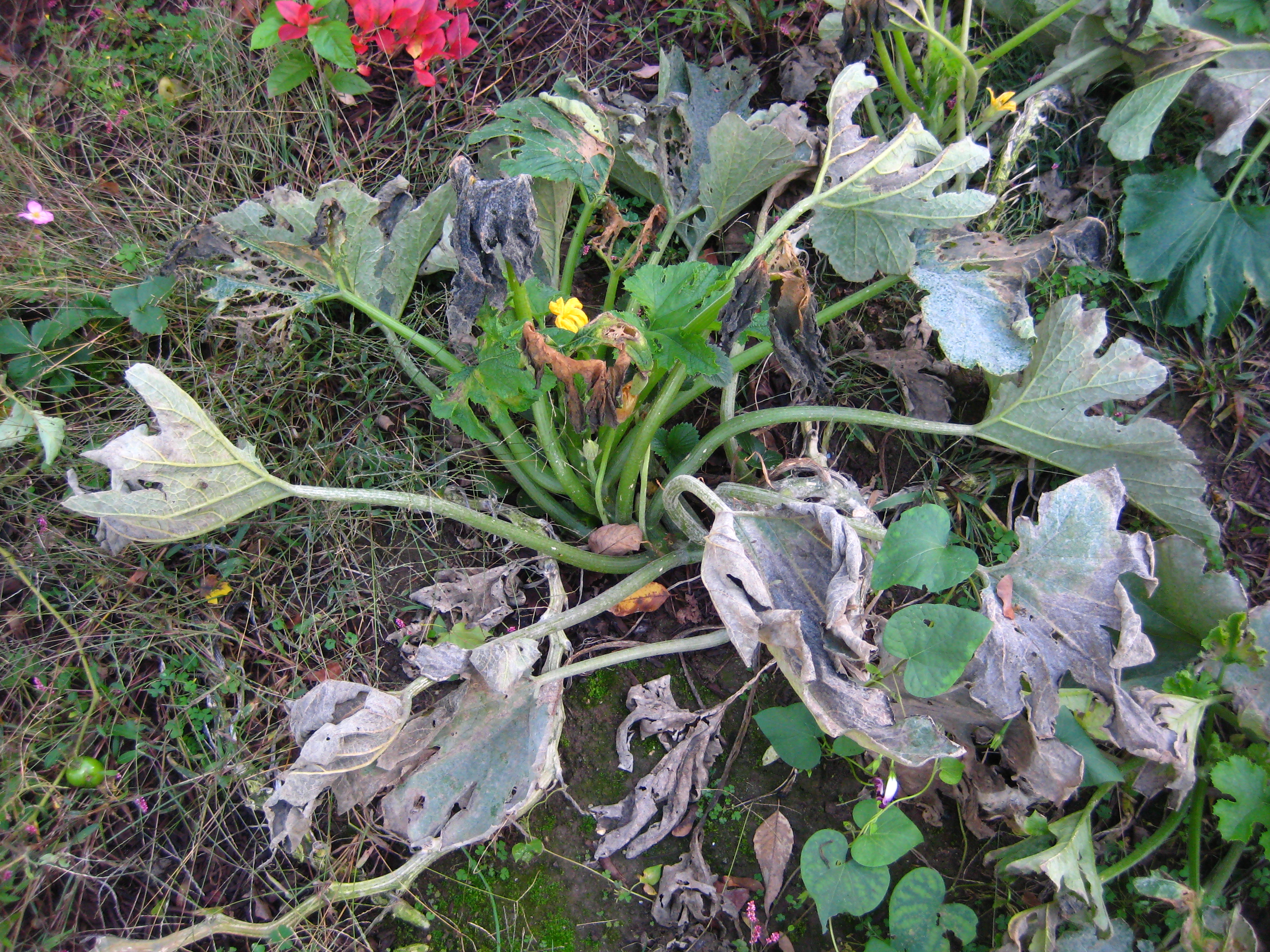
Spent yellow squash plant.

This yellow squash plant was very productive over the summer, providing us with a dozen or so squash, and we ate some of the blossoms, too.

Running in the dark, I feel a bit like a fugitive, darting among the shadows, and aware the drivers are not necessarily aware of me.  It is a bit of a survival game.

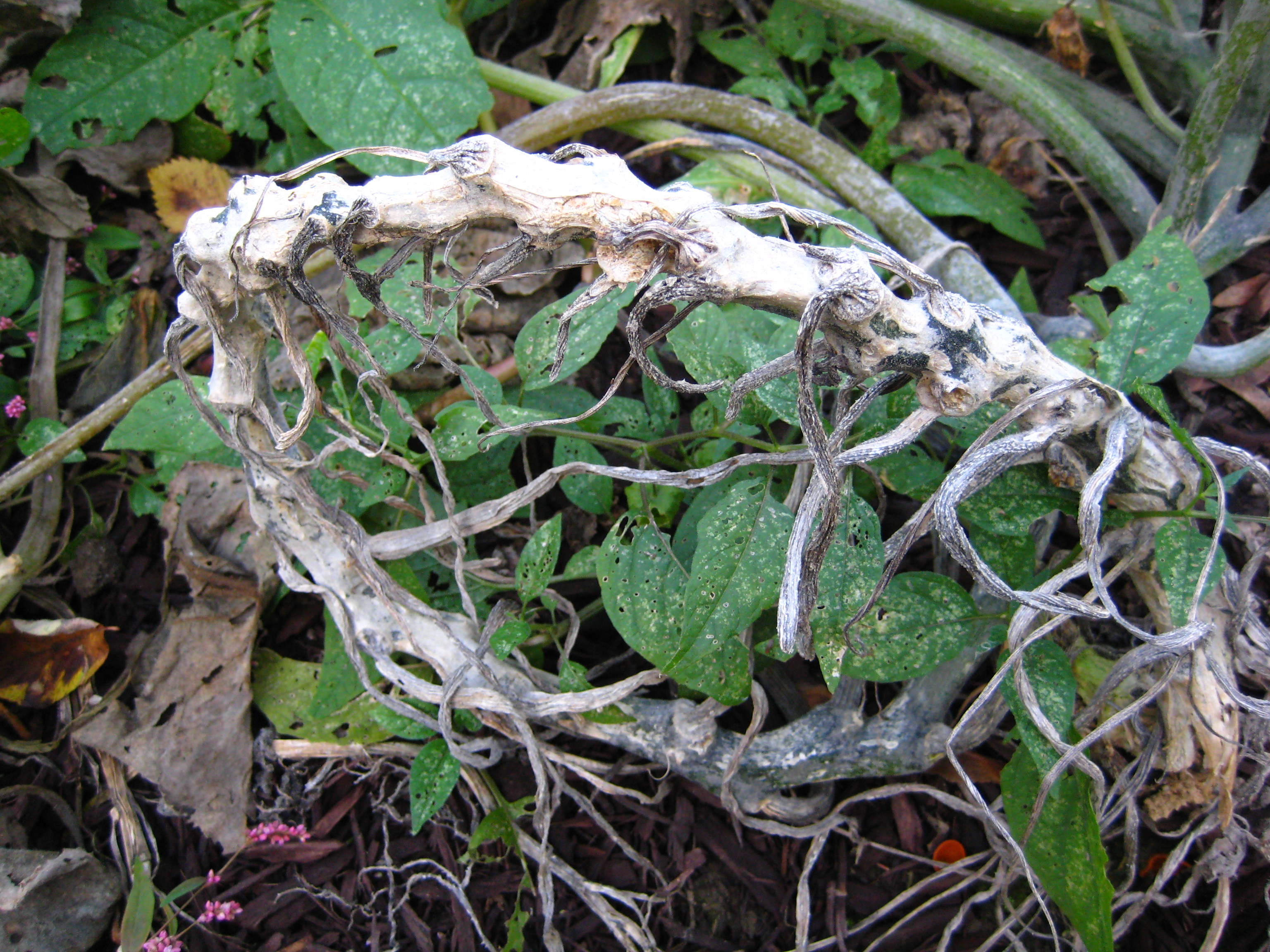
Stem of a zucchini plant.

The wizened stem of a zucchini plant.

Unlike the plants in these photos, I am planning to reach a peak in the next few weeks as I take on the Philly Marathon, November 18.  This will be my fifth year in a row running Philly.  If someone told me back in 2008, that by the end of 2012 I’d have seven marathons in the books, I’d have thought they were crazy.  But, as long as I finish it, this will be my seventh, with one Boston and one Steamtown in the mix.

Tomatoes still green in October.

Green tomatoes still hanging on the vine in late October.

Many of my friends, about my age of 58, are looking ahead to retirement and discussing their bucket lists.  Don’t speak to me of bucket lists.  It’s not that I believe that somehow I am less mortal than my non-running friends.  Quite the contrary.  I seem to take on some risks for which life afterwards is not a given.  I don’t think I’m adding years to my existence by running, or eating right.  But, running, and competing are a great deal of fun, an endless challenge, and a great reason to get together with like minded folks and have a good time…often with good beer involved.  The list of interesting things I would like to do keeps expanding.

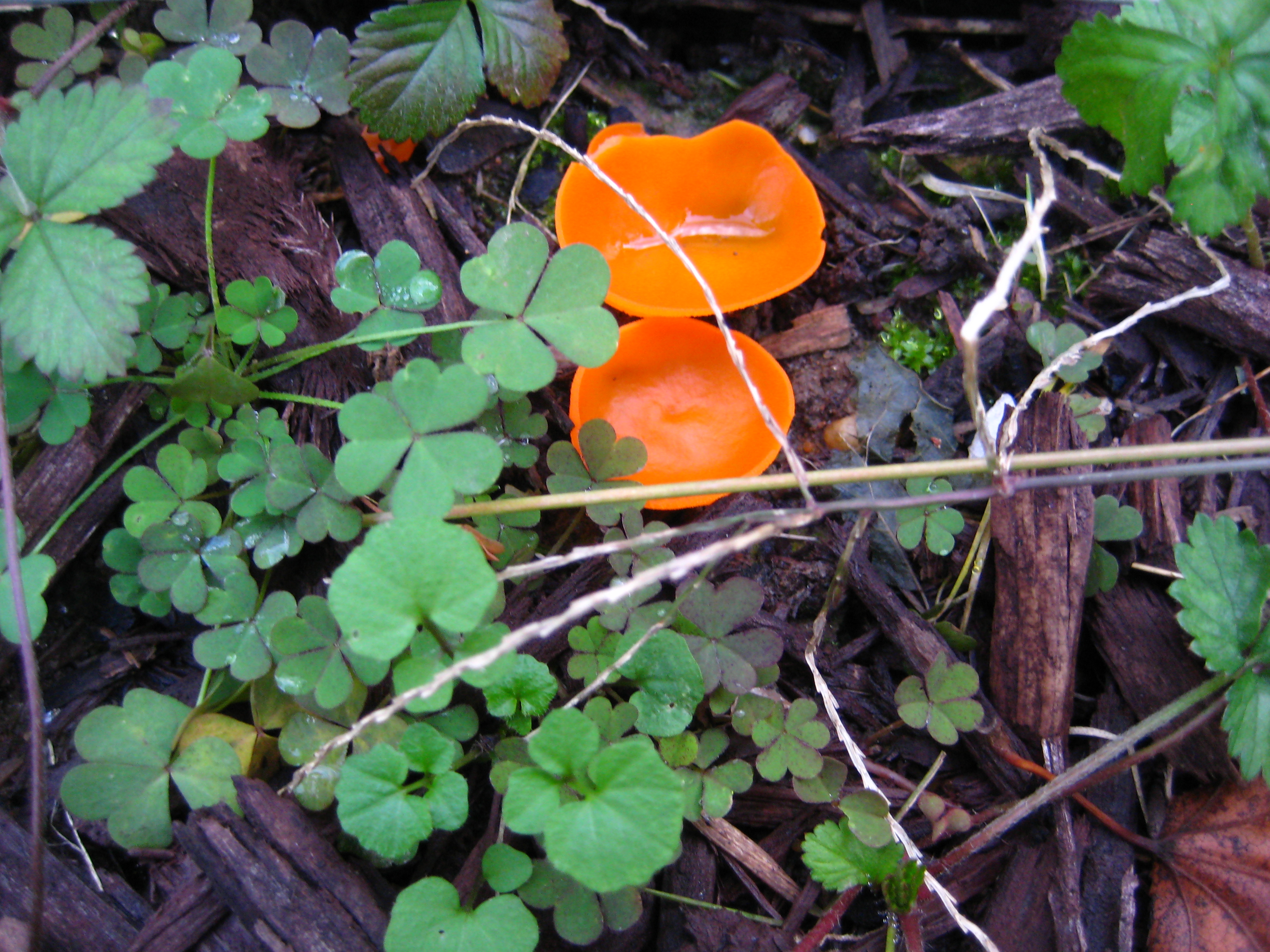
Orange Peel Fungus

I believe these are Orange Peel Fungus, a type of mushroom which bloomed in our garden.

Running Philly so soon after running Steamtown is a bit of an experiment for me.  Collective wisdom says that it takes about as many days as miles in a race to recover properly.  But after the first week following Steamtown of sore quads and an awkward gate, I got back into the training process.  Last Sunday was a 22 miler.  The legs felt very tired around mile 19 and 20, and I wound up slowing considerably, only to get a second wind and run the last two miles in decent form.  Tuesday and Wednesday were good training runs at close to marathon pace.  Running in the dark slows me down a bit, as I mentioned, having to pick my way through in some areas.  After an eleven mile run last night, Steve and Tony, my friends from Steamtown, and I headed out for some good ales and dinner at a local pub called the Pour House.  The talk covered how best to run an upcoming 10K bridge run, a zombie run (lots of zombies out on the course, since Halloween is coming), the Giants and Tigers first world series game, extremely thin waitresses at the Pour House, the difference between ales and lagers, American vs India Pale Ale, and all sorts of other topics.

Poison Ivy along our fence.

Here’s the poison ivy along our fence which gets me every time I trim along the fence line.

This poison ivy gets me every time.  As I wrote in a previous entry, I got the rash everywhere my last encounter with it, and I’m glad to see it turn colors and drop it’s leaves.  It is an attractive vine.  But this winter, after Philly, and with gloves and long sleeves, I will get in to this area and dig out every bit of it.  That is, I hope I will, since finding it after the leaves are gone might be tricky.  Meanwhile, I’m heading for a 50 plus mile week, I am not particularly sore, and I hope my experiment goes well.
Frank
Report from Steamtown, USA

We made our way up the northeast extension of the Pennsylvania Turnpike, often a difficult drive, with tractor-trailer trucks being driven like Miatas, and never ending construction zones.  This Friday evening, though, it wasn’t so bad, and my wife and I made good time.  We were heading up to Kingston, to spend a night with friends, and to shorten the trip to Scranton the next morning.  I sent a “Glympse” email to my friend, Ivan, with whom we’d be staying.  This clever app allows your host to follow your progress in real time along the road, know how fast you are going, whether you’ve made a wrong turn, and know when you will arrive.  It was nice to spend the evening enjoying a delicious spinach quiche made by Ivan’s wife Cheri, have a beer, and sit outside with an outdoor fireplace going in complete relaxation mode.

The next morning, I went for a really slow 3 mile run with Ivan, which was a good way to keep the muscles warm and working.  The weather, which had been predicted to be rain the whole weekend, was starting to look less monsoon-like, and more like scattered showers, especially on Sunday.  After some pancakes, we left and headed up the last half hour of driving to Scranton, and to the pre-race expo.  This is held in the Scranton High School gym.  For a small marathon, which is capped at 3000 entries, the expo was well organized, and had all the necessary elements:  a line to pick up your number and T-shirt, commemorative shirts, hats and other Steamtown branded items for sale, vendors for gels, sports drinks, and accessories, and a nice wall-sized map of the course.  I got the feeling this was a “runners” marathon, since I saw an awful lot of Boston Marathon jackets on the people picking up numbers, and no-one looked like they were just there to take an easy jog from Forest City to Scranton.

After buying a couple of T’s, some gels for me, a hat, and, oh yes, picking up my number, we left and headed up to Clarks Summit, about five miles north of Scranton, and checked into our hotel.

Tony, Frank and Lisa

Tony, Frank and Lisa, outside the Hampton Inn, Clarks Summit, with the fall colors in the background.

We took some time to relax in the hotel, then headed out to dinner, at Bellissimo Pizzeria and Ristorante, with the others in our group.

Welcome to Marathoners

Bellissimo Sign welcoming the runners.

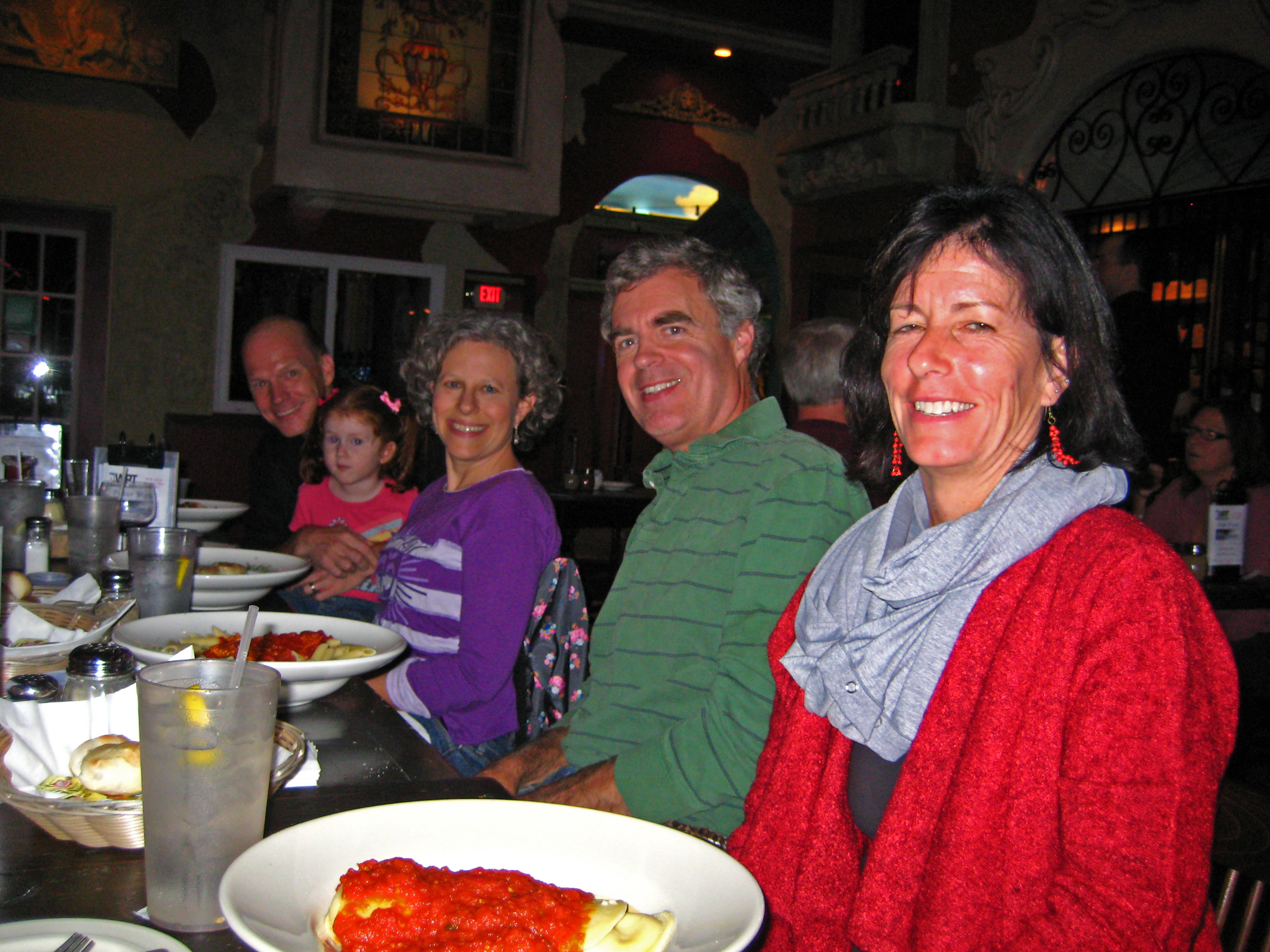
At the restaurant, we had a large group, Lisa, Tony Brian, his wife Sarah and their two kids, Dan and his girlfriend Ashley, Steve and his wife Caren, and my wife Kathleen and me.

Lisa, Tony, Carin, Brian, and his daughter.

One half of the table, Lisa, Tony Caren and Brian with daughter.

Frank, Steve and Dan

The other half of the table, Frank, Steve and Dan.

Pretty much everyone stuck to the rule of pasta before the race.  There was ziti, ravioli, penne, spaghetti, and a few others which I don’t recall.  Tony drank a Bud, and Lisa had a Yuengling.  It seems that’s a sure way to do well in a marathon the next day.

We called it a night pretty early and headed back to the hotel.  The staff at the hotel was very accommodating, and told us they would have breakfast ready to go at five AM the next morning, so we would be well fed heading our for our race.  True to their word, the waffle maker, and the whole rest of the breakfast buffet, was ready to go when we came down the next morning.  Thank you, staff at the Clarks Summit Hampton Inn!
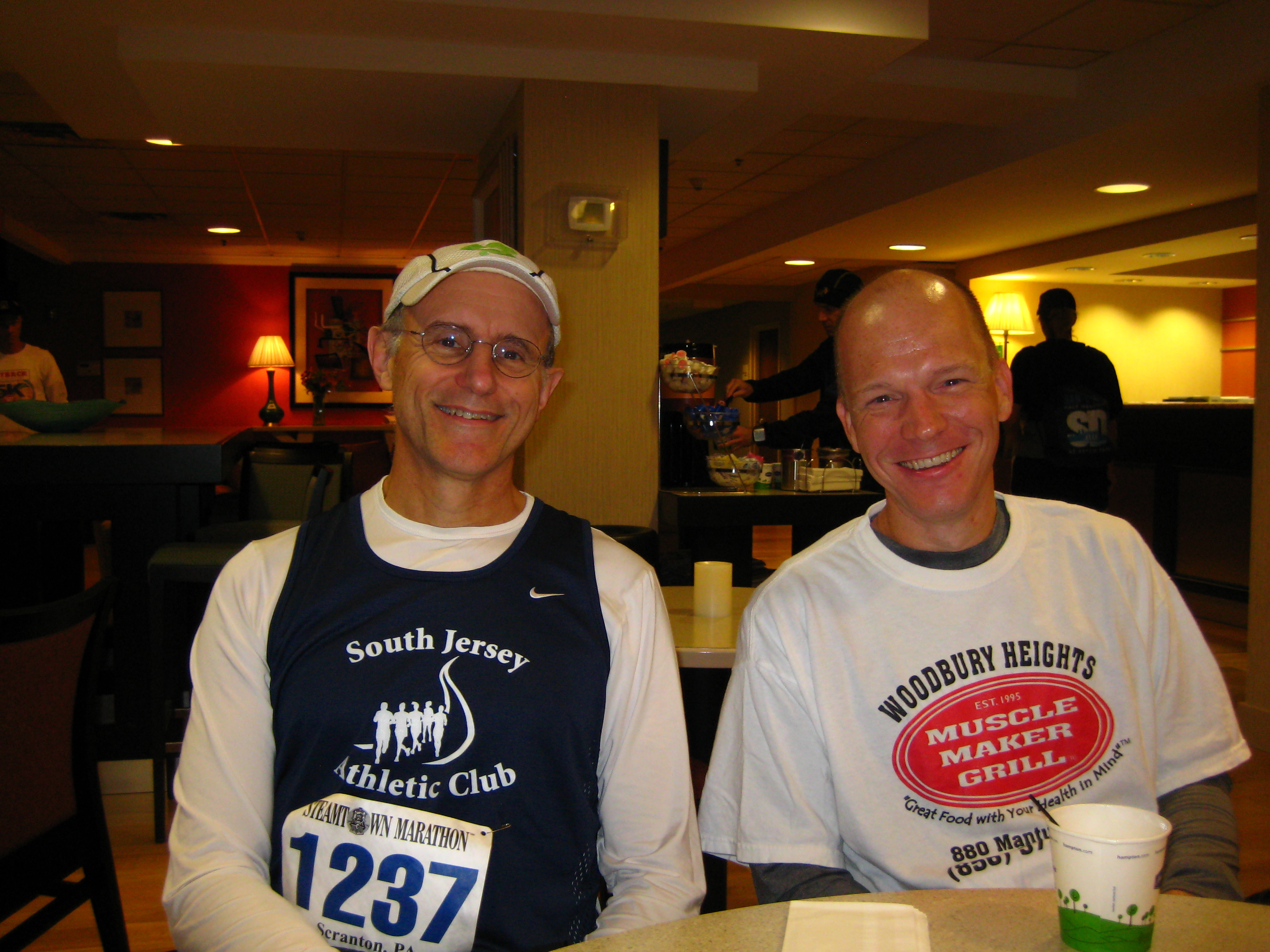
Brian and Frank at Breakfast
Frank and Brian at Breakfast

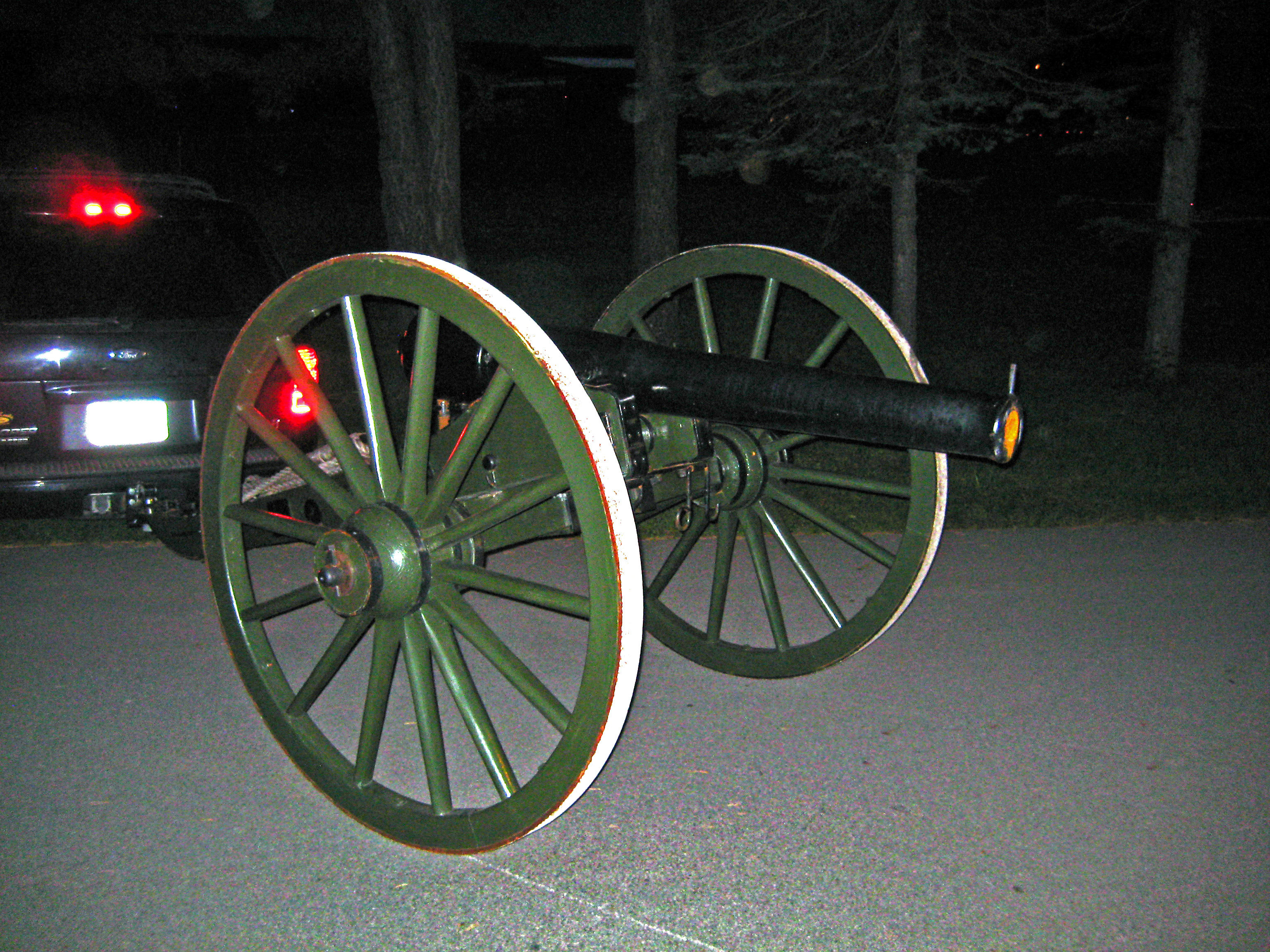
It took some work, a degree in logical thinking would have come in handy, in order to figure out the car arrangements for getting to the start of the race in Forest City.  Our final plan was for Caren, Steve’s wife to drive Steve, Tony, and me to Forest City, then Caren would head to the first support zone.  Lisa would drive Brian and Dan to Scranton and then they would take the bus up to Forest City.  Sarah, Ashley, and Brian’s kids would arrive in Scranton in time for the finish, and Kathleen, likewise would drive to Scranton and find her way to the finish line.  On the way to Forest City, we got to see the starting gun being towed to the start, the “gun” being a civil war canon.

Starting "gun".

The Starting “Gun”. It really sends out a shock wave when fired.

In the gym at the Forest City High School, we took care of last minute details, including, of course, a trip or two to the porta-john.  Interestingly, they had separate units for men and women, which, I’m sure, made the women very happy, since we guys are not exactly neat and tidy.  The runners were filing in, past the cheerleader brigade out front, the friendly students handing out coffee and hot chocolate, and the busy looking officials.  For a smaller marathon, they do know how to make us comfortable.  My impression at the expo was again confirmed, that everyone of the assembling runners looked like they were fit and ready.

Gym at Forest City H.S.

The gym at Forest City H.S. starts to fill up.

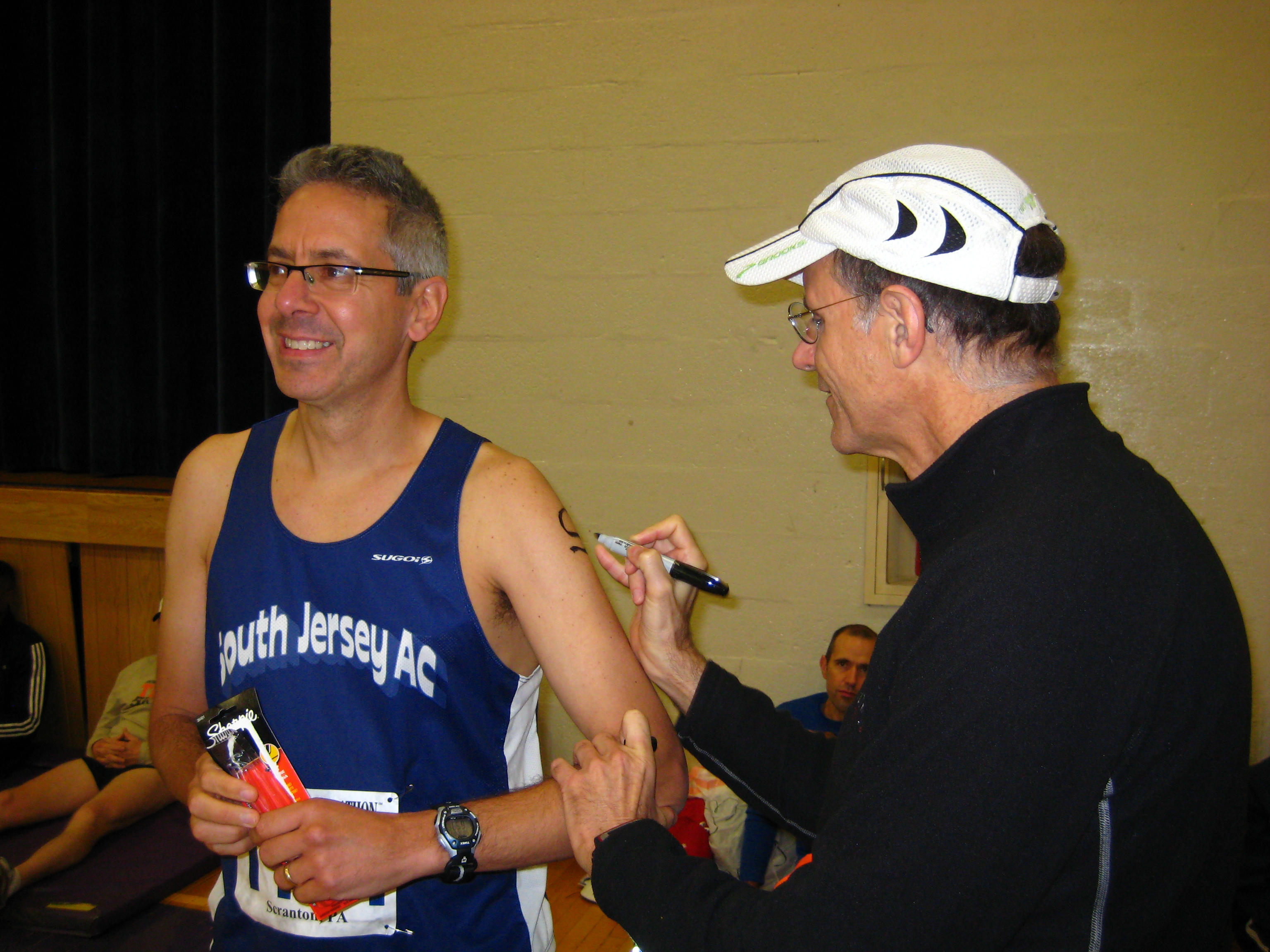
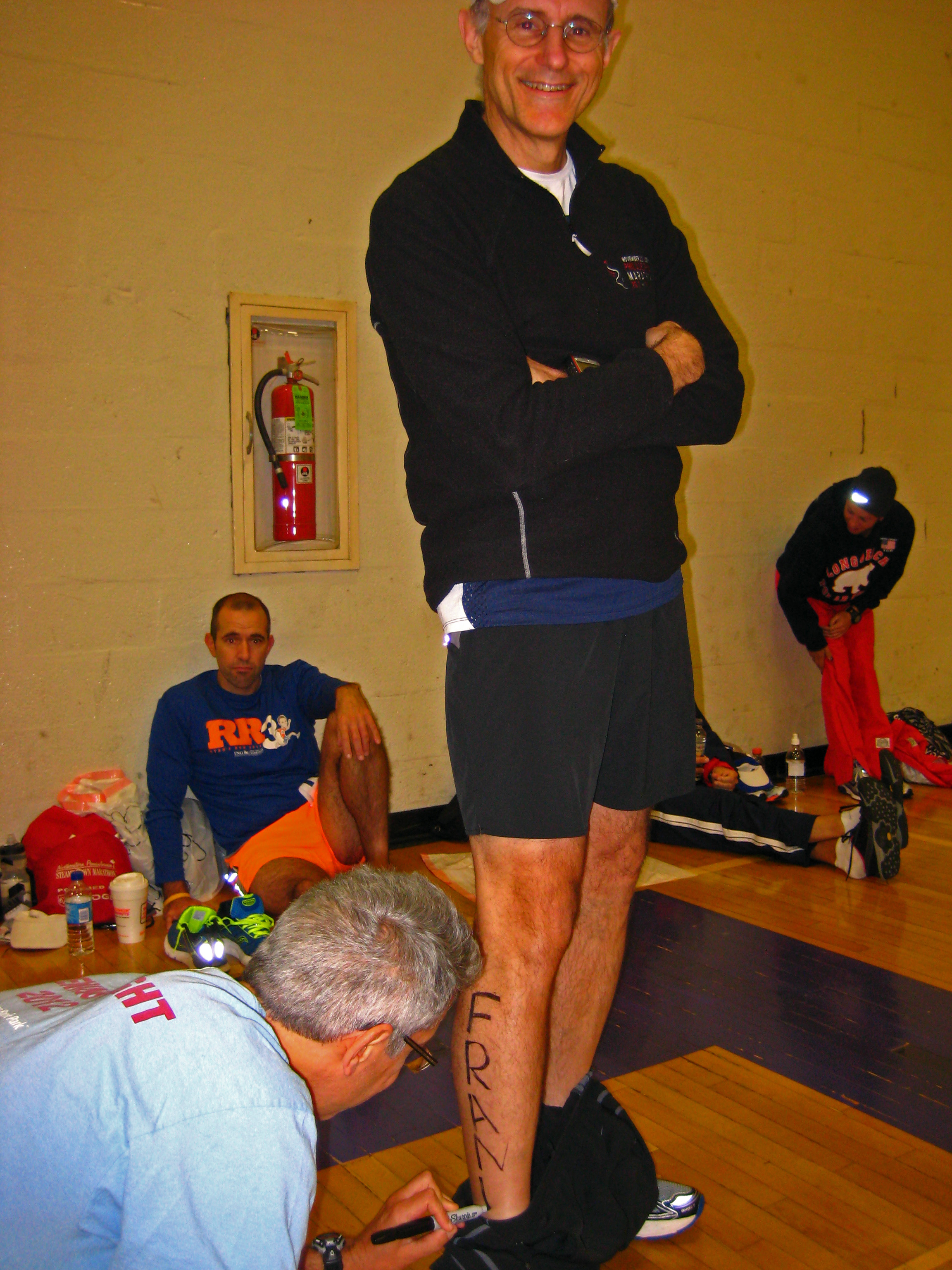
Steve came up with the idea of writing our names on our bodies, so the fans would know who to yell for.

Steve gets a name.

Let’s see, that’s S…..T….E…, don’t want to make a mistake!

STEVE!

Nailed it! STEVE : )

Frank and the magic marker.

They’ll need to look at my legs to see my name. I wonder if that will work.

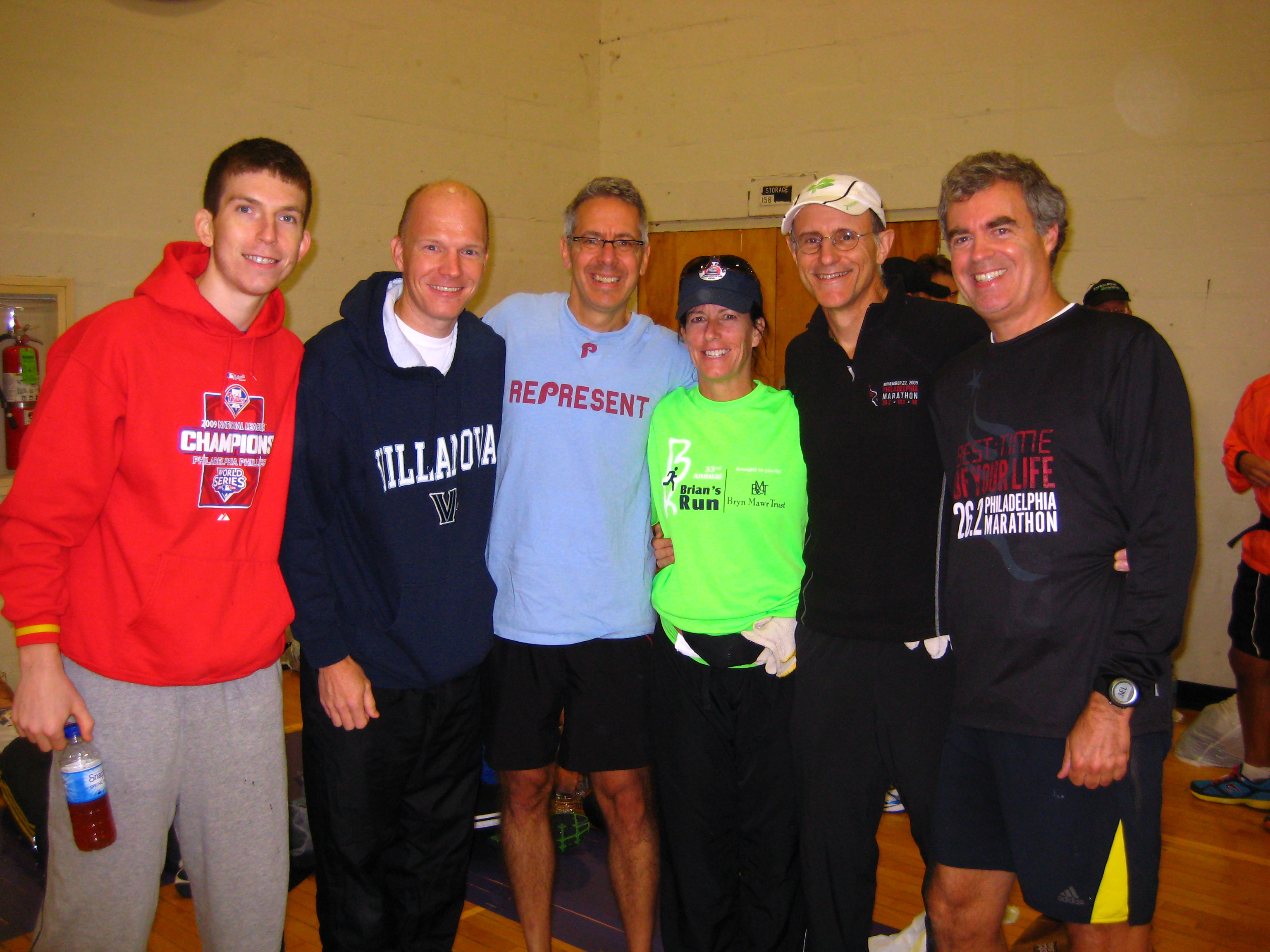
And here’s the group all together, getting a bit nervous, and wanting to get the show on the road.

The group from SJAC

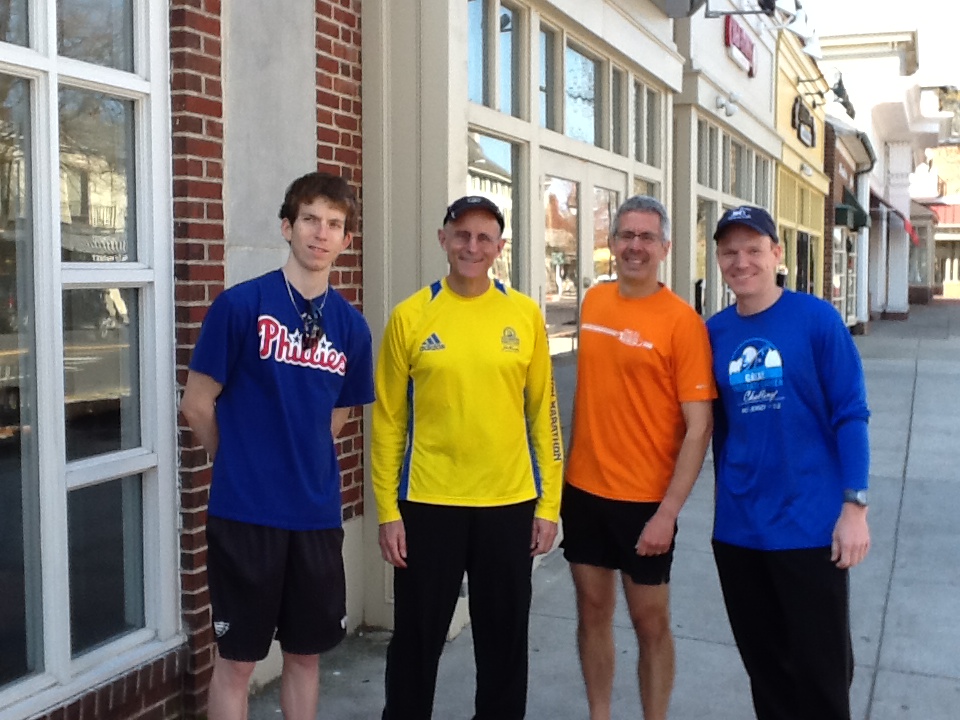
SJAC Marathoners wait in the gym at Forest City, H.S. Dan, Brian, Steve, Lisa, Frank and Tony.

The race started off close to the planned start of 8 AM.  Fortunately for us all, the rain stayed away for the entire race.  The temperature at the start was about 40 deg., and it warmed up to about 50 by the end.  True to all the stories we had heard from former runners, the start is a very steep drop down hill.  The net drop in the first 10 miles is about 900 feet, and one really gets sucked in to the speed one gets from letting it rip down hill.  I noticed that at the halfway mark, while I was still hanging with Tony, my half marathon time was faster than any half marathon I’ve run, just under 1:45.  Ed, from SJAC, warned us about going out too fast.  My feeling was that to slow down also takes a big toll on the muscles, from the braking action, so you are damned either way.  Just past the half marathon mark, the run gets into a rolling hill, up and down, mode.  It heads into the woods over graveled trails, which I found hurt my feet.  By sixteen miles, I had given up all my time savings and started to really slow down.  My legs were in pain, and I was starting to get some twitches  in my calf muscles.  Between the pain building in my muscles and the twitches turning in to real cramps, I could see my time goal not just slipping away, but having left the station a long time ago.  So, what to salvage?  By the way, Tony had steadily moved forward at the halfway mark and it was the last I saw of him until the finish line.  Leaving the last of the trails in the woods, we continued on rolling roads as we headed toward Scranton.  I had the honor of running beside  “Hizzoner” Mayor Chris and his wife Donna, of Scranton, who were both looking very good over the last several miles.  As we ran along, the crowds grew large, and their support for their mayor was tremendous.  I got energized by their loud cheers for their mayor, pretending it was for me, which really helped drive me to the finish.  Over the last two miles I was getting some very strange cramps in my left leg causing my foot to twist almost sideways.  I’m sure I had a bit of a Quasimodo look as I headed up the remaining climb to the finish line.  Crossing the finish line, I was barely able to lift my arms to shoulder height, trying unsuccessfully to look good for the camera.  I finished in 3 hours, 57 minutes and 11 seconds.  My personal best is 3:44:14, so I didn’t make a PR, and I certainly didn’t make my Boston Qualifier.  But, I finished under four hours, and I was happy to have done so.  Tony was brilliant, finishing in 3:39:06, under the Boston standard of 3:40 for his (and my) age group.  He was very depleted at the end of the race, as were we all, although I think he was worse off than the rest of us.  Steve finished in a very respectable 3:45:34, not what he wanted, but then, it’s a tough race.

Tony at the finish.

Tony, wearing the smile of his best marathon ever, and a Boston Qualifier!

Steve, at the finish

Steve, happy to be finished.

Frank, in front of the Scranton court house.

Frank, glad to have warm clothing on, and happy to have survived.

Caren and Kathleen

Caren, Steve’s wife, and Kathleen, my wife, provided invaluable support and cheer in our efforts to prove ourselves on the marathon course, and we thank them from the bottom of our hearts.

After we had a chance to warm up, replenish some fluids and let the muscles stop twitching, Tony, Steve, Lisa, and I, along with our support crew of Caren and Kathleen, headed back up to Clarks Summit for lunch.  We ate at a surprisingly good Mexican restaurant across the street from our hotel, called La Tonalteca, a chain, but with very authentic food.  Poor Tony found it hard to face eating anything at this point, leaving a beautiful bowl of tortilla soup untouched, but the rest of us found it in ourselves to chow down.

I find each marathon I run to be tremendously challenging, often painful, and mostly discouraging.  As soon as I’m done, why am I thinking about the next one?  I think I really love this sport, greatly respect the runners who run with me, and want to keep pushing to get better.

Frank

Uncorking Croatia

The Blog of WINES OF CROATIA

RunnersOnTheGo.com

To help enrich the lives of others, we developed RunnersOnTheGo.com to help runners save money on races, running stores, and much more. We also provide the specific local information that makes your travel for business, vacation, or racing as rewarding as possible.

getsetandgo

Travel Blog of a Budget Traveler sharing stories on travel, books & Vegetarian Food

Marc Hemingway

Trying to keep track of my life (and my life on track)

Mid-Life, Mid-Level, Masters Running

Exploring ideas about running to contribute to a more enjoyable pursuit for the mid-level masters runner

therunningtherapist

"One foot in front of the other and one thought at a time"

WordPress.com News

The latest news on WordPress.com and the WordPress community.

retireediary

The Diary of a Retiree