Keep the Ranger Rolling

We have a great little pickup truck. It is a 2011 Ford Ranger which we bought in November, 2011, the last year Ford made this model. It is a very serviceable truck, which we used frequently to haul water heaters, ranges, furniture, trash, lawn mowers, and all sorts of other stuff which goes along with servicing rental houses. For my wife, it was her only vehicle, and she grew fond of it. Edmunds, the auto website, was not complimentary in its review, but owners gave it mostly five stars with a few four-star reviews, and none less than that. Ford stopped making this model in December, 2011. From various reports, it seems Ford felt this truck was competing with sales of the F-150, their full sized pickup.
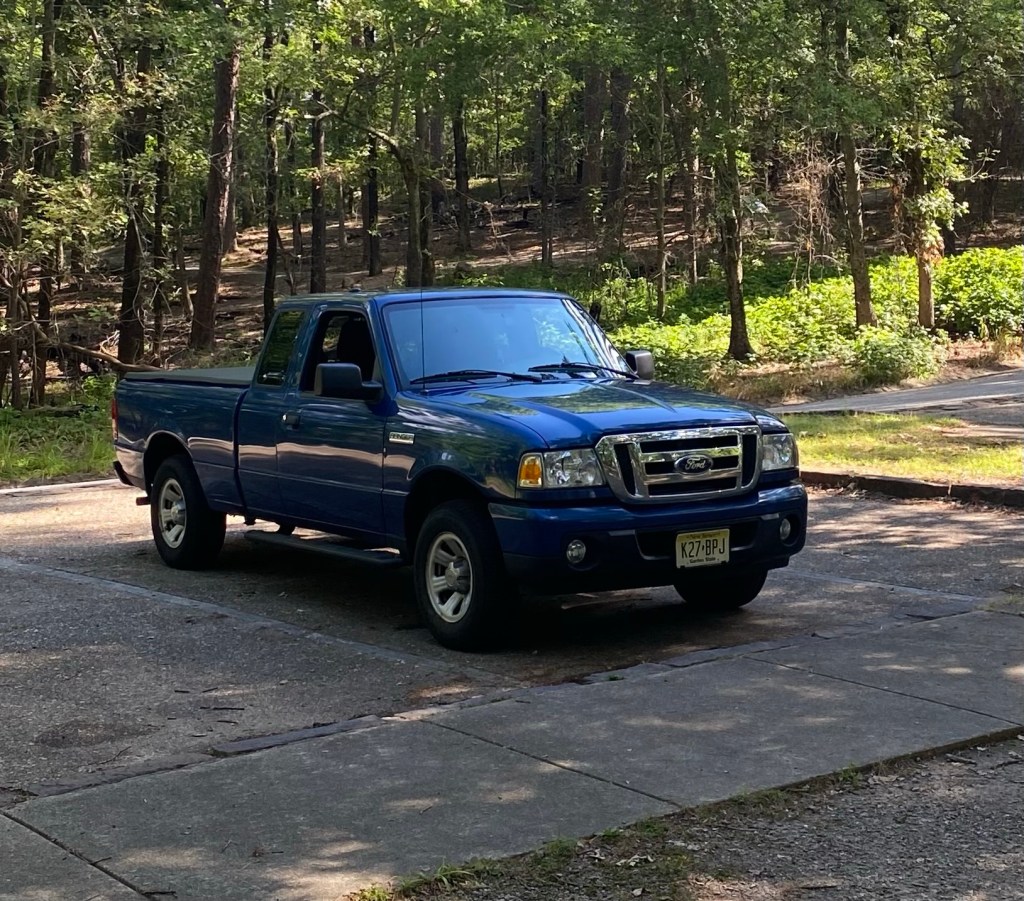
Things went wrong with our truck last year after a long ride back from Oklahoma to New Jersey. We had driven it down to Oklahoma filled with family goods, a silver tea service, heirloom silverware, grandmother’s glassware, and other goods to give to my daughter or keep in our place there. It was a bit humorous. We spent two nights on the road, and each stop we would unload the truck into the motel room for safety, then reload it the next morning. We spent the month of July in Oklahoma, and returned with the truck performing beautifully. But shortly after we got back, it started to have problems with the battery draining. Left idle only a few days, the battery had lost sufficient power to start the engine. My first thought was to replace the battery. We had it checked, though, and it was still in good shape. I checked how much current was being drained when it was not running. I measured 25 mAmps, which is not a heavy draw. We took the truck to the Ford dealer near us and reported the problem. Their first response, after keeping it overnight, was that it started up just fine, so per their brilliant analysis, there was no problem. I had them keep it over a weekend, and behold, the battery had drained to the point it would not start the engine. They ran a number of tests, narrowing the cause down to a malfunctioning ECM, or electronic control module. This is a computer which controls distribution of power to various components depending on need.

However, because our truck was made in 2011, the end of the line for that model, they told us Ford does not sell replacement ECMs for that vehicle, and after searching, they were unable to find a replacement. These ECMs are vehicle-specific, requiring programming for the exact model in which it is installed. We brought the truck home, and I installed a switch on the negative pole of the battery, so we could disconnect it when not in use. This was a very simple copper toggle switch. Granted, we had to open the hood when we wanted to start the truck in order to throw the switch, but it worked. One little problem came up when we needed to get the car inspected. The computer reading at the inspection station showed a failure, but we learned we had to drive it 20-30 miles without disconnecting the battery for the ECM settings to pass. We did that, and it passed. Terrific!

Our problems were not over. We used the truck regularly, but only once a week or so. The disconnect switch was working. Then, in November last year, it occasionally would not start, even with a full charge on the battery. I would throw the switch, put in the key (yes, a real old-fashioned key), and on turning the key all the lights on the dash would go out and the engine would not start. There was no clicking sound like one hears when the battery is low. It was just dead. Then, I would come back an hour later and it would start. My wife needed a reliable car. We did not want to get rid of the truck, though, since all the other mechanical parts, the engine, the body, the interior, were all in good condition. We bought a new Subaru Forester in December. At first, she missed the truck, and despised the computer screen in the Subaru used for controlling car functions. But it served us well on our trip up to Vermont with grandchildren, and she started to appreciate its good qualities. She especially liked being able to raise the driver’s seat so she could see better.

We still used the truck periodically, never knowing if we would get stranded somewhere. So, by necessity, we kept trips local. The ranger got worse, though, and by April of this year, it would not start. It sat parked on our side street, a piece of immobile sculpture. I would go out once in a while, check the charge on the battery which was holding, see the dash lights light up when I put in the key, only to have all go out on turning the key to start. Even the cabin light went out.

We took another trip down to Oklahoma for the month of July, driving the new Subaru. It performed beautifully, and we had a great trip. I still wanted to get the truck working again, though. It became a mission. I had spent some time searching on eBay and various parts dealers, but could not find a replacement ECM. Then, on a web search, I came across a company called Flagship One, Inc., in Lynbrook, New York. Lynbrook is on Long Island, not far from Queens and JFK Airport. It is a privately held company specializing in ECMs and myriad other acronym named computers for cars and trucks. I called the company, got a live person on the line quickly. I told her I needed a replacement ECM for my 2011 Ford Ranger. She took down the VIN, did some quick research, and told me which model I needed. The cost was $214 which I thought was very reasonable. She told me the unit would be programmed for my particular vehicle. Over the next week and a half I received emails informing me of the progress with my ECM. Once it was ready it was shipped second day delivery. After receiving it, I could not wait to install it. Swapping out the old ECM turned out to be very easy. Three cables with connectors attach to the unit. After unplugging them, the unit is held in by two nuts. It was a bit stuck in place, but with a little leverage, I removed it.

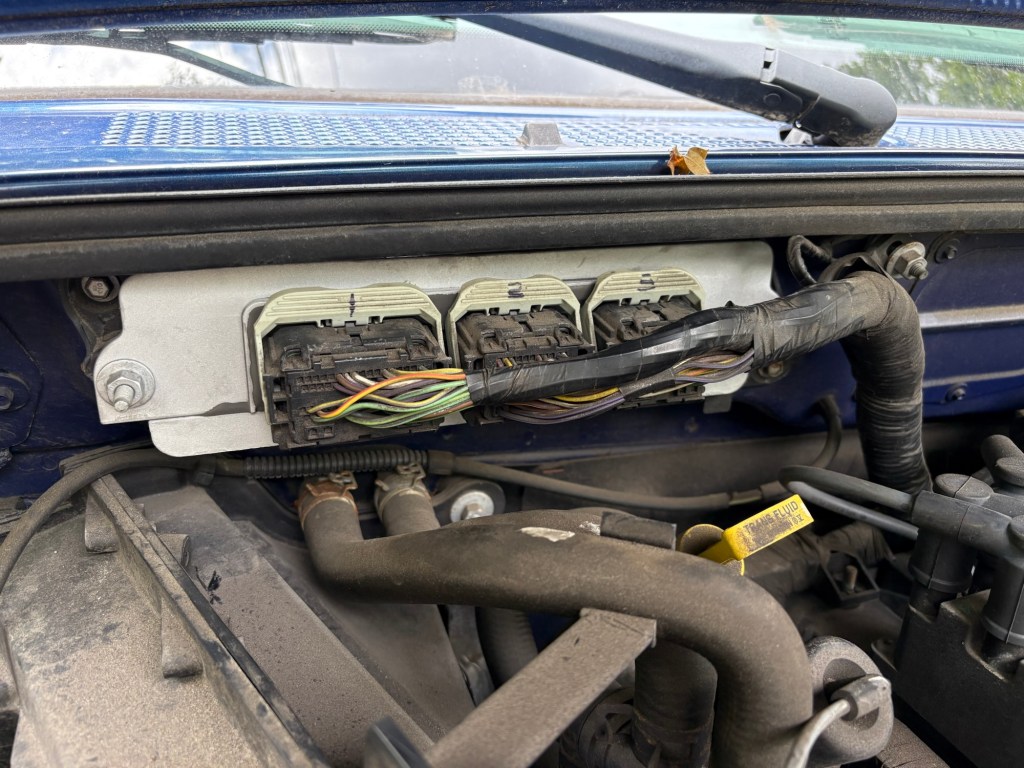
The old ECM
The new ECM in place.

With the new device installed, I reconnected the battery. I opened the driver side door and the cabin light lit. I inserted the key, and the icons on the dash lit. However, on turning the key, nothing happened. I noticed one icon which was lit, showing a car with a padlock.
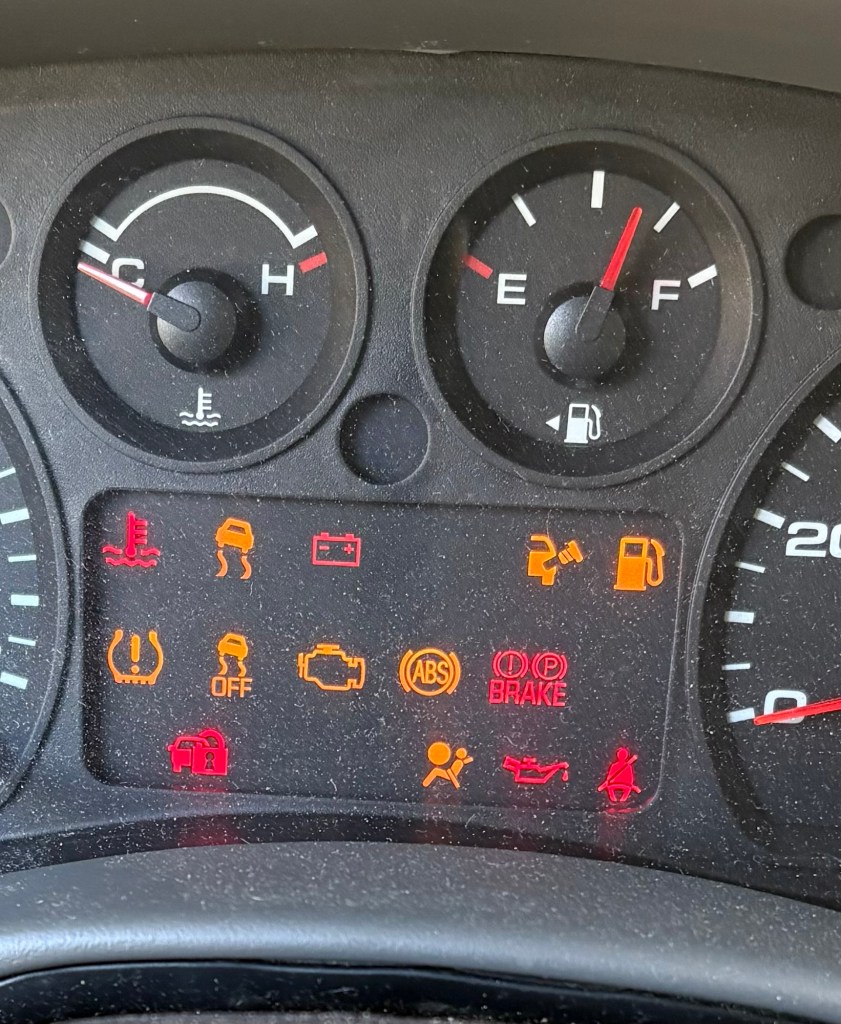

Lower left icon, the “SecuriLock”
From the manual….

The car keys come with a key fob containing a chip. The chip needs to be programmed to the ECM to allow the truck to start. I didn’t know this at first, but had a hunch when I saw the icon, and read about it in the manual. I called the good people at Flagship One. At first, they sent me instructions on reprogramming which required starting the engine. So that was out. I called Winner Ford and spoke to a service rep. I was willing to have the truck towed there to have them reprogram the fob. I was told that since I installed the ECM, they would not help me. I offered to reinstall the old one, but they said, “too late”. I argued that they were the ones who said a replacement ECM could not be found, but again they refused to help. I called back Flagship One, and they said a locksmith should be able to provide this service, as long as they had the right computer setup to work with old Fords. I called Ben’s Lock & Key in Cherry Hill. Twenty minutes later, a very nice man named David (Ukrainian emigre) was parked in front of my truck. He said, “no problem, we’ll get this fixed”. He hooked up a pad to the connector under the steering column and entered some information. Then he told me to insert the key and start it up. The engine roared to life. I got our backup key with fob and that got reprogrammed, too. The cost of all this was about $230 for the ECM and $240 for the locksmith services.

I have also discovered, by leaving the toggle switch on the battery closed and checking its voltage, that the battery is no longer being drained. It turns out a faulty ECM is a known cause of “parasitic” battery drainage. I’m very glad I persisted and did not give up on our pickup. It’s not that old, is in good shape, and should have many more miles in its future. I’m also very appreciative of the excellent service from Flagship One and from David, at Ben’s Lock & Key, without which I would still have that immobile piece of art.
Start off Slow…

And then ease off.

That was our joke with each other on Sunday morning runs ten years ago when I was almost always training for a marathon, or half, or the Broad Street 10 miler. Now, I have settled into running slower, cycling slower and skiing with more care.

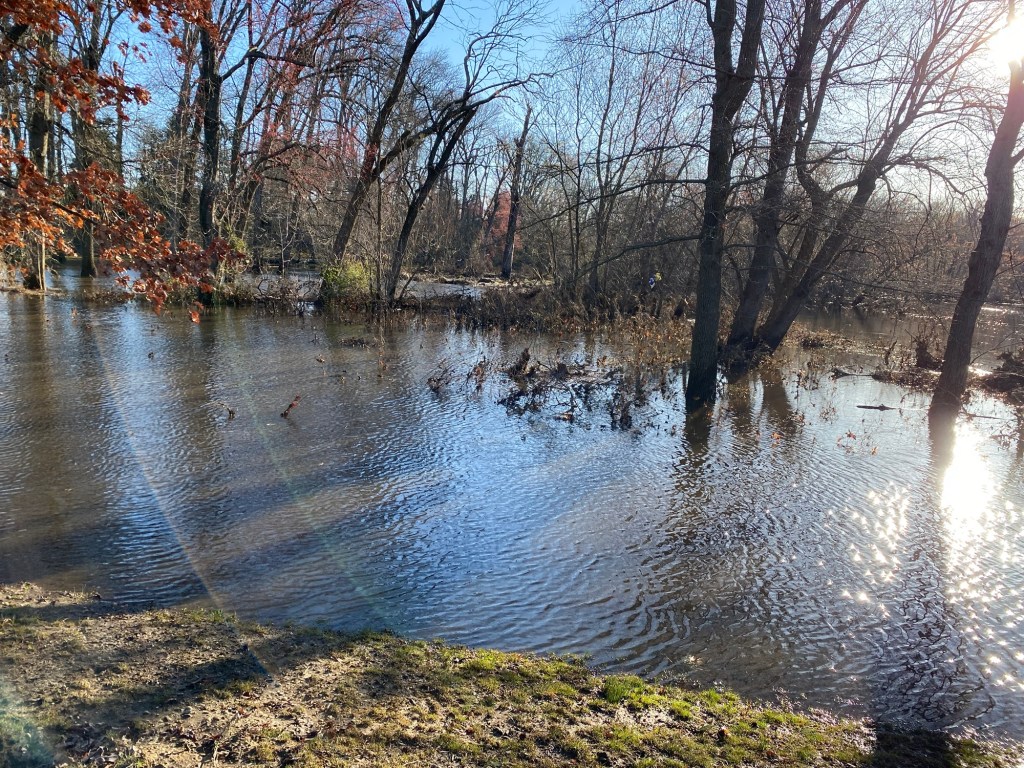
Here is the view from the back of the pack. It is odd to start running with the group Sunday morning only to have them blithely move ahead while I trot a respectful distance to the rear. I am adjusting, though, and there is a calmness to my runs I didn’t have before. I pause every now and then to catch a breather, and even stop to take a photo, as I did last Sunday, a day after heavy rains, when our local park was flooded.

Flooding along the Cooper River.

Regarding cycling, I still am pushing it to keep up with the other guys I ride with. They are mostly around my age and so I can’t pull that “I’m older than you guys” stuff with them. Fortunately several of them have dropped down from their peak a decade or more ago, but some of the guys were not listening, and continue to be beasts on two wheels. So right now I’m using the smart trainer to get the early spring training needed to look respectable in May. I signed up again for the Delaware Gran Fondo, a 100 km ride through the hills around Wilmington. It’s a fun ride with a nice party afterwards.

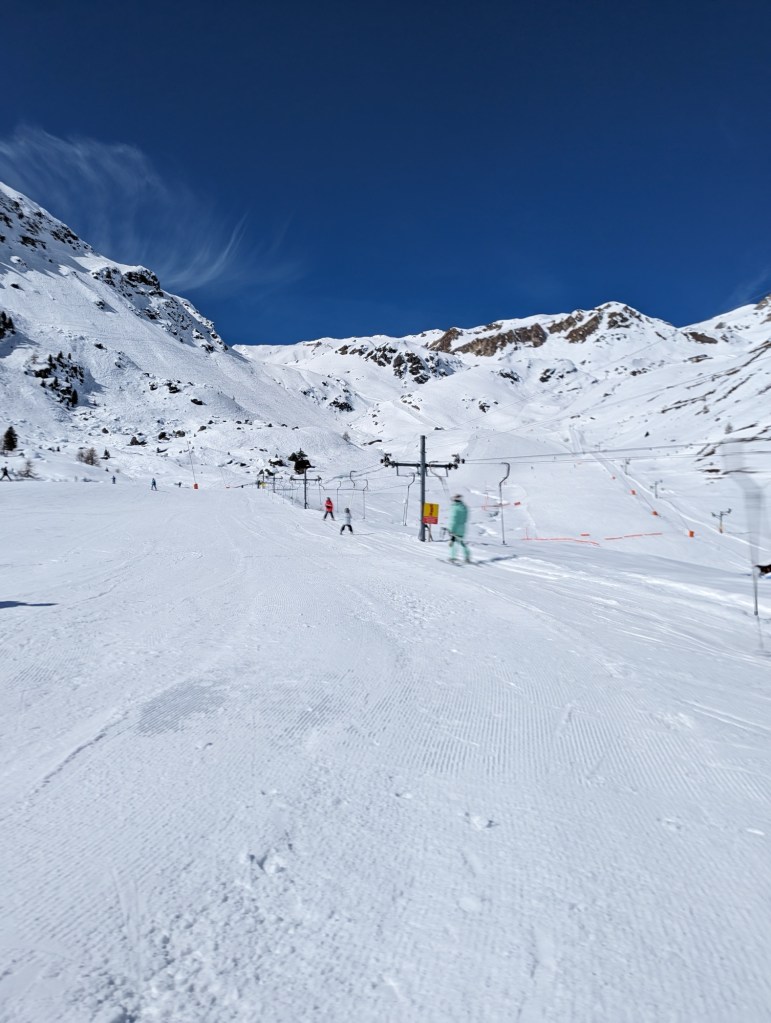
And skiing? I decided to improve my form. A friend of mine who is a ski instructor at Killington in Vermont suggested I try the “Carv” system. It consists of thin plates with sensors one inserts under the lining of the ski boot, inside the boot. They connect with electronic transmitters to my cell phone. I also got Bluetooth speakers for my helmet. I realize this sounds like a lot of gadgetry. But while skiing, a lovely English-accented Samantha gives me tips and encouragement on how to carve better. I actually feel it is improving my form! But the best part of skiing right now is seeing my two granddaughters, aged 7 and 4, learning how to ski. We took a trip to Switzerland and they had a great time with their ski instructors and also skiing with mom, dad and me after their lessons were finished. We were in a small village high in the alps called Grimentz.

So that’s the plan: start slow and then ease off. It seems to be working. Adapting to slower also means keeping one’s pride in check and not obsessing about time, pace or how many runs I got in.

But by all means keep going!

Turning 70

It’s a world of difference, turning 70. In 2013 I wrote a remembrance of growing up, maturing and turning 59. But, life kept moving. Suddenly, things have radically changed. I decided to retire at the end of a long career in general surgery. While working, I always had to squeeze in the time for training for half and full marathons, several shorter races, and for my annual cycling vacation with friends in Northampton, Massachusetts. One of my favorite cartoons shows a peasant training for a marathon. This cartoon, by Frank Cotham, publishedin The New Yorker 3/12/2018, captured my style. (My wife bought a print for me for Christmas and I have it hanging next to my race medals).

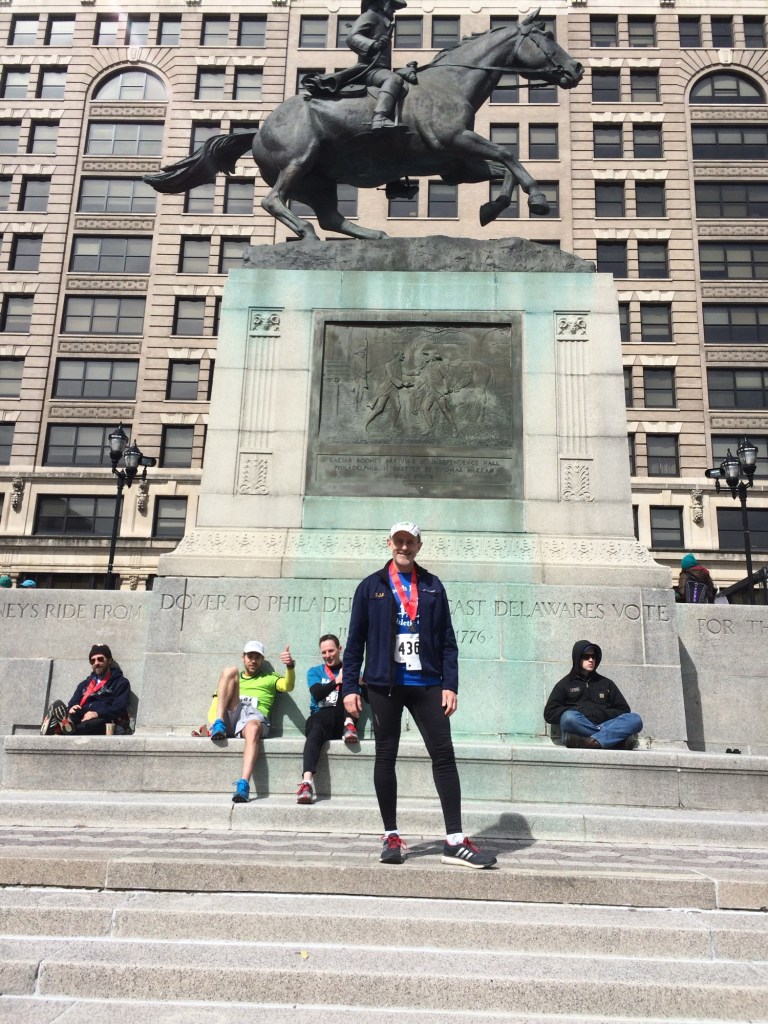
After 59, I still had room to improve. Almost 61, I ran my half marathon PR, at the Caesar Rodney half in Wilmington, March 22, 2015.

I was doing pretty well the next few years, at work and at play. My good friend Brandon, with whom I’ve run many training miles, often told me that once I retire, I can train even harder and really do great things.

Due to unanticipated problems, that didn’t happen. Or, at least, not as I wished. We experienced the covid pandemic, but I cannot say that affected me personally, too much. People still needed surgery, so other than three months in 2020 when we postponed certain elective procedures, we still worked. I got my vaccines when they became available. Running, though, was a great way to get outdoors, mask-free, and enjoy nature. But a couple of problems came up. Two years ago I was out for a run and got a shearing pain in my right calf. It came on suddenly, like a knife wound. It turned out I had ruptured a Baker’s cyst, which is a thinning and bulging, then tearing of the joint capsule around the knee, releasing joint fluid into my calf muscles. I had an MRI of the knee which also showed A complete tearing off of my medial meniscus. Consulting with three orthopedic surgeons, they all came to the same conclusion. Surgery won’t help, you are kind of old. I attribute this condition not to running, but to standing hour after hour in the OR, constant pressure on the joints, and hyper-extending my knees to be able to get procedures done. This waylaid me for months. After about four or five months I tried running again, very gingerly. While it felt okay, I was still limping and had some pain in the knee. Also, no running for that long makes getting back into fitness a big challenge. Slowly, I hauled myself back, into running and cycling. Yet, I found myself going much slower than before.

Over the next year, things slowly improved. I felt fitness returning. I signed up for a 100 mile bike ride in London, the London-Essex 100, put on by the London Marathon Association and scheduled for the end of May, 2023. I got in some good training, including the Delaware Gran Fondo, a 65 mile ride with 5000 feet of climbing. The London ride went great! I had a good ride, finishing under six hours.

At the London-Essex 100 start.
It was then I decided it was time to retire. Work was as busy and satisfying as ever, but taking call, having to wake up in the middle of the night multiple times, sometimes having to go to the hospital at night and still work the next day, was too much. I gave my six months notice. At first, six months seemed like a long way away. As time went by, though, my wife and I had to start planning for Medicare and Social Security. It turns out, there is a lot to do for both those items. The last two months of my employment we spent deciding on things like a Medigap plan and Medicare part D drug coverage. Up to late August, I didn’t need drug coverage. But my blood pressure got the best of me and my friend Glenn, cyclist and physician, started me on a pill. Then, when that wasn’t enough, he switched me to a pill twice a day. Still, not too bad. But in early November, I went for a run after a day in surgery. I got a tenth of a mile and the muscles of the front of my left thigh, the quadriceps, became painful. I stopped, and the pain went away. Being obstinate, I did this numerous times, but had the same problem repeatedly. I tried again the next morning, a Saturday, but still had the same result. When I got home I noticed my left leg and thigh were swollen and bluish. I can recognize a vein thrombosis when I see one! My wife took me to our ER, where I entered like I usually do, the back way, and chatted with the ER doctors. They set me straight, got some imaging done, and discovered I have a condition called May-Thurner syndrome, or a thrombosed left common iliac vein. I was started on heparin, a blood “thinner”, and the next day had surgery to open the vein. Since then, I am on an oral blood thinner which happens to be very expensive. So, now I need that Medicare drug plan. On the positive side, I’m able to cycle and run again.
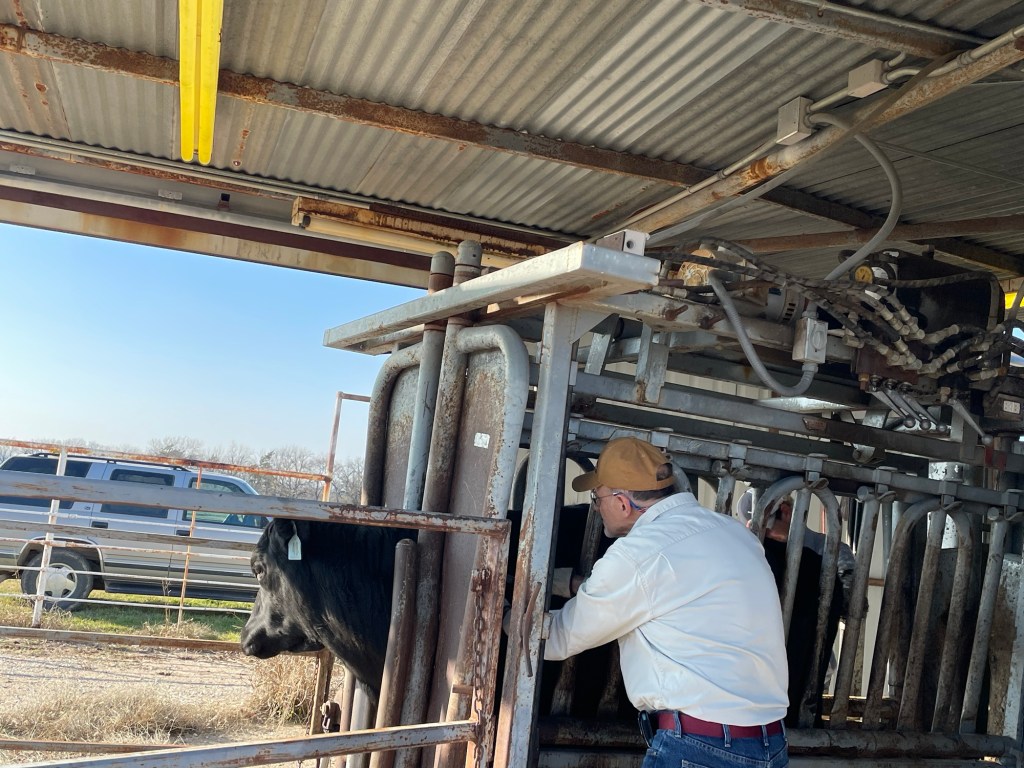
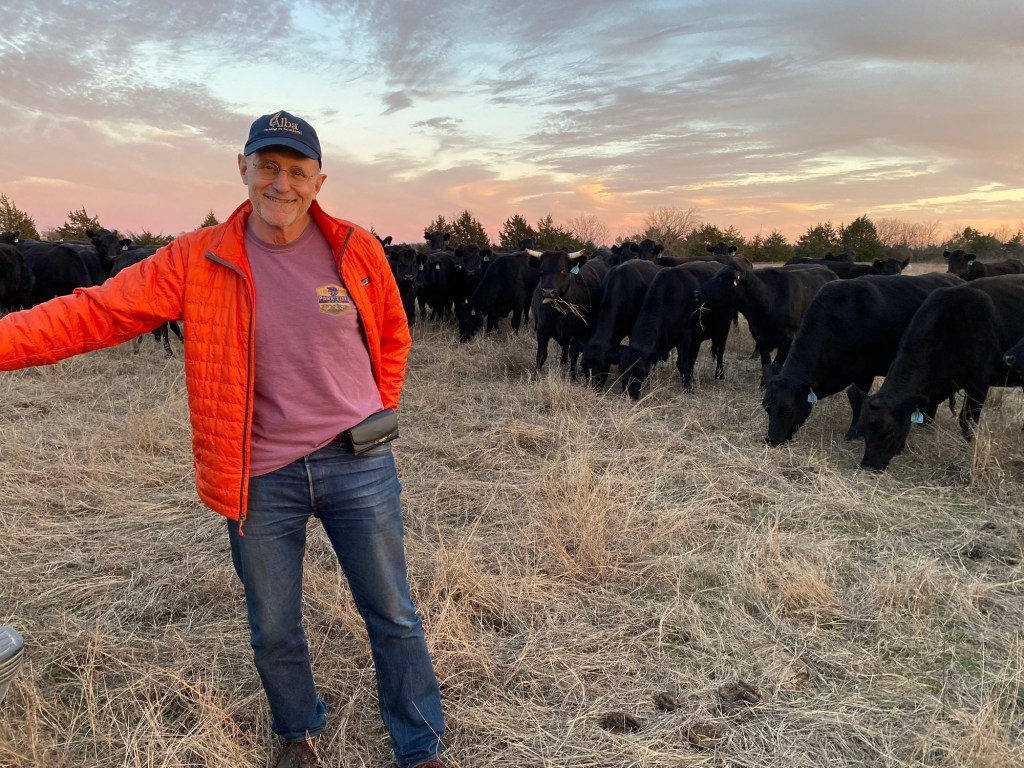
There is some pressure applied when one retires. Many of my friends have said they are eagerly waiting to see what I do in retirement. They predict all sorts of great projects and activities. That’s a lot to live up to. Right now, I have taken a week off to visit my daughter’s family in Texas, and help my brother-in-law work some calves and cows on our ranch in Oklahoma. But this feels like a regular vacation, as if I’ll return next week and have a full schedule in the OR. Nope. But I will be starting a teaching job at our med school teaching first and second year students. This means I have to relearn all that I learned in med school plus all the new information discovered the last 40 years. I will have more time to run, though….

Vaccinating the cows
Me and the herd
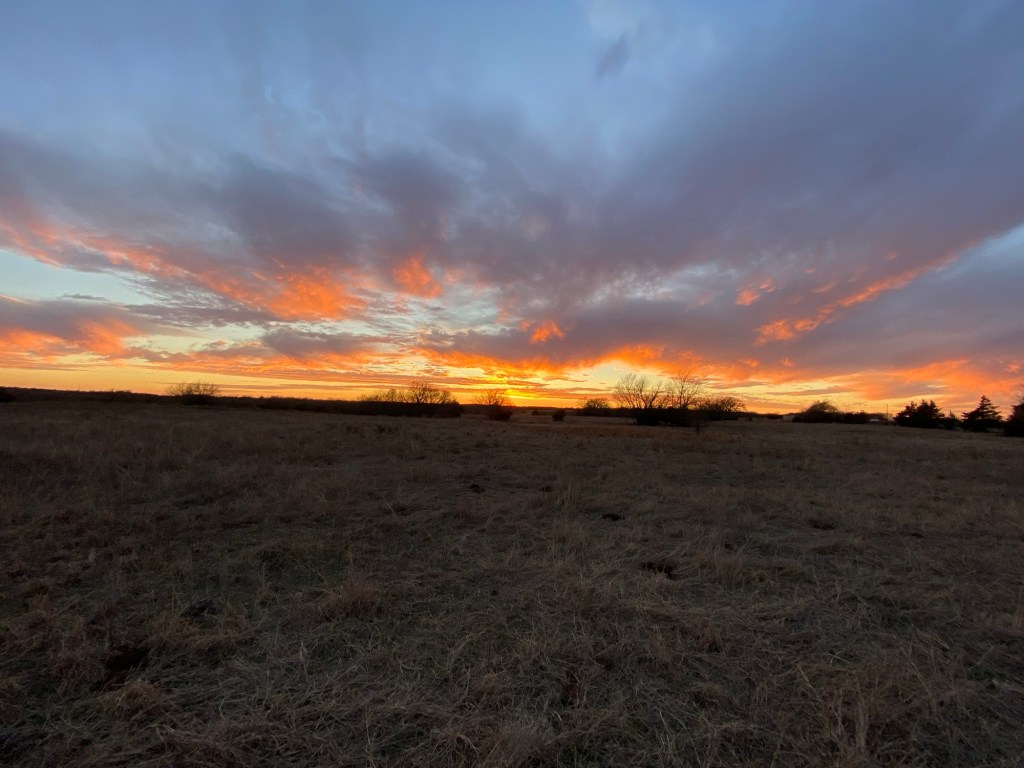
The sunset, as in “riding off into”!

Pinchot Backpacking: A Trail of Two Loops

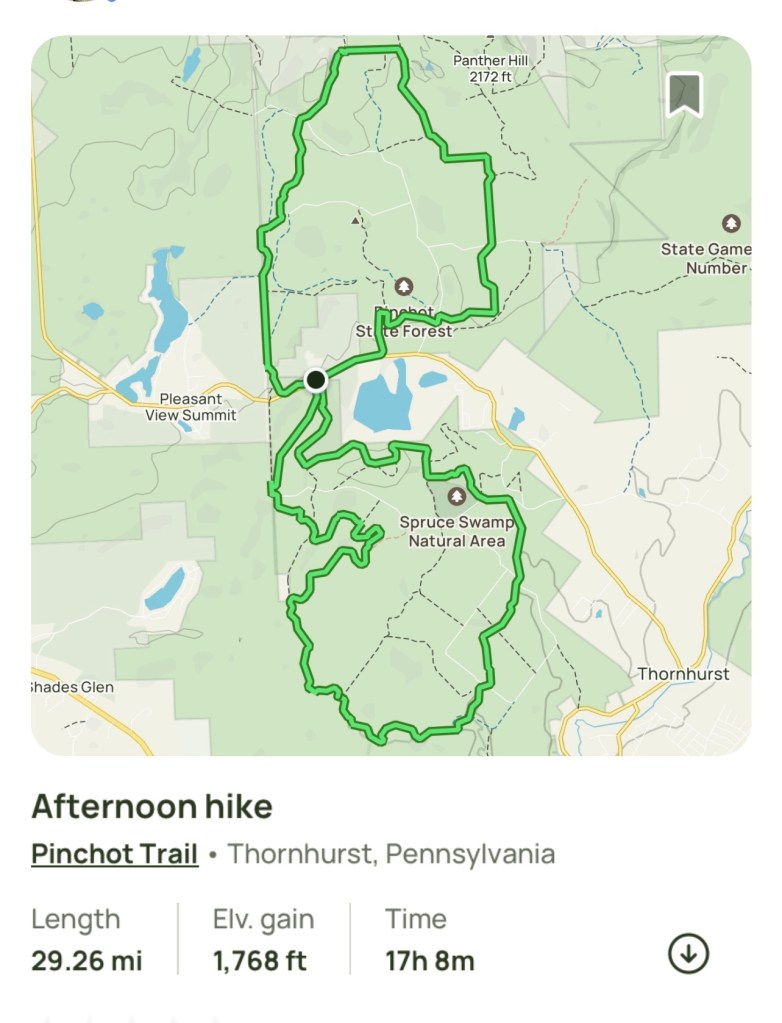
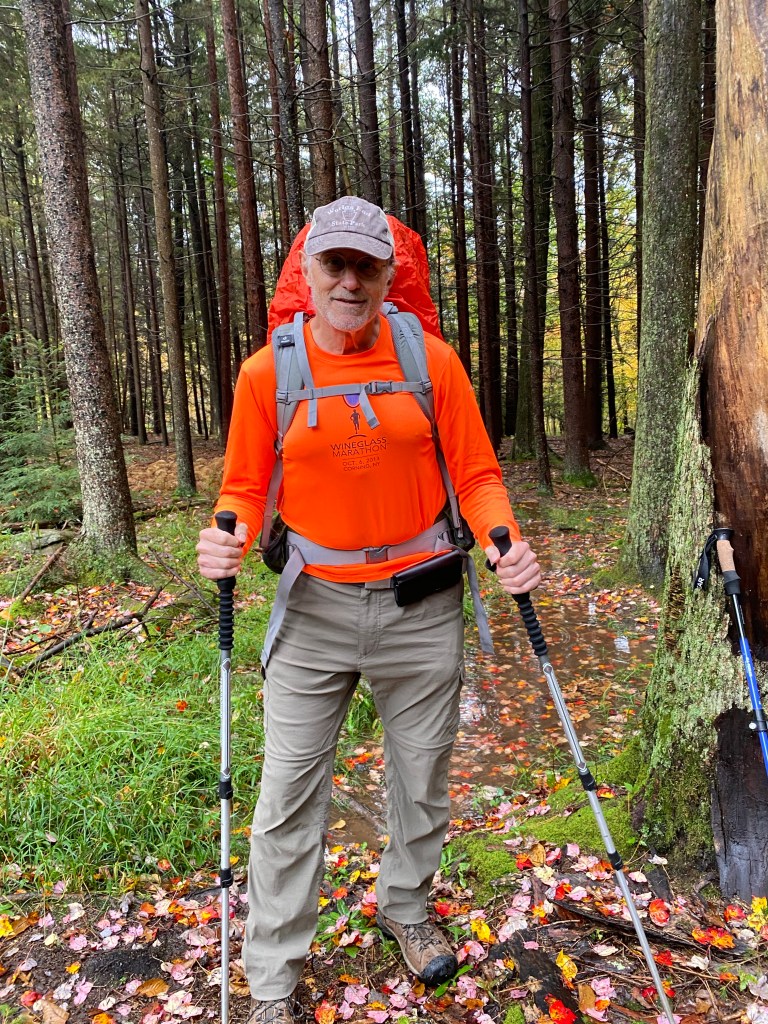
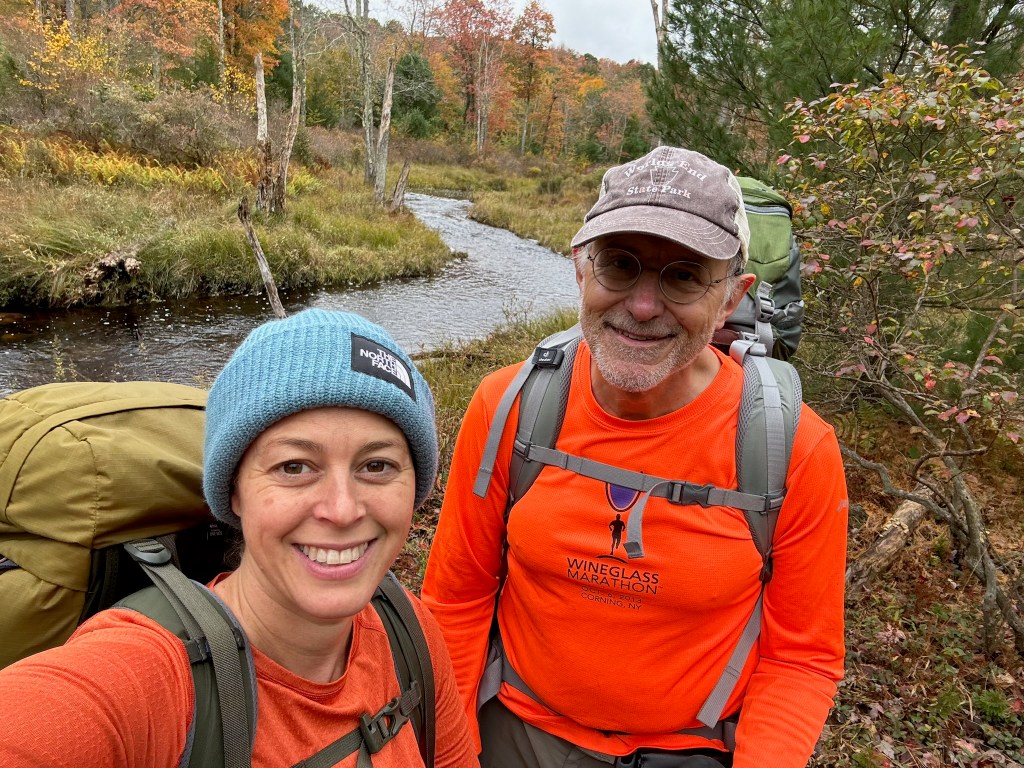
My running and backpacking friend Christine and I headed into the woods last weekend for a three day two night backpacking adventure. We knew rain was forecast for the first day and steeled ourselves to it, thinking we are equipped for rain, so we can deal with it. Our only concern was would we be able to get a fire going with everything thoroughly soaked.

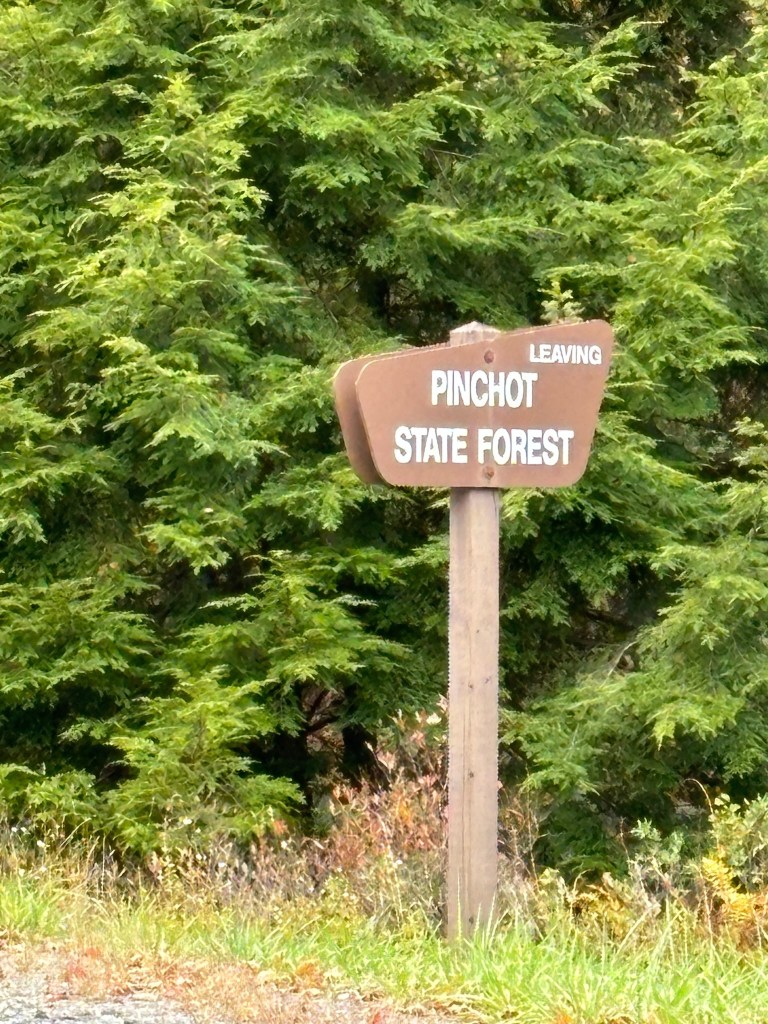
The Pinchot Trail is in the Pinchot State Forest, about 18 miles east of Wilkes-Barre, Pennsylvania. This land was purchased from lumber companies in the late 1800’s, by the actions of Dr. Joseph Rothrock, a pioneering environmentalist and first president of the Pennsylvania Forestry Association. It had been clear cut of old growth trees and left as tree stumps and dried out tree tops. Much of Pennsylvania’s forests had been treated this way. The man after whom the forest was named, Gifford Pinchot, was a prominent forester, served as Governor of Pennsylvania, and was the first chief of the U.S. Forest Service. He promoted clearing and replanting heavily clear-cut areas to preserve the land from fire and erosion. The state forest began small, in 1902, at 2854 acres. It has been greatly expanded several times, most recently in 2005, to 49,635 acres.

The trail layout was created by connecting multiple shorter trails into two loops, a north and south loop, an effort spearheaded by Frank Gantz. He organized forest service workers and volunteers who blazed the trail with orange blazes.

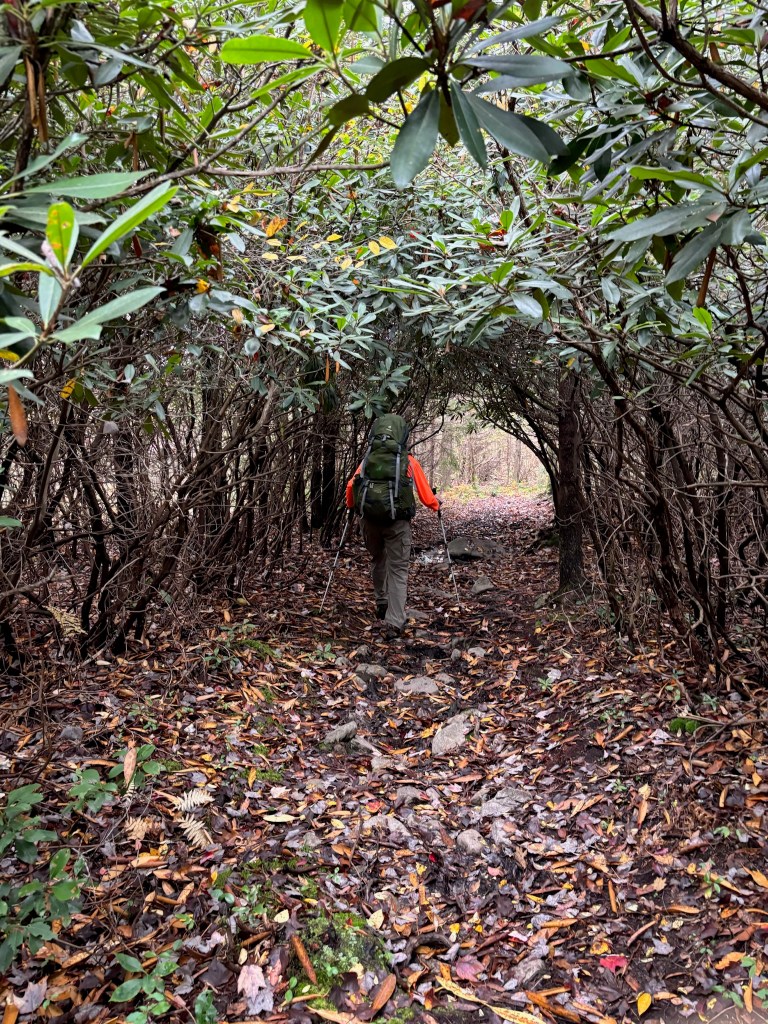
We parked our car at the entrance to the south loop. A light rain was falling with the temperature was in the mid 60’s. We put the rain covers on our backpacks and headed off. We didn’t wear rain jackets, figuring we would just sweat in them and get wet anyway. Once underway, we really were not bothered by the rain, even though it got heavy at times. A unique feature of this trail are long tunnels of rhododendrons arching over one’s head.

Rhododendron Tunnel

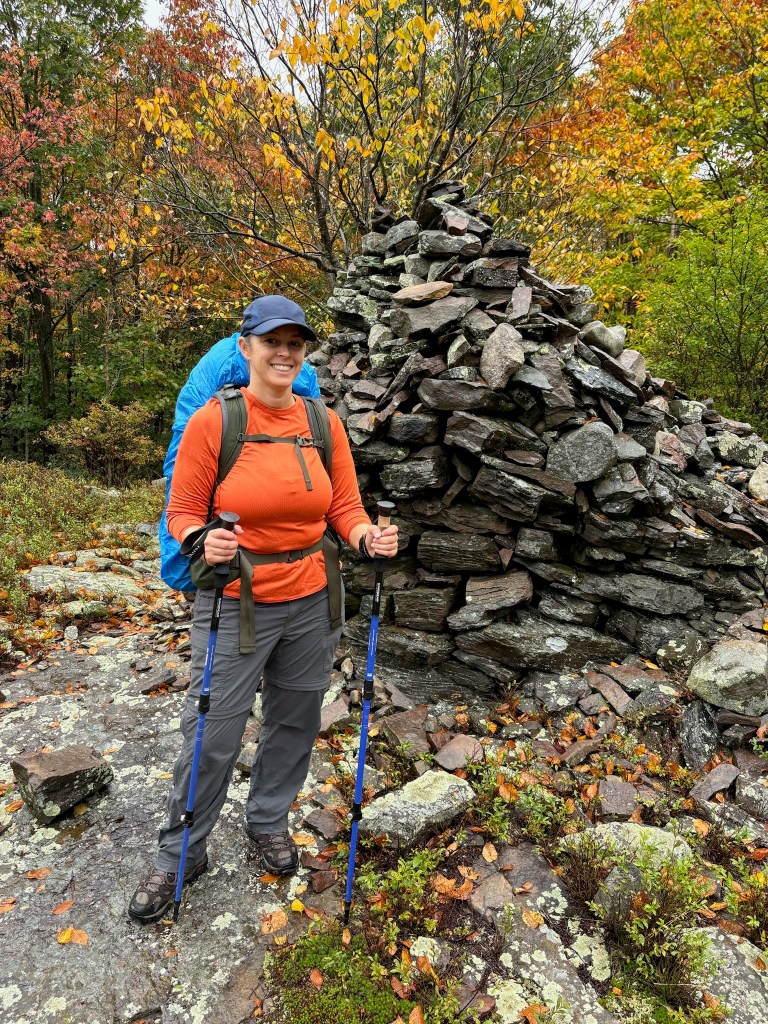
This being autumn, there were no blossoms, but I could imagine them in the spring. The terrain at the start was mostly flat, but into the south loop there are some changes in elevation. The trail passes through hardwood forests (newer growth), the rhododendrons tunnels, and some open meadows. There is a fair amount of mud, standing water and shallow streams to get through, with some parts of the trail quite rocky. We came upon the remains of a stone tower, reported to be a monument to someone who died in a boating accident, although I could not find detailed information on that.

That’s quite a pile of rocks!

Farther on, the rain did not let up as we made our way through the mostly narrow trails. We found it hard to stop for a break. Any downed logs to sit on were water-soaked and soft. We took a short break standing in the now light rain to have a snack and water then headed on.

We came upon this little creature.

This is the eft form of the eastern newt, which is between the larva and adult stage. According to Wikipedia, this stage lasts about three years, during which time the eft travels seeking a new pond. The bright coloration is an example of aposematism, warning coloration to predators that the tissues contain a toxin, tetrodotoxin.

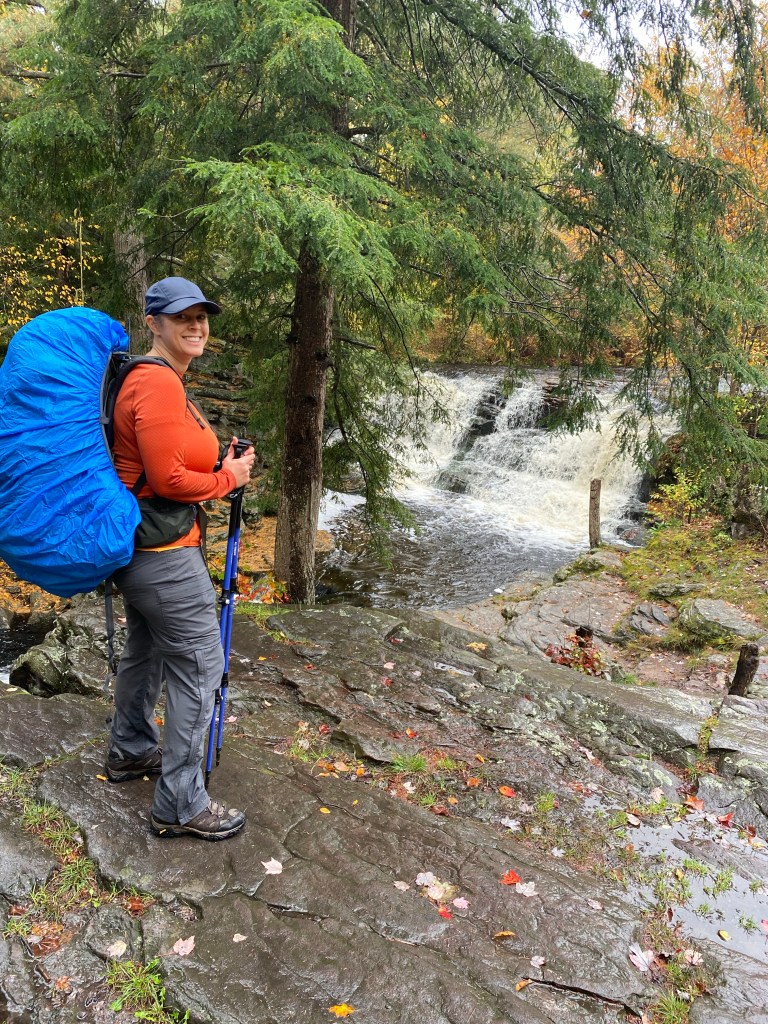
About 7 miles into the south loop, one reaches the waterfall on the Choke Creek. The water was flowing briskly when we got there, making for a beautiful spot to rest a few minutes and enjoy the view. According to write-ups about the area, the falls are not too far from a road, so in the summer, it is a spot crowded with visitors. But on this rainy and chilly Saturday in October, there was no crowd, just us.

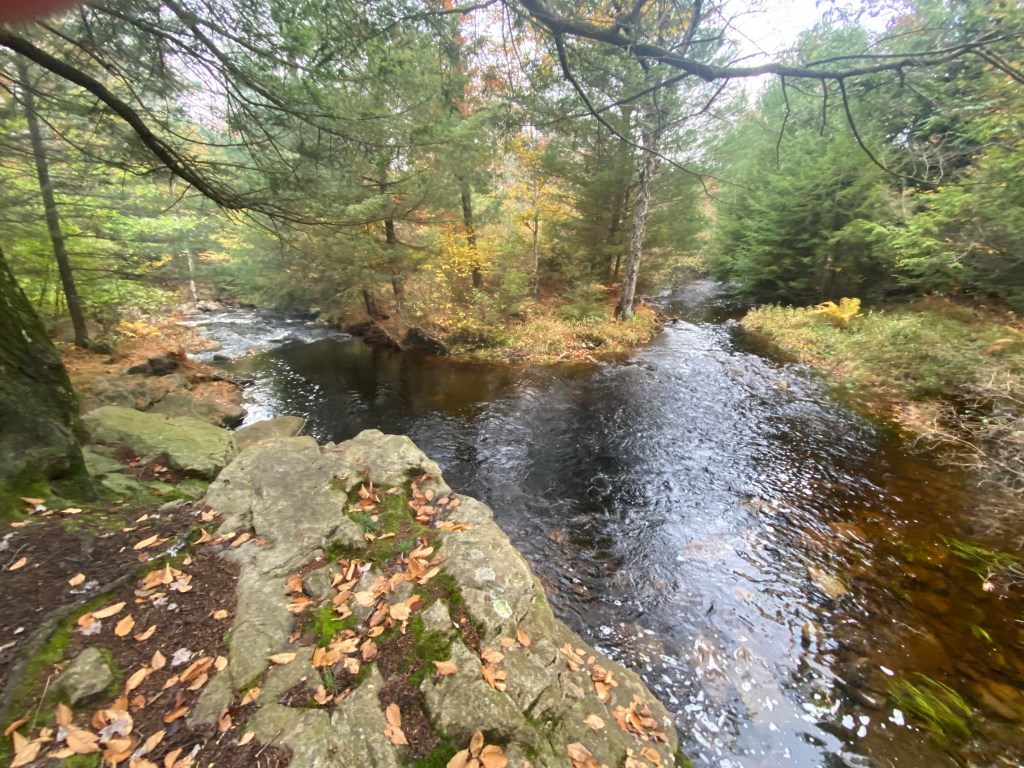
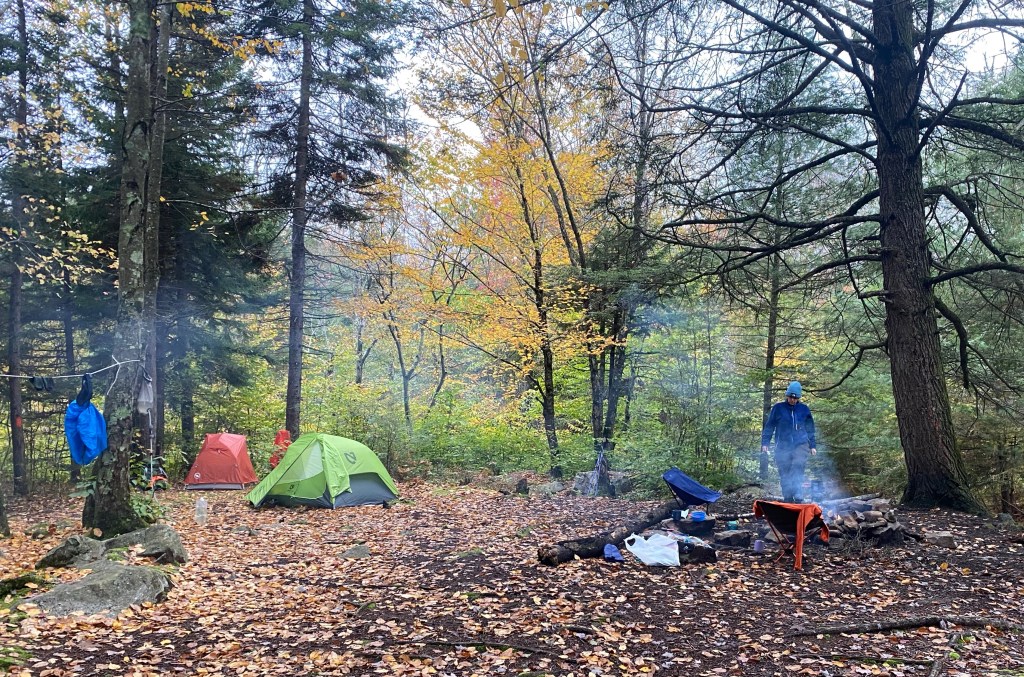
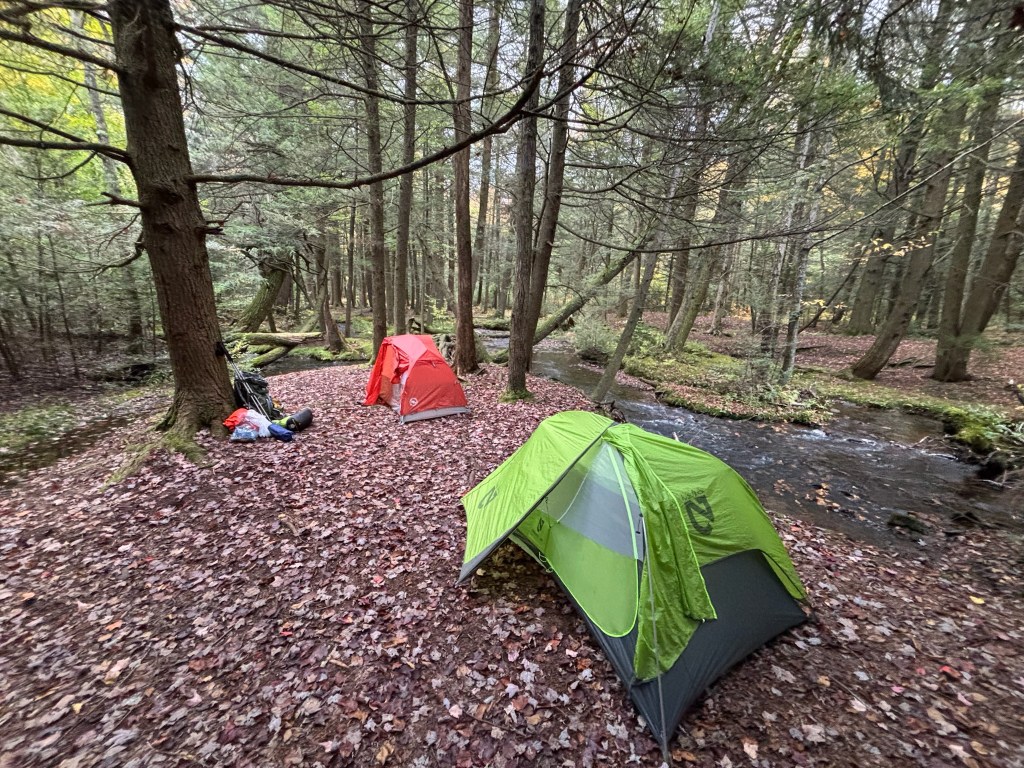
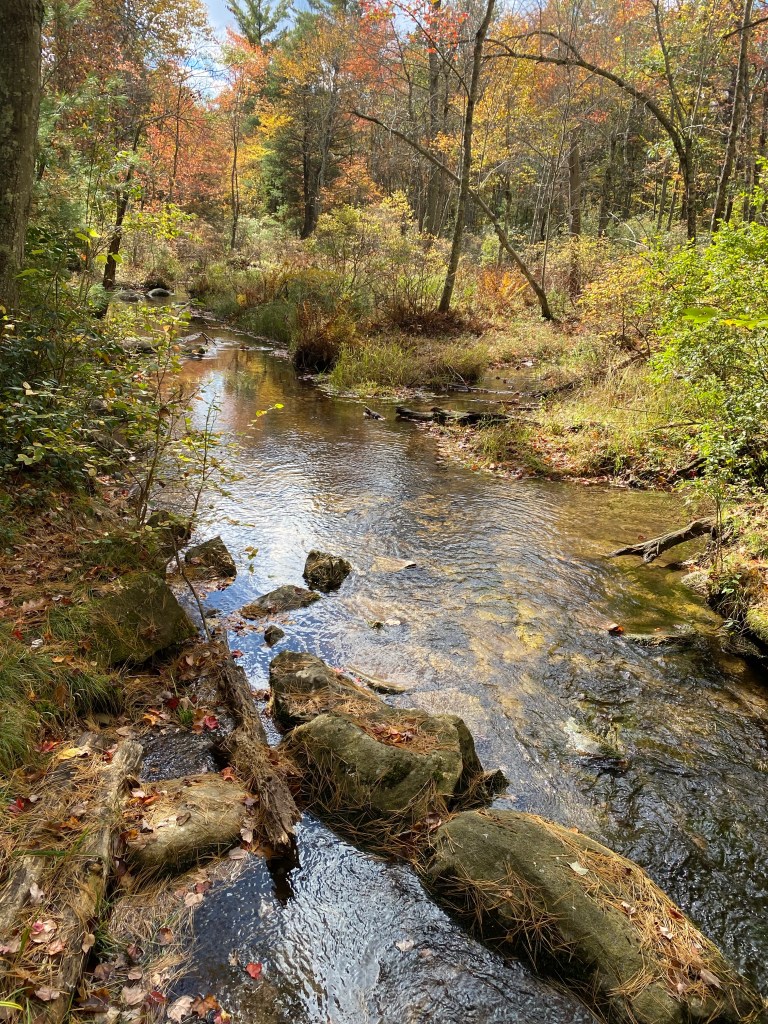
Another two miles and we were at our campsite along Choke Creek. The campsites along this trail are flat areas, usually close to water, with fire rings. The one we chose was very nice, with room for our tents and next to a confluence of creeks forming the larger Choke Creek.

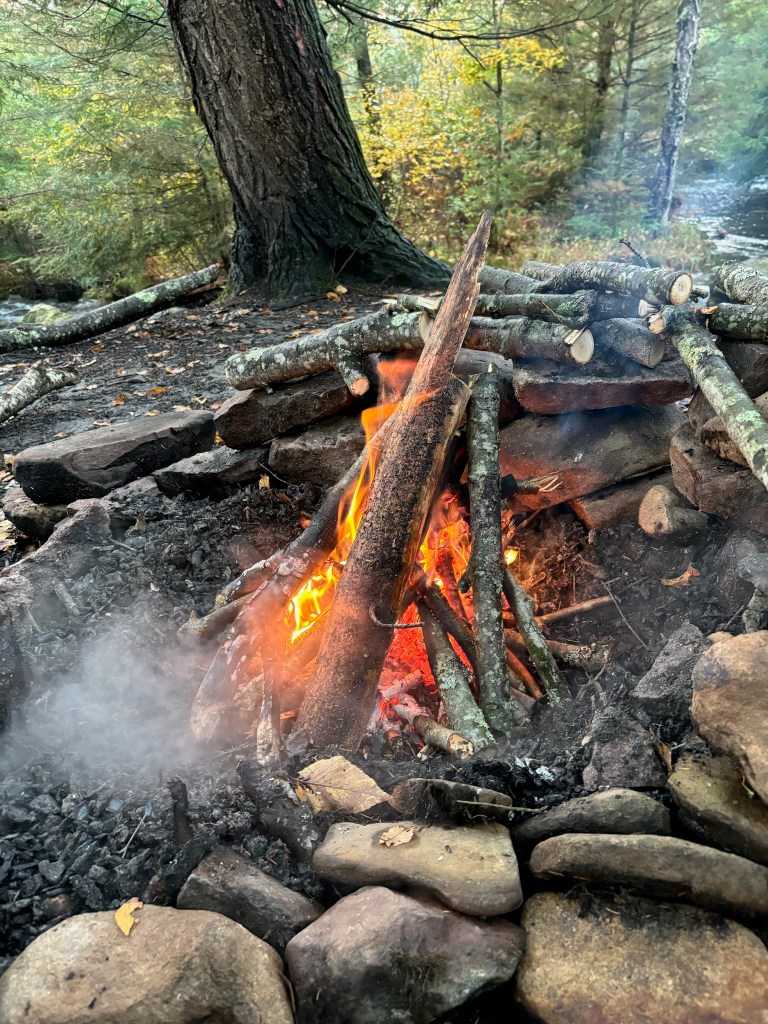
In defiance of the wet weather (the rain stopped about a half hour before we got to camp), we were able to get enough wood and get a fire going. This was the result of our carrying folding saws and Christine’s remarkable fire building talent. Also, she carried a piece of fat wood with her, knowing it would be a challenge.

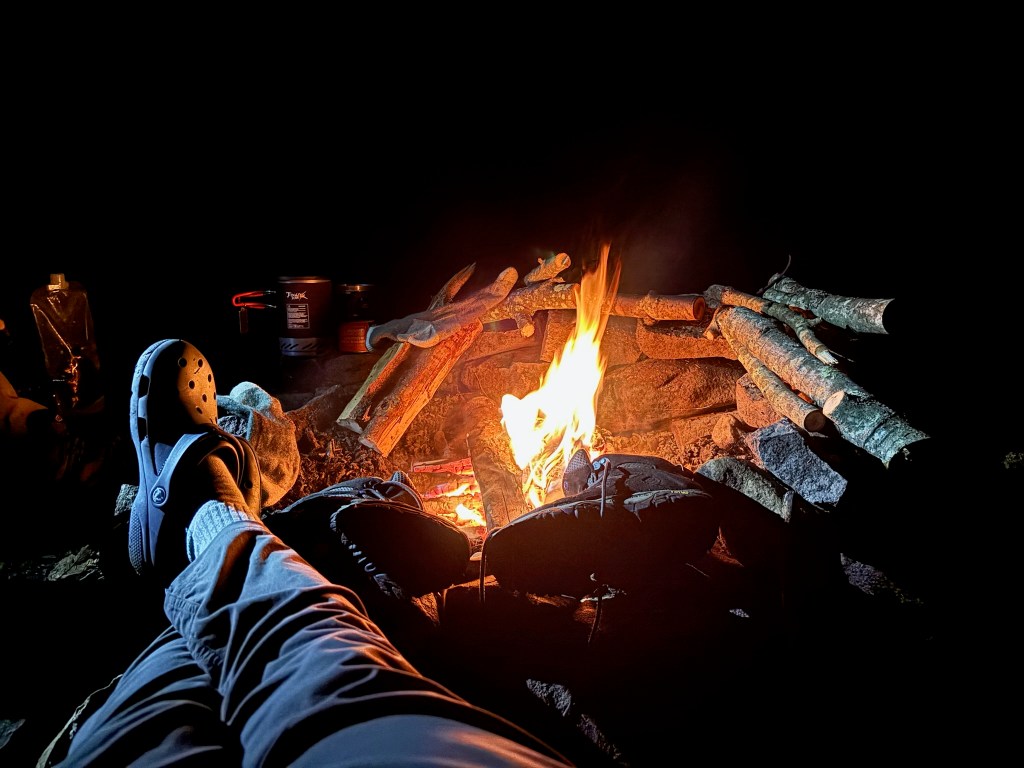
As it got dark, after our dinners of freeze-dried meals, we sat in front of the fire as the temperature was descending, drying boots and socks for the next day.

It got chilly overnight, to about 37 F, so we got the fire going in the morning to keep us warm for breakfast. We then broke camp and headed out for the second day’s hike which would take us close to our starting point then on to the north loop.

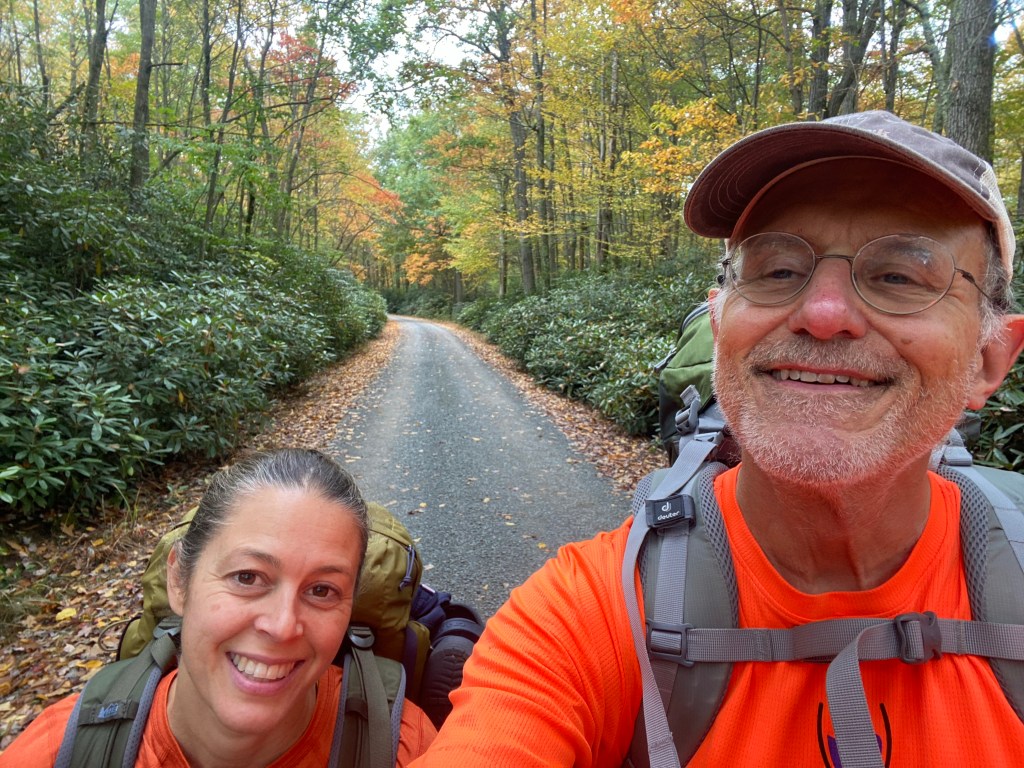
To get to the north loop, we decided to avoid a section called “the swamp”, part of an actual swamp which, given the rain the day before would have been a real trial of mud and muck. Christine hiked through the area previously on a dry day and said it was miserable. We had to take a long bypass around it, adding a mile or so to the hike that day. We also walked along a gravel road lined the whole way with dense rhododendron bushes.

On the north loop, the terrain changed, with narrower trails, more rocks and a change from hardwood trees to a mix with pines. While there are no real vistas, the trails are very well marked and, with the fall colors, very eye-pleasing. Again, we had tunnels of rhododendrons and water under foot.

Our second day hike to our campsite along Painter’s Creek was about 11 miles, due to our diversion around the swamp. Our campsite was a peninsula bordered on three sides by flowing water. The sound from the water was very peaceful. We gathered wood for our campfire, and had to rebuild the fire ring which was not in good shape. One luxury we afforded ourselves, knowing it adds to the weight of the pack, was carrying a beer, which we chilled in the creek and shared sitting in front of the fire.

From a joint effort of New Trail Brewing and Bullfrog Brewing in Williamsport

It got even colder overnight, to 36 F, but we came prepared. The next morning Christine got the fire going again, and we had a hot cup of coffee with breakfast.

On the peninsula

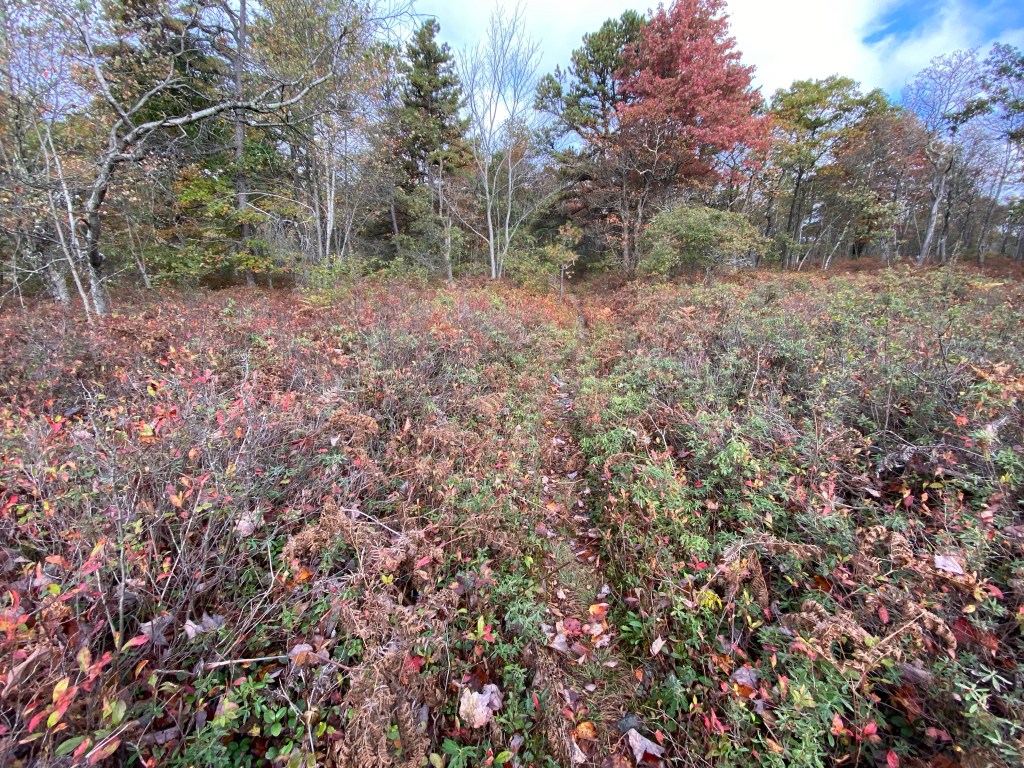
Heading out for the third and last day, our first effort, after breaking camp, was to cross Painter’s Creek. We managed to find some extended tree roots and slightly submerged rocks for footing, so did not need to roll up the pant cuffs and get our boots soaked. The north loop has some long trails with knee-level scrub, lots of rocks, and the width of the trail is about the length of a boot. One of the trail segments was the Sassafras Trail, and sure enough, we found sassafras growing there.

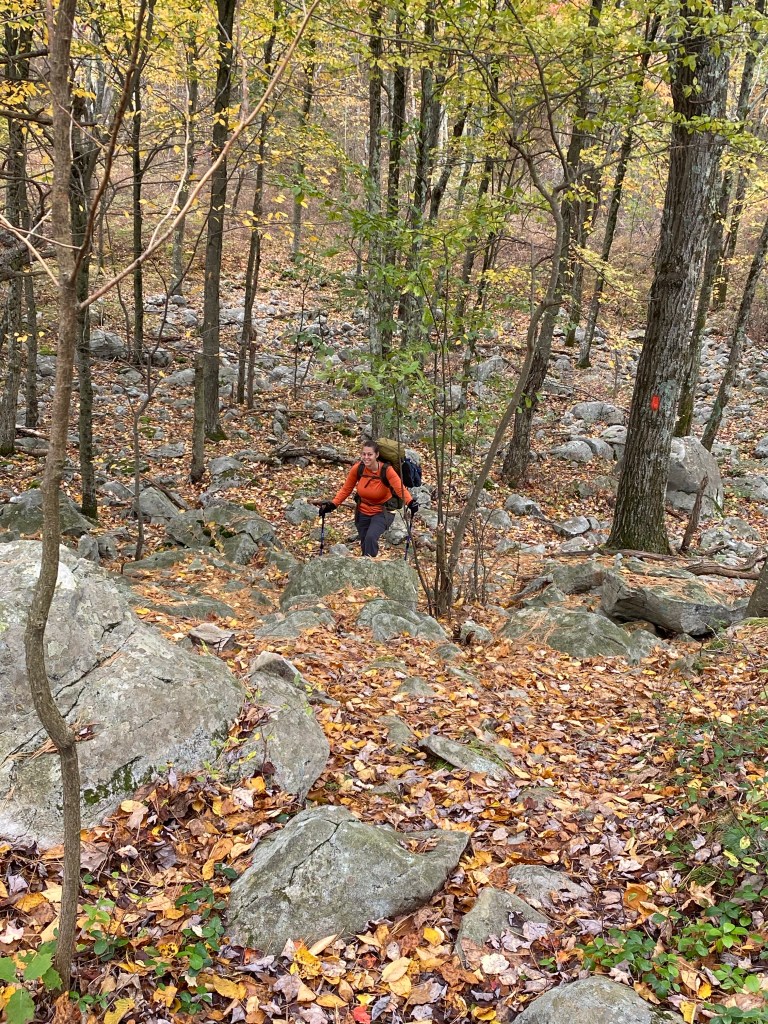
Very narrow trail.

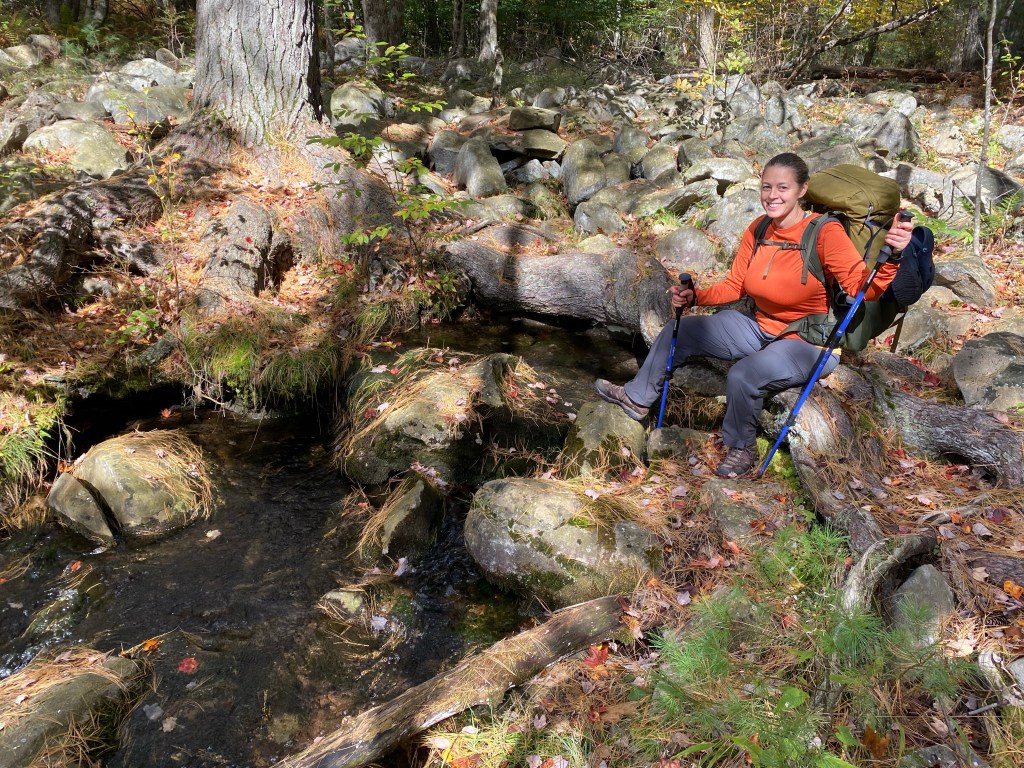
The rocks and boulders made for slow going, but we also came upon spring-fed creeks coming from under the boulders.

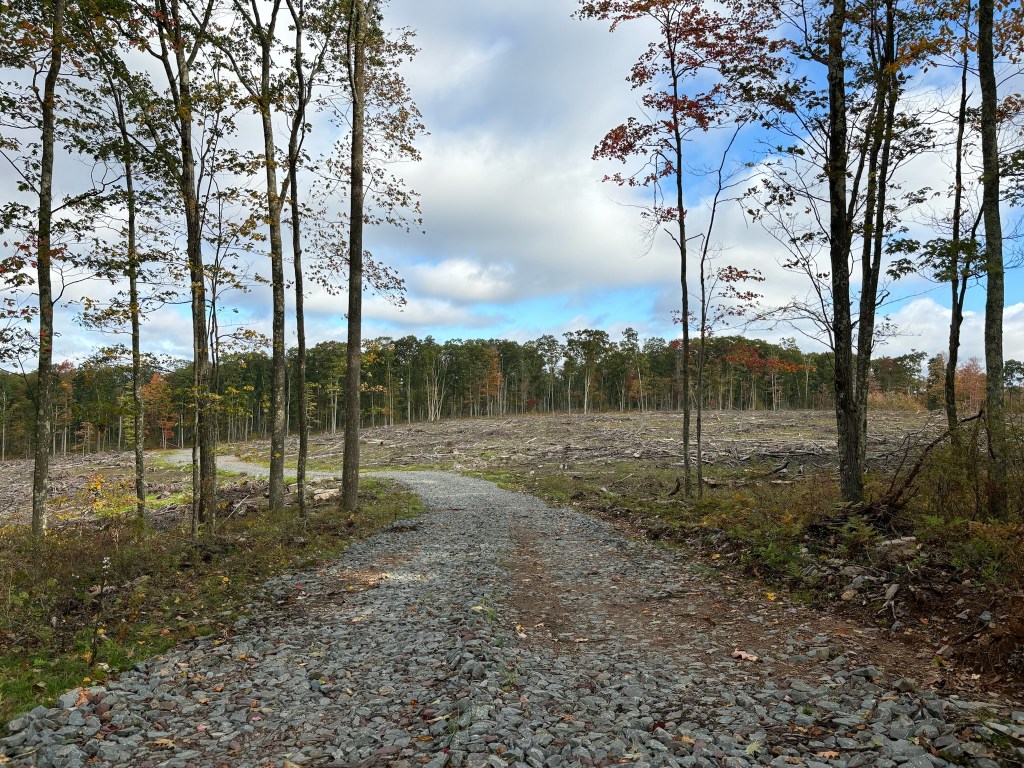
There was some lumber industry activity along the trail, which, according to the Pennsylvania Department of Conservation and Naturall Resources is part of an ongoing plan for management of the Pinchot State Forest.

Clear cut area of forest with a new gravel road.

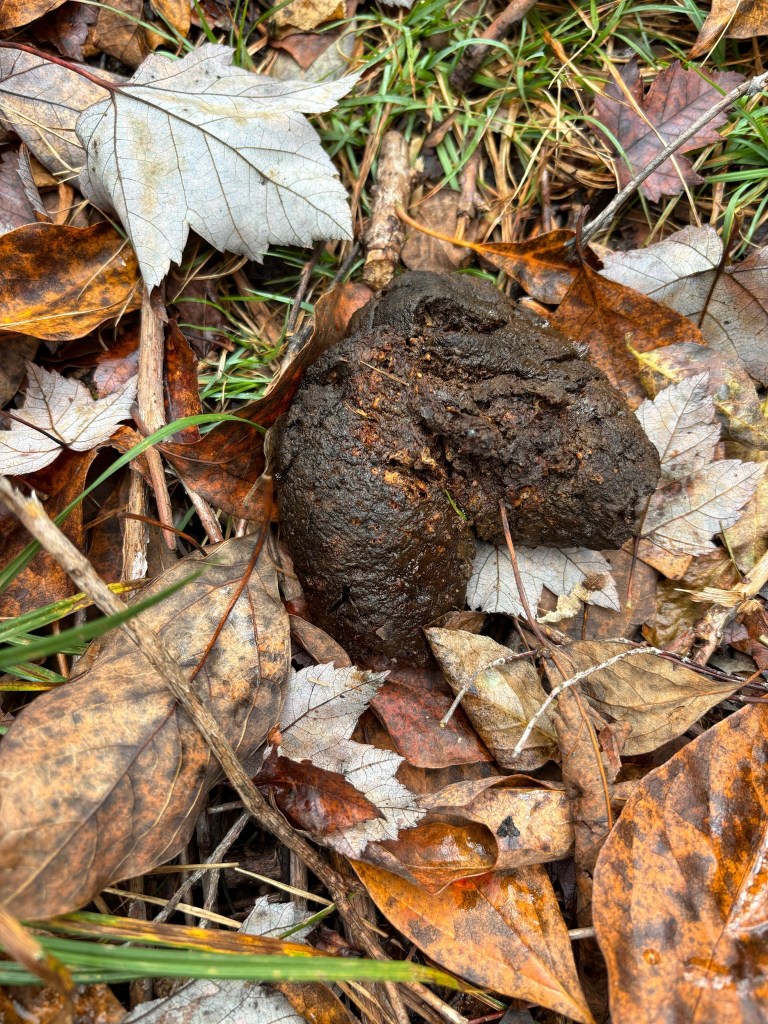
Clambering up some steep bouldered trail was our challenge for the third day’s hike. Along the way, we found some bear scat on the trail, but saw no bears. We also spotted a six point buck who quickly ran off when he saw us looking at him.

Yup, a bear was here.
Steep climb with boulders.

The last day’s hike was about six miles, plus another mile or so on the road to get back to our car. One thing other hikers have mentioned is the number of ticks they picked up going through the narrow trails and scrub brush. At this time of year, though, we got no ticks on us. We came across other backpackers on the trails, but just a few. While this trail gets crowded in the summer, this was an ideal time to hike it.

In the Garden

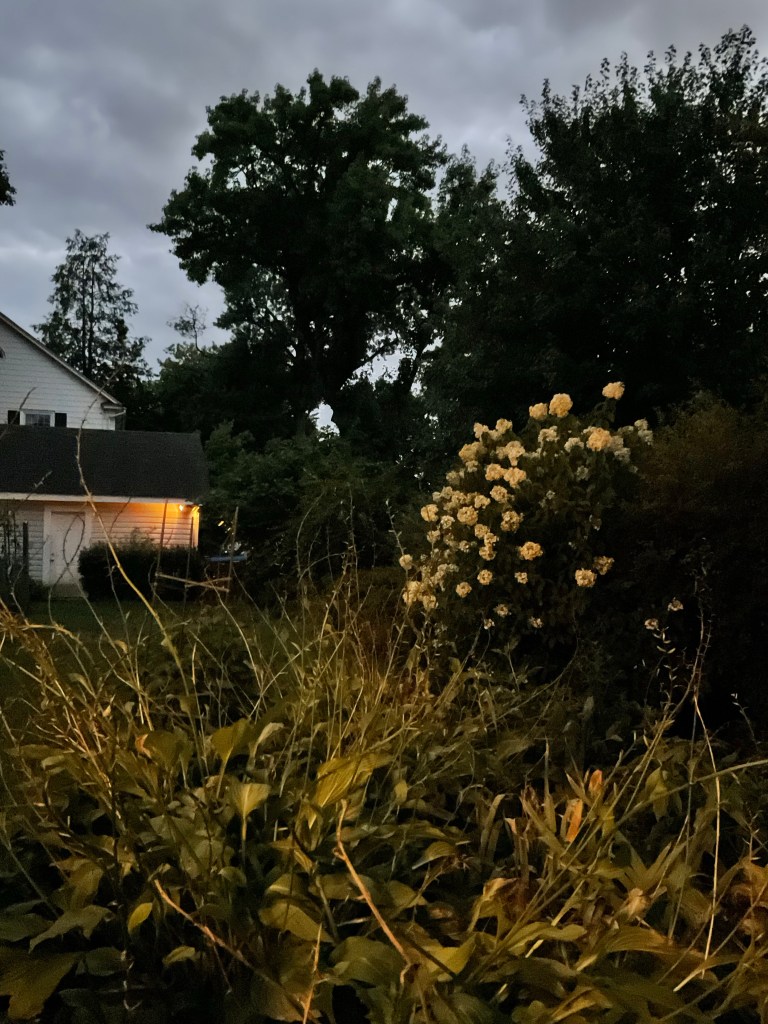
This is a brief ode to sitting in my garden. After a long and very busy day, there is little more satisfying than sitting in my garden. The last bit of light from the setting sun is fading from the sky. The heat of the day is gone, but the humidity stays on. The cicadas loudly vibrate their tymbals, making their familiar droning chorus as they try to draw in a mate. Traffic noises are rare. Although mosquitos are around my insect repellent seems to be working, thankfully. It is peaceful in my garden.

Man vs Nature

A group of my friends and I are heading to the woods soon for three days of backpacking. Conflicts make stories. Classic conflicts are man vs man, man vs himself, and man vs nature. Added to that can also be man vs society. I am referring to people, not a specific sex. I am not anticipating any significant man vs man conflict as we are a group defined by our equanimity. Not to say it couldn’t happen, but I feel confident we can work out any difficulties. Man vs himself is certainly possible. Taking on a rugged hike, setting up a campsite in the woods, one does look inward and face doubts. Age and infirmities take their toll, and a person will wonder if he or she is up to the challenge. Knowing that one has prepared, trained, and come equipped to handle emergencies helps overcome these doubts, yet still there is a fear that must be ignored. To me, man vs nature carries the implication that nature is working to defeat man. However, nature is just there, and man must adapt to it. We have constant natural challenges, but to go hiking in the woods, or take on any adventure means facing sometimes extraordinary and difficult challenges. I can think of many that are specific to backpacking, such as not getting lost, scrambling up and down steep hills with a heavy pack, keeping warm, well hydrated and nourished, avoiding injury, dealing with wild animals, including insects, knowing one’s limits, to name a few. The rewards of taking on these natural challenges are many and they are enriching to the body and spirit. I’m very excited to be going on this trip, and many more in the future.

Fungus Among Us

Fungus is a kingdom, in the biologic sense. Roughly 100,000 species of fungi have been identified, although an estimated 1.5 million species exist. These organisms range from single-celled invaders of the bodies of humans and other animals, such as candida, to massive connected life forms thought to be the largest living things on earth. An example is the Armillaria ostoyae, which covers 3.4 square miles of forest in Oregon, and has been living for more than 2000 years. Fungi are eukaryotic organisms. This means they have a nucleus in each cell which contains their DNA. They are more closely related, genetically, to animals than to plants, and the earliest fungal life arose about 450 million years ago.

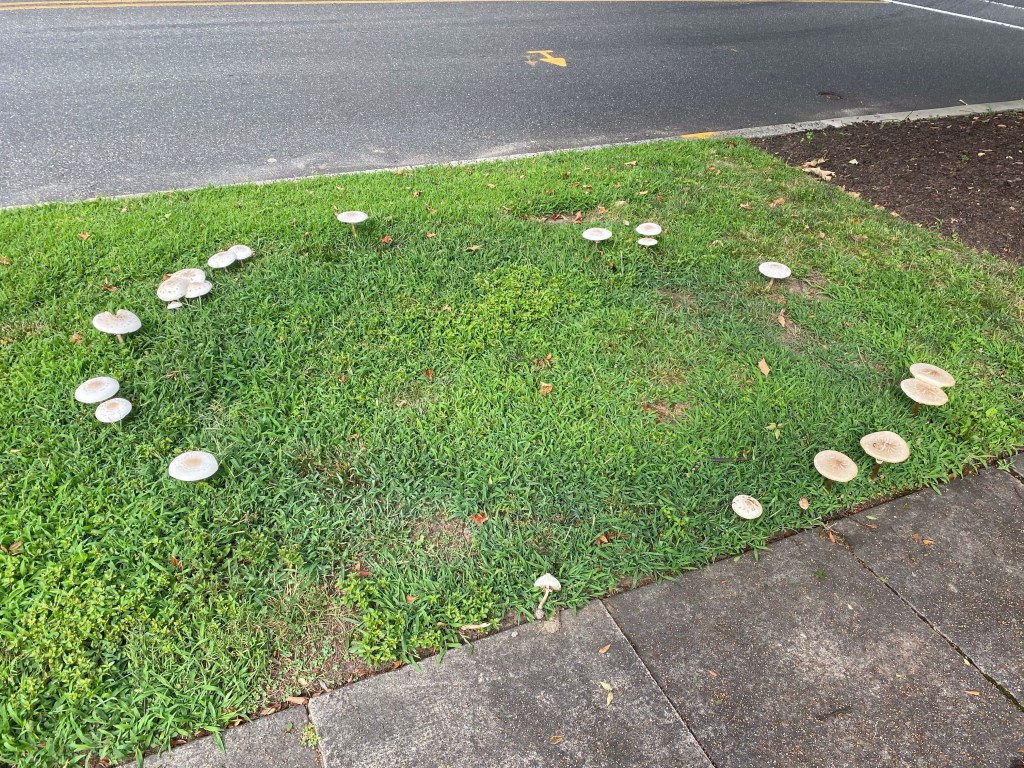
A Fairy Ring

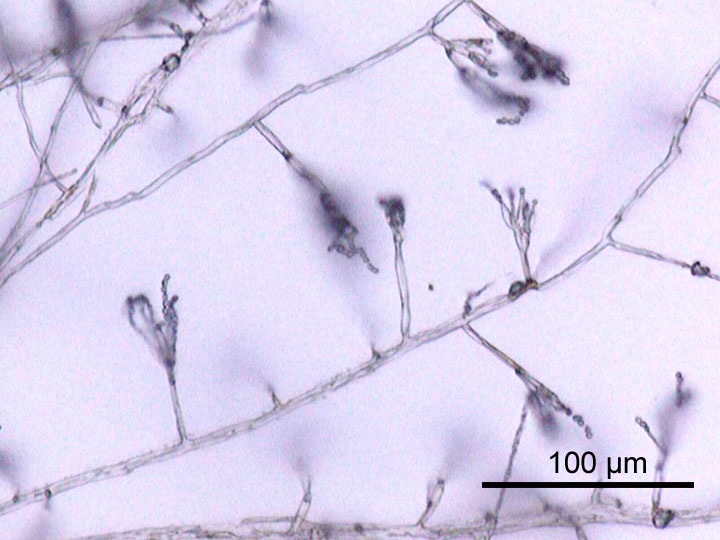
This is a fairy ring. Depending on your culture, it can be evil or good, but evil, witchy or hedonistic elfin seems to win out. If you look carefully, you will notice the darker ring of grass where the mushrooms are popping up. The mycelium, an outward spreading network of hyphae, causes this appearance. Hyphae are the strands of multicellular growth of fungi, in this case, underground, which allow for propagation. Where the mushrooms are popping up, the hyphae are secreting enzymes which digest nutrients outside the hyphae, allowing them to diffuse back into the hyphae and support growth. As part of this, nitrogen compounds are released into the soil for the nourishment of the hyphae, but are also available for grass roots to use, making the grass taller and darker.

Penicillium Hyphae
Y_tambe, CC BY-SA 3.0 http://creativecommons.org/licenses/by-sa/3.0/, via Wikimedia Commons

Not intending to write a treatise on fungus, I want to display some of the amazing forms mushrooms take. Mushrooms are the fruiting bodies of fungi, which spread spores and enable fungi to propagate to new locations. Many are deadly poison to humans, some only a little poisonous and some edible. All, to me, are fascinating.

Trees, Running and Viruses

Trees on the Run

Trees can get sick, too. Since the descent into quarantine, isolation, social distancing, buying weeks’ worth of groceries at a time, and many other anti-communal activities, I have run solo a lot. In doing so, since conversation is limited to my occasional Tourette’s outbreak, I find myself admiring the scenery. Looking at trees along a run, one cannot help but be amazed at the way they grow, spreading branches, leafing out, producing flowers and tons of pollen. Yet they, too, are often victims of infection. Diseases that infect trees include bacteria, mycoplasmas, fungi, viruses, insects and other plants, like mistletoe or ivy. Some of the names of these diseases are whimsical, such as Drippy Nut of of Oak, Crown Gall, and Lucidus Root and Butt Rot. The American Chestnut has been completely wiped out by Chestnut Blight, a fungus. Dutch Elm Disease, another fungus, has killed a large percentage of Elms in the U.S., by obliterating the tree’s vasculature. My purpose here is not to do a treatise on tree diseases, but to appreciate these tall, sappy plants that provide awe and shade as we run.

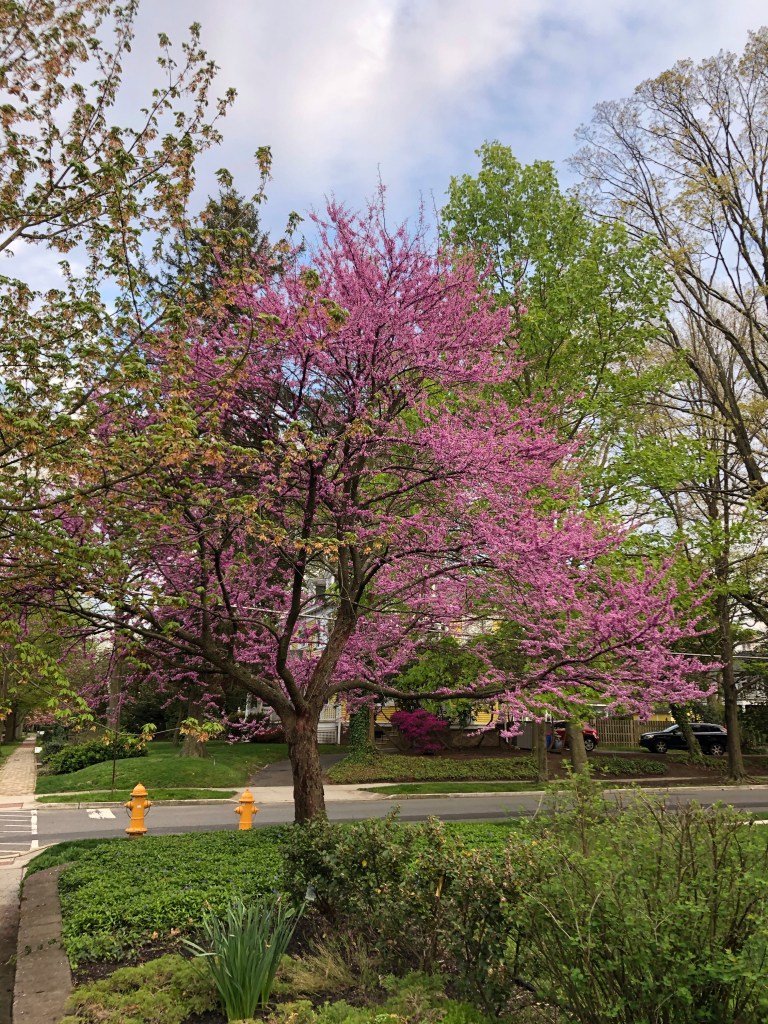
Redbud in Bloom

Trees have nowhere to go, nowhere to hide. But they have developed amazing defenses against nature’s tree enemies, allowing them to survive, some for centuries.

Sugar Maple leafing out, with a fig just beginning to leaf out in the foreground.

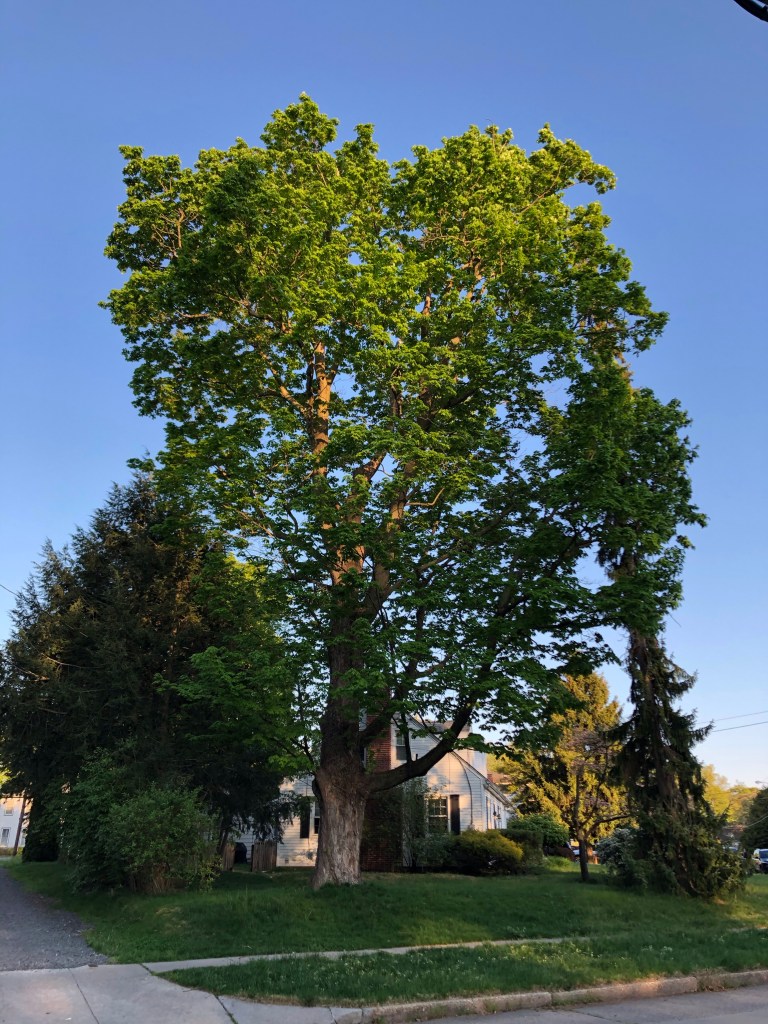
Some can be old and massive.

On Bancroft School Grounds, Haddonfield, New Jersey.
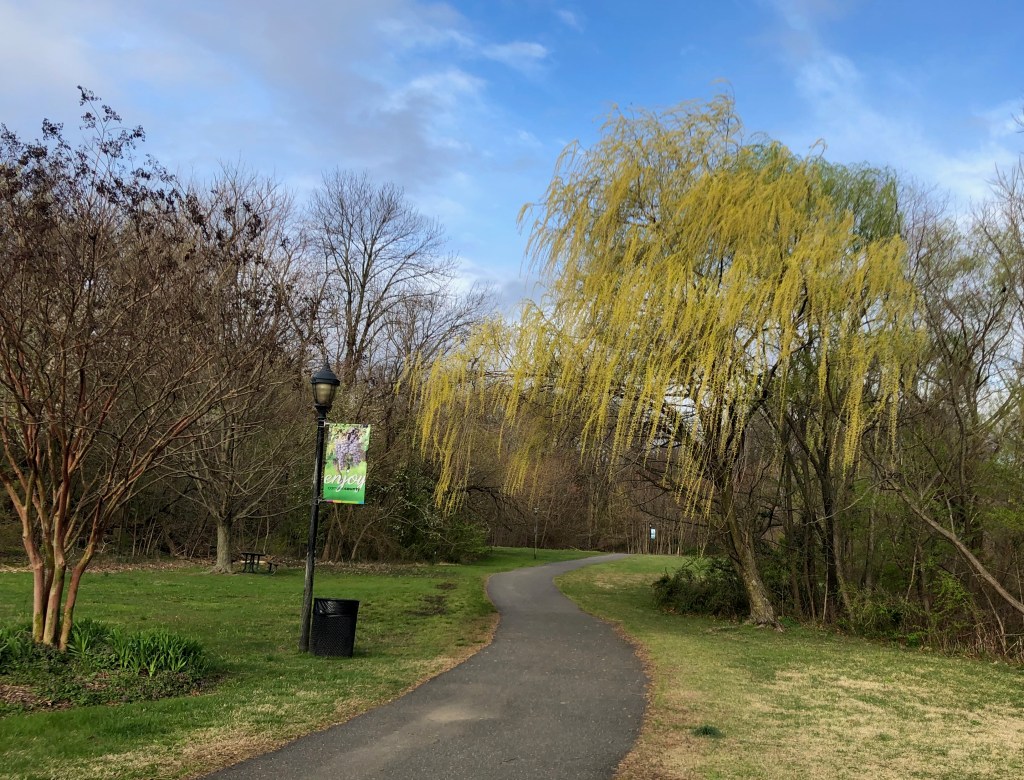
Some get modified to fit our environment, and manage to thrive.
Some modify themselves. Here the trees are reaching for sunshine.
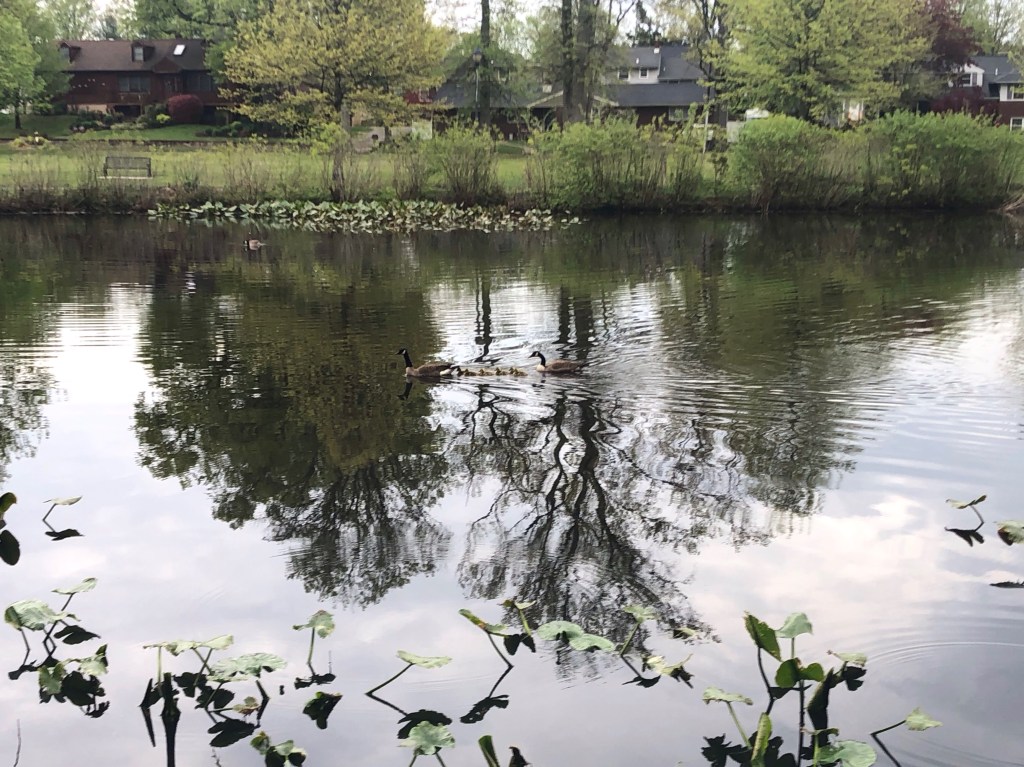
Reflected trees with a family of geese, goose, gander and goslings, in Newton Lake Park.
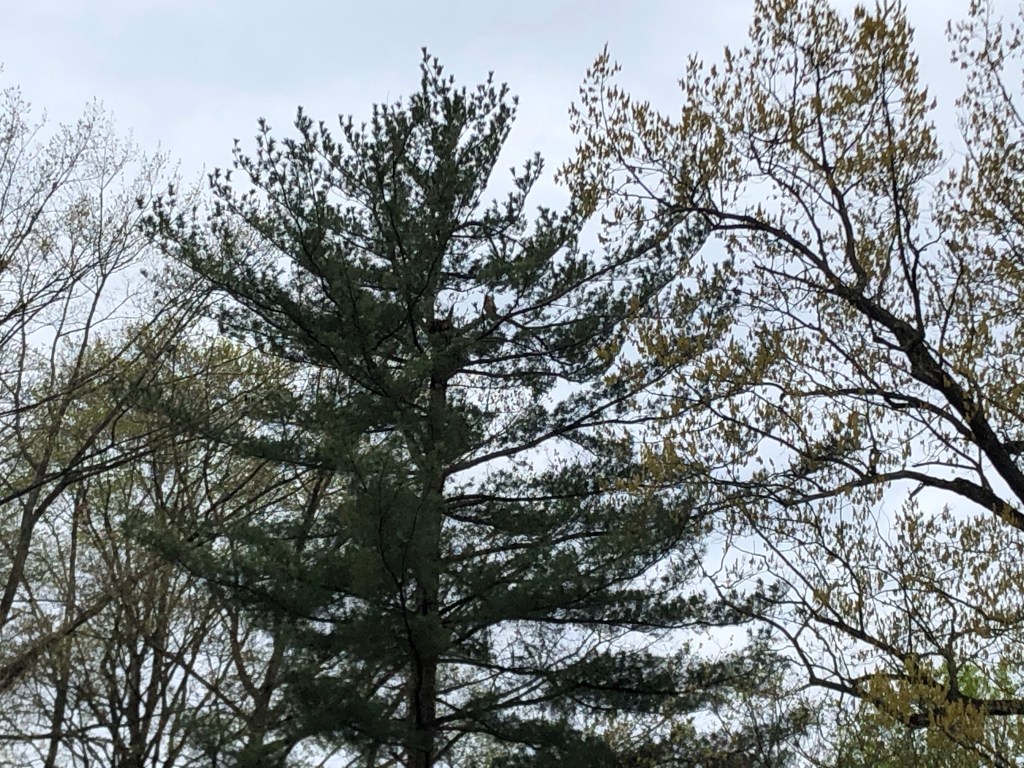
Some are home to birds; see the horned owl?
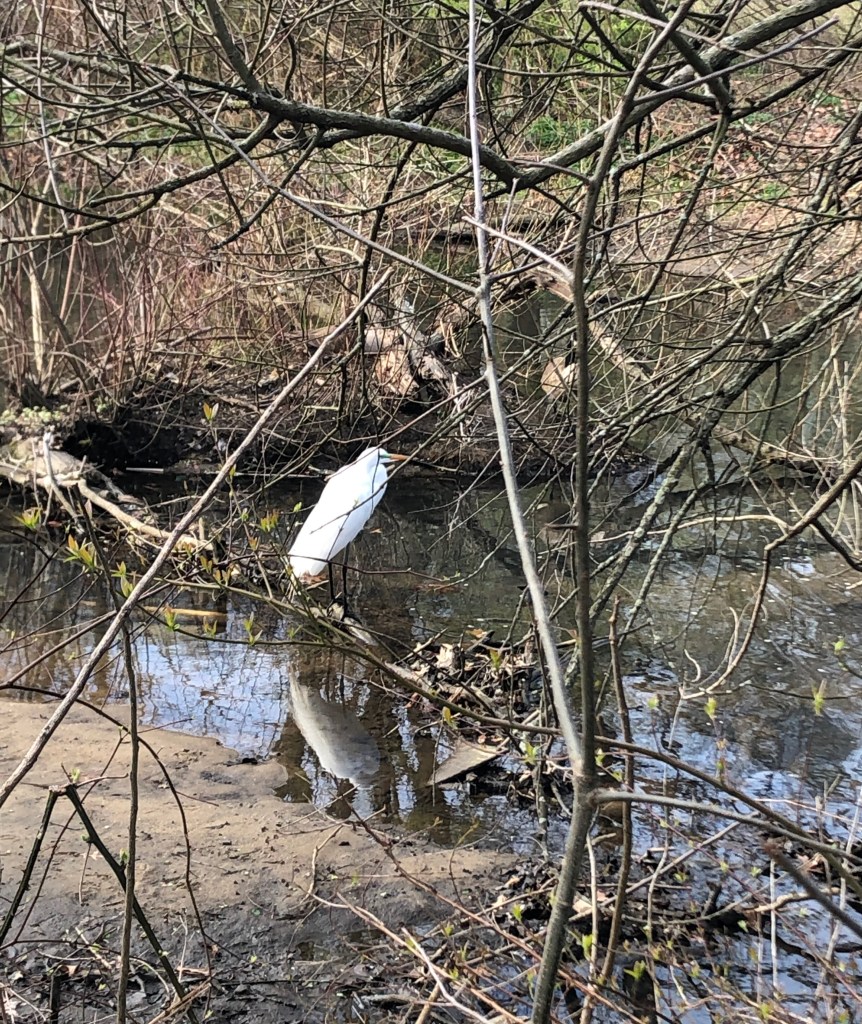
Or provide an egret a roost.
Not all trees have green leaves.
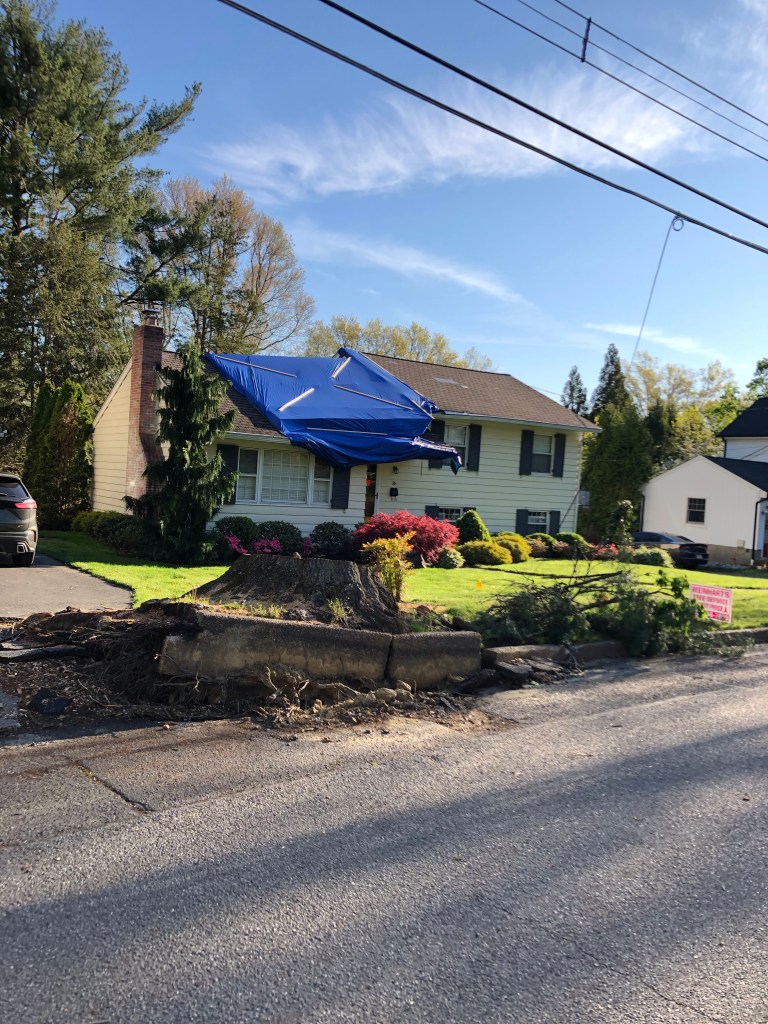
A domesticated tree turned wild, uprooting a sidewalk and caving in a roof.
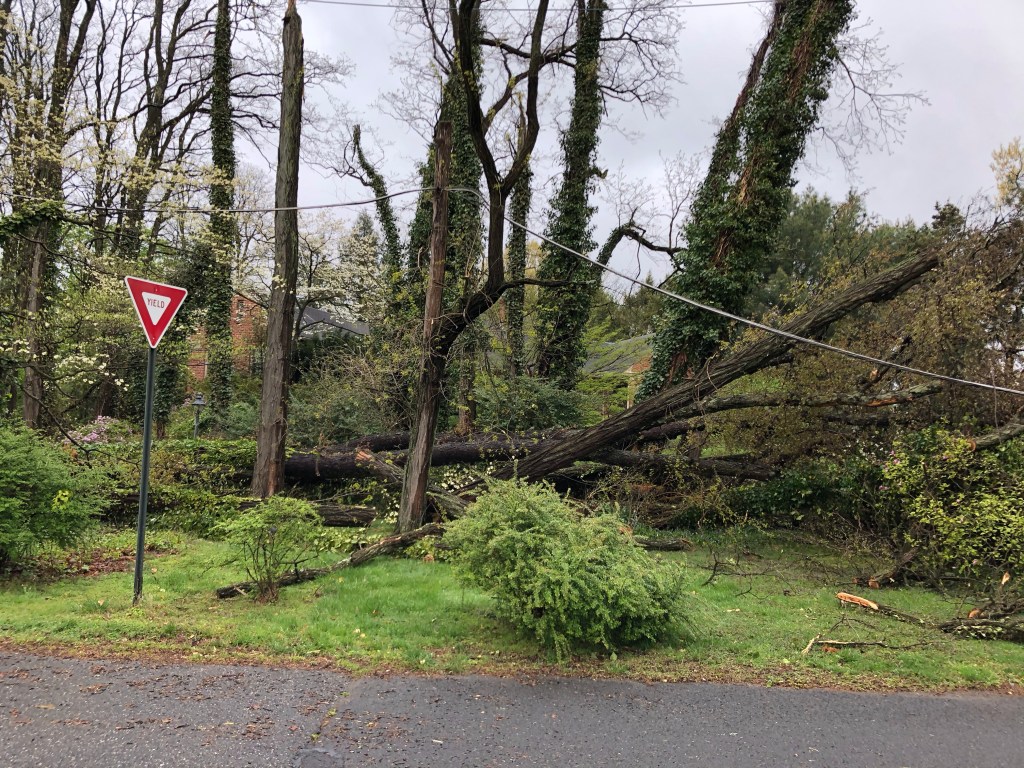
The same storm took down many trees in our neighborhood.
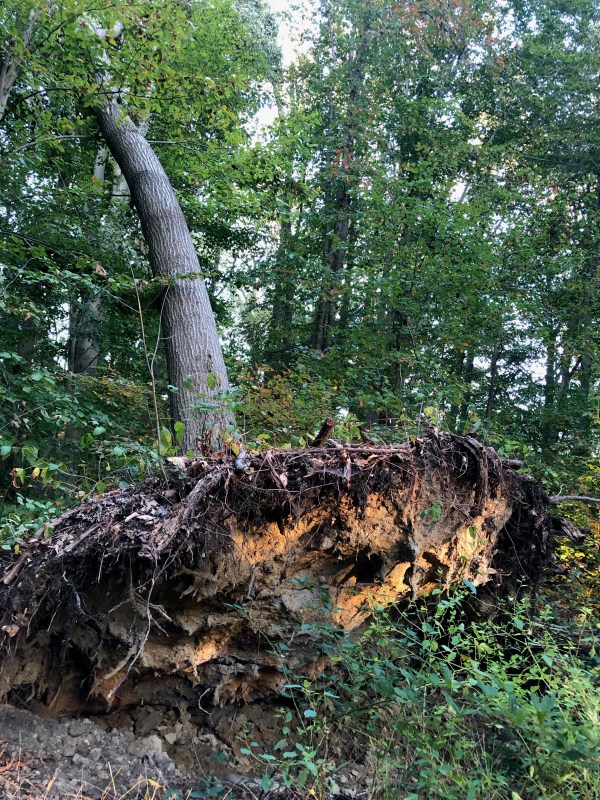
Some just collapse. Perhaps this was a sick tree that died.
Trees grow where they’re planted, and some, like this one, are awe inspiring.
The ducks and I share the path.

Admiring the trees, their hardiness, beauty, longevity, and variety are inspiring as I run alone, waiting for Covid to be gone.

Running in the time of Covid

East side entrance to Newton Lake Park, Collingswood, NJ

We’ve been encouraged to continue to exercise in this time of Covid. For a runner, it means getting outdoors and running familiar routes, but staying clear of others out on the trail. I’m fortunate to have some rather beautiful parks to run in, and thankfully they have not been closed. What I’m finding, is that, for the most part, walkers, strollers, families with baby carriages, and other runners are definitely aware of the rules of separation, and are complying with them. As I approach a person or group, we give each other wide berths, more than six feet, and continue on our way. While I am a strong proponent of wearing a mask while in public, one just cannot do that and still run. Plus, the mask would soon get wet with the humidity of my expired air (perhaps I should have used a different word than expired…). I have seen far fewer people out on the trails than normal, and that, too, helps with social distancing. There is the occasional yahoo who walks right down the middle of the path without a mask and without moving to an appropriate distance. Those I give even more room.

I think the most common person I come across on my runs now is a fellow runner, followed by a dog walker, then a single person walking, then a person or couple pushing a stroller. It must be particularly frightening to be raising a young family at this particular time.

The trees are in bloom, with cherry and pear blossoms everywhere. Other trees are just now starting to leaf out, which of course means a great deal of pollen everywhere. I learned in an obituary today of the death of William Frankland, at age 108, scientist and renowned allergist, who developed the idea of the pollen count, among many other accomplishments. I highly recommend reading the linked obituary, which is very interesting and entertaining. Pollen makes my nose run like crazy, and makes me cough when I finish a run. It makes me a bit of a pariah today. Fortunately, my wife is aware of this and does not get scared.

In the course of my run I came across this beautiful egret in the bushes.

Egret in Newton Lake Park, with a nice reflection in the water. There is also a goose in the photo. Can you spot him?

Today, these plants bursting from the ground had a paleo-biological look to them, in the wet runoff leading to Hopkins Pond.

Plant life in early spring, Hopkins Pond, Haddonfield, NJ

Now for the reward. Running has its benefits, good health, cardiovascular fitness, the opportunity (when this is all over) to participate in races, but one of great importance is breakfast. After I ran this morning I treated myself to pancakes, made from Gormly’s Buttermilk Pancake mix, and, of course, some Vermont maple syrup.

A good friend of mine, Simon, who lives in London, contracted what is probably Covid, although he was not tested, just told to hole up in his flat until he got better. After being inside for more than two weeks, and suffering a lot, he took a walk along the Thames today in the sunshine and said it felt great to be outdoors. A bit of good news, to counteract the really bad news we’ve been inundated with.

Autumn Run in the Evening

One of the most pleasant times to run is as the sun is setting on a cool autumn day.  This evening was just such a run.

The first stretch takes me through Saddler’s Woods.  This is a 25 acre square of old growth trees right in the middle of a well-developed suburban area.  It has a fascinating history.  Joshua Saddler was an escaped slave from Maryland, who was sheltered here by a Quaker family.  They bought his freedom, and he established a small farm, ultimately repaying the cost of his freedom.  The tract called Saddler’s Woods is now a conservatory, dedicated initially by Joshua Saddler as an area where none of his offspring were allowed to cut down any trees.

This giant old tree in Saddler’s Woods was felled by nature.

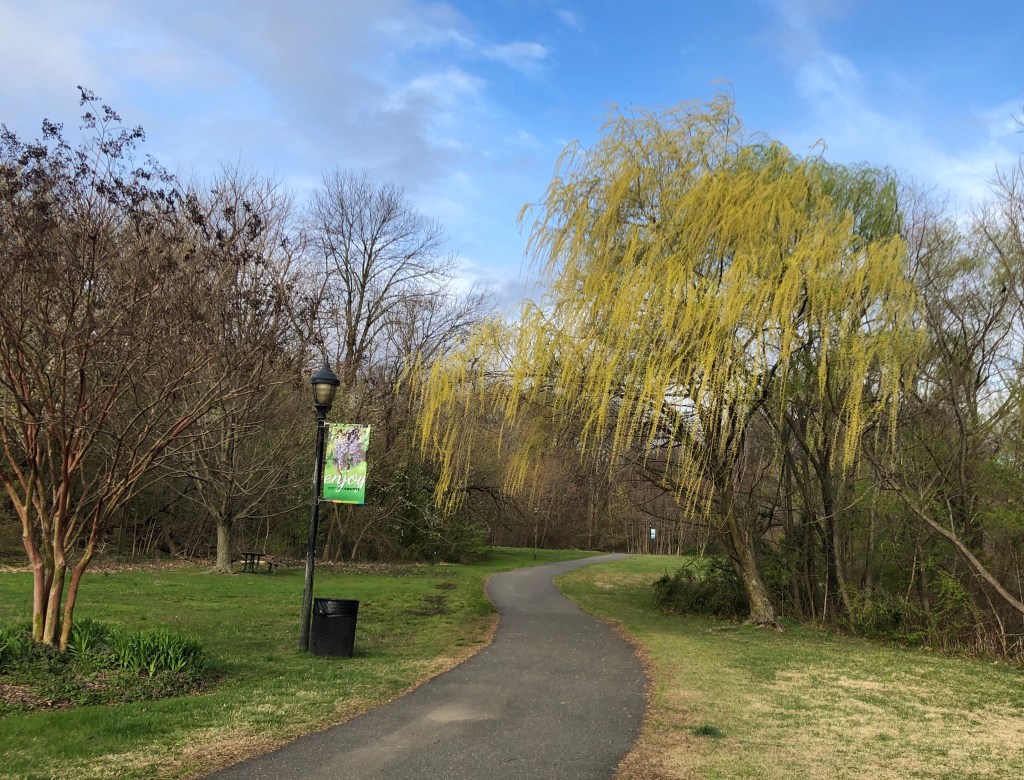
Back on the road, having passed through Saddler’s Woods, I had to cross a busy boulevard to get to the next park.  Newton Lake park is a beautiful chain of lakes bordered by running trails and weeping willow trees.  There are lily pads along the littoral edge, ducks and geese, and the occasional heron or egret can be spotted.  The paths are well-used, as this is a great place to walk, push a baby carriage, run, ride a bike, or throw a ball for a dog.

Fishermen in Newton Lake.

A pleasant aspect of running in autumn, especially in the evening, is that the cicadas are quiet, and the cricket’s songs can be heard.  There are leaves on the ground, and they crunch a bit underfoot.  Other than the padding of my shoes, and the occasional chat of walkers as I pass them, it is pretty quiet along this route.  While I am no fan of the hoards of geese we see in our parks, watching them as the pass with a subtle throbbing noise in their “V” formation and alight on the water is a beautiful sight.

Geese in the distance, lily pads.

When I got a little past three miles into my run, I turned and headed back along the opposite side of the lake.  Getting close to the end of the path I could see a three-quarter moon rising.

Heading back towards the east, as the moon rises.

I got my six miles in, but a lot more, having enjoyed the run tremendously.


Uncorking Croatia

The Blog of WINES OF CROATIA

RunnersOnTheGo.com

To help enrich the lives of others, we developed RunnersOnTheGo.com to help runners save money on races, running stores, and much more. We also provide the specific local information that makes your travel for business, vacation, or racing as rewarding as possible.

getsetandgo

Travel Blog of a Budget Traveler sharing stories on travel, books & Vegetarian Food

Marc Hemingway

Trying to keep track of my life (and my life on track)

Mid-Life, Mid-Level, Masters Running

Exploring ideas about running to contribute to a more enjoyable pursuit for the mid-level masters runner

therunningtherapist

"One foot in front of the other and one thought at a time"

WordPress.com News

The latest news on WordPress.com and the WordPress community.

retireediary

The Diary of a Retiree