Hiking the West Rim Trail, Tioga State Forest, PA

Pine Creek Gorge

This trail, along what is known as the Grand Canyon of Pennsylvania, or the Pine Creek Gorge, is a 30.5 mile trail known among backpackers as one of the best hiking trails in Pennsylvania. Pine Creek Gorge is a unique formation, formed recently in geological time. Pine Creek had a north-east course until 20,000 years ago when debris from the Laurentide Glacier dammed it up. A lake formed near Ansonia, at the north end of today’s Pine Creek Gorge. As the water overflowed the debris, it drained southward, flowing to the West Fork of the Susquehanna River, and forming the gorge. Early natives of this area used the route of the river for land and water routes, and the surrounding mountains for hunting.
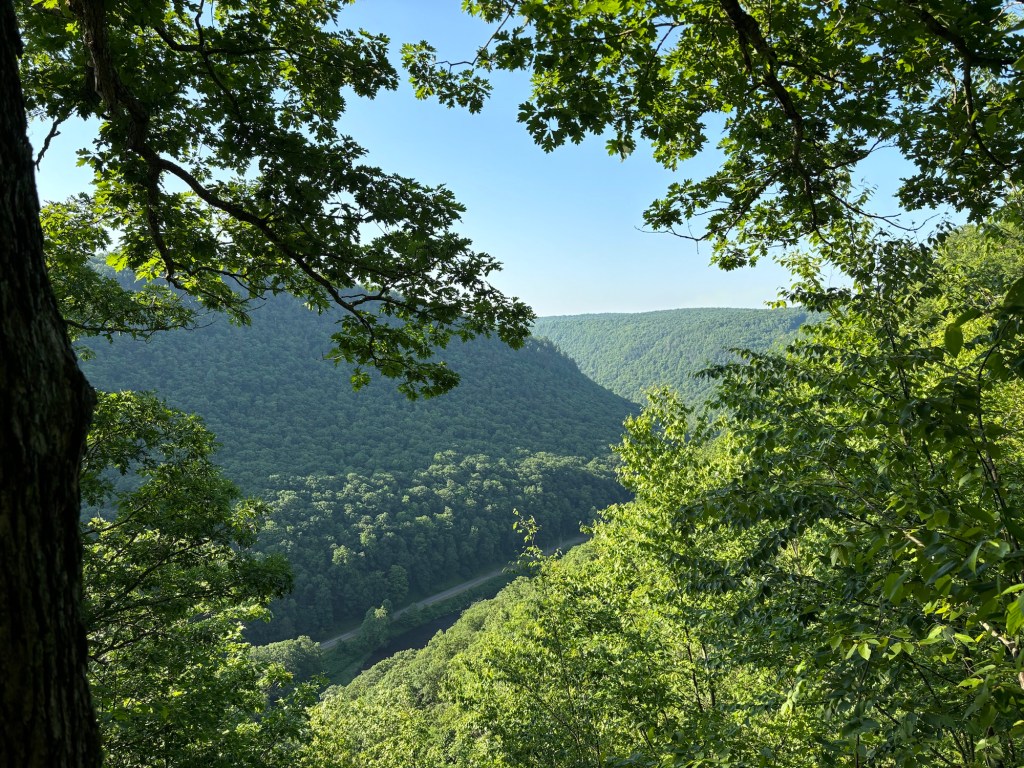
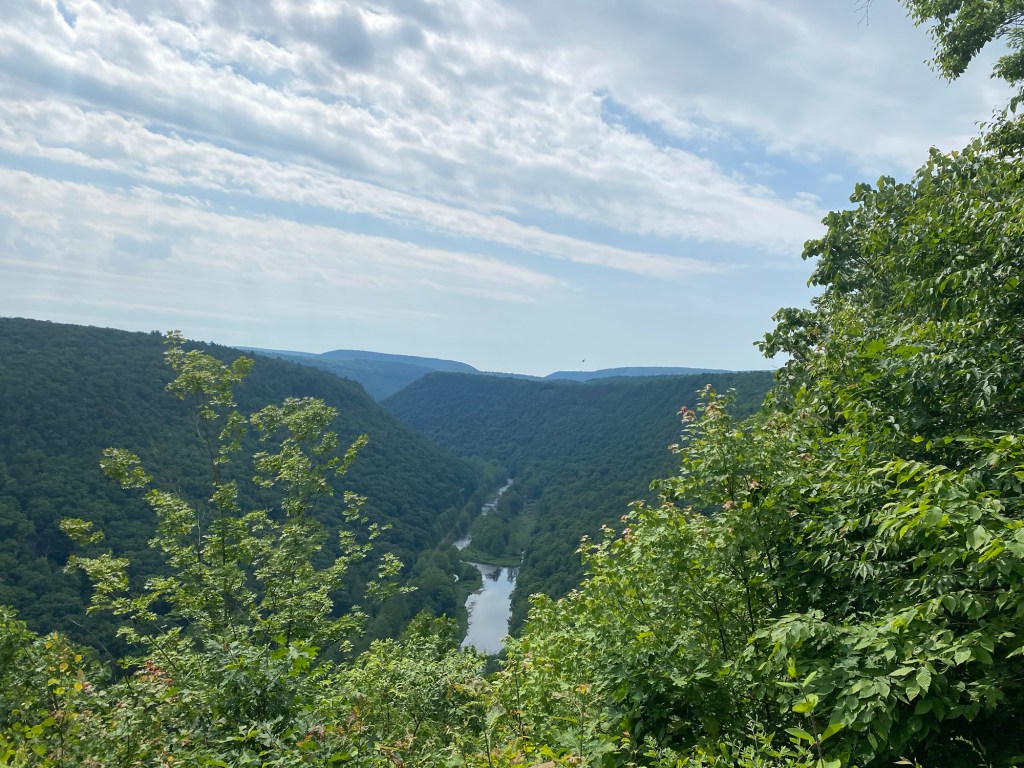
Another view of the gorge from an overlook.

This part of Pennsylvania had forests of eastern hemlock, pine and various tall, straight hardwoods. From the early 19th century to the early 20th century, the trees of this area were harvested for ship building, houses, furniture, shingles, tannins, fuel and myriad other uses. Pine Creek provided the waterway to float the harvested logs down river, past Williamsport and Harrisburg, then on to the Chesapeake Bay and Baltimore. The result of this incredibly rigorous industry was the total stripping bare of the hillsides, leaving tree stumps, dried out tree tops, and dry ground. Fires and floods followed. Wildlife left. Also remaining were rough logging roads no longer needed. These were later used as part of the trail today known as the West Rim Trail. A rail line built in the early 1880’s along Pine Creek, originally part of the Jersey Shore (a town in Pennsylvania), Pine Creek and Buffalo Railway, later called the Pine Creek Railway, transported lumber, coal and passengers along Pine Creek. It made its last run October 7, 1988, as part of Conrail. The track was later removed and the trail became a “rail trail” along Pine Creek now used for cycling.

The recovery of life, flora and fauna, of the mountains of the Pine Creek Gorge began in the 1910’s. It started with mountain laurel and blueberries. Restoration continued with a variety of hemlock, pine and hardwoods. JThe area is now a somewhat protected area as Colton Point State Park, named for Henry Colton, a lumberman from the late 1800’s and the larger Tioga State Forest.

Dynamite shack left from the lumberman days.

I have wanted to do this hike since I first heard of it from a friend at work years ago. Known as the Grand Canyon of Pennsylvania since 1936, when businessmen of Wellsboro started promoting it as a tourist destination, it was recommended to me as an ultimate backpacking experience. With the good company of my backpacking friends, Christine and Michele, we headed up for a planned 3 night 4 day hike on Saturday, June 15, 2024. Many will do this hike in one or two nights, but we wanted to have more time on the trail and in camp, and enjoy our time there.

The northern end of the West Rim Trail, Christine and Michele.

We stopped in Williamsport Saturday night and stayed at the Genetti Hotel. We began that evening at New Trail Brewery, one of the best in Pennsylvania, and had dinner at the Bullfrog Cafe. The next morning, after a fortifying breakfast at the hotel, we drove up to Rattlesnake Rock, for our pick up. We were being picked up by Pine Creek Outfitters and driven to the northern end to start our hike. Our car would be waiting for as at the end of our trek. Of note there is no cell service there.

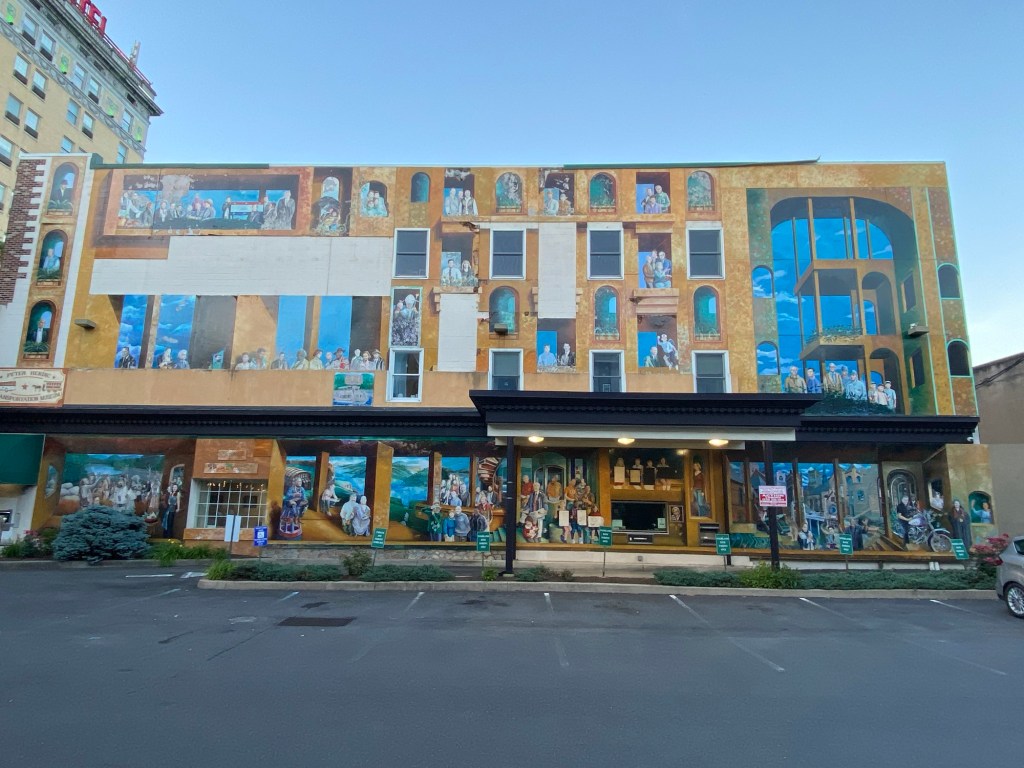
We joined several others in the van, all cycling the path along the river, for our drive north. Our packs were piled in the front passenger side, and we sat together in the second seat, quizzing the driver about the weather. It was predicted we would have a decent first day, then a major heat and humidity bubble would envelope the area the following day. Our driver did not give us the answer we wanted. He said being up on the trail would not be much different than the weather in Ansonia, with highs predicted in the 90’s.

We were dropped off with our packs and poles and the van left. There was nothing to do but get started on the trail and work our way to the end. It is an interesting feeling, knowing you are relying only on yourself and your companions to get to the southern end.
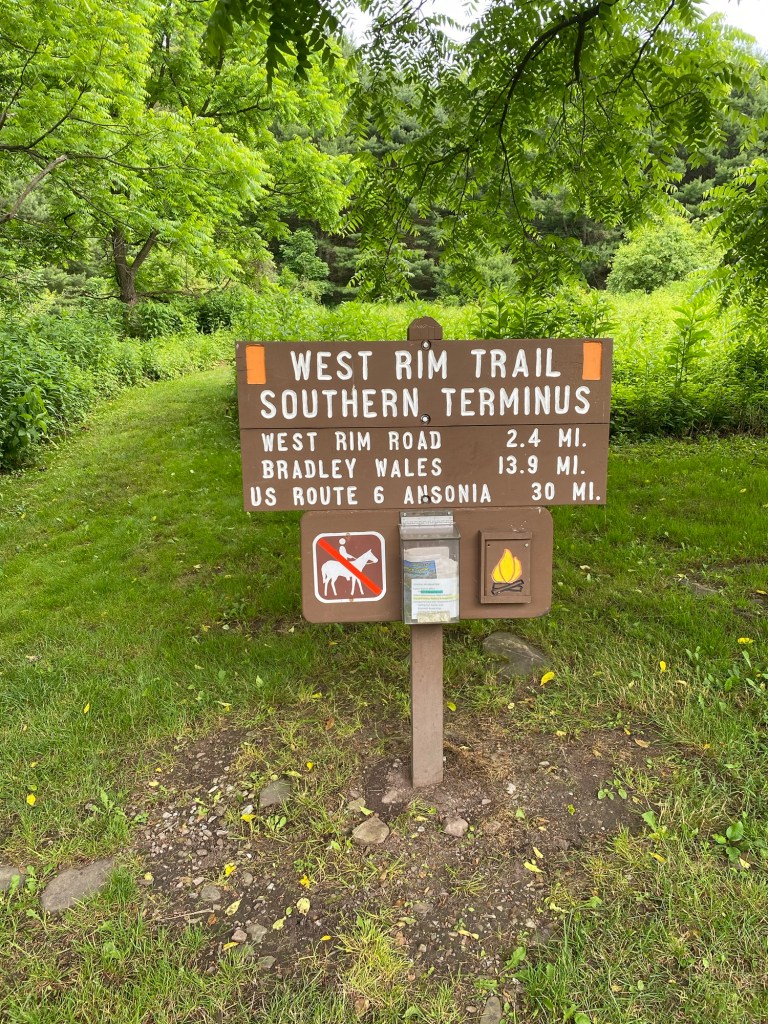
The trail starts with a long uphill trek to the rim of the gorge. It is close to 900 feet up. Once up to the rim, the trail goes up and down, and weaves along and away from the rim. At times the trail skirts the margins of the rim, providing occasional spectacular views of the gorge, but also plummeting drops on one side of a rocky and narrow trail.

For our first night, we stopped at a campsite near the rim at the 11 mile mark. It was a nice campsite, but had no water close by, so we needed to pack in water.

Porcupine visited us the first morning. He was munching on carrot sticks inadvertently left out of our bear bag.

The next day got very warm and humid. We skipped our usual morning campfire and got on the trail fairly early to try to get to camp before it got too hot. Our trail map, which we purchased from Into the Backcountry, was very helpful in pointing out campsites, reliable water sources and seasonal water sources. Since we saw that some of the seasonal water sources had dried up, we needed to plan the route carefully. Due to extreme heat and humidity, we would need to adjust for water availability. So, our second day, while only 7 miles, seemed very tough and we were grateful for the trickling stream we found at mile 17. Along the way, we stopped at the Bradley Wales picnic area for a rest and lunch. There was a hand operated water pump there. But a posted sign said it went down 250 feet, and while it would provide water, about 15 minutes of pumping was needed to bring the water up. Since the pump was out in the sun, and the day had gotten quite hot, we skipped trying to get pump water.
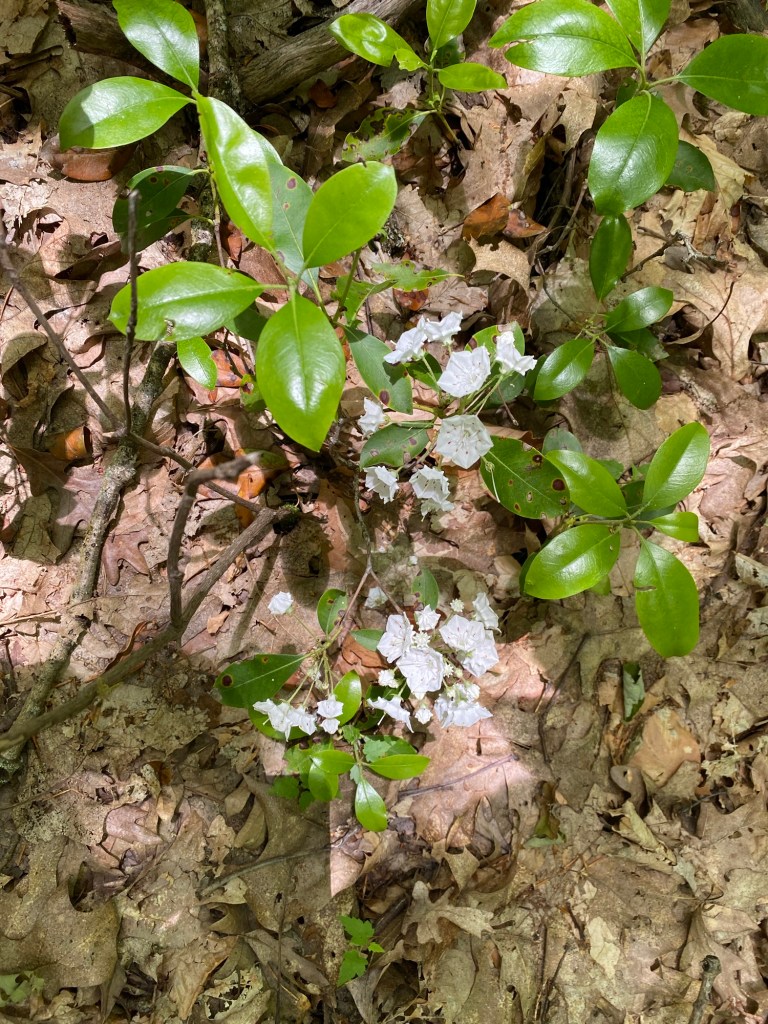
Mountain Laurel, found everywhere on the trail.

We made camp at mile 18, along the trail but only a few hundred yards off a gravel road. It was next to a beaver pond and near a water source on the other side of the road. It was a muggy area, but nice enough. The next leg would take us a long way without reliable water, so we were satisfied. After camp was set up, we started a fire mainly to keep away the gnats and flies. We had dinner, and were relaxing when we started to hear thunder in the distance. Michele’s Garmin InReach Mini 2, gave us a weather report stating the chance of rain was 4% and the expected amount under 0.1”. But the storm clouds were coming for us. Around 9:30 some drops were falling. We closed up our food supplies, hung our bear bag and got in our tents. By 10:00, a violent thunderstorm was passing directly over us, with heavy rain and no time between brilliant cracks of lightning and explosive thunderclaps. The rain seemed to ease up in a half hour, only to get heavy again, with more lightning very close by. We checked with each other to be sure we were all okay. The storm passed us for good by around midnight. Early the next morning we were up, our tents standing us in good stead.

The work of a beaver.

Our next day’s plan was to get to a campsite at the 27 mile mark. While again, not long miles, with the heat, humidity and climbing, we figured it would be a challenge. We loaded up with water, filling our drinking bottles and also carrying an extra liter of water each in a dirty water bag, to be filtered along the way. Michele and Christine allowed me more frequent breaks than they needed, as I was sweating a lot and getting fatigued on the climbs. As it turned out, a couple of seasonal water sources were flowing with sparkling, cold, clear water. We happily stopped, filtered some more and headed on.
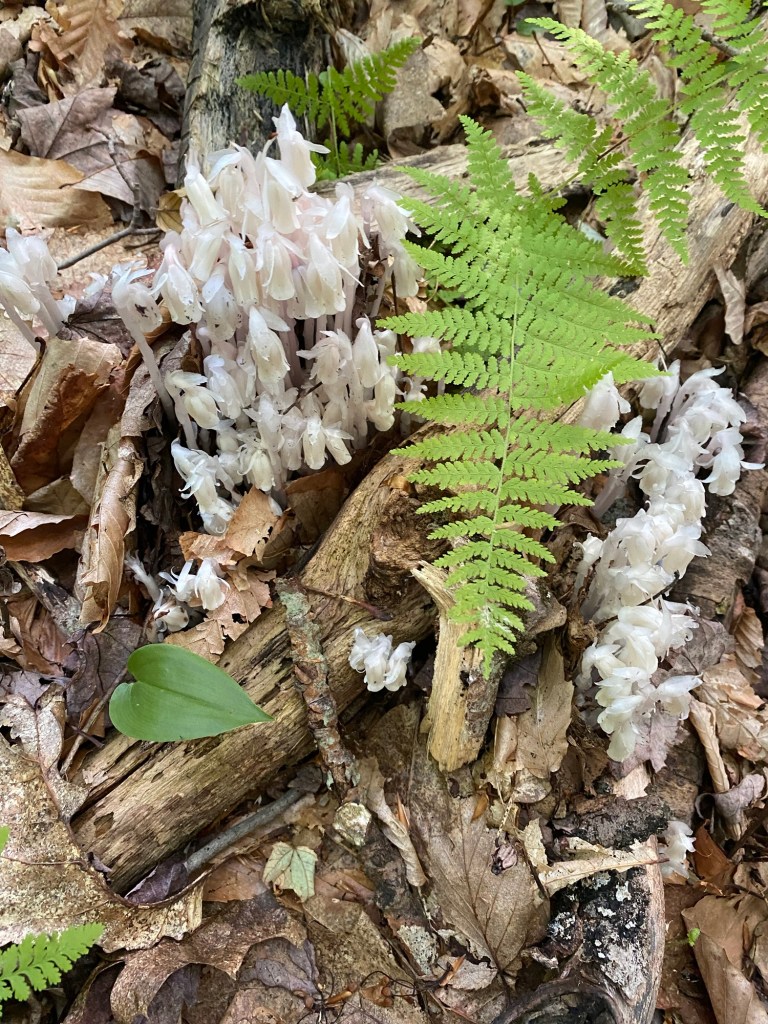
Photo from Michele. These are called “ghost plants”. They opportunistically come up like this when conditions are right (see the link).

The trail varies from narrow, rocky, challenging paths, to long stretches through heavy growths of fern and stinging nettle. We had on long pants to keep the nettle from irritating us. I happened to have a brush of it on my lips and tongue. This caused about 15-20 minutes of numbness and tingling of these parts. It was an interesting experiment, though not on purpose.
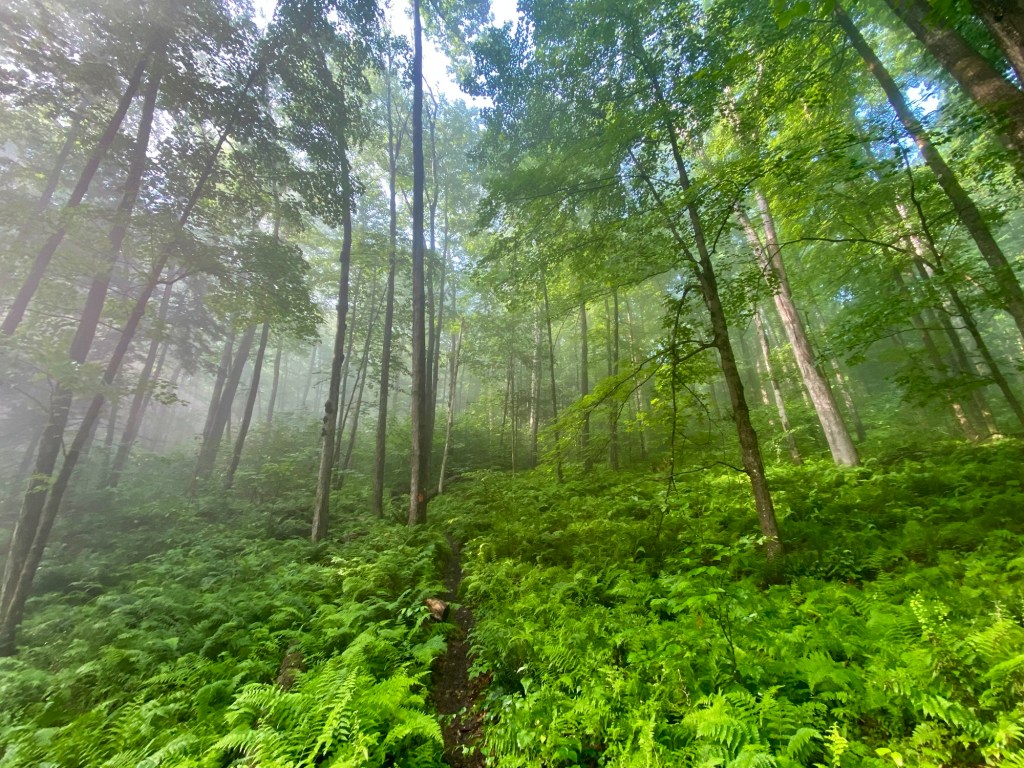
Narrow trail through ferns and stinging nettle, in the early morning haze.

Christine was picturing our next campsite to be the best of all, good fire ring, running stream in which we could cool off plus have the pleasant sound of running water as we slept. While I was skeptical, she pretty much got what she was hoping for. At mile 26.5 a stream flows down through a side canyon, creating a little pool near the campsite. After setting up camp, we stripped to essentials and one by one got into the little pool to wash away the accumulated sweat and grime. It was very refreshing. Christine brought the instant ingredients for rice, bean and vegetable burritos which we had for dinner. We had cooled cans of beer in the creek. So, at Bohen Run we had a bath, burritos, beer and a babbling brook. Bliss!
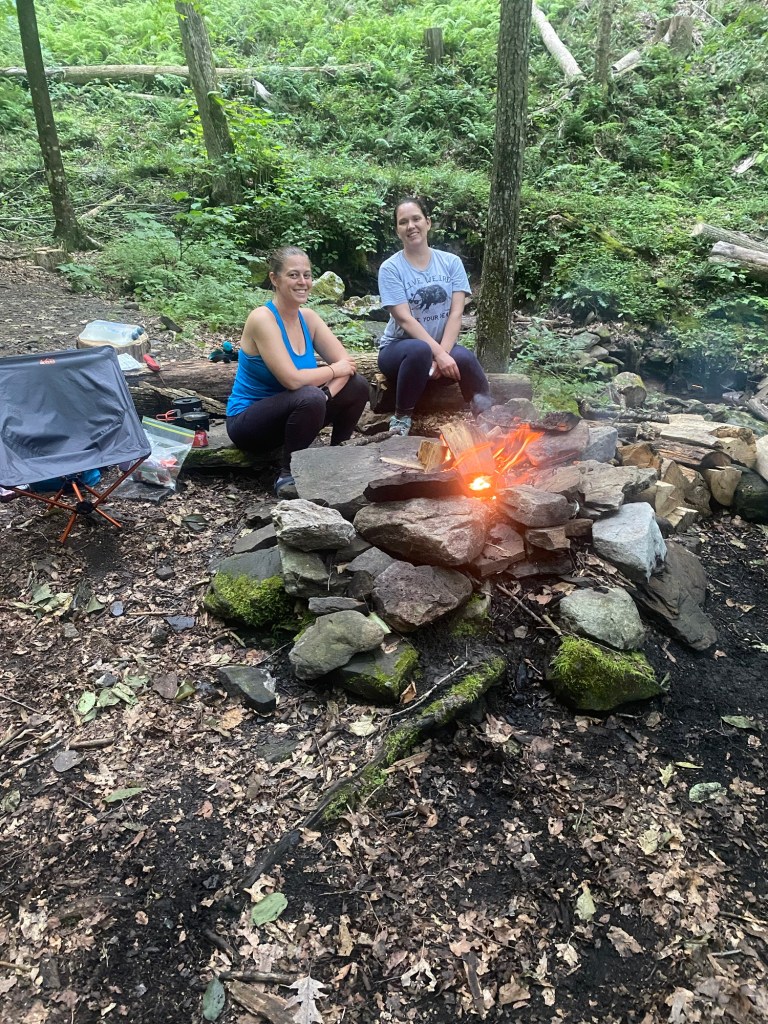
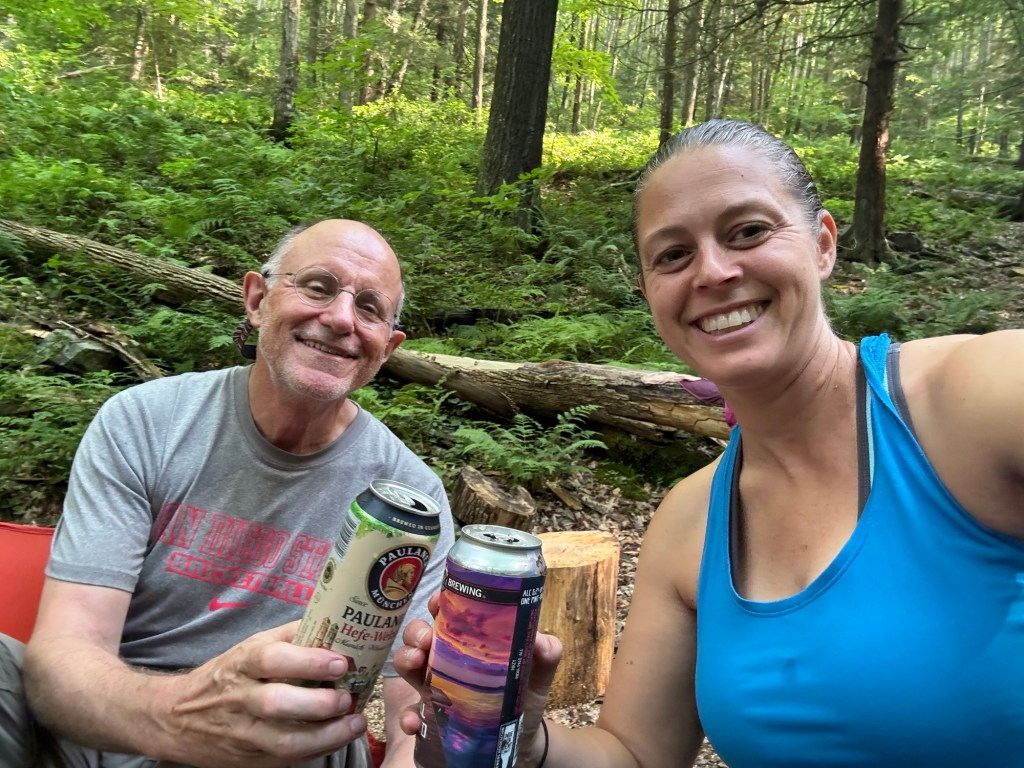
The last night in camp. Christine and Michele.

The last day was our short hike day. Knowing well that other backpackers would not want to take 4 days and 3 nights to complete this hike, our desire was to camp 3 nights and get a good feel for the trail and its history. The last 4 miles were relatively easy, 1.5 miles uphill, 1 mile flat and 1.5 miles down about 900 feet to Rattlesnake Rock, southern terminus of the trail and where our car was parked. We arrived a bit bedraggled but in good spirits. And, as we end all our backpacking trips, we headed to Taco Bell to satisfy a hunger craving.

While this is an iconic trail, and well worth the trip, I probably would not go back and repeat it for a while. The scenic views were nice, but many were obscured by overgrown brush. Hiking along a very narrow trail with a steep drop on one side is challenging, but means one is always looking down rather than being able to glance at the scenery. The heat and humidity, and the constant buzzing of gnats around my ears and eyes influenced my opinion, I’m sure. So maybe if a friend were to say they were doing this hike in April or May, want to join me, I’d likely say yes.

Sources used for history and trail descriptions:

https://trails.dcnr.pa.gov/trails/trail/trailview?trailkey=215

https://en.wikipedia.org/wiki/Pine_Creek_Gorge

https://www.dcnr.pa.gov/StateForests/FindAForest/Tioga/Pages/Wild_NaturalAreas.aspx
Camping with Moths

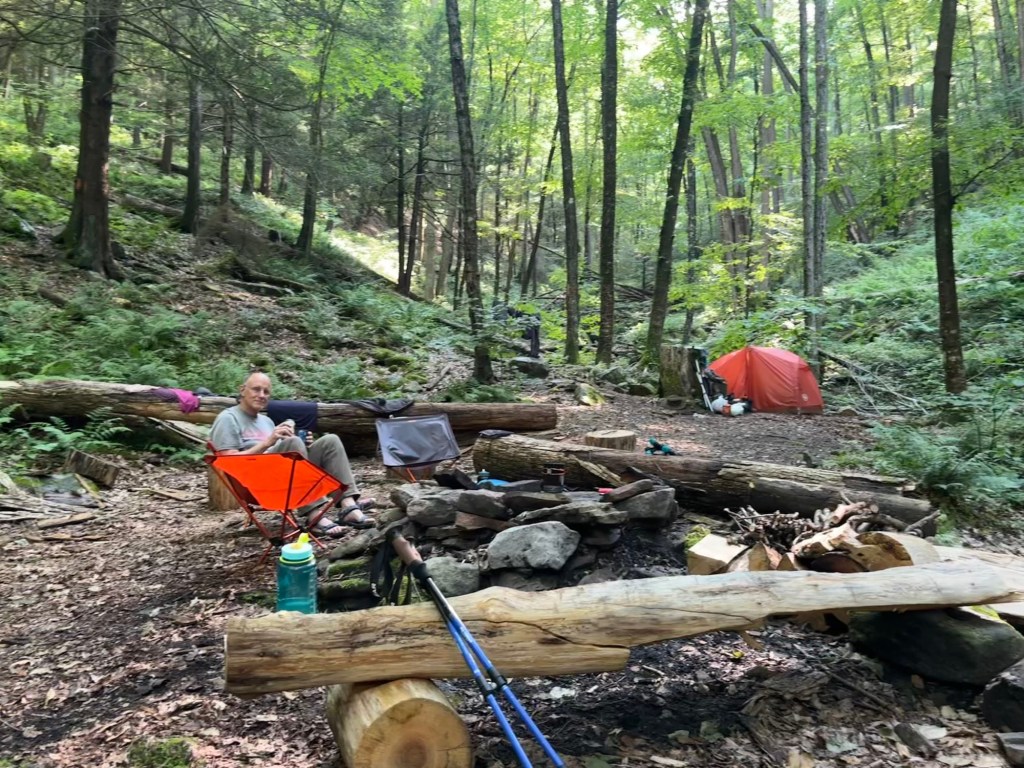
Campsite day 2 on the Old Loggers Path

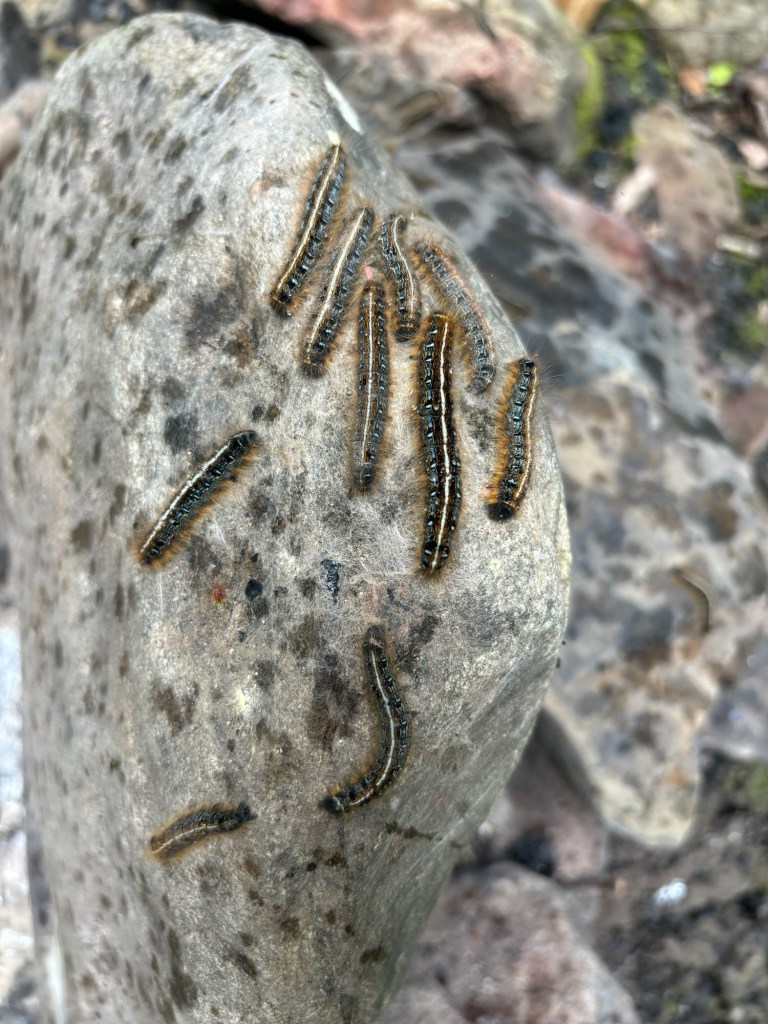
Last weekend my friend Christine, her son Dillon and I backpacked the Old Loggers Path in north central Pennsylvania. After our second 12 mile day, we set up camp, cut firewood, filtered water out of the nearby stream, changed hiking boots for comfortable sandals, started a fire and prepared dinner. We went through swarms of gnats while hiking, which is no more than just annoying. At the campsite, caterpillars were all over the fire pit and surroundings. Again, an annoyance but no more.

After brushing them away, they seemed to stay away.

But at night, after the sun set, the moths came out. It seemed about a thousand benign little white-winged moths fluttered around. As you may know, moths are drawn to lights. On bedding down for the night, I had to trick them by leaving my headlamp out of the tent until I got in, zipped up the screen and snatch the headlamp as I closed the zipper. One got in, so I cupped my hand around it and released it into the wild.

But, it is a given that every night at the campsite, usually around 2:30 or 3:00 AM, I will be awakened with a serious need to pee. This not just me. All my backpacking friends have the same experience. I worked my legs out of my sleeping bag, put on my sandals, donned my headlamp, opened the tent zipper and stood up outside. If it was a clear night with a full moon, there would be enough light to walk safely to a spot to pee. Of necessity, though, when it is dark like it was that night, I needed my headlamp on. As I walked an appropriate distance from the tent, closer than ideal for propriety during light hours, but far enough to not pee in camp, the moths started to come at me. As I performed my necessary function, they swarmed around my face, drawn to the light of the headlamp. They flitted and fluttered very close, landing on my forehead, my eyelids and my ears. They stalked my nose and cheeks. Using one hand to direct flow and the other to madly swipe at them, I knew I had to continue until finished, or undoubtedly need to get up again in another hour. Resolved, I stuck it out, and then, relieved, headed back to my tent.

In the morning, the moths were gone, back to wherever they hide out during the day.

Old Loggers Path is a great place to backpack. The trails are well-marked, there are some steep climbs and descents as well as stretches of flat terrain. There are scenic overlooks, some timber rattle snakes, waterfalls, and beautiful mountain streams. We had a very nice hike.

Starting up the fire from embers in the morning.
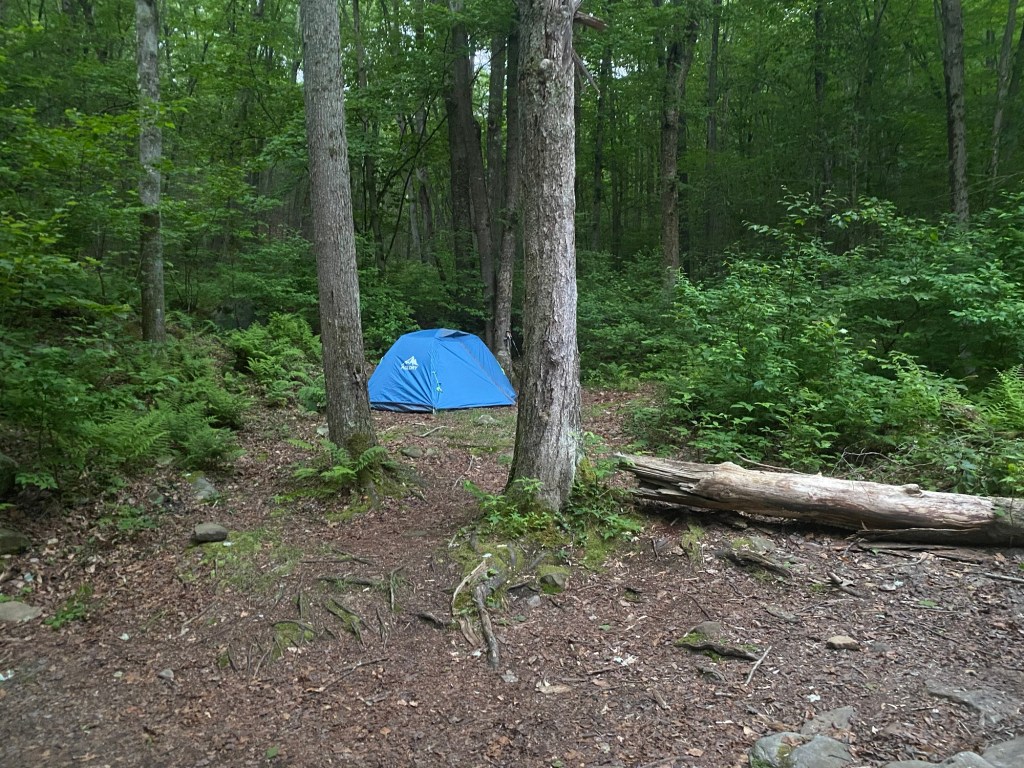
Dillon’s Tent
Timber rattlesnake with a garter snake coiled with it.

What’s Good about Primitive Camping

On a trail in the woods, scant or no cell service, hiking 10 miles or more with over 30 lbs. on one’s back, following hard-to-see trail markers attached to the trees, sleeping on the ground, eating freeze-dried food out of a pouch, and facing weather that can change quickly might seem uncomfortable at best to many people. But, I’d like to describe some of the good stuff.

I’ve had a yearning to go backpacking for decades. I had a taste of it in Boy Scouts, at Camp El Rancho Cima in the hill country of central Texas. Back in the 1960’s, backpacks had external aluminum frames, were made of heavy canvas, and were not weather resistant. At that camp, I recall going on a trek using donkeys to carry our food and tents, and loving the idea of existing out in nature without access to anything comfortable. We took good care of the donkeys, and had a great time looking up at the stars, unlike anything we could see back home in Houston. That was it for my backpacking experience as a youth.

Seven years ago I paid a visit to REI. The hunger to go backpacking got me motivated, and I wanted to be equipped. The sales people at REI really are good at capturing one’s attention. I spent an hour with the guy selling backpacks, and settled on my Deuter ACT Lite 65+10 model. He showed me how to get the straps adjusted just right, and made sure I was comfortable. I also bought an REI branded cocoon sleeping bag, an air mattress, a Big Agnes Copper Spur tent and a camp stove. I was very happy bringing these items home. I set up the tent in my backyard, and marveled at the ease of doing so. I tried out the stove, to be sure I could light it properly in camp. Unfortunately, I could find no one who was interested in a trek in the woods, and I was not about to go out solo for my first real backpacking excursion. These items got stowed away in a corner on the third floor of our house, tucked into a trunk.

In 2021, five years after I bought all that camping gear and buried it in a trunk, things turned around. Two of my running partners, Steve and Pat, said they were interested in backpacking that spring. Both had fairly extensive experience, and so were ideal partners for me. We made plans for an overnight outing in May, and started some training with our packs. We chose to do the Loyalsock Link Trail in north central Pennsylvania. The trail is about nine miles, and starts at the World’s End State Park, on the banks of the Loyalsock Creek. It was an ideal first trek for me, including clambering over large boulders, some steep climbs and descents, and wound up at a great site for setting up our tents. It was by a stream, flat, and had a fire ring and boulders set up for sitting near the fire. 

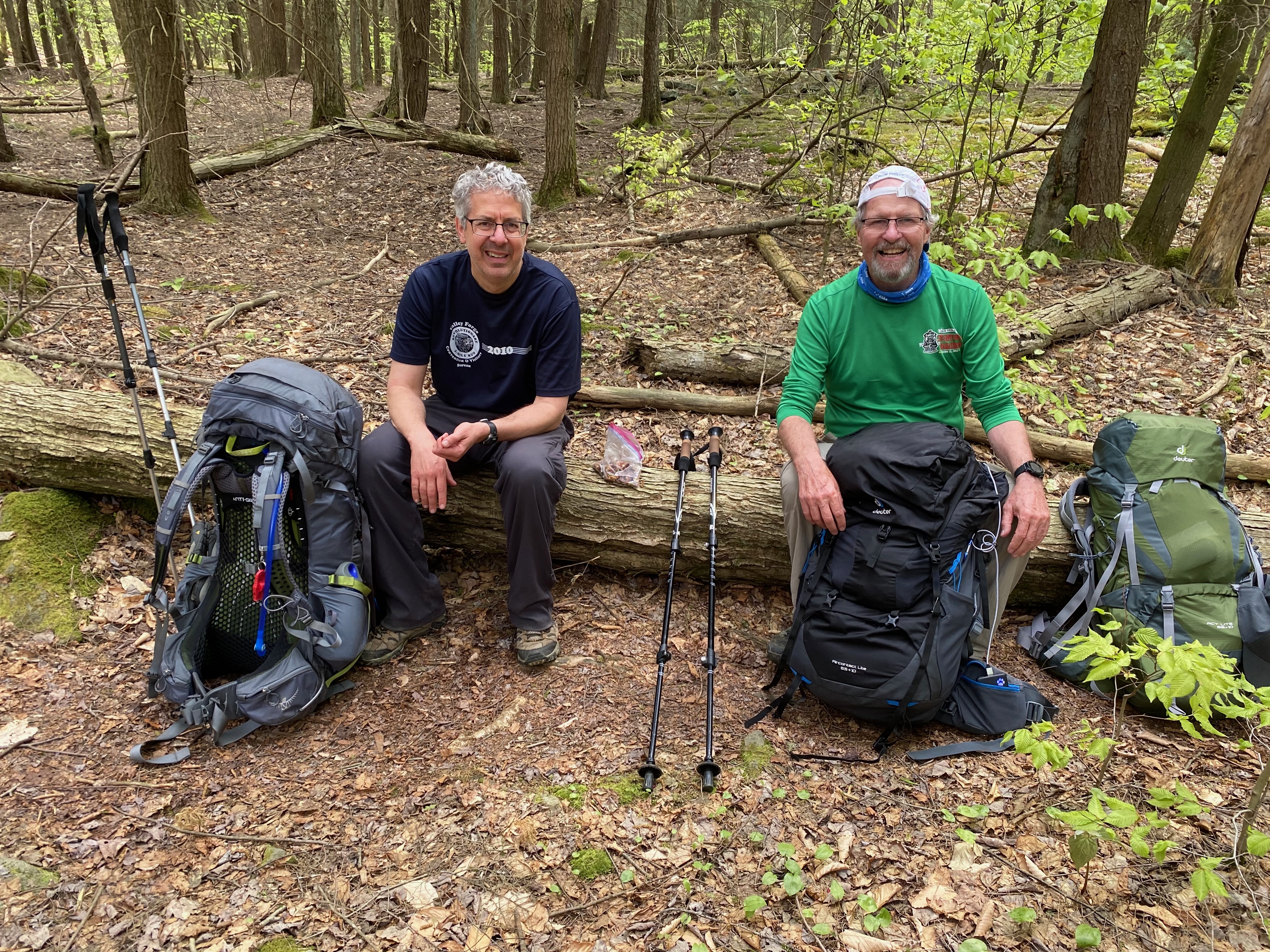
Steve and Pat

Since then, we added two more to our group, Christine and Michele from our running club, who also had the bug to go backpacking. We have done several two night trips with various members of our group taking part, on the Loyalsock Trail and the “Old Loggers’ Path”, as well as a two nighter on the Pinchot Trail in the Pocono Mountains.

What makes these jaunts so rewarding? Any time you can get out in the woods, away from the business of daily life is a treat. As soon as you are a quarter mile into the trail, the civilized world seems distant. This sets me at ease, and I can concentrate on the trail, following the blazes, learning the clues the blazes give for when there is a change in direction, and noting the great variety of plant life we encounter. The subtle, and sometimes obvious, changes in ecosystems along a trail are wonderful to appreciate. Along the Pinchot trail, for example, there are tunnels created by overarching rhododendrons, which then give way to pine and hardwood forests. It is remarkable how much natural spring water comes flowing down these mountains, creating rivulets which empty into larger rills, then into creeks and rivers. 

Rhododendron Tunnel

As you hike along, you get to know your backpacking partners pretty well. When you are out in the wilds and dependent on your partners for help should you need it, you get a great appreciation for their skills and support. Conversation along the trail ebbs and flows. Sometimes, during a tricky ascent, we hold the talk, but it resumes when we are on the flats. Crossing streams becomes a puzzle to solve, are there stable rocks to use, or do we need to switch to water shoes, hike up the leggings, and wade through? Spotting various forms of wildlife is also a reward. We’ve come across all varieties of mushrooms, sprouting plants, old decayed and fallen trees, and brilliant colors, in spring from blossoms and in fall from the leaves. Animal life is a bit scarce sometimes, but there have been some great sightings. We did have a bear run across the road in front of us driving to a trail head, and have seen bear scat on the ground, but fortunately have not encountered bears along the way. I spotted a beautiful eight point buck, about a quarter mile from us, who then bounded away when he saw me. We’ve seen small frogs and toads, newts, and spiders. We’ve seen trout in streams, and a great variety of birds flying about.

This butterfly explored around our camp.
A remarkably well camouflaged toad.
delicate growth of a fungus
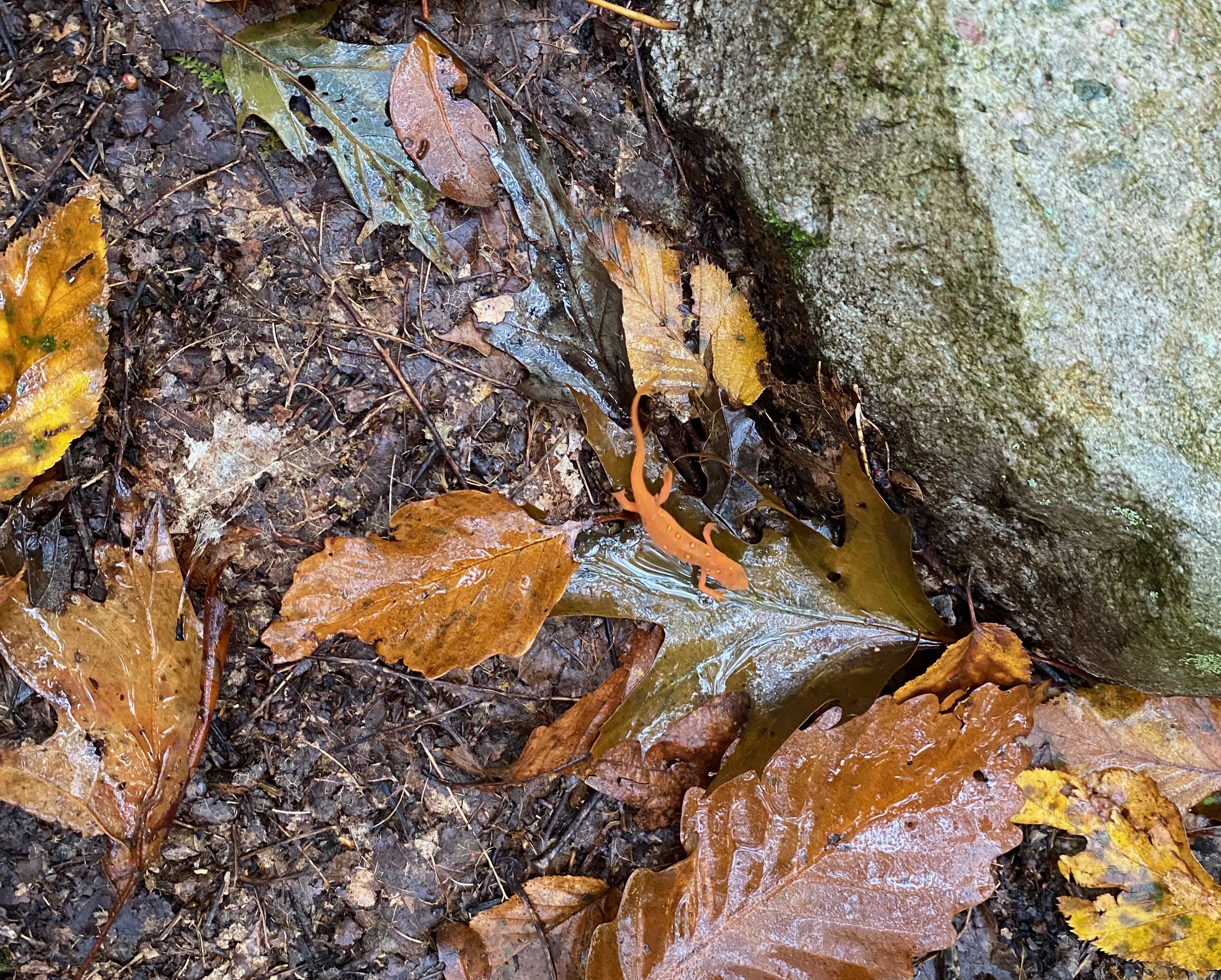
I think this is the juvenile form of he eastern newt.

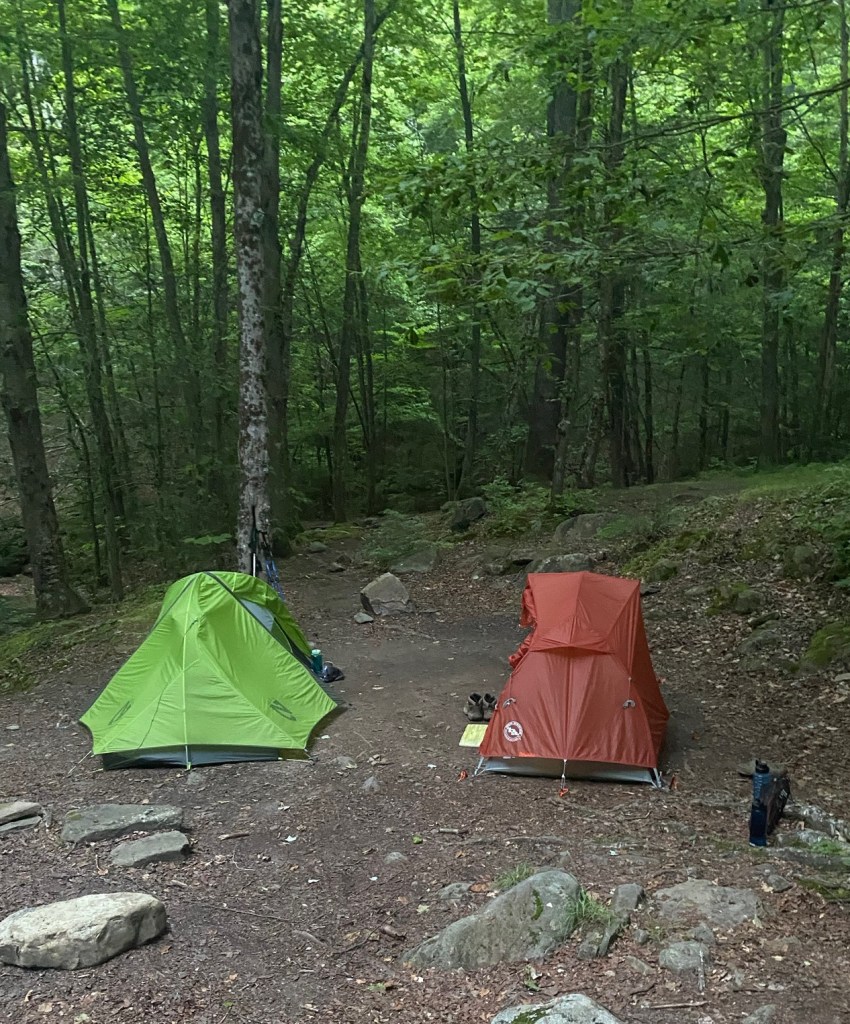
Finding an ideal spot to settle for the night is fairly easy on the trails we’ve chosen, since there are established campsites. These come with stone circles for campfires, and some even have large stones set up around the fire ring for a place to sit. Now, this may sound a bit too comfortable, but we didn’t ask for them, they were just there, set up by scout troops decades ago. One of the chores we approach with great vigor is collecting firewood for a campfire. There is usually none to be had around the camp, but searching a short distance away is usually productive. We learned early on to carry small collapsable saws with us so that we are not limited to what we can break with just our hands. We look for good, solid, fallen wood which is not spongy or saturated with water. It gets chilly in the mountains in the spring and fall, so having a nice warm campfire is not only for pleasure. Warming oneself by the fire, and watching the flames, is mesmerizing. The other chores, setting up our tents, getting water into our filter bag, and getting our air mattresses and sleeping bags set up is a practiced skill. Since it gets dark quickly in the mountains, we set up a stove early to boil water for our freeze dried dinners. Now this may sound unappetizing, but these meals turn out to be pretty tasty. Some backpackers stick with old standbys, such as ramen noodles with added freeze dried vegetables from home, but the pre-made packets are nice for variety, spices, and simplicity. We’ve also brought marshmallows, which add very little weight to a pack, by the way, and had toasted marshmallows as a desert.

Toasting marshmallows.

You might think sleeping on the ground in a tent in the woods would be a poor sleeping experience. I have found the opposite to be true. The air mattress is comfortable, the sleeping bag is warm, and sleeping in the cold night air feels very natural. It may not always be a bed of rose petals, granted. I have had two air mattress incidents. One, which woke everyone up in camp, was a loud pop, which turned out to be one of the channels in my air mattress rupturing. It put a hump in the middle of my air mattress which made me slide one way or the other, but did not allow me to remain centered. That was annoying. On another outing, my brand new replacement for this failed mattress developed a profound leak before I got to use it a single time. This made for a very difficult night with little sleep. I could not get comfortable on the hard ground, and in the morning, could not identify the leak point. The next night, since this trip was in the fall, I collected a large amount of leaves under my tent floor for cushioning, and, as suggested by my partner for this trip, used a foam pad from my backpack under my hips. I slept very well that second night. So another great thing about primitive camping is learning to make do with natural resources.

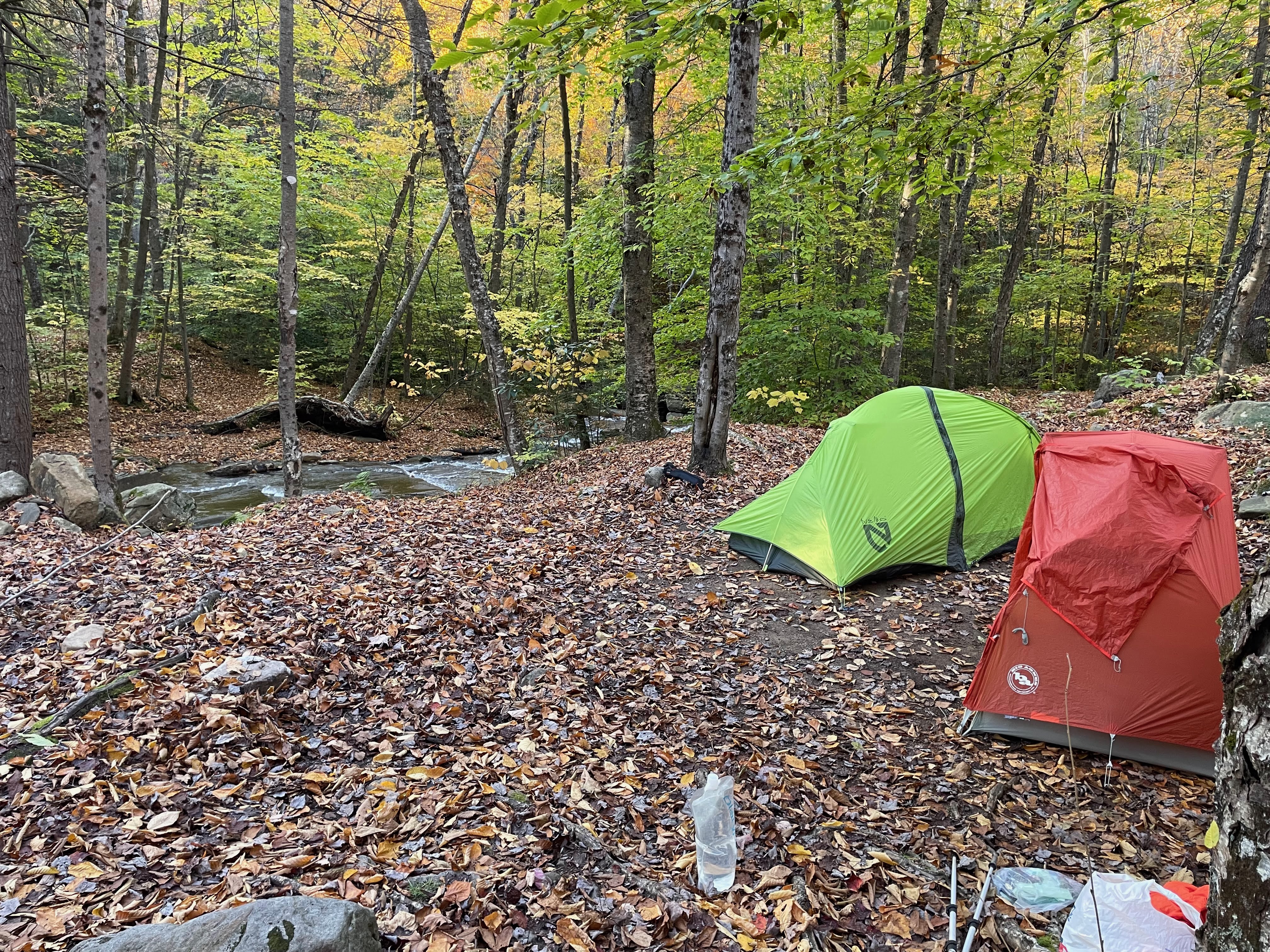
Camp set up near, but not too close, to a stream.

Peeing in the woods, for the guys, is a pleasure. For the women, I recognize it is more problematic, although the principles still apply. It might not occur to those who are stuck back home, but taking a “natural break” whenever and where ever you are is liberating. It also gives an indication of how well hydrated you are. Dark yellow, and infrequent peeing is an indicator one needs to drink more.

Pooping in the woods is another means of reward. It can be tricky, at times. Digging the appropriate hole can be challenging, especially if all you have around you is trees, roots and rocks. But given an appropriate hole, a tree for support, and enough privacy one is not inhibited, it becomes a chance to score nature points by hitting the hole. And, of course, everyone poops.

Getting to the end of the trail is a mix of relief and letdown. You wish you could keep going, enjoying the life in the woods, campfires, philosophical chats, tucking into your sleeping bag at night, rekindling the fire in the morning and enjoying that delicious cup of hot coffee. On the relief side, you have gotten to the end of the trail, are likely hungry, and your limbs might be a bit fatigued. We’ve had some interesting end-of-the-trail experiences. On our first backpacking trip, we got back to the car and found we had a flat tire. It took a while to get the tire changed and get moving. We drove back through Williamsport in north central Pennsylvania, and were fortunate to find a tire shop as we drove into town. We were able to get the regular tire repaired and get the little donut tire back in the well of the car where it belonged. While it was getting fixed, we strolled over to a Taco Bell across the street and gorged on burritos and tacos. This has become a required stop for us on our return from the woods.

On a recent backpacking trip, one of our friends who was backpacking for the first time, was asked at the end of the trip if she had fun. She said it reminded her of making a long trek in an airport carrying a suitcase. I don’t think she’ll be joining us again, although we would love for her to try it again. For the rest of us, it is a wonderful trip into the woods and away from the civilized world.

I’d like to give credit to Christine, Michele and Pat for the use of some of their photos for this blog, and also for their great companionship on our backpacking trips, and for more to come.

Uncorking Croatia

The Blog of WINES OF CROATIA

RunnersOnTheGo.com

To help enrich the lives of others, we developed RunnersOnTheGo.com to help runners save money on races, running stores, and much more. We also provide the specific local information that makes your travel for business, vacation, or racing as rewarding as possible.

getsetandgo

Travel Blog of a Budget Traveler sharing stories on travel, books & Vegetarian Food

Marc Hemingway

Trying to keep track of my life (and my life on track)

Mid-Life, Mid-Level, Masters Running

Exploring ideas about running to contribute to a more enjoyable pursuit for the mid-level masters runner

therunningtherapist

"One foot in front of the other and one thought at a time"

WordPress.com News

The latest news on WordPress.com and the WordPress community.

retireediary

The Diary of a Retiree