A Bridge, a Fox, and a Tie-in to Running

Unless one were lost in the woods these last couple of weeks, it would be impossible to miss the uproar over the George Washington Bridge closures.  Last September 9-13, lanes were closed on the Fort Lee side of the bridge, which is the busiest bridge connecting New Jersey to Manhattan, in a sudden and unexplained move, later brushed aside by port authority officials as a “traffic study”.  On Dec. 16, 2013, John D. Rockefeller IV, chairman of the Senate Committee on Commerce, Science and Transportation, wrote to the chairman and vice chairman of the Port Authority of New York and New Jersey requesting answers to very direct questions regarding the lane closures.  Answers were provided in a letter written by the Port Authority Board Secretary which were filled with standard protocol type language.  It was not until a subpoena from state legislators demanded emails and text messages from various people involved with the closures, specifically Bill Baroni and David Wildstein, that it became evident that the lane closings were political retribution against the mayor of Fort Lee, a man of Croat heritage mistakenly referred to as a Serb in one of the emails, perhaps the biggest insult of all.  The people who instigated the lane closures were all close allies and working for Governor Chris Christie of New Jersey.  While the governor has claimed he knew nothing of the involvement of his team in the closure of the lanes, he has a reputation of being a bully, and taking retribution on a political foe is consistent with his character.  He is known for his bullish, bullying style, making fun or yelling at opponents who have the temerity to speak against him.

It was time for the television pundits and posturers to take a stand, generally, as one would guess, along political lines.  There was one comment that really stood out, though, as being a strange, and utterly outdated way to see this debacle for Governor Christie.  After all, he is positioning himself to be the spokesperson for the republican party, and possibly to run for president in 2016.  He should be preparing the big tent, to attract conservatives and near-conservatives, libertarians and tea-partiers, whites and off-whites, men and, yes, even……women.

Brit Hume, senior political analyst at Fox News, on a Sunday talk show called “Media Buzz”, had this to say:  “Well, I would have to say that in this sort of feminized atmosphere in which we exist today, guys who are masculine and muscular like that in their private conduct, kind of old-fashioned tough guys, run some risk.”  He went on to explain that the governor is an old-fashioned guy’s guy, a masculine and muscular guy, in constant danger of looking thuggish or sexist.  He got a quizzical look from a co-commentator on the program, Lauren Ashburn, but later was supported in his contention by another Fox star, Bill O’Reilly, who said that real men who are rough around the edges, maybe rude or blunt, get a raw deal from the public.  Another way to look at this, though, is that real men, manly men, have a right to their own way of behaving, and women are trying, and now succeeding in ruining it for them.

Has running “suffered” from feminization?  The Olympic Marathon of 1896, held during the first modern day Olympics in Athens, Greece was a men-only event, as were all the events at that time.  Initially, women were probably not considered for competition, since they were not felt physically capable of participating.  They were also excluded based on a men’s club mentality.  But, a woman did run the first Olympic marathon, just not as an official competitor.  Her name was Stamata Rivithi, and she completed the 40 kilometer course in 5 hours and 30 minutes.  The winner that year, a Greek named Spyridon Louis won the men’s event in 2:58:50.  Violet Percy, an English woman, was the first officially timed woman marathon winner with a time of 3:40:22 at the Polytechnic Marathon in London in 1926.  These women broke barriers, but the premier marathon event, the Boston Marathon, had yet to be tainted by the presence of women.  It was not until 1966 that a woman named Bobbi Gibb (co-alumnus(a) of mine from Revelle College, UCSD), ran the Boston Marathon as a non-registered runner.  It being an AAU sanctioned male event, women were not permitted to officially run it.  Bobbi Gibb’s story is nicely told in an interview she did which is posted on the Bill Rodgers Running Center website.  She reports she applied for an entry to the race, but got a reply from the race director, Will Cloney, stating that women were not physiologically able to run a marathon, and furthermore, were not allowed to.  She had to hide in the bushes at the start, wearing her brother’s shorts and a hooded sweatshirt.  She joined the race after about a third of the runners had started.  She reports that she was recognized as female, as she put it, by the men studying her anatomy from the rear. The men around her were very supportive.  She says they told her they would not allow anyone to remove her from the race.  She finished with a very respectable time of 3:21:40.  While unofficial at the time, she has since been recognized by the Boston Athletic Association as the first female winner, and she won three years in a row.  Ironically, at the time she ran her first Boston, the longest sanctioned race for women on the AAU calendar was 1.5 miles.

Since then, the number of women participants in running races has grown dramatically.  In a Wikipedia article, a graph of women’s participation (not just runners) in the summer Olympics has grown dramatically from the early 1900’s to the present:

Women as a percent of participants in the Summer Olympics

Women as a percent of participants in the Summer Olympics

In one of our major races in the Philadelphia area, the 10 mile Broad Street Run, held the first Sunday in May, the number of women participating has grown steadily since the race began in 1980.  This past year, 2013, the total number of women finishers was 17,269.  There were 14,773 male finishers.

For major marathons, women have not yet reached parity with the men, but are not far behind.  For 2013, at Chicago, there were 17,395 women and 21,488 men finishers.  For New York, 19,567 women and 30,699 men completed the race.  In Europe, at the Berlin Marathon, 8,946 women and 27,528 men finished.  And in Los Angeles, 7,773 women and 11,761 men crossed the finish line.  In Boston in 2012, 9,006 women and 12,666 men got to run that last stretch down Boyleston Street to the iconic finishing banner.

Women have also become leaders in the world of running organizations.  Mary Wittenberg, the president and CEO of the New York Road Runners, is responsible for the business and operations of the club, including the production of the New York City Marathon.  Stephanie Hightower is president of the USATF, the national governing body for track and field, long distance running, and race walking in the U.S.

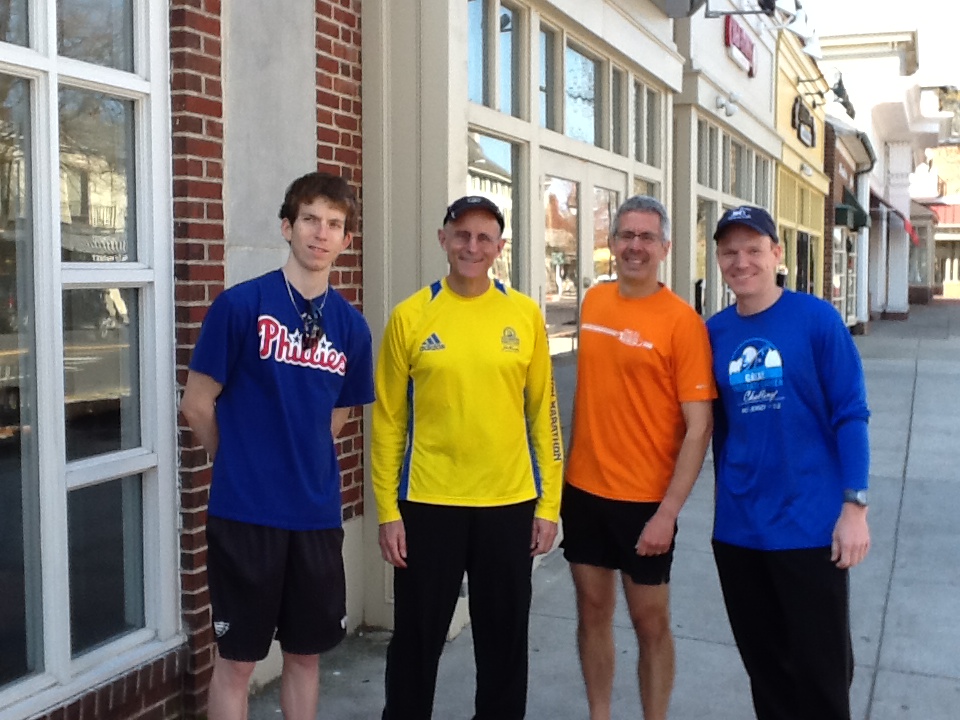
Every Sunday morning, I meet with a group from my running club at 7:30, to run a 13 mile loop.  Sometimes we go farther, if we are in the midst of training for an upcoming marathon.  We’ll start out earlier, get the extra miles in, and then meet the group at 7:30 to start together.  We have a balance of men and women in the group.  I’m sure not one of the guys feels put upon, inhibited or less manly because women are participating in the sport.  Likewise, the thought that women are not capable of participating, the thought held 30 years ago and earlier, has been proven to be bunk.  It is true, that when men and women mix together in a social setting, men behave more civilly, less crudely.  At least, they should.  There really is no excuse, in my mind, for bullying and being obnoxious, and it certainly is not the fault of women if someone who behaves that way is brought down.  I would say, yes, running has been feminized, in that women have been able to participate in this great sport which was once closed to them.  They have shown their mettle, and taken on the challenges of the toughest of races, the marathon.  They have contributed greatly to the organization and running of the sport, and their participation keeps growing.  Far from making us guys unmanly, less of a man’s man, they have joined our ranks, and made it better.  What a bunch of “bushwa” (got that from a NYTimes crossword puzzle) coming from Brit Hume and Bill O’Reilly.
Brandon Runs New York

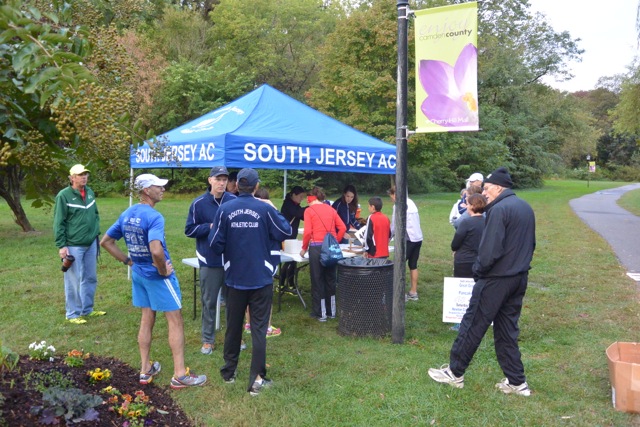
Brandon, in the SJAC jacket, organizing our club's Great Grace race.

Brandon, in the center in the SJAC jacket, organizing our club’s Great Grace race.

People living on the east coast (of the US, for my non-US readers), cannot forget hurricane Sandy.  For some, it was a big storm which didn’t do much damage.  For others along the coastline and in New York and parts of New England, it was a devastating storm from which many have still not recovered,  although it has been a year.  Even if there was recovery, in this campaign season we in New Jersey are constantly reminded of how our fearless governor stood face to face with the storm and chased it away, then went out to help our citizens recover, walking arm in arm with the president.  It made for some strange politics, now replayed as political ads.  It also created mayhem for the New York City marathon, which was cancelled at the last minute.

The New York City marathon started as several loops around central park in 1970, organized by Distance Running Hall-of-famer Fred Lebow.  At the time it had a starting lineup of 125 runners, 55 of whom actually crossed the finish line.  The winner, Gary Muhrcke, finished in 2:31;38, while Mr. Lebow finished in 4:12:09.  Since then it has grown to be the largest marathon run annually, and now traverses all five boroughs.  Staten Island is included by the race starting on the Verrazano Narrows bridge, then it progresses through Brooklyn, Queens, the Bronx, and finishes in Central Park in Manhattan.

Since its start in 1970, it has only been cancelled once, in 2012.  As Sandy hit New York, causing flooding, destruction of houses, buildings, roads and tunnels, electricity outages, and isolation of communities, the Road Runner Club of New York, and Mayor Bloomberg, pushed on, wanting to show the world that the dominant spirit of New Yorkers could overcome anything.  About 36 hours before the race, it was cancelled when the organizers and the mayor recognized the severe impact of the storm on the citizens of the boroughs through which the race would be run.  Instead of using sorely needed generators to provide emergency backup power, these generators were used to heat tents along the route for the runners’ support.  The race was cancelled, and tens of thousands of runners who had gathered in New York were turned away.  Some used their energy to volunteer, helping hurricane victims.  Others, having come from far off points around the globe, returned home, peeved that the race had not been called off before they made the trip.  The sponsors of the race eventually refunded the entry fee to several thousand runners, while others opted for a chance to run in 2013.  My friend and running partner Brandon chose a 2013 entry.

Among several things that Brandon lives for, his beautiful wife and their adopted special-needs son, his faith and his church, running is a very big part of his life.  He ran track in high school, and still relates stories of the races he ran and competitors he raced against.  He has run many marathons, among them multiple Boston Marathons.  He has a tie hanger loaded with Boston Marathon finishers medals on the wall in his living room.  It also displays medals from London and several others, including one from New York.  He ran New York in 1993 at the prime age of 26, finishing with a gun time of 3:02:28.  This was before the modern era of chip timing.

Brandon is a very hard trainer.  He regularly runs upwards of 60 miles per week, mixing long distances at marathon pace, speed work and recovery runs with core training, stretching, and foam roller rolling (for lack of a better term).  Often when I drop by on Saturday mornings for a run, he has a video on in the background of a DVD for core workouts on standby.  The intro shows a woman on a mat raising and lowering her midsection endlessly.  No wonder he enjoys doing core workouts.  Our Saturday morning runs are at marathon pace for me, but a very slow recovery run for him.  He is driven by the fact that our club has some very fast runners who are older than he, and he uses them as a stimulus to keep his game going.  He is also a terrific coach for runners like me who benefit from his years of training and racing experience.

Brandon heads to New York today.  He has plans to take the train to Penn Station, get his number and other swag at the expo, then check in at his hotel.  As he put it, he’ll spend $425 for the privilege of a few hours sleep in a fine New York City hotel, only to have to leave before sunrise to make it to the start line.  Twenty years since he last ran, he has a very good shot at breaking his previous New York City marathon time.  His friends and supporters will be watching the race on TV and on-line, wishing him a great run with the wind always at his back, not too hot or too cold, no stepping in potholes, and a fine finish in Central Park.

GO BRANDON!

“Experienced” marathoner

It may be hard to believe, but this summer is nearly gone. This means the next marathon is looming larger in the near future. For me and my training partners, that date is October 6, for the Wineglass Marathon in Corning, New York. Having now run seven marathons, I am more aware of what is coming. Standing out most clearly in my mind is recalling how, at some point in most of the marathons I’ve run, I tell myself how utterly crazy it is to torture myself this way. Why would I willingly choose to go through the muscle pain in my legs, the pains in my shoulders, the bleeding, the chafing, and sometimes the near delirium, just to say I had done it? While many in our club have run many more marathons than I, I am starting to get the gist of it.

We have several new runners in our club who are planning to run their first marathons this fall. Some have been running with us on our long Sunday runs, and a couple run on their own but tell me how they are doing. To a person, they ask for little advice, but mostly are quite fixed on their training plans. They all have that holy grail of the marathon runner in mind, the Boston qualifying time. When we (our Sunday group) hear this, like a chorus we say, “just work on finishing”. There is little one can say that helps the naive runner get through their first marathon. We offer the familiar advice of not going out too fast, sticking to a plan, hydrating, eating appropriate numbers of gels throughout the race, and preparing ahead with BodyGlide and bandages. Much of this is relative. What is appropriate hydration for one person may be way under or over for another. How many gels, how often, something other than gels, is pure guesswork.

Some advice is sound and well grounded. It is a good idea not to wear brand new anything, especially shoes, for your first marathon. Even that, though, I’ve ignored, when I wore brand new knee high support socks for a race last fall, not having worn anything like them before, and loved them. How to dress is a tough call. Personal preferences, temperature at the start, where that temperature is headed, sun, clouds, humidity, all figure in to that guesswork. I think I changed my mind about ten times the night before my first marathon. In a race that starts early and goes several hours, conditions can change dramatically. Or, they can stay the same. For my first marathon, Philadelphia, 2008, the temperature never got above freezing. It started in the low 20’s with a bit of wind. The water stops were sheets of ice, not very safe to run, or walk on. The next year, that same race started in the mid 40’s and rose to the low 60’s, practically perfect.

Another piece of guesswork is what to eat the night before. I doubt any marathoner would consider it a good idea to eat a huge meal, redolent with fat, and washed down with many glasses of wine. No, save that for the afterparty. Pasta is the standard, but anything light and easily digestible makes sense to me. Is beer okay? My feeling is yes, “a” beer is okay, and probably helps one relax and not be too wound up.

The first time on the start line of a marathon, the atmosphere is euphoric. Dropping one’s bag at the right spot, managing to make it to the portable toilet for one last squirt, finding one’s way to the proper corral, squeezing in with the other runners, and sensing the collective anxiousness makes for a unique, numbing experience. Other runners are wearing giant trash bags with holes cut for the arms and head. Some are stretching in their limited space. Some are chatting incessantly with friends, all of whom are wearing earbuds and probably already listening to some inspirational play list they have created. And some are quietly looking ahead, perhaps playing out the course in their minds. All of this is in a swirl around the new marathoner who is unaware of how the race will unfold.

I plunged right in my first time. It takes a while to actually get to the start once the gun goes off in the bigger city marathons. There’s a shuffling start, corrals move up, and then one gets caught a little off-guard when the start line is actually underfoot. I remember starting my Garmin as I crossed that first detection pad, hearing the faint cacophony of beeps as the chips get registered, like the sound of locusts. Then, one’s own personal best for a marathon is underway.

I am very pleased to see new runners in our club taking on this challenge. I think they will have an experience that will change them for a lifetime. If, like me, they wind up getting sucked in, and go back time and again to challenge themselves, they will really change their lives. Each time I head to the start line now, I don’t know how the race will end for me. I know that I don’t know. But I have become aware of the routine at the start, the way I asses my condition as the race progresses, and certainly the warning signs of trouble, like cramps that all too often befall me along the way. I am still experimenting with strategy, modifying my starting pace, the way I drink during the race, and learning to slow down in the first half to be able to go faster in the second. It is quite a commitment to take on the training, typically about sixteen weeks, all for the one day event which may have great conditions, or perhaps awful conditions. I wish our club’s new marathoners, and anyone else tackling this for the first time, a satisfying and fulfilling experience, that will cause them to come back again.

Frank

Tony Runs Boston

Tony Walter, after qualifying at Steamtown, 2012 for Boston.

Tony Walter, after qualifying at Steamtown, 2012 for Boston.

Back in May, 2012, a group of us from the SJAC decided we would head up to Scranton for the Steamtown Marathon in October, 2012.  One of our dedicated group, Brian, suggested we should write a blog about the group preparing for this event.  I happened to be the one who moved forward on this suggestion, and the sjacmarathoners.com was born.  Through the hottest summer on record in the Philadelphia area, we trained as a group, sweating, running, sweating some more, wringing out wet socks and shorts, hydrating, rehydrating, and getting in the miles.  Our experiences were documented in our blog.  After the grueling summer, and a bit cooler September, our group headed up to Scranton to participate in the Steamtown Marathon.  It is small as marathons go.  Three thousand signed up, the maximum allowed, and the event was closed to registration by the end of May, which speaks to it’s desirability.  It is also known as a Boston qualifier, since an average of about 25% of runners in this race qualify for Boston.  What this means, though, as I found out, was that it is an elite runners marathon.  The reason so many qualify for Boston is that so many fast runners run this race.  This was evident when we were gathered in the gym at the Forest City high school, waiting for the start.  I had not seen so many Boston Marathon jackets since I ran Boston in 2011.

Tony ran Steamtown with an eye to qualifying for Boston, although he would have been happy just to put in a decent performance.  He needed to hit under 3:40 to qualify.  He also needed for Boston not to be filled up by the time his race was run.  There were a few factors that made this prospect interesting.  One was that the Boston Athletic Association decided to change the qualifying times the year before.  Two years ago, Tony could have qualified with a 3:45:59.  They decided to drop the time for all entrants by five minutes, and drop the 59 second allowance.  That set the new time at 3:40 flat.  In addition, they decided to allow finishers who beat the time by certain margins, 20 minutes and 10 minutes, to get preferential sign up privileges.  Theoretically, one could make a qualifying time but not be allowed to run because all the places were taken.  This happened the year before, when some runners had hit the qualifying time, but there were no places left.  For 2013, an anomaly occurred.  The 2012 Boston Marathon was run under very hot conditions, with temperatures into the high eighties.  Participants at Boston who normally would have qualified at Boston for the following year had times much slower than normal due to the heat, and some actually decided not to run.  This left a few places available still in October, after the Steamtown Marathon.  So, when Tony hit his qualifier of 3:39:06, he was able to sign up for Boston.

At the end of Steamtown Marathon, Tony was beat.  He could hardly move, and when someone in our group offered to get him a drink, he had the look of a zombie as he answered that he really couldn’t say.  Our group went out to eat lunch at a very nice Mexican restaurant in Clarks Summit.  Tony ordered a delicious tortilla soup, which remained untouched as he stared at his bowl not saying a word.  We got a little worried about him, but he still had a pulse and respiratory rate, so we figured he would be okay.  On the way home to the Philadelphia area, he stopped at a rest stop to get some coffee.   Lisa, one of our group, followed him there, just to check on him.  Seeing he was managing alright, she drove on and Tony eventually made it back home.

The next day, he signed up for Boston.  Good thing he did, too, for it filled up by Thursday of that week.

Tony is a terrific training partner.  He seems like he is always in a good mood, and he always has kind things to say about everyone.  He is very steady in his training, and got through the summer having put in the miles, logged the long runs and done the track work to be well prepared.  He kept the rest of us going strong, and set a good example for us.  In other words, he earned it.

Many of my non-running friends have asked, “what is so special about Boston?”  Anyone who has run a marathon knows about Boston.  It is the oldest modern marathon, run since 1897, with the exception of 1918, during the first world war.  It is also a marathon for which one must qualify in ones age group.  The runners are all elite runners who have achieved a qualifying time which puts them in the top echelon of marathoners world wide.  But the best thing about running Boston is the support of the fans, who turn out in droves on the day of the marathon to cheer on the runners.  It doesn’t hurt that the event is held on Patriot’s Day, commemorating the start of the revolutionary war, and, as it happens, a holiday in Massachusetts.  The crowds that line the route, cheering, giving support, and making a lot of noise, especially in the last few blocks before the finish line, make the race a wonderful experience.  And, to make it all that much sweeter, the students from Wellesley, an all-women’s college, come out to offer kisses and high fives to the runners as they pass the midpoint of the race.

Tony will be running his first Boston Marathon tomorrow.  From his training partners back home, who didn’t make it in to Boston this year, we wish him the very best.  This morning, after our Sunday morning training run, a 13 mile route, the group gathered to offer Tony advice.  “Don’t go out too fast (duh…).”  “Go out easy and then back off.”  “Go get ’em, but take your time at Wellesley.”  And “whatever you do, make it across the finish line.”

I would like to ask any one reading this to offer support for Tony and we will pass on your advice and good wishes.

Best wishes to Tony from the SJAC Marathoners back home.

Best wishes to Tony from the SJAC Marathoners back home.

Sweat

Sweat: it is a natural product of running. In the summer we ran in such warm and humid conditions, the sweat would not dry, but flowed down into our socks and running shoes, causing a squishing noise to emanate with every footfall. At the end of our runs, especially the long Sunday runs, I could wring a cup of sweat out of my socks and shorts.

Sweat has great symbolism. It is the symbol of hard work. Picture a steelworker, sweat dripping from his face and staining his shirt as he moves a plate of steel destined for the side plating on a tanker ship. There is the sweat of the farmer as he runs his tractor up and down rows of sorghum, the sun unobstructed by clouds in the summer in Oklahoma. In the stifling air of a clothing factory in Bangladesh, the sweat of the woman in the tenth hour of a twelve hour day threatens to ruin her work.

Sweat represents fear. This is the sweat fueled by a flood of adrenaline. It is triggered by the flight or fight response which, somewhere in our past got built into our DNA to give us a jolt of strength to fight off an attacker. The alternative, running away, I imagine was an even better survival plan. Now, though, this sweat comes out in awkward ways, discoloring the armpits of a nervous lecturer, or both of a couple out on a first date. It comes from apocrine glands, different from the eccrine glands of the sweat that drips off our foreheads which is mainly water with a bit of salt in it. The sweat of fear is thicker and has in it protein and debris which bacteria seem to like. They are what cause this sweat to smell. Interesting, though, that this odor is thought to have strong pheromone effects for the opposite sex. Makes sense, one’s nervousness about that first date might be just the thing to get her strangely attracted without really knowing why.

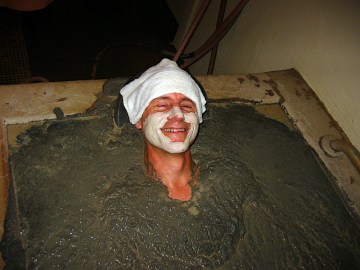
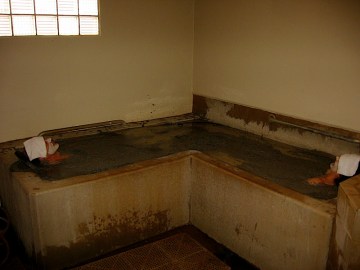
Sweat can be cleansing. Who doesn’t like the idea of sitting in a sauna, allowing the pores to open up and be an exit for stress? For the ultimate experience of sweating out the bad stuff, try a hot mud bath. I had the opportunity to do this with my wife in Calistoga, at the upper end of the Napa Valley.  Water from a natural hot spring, full of minerals, is pumped into a large tub containing a peat-like substance. The tub looks like a relic from ancient Rome. My wife and I got the couple’s room, with two tubs, which I suppose you could share with a stranger, but you would really need to stow your inhibitions in the bag they give you for your clothes.  In an interesting maneuver, we both shimmied ourselves into the peat, with naturally prominent parts still peaking above the level of the mud. It’s hard to get deep into the mud as your body’s buoyancy keeps you close to the surface. Good thing, too, since it gets hotter the deeper you go. You can only take about ten minutes of this immersion before you would start to get cooked like an egg. But, the pores open and the sweat flows. From the tubs, we stepped into a very powerful and hot shower, to get rid of the peat, which clings particularly well to hairy parts. From there, it’s into the Jacuzzi, for another sweat fest. Then, finally, donning striped terry robes we were escorted to the cool-down room, a dark place with cots where we were wrapped in clean white sheets and allowed to recover under the glow of a five watt bulb, listening to “ambient” music.

Frank, in the Hot Mud Bath in Calistoga.

Frank, in the Hot Mud Bath in Calistoga.

Frank and Kat in the couples room at the mud baths.  Note the Romanesque tubs.

Frank and Kat in the couples room at the mud baths. Note the Romanesque tubs.


Now that the cold weather is here, we still sweat. Running just turns up the heat in our bodies, which try to get rid of it by sweating. Starting out in sub-freezing temperatures, we need the warmth of tights and, for me, usually two layers on top, plus gloves and a hat. Soon, the gloves are off and I’m turning up the sides on my knit hat so my ears can radiate away some of the heat. At the end of the run, my face is streaked with salt from the sweat which dried as I ran, and my two shirts are wet. If I don’t change to a dry shirt rather quickly, the sweat starts to cool and I start to shiver. At the finish of the Philly marathon, a friend pointed out that I had a “bit of salt” on my face. When I got to the hotel and looked in the bathroom mirror, I looked like I was being preserved, the salt was so thick.

This is my homage to sweat. I know what it can mean, and I don’t pretend my recreation has the seriousness of what sweat can symbolize. But, I’ve experienced all those types of sweat, from hard work, to fear, to sheer indulgence, (and that pheromone thing, too!). I like the sweat of running. At times, it can be all of these.

Frank K.

Philadelphia Marathon #5

This was an experiment for me, to try to run two marathons in a six week period.  To give away the ending, it worked out okay, and I would do it again.  But, to get back to the details about Philly,  it is a small marathon by big city standards.  There were about 14,500 signed up to run the marathon, which is a sellout number, and also included about 1500 runners signed up for New York City, which was cancelled due to hurricane Sandy.  This compares with NYC, registering 47,000, and Chicago, 51,000.  Even Boston, which has qualifying times, runs 21,500.  Philadelphia runs a half marathon alongside the marathon, starting at the same time, with 12,500 entrants.  So, the start is fairly crowded, totaling 27,000 runners.

I headed over to Philadelphia Saturday, to the expo to pick up my number, and to browse the various booths.  Along the way, I stopped a few times to admire the city, its architecture, public works of art, and general scene.

Dropped off on Broad Street

I was dropped off by my son on Broad Street, and made my way over to the convention center.

I’m always pleased to see what a vibrant city Philadelphia is.  People live all throughout the city, and its businesses and public spaces are always busy.  It’s also a destination city for tourists, with the historical nature of the city, its museums, parks, and local flavor.

Cunstruction in center city.

Philly is building, and there are many construction sites such as this.

I like the way the old and the new blend together in Philly.  The Quaker Meetinghouse has been around since the city was founded, and is still active today.  The dramatic Chrysler Building-like tower is One Liberty Place, the first building to tower taller than William Penn’s hat atop city hall.  The building to its left is Two Liberty Place, a conglomerate of hotel, condo and commercial space.

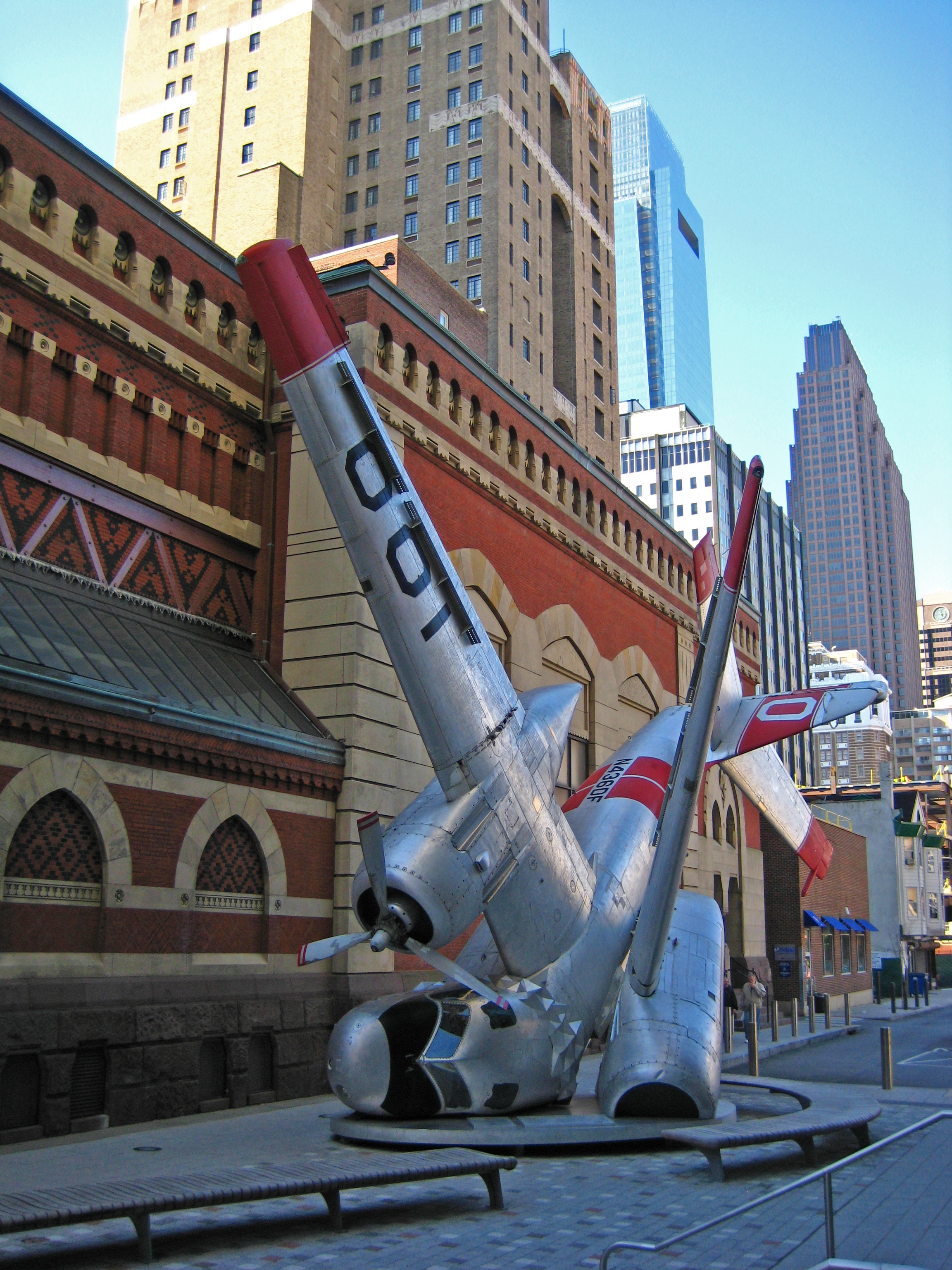
Sculpture in front of the Philadelphia Academy of Fine Arts

The Pennsylvania Academy of Fine Arts public sculpture.

The Pennsylvania Academy of Fine Arts is the oldest art museum and art school in the US, founded in 1805.  It is still teaching budding artists today, allied with the University of Pennsylvania.  This particular public spectacle, a real Grumman SE-2 Tracker, originally on an aircraft carrier, later used to fight fires in California, was installed by artist Jordon Griska, as if the plane hit the ground nose-first.  It is symbolic of swords being turned into plowshares, according to the director of PAFA, and will have a greenhouse built in to the fuselage (from Newsworks.org, a website of WHYY public broadcasting).

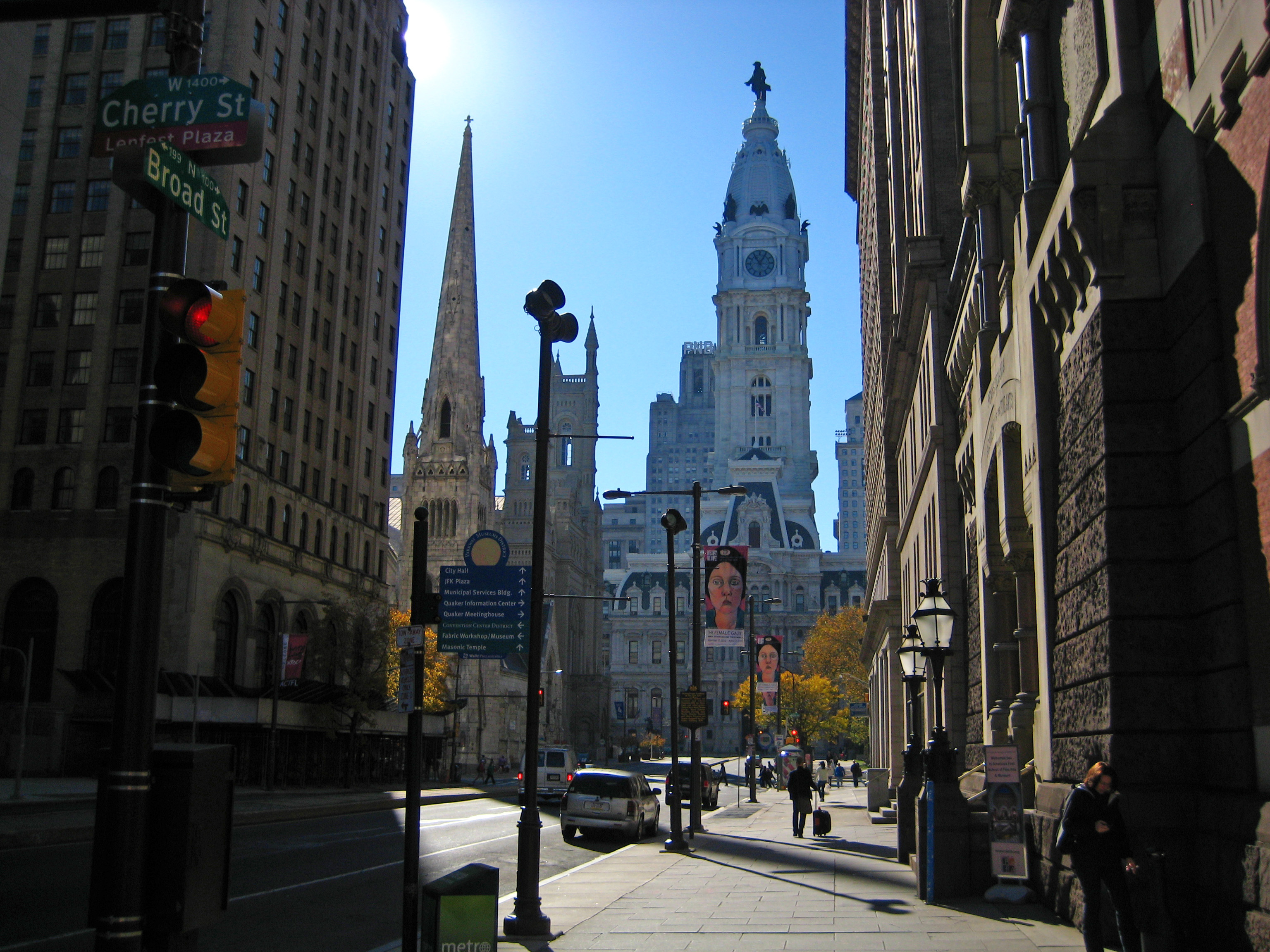
City Hall, Philadelphia

A glimpse of City Hall, with the statue of William (Billy) Penn on high.

The ornate City Hall building in Philadelphia is a much photographed building  Here, it is seen from the darkened byway at Broad  and Cherry.

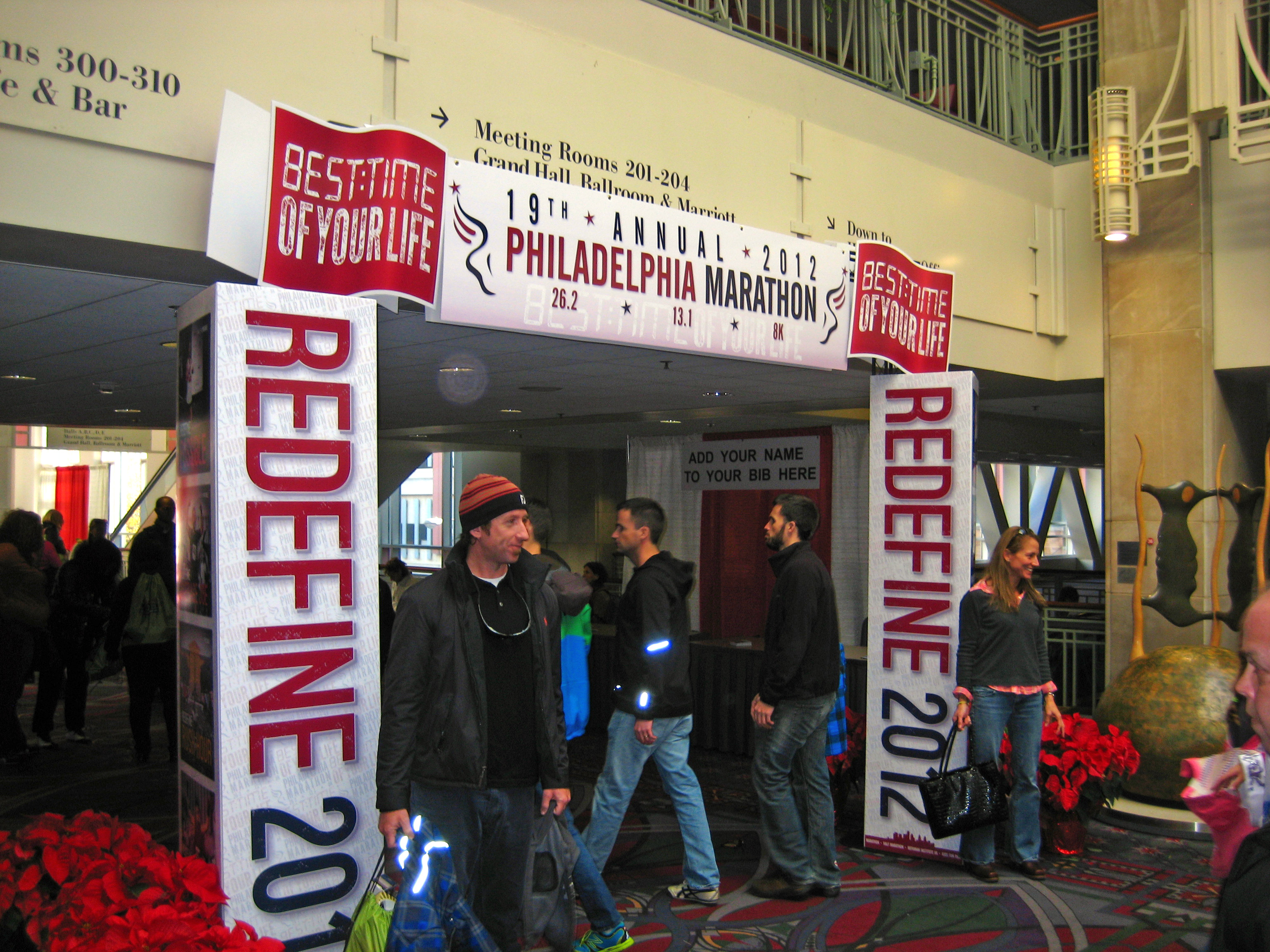
Not much farther, I reached the convention center where the marathon expo was being held.  The clue that you are in the right place is all the thin bodied individuals leaving the building carrying the same minimalist backpack, the kind made of nylon, with shoestrings for straps.  Entering the convention center, one is greeted by this banner.

Entrance to the Philadelphia Marathon Expo

A mock-up of the finish line at the entrance to the expo.

Inside, the first stop is the packet pickup, for your number and your bag with the t-shirt and other little goodies they throw in.  Mine had a refrigerator magnet with clip, a Philadelphia Marathon ball point pen, and a bunch of flyers advertising other marathons as well as a coupon for a complimentary ticket to a Philadelphia 76ers game.

Packet Pickup

Packet pickup, where it all becomes official.

I headed over to the section where official marathon clothing and gear were for sale.  Most of the items were severely picked over, with all the good stuff in the popular sizes taken.  Plus, the check out line looked to be at least an hour wait to pay for your goods.  I had plans to buy a jacket in commemoration of my fifth Philly marathon in a row, but the jacket I wanted was sold out in men’s large.   They had a different jacket with a giant “Philadelphia Marathon” emblazoned on the back, but it lacked the subtlety I was going for.  Leaving the official wear area, I headed out to wander through the aisles of the other booths.

Philadelphia Marathon expo.

Booths at the Philadelphia Marathon Expo.

I came across a booth by Sigvaris, a company which makes compression stockings, mainly for medical use.  I had a nice chat with a saleswoman there, explaining I often wear their stockings at work, having to stand for hours on end.  I was looking for something to run in.

Sigvaris saleswoman who helped me get my compression socks.


Many of the compression garments for runners either don’t have sufficient compression, or cover only part of your leg, or your knee, and act more like a tourniquet than a useful support.  She had just the thing, a knee high sock built for running, 20-30 mm Hg gradient, knee high.  For me, it serves two purposes.  One is to provide compression for my broken down veins, the other is warmth for running in the raw, cooler and windier days of fall and winter.  I bought a pair on the spot.  I was so pleased, I got a photo.


There were many booths selling all sorts of other goods, gels, arm warmers, t-shirts, “The Stick”, ear buds guaranteed to stay in your ears while running, Clif Bars, Power Bars, Snyder’s Pretzels, custom running shoes, and myriad other items.  One display I did not fully explore were the two real buses, one Greyhound, one some other company.  I’m not sure what they were there for, perhaps to take your club to their next big race?

Leaving the expo, I crossed the street to one of my favorite spots in Philadelphia, the Reading Terminal Market.

Reading Terminal Market

Entrance sign for the Reading Terminal Market

This market, which opened in 1892 as part of the Reading Railroad terminal, with tracks over the market space, has survived many economic downturns, and is currently a vibrant, packed, hectic market selling produce, poultry, meats, cheeses, bread, coffees roasted on the spot, cook books, spices, and in short, anything that’s delicious.  The Pennsylvania Dutch have a prominent presence here, and can be identified by their typical garb.  Yes, I dropped a few bucks here, picking up some bread from Metropolitan Bakery (Pain au Levain, and a chocolate cherry loaf), some house-roasted coffee, the Balzac blend, from Old City Coffee, and some fine cheeses from Downtown Cheese.

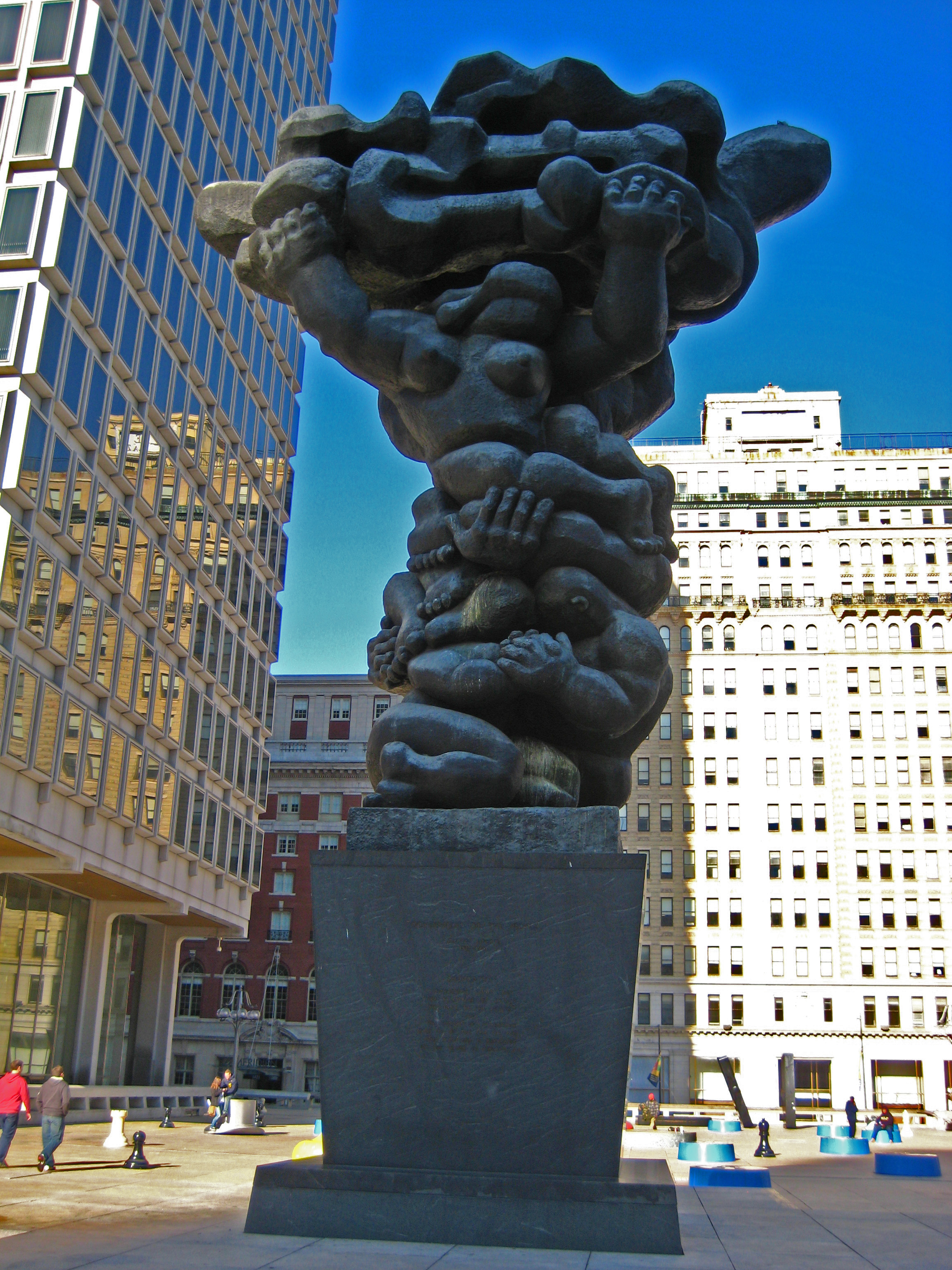
Leaving the market, I walked to the Ben Franklin Parkway, to check in to our hotel room.  Our club rents a room close to the start and finish of the race, to have a spot for our runners to stay warm and stow their bags before the race, and have a comfortable place to change afterwards.  Along the way, I passed some more iconic symbols of Philadelphia.

Jacques Lipchitz, artist, Government of the People, in front of the Municipal Services Building

Ben Franklin and the printing press.

Ben Franklin and the printing press.

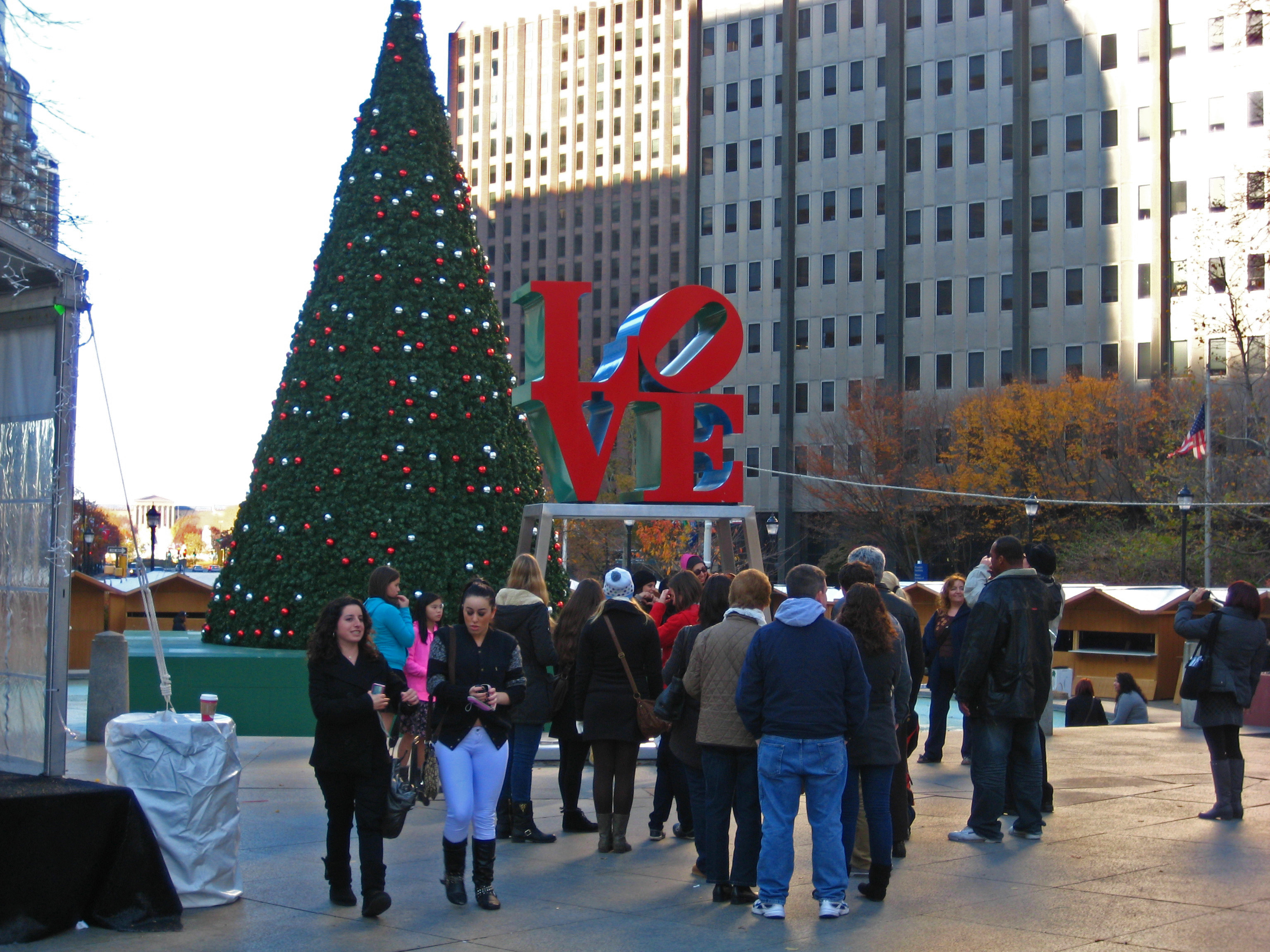
Crossing the street you arrive at the start of the Ben Franklin Parkway, and the nicknamed Love Park, so named for the famous LOVE statue.

Love Statue

LOVE Statue, famous symbol of Philadelphia, is constantly surrounded by people taking photos.

Love Park

LOVE from behind.

I checked in to the hotel, but wasn’t assigned a room yet.  So, coming back later that evening, I finally got in to our room, which was, coincidentally, room 2012.  I had to argue a bit to get the promised view of the parkway from the balcony, but it was definitely worth it.

Ben Franklin Parkway

View of the Ben Franklin Parkway at night from our hotel balcony.

The large circle is Logan Circle, and the fountain in the center is the Swann Memorial Fountain, named for Wilson Cary Swann, the founder of the Philadelphia Fountain Society.  I suppose that’s one way to get your name on a fountain.  It is an incredibly beautiful fountain, though, representing the three rivers of Philadelphia, the Delaware, Schuykill, and Wissahickon, using native American symbolism to portray them.  The marathon starts at the far end of the parkway, and runs down and around this circle as it heads down to Columbus Boulevard along the Delaware.  Later in the race we cross both the Schuykill and the Wissahickon, so in a way, this fountain is a good representation of the marathon.  I didn’t stay over in the hotel, wanting to sleep in my own bed, and have access to my usual breakfast.

On the morning of the marathon, I met up with a few other club members at the train station at 5 AM.  We took the train in to Philly and got to the hotel in time to do a little stretching.  A good number of other club members showed up, and come 6:20, we headed down to the lobby and walked up to the start line.  The crowds of runners and spectators were busily getting to either their corrals or to prime viewing areas for the start of the race.  As with every marathon, there’s an edgy tension, people adjusting clothing and retying shoes, starting of Garmin’s, stretching in the limited space available in the corral, and nervously chatting.  Then comes the national anthem, and the start of the race.  Throw away t-shirts get pitched to the side, and the corrals move up as first the wheel chair racers, then the elites, then the rest of us make our way to the start.  As we got close to the start, the walk broke into a trot, then a run, and we were over the start line, heading for the first of 26.2 miles.  This year we had a special group in their own corral, the runners from the New York marathon, who started after my green corral.  They were heartily welcomed to the race from the runners and the spectators, and I saw many signs along the route in support.  The route is a great tour of Philly, going through old town, down to South Philly, with onlookers in bathrobes standing on their porches, up Chestnut Street, with the street filled to capacity with cheering fans, over the bridge to the Drexel University area, past the fraternity houses where frat boys were out banging on pots, making noise for us, and looking like they hadn’t gone to bed the night before.   From there we head to the Belmont plateau, past the Zoo and the Please Touch Museum, down on to West River Drive.  A quick switchback along the drive, then we head back along West River Drive to where we started, in front of the Philadelphia Museum of Art, and the halfway point.  Large signs, much more visible than years past, show the way for the half marathoners to peel off to their finish line, and the marathoners to continue on to Kelly Drive.  Then, it’s out along another Philly landmark, boat house row, out to the Falls Bridge, over the bridge and down on to West River Drive again for another (and very annoying) switchback.  I don’t like this part because the road heads down hill and you need, of course, to come back uphill again at a time when the legs are starting to feel the fatigue set in.  The last outward bound stretch is along Main Street in Manayunk, with its young and hip fans lining the streets, offering home baked brownies and cups of beer to the runners.  At the end of Main Street, another switch back for the last 6.5 miles to the finish line.  My legs were pretty well cooked by the time I made the turn in Manayunk, and I lost a lot of time having to slow down.  On the bright side, I didn’t have to stop and walk for leg cramps like I have in my other marathons.  I got a big boost from two club members, Rich and Joy, who were waiting for me around mile 23 and ran with me to mile 25.  Their encouragement helped me speed up the last few miles, and really push to the end.  Fellow Steamtown runners Tony and Brian, watching from the sidelines, said that I looked totally focused the last mile.  It was either that, or I had completely lost the ability to think and could only run on basic instincts.  My final time of 3:57:18 was not what I was shooting for, but it is now in the books.  I was pleased to run under 4 hours, pleased to have done two marathons in 6 weeks, and pleased to have completed my fifth Philadelphia Marathon in five years.

Vies from the balcony, Nov. 18, 2012

Frank finishes his fifth Philly Marathon in five years.

Ben Franklin Parkway and the Philly Marathon

View of the Parkway, with the crowd of runners and spectators, the beautiful trees, and the art museum in the background.

That’s how it went, Sunday, November 18, 2012.  Of note, our club, the South Jersey Athletic Club had many runners in the marathon and half marathon, and they all put in great performances.

Frank


Dancing in the Shower

It has been over 19 weeks since I began training for our upcoming marathon. It’s not unfamiliar territory for me, this being my sixth marathon coming up. For us with families and jobs, obligations, relatives, birthdays, weddings, funerals, vacations, and lawn care responsibilities, we can’t just say we commit to the training plan as outlined in Runner’s World, Jack Daniels, Hal Higdon, or any other plan, and then stick to the plan as it is written. It’s always modified. Perhaps “modified” (in quotes) is more like it, since sometimes we get way off track, and the plan is no longer recognizable. I decided to come up with my own plan, and to be sure, I made a lot of it up as I went along. This way, I could always say I was sticking to the plan. Very clever, no? But the general gist was to up the mileage in a steady fashion, get some long runs in early in the training, and steadily get fitter and trimmer.

It has worked out. The last month has shown I can do the long runs, get in the marathon pace runs, do fifty-plus mile weeks, do hills, and recover quickly enough to run again the next or following day. My companions in training are also looking good, trimmed down, faster, and able to go the distance. We talk of a fourteen mile run as a short run. We eat more than most people and still have dropped weight. In fact, all my belts are being pulled up an extra notch this past month. Jen Van Allen, of Runner’s World, spoke at our last running club meeting, talking about the book she wrote with her co-authors Bart Yasso and Amby Burfoot, “The Big Book of Marathon and Half Marathon Training.”. She is an accomplished ultra-marathoner, and talked about training, avoiding injuries, and the like. She referred to the actual running of the race as the “victory lap” after the real event of the training. While that’s a nice way to put it, especially if you know you can complete the race well under, say, a Boston qualifying time, I think it is fair to say that neither I nor my training partners will be running this as a victory lap. It is tough to get through a marathon. There is pain involved. There is what used to be called intestinal fortitude, but now is more appropriately referred to as mental toughness, which is, I suppose, really the mind-gut continuum. Jen Van Allen asked me what my goals are for this marathon. Here they are again, as I previously stated them: First, to finish without cramping. Second, to break my previous best time of 3:44:14 run in 2009. Third, to qualify for Boston. My Boston qualifier is now better than 3:40:00, six minutes under the allowed time previously, since they lowered the bar last year. I think that is a long shot for me, but I think it is possible.

This past weekend was busy with running. Friday evening I ran ten miles, Saturday morning, seven, and Sunday, twenty-one, at an average pace of 8:52 for the Sunday run. Friday morning, before running, I was in the shower, and feeling good, just started dancing under the shower head. I take it as a good sign that Sunday, after my long run, I still felt like dancing in the shower.

Frank

Uncorking Croatia

The Blog of WINES OF CROATIA

RunnersOnTheGo.com

To help enrich the lives of others, we developed RunnersOnTheGo.com to help runners save money on races, running stores, and much more. We also provide the specific local information that makes your travel for business, vacation, or racing as rewarding as possible.

getsetandgo

Travel Blog of a Budget Traveler sharing stories on travel, books & Vegetarian Food

Marc Hemingway

Trying to keep track of my life (and my life on track)

Mid-Life, Mid-Level, Masters Running

Exploring ideas about running to contribute to a more enjoyable pursuit for the mid-level masters runner

therunningtherapist

"One foot in front of the other and one thought at a time"

WordPress.com News

The latest news on WordPress.com and the WordPress community.

retireediary

The Diary of a Retiree