Okemo to Killington

A century ride is unpredictable. Like a marathon, all sorts of things can happen in a long event like this. Weather changes, injuries, bonking and so on can all play a role. Our ride today took us from Okemo to Killington, not a very long trip if your purpose is just to go from one to the other, about 27.5 miles. But that’s not what we did. The route started at Jackson Gore in Okemo, the newest development of the Okemo Ski Resort. Again, breakfast was simple, granola, Greek yoghurt, pastries, coffee and orange juice. We then headed out, up route 100, which runs the length of the green mountains. At route 4, we turned to go past Killington access road, and started the first serious climb of the day, the Sherbourne Pass. It was a good warmup for the climbs to come. After cresting the top of the pass, we had a four mile drop down to Rutland. Racing down these long hills takes nerves, The road has two lanes going up, but only one coming down, making the combination of fast cars and trucks, and narrow, jagged ruts on the side of the road treacherous for the cyclist. Before getting in to Rutland, we turned north, for a loop that would ultimately take us to the major climb of the day, the Brandon Gap. My good friend from college, Keith, and I rode together here along with Dan T. Our other Dan (B.) had taken off at a faster pace and hooked up with a fast group from Connecticut. It turned out Connecticut supplied the most riders of any state for the Vermont Challenge. This seems in no small part due to the director being from Connecticut, with a house in Vermont, and convincing a large contingent of his cycling club to come up for the event. We were content going at a moderate pace, and we even stopped to take a few photos of the Vermont countryside. In this part of the state, there is almost no open or forest land. It’s all farms, some very well kept, some a bit bedraggled appearing. We also saw signs of the destruction from Hurricane Irene, with crumbled buildings and road-sides washed away. There were also many stretches of new pavement where, we were told, entire roads were destroyed. The Vermont Challenge is a fund raiser to help Vermont recover from the effects of Irene. Cycling along these farm roads, we had to stop every now and then to take photos of the picturesque rolling hills, with barns and silos, fields of corn, and the blue sky with cumulous clouds setting the tone. It was along one of these stretches, about a mile or so from the fifty mile rest stop, that we saw a golden retriever zip uncaringly across the road to where a few workers were harvesting hay. As we approached, with Dan T. having shot ahead of Keith and I, we saw a cat running across the road with a mouse in its mouth. The dog came bounding after, right in front of Keith, and he hit the dog. Keith went down hard. He wasn’t riding very fast, and didn’t slide, but instead came down with great force, and lay sideways on the ground making a terrifying noise and managing to say, “I can’t breathe.” I quickly got off my bike and rushed over to him. I helped him turn on his back as he started to come around and his breathing became more normal. The owner of the farm we were passing, who was not the owner of the dog, nor the hay field, came out to help. He moved his industrial sized pickup truck out to the road to block traffic. By then, Keith was starting to breathe more normally. His left shoulder was giving him intense pain, and at first glance, seemed to have a separation between the collar bone and the shoulder. On closer exam, it wasn’t separated, but it was badly bruised. He was sitting up and thinking more clearly. Finally, he was able to stand, and we took a look at his bike. The handle bars were about 90 degrees skewed, but the gears and wheels were intact. I was able to muscle the handlebars back into alignment. Since we were only a mile from the rest stop, we decided to ride there, and Keith could decide if he could continue. It was a very slow mile, particularly painful for Keith, who was cruelly jarred by every little bump in the road. By the time we arrived at the rest stop, Keith was in a lot of pain, and clearly could not go on. The provider of our rest stop snacks, BonkSupport.com, offered to give Keith and his bike a ride to the finish, at Killington Mountain. Keith quickly accepted, recognizing that his Vermont Challenge Tour had come to an abrupt end.

I continued on. Dan T. had already gone blithely ahead, not aware of the accident that felled our companion. The next twenty miles I rode solo, seeing no one from the ride ahead or behind me. This was supposed to be a loop of bucolic splendor, but it was tough not to think about Keith and how he was fairing.  The next stop, at 70 miles was a very brief one. I saw Dan T. heading up the hill as I arrived, but he was too far ahead to hear me, and I needed to get some water and have a gel before starting the main climb. I filled my water bottle from a faucet outside the store, downed a gel I had in my pocket, then started out on the five mile climb. The first four miles were not too severe. I kept a steady but slow pace except where the road occasionally dipped down, for a short break from the climb. At about the four mile mark, the road enters a national forest, and gets severely steep. It took every bit of strength I could muster from my legs to pedal up the last mile, reaching grades of fourteen percent, with no significant flat areas to take a break. As I struggled, going around four to five miles per hour, a young, slender woman rode past me, saying, “I’d say I was passing, but I’m too tired to say it”, when a mere “passing” would have been sufficient. As I approached the summit of the climb, I noticed signs for the Long Trail, the oldest established hiking trail in the United States, and which I plan to hike next summer. After a short stop at the top with a few other cyclists who came up shortly after me, and a round of congratulations, I headed down the four mile descent, taking care to avoid the fissures in the road as I sped around the curves. The last stretch of the ride was to the base of Killington Mountain, then up the Killington Mountain Road to Outback Pizza, about three miles up the road. With all the climbing we had done, I really didn’t want to climb any more. But I made it to the restaurant, where the two Dans were already perched on bar stools telling stories with the other intrepid cyclists, drinking beer courtesy of the Otter Creek brewery, and eating sandwiches provided us by the tour.

After two beers, yes, two, we got back on our bikes to climb the last mile up the road to our Condo, which Keith had already staked out for us. He got our bags delivered to our room, and made a reservation for us at a nearby restaurant. We were completely beat from riding 106 miles with 6875 feet of climbing, but managed to recover and had a very good meal at Ovations restaurant, at the Killington Grand Lodge. We headed back to the condo, and, floating high on our ride, but also on the wine and beer we drank, came up with an idea for a sitcom we plan to call “Four Guys”, about for cycling friends who get into all sorts of crazy predicaments. Then it was to bed, to rest up for the next day’s challenges.

Frank
Manchester to Okemo

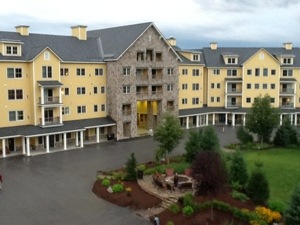
Manchester doesn’t seem to have much in the way of early breakfast. Up For Breakfast, the breakfast place locals like, opens at 7, but we needed to get breakfast a bit earlier in order to get to the ride start on time. Dan B. walked down to the combo Mobile gas station and Maplefields minimart, and brought back a variety of egg and sausage sandwiches, donuts and coffee. Another champion’s breakfast. We gathered for the ride at the Dana Thompson Recreation Park. We were led out on a loop through town, although the expected cheering throngs of townies did not materialize, then headed out for day two. The first twenty miles were covered in well under one hour, since the road was relatively flat and we had a tail-wind. In spite of our speed, we still were able to appreciate the scenery, including dairy farms, meadows with wild flowers, and a large lake, along Route 30. The route got moderately hilly the second 20 miles, which slowed us down considerably, and we lost the tail wind. We stopped at a bakery at around 35 miles to refuel. As with most places in rural Vermont, it had a quaint look, and served home baked goodies that were very tasty. I was feeling a major bonk at this point, and I think my week on call the week before was catching up with me. The last 28 miles included some very long, but moderate grade climbing, long downhills, some highway riding, and it proved to be a great opportunity for 71 year old Dan T. to show what he can do. He really powered up the hills, keeping pace with Dan B., and outpacing Keith and me by a mile. The Lion of Haddonfield roared today! Our ride finished at the Outback Pizza in Ludlow, where very nice sandwiches and salads were waiting for us, and the Otter Creek brewery rep was providing our group free beer. Total miles about 68. Then, we had to mount back up and ride a mile back to the elegant Jackson Gore Lodge, where we checked in to our luxury suite (for real, we are in a premium 3 bedroom suite). Keith and I took advantage of the pool here for a casual swim. Dinner was a barbecue mix of pulled pork, cowboy beans and slaw, while listening to a local band. This was a regular event here, not specific for our group, so a lot of the locals turned out. Tomorrow is a major ride, 104 miles over steep climbs and fast downhills. Should be good.

Frank

20120817-210926.jpg

20120817-211043.jpg

20120817-211053.jpg

Stratton to Manchester

Day one in my adventure in Vermont started on Stratton Mountain, a place with which I am ver familiar. I’ve been here dozens of times with my family for ski trips, but never in the summer. My group, Dan T., Dan B., Keith and I decided to stay in a condo In Stratton, and we wound up being assigned the very same unit my family stayed in back in February when we were here to ski. We were here for the inaugural edition of the Vermont Challenge, a four day point-to-point cycling tour in the Green Mountains. We got checked in to our condo easily enough. We then wandered the area of the Stratton Village, searching for signs of life and the registration area for the event. Finally, we located it in a building near the gondola. Looking up the mountain, the ski runs look very different, covered in green grass and surrounded by leafed-out trees. We signed in and were given a strap to be worn around our wrist the duration of the event, like the ones used at multi-day concerts. We got a large bag with a Vermont Challenge cycling jersey, very attractive, although Dan T. thought it was “hideous”. It also contained a bunch of Hammer gels, several tourist pamphlets, printed cue sheets, and a name badge. Upstairs in the bar, they had dinner waiting for us, buffet-style burgers, salad and brownies, plus we were given two tickets for beers from the bar. A live band of slightly past-their-prime rockers was playing, including one odd song “Take it like a man”. I wasn’t sure what kind of bar this was… Anyway, this was the send off party for the group, and we sat out on the deck, enjoyed the view of the mountain, and just relaxed. We got a speech by the director of the event, thanking all those who helped, naming all the sponsors, and giving instructions on how to proceed the next day.

The next morning we got up early, got our suitcases to the drop-off point, and got a barely adequate breakfast of raisin bran, yoghurt, bagels and coffee. After the obligatory speech, again thanking the sponsors, about fifty riders headed out for the first day’s ride. This number would grow with each day, as many more riders would be joining us for the three, two and one day options. The first part of the ride was a long, screaming downhill, part of which was through a road construction zone. The flag girl held traffic for us as our group rode through. Then the ride started into rolling hills, and a couple more long down hills before we got to the valley where Manchester is. This ride was a pretty benign ride, mostly down hill, with a long loop around Manchester, before winding up in a beautiful park outside of Manchester. The total miles for the day was 56. They had a catered lunch waiting for us under a large tent, music playing from speakers set up by our combination DJ and photographer, and we sat out enjoying the warm sun.

We checked into our inn, a very quaint old victorian house called Sutton’s Place, run by Frank Sutton for over thirty years. He’s a tall gent who lives with his wife in the inn, charges very reasonable rates, and is very accommodating. The inn is close to Northshire Bookstore, which I feel is the best independent bookstore in the country. We spent an hour browsing, and each of us buying a book or three. I bought “This is a book” by Demetri Martin. Very funny. After that, I had to get in a run. I did a five mile run out Barnumville Road 2.5 miles then back. I was able to manage an 8:50 average, with some significant hills in the run. I’m thinking of laying off the running the rest of the tour since the serious climbing is coming. Dinner was at “Ye Old Tavern” (for real) and it was delicious. Then it was back to the inn to get rested for the next day.

Frank

Vermont Challenge

Ed told me, “Frank, at some point you will need to decide between cycling and running in your training.” This was a few years ago when I was training for my first marathon, but still cycling a few days a week. Over the next year I made a big shift, devoting more time to running, and putting fewer miles on the Pinarello. Now, I still ride to work when I can, and get in the occasional longer ride. Ironically, the last longer ride I took was out to Valley Forge with Ed, Michelle, and a resident of mine named Mike. Ed’s knees don’t allow him to run like he used to, and he has become a cycling and swimming demon.

Today, I awoke at five AM, because that is my habit, but I’m in a condo on Stratton Mountain getting ready to ride the four-day Vermont Challenge. This is the inaugural year for this event, which, on paper, looks very daunting. It’s four days of cycling in the Green Mountains of central Vermont, going from point to point. We start from Stratton to Manchester, then Manchester to Okemo. The third day is Okemo to Killington, and the last day is Killington back to Stratton. Each day is around 60 miles, except for the third day which covers 104 miles and includes a long, hard climb in the middle of the route. Of course, this being the Green Mountains, it appears every day is all climbing and descending, since there is not much flat here.

Whether this will hurt my training for Steamtown, or be a good counterpoint, with a successful cross-training effect, I don’t know. I am up here with three friends, two Dans and a Keith, with whom I ride every year, and we are out to have four tough but fun days of cycling. I think I’ll be riding into shape during the event, and not hoping to shine the first day. I will try to write each day to let folks know how this respite from marathon training is going. I brought my running shoes with me in the fanciful belief I could get in a run or two. We’ll see if that happens…

Frank

I run. I doctor.

As an Internal Medicine resident I penned a letter to the Nike corporation suggesting they sponsor out internal medicine team. Sports companies sponsor amateur teams from Little League to college. It seemed reasonable the best known sports company in the world may want to throw its sponsorship in the direction of some underpaid, overworked residents, especially when I imagined the TV commercial.

University Hospitals of Cleveland, 2 AM .…Any day

….the camera catches the bottom the green scrubs, the tail of the well worn white lab coat a glancing view of the Nike swoosh as it pans the ankles and feet of medical residents in a dimly lit room. You can barely make out the tired voices….

Resident #1: “Ms. Murphy spiked another fever. I need to draw blood cultures after I get the ABG on room 545, and check the PTT on 318. Only 16 hrs and my 36 hours are over. Then I can sleep in my own bed.”

Resident # 2: The Chief Resident called – we have an admission in the ER. A 78 y/o woman with urosepsis and a change in mental status; another sleepless night.”

Overhead announcement: “Code Blue!!!, 8th floor Lerner Tower, Code Blue!!!

The camera catches four figures scrambling out the door, stethoscopes in hand, rounding the corner. When they spot another medical waiting at the elevator they crash through the door into the stairwell and furiously climb flights of stairs, beads of sweat forming as their breathing becoming simultaneously more rapid and audible. Springing out of the stairwell the four heroes dash into a patient’s room as the crash cart slides in, and other team members collapse into the small patient room. The four residents take their positions: chest compressions, airway management, vascular access and the senior resident at the head of the bed barking out commands. They work  feverously works to regain a pulse while the other medical team, the one waiting at the elevator, watches helplessly from outside. As the cardiac monitor acknowledges the beep and digital display of a heartbeat, across the screen in large letters:

Save Lives.

Just Do It! Then the Nike swoosh and …fade to black.

I never received a response.

Now my rounding looks at lot like my running. No sprinting to codes, just the long plodding of more miles; caring for patients with chronic illness. The punishing 36 hour shifts have given way to years of patient medical practice.

I now take call from home, but needing to round at two hospitals this past Sunday. The Steamtown Marathon is two months away and I am in the midst of increasing mileage. No time to take a weekend off. At 4:45 AM I rolled out of bed, and by 5:25 I was starting the first steps of 17 miles. A quick shower, a 2 minute breakfast, and then out the door to start hospital rounds.

At the end of the day I am fatigued and can feel the ache in my legs, but I am satisfied my miles and my medical advice have been solid. And satisfied from a day of physical and mental work. Hopefully both result in positive outcomes.  

I have no true aspirations for a professional sponsorship – at least not from running. At one time it was fun to think about a completely different biathlon: running and saving lives. But those days are long gone. I run. I doctor. Two separate events that keep me whole.

Hydration, Electrolytes, and Running

My cycling friend, Dan T., brought to my attention an article in Mother Jones, an online and print news magazine, which asks the question, “Do Sports Drinks Really Work?”  The article is a discussion of seven articles in the British Medical Journal which discuss the research supposedly supporting sports drink manufacturers’ claims that their products actually improve athletes’ performance.  In the articles, very valid arguments are made that the whole science behind sports drink claims is heavily tainted by the source of funding for the research, the small number of participants enrolled in the studies, the lack of adequate controls, no blind studies, the proprietary nature of the studies, little or no studies showing negative results, and the sources of funding for the journals and societies themselves.

The lead article of the seven, titled “The Truth about Sports Drinks,” is an investigative essay looking at the rise of the sports drink industry, the ownership of the various sports drinks by the giant multinational corporations Coca-Cola, PepsiCo and Glaxo Smith Klein, and the way the have used supposedly scientific research to support their claims that sports drinks are a necessary adjunct to superior athletic performance.  The science comes from institutes owned by the sports drink companies themselves, or from researchers heavily supported by the companies.  Assumptions, such as the major role of maximizing hydration, the claim that thirst lags behind the need for fluid replacement, that water alone is inferior to the sports drinks for achieving hydration, that color of urine is a key indicator of whether one’s hydration is adequate, are all made without good  scientific evidence.  For the article, the writer and staff studied hundreds of articles used by these companies to justify their claims, and found that the “quality of the evidence was so poor that it was impossible to draw firm conclusions about the effects of the sports drink.”  The research and marketing have been taken as proof by many sports medicine physicians, coaches, and everyday athletes, and become a kind of gospel of training and competing.  A major criticism in the article is that the marketing is also directed to teens and children participating in typical school or club sports, contributing to child obesity.

All of us who run marathons, participate in triathlons, engage in long cycling events, or do other endurance sports, have been influenced by this.  Not everyone buys into it.  We are offered either water or a sports drink at most running events, and my personal observation is that about half the runners go with water.  I’ve been offered gels and salt packets at marathons, advised to “make sure to start hydrating at least a day before”, told to drink before I got thirsty, and all sorts of other hydration related advice.  It becomes especially confusing training in the summer, with warm days of high humidity when we sweat so much our socks squish with every step, and we look like we jumped in a lake.  I know I need water, and I even get terrifically thirsty, but knowing what is appropriate fluid replacement, and whether the sports drink claims have any merit at all is not a simple thing.  I would recommend anyone with an interest in this to look at the articles, and see how they examine with the rigor of true, objective scientific investigators the truth about the claims and marketing of the sports drink makers.

Frank
Ref:  BMJ 2012;345:e4737 doi: 10.1136/bmj.e4737 (Published 18 July 2012)

Mother Jones, “Do Sports Drinks Really Work?, All that stuff about replacing electrolytes and so on you’ve been hearing all these years? Not so much.”  By | Mon Jul. 30, 2012 3:00 AM PDT

Slackers

Each athlete, whether amateur or professional, has the athletic standard they can reach and the level of competition they achieve. The great assumption is we will all work to the best of our ability; however, our mental and physical state along with our previous experiences limit what we can achieve. Malcolm Gladwell writes on this very topic in “Slackers” (New Yorker July 30, 20120), when he highlights the career of running great Alberto Salazar and reviews his new memoir. Gladwell muses that Salazaar is an anti-slacker (my term, not his), who in his prime, worked beyond the expectations of his coaches and co-runners – sometimes to his detriment. Steve Prefontaine ran times far quicker than would be calculated by his vO2 max.

I incorporate the idea of the slacker in my training runs. As my weekly mileage increases and the workouts increase in intensity I hope I will be able to run at the level of competition I have set for myself.  In the last 2 months before Steamtown my goal is to minimize my slacking. Every long run – no slacking. Each interval or hill workout – no slacking. Every lost toenail, blister, sore muscle – no slacking. I have run enough to understand the challenge. Now I just need to run the very best I can.

Pho- It heals what ails you.

My family has amended the old comedic adage of “take two aspirin and call me in the morning” to” take two Tylenol and 24 ounces of water and let us know how you are doing.” The modern adaptation comes from a family of NSAID allergies and the realization the majority of our families’ headaches and general malaise is from not drinking enough water throughout the day. Yesterday posed a particular challenge to keeping hydrated. I woke yesterday morning with what I was calling a “dry throat.”  I had no malaise, chills, fever or other symptoms of an infection. Recognizing this may be the first sign of an infection, but unwilling to admit it less I miss my Sunday long run I convinced myself that a few gulps of water a 2 Tylenol would fix the problem.  And 6 miles into my 13 miler I was feeling good and pleased I had not succumbed to some false symptom.  By mile 10 I was holding my own as Tony and Frank were also beginning to struggle through the humidity. I finished the run ok, but immediately felt like I had finished 18 miles. I knew something was wrong when I didn’t feel I could enjoy the normal post run coffee with my friends. Let’s pause here and stress the gravity of the statement. Many athletes have their routines. Here is what goes through my head on a long run: miles 1-4: catching up with the guys; miles 5-10: absolutely nothing to completely banal thoughts like – oh, that’s a nice tree, because this is my meditation time; and from mile 10 till the finish each step, every breath is one step closer to a large cup of coffee.   So not going for coffee was a sign of serious distress.  I headed home with a burning in my throat that made swallowing difficult, and within a couple of hours sneezing and a runny nose began to appear. Two Tylenol made little difference. And tea or orange juice faired only slightly better.  My dilemma was clear. I needed hydration but each swallow burned. I turned to my fail safe approach to hydration – pho.

Pho is a Vietnamese soup. Granted any chicken soup may have helped, but pho has become my family’s favorite for cold and flu season. A large bowel of vegetable pho gives plenty of hot water, vermicelli noodles, a vegetable (or chicken or beef) broth and a heaping of vegetables all for under $7. It’s also not as salty as most restaurant versions of chicken soup.  While not a complete cure I felt much better post-pho. If there is a point to this tale it is the importance of hydration and use of good quality soups to keep us healthy. Every culture has its favorite soup, and I am not turning my back on chicken soup with matzoh balls (lest my grandparents turn in their graves), but if you find yourself under the weather, or in the need of tasty hydration, pho may be the fix.

Sweatin’ with the oldies, or It’s still summer!

Call me wet. For today’s Sunday run, the temperature was, well, temperate, in the mid-seventies. The humidity, though, was closing in on the 100% mark. Almost everyone was running with a water bottle today, even though we have water fountains along our route. Staying hydrated was paramount, as the shorts, shirts, socks and hats got thoroughly soaked with sweat.

The crew have been cranking up the miles. Tony ran 15.86 miles today, totally ignoring the Garmin master telling him to do the extra 0.14. I give him credit for not being a slave to the Garmin. Steve and Bryan also upped the distance, but I didn’t get their totals for today. My own approach has been to get the long runs in earlier in the training plan so I did 19 today, and glad to say, it was a good run, averaging a 9:15 pace.

We now have only ten weeks until Steamtown. Having run five marathons, I’m starting to detect a pattern. Sixteen weeks seems like a very long time to train. As the event gets closer, time, in spite of known physical laws, compresses, and seems to go by in chunks. I think our group is doing well, getting in the proper training, and each sticking to his plans. I can only wonder what it would be like to run in a dryer place, though. It takes two days for my shoes to dry. Well, that’s the way summer is here.

I hope everyone is enjoying watching the Olympics. London seems to have done an excellent job preparing, and the games are always exciting.

Frank

A Message from Steamtown Asst. Race Director to SJAC

Greetings South Jersey Athletic Club members!

Alert SJAC club member Tony Walter sent us an e-mail letting us know that a big part of your crew is doing Steamtown this year.  That’s excellent news.  We love New Jersey runners!

I hope your training is going well.  I know that you have begun your long runs and are probably in the 12 to 14 mile range by now (at least I hope you are).  Make sure you mix in some downhills.  When I ran Steamtown, my quads were so sore afterwords that I couldn’t walk downstairs forwards for three days.  But believe me, when you cross the finish line and get that medal hung around your neck, it’s all worth it.

I think you’ll like our medal this year – 3″, antique nickel, with a cool ribbon.  And make sure you stick around for the post race party!

Tony said about 10 of you are doing Steamtown.  Hopefully the 10 of you will be able to inspire even more runners to give Steamtown a try next year.  Training for a marathon together is a great experience, provided you don’t kill each other in the process.

Anyway, I’m confident you’ll have a great experience here  – and you’ll even like Scranton.  We’re just like Haddonfield but without the glitter!

Keep up the good work.  See you in October!

Yours in running,

Jim Cummings, Asst. Race Director, Steamtown Marathon

Uncorking Croatia

The Blog of WINES OF CROATIA

RunnersOnTheGo.com

To help enrich the lives of others, we developed RunnersOnTheGo.com to help runners save money on races, running stores, and much more. We also provide the specific local information that makes your travel for business, vacation, or racing as rewarding as possible.

getsetandgo

Travel Blog of a Budget Traveler sharing stories on travel, books & Vegetarian Food

Marc Hemingway

Trying to keep track of my life (and my life on track)

Mid-Life, Mid-Level, Masters Running

Exploring ideas about running to contribute to a more enjoyable pursuit for the mid-level masters runner

therunningtherapist

"One foot in front of the other and one thought at a time"

WordPress.com News

The latest news on WordPress.com and the WordPress community.

retireediary

The Diary of a Retiree