

i jumped into the pool as I always do, backside first, to start my first swim workout in a few weeks, having just returned from a very enjoyable two weeks in Italy. I positioned my goggles and pushed off, clicking my Garmin as I did. After a mere two 400’s, I noticed my left arm had become swollen and tense. But this is the most recent part of the story. Allow me to go back a few years.
Around the new year in 2021, while I was still busily working as a general surgeon, I went for a run with my friend Pat. We had run about a mile and a half when I was hit by a shearing pain in my right calf. Pat helped me hobble back to his house. I was able to drive my car home. The pain slowly eased, and I went back to work as usual, but had a noticeable limp. I sought out one of my orthopedic colleagues who examined me. He said I ruptured a Baker’s cyst, which is a cyst of the knee’s joint capsule. There was no treatment for it, just had to wait for it to improve. He ordered an MRI of my knee, which confirmed the cyst rupture, but also showed I completely tore off my medial meniscus on that side. He did not say I could not run, but suggested it may increase the wear on my knee.
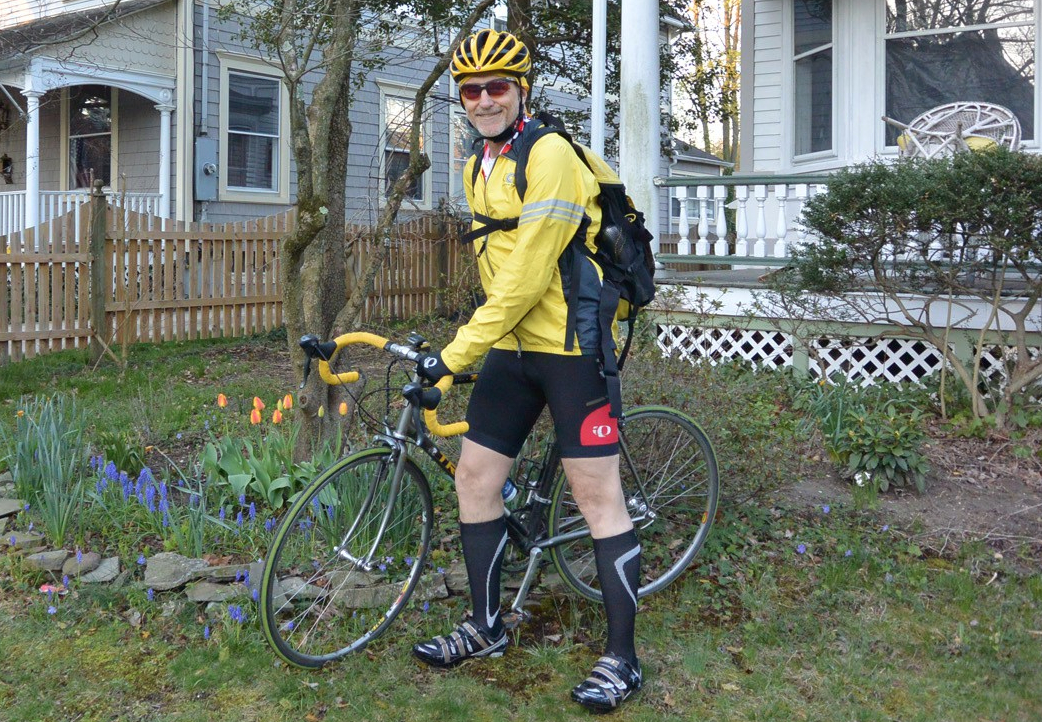
So, naturally, after the pain got better, I started running again, although it took a few months of downtime. I started getting in some longer runs, cycling, and some rowing machine workouts. On a Friday in early November, 2023, I went for a run at the end of a long day at work. Oddly, I got about a tenth of a mile and developed pain in my left thigh. I stopped my run and the pain disappeared, so I started up again. But the pain consistently came back at each tenth of a mile. Being bullheaded I kept this up for a couple of miles. When I got home I rested, then felt back to normal the next morning. I went out for a run, thinking everything was back to normal. The same pattern happened again, and looking down at my left leg, it appeared swollen and blue. I know the signs of a deep vein thrombosis, so I hobbled home and took an aspirin. My wife was out, but when she returned she drove me to my hospital’s ER. It is strange as a well-known surgeon walking into one’s own ER, and explaining I am not there to see a patient, I am the patient. I received very nice care from all the ER personnel, and I recognize that because I work there they looked out for me. But I know from my patients’ experiences they have received the same considerate care. At first, an ultrasound of the veins of my left leg and thigh was done which showed no blockage. But a CT scan of my pelvis followed, which showed a complete obstruction of my left common iliac vein, a major vein leading to my vena cava. This condition has a name, May-Thurner syndrome. I was admitted to the hospital and the next day I was operated on by one of my former trainees who used a catheter to remove the blood clot. I’m thankful she turned out to be such an excellent vascular surgeon. I was discharged the following day, Sunday, and back at work on Monday. But my days operating were coming to an end, as I had planned to retire on January 1, 2024. I did just that, and felt it was good timing. I took up teaching at our medical school, and started running again about six weeks after the surgery.
I noticed early on in 2024 that when. I put a push on at the end of a run, I would get a strange feeling in the front of my chest. I attributed it to a fall I had skiing that February, when I hit the snow hard. The feeling came and went. I had a stress test ordered by my physician which was normal. In fact, while on the treadmill the nurse asked if I was a runner, since they had the pace cranked up pretty high. The chest discomfort persisted, though, and by late October it had become predictable. I would run about half a mile when the squeezing sensation started, I’d stop for a minute or two, then it would occur again at another half mile. I called my physician who spoke with a cardiologist. The decision was to have a cardiac catheterization done as a precaution.
A few days later I was in the cath lab. I was awake as the cardiologist snaked a catheter up my right radial artery, through my aorta and into my coronary arteries. He only made a few technical comments as he did this. When he finished the study, but with the catheter still in, he pulled up the video screen and showed my what he found. There was an area of significant narrowing from plaque in one of my major coronary arteries, the left anterior descending. He had taken pressure measurements across the area showing a drop in pressure. He said I could have surgery or a stent, but recommended the stent. While I’m partial to surgery, the stent seemed the best choice. First, a narrow balloon is used to dilate the blockage, then a stent is expanded at the site. As this was happening I notice feeling the same squeezing sensation I had experienced while running. That confirmed that I needed this dilation and stent.
Six weeks later, I took my first run after the stent. I got to a half mile and kept going. I didn’t feel great, but there was no chest pain. I got back to my usual activities, went skiing, running, cycling and swimming, and felt pretty good. My backpacking friends and I tackled the “Grand Canyon of Pennsylvania” in June of 2024. We decided it was along a canyon, but perhaps not so grand. It was also very warm, and as we backpacked we had to be sure to keep enough clean water with us, as we were losing a lot to sweat. By the one year anniversary of my stent, in November, I was very thankful for the skill of the cardiologist and that I spoke up about my chest pain.
Things continued. on an even keel through February of this year when I went skiing again. I felt pretty good on the slopes, although had another fall when Sierra cement-like snow stuck to the bottom of my boot causing a ski to come off as I was flying down hill. I hit the ground hard on my left shoulder. Nothing broken, but the shoulder sure hurt. In mid-March, I noticed something peculiar. My normal resting heart rate had gone from its usual 48 to the low to mid thirties. I again saw my physician, although it was just for a routine visit. The nurse mentioned my slow heart rate which my physician, who happens to be a friend and fellow cyclist, attributed it to my fine athletic conditioning (he he). However, on a trip with my wife to Ireland, I noticed she could march right up a trail on a hill while I struggled and got short of breath. After returning from Ireland, I went backpacking for a weekend. While my companions had no trouble climbing hills with their packs, I had to stop every ten feet to catch my breath. I survived the backpacking trip, but on return had an appointment, routine, to see my cardiologist. I mentioned the shortness of breath. An EKG was done. The doctor stepped in to see me, but got a phone call. So he stepped out the door to take the call. On coming back in the room, he said “that call was about you”. That perked my ears up. He explained that my EKG showed complete, or third degree, heart block.
A little explanation may be needed here. The heart has a natural pacemaker located in the right atrium where the normal rhythm of the heart is set. This pacemaker causes an electrical signal to progress through fibers from the atrium to the ventricles, causing each to contract in turn. This is why a lub-dub rhythm is heard when listening to the heart with a stethoscope. Third degree heart block occurs when that electrical signal does not flow to the ventricles from the right atrium. This leaves the ventricle on its own. It fires at its own rate, which is called an escape rhythm, and at rest is normally in the mid thirties per minute. I was told by the cardiologist I would need a pacemaker inserted.
I was, around the same time, referred to an infectious disease (ID) specialist. Along with the abnormal heart rhythm I had developed a frequent cough. I told my story to the ID doctor, who also happens to be a colleague. He said I would need to be tested for Lyme disease. It turns out that heart block can be caused by Lyme disease, but I could not recall ever having the classic target rash or getting bitten by a deer tick. I got tested, first a screening test which was positive, then more definitive tests. These showed I had Lyme disease, although not within the last few months. He started me on a six week course of doxycycline. Meanwhile, I had a few more tests which showed evidence of congestive heart failure.
So, I was back in the same cath lab again, this time for a pacemaker insertion. The cardiologist was an electrophysiologist, different from the one who did my stent. I received a pacemaker with two leads, one to my right atrium and the other to my right ventricle. The atrial lead picks up my natural pacemaker’s rhythm, and the ventricle lead fires at an appropriate interval to cause the ventricles to contract. I recall saying to my wife as I lay in the hospital bed after the procedure, “wow, I feel so much better already!”.
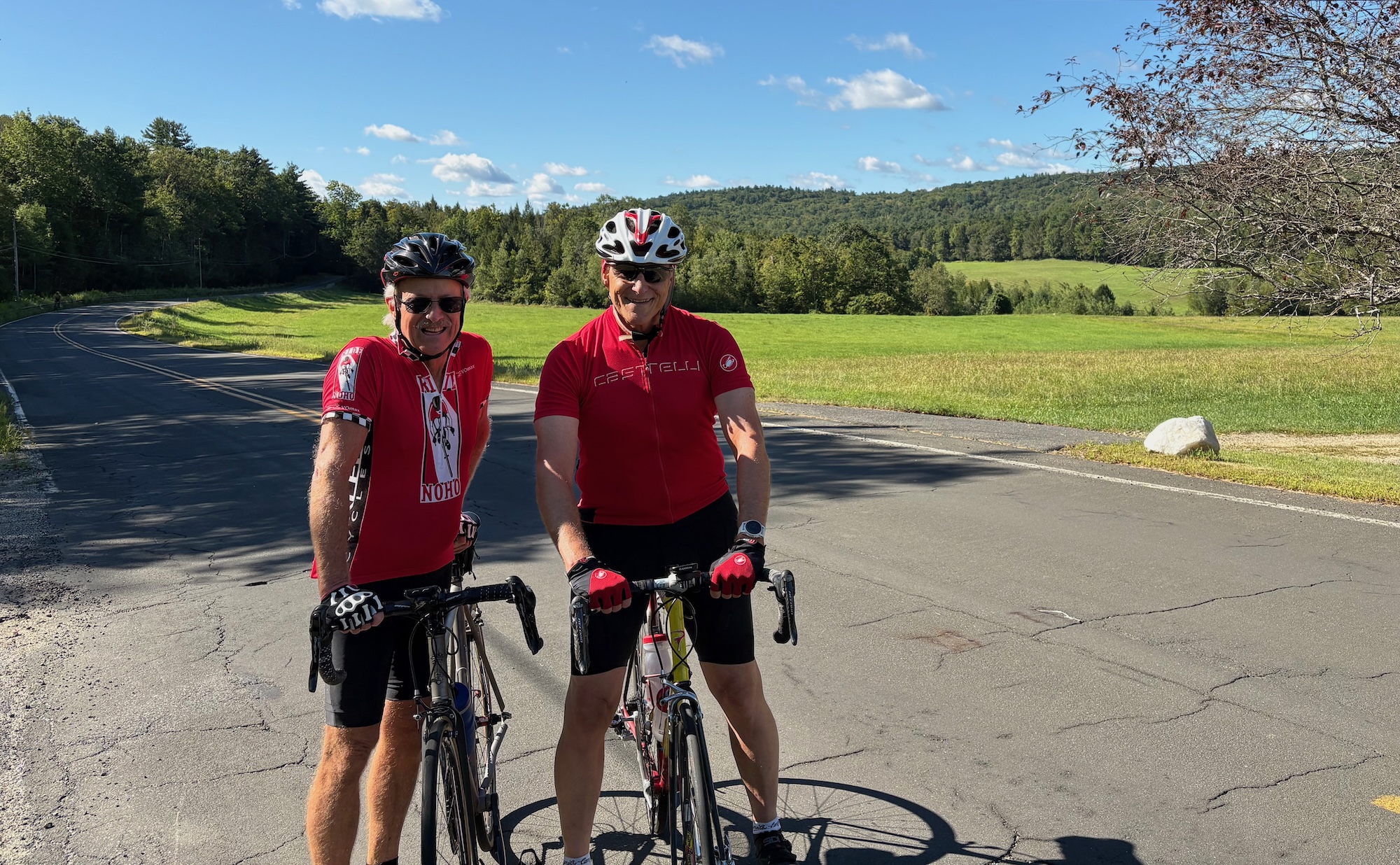
That was at the end of April of this year. I recuperated a few weeks, then at the end of May was able to do a thirty three mile bike ride in Delaware, the “Medio-Fondo”. My knee has gotten a little worse, but I still get in a short run or two, and I got back to swim workouts. In August, I spent a week riding with friends in Western Massachusetts. So, it appears the new pacemaker is doing its job. It is definitely odd feeling the device in my upper left chest and knowing I am dependent on it for my heart to beat properly.

But about that swelling in my arm. Things were going well. We had a very nice trip to Italy, walking all over Rome, Pompeii, Naples, Venice and Florence. We took very interesting and illuminating side trips to Padua and Siena. We even stopped over in London to visit friends on our return trip. When I got back, I went for a swim workout a few days later. I had not swum very far when I noticed my left arm tightening up a bit. After a second 400 yards, my left arm was quite stiff and the veins were bulging and tense. I got worried that I had developed a blood clot causing a major vein to be obstructed, possibly due to the leads from the pacemaker. I stopped my workout, got dressed and made some calls. First, I called the cardiologist who inserted the pacemaker. He was also concerned and recommended I get a venous ultrasound. My next call was to my vascular surgeon who helped me schedule the ultrasound for that day. The good news is that there was no blood clot. However, the arm was still a bit swollen. It appears I’ve developed some restriction of blood flow out of my arm, and when I stress the muscles, increased blood flow to the arm cannot leave easily. My hope is that with use, other veins will dilate to accommodate the increased blood flow thus reducing the swelling.
I did not anticipate any of this, and am telling the story as a reminder to myself that things like this happen as one gets older. This is both from aging, but also just chance. I must change my ideas about “getting fit”, and setting goals.

Given this is the Christmas season, the end of the year and start of a new year, I hope you all have a very pleasant and safe holiday time and keep going for another adventure.





 sjacmarathoners