Rudolph’s Red Nose Ale

“To alcohol!  The cause of–and solution to–of all of life’s problems”  Homer Simpson

I did a quick check on Google, asking the question, “Why do runners like beer?”  Not too surprisingly, there are plenty of comments, articles and pseudo-scientific research about how running and beer go together.  There is an entry in a Runner’s World forum asking why runners like Craft (Craft is capitalized in the entry) beers more than the general populace.  This query, posted in March, 2012, got answers ranging from “that’s because runners are snobs” (I’m paraphrasing here), to runners are craft beer fans who like the quality over the Bud/Miller/Coors brews.  There were a few comments on why Michelob Ultra might be marketed to athletes, or at least, to sedentary slugs who see drinking that beer as a first step towards fitness.  Little mention though, at least in the first several pages of hits on Google, on home brewing and running.  So, that’s where I step in.

Last spring I made a beer of my own recipe which I called “Long Run Ale”.  The idea was to make a beer dedicated to my running friends about to run the Boston Marathon.  In order to make it special for runners, I investigated how to make home-made energy gel.  It turned out that two primary ingredients were honey and molasses.  I made the brew as a very hoppy American pale ale, with Cascade and Willamette hops, and honey and molasses as part of the sugar source.  It turned out it was a real hit.  My running friends loved it.

When I wanted to make a Christmas Spiced Ale this winter, I decided to include the “Gu” in the recipe in order to keep it runner oriented.  Not that including honey and molasses makes it sweet.  The yeast convert all the sugar to alcohol and CO2, and the honey and molasses add to the color and impart a bit of flavor.  This is my version of a Christmas or Winter seasonal ale.  It is a partial mash recipe, which means part of the sugar for fermenting comes directly from steeped grains, and partly from malt extract.

Partial Mash:

  • Belgian 2-Row Pale Malt  5 lbs.
  • Caramel 80    0.5 lbs. (for the red color)

Boil 60 minutes

  • Grain extract from partial mash
  • Amber Dry Malt Extract   4 lbs
  • Honey  1 lb
  • Molasses  0.5 lbs
  • Spices:  Nutmeg, Ginger and Clove (I intended to use Allspice, too, but the stores were all out, every one I tried).

Hops:

  • Centennial                0.5 oz. at 60 min.
  • Northern Brewer     0.5 oz. at 30 min.
  • Sterling                      0.5 oz. at 10 min.

Yeast:  Wyeast 1214 Belgian Abbey

The first step in the brewing is the partial mash. The crushed Belgian 2-Row malt and the Crystal malt are put in a nylon bag and suspended in water heated to 154 degrees Fahrenheit. This extracts the sugar from the crushed grain, dissolving it in the water. The grain is then sparged (rinsed) a couple of times with hot water to extract as much sugar as possible. The grains are then discarded, although they can be saved and used as an addition to bread, for animal feed, or as mulch.

Malted crushed barley

Combined and crushed malted barley and caramel 80 grains.

Partial Mash

The crushed grains being steeped in 154º F water for one hour.


The sweet liquid which is left is called the wort, not yet beer, but that is its destiny.  Water is added to bring the volume to about 2.5 gallons, and the wort is brought to a boil.  The additional malt extract, which is sugar extracted from malted grain, just like in the mash, above, but prepared and pre-packaged either in liquid (LME) or dry (DME) form, is added to the boil.  Now, all the wort needs is the hops.  Hops are a wonderful aromatic flower which grows on vines, and add bitterness and aroma to beer.  Hops added early in the boil are the bittering hops, in the middle, flavoring, and those added at the end are the aromatic hops.
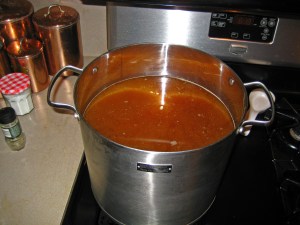
Wort on the stove.

The wort is boiled and the hops added according to a time schedule.

Once the boil is finished, the wort must be cooled to approximately 70 degrees F as quickly as possible.  There is equipment for this, but I use a very basic method known as putting the brew pot in the sink and swirling cold water around it.  It takes about 30 minutes to bring the temperature down this way.
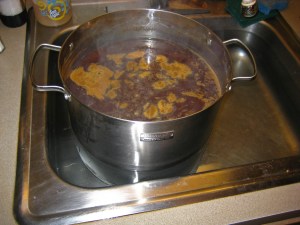
Brew pot being cooled with cold water.

At the end of the boil, the wort is chilled as quickly as possible to 70ºF.

After the wort is chilled to room temperature, it is ready to pour in to the fermenter.  This is done fairly vigorously, to aerate the wort in preparation for the yeast.  Water is added to bring the volume up to five gallons, and the mix is again aerated to supply oxygen.  Also, a measurement of the specific gravity of the wort is taken, which will be used later to estimate the percent alcohol in the beer.  For this recipe, the O.G. (original gravity) was 1.066.

Package of yeast

The yeast comes packaged with nutrients, and is activated before adding to the fermenter.

Then comes the almost ceremonial “pitching” of the yeast.  This is truly how the magic happens.  In the days before the microscope, beer was made with barley, water and hops (or other spices before hops were used).  The yeast was there, but no one knew it.  Then, Louis Pasteur discovered what was happening at the microbe level.  Now, we have the remarkable choice of numerous strains of yeast, each with their own behavior, which is how beers get certain fruity, spicy or caramel flavors, achieve higher alcohol levels if provided enough sugar from the malt, and may also contribute undesirable flavors.  I chose this particular yeast because it is often used for Belgian style spiced seasonal ales.  Once the yeast is pitched in, the fermenter carboy is sealed with a lid with an escape airlock.  As the yeast go to work, producing alcohol, carbon dioxide is also created which is released through the airlock.  It takes a day or so for the yeast to start converting the sugar to alcohol, and there is nothing more satisfying at this stage than seeing the bubbles merrily making their way through the air lock.  Ales are fermented between 65 and 75 degrees F.  Lagers are fermented at lower temperatures (45-55 degrees F) for longer times (weeks to months) using yeast which are active at those temperatures.
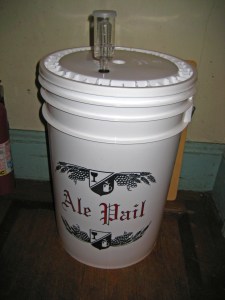
Fermenter.

The fermenter, with lid on and airlock up and ready.

There’s nothing left to do at this point except wait for those marvelous little yeasts to do their job.  After about a week, the beer is transferred, this time with a siphon to prevent aeration, to a secondary fermenter.  The first week is for the major conversion of sugar to alcohol.  The secondary phase is for conditioning, when the yeast are still active, but taking on more complex sugars and initial byproducts of fermentation.

After another week or two in the secondary fermenter, the beer is ready to be bottled.  Bottling day can be busy.  One needs all the bottles cleaned, sterilized and ready to go.  The bottling equipment, including a bottling carboy, siphon and tubing, bottle filler and tubing, and bottle caps all need sterilizing.  I find the first step in this process is to pour a homebrew from the last batch, and then set about tackling all these steps.
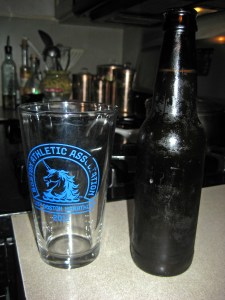
Bottle of beer and glass.

A bottle of my last brew, a German Hefeweizen.
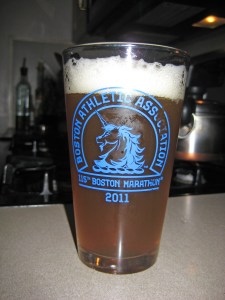
IMG_1895

Nice head, nice color, this should augment the bottling day activities nicely.

Bottling is best done with a helper.  It is possible to do it by yourself, but a whole lot tougher, and it is not easy to keep all those parts I mentioned clean and sterile without an extra pair of hands.

The beer is decanted into the carboy used for bottling, which has a spigot at the bottom, and doesn’t require a lid.  Priming sugar, which has been dissolved in boiling water to sterilize it, then cooled, is added to the mix.  This provides the additional amount of sugar needed to allow carbonation to occur in the bottle.  The yeast are still there, and will convert this small amount of sugar to additional alcohol and carbon dioxide, not enough to change the alcohol content significantly, and just enough to provide carbonation in the sealed bottle.  Many tales of exploding bottles are told by home brewers of their early attempts at getting this right.  The amount of sugar needed is readily available in homebrewing books and online.  A final gravity (F.G.) measurement is taken, with my brew having a F.G. of 1.010, which indicates the yeast did their job.  This should be about 7.3 percent A.B.V.   The spigot is then opened and the bottling begins.
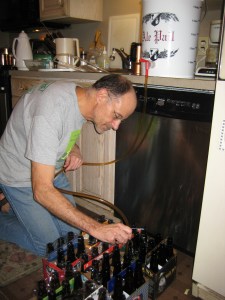
Filling the bottles

Filling the bottles takes a bit of concentration and assistance.

Finally, the bottles need to be capped.  My son and I worked together on this, with him holding the bottles so they wouldn’t tilt, and with me working the capping device.
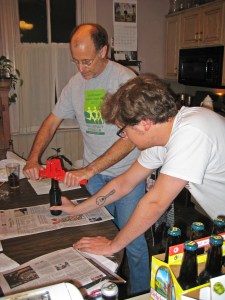
Bottle capping.

Capping the bottles.

The yield from five gallons of beer is about 50 twelve ounce bottles, plus or minus a bottle.  We eked out forty eight and three quarters.  The beer is now ready to be bottle conditioned, which means storing it in the cellar for about four weeks.
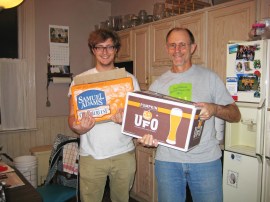
Two cases of beer.

The beer is in the bottles, and they are capped and ready to go to the cellar.

IMG_1901

On the shelf in the basement, they will sit and condition, adding flavor and carbonation over the next several weeks.


At this stage I just need to forget they are down in the cellar, and let the weeks roll by.  While I can get an idea of how the finished product will taste, from various whiffs and sips of the dregs, I won’t really know the outcome until it is ready to drink.  We’ll probably uncap a bottle at Christmas time, since the family will be around, but it will be a bit early yet.  Also, higher alcohol beers like this can use a much longer bottle conditioning time before they reach their best flavor, mouth feel and overall presentation.  It is mentioned, the time a homebrew is ready to drink is when you are opening the last remaining bottle from the batch.

Is beer good for runners?  That’s not an easy question to answer.  I do believe in the relaxing and socializing qualities of beer, and nearly all of my running friends like it.  It turns out Ben Franklin was speaking of wine, not beer, in the quote attributed to him about how god loves us and wants us to be happy, but it applies to beer, too.   Pro-temperance zealots have their own reasons for disliking all alcohol, and some trainers will come out strongly against it for their athletes.  On the other hand, there is tremendous support in the running community for beer.  It’s freely distributed at the end of many marathons.  The international group known as the Hash House Harriers is based on the combination of beer and running, and they admit that they are a drinking club with a running problem.  Our neighbor, Philadelphia, has a great group of runners known as the Fishtown Beer Runners, who hold weekly runs which end at the selected pub of the week.  I think the combination of running and beer is here to stay, and I couldn’t be happier.

Frank

Whoa, this wasn’t supposed to happen (Sandy, that is).

Rain from hurricane Sandy

It’s raining, but Hurricane Sandy’s full force has yet to take effect.

One thing I’ve found fascinating, and sometimes discouraging, is the way we sign up for a marathon many months in advance, start the training program about four months before the race, and have no idea what may befall us during that time.  Right now, it’s hurricane Sandy which is disrupting our smooth passage to the Philly marathon, Nov. 18.  It’s also one week before the New York City marathon, and a few of our club members are running that race.  With one week to go for NYC, a forced couple of non-running days may be just what they need to be in top form.

Where I live in South Jersey, minutes from Philadelphia, we are, as the forecasters have noted, in the “cross-hairs” of the hurricane.  As a hunter, that implies intent, as if we are the target.  In fact, it is the joining of weather forces, with a waxing moon and rising tides, that steers this particularly enormous weather system directly towards us and makes it so threatening.  Not very long ago, around 1960, the first successful weather satellites were launched which allowed tracking and predictions of hurricanes’ paths.  Before then, barometers and reports from the Caribbean were harbingers of a storm, with little predictability of which way the storm would go.  Our house was built in 1884.  I imagine at that time, a storm of this nature would be devastating, with no hint of it’s arrival.  It is humorous, though, to see what is going on at Lowe’s and at the grocery store in terms of preparedness.  At Lowe’s, they were completely out of “D” batteries, for powering flashlights, I guess, although other appliances come to mind.  Plenty of AA or AAA, though.  I noted a good number of customers buying a garden hose and a pump.  I’m not sure if the pump was plug-in or manual, but good luck to them who need to pump out the water with that limited device.  We were at Lowe’s for a new washing machine, since ours died.  Not many folks shopping in our side of the store yesterday.  At the local Acme and at Lowe’s, customers were carting away enormous plastic-wrapped bundles of 0.5 L water bottles containing 50-100 bottles per bundle.  I can see a use for this.  If the water level gets very high, one can empty the water bottles, put the caps back on, and create a raft by tying the bundles together.  If one is concerned about the water supply, another, perhaps saner approach, would be to put water from the tap into available containers at home, but that means not contributing to the economy, so never mind.

We did a check of all our outdoor areas, for loose furniture, potted plants and other objects that might take flight in the storm.  Of major concern around here is the possibility of trees coming uprooted as the ground soaks and the winds rise.  We have a few tall trees close to our house, hopefully strong, and also hopefully protected from the full force of the wind by being between houses.  Our tallest tree menaces were taken down in the last few years, having lived to about 100, and starting to drop large branches indiscriminately.

My hospital was closed for all but emergencies today, so no elective procedures.  The trains are not running into Philadelphia.  The bridges are staying open unless sustained winds up to 70 miles per hour hit, then they will close.  At the moment, it is fairly windy, with a steady fine rain blowing sideways, covering areas usually under cover with a wet sheen, and creating large puddles around the leaves raked into the streets.  The township was supposed to do an emergency leaf removal yesterday, but I didn’t see it happening.  The center of the storm is due to hit New Jersey around midnight tonight.  I think our offices will remain closed tomorrow, since this storm has not yet peaked, and is cruising at a very conversational pace, to relate it to running.  By the traffic I see from my window at home, plenty of folks are braving the weather.  I am taking this opportunity to catch up on things I say I will do, but can’t seem to find the time.  Hopefully, by at the latest, Wednesday, we’ll be able to get out there and hit the pavement.

I hope all of our neighbors, i.e. the whole eastern seaboard, remain safe and dry.
Frank

The Heart of Fall

Golden leaves.

The bright golden colors of fall.

Here we are in the middle of fall, with the bright but fleeting colors of the leaves creating a beautiful backdrop for  our runs.  Right now, the weather doesn’t quite know if 75 or 45 is the correct temperature.  One day it’s tights, long sleeve shirt, and light gloves, then its back to shorts and short sleeves.  One thing is constant, though, evening runs are in the dark.  I equip myself with a headlamp and reflectors for these runs.  The headlamp is annoying, but necessary.  Some areas are well lit by streetlights, but our town is notorious for potholes, especially in areas where the streets are dark.  Potholes seem to congregate in the dark.

Spent yellow squash plant.

This yellow squash plant was very productive over the summer, providing us with a dozen or so squash, and we ate some of the blossoms, too.

Running in the dark, I feel a bit like a fugitive, darting among the shadows, and aware the drivers are not necessarily aware of me.  It is a bit of a survival game.

Stem of a zucchini plant.

The wizened stem of a zucchini plant.

Unlike the plants in these photos, I am planning to reach a peak in the next few weeks as I take on the Philly Marathon, November 18.  This will be my fifth year in a row running Philly.  If someone told me back in 2008, that by the end of 2012 I’d have seven marathons in the books, I’d have thought they were crazy.  But, as long as I finish it, this will be my seventh, with one Boston and one Steamtown in the mix.

Tomatoes still green in October.

Green tomatoes still hanging on the vine in late October.

Many of my friends, about my age of 58, are looking ahead to retirement and discussing their bucket lists.  Don’t speak to me of bucket lists.  It’s not that I believe that somehow I am less mortal than my non-running friends.  Quite the contrary.  I seem to take on some risks for which life afterwards is not a given.  I don’t think I’m adding years to my existence by running, or eating right.  But, running, and competing are a great deal of fun, an endless challenge, and a great reason to get together with like minded folks and have a good time…often with good beer involved.  The list of interesting things I would like to do keeps expanding.

Orange Peel Fungus

I believe these are Orange Peel Fungus, a type of mushroom which bloomed in our garden.

Running Philly so soon after running Steamtown is a bit of an experiment for me.  Collective wisdom says that it takes about as many days as miles in a race to recover properly.  But after the first week following Steamtown of sore quads and an awkward gate, I got back into the training process.  Last Sunday was a 22 miler.  The legs felt very tired around mile 19 and 20, and I wound up slowing considerably, only to get a second wind and run the last two miles in decent form.  Tuesday and Wednesday were good training runs at close to marathon pace.  Running in the dark slows me down a bit, as I mentioned, having to pick my way through in some areas.  After an eleven mile run last night, Steve and Tony, my friends from Steamtown, and I headed out for some good ales and dinner at a local pub called the Pour House.  The talk covered how best to run an upcoming 10K bridge run, a zombie run (lots of zombies out on the course, since Halloween is coming), the Giants and Tigers first world series game, extremely thin waitresses at the Pour House, the difference between ales and lagers, American vs India Pale Ale, and all sorts of other topics.

Poison Ivy along our fence.

Here’s the poison ivy along our fence which gets me every time I trim along the fence line.

This poison ivy gets me every time.  As I wrote in a previous entry, I got the rash everywhere my last encounter with it, and I’m glad to see it turn colors and drop it’s leaves.  It is an attractive vine.  But this winter, after Philly, and with gloves and long sleeves, I will get in to this area and dig out every bit of it.  That is, I hope I will, since finding it after the leaves are gone might be tricky.  Meanwhile, I’m heading for a 50 plus mile week, I am not particularly sore, and I hope my experiment goes well.
Frank

The Art of the Taper

Frank tapering

Exercising the brain, i.e., doing a NYT crossword.

What a cheap excuse!  No, not running today.  I’m tapering.  Tapering my butt!  I’m expanding.  I must be.  My shirts are tapered.  No-Iron, too, but that’s for another blog.  No, I can’t be running less than half of what I’ve been running, and then say that I’m gaining fitness.  My last long run, 21 miles, was 10 days ago.  Since then I’ve managed to get in a total of 19 miles, all at a repressed pace to allow for the magic of the taper to take effect.  Part of that low mileage was due to my being on call last week, so I had to work some long hours, and didn’t get in the usual run with the club on Sunday.  It was, in a way, a forced taper.  Now we only have three days left before the marathon, and I don’t feel like a sprite dancing over the water.  I was expecting, perhaps, a feeling of “incredible lightness of being” with homage to, and a twist on, one of my favorite authors, Milan Kundera.  Oh, I will grant that I’ve taken my bluejeans belt up a notch, and I’m running comfortably at paces which used to be impossible.  But I have a fear that all that will slip by, that the peak is passed, and that the old bugaboos will still haunt me when it comes time to face the start line.  We say we are ready, that we’ve put in the miles.  We have certainly sweated a lot these past four months.  Imagine the cost of all the sports drink which cycled through our systems, only to be lost as a stead flow of drips on the ground, and wrung out from shirts, shorts and socks.  Running is considered an inexpensive sport, since there are not many necessities, but buying shoes every few months, and refueling with organic, healthy foods to replace the calories burned is not cheap.

One of our club mates asked that I report on who eats what the night before the marathon.  Our group will be heading out to dinner together the night before, at an Italian restaurant.  Steve, who made the reservation, had the temerity to ask the owner if he was sure he would have enough pasta to feed us.  I’m sure there was silence and disbelief on the other end of the line, then “what, are you jokin’?”  Wine or beer the night before?  Good idea or bad?  I don’t know, but I plan to go ethanol-free.  All these fears come bubbling to the surface a few days before the marathon, but come the day, I’m sure they’ll be suppressed, and only confidence and good cheer will prevail.

Now, it’s off to run my last Wednesday night run before the race.  By the way, I signed up for Philadelphia, Nov. 18.  I think it’s good to keep looking forward.

Frank

Dancing in the Shower

It has been over 19 weeks since I began training for our upcoming marathon. It’s not unfamiliar territory for me, this being my sixth marathon coming up. For us with families and jobs, obligations, relatives, birthdays, weddings, funerals, vacations, and lawn care responsibilities, we can’t just say we commit to the training plan as outlined in Runner’s World, Jack Daniels, Hal Higdon, or any other plan, and then stick to the plan as it is written. It’s always modified. Perhaps “modified” (in quotes) is more like it, since sometimes we get way off track, and the plan is no longer recognizable. I decided to come up with my own plan, and to be sure, I made a lot of it up as I went along. This way, I could always say I was sticking to the plan. Very clever, no? But the general gist was to up the mileage in a steady fashion, get some long runs in early in the training, and steadily get fitter and trimmer.

It has worked out. The last month has shown I can do the long runs, get in the marathon pace runs, do fifty-plus mile weeks, do hills, and recover quickly enough to run again the next or following day. My companions in training are also looking good, trimmed down, faster, and able to go the distance. We talk of a fourteen mile run as a short run. We eat more than most people and still have dropped weight. In fact, all my belts are being pulled up an extra notch this past month. Jen Van Allen, of Runner’s World, spoke at our last running club meeting, talking about the book she wrote with her co-authors Bart Yasso and Amby Burfoot, “The Big Book of Marathon and Half Marathon Training.”. She is an accomplished ultra-marathoner, and talked about training, avoiding injuries, and the like. She referred to the actual running of the race as the “victory lap” after the real event of the training. While that’s a nice way to put it, especially if you know you can complete the race well under, say, a Boston qualifying time, I think it is fair to say that neither I nor my training partners will be running this as a victory lap. It is tough to get through a marathon. There is pain involved. There is what used to be called intestinal fortitude, but now is more appropriately referred to as mental toughness, which is, I suppose, really the mind-gut continuum. Jen Van Allen asked me what my goals are for this marathon. Here they are again, as I previously stated them: First, to finish without cramping. Second, to break my previous best time of 3:44:14 run in 2009. Third, to qualify for Boston. My Boston qualifier is now better than 3:40:00, six minutes under the allowed time previously, since they lowered the bar last year. I think that is a long shot for me, but I think it is possible.

This past weekend was busy with running. Friday evening I ran ten miles, Saturday morning, seven, and Sunday, twenty-one, at an average pace of 8:52 for the Sunday run. Friday morning, before running, I was in the shower, and feeling good, just started dancing under the shower head. I take it as a good sign that Sunday, after my long run, I still felt like dancing in the shower.

Frank

Uncorking Croatia

The Blog of WINES OF CROATIA

RunnersOnTheGo.com

To help enrich the lives of others, we developed RunnersOnTheGo.com to help runners save money on races, running stores, and much more. We also provide the specific local information that makes your travel for business, vacation, or racing as rewarding as possible.

getsetandgo

Travel Blog of a Budget Traveler sharing stories on travel, books & Vegetarian Food

Marc Hemingway

Trying to keep track of my life (and my life on track)

Mid-Life, Mid-Level, Masters Running

Exploring ideas about running to contribute to a more enjoyable pursuit for the mid-level masters runner

therunningtherapist

"One foot in front of the other and one thought at a time"

WordPress.com News

The latest news on WordPress.com and the WordPress community.

retireediary

The Diary of a Retiree