A Gibbous Moon Doth Shine

As I ran this evening along the path beside the lovely Cooper River, a shining gibbous moon was on the rise.  It seemed to pull me on, moving with me as I ran, never getting closer nor farther.  More than half, but less than full, it presented a beautiful picture in the sky. I got spellbound as I ran, but coming up to a busy intersection, I was snapped back to full alert state.  It was a subtle reminder, though, how the seasons are changing. There I was at 7:30 in the evening, and already the sun had set and the moon was clearly visible.   It has been warm this week, the warmest week of the summer.  I’ve been finishing my runs soaking wet from sweat.  When I take off my socks I can wring out a cup of sweat between the two of them.

The sound of cicadas would be impossible to describe to someone who had never heard one.  It is an unmistakable sound, though, and so typical for this time of year.  It is never one cicada, it is a crowd of male cicadas sending their messages to females that they are present and ready to mate.  The loudness of the song, and its constancy are remarkable.  As I ran along I listened for the much more delightful sound of a cricket chirping, but my search was unsuccessful.  If there was one it was drowned out by the blaring cicadas.

We are in the last throws of summer.  As the evening sky comes earlier, I am reminded that soon I will need to wear a head lamp.  While a definite safety feature, there is not much that is fun about wearing a headlamp.  It creates a sharply demarcated cone of visibility around my feet and a few yards in front of me, but shuts out the rest of the view.  Early morning runs on the weekends, also, will be dark, although made more pleasant by the lack of traffic compared with the evening weekday run.

Eating in the summer is always fun.  The fresh vegetables from local farms, the peaches, the tomatoes, and the small but significant harvest from our backyard garden make summer meals a festival.  My favorite, the blueberries, seemed to last particularly long this year.  I admit to being a blueberry addict.  I bought several ten pound boxes of them at the height of summer, and washed and froze them for my habit year round.

With colder days and longer nights, there is also an urge to indulge.  Football games with beer and nachos, colder temperatures driving up the appestat, and the diminishing supply of fresh garden produce yielding to potatoes, squash and other filling foods makes for a challenge against fitness.  With a marathon coming up in November, and my desire to be fit into the New Year, I must redouble my efforts at this time to stay the course, get in the runs, watch the calories, and not yield to temptations.  On the positive side, though, my hops are ready to harvest, and there will be another good Backyard Homebrew in the making in the near future.

Three Times the Fun

NFL news today is not about the game, but about lawsuits, contracts and other off-season minutia. Baseball is now mid-season, and in the hot days of summer, it really is a pastime. NHL hockey is done for the year, after the LA Kings won the Stanley Cup. Los Angeles is a real natural for a top hockey team, with its long tradition of ice sports. The NBA finished its season last month with the San Antonio Spurs taking the top spot, another city known as a hot spot for development of its winning team’s future players.

If like me, you are not a big fan of these big sports, this may be your weekend. We have the quarter finals of World Cup Soccer (or football), the finals of Wimbledon, and the start of the Tour de France. For me, its an opportunity to spend some serious couch potato time glued to the set, ignoring the lawn, and watching my favorite professional athletes battle it out.

World Cup play began Thursday, June 12, when Brazil took on Croatia, beating them 3-1 in a game that showed the Brazilian team’s typical style of play, non-linear, dance-like and taking advantage of their ability to confuse the other team.  The World Cup has exceeded all expectations so far.  The threats of protests melted as play got under way, and the matches got under the locals’ skin.  The venues, while some had Amazonian jungle conditions, were all in good shape and seemingly prepared for the crowds.  The fans have come from around the globe to cheer on their teams, and it appears that Brazil has played excellent host to the visitors.  My USA team rose to the challenges facing them and managed to win one, tie one and lose one in the first round, making out to the knockout round.  There, they got knocked out by an organized and efficient Belgian squad, but they performed admirably, gave us some thrilling moments, and showed that the USA team can play soccer in the world’s stadium.  Other matches of the first round have been equally exciting, with strong showings by such teams as Costa Rica, Mexico, Colombia, Nigeria, and Greece.  I love the fact that World Cup Football brings together such widely placed teams from around the globe, along with their cheering fans, in the same stadium.  No other sport does this, and its a great boost for mankind.

At the same time, Wimbledon started play Monday, June 23, and we are now in the last two days.  While the women’s singles play is finished as I write this, the men’s singles will be tomorrow, and should be a real classic battle.  Roger Federer, who has been struggling lately, and did not make it out of the second round at Wimbledon last year, will take on Novak Djokovic.  Federer first played Wimbledon 15 years ago, and has taken the top prize seven times.  He has mastered every aspect of singles tennis, can prevail on any surface, and has a style of play that is efficient and surprising, when he whips out a passing shot that does something that seems physically impossible.  His opponent in the finals tomorrow, Djokavic, is also an all-around player, currently rated number one in the world.  He is younger (32 vs 27) and possibly fitter than Federer, and he has proven himself able to beat Federer.  The record favors Federer, though, with Federer leading 18-16 in head-to-head matches with Djokavic.  The match starts at 9:00 AM EDT, and should be very exciting to watch.

The third of the three big sports this weekend is cycling, and the opening stage of the Tour de France.  While one might expect this race to take place in France, and mostly it does, it starts this year in Leeds, England with the riders doing a 45 minute slow paced tour through the town before heading out to the countryside as they race to Harrogate.  Usually, the tour starts the first day with a short time trial, but this year the race starts with a 190.5 km stage made for the sprinters.  As I write, the finish is unfolding with the teams of the sprinters driving the race at unreal speeds, with the pace line of the teams straining to carry their sprinter to the line first.  Heart in throat I watch, seeing if the riders can hold their lines, go through turns fearlessly, not touch the brakes or the wheel of the rider in front.   As it happened, Mark Cavendish was not able to hold things together and wound up hitting the pavement in a high speed crash, denying him the thrill of winning this stage in his hometown in front of the royal family.  Instead, the honor went to German Marcel Kittel of team Giant-Shimano.  In the odd world of cycling teams, this team is a Dutch team sponsored by Giant bicycles, a Chinese company which does have a manufacturing facility in the Netherlands, and Shimano, a Japanese maker of bicycle components.  The race will continue two more days in England before moving across the English Channel to the French mainland.  Watching the tour can be rewarding even if you are not a cycling fan, since the coverage from the helicopters and motorcycles shows the amazing and beautiful scenery of the route.

So, it’s time for me to go watch Argentina take on Belgium.  Maybe Messi will show us some of his brilliant moves and score a goal.  Happy watching, sports fans.

Waiting for the Dawn

I’m here.        Are you there?

I’m here.         I’m here.        I’m here.       Are you there?          Are you there?

I’m here.  I’m here.  I hear you.  I’m here.  Are you there?  I’m here.  Are you there?

I’m herAreyouthere?I’mhereAreyouthereI’mhereAreyouthere?I’mhereAreyouI’mhereArethere.

I am an habitual early riser.  I get up before the dawn.  Even in the late spring as we approach the summer solstice I am up when it is still dark, and hearing is very acute.  I can hear a train very far off making it’s way down tracks.  But as the dawn nears, the birds start to sing.  First only a single bird sounds a few chirps, then another starts to answer, and another, and another until there is a cacophony of bird noises filling the early morning air.  This is the best time of the morning.  The air is still cool, the scent of the air coming through the open window is fresh, and I am by myself, able to think about plans for the day, the week, and the coming months.

There is a clarity of thought early in the morning that does not carry through to the end of the day.  As the day progresses, the surrounding noises get louder, people talk over one another, conversations are rapid fire and brief, and one tends to react rather than think things through.  So, it is a real pleasure to have the early morning to pour a bowl of cereal, grind some beans and make coffee, and then sit by myself, listening as the birds sing, and think about my plans.

I like to read the NY Times on my iPad early in the morning.  I’ll go through the headlines, and read the latest from Gail Collins who always makes me laugh as she points out absurdities in politics.  I’m amazed and depressed by all the news of the nightmares some people are living in places like Syria, Pakistan, Afghanistan, Nigeria, Somalia, Eastern Ukraine, and on and on.

I think about my day and try to remember the things I must do, the things I want to do and the things which would be good to do.  It’s especially important to remember the things which didn’t make it to all my various forms of calendars, whether the Outlook calendar for work, or my phone calendar which I’ll often set to remind me a day or a couple of hours ahead of time of something which needs doing.  But things like car repairs, bill paying and other activities don’t make it to the calendar and must be remembered.  I also have several presentations for work to prepare, which I know need doing but for which I don’t have any reminders.

As for running, I have done with my spring races, two half marathons and a ten miler.  I signed up for the Philadelphia marathon November 23, and I plan to start the training process sixteen weeks earlier, Sunday, August 3.  As my friend Tony pointed out, looking at the usual training plans, I’ll have to back off on my running to fit into the plan.  Not that I would do that, of course.  My thoughts at present center on how to remain pain free and get into good condition for the marathon.  I have some nagging pain in my right knee which I have had before but always makes me worried.  It is nice, though, to get a break from the buildup to races, and just enjoy the running now for running’s sake.

For now, I will enjoy the pre-dawn time as the sun begins to light the sky, the birds awake and sing, and my ears have dropped their defenses and can pick up the slightest sounds of the early morning.

Frank


No Meat Michele

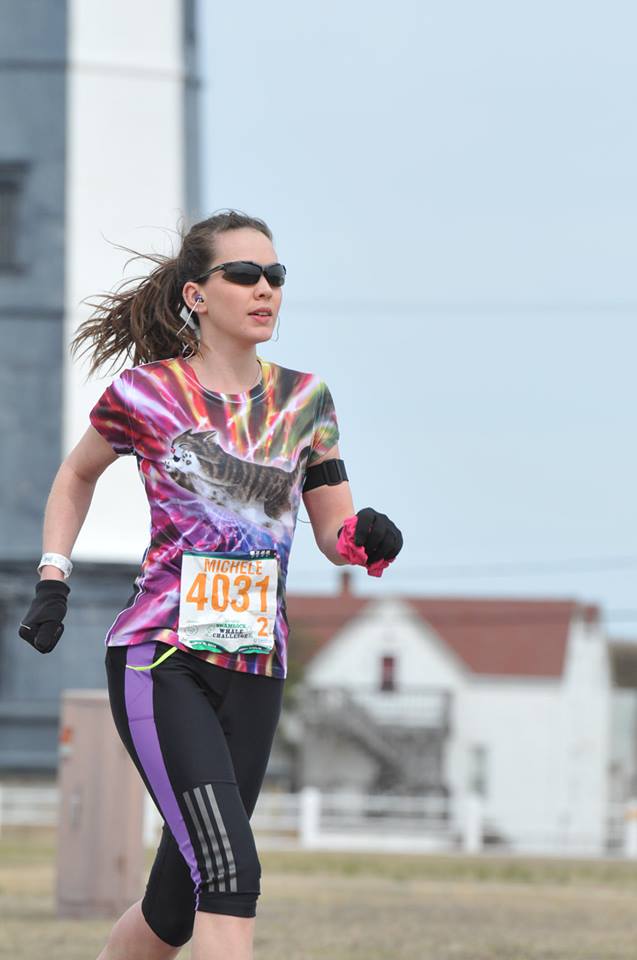
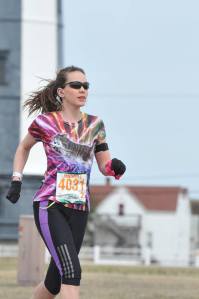
Michele running her marathon PR this year.

Michele running her marathon PR this year.


Our running club, the South Jersey Athletic Club, has a lot of running stars.  Some are stars because they simply outperform everyone in their field.  Some are stars because of their longevity in running, with one of our group about to run Boston for the twenty seventh time.  Michele doesn’t fit either of these categories.  Her stardom comes from her personality, her drive, and her steady improvement as a blossoming runner.   She first introduced herself to our group about five years ago, for our Sunday morning runs.  She wasn’t fast, and she didn’t usually go the long route.  But that changed as she kept with her training and dedication to becoming a better runner.  She ran in the cold, ran in the rain, in the heat, early before the sun came up, and after dark, carrying a light to avoid potholes.  After our Sunday runs, a group of us will gather at the local Starbucks to chat, joke around, talk about upcoming races, and make the big decisions regarding club activities.  Michele is an active participant in this group, not least because she often plies us with homemade pastries, such as biscotti, or blueberry-spelt muffins, to refuel after our long runs.  Oh, and she is also a No Meat Athlete.  The term comes from Matt Frazier, who writes a blog by the same name and has developed a large following.
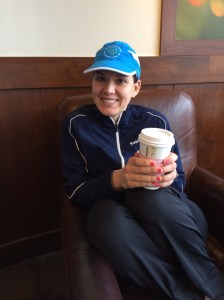
Michele, warming up after a cold run at the end of March.  Whatever happened to March going out like a lamb?

Michele, warming up after a cold run at the end of March. Whatever happened to March going out like a lamb?

I was curious what led Michele to become a vegetarian, and how she felt it helped her in her athleticism.  I also wanted to know her secret for dropping over thirty minutes from her previous marathon PR when she ran the Shamrock Marathon this year.  I put to her ten questions, and she was kind enough to answer them in a very thoughtful and serious manner.  Here are the questions and her answers:


1.  I assume you were not always a vegetarian.  Why did you decide to go vegetarian?
Short answer:  Ethical reasons.
For as long as I can remember, I was always an animal lover.  No one in my family is a vegetarian, and meat was as much a staple in our daily diets as I imagine any other typical American family. Lunch was always some sort of lunch meat style sandwich and dinner was always centered around some kind of meat. From a young age, eating animals never quite sat right with me, but I was at the mercy of my mother, who prepared all of our meals.  When I was 14, I simply decided one day that it was time I made the switch to a vegetarian life.  I stopped eating meat “cold turkey” (Brandon would love that pun). Within a year, it was just second nature to me.  After the first few months, I really never missed it.
2.  Which came first, no meat or athlete?
No meat.  I was certainly not an athlete in high school, although I occasionally pretended to be one, joining the lacrosse, softball, and soccer teams (I was terrible at both of these), and even cheer-leading one year. When I discovered running, I realized that I prefer sports that don’t involve much hand-eye coordination.
3.  What special dietary considerations do you need to know to get all of your nutritional needs met?
The two most popular (and annoying) questions most vegetarians are asked by non-vegetarians are “So, if you don’t eat meat, what do you eat?” and “How do you get enough protein?” Contrary to popular belief, protein is not an issue for most vegetarians and even vegans. A person eating a well-balanced diet, full of a variety of fruits, vegetables, grains, nuts, and legumes, will satisfy most of his or her dietary requirements.

There are only two exceptions that I know of that vegetarians and vegans should be a little more conscious of:

Vitamin D – important for bone and muscle health. Vitamin D is most plentiful in non-meat animal sources such eggs and cheese, as well as through exposure to the sun. A vegan would have to rely mostly on sun exposure, fortified foods such as nutritional yeast (an interesting type of food I have only recently discovered, most often used as a substitute for cheese, sprinkled on food or in sauces), fortified cereals, or supplements.
Vitamin B-12 – important for the health of the nervous system, as well as making red blood cells. The daily requirement of B12 for a healthy person is quite low, and the body can store it, so a vegetarian could easily get enough through sources such as eggs, milk, and yogurt. However, for vegans, it is a little more difficult, and one would have to rely on fortified foods such as fortified cereals, nutritional yeast, or supplements.

At this point, I still eat some animal products (occasional eggs and dairy products), and have never suffered any symptoms suggestive of a Vitamin D or B12 deficiency. As I move more towards a complete plant based or vegan diet, I am starting to pay a little more attention to these essential nutrients.


4.  When did you start running as a sport, and how did you get started?
Aside from the forced 2 miles we had to run every day for high school lacrosse, which I loathed, I really started running in the spring 2009.  Prior to that, my running history would go something like this:  Spring time arrives.  I make a vow to run every day.  I go out on day 1 and try to run a mile as fast as I can.  It is awful.  I do this 2-3 days in a row, and then give up because by then I’m hurting and it’s clear that I can’t run.  Swear off running.  Following year, start again.

In 2009 I was gearing up for the same old routine, but I happened to come across a clinic to train for your first 5K thought the Cherry Hill Recreation Department.  I think it was a 6 or 8 week clinic, and it was run by the Cherry Hill West track coach, Nick Mitidieri. Coach Nick was also Brandon’s high school track coach, and I’ve since bumped into him with his track team at some of our No Frills races.  My first week training with Coach Nick I learned the most important thing – how to pace.  That first night I ran a mile and a half and amazingly felt good at the end, much unlike my previous 1 mile solo runs.
5.  What was your first race?  How did it go?
My first race was at the end of that training clinic.  It was called the Run Your Own Life 5K (which no longer exists).  My main goal was to run the entire thing without stopping to walk.  I met that goal.  My finishing time was 31:56.  My husband was there cheering me on at the finish line, which was just amazing.  It was really the first time anyone had come to watch me in any of my sports, and it was such a great feeling having him there, supporting me.  After the race I could not wait for my next 5K!  I was, however, afraid I’d fall off the wagon, so I made a point to sign up for one 5K per month.  I knew if I had a race on the calendar, I’d keep training.
6.  What influenced you to try to run a marathon?
99% of my influence came from being around other runners, namely, SJAC members.  Before joining the club, the “marathon” was kind of some mystical fantasy in the back of my mind, which I thought maybe, just maybe, I could accomplish one day.  I gave myself a rough time frame of 5 years to complete my first marathon.  When I first joined SJAC in the fall of 2009 I was training for my first Half Marathon, and did many of my long runs with Sue Hamilton.  At the time she was training for the Philadelphia Marathon.  Over the weeks of running with Sue (and Heather), I realized that she and I ran similar pace, and seemed rather similar in our running abilities, and it made me think that if she could run a marathon, why couldn’t I?  That was when I first started thinking more seriously about the marathon.
7.  What was your first marathon?  Do you recall how it felt to finish?
Ultimately, my first marathon was in March 2011 (less than 2 years after my first 5K!).  It was the National Marathon in Washington, DC (I think this race was recently sold to the Rock N Roll series).  My time was 4:34:36, which remained my PR until my recent marathon.

Finishing was quite emotional.  I felt decent most of the race, until about mile 22, when I started a lot of walking/running.  In the last quarter mile, running up the hill to the finish line, all kinds of things started freaking out in my legs, and I think it was only the sight of the beautiful finish line that got me up that hill and kept me running at that point.  I don’t remember exactly how I felt when I finished, but I do remember being on the verge of tears, when suddenly Tom appeared before me, snapping me back to reality.

Side note about Tom:  He was, once again, a great supporter.  Spectating a marathon can be a little challenging, especially navigating around an unfamiliar city to hit as many mile points as possible.  He managed to make his way around the Metro and see me at a few different points along the race, including the finish.  Later in the day, when we were back at the hotel and I was attempting to find a position which didn’t hurt, he said to me, “Man, watching a marathon is really exhausting.”  Really?
8.  You recently ran a marathon PR by a huge margin.  How much was the margin, and to what do you owe this superior performance?
My first marathon remained my PR until this March, when I ran the Shamrock Marathon in 4:01:58, making the exact margin 32:38.  I did a lot of things this past year which I attribute to my PR.  2013 started out with me being injured and having to back out of the Shamrock Marathon.  My injuries were mostly the result of over-training. I found myself unable to do most forms of exercise.  I certainly couldn’t run, but also couldn’t bike or even do the elliptical.  The only form of cardio exercise I could tolerate was swimming.  At this point, I already was not happy with my weight and was terrified where my weight would go without being able to run.  This finally gave me the kick in the ass I needed to get some things in order.  I started paying better attention to my diet, focusing more on whole foods.  I also hired a personal trainer, who really seemed to appreciate the fact that I was an athlete, more so than most of his clients (his words, not mine) and pushed me really hard, changing up my usual gym routine, and adding in a ton  more core work.  The concentration on diet and change in exercise routine led me to lose about 18 pounds over the course of the year.  The weight loss just naturally adds some speed, and I found the cross training and increased core strength really helped my endurance.  Towards the end of the marathon, of course my legs felt beat up, but I never felt like I had to stop to walk or hit “the wall.” In my race pictures, even in the later miles, I’m still standing tall, not slouching from a weak, fatigued core like I often found myself in race pictures in the past.

The other thing was that through being injured, I really learned the difference between general soreness from training hard and actual pain.  I learned to listen to my body when something wasn’t right, and addressed those issues right away, before they turn into full-blown injuries.  I still battle a little bit with my IT band, but thankfully it hasn’t totally given out on me in quite some time, and I continue to work on strengthening the muscles in my hips, where the ITB issues originate.
9.  What keeps you running?
I love that I am truly only competing with myself.  When I played team sports, I always felt bad that I wasn’t good, like I was letting my team down.  In running, there isn’t that pressure, only whatever amount of pressure I want to put on myself. There is always another goal to achieve, whether that is to do a particular race, or to get a PR in a specific distance.  Running has also become an integral part of my social life, knowing that I have a weekly date with running friends. Everyone in the running community is supportive of one another, and there seems to me a mutual respect among all runners, regardless of abilities.  I am often amazed when other athletes, many of whom I look up to and would go to for advice, have come to ME for advice. There’s no competition or one-upsmanship – everyone simply wants their fellow athletes to succeed, whatever that means to them.
10.  If someone wanted to become a No Meat Athlete like yourself, what would be your advice? What would be the benefit?
It’s hard for me to say how one should transition from eating meat to not doing so, since I’ve been doing it for so long. But I would suggest perhaps making small changes. Cut out one form of animal product, for example, red meat, and go from there. One should focus one’s diet on eating more whole foods, eliminating most processed. As you get more into the plant based lifestyle, you can be more adventurous. Trying new ingredients that previously sounded too weird to try in a recipe start to become not so scary. (I discussed nutritional yeast in #3 above. This is something I avoided in recipes for years. Finally I took a chance, figuring if it appears in so many recipes, it can’t be that awful. Now it’s a staple in my pantry).

There are so many resources for plant based nutrition for both athletes and non-athletes. My personal favorites are:

The Thrive Diet:  This diet was created by vegan former pro-Ironman triathlete, Brenden Brazier. Brazier takes the vegan diet to the next level, by concentrating on foods that deliver the maximum amount of energy with the least amount of stress to the body. The basic principal is the fuel the body with nutrients that are easily absorbed and easily digested foods. If the body is spending less energy in the actual process of digesting the food, one has more energy for training. I have 2 of Brazier’s books, and follow several of his recipes every week.

Oh She Glows Blog and Cookbook: www.ohsheglows.com. I discovered this blog about 6 months ago. It’s not geared towards athletes specifically, but all recipes are vegan and made with natural foods. The creator of the blog, Angela Liddon, recently released her first cookbook in March 2014. I pre-ordered it and have already made at least a dozen recipes from the book.

And of course, how could I answer an entire 10 questions without mentioning the No Meat Athlete website itself: www.nomeatathlete.com. This blog creator, Matt Frazier, also recently released a book, but I have not checked it out yet. While No Meat Athlete (NMA) has some recipes, the blog is designed more as just a general discussion of the NMA lifestyle. Lately I’ve been listening to Matt’s podcasts (available on iTunes) during some of my solo runs.
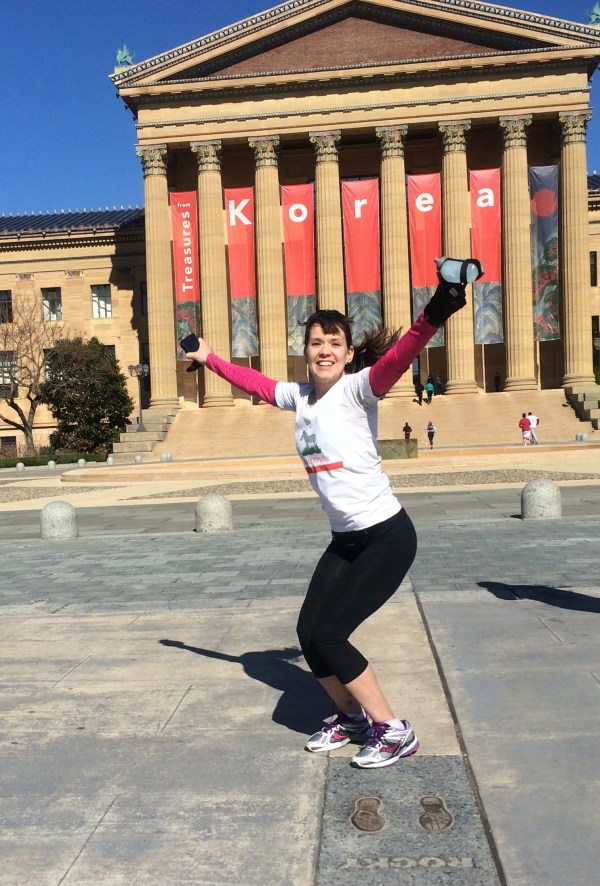
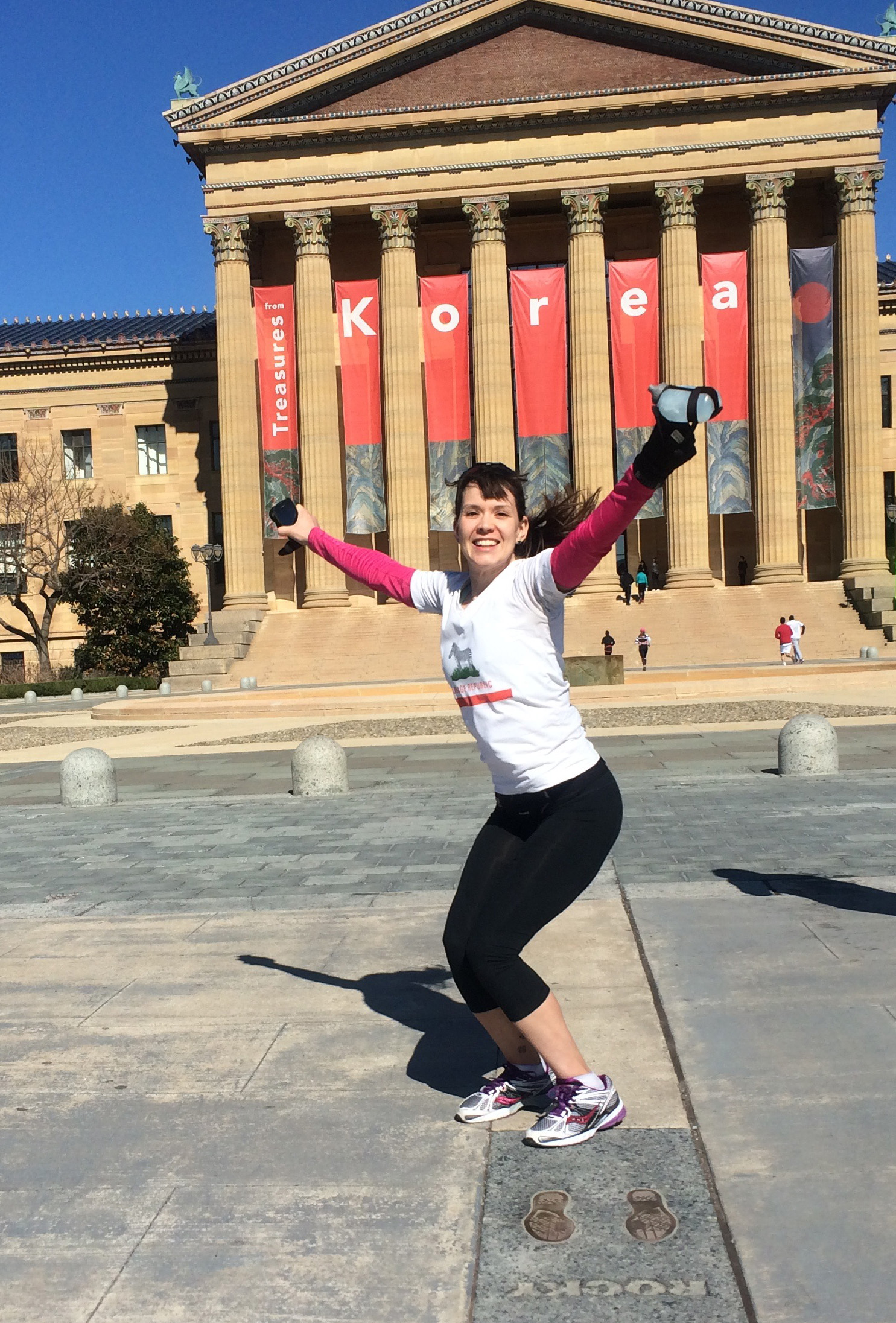
Michele atop the Philadelphia Art Museum steps (see my previous blog, "Rocky II, It's a Knockout")

Michele atop the Philadelphia Art Museum steps (see my previous blog, “Rocky II, It’s a Knockout”)
Rocky II: It’s a knockout!

Sunday, April 6, 2014

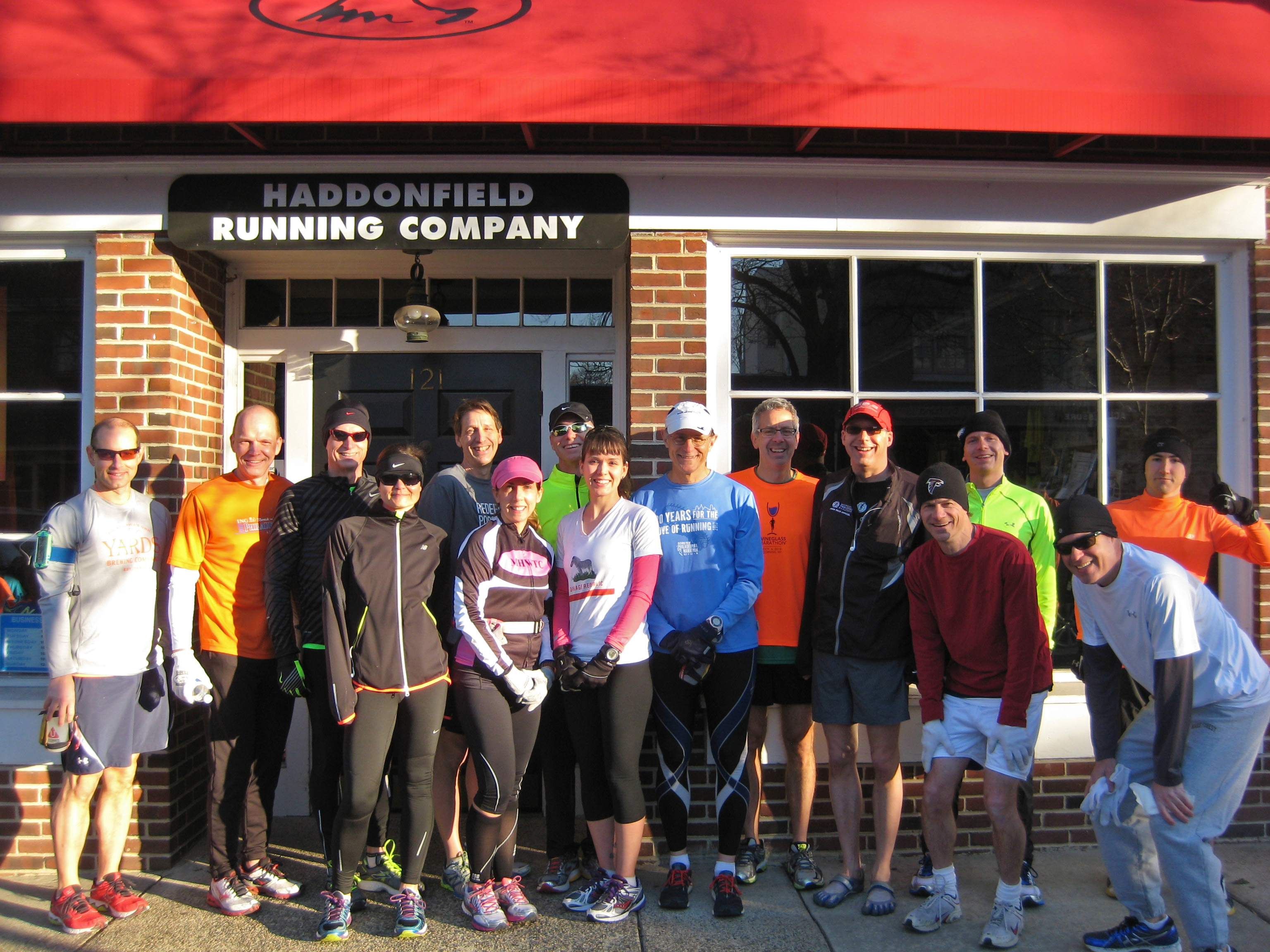
At the start of Rocky II, in front of the Running Company in Haddonfield

At the start of Rocky II, in front of the Running Company in Haddonfield


Haddonfield, N.J.  – Last Sunday morning, fifteen members of the South Jersey Athletic Club gathered in front of the Haddonfield Running Company for the start of Rocky II, a point to point run from Haddonfield to the finish at the top of the steps of the Philadelphia Art Museum.  It was a perfect day for this type of run.  It was bit chilly at the start, around 37 degrees F, with the sun just starting to peak over the buildings on King’s Highway.  The runners stowed their gear in the bag carrier’s car and prepared to get going.  The bag carrier, Craig,  was the son of the organizer, and had offered his time in exchange for his Dad’s gratitude and the promise of brunch with the group.

The club, known as SJAC, has a usual Sunday run which is a loop of about 13 miles.  Every once in a while, though, a different run is proposed to add some variety and challenge.  The first Rocky Run was just about a year ago, so it was time for the sequel.  The route this year was very similar to last year’s route.  It follows the usual Sunday morning route up to Route 130, which is a busy highway on the edge of Camden.  This year, we went across 130 and past the Camden County Golf Academy, formerly known as the Cooper River driving range.  This has a sixty station, double-decker driving range where one is expected to hit the ball into the water.  Once merely a driving range, it is now home to Rutgers Camden’s golf program.  Moving on, we ran along Admiral Wilson Boulevard, where the memory of strip clubs and cheap motels, torn down for the Republican National Convention in Philadelphia in 2000 is fading.  Now, it is a rarely used park, with pretty rose bushes lining the boulevard, and a wide paved curving path along which few bikes or runners pass.  The park ends on a narrow sidewalk at the edge of the road, which takes one in to Camden City proper.

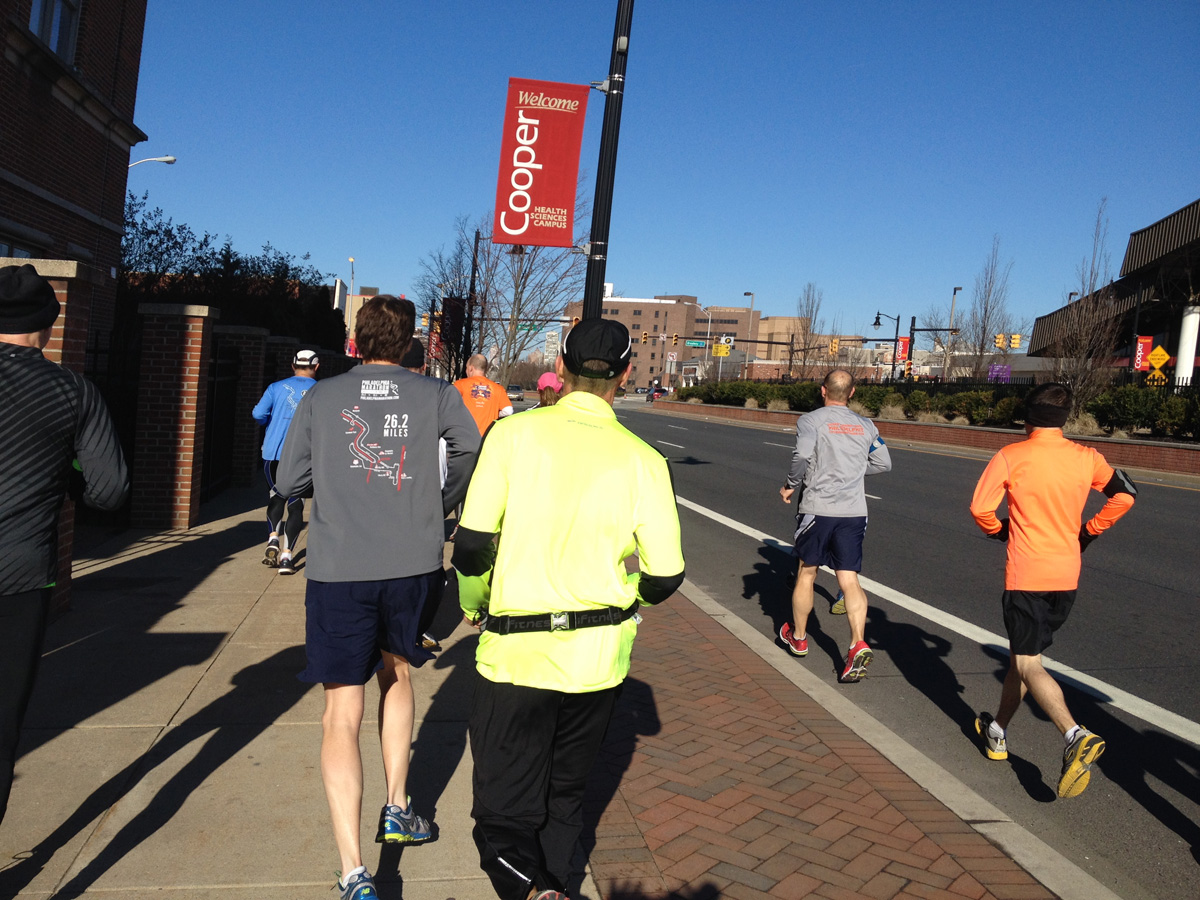
Leaving Cooper Hospital, and heading for the Ben Franklin Bridge

Leaving Cooper Hospital, and heading for the Ben Franklin Bridge

As we did last year, at the 7 mile mark we again went right through the main floor of Cooper Hospital, stopping for a restroom

Up the Ben Franklin Bridge walkway.

Up the Ben Franklin Bridge walkway.

break and water.  Then it was on to the Ben Franklin Bridge.  The road through Camden goes past the Rand Transportation Center.  Here, the PATCO line into Philadelphia, the River Line to Trenton, and the New Jersey Transit buses all come together.  It is a busy place, even on a Sunday morning, and we got a few amused stares by the locals as we ran by.  Nearby is the Walt Whitman house, where the famous poet spent the last eight years of his life.  We did not run by his house, but may on future editions of the Rocky Run (Rocky III, the Leaves of Grass edition!


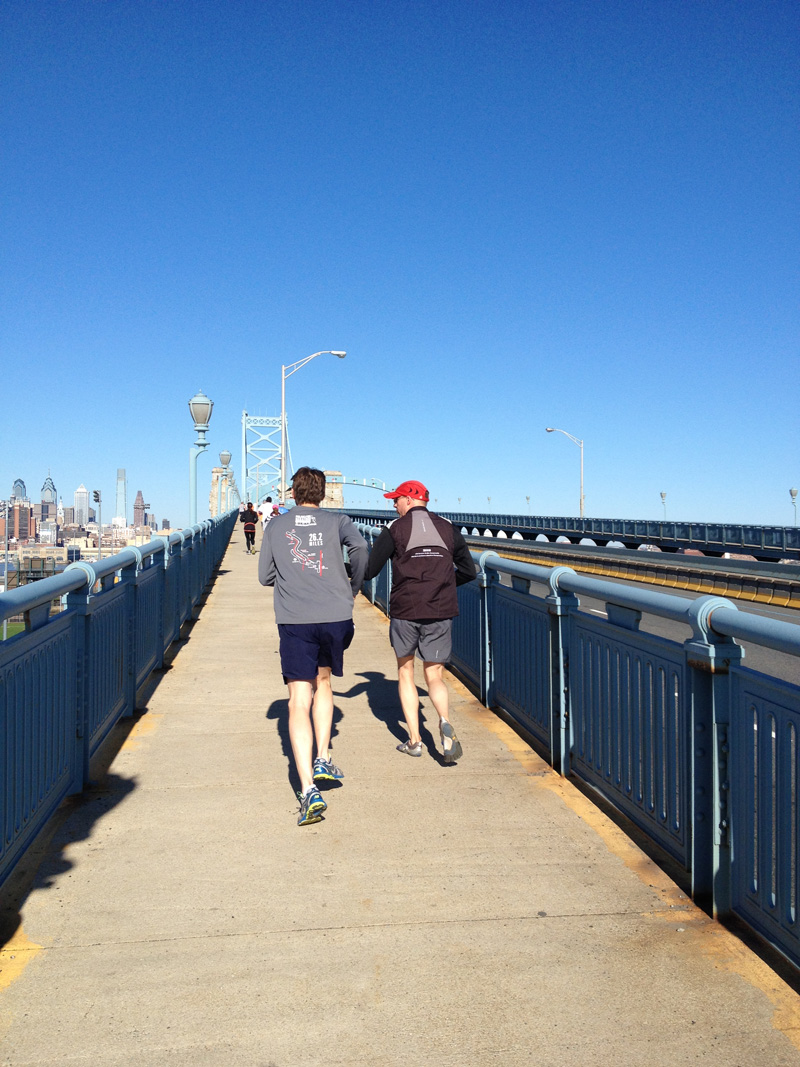
The first real challenge of the run was the stairs up to the Ben Franklin Bridge walkway.  Three flights one must ascend to get to the walkway, and there were a few groans from our group, although nothing too serious.  As mentioned, we had a beautiful day for this run, and the sky was deep blue, a perfect backdrop for the cityscape of Philadelphia.  The bridge rises for three fourths of a mile before it turns down again.  We stopped as a group near the apex for a photo, and got a nice passerby to take the shot.

Near the top of the walkway, Ben Franklin Bridge, looking toward Philadelphia

Near the top of the walkway, Ben Franklin Bridge, looking toward Philadelphia

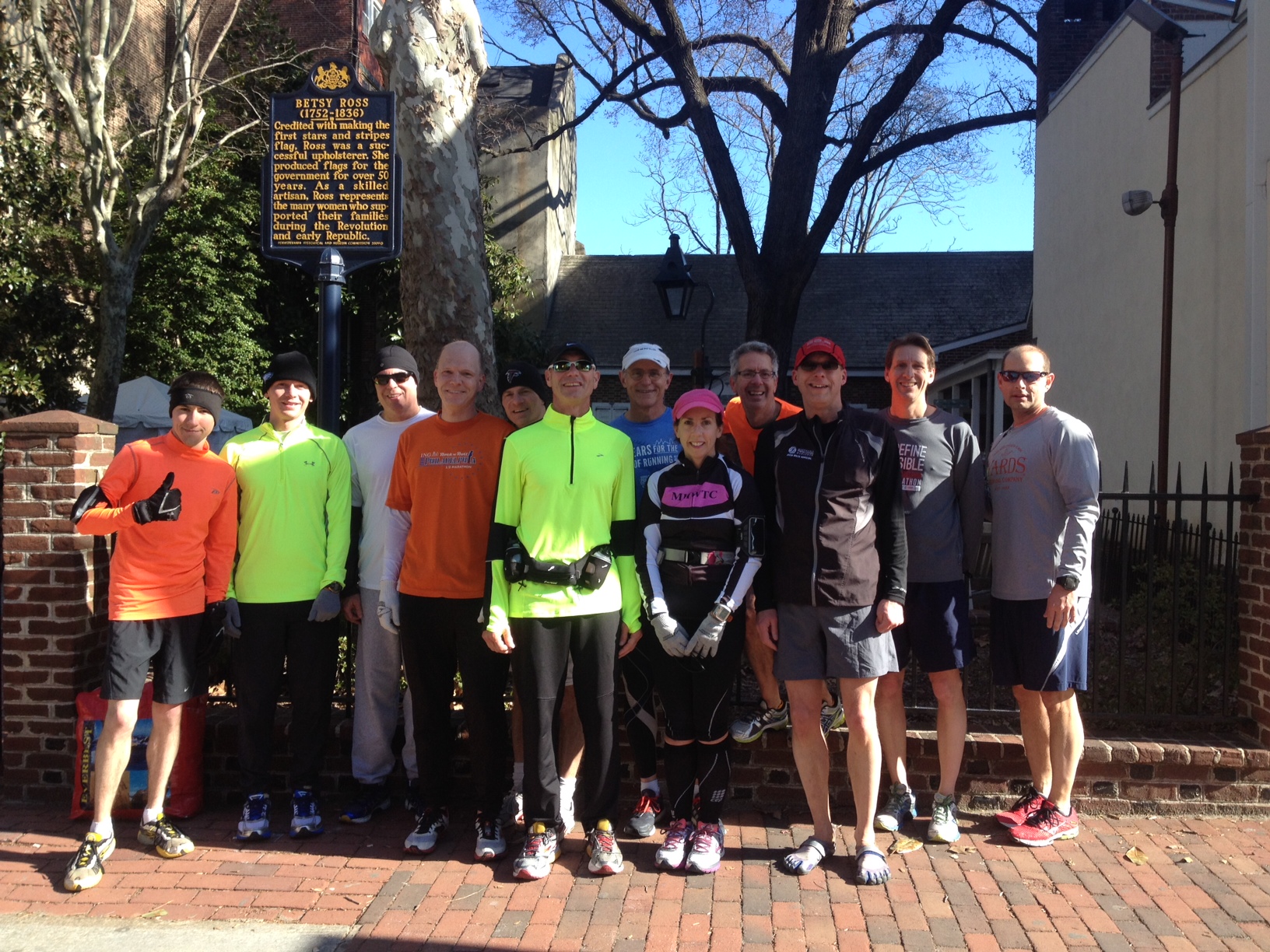
At the base of the bridge on the Philadelphia side we took a sharp u-turn down to “Old City”, and made the second change from last year’s route.  This was to take us by another landmark, the Betsy Ross House.  We took another brief stop to document our run.

In front of the Betsy Ross House on Arch Street in Philadelphia

In front of the Betsy Ross House on Arch Street in Philadelphia

Then, it was on past other landmarks in the city, the Arch Street Friends Meeting House, the Constitution Center, the Liberty Bell, and, of course, Independence Hall, where the Declaration of Independence was signed.  We continued down Sixth Street all the way to Christian Street in South Philly, home of the Italian Market.  Rocky Balboa made this spot famous in several scenes in his movies.  We didn’t try to replicate his movie runs.  In fact, to that, one would have to have magical powers.  If you’d like to see what it would take, writer Dan McQuade published an article in Philadelphia Magazine exploring the theoretical route.

After passing my favorite pizza and steak place in the Italian Market, Lorenzo’s, we kept on running to 16th Street, where we headed north all the way to the Ben Franklin Parkway.  The goal of the run was finally in view.  The Parkway is a great stretch of road, flanked by various museums, and lined by the flags of 109 Countries.  At the top of the Parkway, the Philadelphia Art Museum is a beautiful architectural achievement in its own right.  Situated where it is, braced on either side by Kelly Drive (formerly East River Drive) and West River Drive, and at the base of Fairmount Park, it is the epicenter of weekend outdoor activities in Philadelphia.  West River Drive is closed to automobiles on weekend mornings during daylight savings time.  Kelly Drive has Philly’s iconic Boat House Row, not just pretty to look at, but the base of a very active rowing community.  Every weekend, some type of race or organized activity is going on, centered around the Parkway and the art museum.  This day was no exception.  The first running of the Hot Chocolate 15k run was wrapping up as we finished our run.

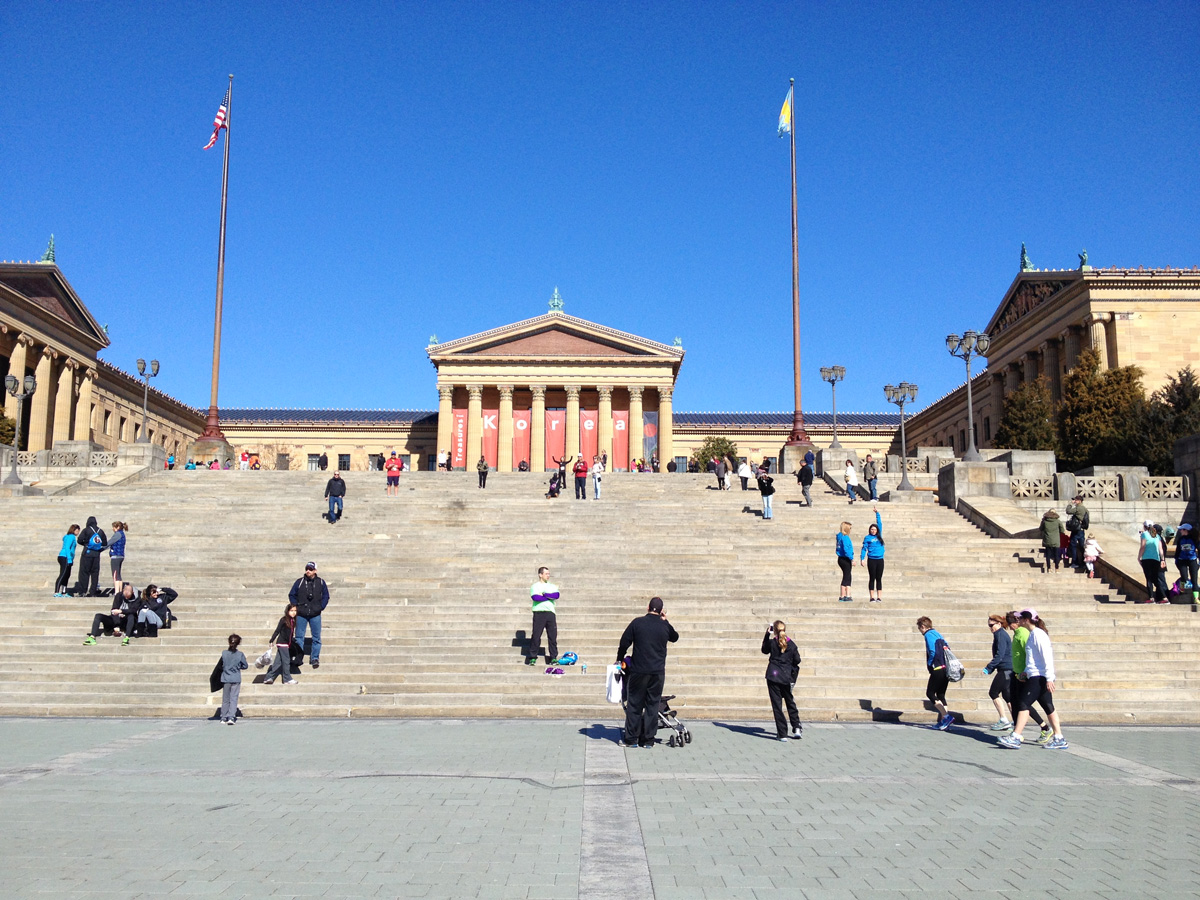
We ran straight up the middle of the Ben Franklin Parkway to the art museum.  Starting at the Basilica of Saints Peter and Paul, along the way, we passed the Parkway’s most famous fountain, the Swann Memorial Fountain, or the Fountain of the Three Rivers.  As we got close to the museum, we got funneled through the staging are of the Hot Chocolate race, and had to clamber over the barriers to get to our final goal.  I found an open barrier so I didn’t have to embarrass myself trying to climb over, but others in the group were much more agile.  Finally, it was up the steps to the art museum entrance.


Philadelphia Art Museum, and the "Rocky Steps"

Philadelphia Art Museum, and the “Rocky Steps”

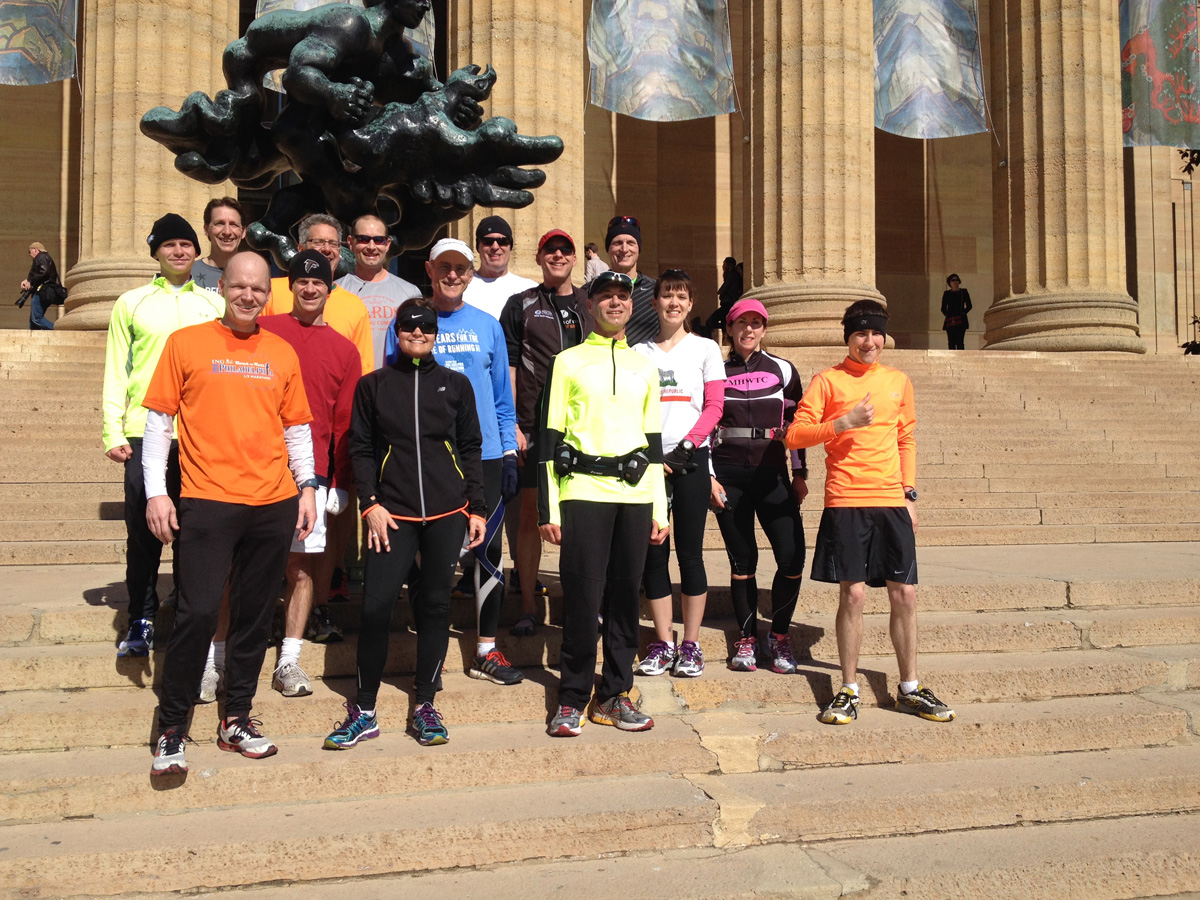
Everyone made it to the top!

Everyone made it to the top!

Of course, what would a trip to the venerable art museum be without a stop at the statue of one of Philadelphia’s most famous citizens, Rocky Balboa himself.  Well maybe he wasn’t really a “citizen”, and I guess, maybe  he wasn’t “real” but he sure brings out people from everywhere to pose by his statue.

Giving the old Rocky pose.

Giving the old Rocky pose.

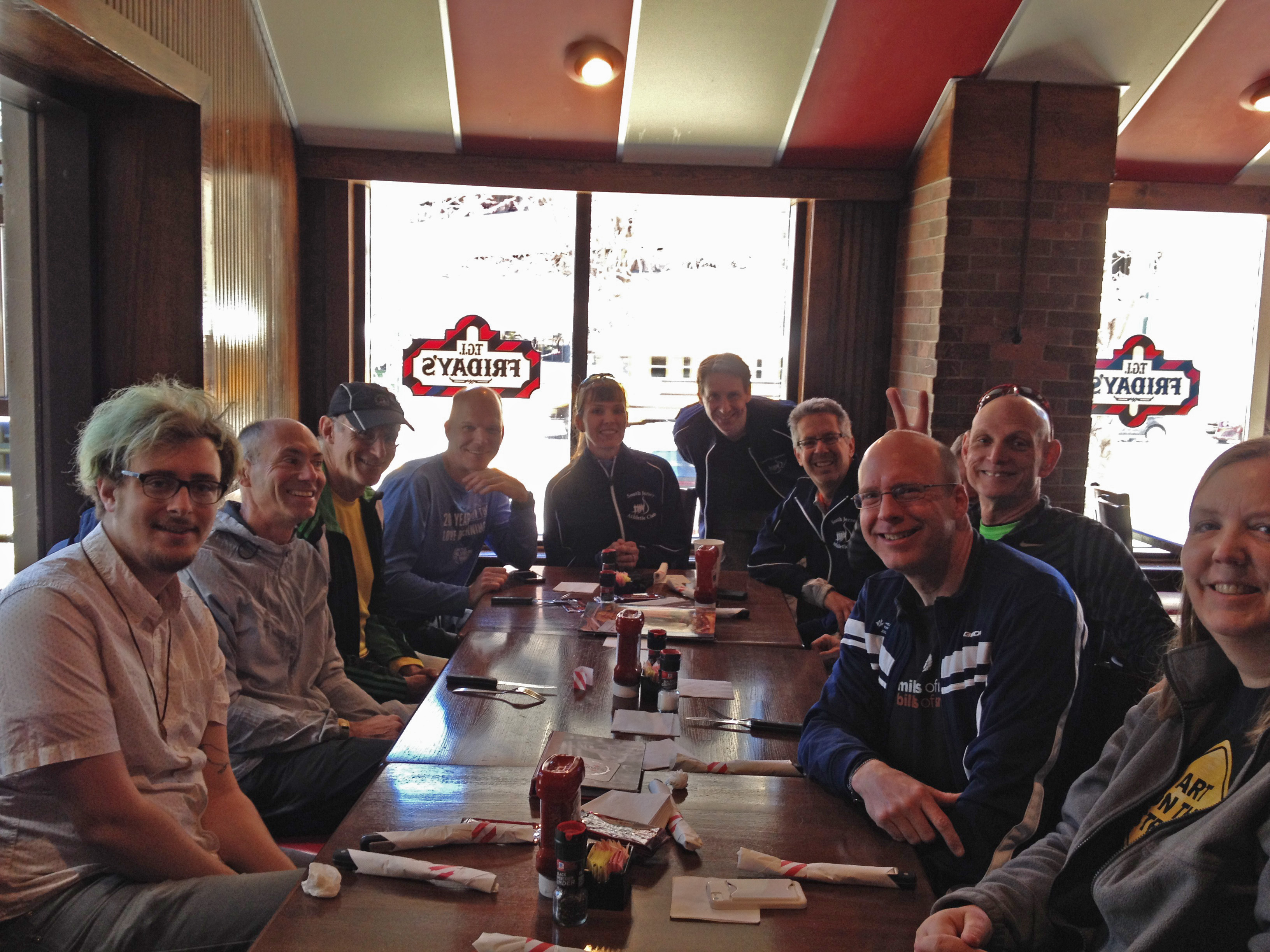
After we finished the run, we reconnoitered with a plan to have brunch at the famous Sabrina’s Cafe on Callowhill Street, about a mile from the art museum.  When we got there, the place was teeming with people with the same idea, many of whom had run the Hot Chocolate run that morning.  We wound up heading over to Friday’s on the Ben Franklin Parkway, not a unique Philly experience, but we were hungry.  As it turned out, breakfast was over, and they were serving lunch.  We were also almost their only customers.  We had a very nice lunch of burgers, a some had beers, and all were quite happy.

SJAC runners at Friday's after the Rocky II run.

SJAC runners at Friday’s after the Rocky II run.

After lunch, it was back to Haddonfield.  We had just enough room in a couple of cars to haul everyone back home across the bridge.  Now, we’ll need to start planning next year’s sequel.  As one of our runners, Brian, put it, the sequels really went down in quality after Rocky II.  Let’s hope the Rocky Run’s don’t suffer the same fate.

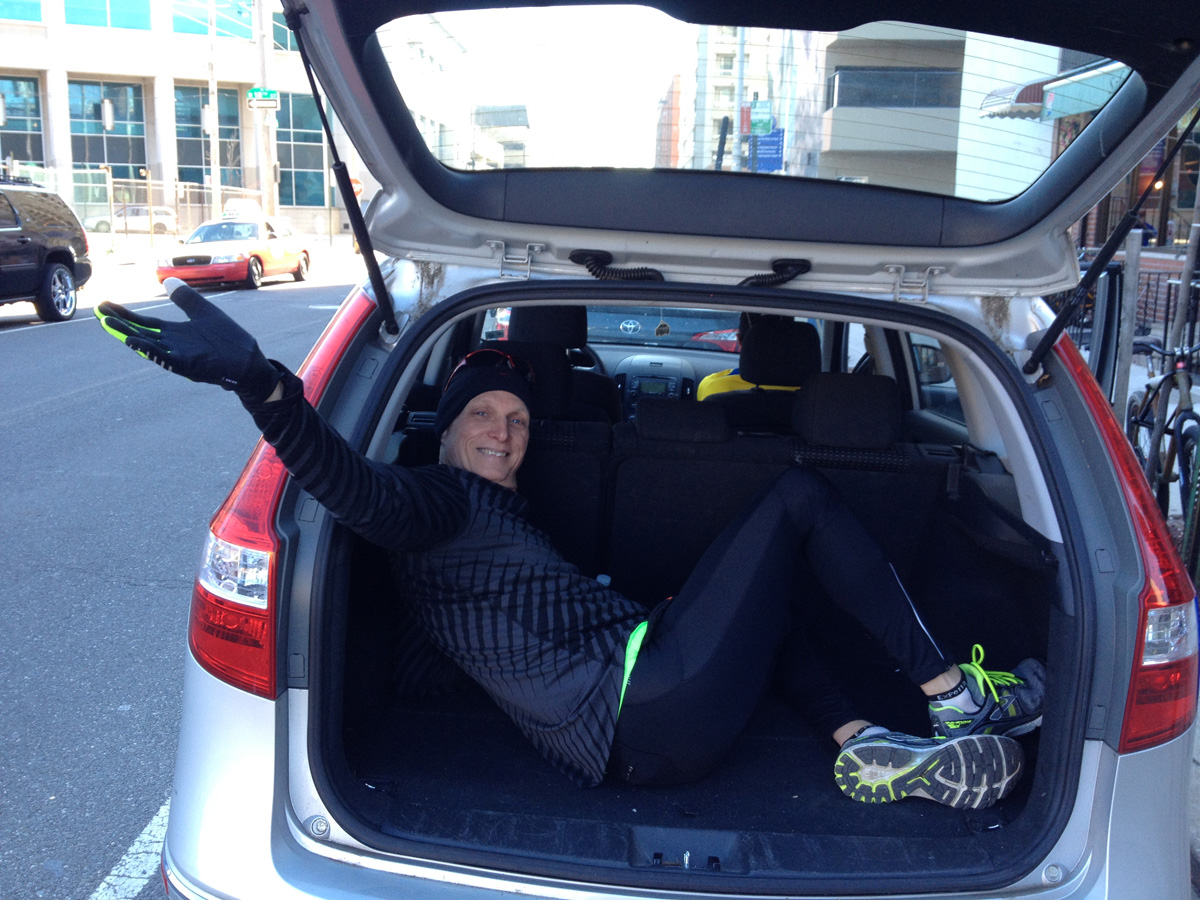
Randy says so long, from Philadelphia!

Randy says so long, from Philadelphia!

Un détournement de Chamonix.

Chamonix

Chamonix, and a view of Mont Blanc

On my return from Chamonix, the most common question asked of me was how I was treated by the French.  I said very well, but my friends weren’t buying it.  Weren’t they rude and dismissive? Or, do I speak French, and so had an easier time.  Or, if one just makes an attempt to speak French, is that enough?  Until one travels to a foreign country (foreign to the traveler, not so foreign to the people living there), it is difficult to understand the experience.   In the case of Chamonix, it is an international resort, welcoming adventuresome people from all over the world throughout the year. French is the native language, but English, German, Italian, Japanese, Arabic, Russian, Turkish, and Polish, were among the languages I heard while there. There is no doubt about it’s French nature, though. This is evident in the super marché, or super market.  Generally, ski towns have very nice super markets, and here is no exception.  But the meats and cheeses were the best, the wines excellent for about $7-10, the alpine butter delicious, and the choices of fresh vegetables, superb.  It was a very busy place, and typically, around 4 to 5 PM, the locals were crowding the store to buy food for dinner.  It is not customary there, to stock up for a week or more.  How would the food be fresh?  There were boulangeries (bakeries) on every street, and the image of a person carrying a baguette or two sticking out of the bag or backpack is real.  The bread is devine, crusty, yeasty and just the right texture.  Pâtisseries, the pastry shops selling incredible raspberry tarts, eclairs, and other sweets are also common, their wares displayed in windows to lure in the customers.
I don’t speak French, at least not well enough to engage in a conversation, and I may never, but I took the time to learn a little, and have picked up some over the years. While this is an international town, not everyone speaks English, so it helps to know a bit of the native tongue.  Whenever I am in France, I am reminded of the brilliant essay by David Sedaris, “Me talk pretty one day” , in which he describes his attempts to get conversant in French. It is so funny and true, and dangerous to read in company. You’ll embarrass yourself.

I was in Chamonix for a ski trip with friends from Pennsylvania and the UK.  We are an interesting mixed group, thrown together by chance and acquaintanceship, and of varying abilities on the slopes.  Yet we invariably have a great time, and plenty of adventure to boast about.

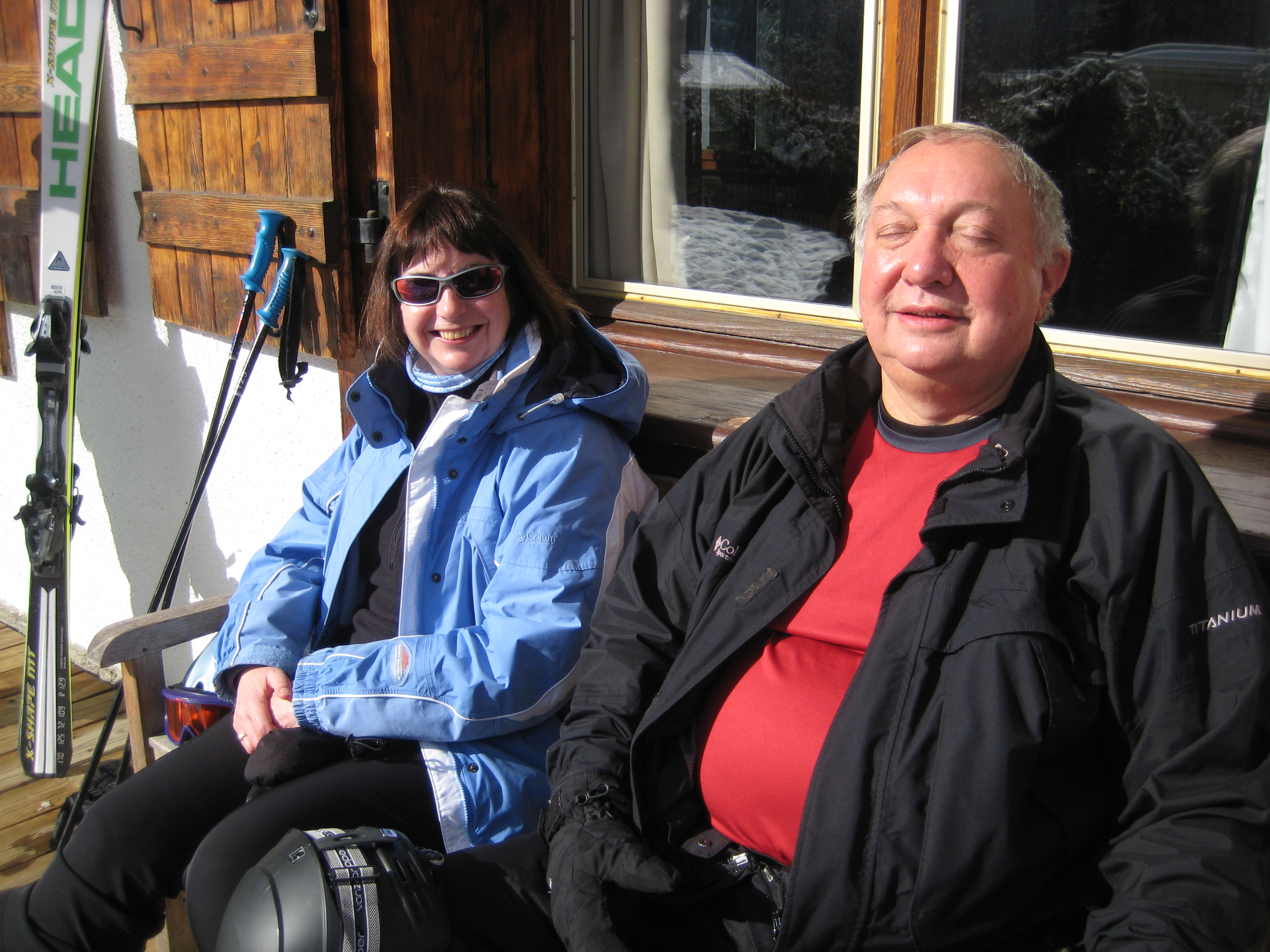
Teresa and AJ, among the UK set, enjoying the alpine sun.

Teresa and AJ, among the UK set, enjoying the alpine sun.

We arrived in Geneva on Sunday, March 2, and took a van to Chamonix.  We were dropped off at our elegant Chalet close to the center of town.  One advantage of going with a sizable group, there were eleven in ours, is that we can rent a whole chalet together, and get the benefits of a kitchen, nice rooms, and comfortable living areas.

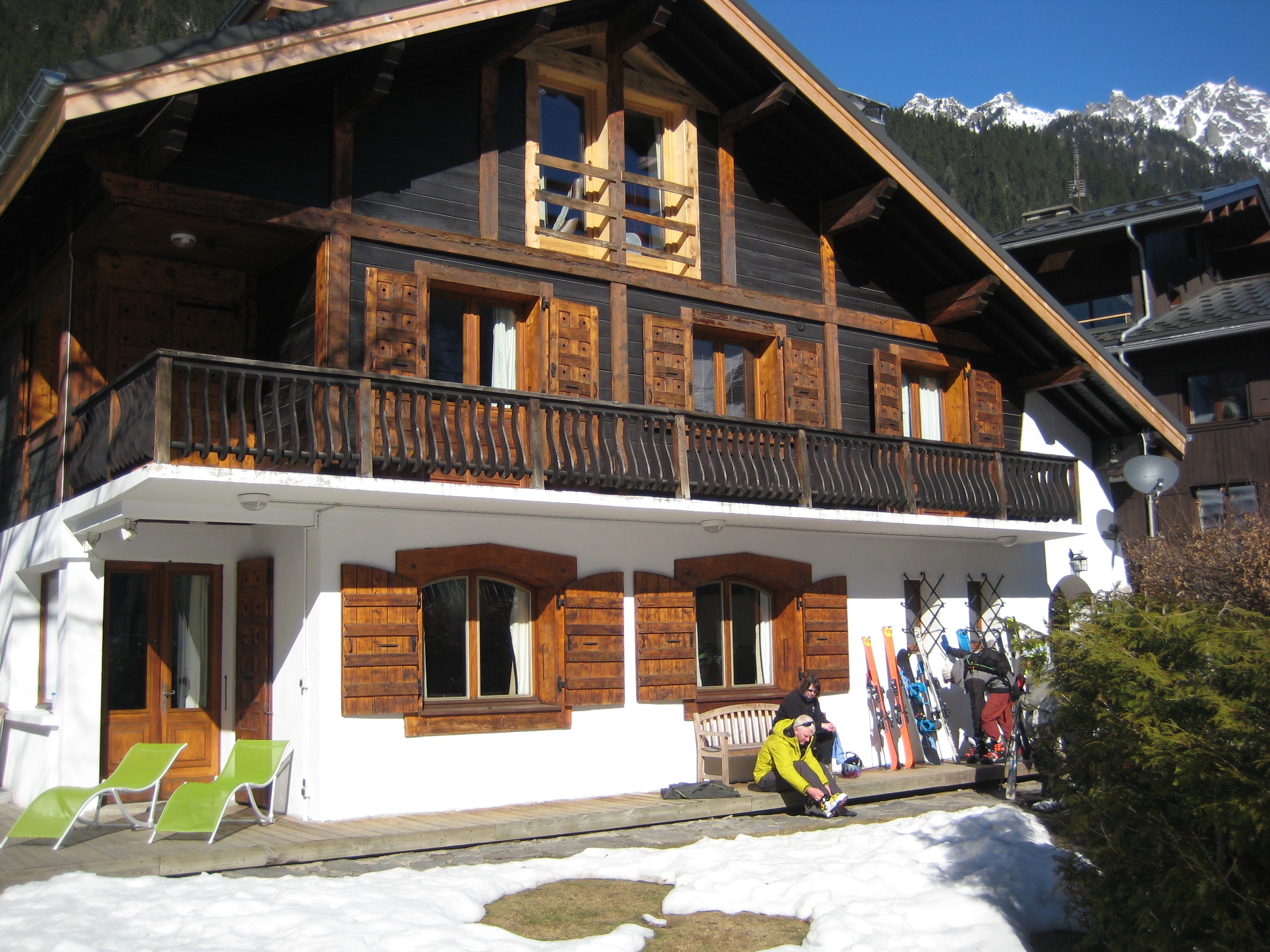
Our chalet, Chalet Arkle, on Rue Joseph Vallot in Chamonix.

Our chalet, Chalet Arkle, on Rue Joseph Vallot in Chamonix.

Our chalet was, according to the “bible” left for our perusal by the owners, originally a home built for a physician in Chamonix, over 100 years ago.  It was solidly built, and the current owners upgraded everything to modern standards, with bathrooms in all the bedrooms, a huge, modern kitchen with an industrial stove, and even an outdoor hot tub, which we certainly did make use of.  A few peculiarities of local life:  recycling is done, but one must carry the trash and recyclables to receptacles in town, where there are big bins for trash, glass, plastic and paper.  Bags are not free in grocery stores.  They do sell reusable shopping bags, though.  Vegetables and fruits are weighed by the customer on a scale near the produce section, which spits out a label with the weight and cost.  Without this, one is sent back by the check-out person to fulfill one’s responsibility.

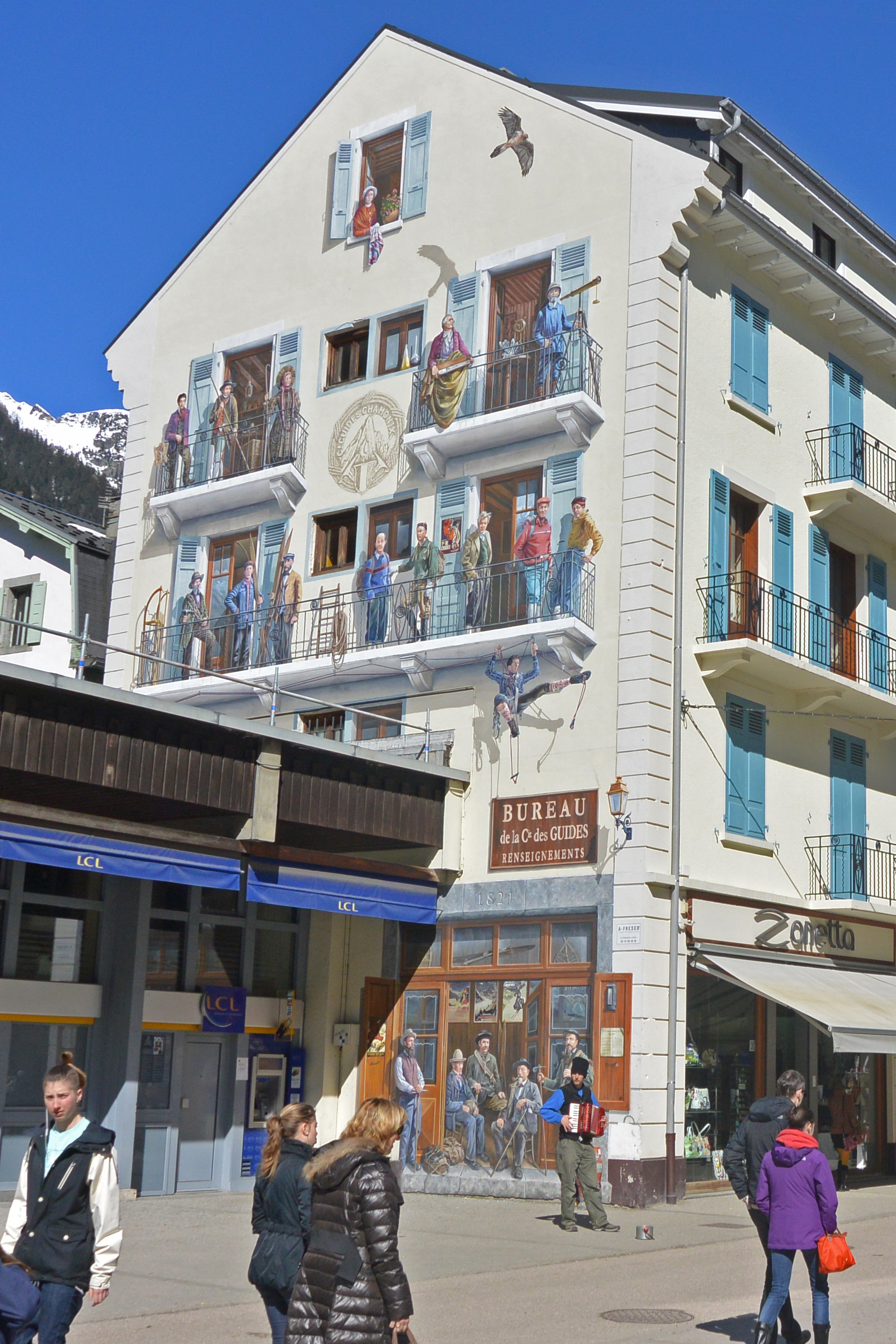
Famous early members of Le Compagnie des Guides de Chamonix

Famous early members of Le Compagnie des Guides de Chamonix

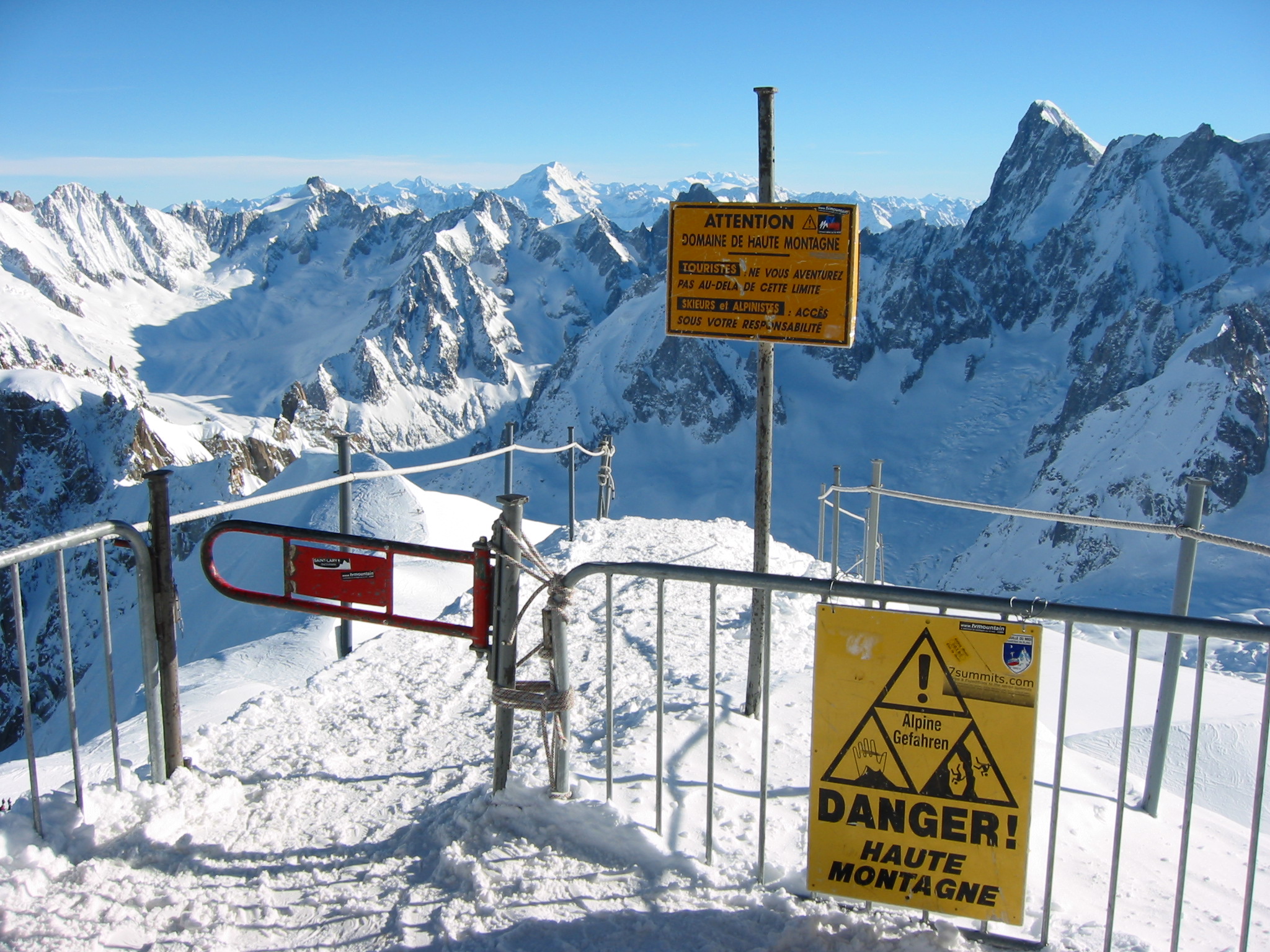
Chamonix is famous for extreme sports, winter sports, and mountain climbing.  The mural above shows early, formative members of the Compagnie des Guides de Chamonix, an association for the guides in this region.  The woman depicted at the top, Marie Paradis, at the time a worker in a hotel, was the first woman to climb to the summit of Mont Blanc, in 1808.  Chamonix was the home of the first Winter Olympics, in 1924.  Mont Blanc, the tallest mountain in Europe, can be seen clearly from the town, and is a primary attraction here.  The Vallée Blanche is the ski route off of Mont Blanc, accessible from L’Aiguille du Midi, the highest reaching cable car in the valley.  It is unmarked, unpatrolled and quite a challenging run.  I did this run in 2003, with a group from Philadelphia, led by a guide named Christian.

Entrance to the Vallée Blanche

Entrance to the Vallée Blanche

The trek down to the start of the ski run, Vallée Blanche

The trek down to the start of the ski run, Vallée Blanche

Our guide, Christian.

Our guide, Christian.

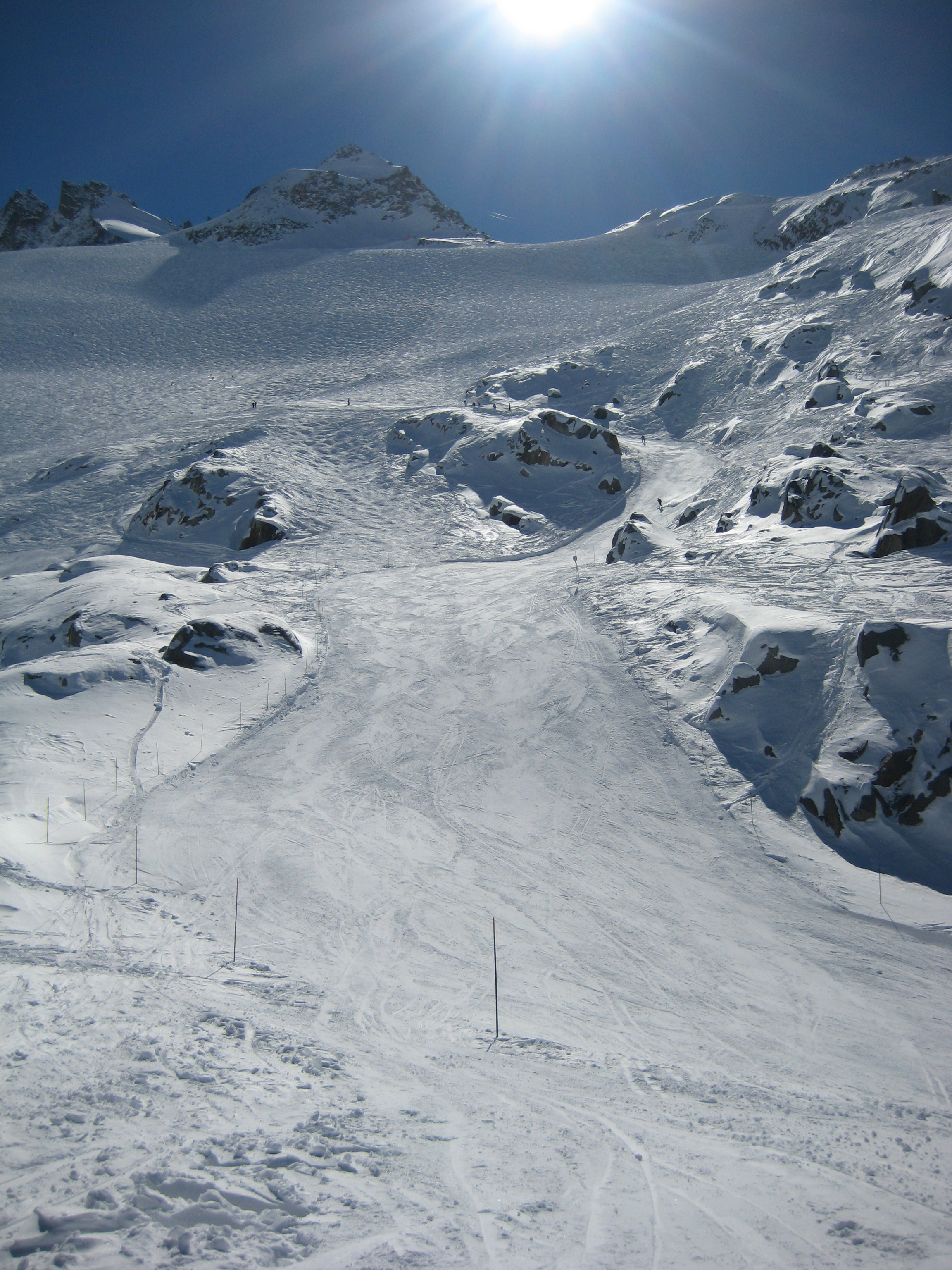
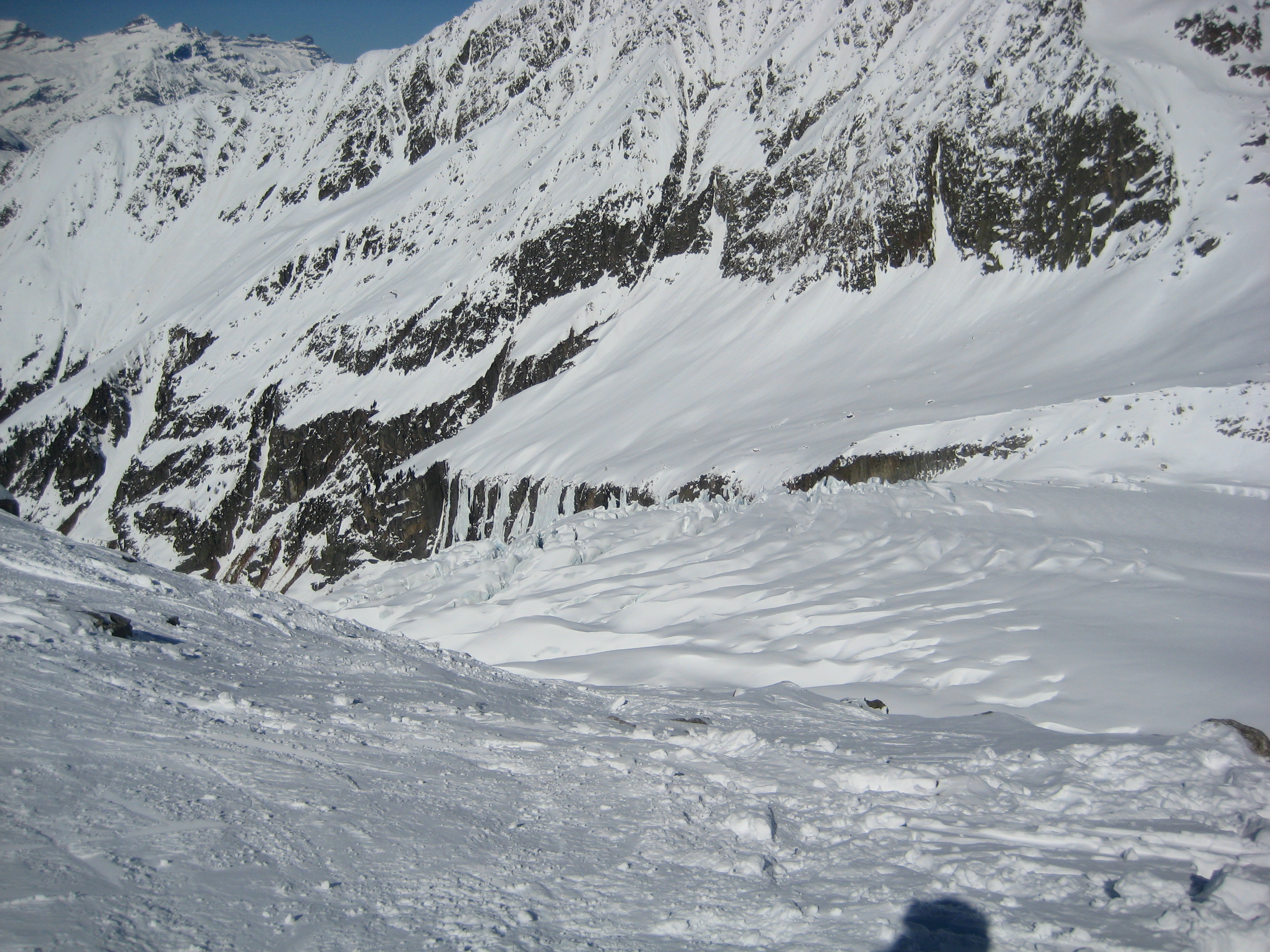
Some of our group did this same run this year.  I decided not to go, having done it once and survived.  The skiing, though, in this region is not easy.  While there are slopes meant for beginners and intermediates, they are pretty tough due to their steepness and iciness.  Up high at the top of the multiple ski areas which surround the valley, the snow is good and the views amazing.  But the runs at that height are steep, ungroomed, and mainly moguls.  My friends Teresa and Kristine and I took on the second most challenging descent, off the top of Grand Montets, the Point de Vue run along the Argentière glacier.

Frank and Kristine at the top of Grands Montets

Frank and Kristine at the top of Grands Montets

Point de Vue run off Grands Montets

Point de Vue run off Grands Montets

The Argentière glacier along the Point de Vue run.

The Argentière glacier along the Point de Vue run.

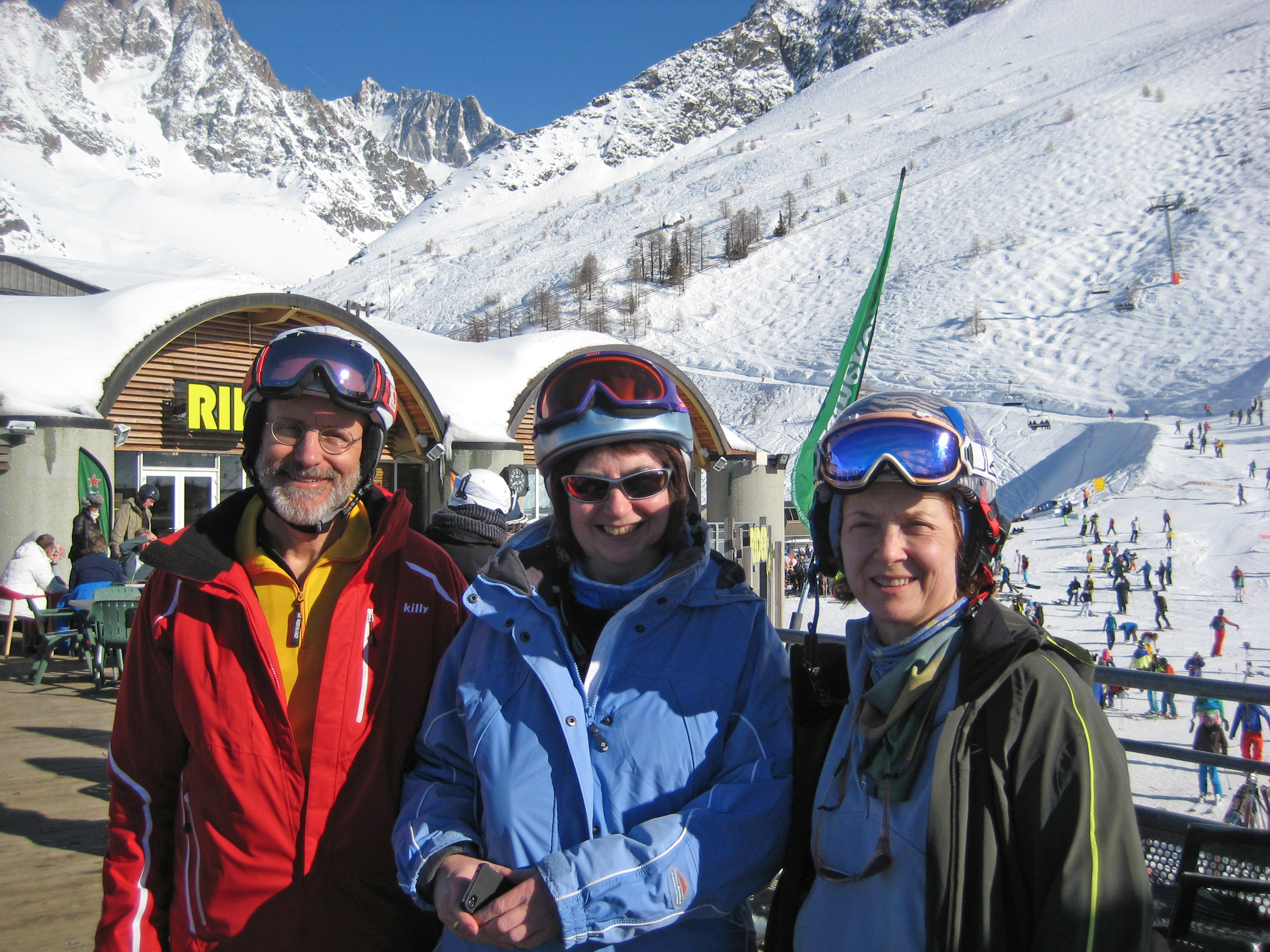
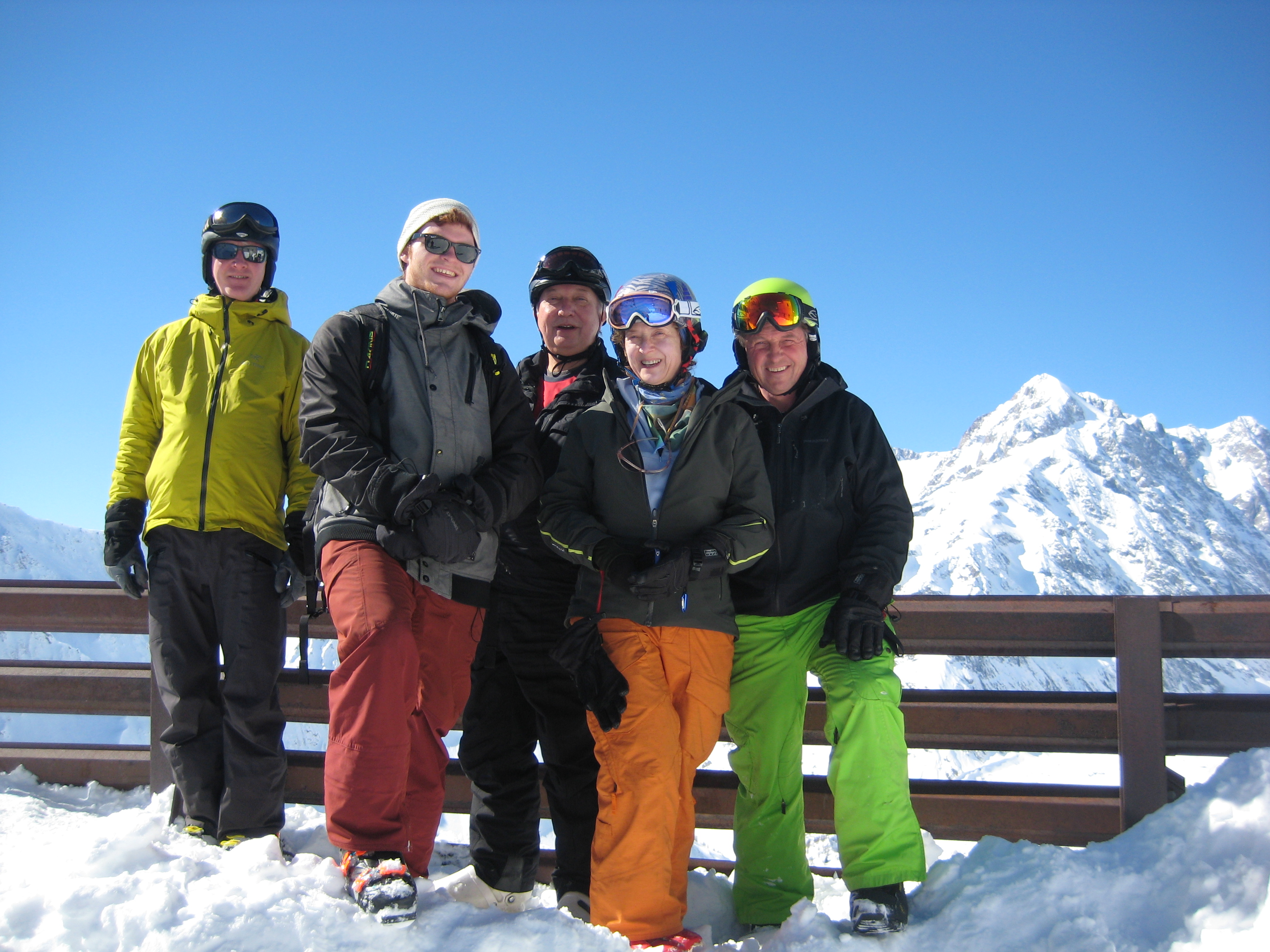
Frank, Teresa and Kristine after successfully descending off the top of Les Grands Montets summit.

Frank, Teresa and Kristine after successfully descending off the top of Les Grands Montets summit.

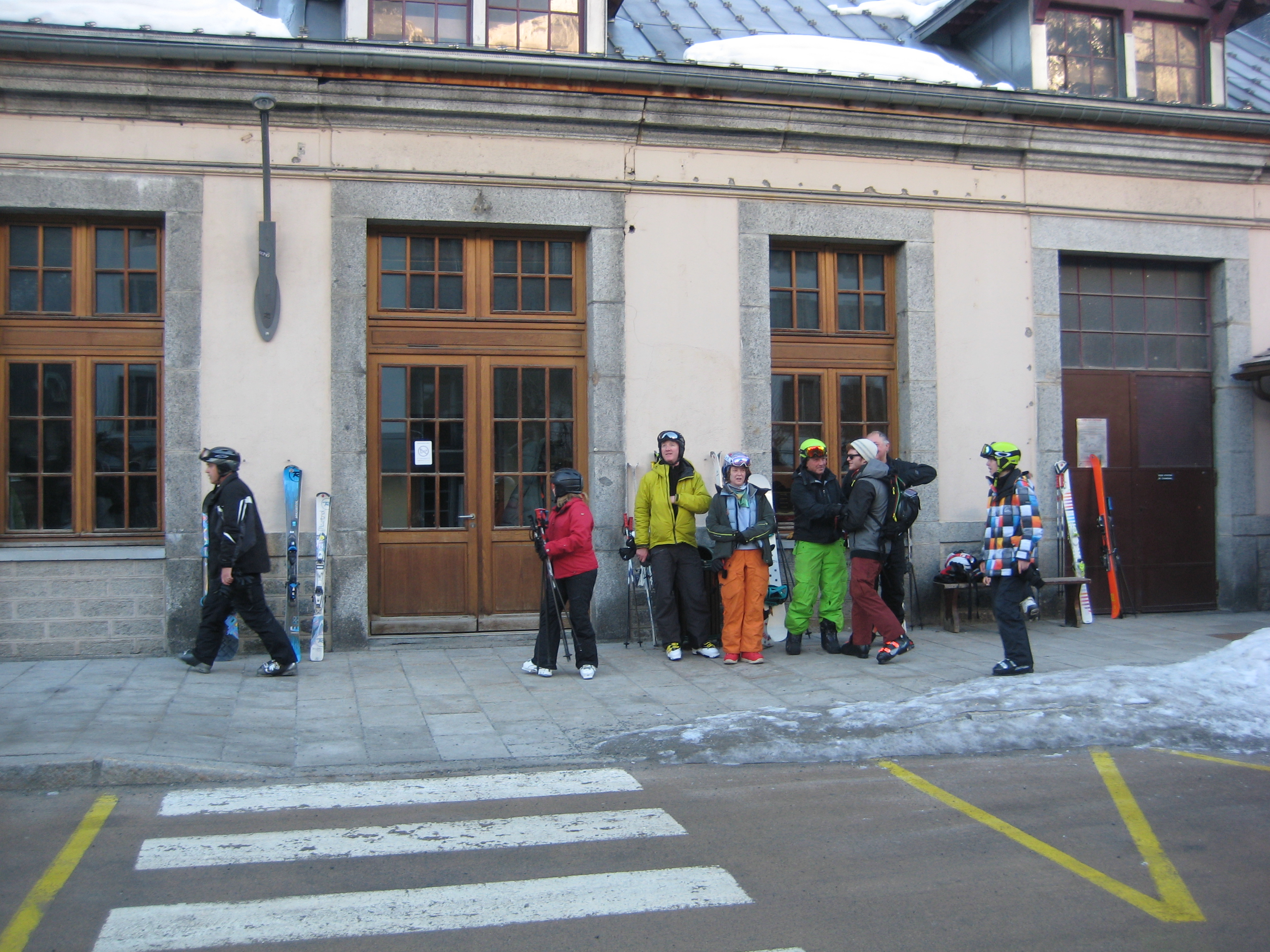
During this trip we also spent a day on the Italian side of Mont Blanc, the Monte Bianco side, in Courmayeur.  To get there, we took a bus from Chamonix through the famous Mont Blanc tunnel.  This eleven kilometer long tunnel runs under Mont Blanc, and was the site of a fire in 1999, due to a truck catching fire which was carrying flour and margarine.  Thirty-nine people died, and the tunnel was closed for three years after that for repairs and improvements.  Our bus left from the Chamonix train station and took us directly to the ski resort on the other side of the mountain, with no problems to report.

Our group, waiting for the bus to Courmayeur.

Our group, waiting for the bus to Courmayeur.

Skiing in Italy seemed a bit more fun and lighthearted than skiing on the French side.

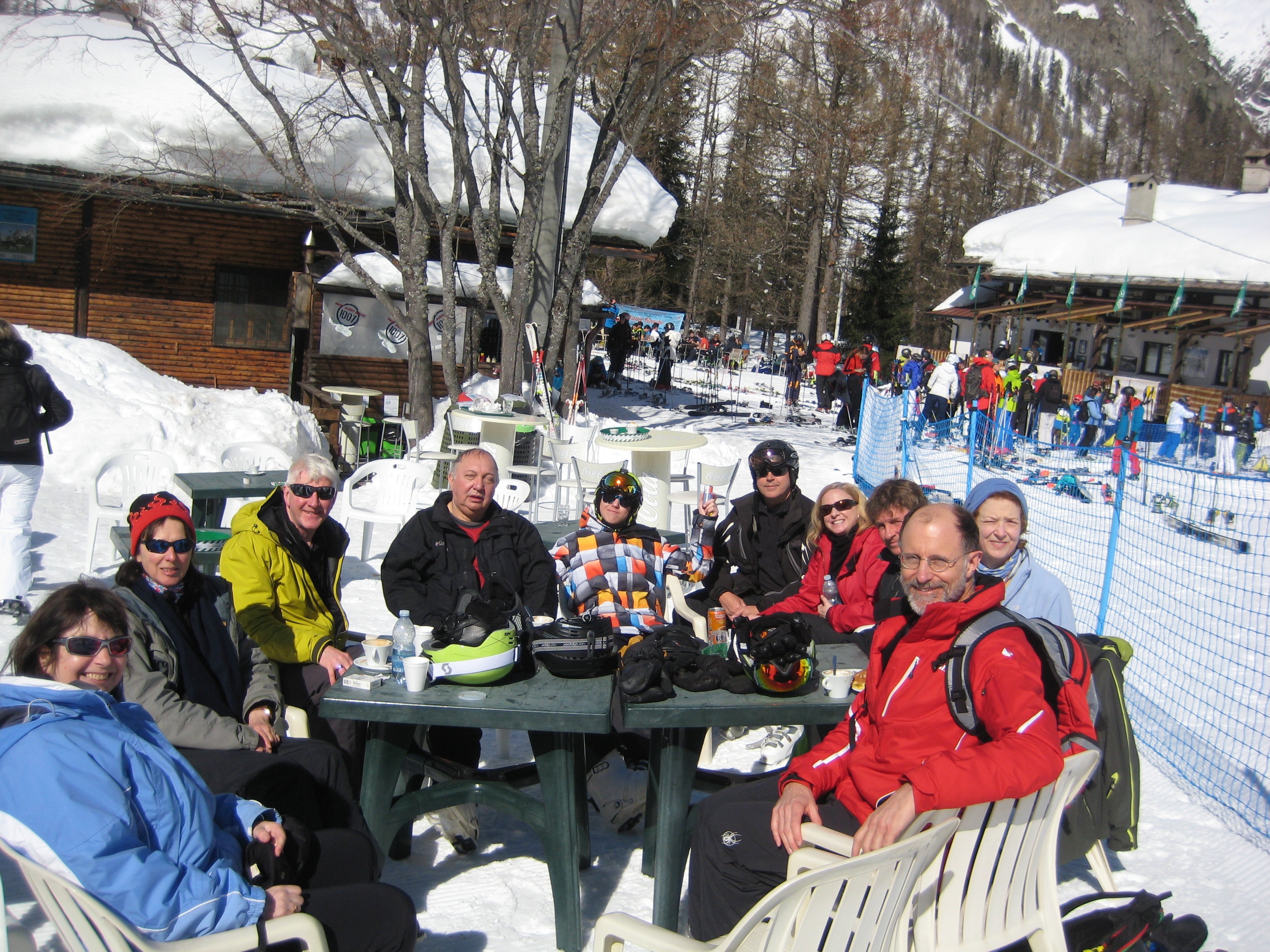
Enjoying a break in Courmayeur.

Teresa, Christine, Simon, AJ, Drew, Eric, Jen, Paul, Kristine and Frank enjoying a break in Courmayeur.  Thanks, Will, for taking the photo.

The challenges were there, too, as we learned ascending to the top of the Youla gondola.

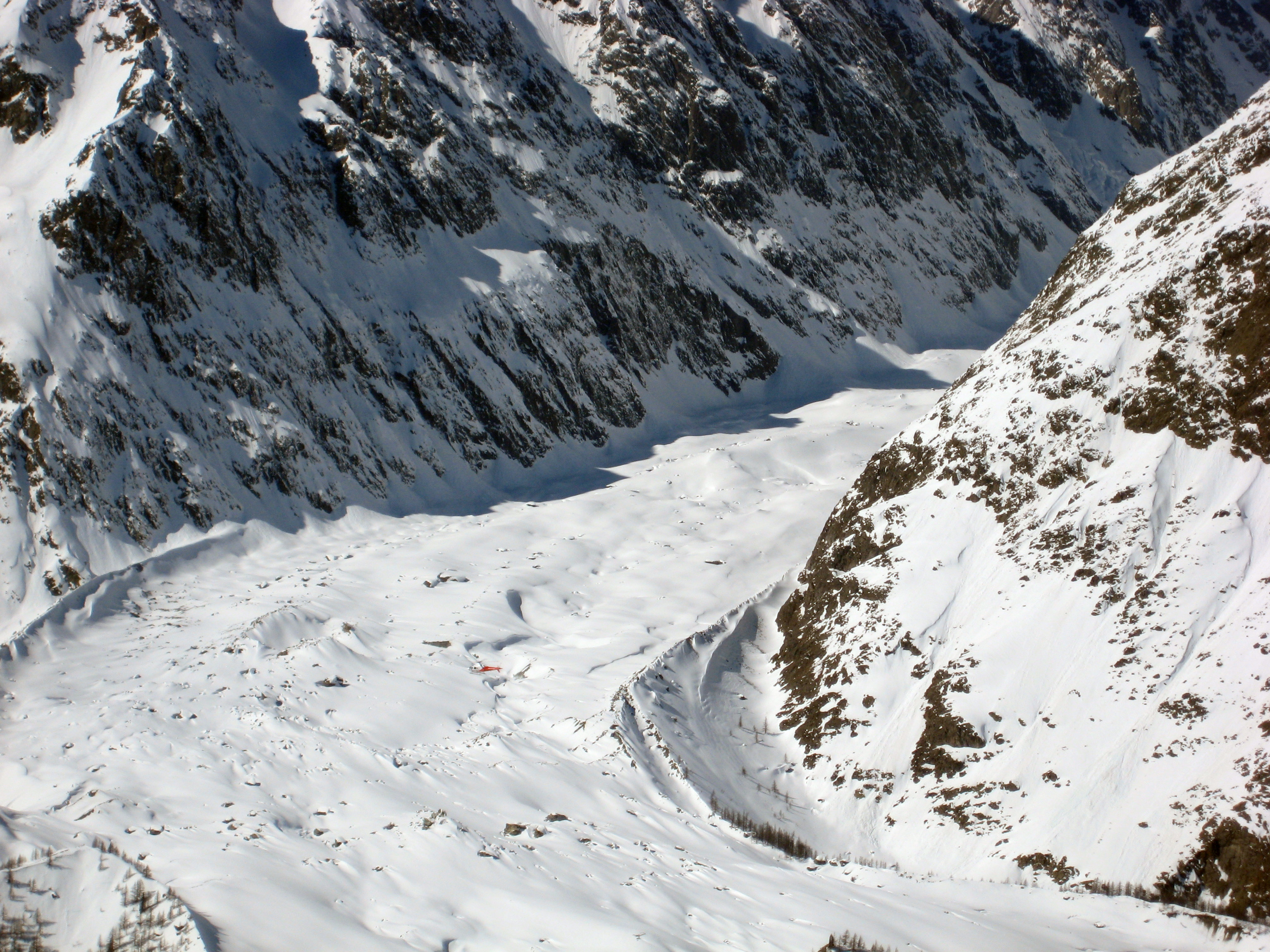
Looking down from the top of the Youla gondola station, see if you can spot the helicopter.

Looking down from the top of the Youla gondola station, see if you can spot the helicopter.

Simon, Will, AJ, Kristine and Paul at the top of the Youla gondola.

Simon, Will, AJ, Kristine and Paul at the top of the Youla gondola.

Drew, Jen and Eric, part of our Pennsylvania contingent, with Monte Bianco looming over us.

Drew, Jen and Eric, part of our Pennsylvania contingent, with Monte Bianco looming over us.

Traveling to really get away, to have an adventure, take some risks, and be out of range of work allows one’s batteries to recharge.  We had great food, some cooked by our chalet’s caretaker named Abdel.  He is Algerian by birth, with a Moroccan passport, and he loves to cook.  He prepared several dinners for us, including a Moroccan style dinner, and a fondue dinner.  Always he would include fresh salads and lots of vegetables, unlike what a restaurant meal might provide.  We played a truly bawdy card game called “Cards against Humanity”, which we learned from our UK representatives, was heavily weighted toward Americanisms.  Nevertheless, it had us rolling with laughter.  We drank plenty of beer and wine, and completely enjoyed ourselves.

I arrived home late Sunday night and had to be at work the following morning at 6:30.  It was a jarring reminder that I don’t live the holiday, jet-set life full time, only on special occasions.  I also have a half-marathon coming up, and the week of skiing is hardly preparation for a run.  I did run a couple of times in Chamonix, with Will, the eighteen year old who needs to stay in shape for lacrosse.  Good that I was able to keep up with him, although he did carry a backpack on our runs.  By the way, the French people I met were very friendly and forgiving of my grade-school French.  It was a great get-away, and I am looking forward to the next big adventure.

A Bridge, a Fox, and a Tie-in to Running

Unless one were lost in the woods these last couple of weeks, it would be impossible to miss the uproar over the George Washington Bridge closures.  Last September 9-13, lanes were closed on the Fort Lee side of the bridge, which is the busiest bridge connecting New Jersey to Manhattan, in a sudden and unexplained move, later brushed aside by port authority officials as a “traffic study”.  On Dec. 16, 2013, John D. Rockefeller IV, chairman of the Senate Committee on Commerce, Science and Transportation, wrote to the chairman and vice chairman of the Port Authority of New York and New Jersey requesting answers to very direct questions regarding the lane closures.  Answers were provided in a letter written by the Port Authority Board Secretary which were filled with standard protocol type language.  It was not until a subpoena from state legislators demanded emails and text messages from various people involved with the closures, specifically Bill Baroni and David Wildstein, that it became evident that the lane closings were political retribution against the mayor of Fort Lee, a man of Croat heritage mistakenly referred to as a Serb in one of the emails, perhaps the biggest insult of all.  The people who instigated the lane closures were all close allies and working for Governor Chris Christie of New Jersey.  While the governor has claimed he knew nothing of the involvement of his team in the closure of the lanes, he has a reputation of being a bully, and taking retribution on a political foe is consistent with his character.  He is known for his bullish, bullying style, making fun or yelling at opponents who have the temerity to speak against him.

It was time for the television pundits and posturers to take a stand, generally, as one would guess, along political lines.  There was one comment that really stood out, though, as being a strange, and utterly outdated way to see this debacle for Governor Christie.  After all, he is positioning himself to be the spokesperson for the republican party, and possibly to run for president in 2016.  He should be preparing the big tent, to attract conservatives and near-conservatives, libertarians and tea-partiers, whites and off-whites, men and, yes, even……women.

Brit Hume, senior political analyst at Fox News, on a Sunday talk show called “Media Buzz”, had this to say:  “Well, I would have to say that in this sort of feminized atmosphere in which we exist today, guys who are masculine and muscular like that in their private conduct, kind of old-fashioned tough guys, run some risk.”  He went on to explain that the governor is an old-fashioned guy’s guy, a masculine and muscular guy, in constant danger of looking thuggish or sexist.  He got a quizzical look from a co-commentator on the program, Lauren Ashburn, but later was supported in his contention by another Fox star, Bill O’Reilly, who said that real men who are rough around the edges, maybe rude or blunt, get a raw deal from the public.  Another way to look at this, though, is that real men, manly men, have a right to their own way of behaving, and women are trying, and now succeeding in ruining it for them.

Has running “suffered” from feminization?  The Olympic Marathon of 1896, held during the first modern day Olympics in Athens, Greece was a men-only event, as were all the events at that time.  Initially, women were probably not considered for competition, since they were not felt physically capable of participating.  They were also excluded based on a men’s club mentality.  But, a woman did run the first Olympic marathon, just not as an official competitor.  Her name was Stamata Rivithi, and she completed the 40 kilometer course in 5 hours and 30 minutes.  The winner that year, a Greek named Spyridon Louis won the men’s event in 2:58:50.  Violet Percy, an English woman, was the first officially timed woman marathon winner with a time of 3:40:22 at the Polytechnic Marathon in London in 1926.  These women broke barriers, but the premier marathon event, the Boston Marathon, had yet to be tainted by the presence of women.  It was not until 1966 that a woman named Bobbi Gibb (co-alumnus(a) of mine from Revelle College, UCSD), ran the Boston Marathon as a non-registered runner.  It being an AAU sanctioned male event, women were not permitted to officially run it.  Bobbi Gibb’s story is nicely told in an interview she did which is posted on the Bill Rodgers Running Center website.  She reports she applied for an entry to the race, but got a reply from the race director, Will Cloney, stating that women were not physiologically able to run a marathon, and furthermore, were not allowed to.  She had to hide in the bushes at the start, wearing her brother’s shorts and a hooded sweatshirt.  She joined the race after about a third of the runners had started.  She reports that she was recognized as female, as she put it, by the men studying her anatomy from the rear. The men around her were very supportive.  She says they told her they would not allow anyone to remove her from the race.  She finished with a very respectable time of 3:21:40.  While unofficial at the time, she has since been recognized by the Boston Athletic Association as the first female winner, and she won three years in a row.  Ironically, at the time she ran her first Boston, the longest sanctioned race for women on the AAU calendar was 1.5 miles.

Since then, the number of women participants in running races has grown dramatically.  In a Wikipedia article, a graph of women’s participation (not just runners) in the summer Olympics has grown dramatically from the early 1900’s to the present:

Women as a percent of participants in the Summer Olympics

Women as a percent of participants in the Summer Olympics

In one of our major races in the Philadelphia area, the 10 mile Broad Street Run, held the first Sunday in May, the number of women participating has grown steadily since the race began in 1980.  This past year, 2013, the total number of women finishers was 17,269.  There were 14,773 male finishers.

For major marathons, women have not yet reached parity with the men, but are not far behind.  For 2013, at Chicago, there were 17,395 women and 21,488 men finishers.  For New York, 19,567 women and 30,699 men completed the race.  In Europe, at the Berlin Marathon, 8,946 women and 27,528 men finished.  And in Los Angeles, 7,773 women and 11,761 men crossed the finish line.  In Boston in 2012, 9,006 women and 12,666 men got to run that last stretch down Boyleston Street to the iconic finishing banner.

Women have also become leaders in the world of running organizations.  Mary Wittenberg, the president and CEO of the New York Road Runners, is responsible for the business and operations of the club, including the production of the New York City Marathon.  Stephanie Hightower is president of the USATF, the national governing body for track and field, long distance running, and race walking in the U.S.

Every Sunday morning, I meet with a group from my running club at 7:30, to run a 13 mile loop.  Sometimes we go farther, if we are in the midst of training for an upcoming marathon.  We’ll start out earlier, get the extra miles in, and then meet the group at 7:30 to start together.  We have a balance of men and women in the group.  I’m sure not one of the guys feels put upon, inhibited or less manly because women are participating in the sport.  Likewise, the thought that women are not capable of participating, the thought held 30 years ago and earlier, has been proven to be bunk.  It is true, that when men and women mix together in a social setting, men behave more civilly, less crudely.  At least, they should.  There really is no excuse, in my mind, for bullying and being obnoxious, and it certainly is not the fault of women if someone who behaves that way is brought down.  I would say, yes, running has been feminized, in that women have been able to participate in this great sport which was once closed to them.  They have shown their mettle, and taken on the challenges of the toughest of races, the marathon.  They have contributed greatly to the organization and running of the sport, and their participation keeps growing.  Far from making us guys unmanly, less of a man’s man, they have joined our ranks, and made it better.  What a bunch of “bushwa” (got that from a NYTimes crossword puzzle) coming from Brit Hume and Bill O’Reilly.

Whole lotta chafin’ goin’ on

I noticed when I got up this morning that the sky looked a bit dark and uniform.  The sun had not risen yet, so I couldn’t tell if the sky was clear or overcast.  It wasn’t as cold as it had been the last few days, around 40 degrees F, so I dressed lighter than for a frigid run.  I checked the weather on weather.com.  It showed a massive band of rain heading our way, and it looked like it would reach us around 11:00 AM.

We gathered for our usual run this morning, Sunday, December 29, in front of our local running store, the Haddonfield Running Company.  About 12 runners were out this morning, one new to our group; the rest were the usual gang.  Our typical Sunday run is a thirteen mile loop starting at 7:30, followed by coffee at Starbucks.  We have a number of runners in the group who have started their training for the Boston Marathon, April 21, 2014.  For them, the weather is not an issue.   They are committed to run regardless.  The rest of us have our various races scheduled in the spring, so we also don’t mind getting a few raindrops on us.

I ran from my house to the store, and after a few pleasantries, we started off on our run.  As soon as we started, the ran began.  It was very light at first, just a mere sprinkle.  But not too far into the run, it became a steady, cold rain, with a grey uniform sky, and no real color anywhere.  We kept together as a group, probably from a preservation instinct, unlike other days when the fast ones take off like rabbits.  At first the rain didn’t seem to faze anyone too much.  There was a lot of talk amongst us, about Boston, training, cyclocross racing, geese, news of the day, and so on.  The new guy came from a cyclocross background, and had only been running since he got new running shoes for Christmas.  Geese are everywhere we run around the Cooper River Park.  They are Canadian geese which have settled permanently in our neighborhood.  They don’t migrate anywhere; they are perfectly content to stay here the year round.  Every year a new gaggle of goslings is produced, and the numbers just keep going up and up.

As the run went on, the talk trailed off.  We really just wanted this run to be over.  The rain continued with small, cold drops that now had drenched us thoroughly.  Puddles were all around, and impossible to avoid completely, so our shoes and socks got soaked, too.  We made a quick stop for a drink at the Cooper River boat house.  Oddly, there is no water fountain on the premises, so we have to drink from the faucets in the restroom.  As we got going again, we all noticed how cold we had gotten from just a quick stop.  Crossing a road on the way back, a driver, who had the right of way, stopped to let us cross the road, no doubt wondering why presumably sane people would get out and run in this weather.  While a couple of the group cut the run a bit short toward the end, my friends Tony and Brandon and I gutted it out for the full thirteen miles.  Brandon, who is usually one of the above mentioned rabbits, seemed content to hang with us older, slower types today.  I noticed, after I had stopped, that my body temperature seemed to plummet.  I made straight for the Starbucks, and grabbed my backpack.  I headed for the restroom to change into dry clothing.

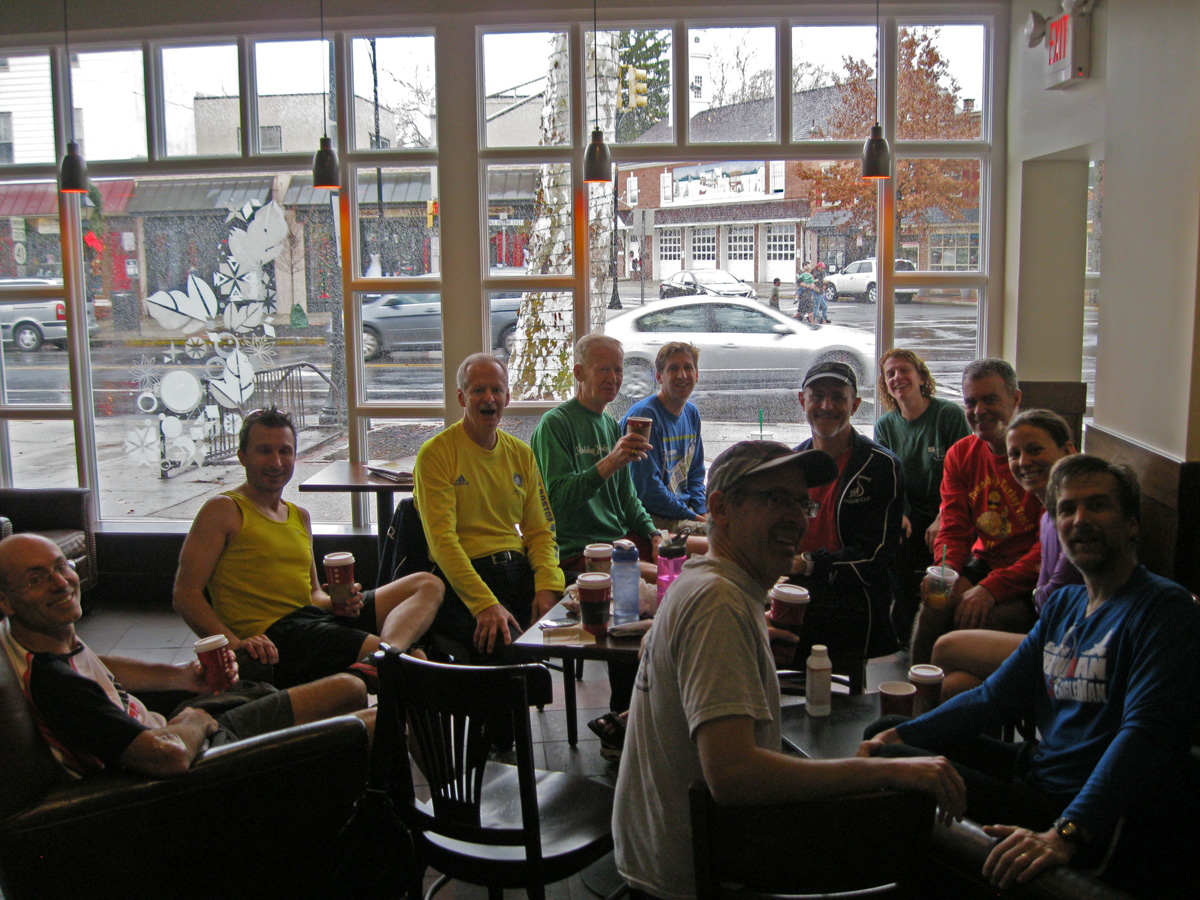
The coffee shop has a gas fireplace, which was very welcome today.  We were all shivering on arrival, but rapidly warmed up in front of the fire.  After I got home, I hopped in the shower.  Yeowww!  Those areas that had been rubbed raw by the wet clothing were suddenly and shockingly evident as the hot water sluiced over me.  The shower felt awfully good, though, and once done, I put on some warm jeans and a long-sleeved t-shirt, and stayed indoors the rest of the day.  We have only a couple of days left in 2013.  To all my family, friends, fellow bloggers, and running mates I wish you all a healthy and happy new year.

SJAC members hanging out at Starbucks after our Sunday morning run.

SJAC members hanging out at Starbucks after a Sunday morning run.

Running Philadelphia

Lining up to get in to the Philly Expo, 2013 Marathon

Lining up to get in to the Philly Expo, 2013 Marathon

We had to get up awfully early.  The start of the race was scheduled to be at seven AM, and the officials were recommending runners arrive by five AM to get through security.  That would mean a lot of time standing around waiting to start, in the dark, getting cold.  After Boston, it seems all of the US based marathons, and perhaps worldwide, I don’t know, have gone to higher levels of security around the start and finish of the races.  It seems a false sense of security, but I understand the motivation.  In Philly, we were told there would be security entrances at the staging area of the race and we should expect lines.  Hence, the reason for early arrival.  We compromised, with a knowledge that this being our hometown race, we could predict how things would go.

I set my alarm for 4:00.  I wanted to get a decent breakfast before heading out.  I ate a bowl of cereal and had a cup of freshly brewed coffee.  I bought the beans the day before at Old City Coffee at the Reading Terminal Market.  It has become my tradition, to go to the marathon expo at the Philadelphia Convention Center, pick up my number, browse the expo, then head over to Reading Terminal Market across the street.  I even know the route I will take through the market.  First, a stop at Metropolitan bakery, for a pain au levain and a loaf of cherry chocolate bread, because life is better with cherry chocolate bread.  Then I head to Downtown Cheese, to pick up something tasty, usually a goat gouda or morbier.  Then, it’s on to Old City Coffee for some of their freshly roasted beans.  At Old City Coffee I had a conversation with a young woman also buying coffee.  She asked if I was running tomorrow.

“Yes,”  I said.

“The full?” she asked.

“Yes, the full,” I said, smiling.

“I’m only running the half.  I started to train for the full but got distracted, and I’m just not ready for a full.”

She looked plenty young and fit enough to run an ultra if she wanted, and I felt a bit wistful, that someone could be perfectly satisfied running the half, knowing others would be running the full, and thinking she had done the right thing.  While waiting for our coffee, we talked about the course, how the crowds gather on Chestnut street, how the weather would be, and how early we had to show up the next day.  I then said “have fun tomorrow”, and headed back to meet my friends who had come to the expo with me, and were patiently waiting, actually having lunch, while I indulged my wants.

A group from my running club met at the train station for the five AM train into Philly.  There were plenty of others on the PATCO line from South Jersey heading in for the race.  We definitely were a bigger crowd than the normal 5:00 AM Sunday train sees.  We rode to the end of the line, 16th and Locust, then started walking to the Ben Franklin Parkway. It is more than a walk. We sped along, the adrenaline pumping up the pace and the chatter. We passed two closed Starbucks, and commented, “we’re up before the baristas.” As we reached the Ben Franklin Parkway, the crowd got thicker. There were entrance gates into the staging area for the runners, but we went through without a holdup. The security guards at the gates seemed to recognize who were runners, and just waved us on through. As we wandered up the parkway we saw the UPS trucks waiting to take our clear plastic personal items bags. We decided whoever makes clear plastic bags for marathons is having a banner year this year. Along a grassy stretch there were dozens of portable toilets with almost no line yet. We all stopped to use the facilities, not because we had to, but because the lines were so short. This is never the case at these big races. We then strolled over to sit at on the steps of the Washington Monument fountain in Eakins Oval. It was still early, about 6 AM, so we had another hour before the start.

20131126-220623.jpg

On the steps of the Washington memorial fountain, awaiting the start of the Philly marathon.  Photo by B.A.

I spoke to a young woman seated on our same steps. She was with her mother and father, who were not running today, but just making sure she was not alone in the crowd. I found out this was her second full marathon, but her father was on his way to running a marathon in all fifty states.  That, it would appear, was where the motivation came from for her to run.  He had completed about 20 states, and said Alaska was the most interesting so far.  The marathon, in Anchorage, is run during the summer solstice in the middle of the night.  He’s saving Hawai’i for last.

Another trip to the portable toilet was out of the question. The lines had grown tremendously, and the way the toilets were lined up facing each other, the lines melded into a confusing conglomeration. One didn’t know if one was coming or going.   As the start time grew nearer, we headed to the UPS trucks, dropped off our bags, and found our way to the corrals.  Unusual for this time of year, the temperature was balmy, in the mid 50’s.  I came with a throw-away long sleeve shirt, but decided to pitch it before the race started.

We lined up, and then, before you know it, we were off.  The course for Philly is a great urban course.  It starts down the Ben Franklin Parkway and past our incredibly ornate city hall.  The statue on top is known familiarly as Billy Penn, the founder of the city of brotherly love, and as now known also of sisterly affection.  Then, it’s down Arch Street, and over to the aptly named Race Street to Columbus Boulevard.  The route heads south to Washington Avenue, then in to South Philly.  South Philly has a character all its own.  In addition to the usual signs held up by fans, I spotted a permanent sign on the street which said, “The last car that parked here still hasn’t been found.”  Turning up South Street and heading west, the crowds had grown thick.  The nice weather had brought out a great number of spectators, and they were all very noisy and encouraging.  Then, its over to Chestnut Street, choked with fans to the point that the course got a little narrow in places.  The race was briefly interrupted by a taxi carrying a woman to Pennsylvania Hospital.  Over the Schuykill river, the race turns north through the Drexel University area, where celebrating frat boys are banging on pots as the runners go by.  Beyond that, the crowds thin considerably as the route heads past the Zoo.  Up and around the Belmont Plateau, and the Please Touch museum, the first offering of gels is provided.  The sponsor this year was Clif, so we got Clif Shots in all different flavors.  The last part of the first half heads down hill to West River Drive, along the Schuykill, then back to the Philadelphia Art Museum.  At this point, large signs attempt to direct the half-marathoners one way, and the marathoners the other, for the full trip out to Manayunk.

I was feeling pretty decent up to the half, but noticed my nemesis, muscle cramps, starting to threaten.  It was certainly early in the race for this to become a factor for me, and I was seriously considering  bailing at the half.  I would have finished the half in a decent but not earth shaking time.  But, my stubborn side would not allow it.  This would be my sixth consecutive Philadelphia Marathon, and I did not want to only finish a half, and break my streak.  Looking at it from a rational, objective view, who would care?  Would stopping at the half make me half a person, unworthy of honor?  Regardless of whatever logical argument I could have made, I made the illogical choice to run on.

I had arranged with my friend Tony to have a bottle of Gatorade for me at this point.  I almost missed him, looking on the wrong side of the street.  Fortunately, he was with another of our club members, the delightfully attractive Michele, who I didn’t miss, and I was able to grab my Gatorade and muster on.  Around the front of the art museum I went, heading out for the second half, the long slog out to Manayunk and back.  I was still going fairly well, with the occasional calf cramp sending one leg or the other out in a bizarre spasm.  Another club member had joined me at this point, Dave, running just to support us SJAC club members.  He’s a remarkably fast runner, and I felt guilty as I started to fall apart running with him.  I also caught up to my teammate Brian, normally much faster than me, who, it appears, was having a worse day than me.  The route goes out along Kelly Drive, past the famous boat house row, and along the Schuykill to the Falls Bridge.  This is the only part of the course I really don’t care for.  We have to go across the bridge, down a hill along the West river drive for a ways, then make a U-turn to come back up and across the bridge again, for the sole purpose of adding distance.

As we got back to the road to Manayunk, I started to have serious problems with the legs.  I was having not just cramps, but real pain, and my back, shoulders and arms were cramping up, too.  It made for an amusing sidelight.  As I grabbed a cup of water from a water stop and raised my arm to drink, my bicep and forearm muscles cramped, and I had to pull my arm down with the other hand to get it to straighten out.  By this time, I was already in Manayunk, and the only way back was to go the last six or seven miles, even if I had to walk.  Which was what I did.  Not the whole way, but a good part of it.  My terrific time tumbled, and the walking was all I could muster.  I noticed a good number of other runners who had succumbed to fatigue, or the wall, or whatever, and were walking, too.  It became a race of walkers.  I was jealous of the other runners who continued to zip by me, still able to run and even chat.  I stopped several times to stretch, and Dave, my friend from the club, who had lost me for a while, found me again and was very patient and encouraging.  Finally, as I neared the boat houses again, I had recovered sufficiently to run again.  Interestingly, the pacesetter for the 4:15 group, who had passed me a little earlier, seemed to be having his own troubles, and I passed him as I rounded the curve to the home stretch along the Parkway.  I have always said, “look good going out and coming in.”  What happens in-between, only I am privy to.  So, I looked as good as I could for the finish line.  I gave Mayor Nutter a high-five as I crossed the line with the Rocky theme playing loudly over the speakers.  The crowds were there and shouting, and the atmosphere, as always at this race, was very upbeat and positive.  I sidled along the line of recipients receiving their marathon medals, which this year were beautiful, large gold colored medals for the 20th anniversary of the race.  I didn’t need the mylar blanket, because the temperature had risen considerably and it was quite warm.  I got in line for my post-race snacks, and headed out to the UPS trucks to pick up my clear plastic clothing bag.

Another marathon done, I pondered about the way my muscles had failed me.  I was in very decent shape going in to this race, having done a 21 miler two weeks earlier in fine form.  It turned out the following day, I had, perhaps, a partial explanation.  I developed a fever, sore throat and runny nose, and felt completely washed out.  I think I was in the pro-dromal stage of a virus, and that explains the muscle soreness and cramping of everything, not just my legs.  I was a real sight the day after the race at work.  It is my standard practice to always take the stairs, no elevators for me.  As I hobbled in pain on the stairs, particularly going down, sniffling, and moving slowly, my surgical residents were probably wondering why I would do this to myself.  I don’t have a ready answer, but I do know that I am already planning next years assault on the marathon circuit.  We, my running partners and I, are thinking about Minneapolis/Saint Paul.  We hear it is a great marathon, and perhaps a little easier course than Philly.

Brandon Runs New York

Brandon, in the SJAC jacket, organizing our club's Great Grace race.

Brandon, in the center in the SJAC jacket, organizing our club’s Great Grace race.

People living on the east coast (of the US, for my non-US readers), cannot forget hurricane Sandy.  For some, it was a big storm which didn’t do much damage.  For others along the coastline and in New York and parts of New England, it was a devastating storm from which many have still not recovered,  although it has been a year.  Even if there was recovery, in this campaign season we in New Jersey are constantly reminded of how our fearless governor stood face to face with the storm and chased it away, then went out to help our citizens recover, walking arm in arm with the president.  It made for some strange politics, now replayed as political ads.  It also created mayhem for the New York City marathon, which was cancelled at the last minute.

The New York City marathon started as several loops around central park in 1970, organized by Distance Running Hall-of-famer Fred Lebow.  At the time it had a starting lineup of 125 runners, 55 of whom actually crossed the finish line.  The winner, Gary Muhrcke, finished in 2:31;38, while Mr. Lebow finished in 4:12:09.  Since then it has grown to be the largest marathon run annually, and now traverses all five boroughs.  Staten Island is included by the race starting on the Verrazano Narrows bridge, then it progresses through Brooklyn, Queens, the Bronx, and finishes in Central Park in Manhattan.

Since its start in 1970, it has only been cancelled once, in 2012.  As Sandy hit New York, causing flooding, destruction of houses, buildings, roads and tunnels, electricity outages, and isolation of communities, the Road Runner Club of New York, and Mayor Bloomberg, pushed on, wanting to show the world that the dominant spirit of New Yorkers could overcome anything.  About 36 hours before the race, it was cancelled when the organizers and the mayor recognized the severe impact of the storm on the citizens of the boroughs through which the race would be run.  Instead of using sorely needed generators to provide emergency backup power, these generators were used to heat tents along the route for the runners’ support.  The race was cancelled, and tens of thousands of runners who had gathered in New York were turned away.  Some used their energy to volunteer, helping hurricane victims.  Others, having come from far off points around the globe, returned home, peeved that the race had not been called off before they made the trip.  The sponsors of the race eventually refunded the entry fee to several thousand runners, while others opted for a chance to run in 2013.  My friend and running partner Brandon chose a 2013 entry.

Among several things that Brandon lives for, his beautiful wife and their adopted special-needs son, his faith and his church, running is a very big part of his life.  He ran track in high school, and still relates stories of the races he ran and competitors he raced against.  He has run many marathons, among them multiple Boston Marathons.  He has a tie hanger loaded with Boston Marathon finishers medals on the wall in his living room.  It also displays medals from London and several others, including one from New York.  He ran New York in 1993 at the prime age of 26, finishing with a gun time of 3:02:28.  This was before the modern era of chip timing.

Brandon is a very hard trainer.  He regularly runs upwards of 60 miles per week, mixing long distances at marathon pace, speed work and recovery runs with core training, stretching, and foam roller rolling (for lack of a better term).  Often when I drop by on Saturday mornings for a run, he has a video on in the background of a DVD for core workouts on standby.  The intro shows a woman on a mat raising and lowering her midsection endlessly.  No wonder he enjoys doing core workouts.  Our Saturday morning runs are at marathon pace for me, but a very slow recovery run for him.  He is driven by the fact that our club has some very fast runners who are older than he, and he uses them as a stimulus to keep his game going.  He is also a terrific coach for runners like me who benefit from his years of training and racing experience.

Brandon heads to New York today.  He has plans to take the train to Penn Station, get his number and other swag at the expo, then check in at his hotel.  As he put it, he’ll spend $425 for the privilege of a few hours sleep in a fine New York City hotel, only to have to leave before sunrise to make it to the start line.  Twenty years since he last ran, he has a very good shot at breaking his previous New York City marathon time.  His friends and supporters will be watching the race on TV and on-line, wishing him a great run with the wind always at his back, not too hot or too cold, no stepping in potholes, and a fine finish in Central Park.

GO BRANDON!

Uncorking Croatia

The Blog of WINES OF CROATIA

RunnersOnTheGo.com

To help enrich the lives of others, we developed RunnersOnTheGo.com to help runners save money on races, running stores, and much more. We also provide the specific local information that makes your travel for business, vacation, or racing as rewarding as possible.

getsetandgo

Travel Blog of a Budget Traveler sharing stories on travel, books & Vegetarian Food

Marc Hemingway

Trying to keep track of my life (and my life on track)

Mid-Life, Mid-Level, Masters Running

Exploring ideas about running to contribute to a more enjoyable pursuit for the mid-level masters runner

therunningtherapist

"One foot in front of the other and one thought at a time"

WordPress.com News

The latest news on WordPress.com and the WordPress community.

retireediary

The Diary of a Retiree