Looking out; Looking Back

Way back in college, one of my professors, in a class in which I was a bit lost, talked about “signifier and signified”.  Hang with me on this, because it gets confusing before it gets clearer.  This professor, who was French and had an accent, said something about signifier and signified which has stuck with me, and seemed important.  He referred to these concepts as someone looking at another image, whether in a mirror, or another person or thing, and that the image changes the originator of the interaction.  That was probably a misinterpretation on my part.

It turns out, these terms, signifier and signified, are concepts in the large field known as “semiotics”.  Also, the signifier is not a person, it is a form that refers to something else, together making a meaningful sign.  An example would be a written word, like tree, referring to the object which we know as a tree.  But these signifiers are not limited to letters, or words.  They can be body language, facial expressions, clothing, grunts, color coding, and so on.

What the professor meant, and what I took from it, are too far removed from today, for me to say whether he knew what he was talking about (I bet he did), or if I just took from it what I wanted.  But I liked the idea that the message, whether a word, an expression, a gasp, a groan, a sneer, is reflected back and alters the sender, which is where I begin.

I look out from my own eyes, and if there is no one watching, I feel a certain way.  Trees, rocks, the road, my environment, will affect the way I feel or act, but they are not actively answering my message that I am either consciously or unconsciously sending out.  Still, the reflection of that message, say a groan when I see a hill coming up, or a sideways glance at a tree just starting to blossom, will reflect back at me and alter my course.  How we feel starting out on a run is almost never how we feel at the end, likely due to these interactions which change us as we run along.

Adding another person running with me is another complexity altogether in this analysis.  Now, I have someone actively receiving my message, interpreting it, and sending back a reflection with that person’s own message included.  I suppose this can happen with an animal as well, say, if one encounters a deer on the run who gets startled by one’s presence.  Or, if one happens upon a snarling dog in the road.  Or, as happened to me on a run in Wyoming, along the road bordering the National Elk Refuge, a ram in a group of big horn sheep standing in the roadway staring me down.  That was a definite direction changer.  Having a person run with me means keeping up, slowing down, talking, looking strong, looking beat, changing posture, and many other changes in direction, attitude, and feeling based on the reflection from the running partner.  This is not to include direct communication, but rather the meaning of the message sent and the reflection received.  We have these interactions with others throughout the day, but in running they take on a certain impact.

One of the most insidious, and dangerous interactions between messages sent and received, is from our own reflection.  As I mentioned earlier, when I am looking out through my own eyes at things around me, I feel a certain way.  But, seeing my own reflection is a message which can really go deep.  As I run, I can feel athletic, strong, tired, wet, dry, sore, fast, slow, or tough.  I can be distracted, angered, calm, happy, gritty or simply wondering at nature.  Almost never am I depressed or lonely, even when running alone.  One glance in a shop window, though, can change my perception immensely.  Almost always, I feel that I look younger  and more athletic than my reflection in the window.  How does one respond to that message, that you are older than you feel.  For me, it’s a great reminder to pull in the abs, straighten the shoulders, head up, and look more like I’m enjoying myself than look like I’m on a forced march.  Then there is the core of feeling, a sense of inner strength but also a minor sense of inner weakness.  These messages confront one’s sense of self, of ability, and of vulnerability.  All that from a simple reflection, one glance which may take less than a tenth of a second.

In sum, these are all messages and reflections over which we have no direct control.  They are ingrained in the way we interact with our surroundings, and we don’t take too much time to think about them or formulate a reaction.  Recognizing them, though, allows us to consider how we think and act on a basic, reflexive level, and use parts of our brain which are in the realm of the subconscious.

Lemmings?


The End is Near, or, "you got this!"

The End is Near, or, “you got this!”

I’m a big fan of cartoons, particularly the ones found in the New Yorker magazine.  Robert Mankoff drew a cartoon a few years back,  “What Lemmings Believe”, which showed lemmings going off a cliff and ascending skyward.  My marathon experiences are sometimes like that.

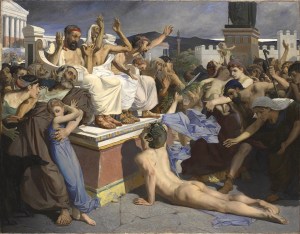
Pheidippides giving word of Victory, by Luc-Olivier Merson

Pheidippides giving word of Victory, by Luc-Olivier Merson

To runners, the legend of Pheidippides running from Marathon to Athens to announce the Greek’s victory over the Persians is familiar.  The battle took place in 490 BC (although they didn’t call it BC back then).  Pheidippides was said to have fought in the battle, then ran non-stop to Athens and collapsed and died after he delivered his message.  This was the inspiration for the creation of the road race called the marathon.  In 1896, the era of the modern Olympics began in Greece, and the marathon was run with Spyridon Louis winning in 2hr 58min 50sec.

Training for 1896 Olympics

Training for 1896 Olympics

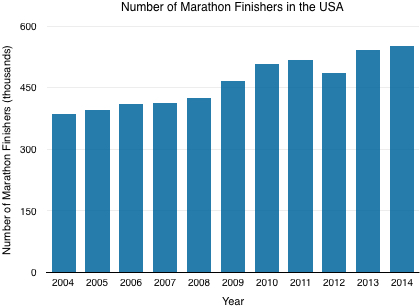
John Graham, who belonged to the Boston Athletic Association and was the manager of the U.S Olympic team at that event, was himself inspired to create the Boston Marathon, which had its initial running April 19, 1897.  In the early days of marathon racing, the number of runners in this and other early marathons was small, numbering in the tens to hundreds per race.  The first Boston Marathon had 18 finishers.  Average times were quite fast, and have gotten slower as the number of marathoners increased.  Running USA, a non-profit company which is a joint venture of USATF and major long distance races in the USA, keeps statistics on number of marathon runners, median finishing times, and many other subcategories.  The most recent marathon reports shows that in 1980, of 143,000 marathon runners in the US, 90% were men and 10% women.  Their median finishing times were, respectively, 3:32:17 and 4:03:39.  In 2014, 550,637 runners, 57% men and 43% women, finished with median times of 4:19:27 and 4:44:19.  Since 1980, there has been a steady rise in the number of marathons in the US and the number of marathon runners.

Number of marathon finishers in the USA by year.

Number of marathon finishers in the USA by year.

What is the attraction for all these runners?  What were they doing before marathons got popular?  Will the numbers keep rising, or have we reached a plateau?  While I was not able to find reliable information explaining the phenomenon of ever-increasing participation in marathons, the trade site RunningUSA does an annual survey of runners which it sells for $159, and includes information from interviewing over 15,000 runners on topics such as demographics, running shoes and apparel, travel, and even sponsor recall.  From my personal experience, and speaking with runners I know, I can take some guesses.  The marathon is a premier event in many people’s minds, which takes guts and dedication to complete.  One who completes a marathon can, with justification, be proud of his or her accomplishment.  Marathons have become big city events, and get a lot of publicity, bring in money for hotels and restaurants, and show off the good side of most cities.  As marathons became more popular, and more of a mainstream athletic activity, more people knew someone who had run a marathon.  It became a sport that, like a ponzi scheme, fed on pulling more people into the fold.  The more people who run marathons, the more profit there is in running shoes, running clothing, GPS watches, books and training programs.  When marathons began selling out, the scarcity of the spots made them that much more desirable.  The fact that median finishing times have gotten much slower over the years shows that many people are joining in who are not elite athletes, but still have the desire to participate.  The marathon is marvelously suited to participation by people of different ages, abilities and fitness levels.  Training for a marathon, rather than being a solo venture, is often a group effort, and a very social one at that.

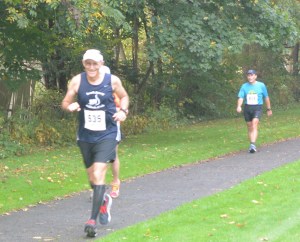
Struggling to finish Wineglass.

Struggling to finish Wineglass, 2013.

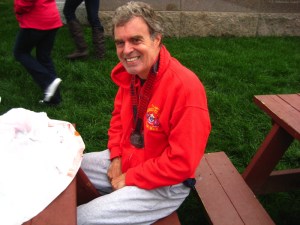
Left it all on the course.

Left it all on the course, Steamtown, 2012.

Yet, the marathon is a very demanding and grueling event.  It is run whether the day is warm or cold, dry or wet.  My first marathon, in Philadelphia, in November of 2008, the temperature did not rise above freezing, and there was ice on the ground at all the water stops.  So back to my initial thought, that to start a marathon, one needs a belief in oneself that is often unrealistic.  We train, but our training is mixed in with the rest of our daily responsibilities.  Like those lemmings, joining in the rush of the start of the race, one believes one will fly, when the sad fact is only a few truly do.  Most of us, myself included, will have a rough time finishing, and will, during the last few miles, ask ourselves why we are punishing ourselves so much.  But then, one crosses the finish line, gets a medal and a commemorative mylar blanket, and congratulations fly all around.  It is a very uplifting experience to finish this great race.  Shortly after the finish, in spite of how well or miserably I may have done, I start to think about my next one.  And, I’m back to the belief that as I start, I will fly….


Seizing up the Muscles

Christine, one of our Sunday morning regulars, asked this morning, “How do I get rid of muscle cramps?”  Sounds simple, and surely there is a scientific explanation and answer, right?

No one knows.

That’s the answer.  At least, no one who has done the research and looked for a cause, and has evidence to support their conclusions has an answer.  In an excellent article by Kevin Miller, Marcus Stone, Kellie Huxel, and Jeffrey Edwards, sports physiology scientists, titled “Exercise-Associated Muscle Cramps,” (Sports Health. 2010 Jul; 2(4): 279–283), and provided through the National Institutes of Health, the subject of muscle cramps in athletes is reviewed in depth.

There are myriad theories and cures for this vexing problem.  Most of the theories and suggested cures are based on hunches, anecdotes and guesses.  The most common thoughts about why muscle cramps occur in athletes have to do with dehydration and loss of electrolytes.  The thinking goes that if one is dehydrated, meaning a loss of free water in the body, and loss of electrolytes such as sodium, potassium and magnesium, the nerve terminals to muscles are over-sensitized leading to cramps.

Another leading theory is based on neuromuscular interactions.  This theory states that, in overworked muscles, excitatory impulses and inhibitory impulses are not in balance, and the excitation of muscle fibers wins out.

The report mentioned above goes into detail about these theories, looks at the research that has been done in these areas, and the reasons that these theories are not clearly supported by the research.

Most muscle cramps in athletes occur well into a workout or race, or occur after the end of the event.  There is a period during which muscle cramps occur after the event is finished called the “cramp prone state”, and until this period is finished, which may be eight hours or longer, the athlete is still susceptible.  While some cramps may be minor, and not interfere with performance, often the cramps can be debilitating.  Many cures have been tried over and over, with only anecdotal evidence to back them up.  Sports drinks containing (minimal) electrolytes, pickle juice, mustard, bananas, oranges, cold therapy, hot therapy, massage and TENS (trans-cutaneous nerve stimulation) have all been used.  But studies looking at hydration status, electrolyte status and all the above mentioned cures have failed to show statistical improvement in study groups.  Known to work to relieve a cramp, but not for prevention, stretching will stop the cramp.  However, that is a temporary solution, and not one that will prevent a cramp the moment activity is resumed.

I have been plagued with cramps, mostly of the legs and thighs, throughout my athletic career, starting from when I swam as an eight year old.  In my experience, the cramps are less likely to occur the better condition I am in.  When I was a competitive swimmer, the early part of the season was the worst, but as my training went on, they were less and less a problem.  Now, as a runner, and mostly with long distances, I find the muscle cramps hit me very consistently during a marathon, usually around the sixteen to eighteen mile mark.  This is in spite of maintaining good hydration, using salt or drinking electrolyte drinks, and supports the contention that these factors don’t play a role.  My best marathon performance, in which cramps definitely played a very minor roll, was the one where I had trained the best and most consistently.  There are plenty of good reasons to stay well hydrated of course, which have to do with other body systems.  Running in the heat and humidity causes excessive fluid losses, raises core body temperature as the body has trouble getting rid of excess heat, and can lead to hyperthermia and affect kidney function.  Overhydration by consuming too much water to replace losses, can cause hyponatremia, meaning too low sodium levels, which is equally serious.

Kevin Miller, the lead author of the article mentioned above, wrote a simplified version of myths regarding muscle cramps and what to do about them, called “Exercise-Associated Muscle Cramps: Debunking Five Myths”.

While research into the reason for muscle cramps and the treatment has not provided an answer, he makes sound suggestions on how best to avoid them.  If you wish to have a more complete understanding of the research and conclusions, his paper is a good source, and provides many references on which it is based.  I hope your runs are as cramp free as possible.  Happy running.

Animals on the Run

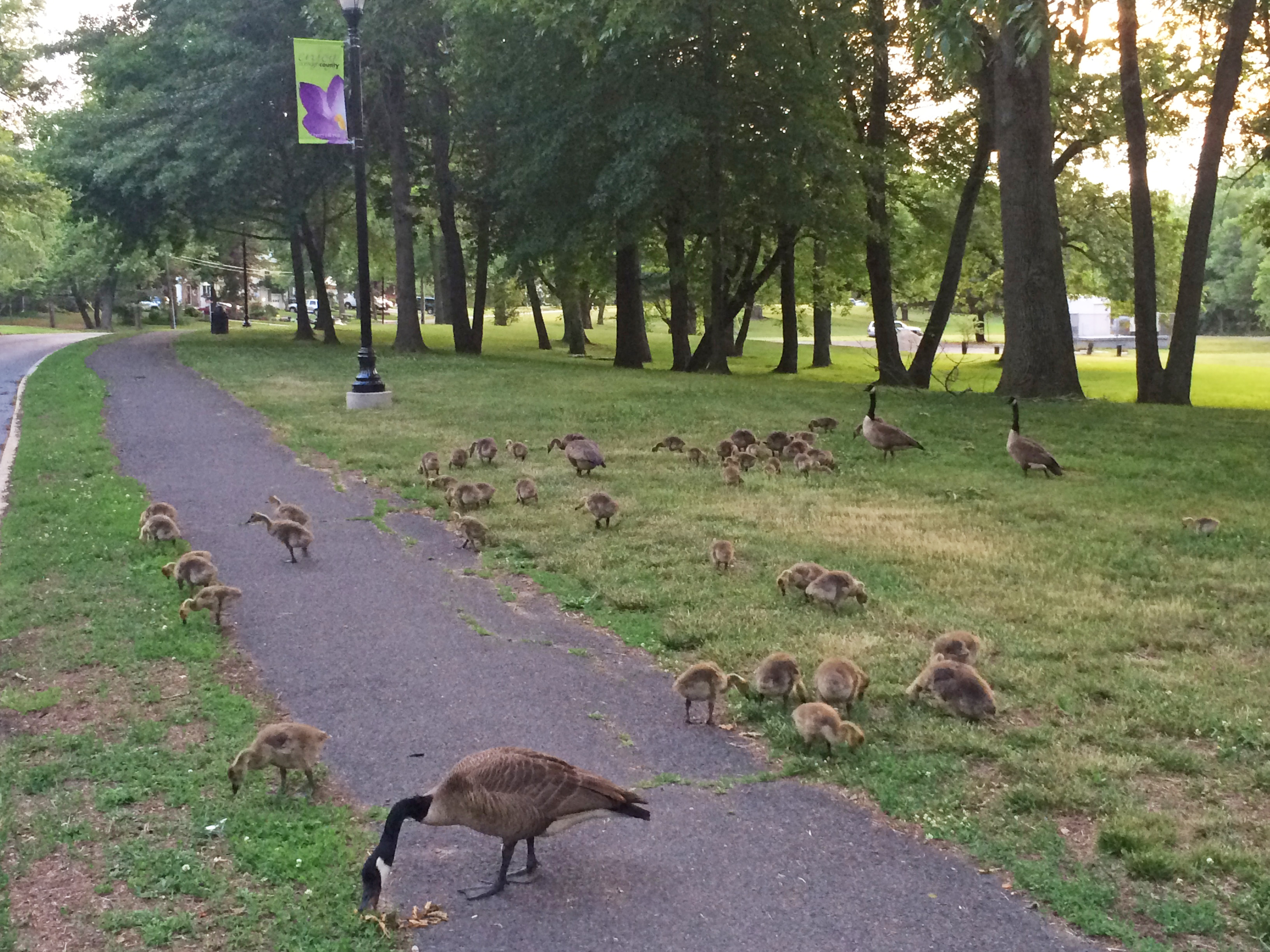
Saturday mornings, my friend Brandon and I usually head out from his house for an early morning run around our local park, the Cooper River Park in Camden County, New Jersey.  We don’t have to go too far before we run into the most populous animals in the region, the so called Giant Canadian Goose.  These animals have learned to call New Jersey home, and long ago gave up their instinctive migratory pattern.  The reason they stay is that life here is pretty good for them.  According to state biologists and naturalists, they thrive on fresh water, grazing areas of tender, mowed grasses, and areas where they have a wide view of potential predators.  They like safe areas to make nests, which they make on the ground, with the goose laying five or six eggs, nesting for 30-35 days in April, and with the gander keeping guard.  All the eggs begin to develop the same day, and hatch the same day.  Once the goslings are out of the shell, they are taken right to the water.  The geese gather multiple nests-full of goslings together, making a very attractive grouping of thirty or forty goslings being watched over by the multiple parent geese of the broods.  It is sort of like how it takes a village to raise a child.  Apparently, our parks and lawns have created ideal places for these formerly migratory birds never to want to leave.  This is just one of numerous species we encounter on our runs.

Non-plussed geese and gosslings along the trail. (courtesy Sue Hamilton)

Non-plussed geese and gosslings along the trail. (courtesy Sue Hamilton)

Geese can be annoying.  They are crowding our parks, cover the trails with goose droppings, and hiss at us as we run by, indicating it’s their park now.  Counter to the geese, much fewer in number, and generally a pleasant natural site are our local ducks.

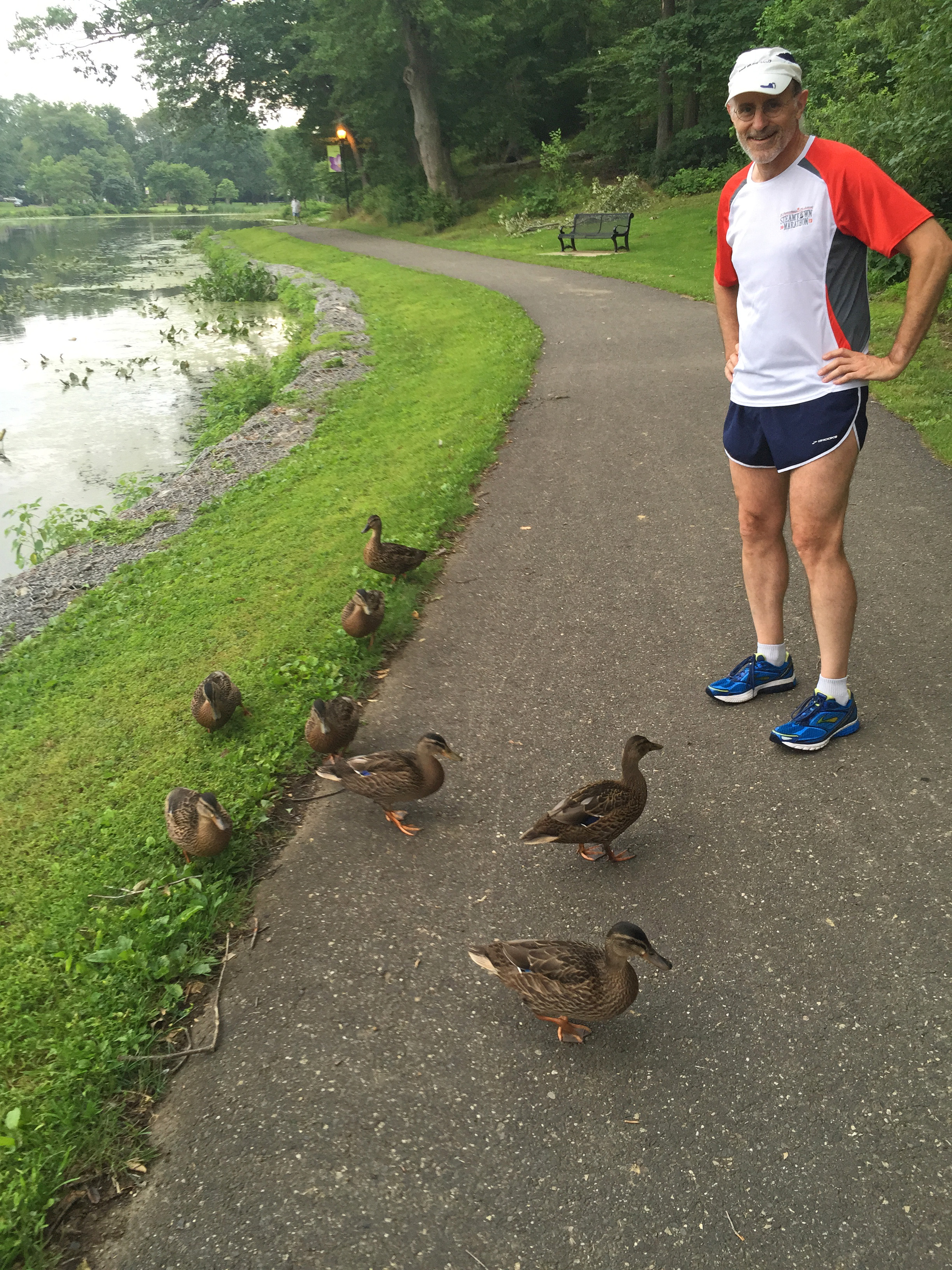
Ducks looking for a handout at Newton Lake Park

Ducks looking for a handout at Newton Lake Park (courtesy Brandon Hamilton)

I’m not sure of the particular species of these ducks, but I believe they are American Black ducks, common throughout the greater northeast.  Known as a dabbling duck species, meaning they tip bottom side up in the water to find food, they are fun to watch as they feed in the ponds.

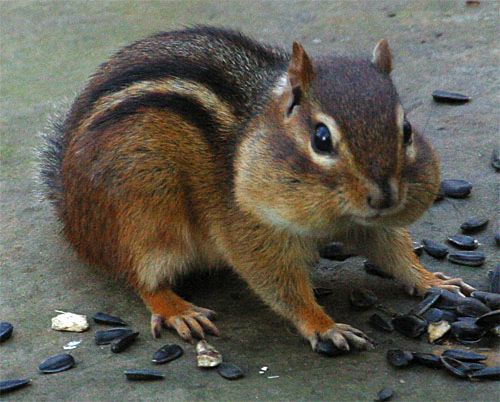
Another very common site is the squirrel.  Now, everyone knows squirrels, and they do seem to be everywhere.  Our particular South Jersey squirrels are the Eastern Grey Squirrel, known by their genus Sciurus, a portmanteau of Greek, skia (shadow) and oura (tail), meaning that it is in the shadow of its tail, per the Wikipedia article.  They have adapted very well over a large geographic area, and even have pushed out other squirrel types in places such as the United Kingdom and Australia.  Closely related, but much harder to see for more than a few tenths of a second, are our local Eastern Chipmunks.

Chipmunk gathering seeds.

Chipmunk gathering seeds.


I see them mainly along heavily wooded trails in the local parks, darting across the trail to hide in dense roots and ivy.  They live in extensive burrow systems underground, where they store food, and have many entrances and exits.  I also see them darting out from overgrown ivy in my backyard to gather seeds that have fallen from our bird feeder.

A variety of turtles and frogs occasionally poke their heads out, or send a croak out along our lake side trails.

A little larger in the animal kingdom, and certainly more rare as a sighting, is the local red fox.  There are two species of fox in New Jersey, the red and the grey.  I’ve never seen a grey fox, probably because they live in the woods and rarely show themselves.  The red fox we see every now and then, early in the morning, trotting along the side of the water in our local park, looking for rodents.

Red fox.  Wonder what he is thinking....

Red fox. Wonder what he is thinking….

White Tailed Deer have become extremely common around us, which is a bit puzzling to me.  Living where I do in New Jersey, these animals had to cross some major highways, such as the New Jersey turnpike, I295 and US 130 to get to us.  I guess we are seeing the deer that got pushed out from the more desirable locations, or just a population that enjoys suburban living.

Some does have antlers, but this looks like a buck to me, with a fawn.

Some does have antlers, but this looks like a buck to me, with a fawn.  (from Rutgers website)

On a run through a local park not long ago, early in the morning, I was startled by a small herd of six deer bounding across my trail in a wooded area.  According to Rutgers School of Environmental and Biological Sciences, the deer population in much of the northeast was almost gone around 1900.  This was due to a combination of hunting and natural predators.  Since then, there has been an explosion in the population, due to lack of predators such as wolves and cougars, lack of space for hunting, and increasing habitat in populated areas.  As with any part of an ecosystem, balance is important.  An acceptable herd size is good for forest edge regions.  Too many deer, though, can cause a spiral of decline of forests, as the underbrush is eaten out, leading to lack of saplings, lack of cover for birds and many small animals, and lack of leaves falling from the decreased tree population.  For runners, I’ve yet to hear of someone hit by a deer, but deer also carry the scourge known as the deer tick, a tiny biter which can pass on Lyme disease as well as other illnesses.  Watch your legs in grassy areas.

Looking up, one of the hardest birds to spot is the woodpecker.  In our area, we frequently hear these birds rat-a-tat sound from high in the trees along the trail.  But, the sound is tough to locate, so without spending some time standing still, not what we usually do on a run, we usually don’t spot these birds.  Most likely, we are hearing the tap of the red-bellied woodpecker, the most common in our area, or we could be hearing the marvelously named yellow-bellied sapsucker.

Red-bellied woodpecker (not red-headed, that's another type which is much rarer)

Red-bellied woodpecker (not red-headed, that’s another type which is much rarer) (from NJ Audobon Soc.)


Yellow-bellied sapsucker.

Yellow-bellied sapsucker. (from NJ Audubon Soc.)


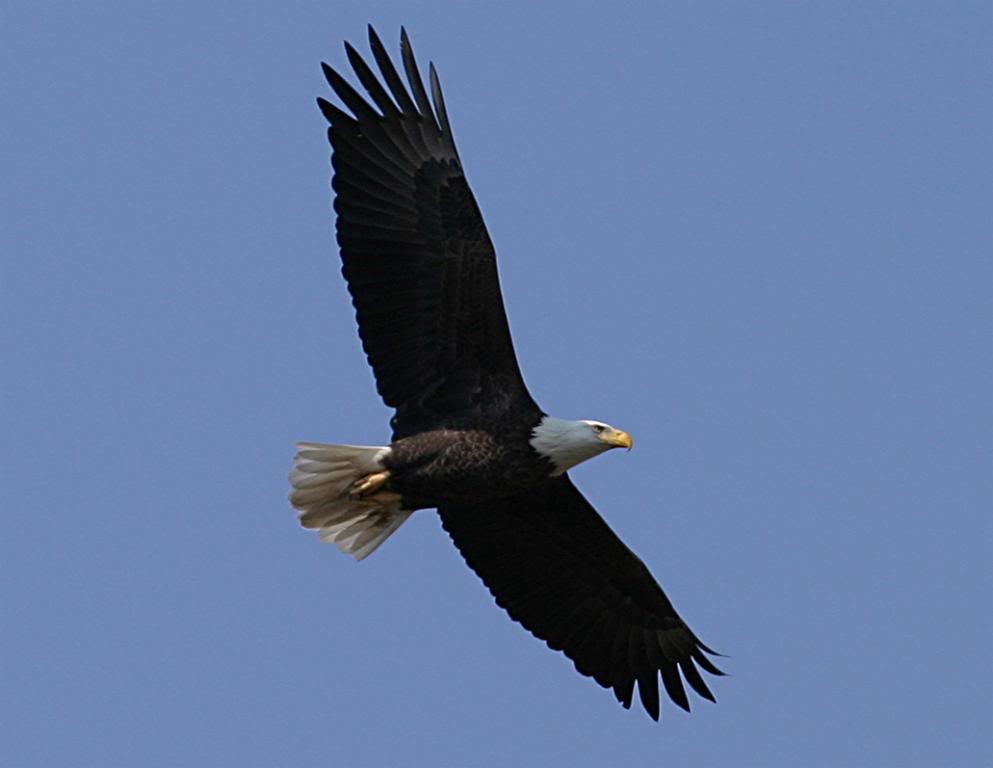
The ultimate wildlife spotting while on a run, in my opinion, was when I was running early Sunday morning a few months ago.  What first appeared to be a large hawk took off from the high branches of a sycamore tree.  As it made a wide, arcing turn, though, we could see it was no hawk.  It was a bald eagle.  I had heard there was a bald eagle nest in this area, but this was the first and only time I have seen one.  It was a beautiful sight, and we followed it with our eyes as it headed along the park lake.

Bald eagle photo (taken from free photos from photobucket)

Bald eagle photo (taken from free photos from photobucket)

There are many other birds and land animals we encounter on our runs.  There are blue herons, red-winged blackbirds, groundhogs and an occasional snake.  On runs outside my own territory, there have been many animals I have spotted, including beavers, skunks, and others.  No bears, fortunately.  I enjoy spotting these animals on the run, and it’s part of the joy of running outdoors.  Very few animals, other than homo-sapiens, are spotted running on a treadmill.

Why I Love the Caesar Rodney Half Marathon

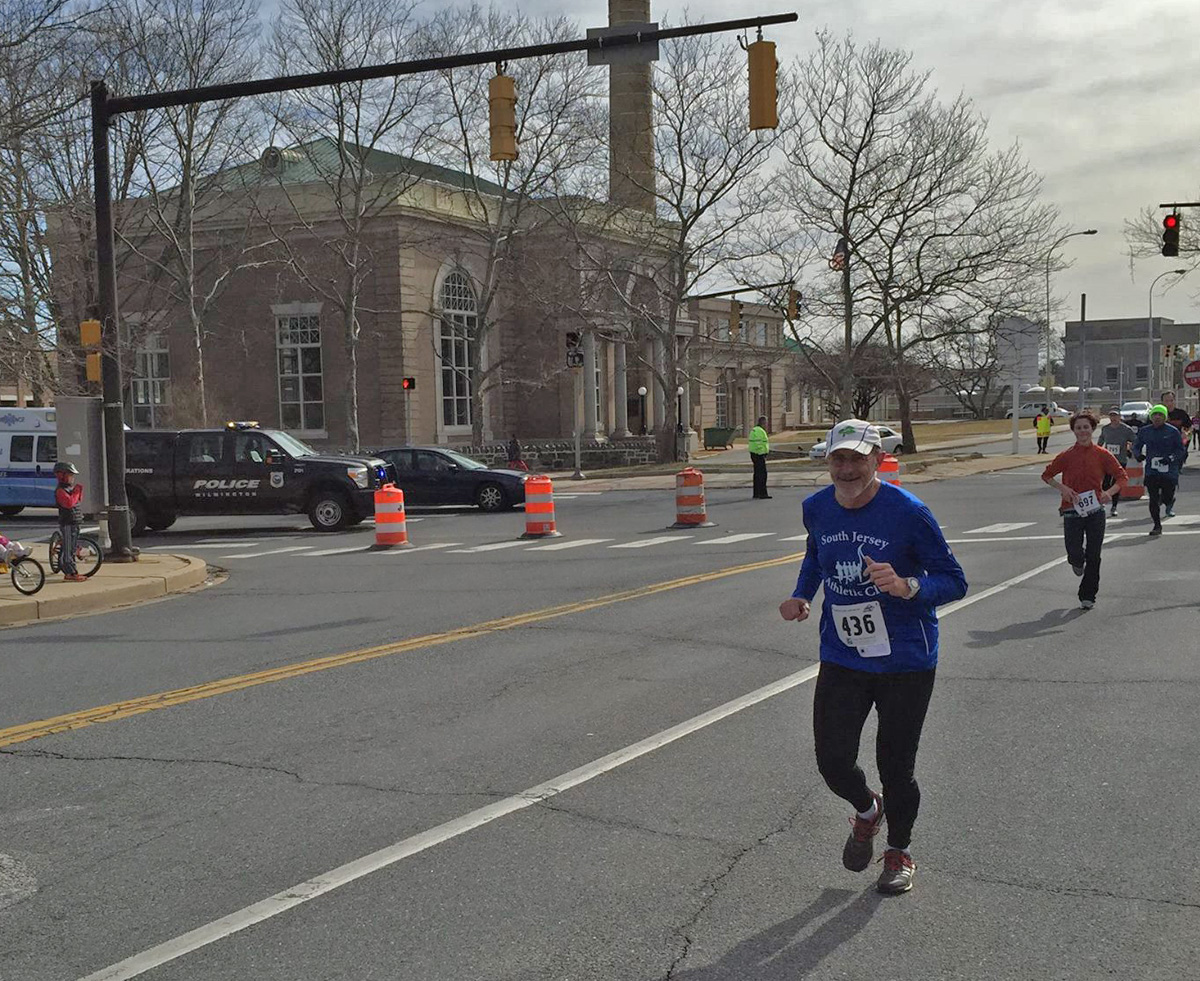
Frank nears the halfway point

Frank nears the halfway point


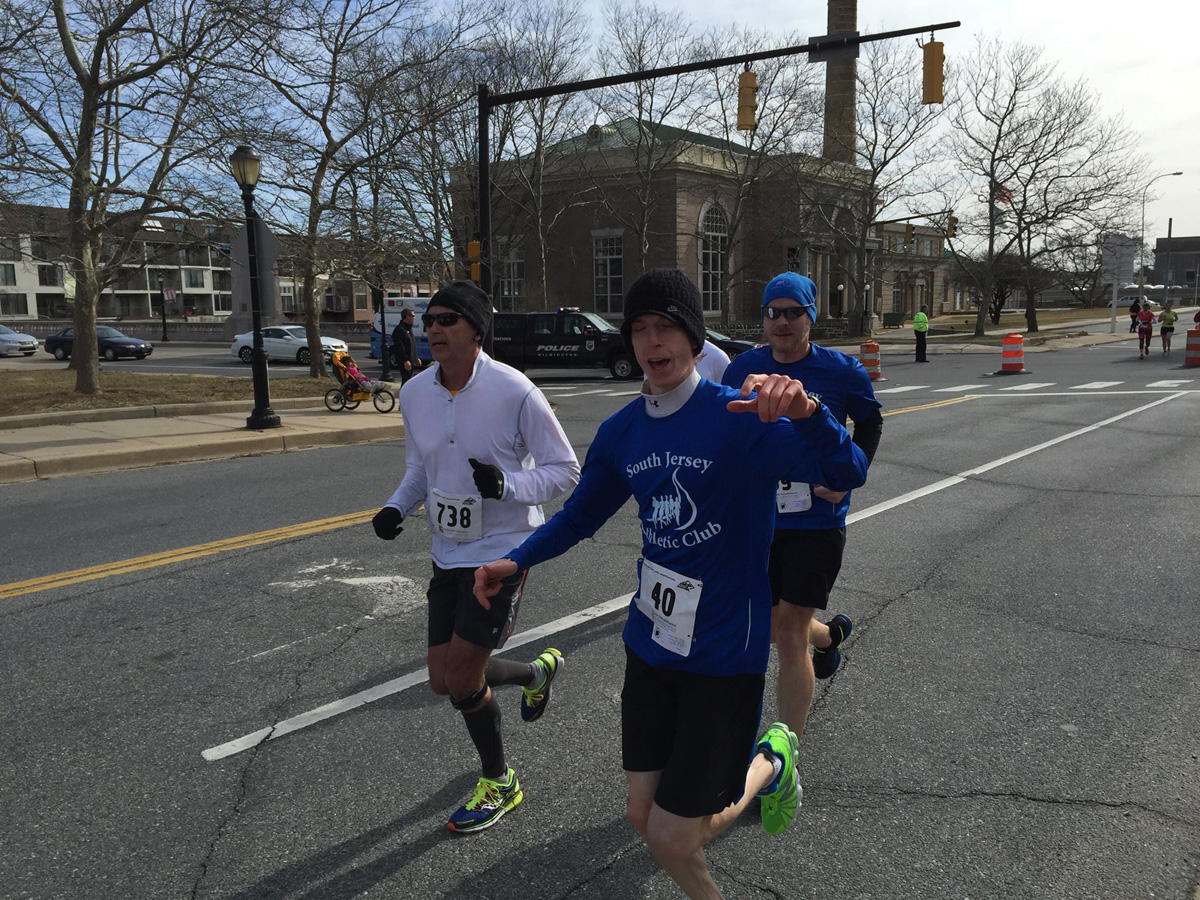
I have written about this race before, The Caesar Rodney Half Marathon, in which I described the race, its history, and the particularly challenging profile of the course.  In brief, the first half of the race is relatively flat after an initial downhill first mile.  Then, there is a long and sometimes steep, 2.5 mile uphill climb, a number of turns through neighborhoods, then a downhill stint to the final steep uphill 1/3 mile to the finish.

This race is run the third Sunday in March, when chill winds still blow.  In fact, this year, we had a snowstorm all day Friday two days before the race.  Most of the snow on the streets melted the following day when it rose to 50˚F, but then the temperature dropped back to below freezing that night.  For race day, we had gusty winds and temperatures in the low 40’s.

Dan and Brian Ambrose pumping up for the hill.

Dan and Brian Ambrose pumping up for the hill.

What is good about this race?  It is one of the first races of the early spring, meaning to be in shape, one must train through the winter.  So, it encourages fortitude in training when the weather is frigid, daytime hours are few, and the conditions on the ground can be pretty miserable.

It is a race with a history.  It is one of the first half marathons in the country, first run in 1964 when Browning Ross, from Woodbury, NJ, won it in 1:07:24.  It has been run every year since then, making this year the 52nd running.

It is well organized.  Runners are given permission to use the Downtown Wilmington YMCA locker rooms, to store gear, use indoor restrooms, and provide showers after the race.  Few races I know of have that sort of facility available.  Picking up one’s number and race packet is simple and done on the day of the race.  There is a very friendly bag drop manned by volunteers.  In fact, there is a friendly atmosphere throughout, and senior Delaware Senator Tom Carper, former Delaware governor and congressman, former naval air commander during the Viet Nam war, runs the race with the rest of us.

It is for a good cause.  The money raised goes to support the American Lung Association, certainly an easy tie in with running.

From a personal view, this was my first half marathon, and the race I keep returning to year after year.  I first ran it in 2007, missed 2008, but have run it every year since.  Up to this year, I have been kind of stuck in a rut, time-wise.  My times these past years have been fairly consistent:

2007  1:51:59

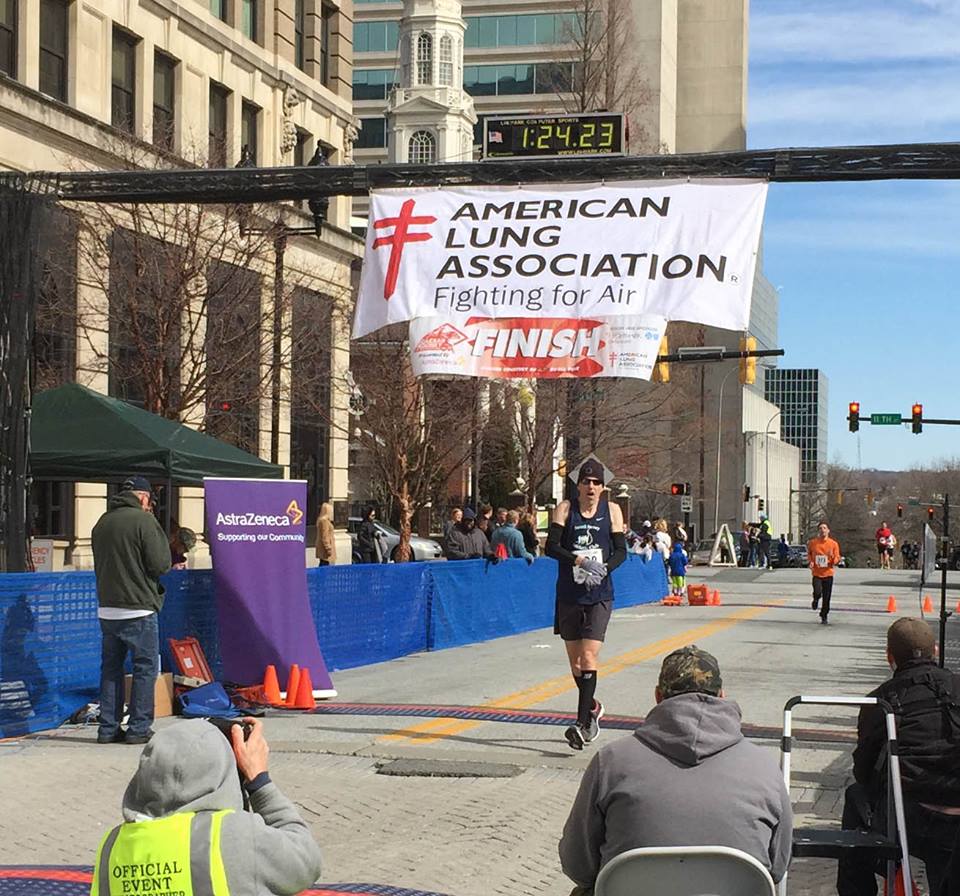
Brandon at the finish line.

Brandon at the finish line.

2008  Didn’t run

2009 1:49:45

2010  1:49:48

2011  1:49:40

2012  1:53:35

2013  1:49:16

2014  1:49:34

This year I wanted to break out of my rut.  I ran fairly consistently through the darkest days of winter, through slush and cold rain, enjoyed the occasional cold but sunny morning run on the weekends, and was feeling pretty good going into the race.  Still, I had some trepidation.  I know the course, and how challenging it is.  After running it all these years I know every turn, and know when it seems like the race will never end.

So, I lined up with everyone else at the start, and took off feeling good.  One cannot help feeling good in a race which starts heading downhill for a mile.  Of course, the clever among us will recognize uphill is coming.  Instead of feeling washed up as the road headed up, though, I felt I still had some energy in me, and managed to gut out the 2.5 mile climb mid-race.  I cruised back down the hill towards the finish, and my good friend and running partner, Brandon, came back to encourage me on the last mile.  This all resulted in a very satisfying finish of 1:47:56, my best half marathon anywhere.  I finished fifth in my age group, averaging 8:15 per mile.

After the finish, a new half marathon PR for Frank.

After the finish, a new half marathon PR for Frank.

Now, I’ve set the bar higher for myself, and each year get older.  I’ll really have to turn up the training screws next winter.

Arrivederci Winter

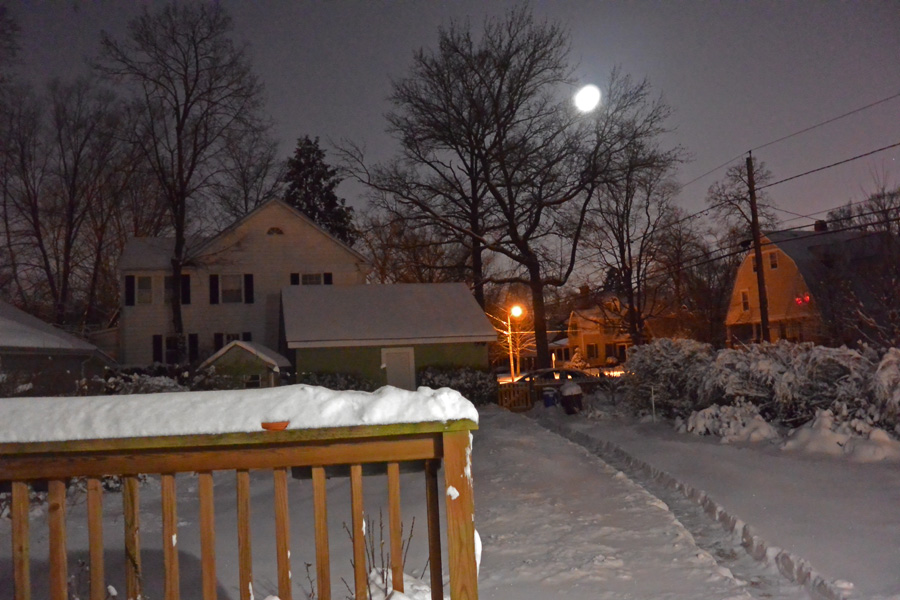
Moon, 4:30 AM, Friday, March 5, 2015.

Moon, 4:30 AM, Friday, March 6, 2015.

The whole eastern part of the U.S. was under the icy clutch of a band of frigid air the last two weeks. This air traveled from the Pacific, over the north pole, through the northern reaches of Canada, freezing Niagara Falls as it crossed the border and settled on our home. When winter comes upon us, everyone wonders, will this be another year of little snow and mild temperatures, or will we get hit with big snowstorms, creating scenes of pathways dug through backyards to driveways, snow piled high in parking lots, plows running up and down our roads, salt spray painting our cars gray-white, and people walking through the snow bundled with layers of clothing, knit caps, and big gloves.

While the weather forecasters got it mostly right this year, they did miss on a couple of occasions, when the snow hit Boston but pretty much missed us in South Jersey.  We managed to get a late winter snow three days ago, in the early days of March, while the temperatures were still in the frigid single and teen digits.  I went for an evening run the day of the latest snowfall.  It was only 7:00 PM, usually a time of the later rush hour crowd irritated and pushing to get home, but the roads were oddly quiet.  Since it had been snowing all day, it seems many businesses closed early.  The snow plows had passed through, but the snow kept falling, so the streets were covered with a thin layer of snow which had not turned to ice.  The combination of fresh snow everywhere, low clouds, and streetlights made for a very well-lit run in spite of the sun having disappeared an hour earlier.  There was a nice, faint crunch under foot as I ran, and the cold air felt good in my lungs.  My run took me past many local small shops and restaurants, all closed for the weather.  With one exception, that is.  The bars were hopping.  I think the bar owners get special attention from the snow plow drivers cleaning their parking areas.  Perhaps they need to pay a little extra for this but I’m sure it is worth it.  Teachers can’t get to the schools, but they make it to the bars.  Office workers get in late and sent home early, but they can make it to the bars.  Doctors, lawyers and dentists close early, no patients or clients are braving the slick roads to make their appointments, but they all make it to the bars.  The last few miles of my running route I pass about ten bars and every one of them was doing business like it was St. Patrick’s day already.  There is a quaintness about bars in the depths of winter.  It’s dark outside, the windows are frosted over, and one sees the profiles of the people inside all animated and lively.

In my house, we retreated to the front part of the house where the den with the fireplace is. The back half is beset with all sorts of problems. We live in an old Victorian, and the original design did not account for living in the 21st century. Bathrooms and appliances have been added over the years, and in spite of best intentions, cold air manages to sneak in like a cat burglar, freezing the water within. This past week, as the temperature dipped to a cruel zero, streams of that dense cold air moved in and around our old pipes, freezing some and leading to a couple of burst pipes.  This year, I had the foresight to at least turn off the inflow to these pipes so the damage was minimized, but we’ve had to wait until the thaw before we could fix them.

This weekend, though, brought a break in the icy pattern.  As we clicked over to daylight saving time, temperatures soared to 52 degrees.  The sun shone brilliantly, melting the patches of ice on the sidewalks.  Constant rivulets of water flowed down the street as the snow melted.  And people are out getting all their usual weekend errands in, not sure how to deal with a day when the only cover up needed is a light jacket.

Now we can start thinking about getting the garden ready for planting, cleaning up the debris that conveniently was covered up by the snow, and watch the road crews fixing all the treacherous potholes which have multiplied the last few weeks.  I’m sure in a couple of months we’ll be baking in premature heat, barely remembering how cold it got and stayed this winter.  Before that happens, I’d like to have a few more fires in the fireplace, have a reason to wear long tights and two layers on top when I run, and feel the cold air filling my lungs.

A Slog through the Slush

Here’s how the conversation, via text, went:

It’s all slush and big puddles out there do you think we should run?  And it is raining, too.

Sorry, just saw this.  Let’s go for it.  We won’t know till we try

Okay.  I am just getting ready now.

Take your time driving over.

That was at 6:45 this morning.  The snow, rain, freezing rain, and sleet had started the night before.  I was out with friends in Philly, and late at night, heading for the train, we marveled at the enormous size of the snow flakes falling steadily.  With the temperature close to freezing, they turned to slush as they hit the ground.  This morning, I stayed in bed as late as I could but still make a 7:00 AM start to my morning run.  My running partner and I had the above conversation and so I was committed to the run.  I was relieved, since I didn’t want to be the one to make the call, knowing this would not be our best run of the year.

We had to gingerly pick our way from his front door out to the street, not wanting to start running with cold, wet feet.  The road had not been plowed, and while the “inches” of snow were not that much, it was all wet and forming large pools of ice slurry.  We started off very slowly, running along areas cleared by tire tracks, being careful not to slip as we went downhill towards our loop around the park.  We had to run in the street rather than the multi-use path, which was completely covered by this slurry.  As we ran, we picked up the pace a bit.  Along the Cooper River, the geese were out in force, coping with the conditions without a problem, as far as I could see.  Approaching the far end of the loop around the park, the path was one large slush puddle, which we muddled through.  Now my shoes were wet, and my feet cold.  On the far side of the park, the road was narrowed by construction.  We had to run along on the road, with cars passing us closely and spraying ice and frozen water on our legs.  I think it was partially on purpose, since not all the cars came that close.  We moved over to the construction zone, running in ruts created by a truck that had gone through recently.  As we ran we were able to have a nice conversation, since the forced slow pace made talking that much easier.  We talked about running in the winter, and also about the play I saw last night at the Lantern Theater.  The play, called “Doubt, A Parable”, by John Patrick Shanley, takes place in a Catholic School in the Bronx, in 1964.  The story is that of an older nun, the principal of the school, suspecting the priest of having sexual relations with one of the boy students.  The story gets complicated when one hears the boy’s mother’s side of her son’s life.  The play takes only ninety minutes with a single act, and seems to leave out some crucial inner thoughts of the four characters.  One critic I read afterwards suggested the second act was when the audience discussed their feelings about the play.

Our run finished with a long uphill climb and then a flat last mile, still with the skies gray, and our feet cold and wet.  But accomplishing our seven miles, and then warming up with a change to dry socks and shoes, a dry shirt, and a hot cup of coffee was very satisfying.

A parable is a short narrative about individuals meant to be an example of a larger truth.  So, this narrative I relate to you shall also be short, and meant to convey that even when nature is uncooperative, getting out and doing is better than holing up and not doing.


It’s all about that pace.

It’s all about that pace, ’bout that pace, no hustle.

It’s taken a little time for me to settle after my last marathon experience.  The short of it is, I cramped up at mile 16.5, and after a brief rest and another half mile, I wasn’t able to continue.  This was to be my tenth marathon, and I hadn’t quit any before, even when suffering mightily.  So what was different this time, and what went wrong?

There are many marathon training programs out there.  Runner’s World Magazine, Jack Daniels, Hanson, Hal Higdon, and others specify when to start training, how often to run, how far to run, and at what pace for one’s abilities.  Generally, one starts about sixteen weeks ahead of M-day, progressing in miles and longest run as the weeks progress.  The basis for this is the way our muscles and heart accommodate to the demand of steady running for three to four hours.  That kind of endurance, unless one is particularly exceptional, requires a long build-up.  Things can go wrong the day of the marathon.  Weather can be awful, a virus can lay out a runner, but if one has not put in the training, a perfect day will not make up for that lack.

For me, the training for my latest marathon, Philadelphia, November 23, 2014, started on time and rather well.  I had a good base, coming off a half marathon in Nice, France, at decent time in late April, and the 10 mile Broad Street run in early May in Philadelphia.  I’ve always designed my own training program, since sticking with one of the popular plans is just impossible due to my work schedule.  I also was working with a new marathoner, helping her train for her first marathon.  We had our long runs planned out for every Sunday, a mid-week ten mile run, and other training runs in between.  Paces were mixed up, and routes changed so that we would not fall into automaton behavior that comes with repetition.  My first slip up came about seven weeks before the marathon.  We were doing one of my favorite long runs, 9 minutes at a 9 minute per mile pace, then 1 minute at a fast pace, generally about 7’45” per mile, for a total of 14 miles.  One does need to keep an eye on the watch, and the pace, to get things right.  Done well, the miles fly by, and the run is energizing.  I think my eyes were too closely focused on the watch.  At about eleven miles, along a dirt path being graded for paving, I hit a rock with my toe and fell hard and fast.  I came down on my right side, connecting my chest, shoulder and head to the ground.  Fortunately, nothing was broken…I think.  I may have broken a rib but it wasn’t displaced and so since nothing would be done about it, I didn’t have it x-rayed.  That little incident slowed my training down, and made the next couple of weeks a little difficult due to soreness.  About five weeks before the marathon, we had a 20 mile run planned. It actually went very well, and I think if I had to run the marathon that very day, it would have been a good run.  After that, two weeks of very busy late nights at work completely blew apart my final weeks of training.  With two weeks to go, we went out for a 21 miler.  The conditions were nearly perfect.  The temperature started in the mid 40’s (F) as we headed out in the pre-dawn light.  The first bothersome event was that my new Adidas shoe was causing a great deal of pain where the tongue of the shoe meets the foot.  The tongue on these shoes is minimal, and the underlying tendon in my foot was being rubbed, causing the pain.  At around the 10 mile mark, I ran to my house to change shoes, while my ingenue marathon training partner waited a few minutes.  That done, my foot felt better.  We continued on, but at 17 miles a familiar and very annoying feeling sprang up in my calves and quads.  I was starting to get cramps in my leg muscles.  I am quite a sight when this happens, taking on the stride of John Cleese of Monty Python fame doing his silly walks sketch.  Not so funny for me, though, and I could not continue.  My training partner was doing well, and continued on to finish her 21 miler, the longest she had ever gone in one run.  I, on the other hand, hobbled back to our home base, unable to run, and in pain.  After walking the mile back, my legs did start to calm down, but the day and the run was shot.  I was very concerned that this might be my fate at the marathon in two weeks time, and I seriously considered not starting.  I had a chat with one of my marathon advisers, an experienced marathoner named Brandon, with whom I regularly run Saturday mornings.  With one week to go, I really didn’t get in the usual taper, because the three weeks before were so poor.  Brandon said he felt I could slow the pace and make it through the race.  He said it would be a shame to not run after putting in the many weeks of preparation.  With that encouragement, I started the marathon the following Sunday.

I thought about just doing half.  The official half marathon had closed weeks earlier, so I couldn’t drop down as a registered runner.  I felt if I kept my pace reasonable, around a 9 minute mile, things would be okay.  I did feel quite fine through the first half, and the Philadelphia marathon route is a very nice one.  It starts along Ben Franklin Parkway, with thousands of spectators lining the start, and Mayor Nutter giving hi-fives to runners as they pass the start line.  The route goes through Old City to Delaware Avenue, down to South Philly, then up along South Street to Chestnut and through Center City.  Crowds with clever (or not-so-clever) signs cheer on the runners.  The frat boys at Drexel bang on pots and shout out to the runners.  The route winds along to the Belmont Plateau, and past the Please Touch museum, then down hill to West River Drive along the Schuykill river and back to the Philadelphia Art Museum at the half.  At this point, the runners doing the half peel off and head to their finish line along the Ben Franklin Parkway, which is where I should have headed.  Thinking I could muster on, and not feeling bad, plus averaging around 8’45” to that point, I kept going, making the turn around the front of the museum to head out Kelly Drive towards Manayunk.  It is a route I have done six times before, sometimes suffering with leg cramps and having to walk, sometimes cruising through, and once, doing well enough to make my Boston qualifier.  This time, at mile 16.5, the cramps set in.  I tried to slow down and keep running, but it was just impossible.  I moved off the course, and like some soldier going AWOL in an old movie, removed my number from my chest.  I started walking back towards the start line, which was about 3 miles away.  I should have quit as I turned in front of the museum, so the walk would have been much shorter.  After walking for 5 minutes, my legs felt better, and seeing all those other runners streaming by me I put on my number again, got back on the course, and started to run.  Well, that didn’t last very long.  I got about a half mile when my legs seized up again.  This time I decided to quit for good.  I moved off the course, this time leaving my number on, and walked back towards the start.  Shortly, a volunteer driving a golf cart-like vehicle, already carrying two other runners, stopped to pick me up.  I got in, and the young man next to me offered me the Mylar blanket he had around his shoulders.  He was very thin and fit-looking, not the kind to quit a marathon I thought.  But he had a similar problem to mine, and had to stop.  He insisted I take the blanket against my protests, as he appeared to have far less insulation than me.  He wouldn’t take it back, so I kept it.  Shortly after getting in the cart, I had to get right back out.  My legs were seizing up, and there was no way to stretch them out in the cramped seat.  So I was resigned to the long walk back.  Along the way, I passed another fellow DNFer, about my age, who had quit due to ankle pain.  As I walked I thought about my justification for stopping and not mustering on.  I felt that I had made the right decision, to not hurt myself further, recover, and live to run another marathon another day.

I got back to the art museum, and made my way around the outside of the course to the bag pickup.  Several people told me “way to go”, and “good job” as I made my way through the crowd, giving me the feeling of a complete charlatan.  It was crowded, and I didn’t want to take the time to explain, but I simply put my head down and decided it would be best to not recognize these well wishers.  I made it into the bag area having to enter through an exit guarded by police, since the security around marathons is way up these days.  Once I picked up my bag, I had my cell phone.  I phoned my wife, who had been monitoring my progress on her phone.  Up to that point, I was pretty calm and collected.  As I spoke to her, though, I completely broke down, as the emotion of quitting hit me.  The rational me had left as the feeling of failure overcame.  I like to be seen as the invincible warrior, not the vulnerable person I am.

Since then, I have recovered, both my body and my senses.  I have heard many stories from my experienced marathoner friends of times they, too, have had to quit for various reasons.  I have plans for a half marathon in March, my annual shot at Caesar Rodney in Wilmington, and I am trying to decide which marathon to sign up for in the fall.  I think I want to do an early October marathon, since the training doesn’t run into the problem with short days and the conversion to standard time.  Of course, I may piggy back Philadelphia onto that, since I will have done the training after all….  In the end, it really wasn’t about the pace, it was about the training, and getting it right.  Yes, the pace is important, but not if the training is missing.


Enlightenment versus Romanticism and Marathon Training

Is marathon training a product of the Enlightenment, the age of reason, or is it more a result of romanticism, seeking nature and intuitive feeling?  In the era of the Enlightenment, men, well almost only men due to the circumstances of the time, were not likely to be out running for sport or athleticism.  Descartes did not write, “curro, ergo sum”, or “I run, therefore I am.”  He did write “Cogito, ergo sum”, or “I think, therefore I am.”  Who were the famous people of the Enlightenment?  Sir Isaac Newton stands out.  His laws of motion laid the basis for centuries of physics study and they may say something about running.  A body in motion tends to stay in motion, while a body at rest tends to stay at rest.  A lot can be read into that statement, beyond the mere physics.  One pictures a runner who needs to get out daily and run or his or her day is not complete, versus the person lying on the divan waiting for divine intervention to get moving.  The second law states that the force exerted on an object is equal to its mass times acceleration.  Another way to look at that is the acceleration equals the force divided by the mass, meaning the lower the mass, the greater the acceleration.  So, when you lose weight, and get into running trim, less force is needed to get up to speed.  His third law about equal and opposite actions may be more applicable to ice hockey than running.  Other famous individuals include Baruch Spinoza, Immanuel Kant and John Locke.  They wrote about individual liberties, blending logic, reason and empirical knowledge, and religious freedom.  They represented those who felt selling indulgences was not the way to heaven, which began with Martin Luther nailing his ninety-five theses to the door of the Castle Church in Wittenberg.  I read this as one cannot buy himself into anything that takes dedication, work and time, never mind the implications to organized religion.  Our own Ben Franklin was a great thinker, inventor, writer, politician and leader.  He was not a runner, as far as I can tell.  He was part of the Enlightenment, and his words and works had great impact in his time and forward.  A reading of famous quotes from Poor Richard’s Almanac provides the curious with plenty of sayings to thinku about while running solo on a 20 miler.  Here’s a taste:  “The noblest question in the world is:  What good can I do in it?”  We’ll return to that thought.

How do romanticism and running relate?  Romanticism followed the age of reason, as a reaction to the scientific and industrial advances which seemed to obliterate the beautiful, natural and emotional.  To a scientist, Maxwell’s equations were beautiful, but to Lord Byron, beauty was found in nature, love, turmoil, adventure, and pleasure.  George Gordon Byron, called “Lord” because at age 10 he inherited the lordship of Byron, was born of a profligate father named Captain John “Mad Jack” Byron, a rogue and scoundrel who apparently had anger problems.  Lord Byron, a most famous figure of the romantic era, who wrote “She walks in beauty”, and a wealth of other poems, long poems, satires and tales, was an athlete and warrior.  This was in addition to being a lover, adventurer, cad, and debtor.  He was known for boxing and equestrian skills, and played cricket.  Many other authors, poets, musicians, and artists, including Jane Austen, Delacroix, Wordsworth, and Mary Shelley, who penned “Frankenstein”, defined this era.  Romanticism meant defying order, industrial progress, rigid attachment to religion and social norms, and seeking the whole of natural and human experience.  Does this sound like a marathon runner?  In many ways, I think it fits.  We train under all sorts of adverse conditions, from the sweltering heat of summer to the icy roads of winter.  We train in the dark, and in the rain.  We gather at the local pub to swap running stories while downing pints of beer.  Our goals may be ephemeral, enjoying the training as much as the racing.  We are smitten by the beauty of our co-runners, their form and grace.

When training for a marathon, we are drawn in by plans which prescribe the length, the pace and the frequency of our runs.  There are competing programs, and some swear by one while others will follow a different program.  Some, like scientists in a lab, will try different programs and measure success by the outcome of their latest race.  We use the latest technology of the day, GPS, Garmins, heart rate monitors, and smartphone apps.

Counter to this is the marathoner who just wants to finish the race and is not so concerned about a Boston Qualifier.  This is the runner who gets in the zone, and is focussed on the Zen of the run.  He or she is still facing the great challenge of 26.2 miles, a long run, but who eschews technology and goes for the feel.

Regardless of one’s perspective, what good can we do?  Does running a marathon help mankind or is it a personal indulgence so inwardly focussed to be useless to society?   This question could be fodder for pages of argument, but not here.  I would say it is both a personal indulgence and a way to enhance life experiences for many.  It keeps us fit.  It engages us socially, away from the desk and computer.  With the enormous growth in popularity of marathon running, it has become an economic boon for many cities.  I’ve been impressed and amazed by the support given by the crowds lining the course.  I think marathon runners set a great example of dedication to the supporters, who in turn provide us with encouraging cheers and clever signs to make it across the finish line.  My readers can let me know whether Enlightenment or Romanticism best represents the marathon runner, but ultimately, it is a noble effort.

Note 1:  Lord Byron’s daughter, Ada Lovelace, was an example of Enlightenment wrapped in Romanticism, designing the first type of algorithm used in an early type of computing machine.

Note 2:  the header photo shows Lord Byron’s scrawled name in a pillar in the dungeon of the Chateau de Chillon, where he was inspired to write “The Prisoner of Chillon”, photo by the author.

The Salt Flats of San Francisco Bay

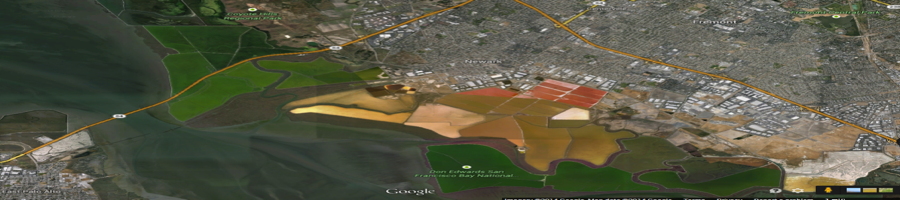
newarksalt


In 1850 in San Francisco, there was a commodity almost as valuable as gold, and it was plentiful. Not that it brought in the same reward, ounce for ounce, but it made a few individuals very rich. That commodity was salt. It was in easy reach, wherever the briny water of the bay lay very shallow, lapping on the littoral edge and drying in the sun. A white crust of salt on the sand and dirt was the result. The gold rush brought thousands to this mecca of fortune, but they needed to be fed, and salt was in high demand. To get it to the boarding house kitchens, though, took some ingenuity and very tough men. The southern and eastern part of the bay is a large flat expanse, and creating drying ponds for the salt crystals to grow was a natural for this area. Acres of space was available, and the early inhabitants of the area, the Ohlone tribe, had harvested salt here for centuries.  Former sea captain and failed gold miner John Johnson started commercial mining of salt in this area in 1854, selling it for $50 a ton, according to a Wikimapia article on the subject.  Competition developed, bringing the price down to $2 a ton, but still it was a profitable venture. Eventually, the ownership of the salt production passed through the Leslie Salt Company, and finally to Cargill, Inc., the largest, privately-held corporation in the U.S.

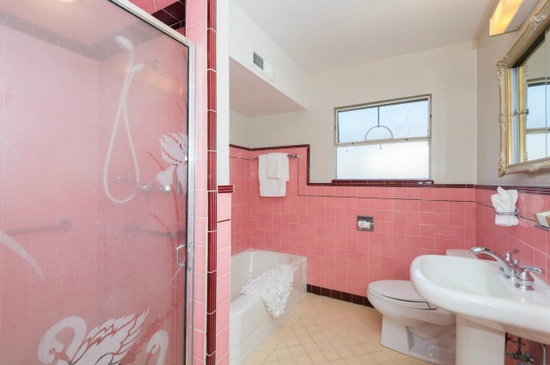
Why bring this up on a blog purportedly about running?  I had the opportunity to attend my nephew’s wedding two weeks ago, in Newark, California, located in the heart of the salt flats.  The San Francisco Bay area is an amazing mix of have and have-not, beauty and ugly, ultra-high tech and grunt labor, old and new, the arts and sport, and academic and common knowledge.  I flew in from Philadelphia to San Francisco and headed for the car rental area.  This is reached from the terminal by a very modern, automated rail line.  On arrival in the car rental pavilion, where all the rental companies have counters, I was amazed at the huge number of people waiting in line to get a car.  Clearly, this would be a major week for tourism in the bay area.  I was impressed how the lines moved, and the rental process was very streamlined.  Thousands of people were renting cars while I was there.  Once one’s contract is complete, a walkway leads to the garage where, on multiple levels, the cars are parked.  I waited in another line until a young man escorted me to my car.  We took the usual tour of the car to note scratches and dents, he gave me his card and told me to call him if I had any problems (a nice touch, Enterprise), and I was off.  Instead of heading north into San Francisco, I headed south on Highway 101.  This is a famous road, known in the early Spanish settler times as El Camino Real.  Today, it passes through Silicon Valley, home to such major corporations as Oracle, Apple, Google and Adobe, to name but a few.  Silicon is an element.  It is the basis, due to its semiconductor properties, of transistors, diodes, and integrated circuits.  From these came computers, and thus, eBay.  The companies in this area have been enormously successful in recent years, and their employees are very well paid.  The homes in this area are absurdly expensive.  For example, a two bedroom, two bath ranch style house in Mountain View, 1953 sq. ft., with very little style on a quarter acre lot, is listed at $1,875,000.

Bathroom in the 1.875 million dollar rancher in Mountain View.

Bathroom in the 1.875 million dollar rancher in Mountain View. (from the Zillow listing)

Heading down route 101, I made a turn onto route 84, which becomes the Dumbarton Bridge over the southern end of the San Francisco Bay.  Along this road I could see the salt drying along the roadside as the east bay area is reached.  This took me into Newark, home of Cargill’s salt headquarters and the site of the wedding.  I checked in to the Courtyard Marriot Silicon Valley.  They refer to it as Silicon Valley, but it is really on the wrong side of the bay.  It is hard by the salt ponds.  I arrived later in the afternoon and needed to get to the pre-wedding family dinner at my sister’s house in Livermore.  This was a very pleasant dinner with lots of wine and good food.  For the most part, everyone was in a good mood.

The next day, Saturday, was wedding day.  Since the wedding was not until 6:30 P.M., I had plenty of time to get a run in that morning.  Newark does not seem to be a runner’s town.  I asked at the hotel desk for advice where to run, and the desk person suggested a loop around the Lakeshore Park.  I asked how long the loop was and was told it was about 2 miles.  I went back to my room to check this out on the map.  It turned out the loop was a bit under a mile, and was about a mile from the hotel, so I needed a little bit longer run.  I put on my running clothes and headed out, trusty Garmin on my wrist.  My route took me past the park and over a freeway to the wedding venue, a very pretty park called Ardenwood Historic Farm.  It was where George Patterson, another unsuccessful gold seeker in 1849, was able to buy property in 1856 after working as a farm hand.  He had a house built on the property, and started his own farm.  Apparently, it was a very productive farm, as he was able by 1889 to rebuild the original humble farm house into an elegant Queen Anne style mansion.  Today, the farm continues as a working museum, owned by the city of Freemont, and host to many weddings, day trips and farm experiences for students.  Unfortunately, on my run, the whole park was locked up tight, and I couldn’t progress through it’s dirt roads.  Turning back, I made my way to the Lakeshore Park, a man-made doughnut shaped pond with a paved path around it.  I ran two laps around the pond, and marveled at the variety of birds that were attracted by this small body of water.  Many different breeds of ducks, geese, herons, snowy egrets and numerous other species had made a home here, and it made for an entertaining couple of laps.  On my way back to the hotel, along Cedar Boulevard, I made note of the homes along the road.  Again, they were small, ranch-style houses with car ports.  A number had for-sale signs.  The last leg of my run was through a very long strip mall of shops, which seemed to be not the original intent for the stores.  There were karate studios, hair salons, and a Chinese diner, to name a few, with empty shops between.

After I got back in my hotel room, I was again curious about the houses for sale in this area.  Looking up some prices, here the prices are much more reasonable.  Offered for $899,000 was a five bedroom, three bath house with 2500 square feet.

5 BR, 3 BA house in Newark.

5 BR, 3 BA house in Newark. (from the Zillow listing)

Still no bargain, but more living space than in the highly desired parts of Silicon Valley.

Of course, I was there for the wedding, and it went off without a hitch.  Well, not exactly, as my nephew and his new bride really did get hitched.  The wedding venue was just beautiful, the outdoor ceremony was quite nice, and the after-wedding party was very enjoyable.

My nephew and niece-in-law say their vows.

My nephew and niece-in-law say their vows.

George Patterson house at Ardenwood Farms.

George Patterson house at Ardenwood Farms.

On my way back to the airport the next morning, I again passed the salt encrusted shoreline, then passed a very large building being built along Route 101 with a Facebook sign in front.  I stopped for gas and turned around in front of Oracle headquarters, a collection of rounded steel and glass tall buildings aside another man-made lake.  I see it is thanks to these pioneers of computing and the internet that I am able to express myself on a WordPress blog.  We’ve certainly come a long way from George Patterson building a farm.


P.S.  Robert, from Zillow, Mountain View, can provide more information on the surrounding area properties:

http://www.zillow.com/mountain-view-ca/

Uncorking Croatia

The Blog of WINES OF CROATIA

RunnersOnTheGo.com

To help enrich the lives of others, we developed RunnersOnTheGo.com to help runners save money on races, running stores, and much more. We also provide the specific local information that makes your travel for business, vacation, or racing as rewarding as possible.

getsetandgo

Travel Blog of a Budget Traveler sharing stories on travel, books & Vegetarian Food

Marc Hemingway

Trying to keep track of my life (and my life on track)

Mid-Life, Mid-Level, Masters Running

Exploring ideas about running to contribute to a more enjoyable pursuit for the mid-level masters runner

therunningtherapist

"One foot in front of the other and one thought at a time"

WordPress.com News

The latest news on WordPress.com and the WordPress community.

retireediary

The Diary of a Retiree