“Experienced” marathoner

It may be hard to believe, but this summer is nearly gone. This means the next marathon is looming larger in the near future. For me and my training partners, that date is October 6, for the Wineglass Marathon in Corning, New York. Having now run seven marathons, I am more aware of what is coming. Standing out most clearly in my mind is recalling how, at some point in most of the marathons I’ve run, I tell myself how utterly crazy it is to torture myself this way. Why would I willingly choose to go through the muscle pain in my legs, the pains in my shoulders, the bleeding, the chafing, and sometimes the near delirium, just to say I had done it? While many in our club have run many more marathons than I, I am starting to get the gist of it.

We have several new runners in our club who are planning to run their first marathons this fall. Some have been running with us on our long Sunday runs, and a couple run on their own but tell me how they are doing. To a person, they ask for little advice, but mostly are quite fixed on their training plans. They all have that holy grail of the marathon runner in mind, the Boston qualifying time. When we (our Sunday group) hear this, like a chorus we say, “just work on finishing”. There is little one can say that helps the naive runner get through their first marathon. We offer the familiar advice of not going out too fast, sticking to a plan, hydrating, eating appropriate numbers of gels throughout the race, and preparing ahead with BodyGlide and bandages. Much of this is relative. What is appropriate hydration for one person may be way under or over for another. How many gels, how often, something other than gels, is pure guesswork.

Some advice is sound and well grounded. It is a good idea not to wear brand new anything, especially shoes, for your first marathon. Even that, though, I’ve ignored, when I wore brand new knee high support socks for a race last fall, not having worn anything like them before, and loved them. How to dress is a tough call. Personal preferences, temperature at the start, where that temperature is headed, sun, clouds, humidity, all figure in to that guesswork. I think I changed my mind about ten times the night before my first marathon. In a race that starts early and goes several hours, conditions can change dramatically. Or, they can stay the same. For my first marathon, Philadelphia, 2008, the temperature never got above freezing. It started in the low 20’s with a bit of wind. The water stops were sheets of ice, not very safe to run, or walk on. The next year, that same race started in the mid 40’s and rose to the low 60’s, practically perfect.

Another piece of guesswork is what to eat the night before. I doubt any marathoner would consider it a good idea to eat a huge meal, redolent with fat, and washed down with many glasses of wine. No, save that for the afterparty. Pasta is the standard, but anything light and easily digestible makes sense to me. Is beer okay? My feeling is yes, “a” beer is okay, and probably helps one relax and not be too wound up.

The first time on the start line of a marathon, the atmosphere is euphoric. Dropping one’s bag at the right spot, managing to make it to the portable toilet for one last squirt, finding one’s way to the proper corral, squeezing in with the other runners, and sensing the collective anxiousness makes for a unique, numbing experience. Other runners are wearing giant trash bags with holes cut for the arms and head. Some are stretching in their limited space. Some are chatting incessantly with friends, all of whom are wearing earbuds and probably already listening to some inspirational play list they have created. And some are quietly looking ahead, perhaps playing out the course in their minds. All of this is in a swirl around the new marathoner who is unaware of how the race will unfold.

I plunged right in my first time. It takes a while to actually get to the start once the gun goes off in the bigger city marathons. There’s a shuffling start, corrals move up, and then one gets caught a little off-guard when the start line is actually underfoot. I remember starting my Garmin as I crossed that first detection pad, hearing the faint cacophony of beeps as the chips get registered, like the sound of locusts. Then, one’s own personal best for a marathon is underway.

I am very pleased to see new runners in our club taking on this challenge. I think they will have an experience that will change them for a lifetime. If, like me, they wind up getting sucked in, and go back time and again to challenge themselves, they will really change their lives. Each time I head to the start line now, I don’t know how the race will end for me. I know that I don’t know. But I have become aware of the routine at the start, the way I asses my condition as the race progresses, and certainly the warning signs of trouble, like cramps that all too often befall me along the way. I am still experimenting with strategy, modifying my starting pace, the way I drink during the race, and learning to slow down in the first half to be able to go faster in the second. It is quite a commitment to take on the training, typically about sixteen weeks, all for the one day event which may have great conditions, or perhaps awful conditions. I wish our club’s new marathoners, and anyone else tackling this for the first time, a satisfying and fulfilling experience, that will cause them to come back again.

Frank

Summer cooking for runners: Fish Taco Dinner

A monkfish in it's natural element.

A monkfish in it’s natural element.

Summer is going fast.  Here we are, already in August, and it seems the autumn races will be on us in no time.  But while it is still here, summer is the time to enjoy cooking on the grill, and eating the fresh produce available locally.  Certainly there is an abundance of fresh vegetables and fruits now.  This report will focus on a nice way to enjoy grilled fish.

The fish taco has a great many variations, and there are those who would argue for one over another, one being more “authentic”.  Paying no attention to purists, this is my version of this dish, along with an accompanying vegetable medley.

Menu:  Fish Tacos (or fish fajitas)

Bean, Corn and Pepper medley

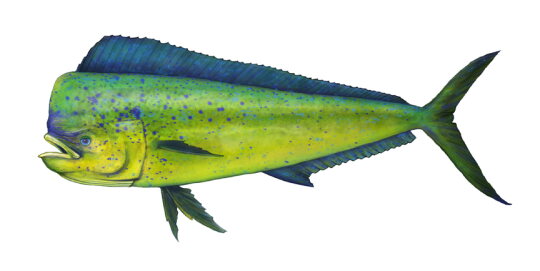
The main attraction of this dish is the grilled fish.  Two of my favorites for making fish tacos are Mahi Mahi, otherwise known as dolphin fish:

Mahi Mahi

Mahi Mahi

and monkfish, a really bizarre bottom dweller known as the “poor man’s lobster.”  It is also known as having all head and tail and no body, and the tail, cheeks and liver are the parts that people eat:

Monkfish in the market

Monkfish in the market

In most markets, one won’t see the whole monkfish, just the tail portion.  Both of these fish are generally available, and are not considered endangered.  There is a tagging program for monkfish run by the National Oceanic and Atmospheric Administration of the US government, and the website has some very interesting information on this fish, as well as great photos.

The mahi mahi is a tender, tasty fish which is very lean.  It can be cooked directly on the grill, but I prefer to grill it on foil, to protect it.

Mahi mahi filet prepared for grilling.

Mahi mahi filet prepared for grilling.

I used a mango chipotle marinade on the top half, for the fish tacos, and a sesame soy marinade on the bottom half, for another dinner.  On the grill, the cooking time varies depending on the intensity of the heat and the thickness of the fish.  It is done when it is flaky and cooked white all the way through.

Mahi mahi sharing the grill with some bison burgers and sliced yams.

Mahi mahi sharing the grill with some bison burgers and sliced yams.

I cook the monkfish the same way, on foil to protect it.  Monkfish is a lot denser than mahi mahi, yet it is still very lean.

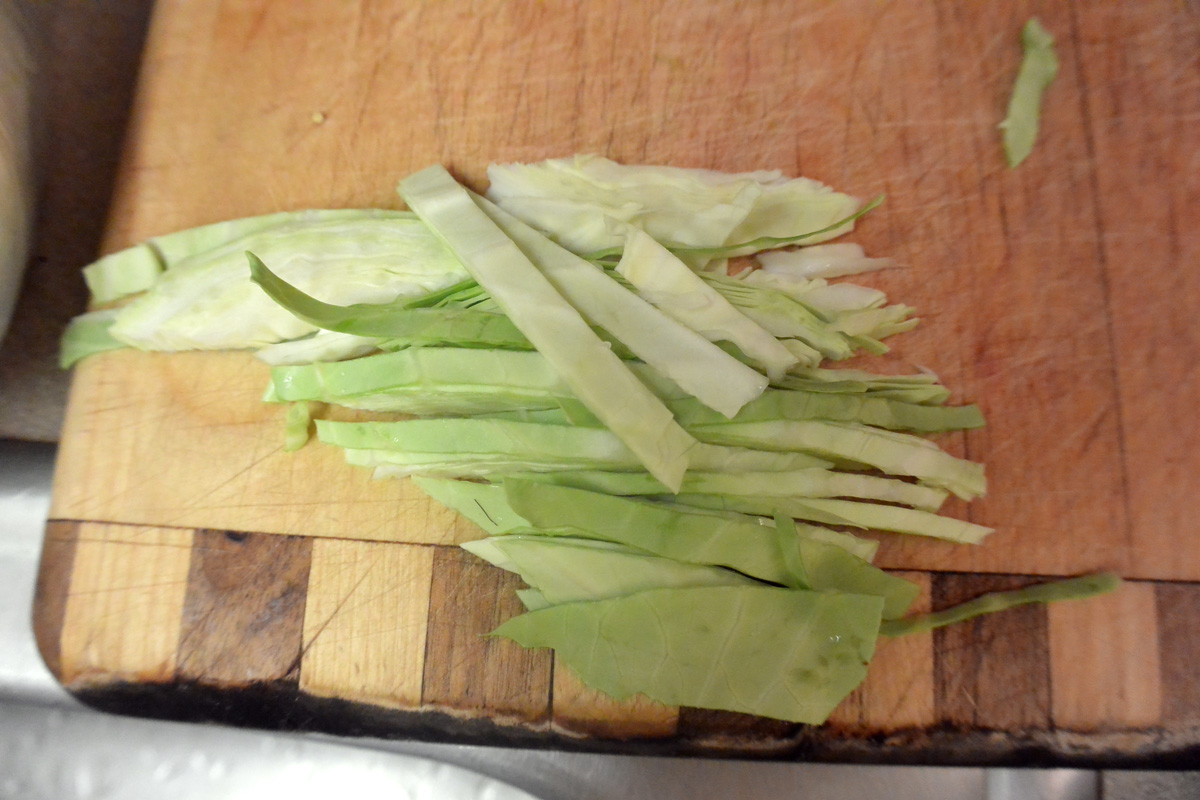
Shredded cabbage

Shredded cabbage

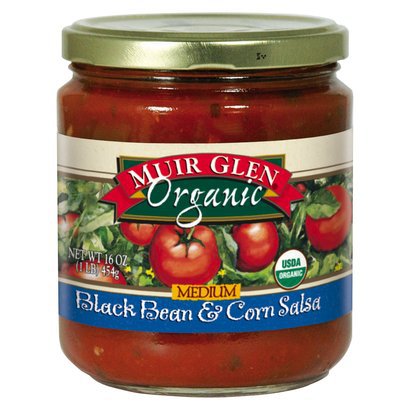
Black Bean and Corn Salsa

Black Bean and Corn Salsa

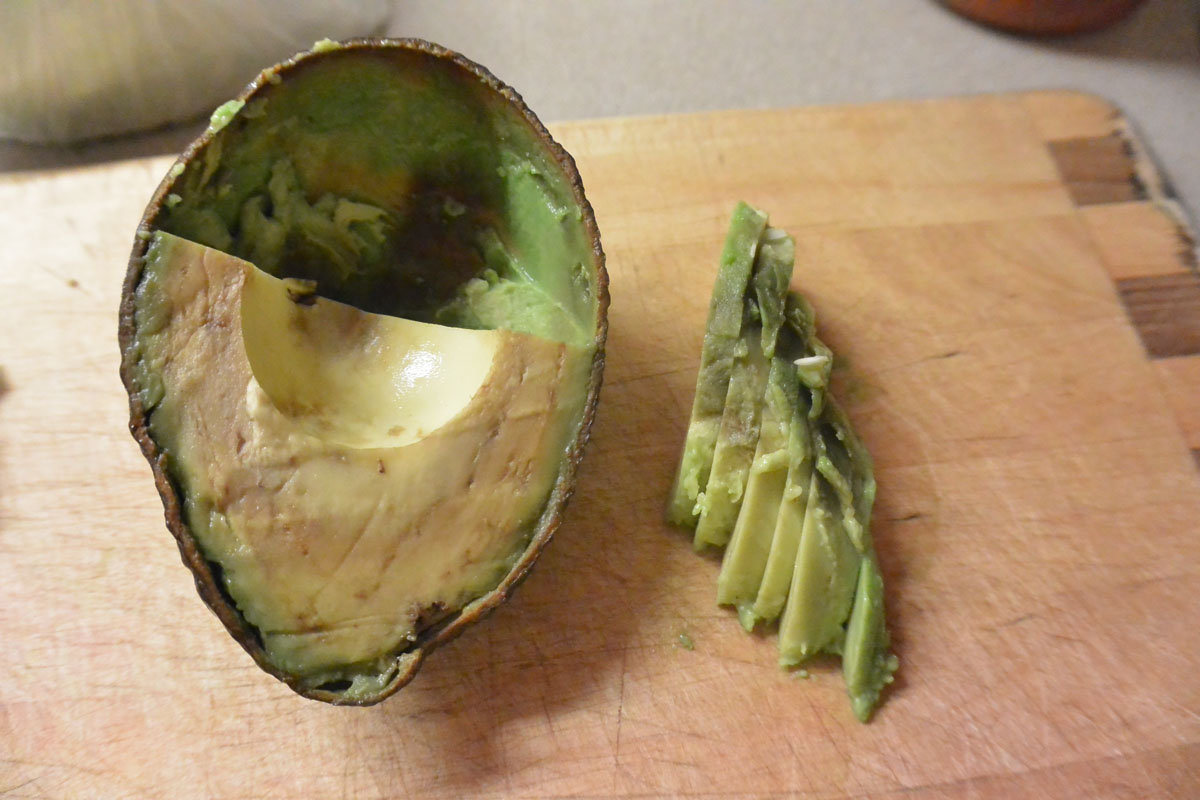
Avocado

Avocado

Assembling the tacos requires the following ingredients:

tortillas (of your choice, corn or flour, but they should be the large ones)

grilled fish

shredded cabbage

Muir Glen Organic Black Bean & Corn Salsa, medium hot

ripe avocado

light pepper ranch salad dressing

The fish can be used right off the grill, fresh and hot.  It can also be refrigerated once it is cooked and it is still good for a few days.

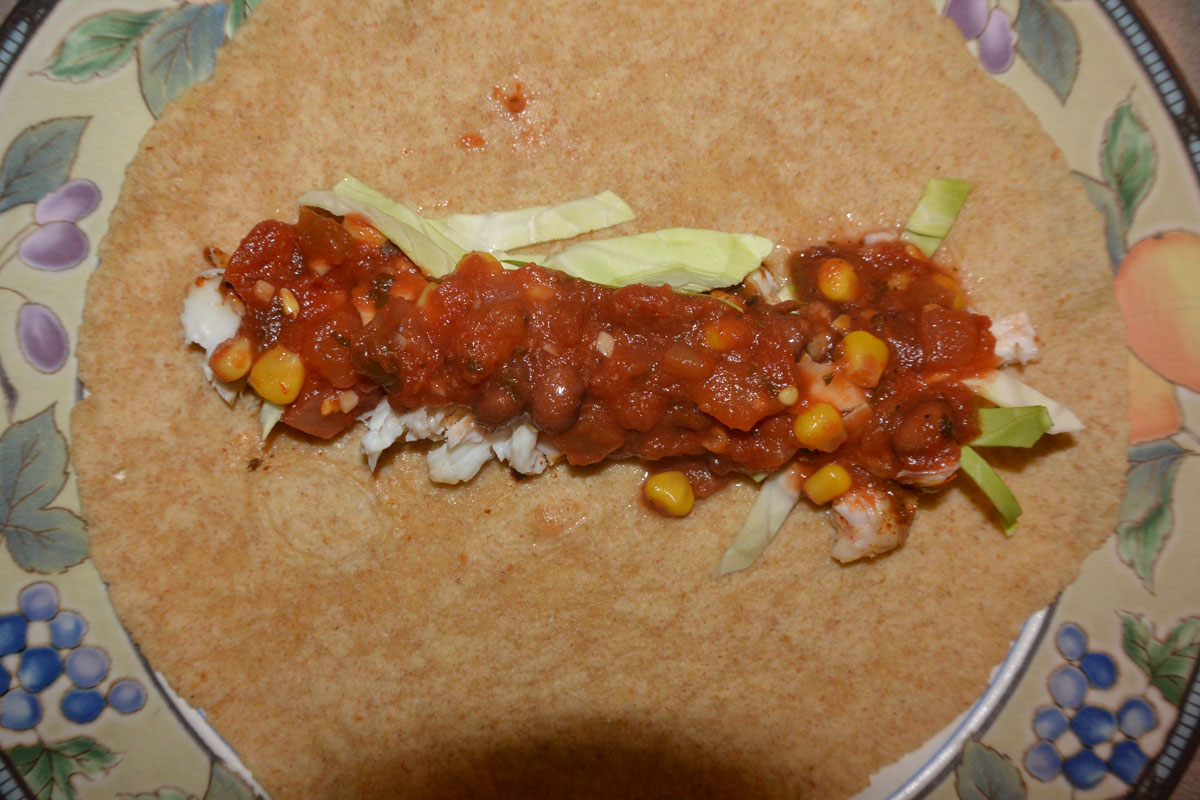
Tortilla with monkfish.  This was grilled with a fajita marinade.

Tortilla with monkfish. This was grilled with a fajita marinade.

Next comes the fresh, shredded cabbage.

Next comes the fresh, shredded cabbage.

Spoon some of the salsa over the fish and cabbage.

Spoon some of the salsa over the fish and cabbage.

Add some avocado slices to top it off.

Add some avocado slices to top it off.

Add a drizzle of light pepper ranch salad dressing on top.  This adds a little creamy sweetness to counter the heat of the salsa.  Then, wrap it up!


Black and White Bean, Black Eyed Peas, Corn and Pepper side dish:

This is my wife’s recipe, and she is the cook for this cold dish.

Ingredients:

grilled corn on the cob, four ears

two ripe Jersey tomatoes, chopped small

one large can of black beans, 1lb. 13oz., rinsed

one can of small white beans, 15.5oz., rinsed

one can of black eyed peas, 15.5oz., rinsed

two bell peppers, one green, one red, chopped in small pieces

six green onions, diced

one quarter cup of chopped cilantro

Ken’s Light Caesar dressing or red wine and vinegar dressing

We start by grilling the corn shucked and straight on the grill, to give it a nice char.  This enhances the flavor of the corn.  The corn is cut off the cob and placed in a large bowl.  The other ingredients are added.  Finally, we add a dressing of Ken’s Light Caesar dressing, or some other such as red wine vinegar dressing, to give it some zing.  Mix it all up and serve.

For a beverage to go with this meal, here are some suggestions:

Kona Brewing Company Longboard Lager, a malty lager which complements fish tacos, if only because of it’s Hawaiian heritage.  The Kona one buys on the mainland is brewed here, not in Hawai’i, but according to the Kona recipe.

Iced tea, can’t go wrong with this.

Milagro Farm Estate Grown Rosé of Sangiovese, a dry rosé which matches well with the spicy fish.  If you happen to live in San Diego, seek this one out.  If not, you’ll probably need to find another rosé, preferably dry and medium bodied.

Today was an “almost too good to be true” day.  No rain, blue sky with an artists display of cumulus clouds, and dry, moderate temperatures.  I had a good fourteen mile run today, at a very decent pace.  It was such a relief not to run in murderous heat and humidity.  I’m looking forward to enjoying a couple of these tacos for dinner this evening.

¡Buen Provecho! and happy running.

Summertime, and the livin’ is easy, but the running isn’t!

This feels like the summer of 2012 all over again.  We had a stretch of rainy days which seemed to go on forever, although it was really only about a 10 days or so.  I had two rather interesting rain-related experiences during this time.  Both were during my Monday run from my hospital in Camden, NJ, over the Ben Franklin bridge to Philadelphia, a loop down to the Race Street pier, then back over the bridge and back to the hospital.  It is a very nice six mile round trip, with the challenge of the bridge, but also with a pleasant breeze on the bridge and very nice views.

The first interesting experience occurred on my way back through Camden.  Dark rain clouds and the rain coming down to the east were illuminated by the setting sun to the west, and a beautiful, full-arc, sharply colored double rainbow could be seen as I was crossing Market Street.  I stopped a local man crossing the street who hadn’t noticed this wonder of nature and pointed it out.  He smiled broadly, and said “yeah, cool.”

The other incident was a little more worrisome.  I was doing the same run again.  It was overcast, but the rain seemed to be off to the east, and usually the direction of travel of the rain clouds is west to east.  As I was cresting the high point on the bridge, large raindrops started to splat the walkway.  I still felt this didn’t seem like much of a problem.  In fact, I was marveling at how the rain on the walkway created an outline of the old-fashioned style lamps along the railing.  My reverie was short lived.  Instead of moving east, the storm was heading right towards me.  I still had about a quarter of the bridge to go as the rain picked up and became torrential.  Worse, lightening was flashing around me.  I don’t know the risk of being on an enormous steel structure during a lightening storm, but my gut feeling was that it was not safe.  I scurried down the ending stairway of the bridge, three sets of wet stairs, to the street.  I made it shortly to a loading dock area on the Rutgers campus, and got out of the storm.  As I waited out the storm, several other runners behind me on the bridge kept running in the storm, and I watched them go by.  I felt a little wimpy, as if I should shake my fear and continue running.  But then, reason took hold and I waited a bit more.  Looking up at the sky, I could see swirling clouds which looked like they were attempting to make a tornado.  Fortunately, it never go to that.  With the storm, and the lightening, having moved on, the thunder now coming more than 10 seconds from the lightening, I ventured out and ran the last mile or so back.  It was still raining, and when I got to the hospital I made sure to allow a little drip time before going back in to change.

Now, though, the rain has been gone for several days and the heat has arrived.  As we all know, running in the heat can be brutal.  One’s body must acclimate to the heat.  This is a complex process, involving changes in the body’s blood volume, hormonal status, immunological changes, sweat composition and response, and other alterations.  All those intricate physiological changes have yet to occur in me.  I ran yesterday for a seven mile run, and today for a 12.5 miler.  While the starting temperatures don’t sound that brutal, around 79 degrees F, the high humidity of 90%, low to non-existent breeze, and sun made for very uncomfortable running.  Both days we started at 7:00 AM.  My friend Brandon, with whom I ran on Saturday, seemed to already have made that jump to summer running, as he was not nearly as affected as I was.  Perhaps it is his incredibly lean, thin body, or the fact that he runs normally more than fifty miles a week, but he cruised without dying.  I, on the other hand, felt like collapsing after a few miles.  Saturday, I mustered on, drinking water from the fountains along our route, and going a very diminished pace.  Sunday, I started out running with two other runners, planning to go 13.5 miles.  I carried a bottle of water with me in one of those handy runner’s bottles, with a strap for my hand, and a protruding enormous nipple-like spigot, allowing a drink on the run.  One of the guys in my group peeled off at four miles, saying he was never going to make the 13.  The other kept with me until his usual turnoff at my six mile mark.  So I was left alone for the rest of the run.  As I steadily, but at a considerably slower pace than normal, made my way around our standard Sunday loop, the sun got higher, cresting the trees and shining down on me.  Other runners came by in the opposite direction, looking pretty bedraggled, with the exception of one young guy.  He had on a gray army-style t-shirt and was running with a backpack.  He looked pretty tough in the heat.  I was drinking steadily to ward off dehydration, and used the amount of sweat on my hands as a guide.  If they were dry, I figured I had stopped sweating from not enough fluid, and took another gulp.  The sweat continued to drench me, and I could feel my feet getting soaked in my shoes.  At around ten miles, I stopped at a water fountain and had the good fortune of meeting a friend running in the other direction.  I hadn’t seen him in a long time, but still we stopped to talk far more than would be normal under milder circumstances.  As I headed for the last leg, I was running now at around a 9’30” to 10 minute per mile pace, not able to go any faster.  I switched sides on the road a few times to take advantage of the bit of shade I could find from the trees.  With two miles left to go, I made the decision to cut this run short, and headed back up the hill for only a one mile return to the start, thinking that lost mile would not be doing me much good anyway.  I made sure to finish strong, though, as I passed my fellow Sunday morning crew who had run shorter and were already hanging out at the Starbucks.  One always should look good at the start and end of a run.  In between, nobody is really watching.  I banged on the sign marking the end of the run, and wobbled over to get my backpack and my extra bottle of sports drink I had stowed for my recovery.  Sitting in the shade, bent over, calf muscles doing their quivering imitation of fireworks going off, I took off my shoes and socks, wrung the sweat from my socks, and slowly felt the heat dissipating.  Once I had cooled to a nearly presentable state, I made my way over to join my friends. I changed to dry clothes, and sitting outside, with a little breeze and in the shade, it didn’t seem so awful.  But, boy, running in the heat can be brutal.  I do look forward to that magical transformation of being acclimated.

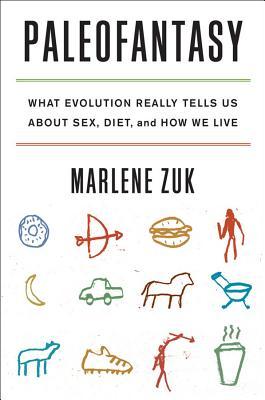
Paleofantasy: a book report

Paleofantasy

What Evolution Really Tells Us About Sex, Diet and How We Live

by Marlene Zuk

Published Feb. 2013 by W.W.Norton & Co., 328 pages

paleofantasy


When I was in high school, first learning about genetics, things seemed fairly simple and straightforward.  Blue eyes, a recessive trait, required two genes, one from each parent, specifying blue eyes.  Otherwise, the eyes would be brown, being from a dominant gene.  Since then, with the explosion of scientific knowledge of molecular biology and the analysis of the entire human genome, the world of genetics and evolution has, well, evolved, to put it in the phrasing of Dr. Zuk, a professor of Ecology, Evolution and Behavior at the University of Minnesota.  But it is as if we have just dipped our toe in a vast and unexplored ocean, which was previously unknown.

I picked up this book at my favorite book shop in the U.S., Northshire Bookstore in Manchester, Vermont, while on a ski trip in February.  The title captured my interest.  There is a huge “Paleo” movement at present, based on the theory that our genes adapted to life of the paleolithic time, that is, from about 2.5 million years ago to about 10,000 years ago.  This covers a lot of time, from when earliest human-like creatures developed, to the development of modern homo sapiens.  A search on Amazon for books with paleo in the title yields 2,719 titles, very few of which have to do with actual paleontology.  They are almost all about eating paleo, living the paleo lifestyle, and there was even a paleo cookbook for your dog.  The concept is that humans evolved before the era of agriculture, caught their meals in bursts of speed chasing down animals, gathered vegetable food from nature, and walked and ran barefoot.  Thus, the argument goes, we are best suited for this type of food, and life, and that our genes are ill equipped to handle crops such as grains, non-meat sources of protein, and running long distances, especially in shoes.  There are also devotes to various concepts of how stone-agers lived in family units, or groups, how they coupled up and reproduced, and whether there was pairing for life versus multiple partner life.  The purpose of devoting oneself to a paleo lifestyle, then, is to be in harmony with ones nature and genes, to be healthier, leaner, fitter, sexier, have less immunological problems, and presumably, to be able to run injury free.

Dr. Zuk starts off with a brief description of human evolution.  She explains some of the complexity of the evolutionary process, that many human ancestor lineages were changing in different ways, that we share an enormous percent of our genome with earlier species right down to bacteria, and that evolutionary change is not always change for the good.  She points out some of the complexity of genes being favorable or unfavorable for survival.  For example, if a trait is unfavorable, and results in loss of that trait, other genes will be lost along with that  trait due to their being linked together.  She gives specific examples. She also documents that there was not just one paleolithic lifestyle; there were many different routes taken along very different paths.

Her second major point is that evolutionary change can happen quickly or slowly, and may occur without any type of survival pressure.  An argument of the paleo adherents is that our genes were fixed back in pre-modern times, and that the last 10,000 years is too short a time to allow for adaption to new foods, and new ways of living.  She rebuts this with specific examples of changes that have occurred in that relatively short period.  Blue eyes, mentioned above, came about in the last 10,000 years.  Lactose intolerance seems to have a lot to do with where and how one’s group survived, and is also very recent.  It has the complex nature of being caused by a lack of a gene to inhibit built in turning off of another gene which inhibits lactase production as one matures, lactase being the enzyme required to digest lactose.  She mainly discusses genetic changes which are changes in gene expression, as opposed to major gene alterations such as occur with mutations.  In other words, she’s not talking about how we got to be human, but rather how our genome is modified over time to adapt to our surroundings.

The following chapters deal with diet, food procuring methods, exercise or physical activity including running, sex, monogamy versus multiple partners, family structure, child raising, susceptibility to diseases, and how we protect ourselves from disease.  Her discussions of these topics are backed up with scientific studies, and she cites the literature from which she makes her arguments.  She also points out where the science does not support the claims made by paleo adherents, thus the “Paleofantasy” of the title.  In many ways, she does not try to say that the “paleo” approach to diet or exercise is harmful, just that it is not based on real scientific reasoning.  As with any devoted scientist, she includes a lengthy bibliography which she used to form her arguments, as well as a notes section and an index.

Her writing style was an interesting, and sometimes to me, annoying mix of sound scientific argument with a conversational tone that seemed unnecessary.  It was like watching a really good Nova TV show on a particular topic, and then having a few lines from the sitcom “Cheers” thrown in.  She uses the word “well” a lot, as I used it above in the first paragraph.  I enjoyed the humorous touches, though, and I think she would make a very entertaining teacher in the classroom.  The title of the book is clearly meant to titillate, listing sex as the first major topic, when it’s really primarily about diet.  She got most of her information regarding the paleo lifestyle from the internet and popular books, which makes sense, since it’s not a scientific discipline, but it does make comparisons of real research with what paleo advocates consider perfectly logical thinking a bit one-sided.  This is not meant to be a book for scholars, but for the lay public, and I think she has accomplished that very well without sacrificing the scientific complexity which makes this topic so interesting.

I learned a lot reading this book, about evolution and current thought about genes and molecular biology.  I think she makes very sound arguments that, while living a paleo lifestyle may not hurt you, you won’t necessarily be any better off for it.  She successfully defends her thesis, that the paleo movement is based on fantasy, not fact.  Reading the comments about her book online, there were obviously many adherents of the paleo life who were not only unconvinced by her arguments, but found her book essentially sacrilegious.  In fact, a number of commentators remarked that they would not read the book. For me, it was an exciting look at topics which are themselves changing rapidly as new research is done in the areas of evolution, genes, reproduction, disease, disease prevention, fitness and longevity.  I think anyone who is interested in these topics will find this book fascinating and a good read, as long as you can, well, ignore some of the style issues.

Vlad Averbukh, 29, a follower of the paleo diet, eats raw meat along the Hudson River in New York in 2010. Emmanuel Dunand/AFP/Getty Images

Vlad Averbukh, 29, a follower of the paleo diet, eats raw meat along the Hudson River in New York in 2010.
Emmanuel Dunand/AFP/Getty Images

Why I Didn’t Run in Hawai’i (part one)

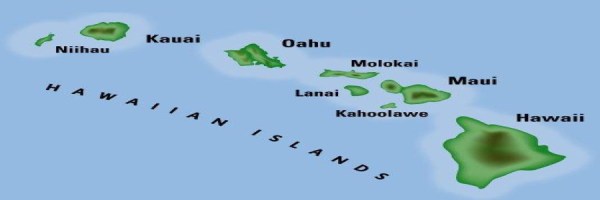
Hawaiian Islands

Hawaiian Islands

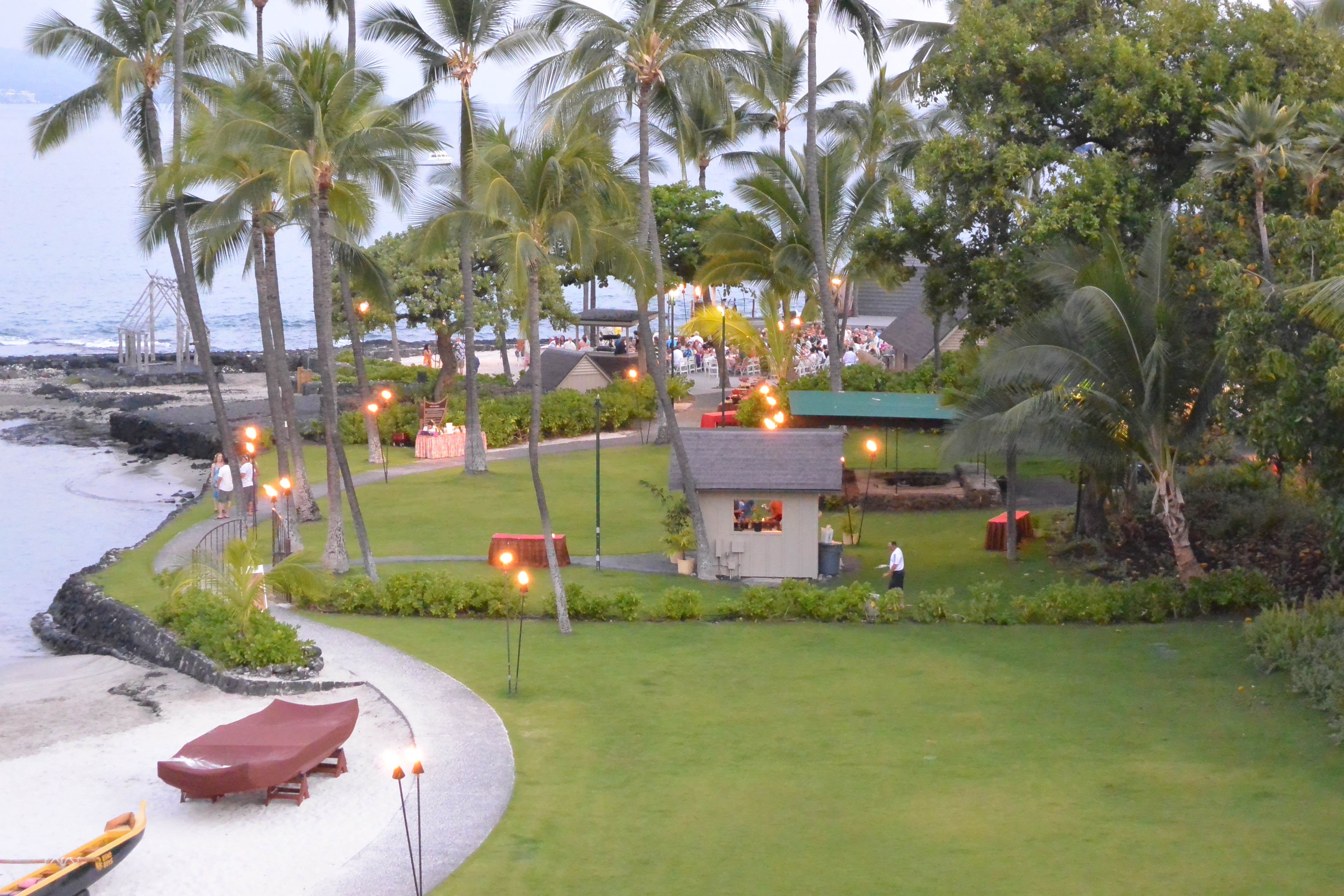
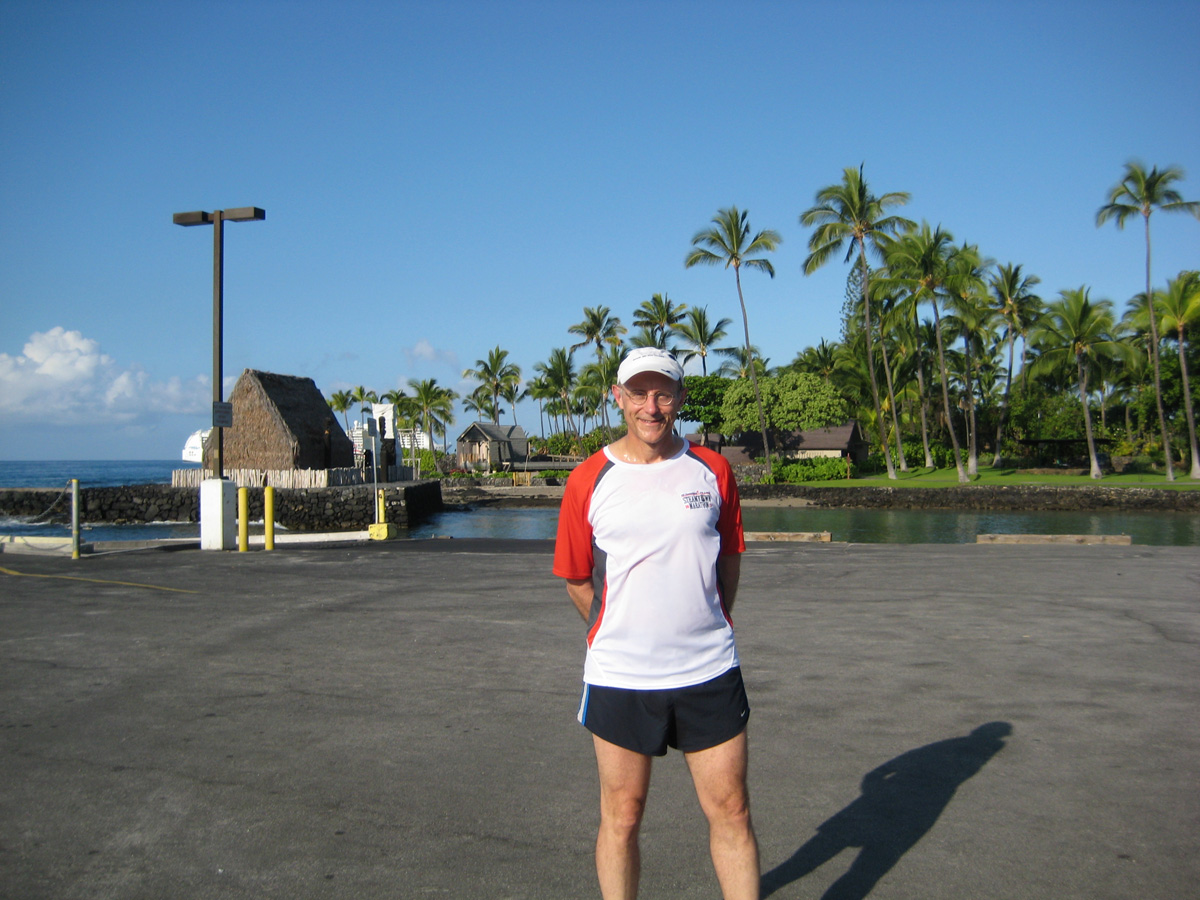
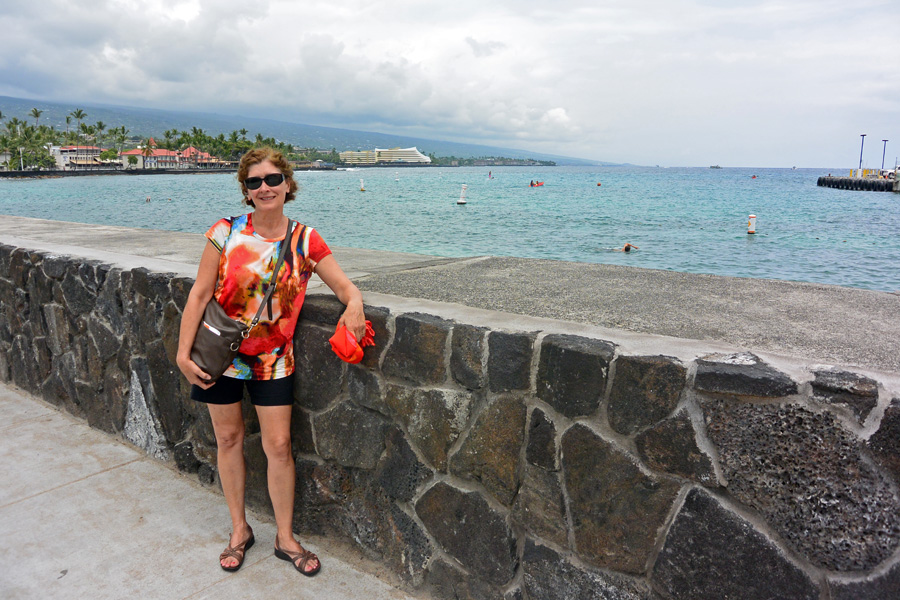
To be sure, I did run, and I’ll get to that, but certainly not as much as I had planned. Since we, being my wife and I, were already on the west coast for my daughter’s graduation, we felt, “why not extend our trip a few days, and have a real vacation”. We decided to take a trip to Hawai’i. Never having been there before, we decided to visit the “big island”, because of the opportunities for adventure. It took a bit of reading to find there are two main airports on Hawai’i, in it’s capitol Hilo, and in Kona. Yes, Kona, the home of the Ironman Triathlon World Championship. Kona is also the more touristy of the cities on Hawai’i, with more hotels, restaurants and bars than Hilo, and it is where we decided to stay. Our flight from San Diego took us eastward first to Phoenix, then we changed planes for Kona. We left San Diego at 6:30 AM, and arrived in Kona at 2:40 PM, a total of eleven hours travel time. It’s not a quick trip. The arrival in Kona, though, is other-worldly, though, as the plane descends over barren lava fields to the airport. Once on the ground, we we disembarked the old fashioned way, by a stairway rolled out on the tarmac. I felt like waving as I stepped through the doorway of the plane onto the stairs. The terminal itself is completely outdoors. No walls, just open air, with some overhead coverage for rain. Exotic looking plants and flowers were in abundance around the terminal. We collected our bags and rented our car without a problem. It was a short drive to Kona and to our hotel. We stayed at the Courtyard King Kamehameha’s Kona Beach Hotel. This hotel is built on grounds of the royal court from the time of King Kamehameha I. It faces a beach, a rebuilt temple of the royal residence, and a pier. The first room they gave us did face the water but was adjacent to a busy street and parking area. They were kind enough to move us to a different room which was much more what I had in mind, overlooking the beach and a grassy area surrounded by palm trees.
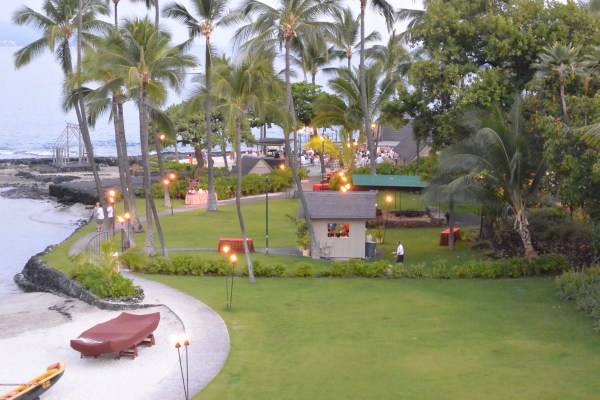
View from our balcony, King Kamehameha hotel

View from our balcony, King Kamehameha hotel

While we had investigated the various things to do on the island, we had not yet made any plans. So, once settled, we began making some reservations. This island is the home of the famous Kona Coffee, and we put visiting a coffee plantation on the list. Most dominant on the island are the two major mountains, both volcanos, and both reaching close to 14,000 feet high. The higher of the two, Mauna Kea, is the home of the largest observatory in the world. There are a number of zip line opportunities, through rain forests and over waterfalls. Hawai’i is known for the opportunity to see giant manta rays doing ballet on nighttime snorkeling boat trips. Of course, there is Volcano National Park. With five days to get this all in, it took a lot of calling, reserving spots, and adjusting plans when one tour was filled and we had to shift things around. While I had the job of getting us to the island and finding a hotel, my wife, Kat, handled most of the engineering of the schedule. I should add, all these touristy things do not come cheap. We anticipated that, and while there are plenty of free or reasonable things to do in Hawai’i, organized activities are expensive, but, as we found, very much worth it.

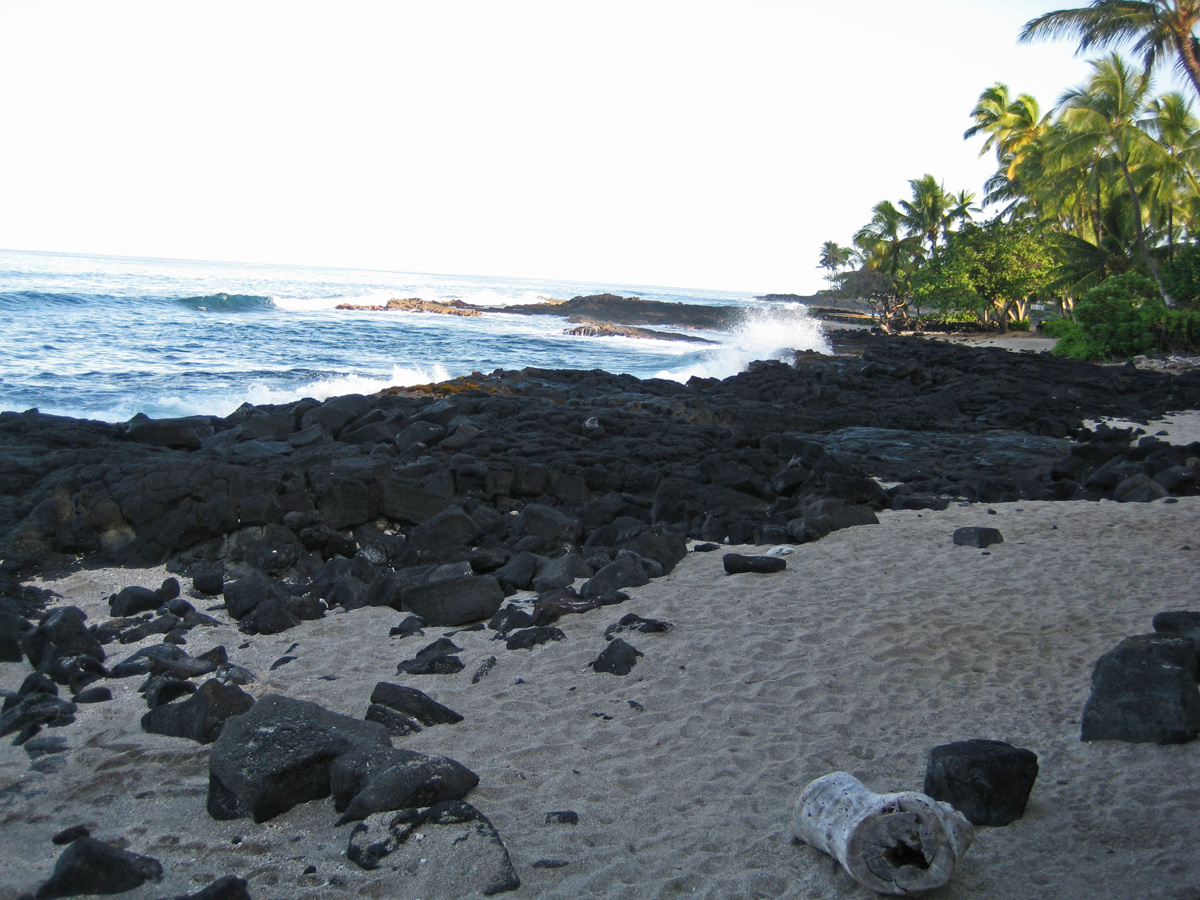
The next morning I awoke feeling frisky and ready to run. I got out at 6:00, which was no problem given Hawai’i is three hours behind west coast time. There are few roads on which to run, so I followed the path most of the runners in this area seem to take, which is along Ali’i road, which runs south along the coastline from Kona. The road is narrow, but does have a shoulder/bike lane, and there were other runners along the route. It is a beautiful route, since there are frequent areas where the waves crashing against the lava rocks are in view. Getting out early, it wasn’t too warm, about 74˚F, but it was very humid.  I ran out a bit past the 2.5 mile mark, then turned around and ran back.  The road is undulating, with a few hills of significance over that distance.
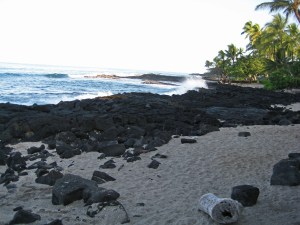
Ocean view while running along the Ali'i Highway

Ocean view while running along the Ali’i Highway
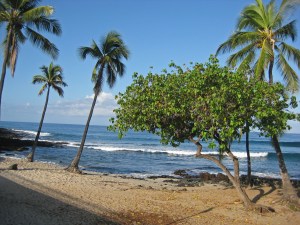
Another beach view along Ali'i Highway

Another beach view along Ali’i Highway
Big Island Running Company

Big Island Running Company

End of the run, quite sweaty.

End of the run, quite sweaty.

After running, I took a quick shower and joined my wife for breakfast at Honu’s, the hotel restaurant.  It is such a temptation to want to fill one’s plate with every tasty item available at hotel breakfast buffets.  I held the line at a made-to-order omelet, a mini Belgian waffle with coconut syrup and blueberries, loads of pineapple, and coffee.  I may have added a few other items as well….  After breakfast we headed out for the coffee plantation.  While there are several dozen on the island which give tours, we chose Mountain Thunder.  It had been featured on an episode of “Dirty Jobs”, and it was located high up Mauna Loa.  It also grows organic coffee, and seemed like a good bet.  We not only took a tour of the coffee growing and roasting operation, we arranged to roast our own organic Kona coffee.

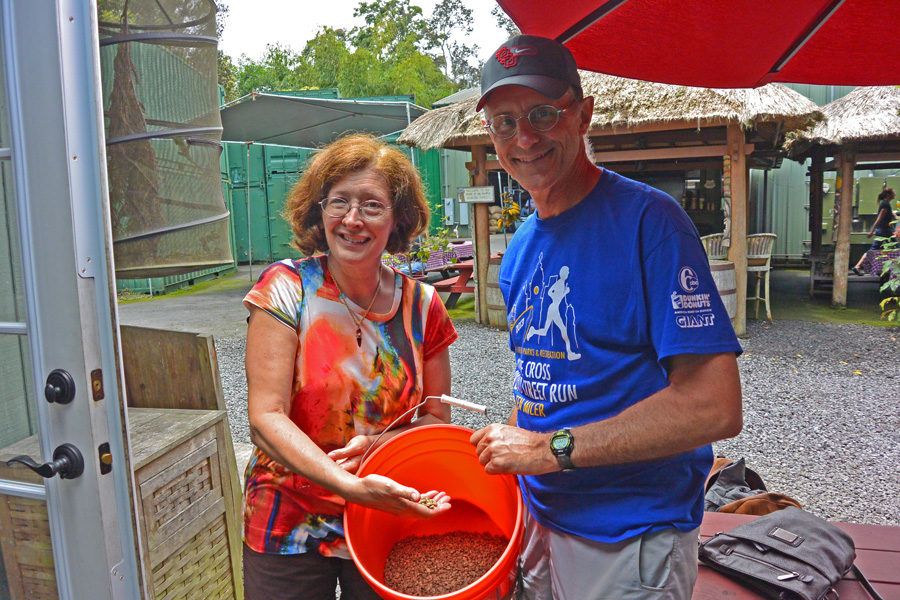
Here is our bucket of 5 pounds of raw, organic Kona coffee
Here is our bucket of 5 pounds of raw, organic Kona coffee

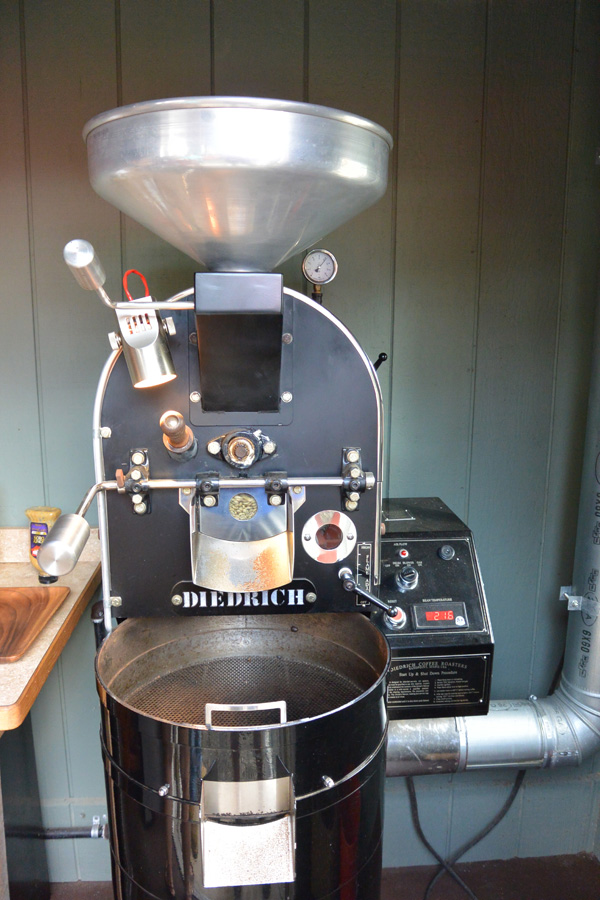
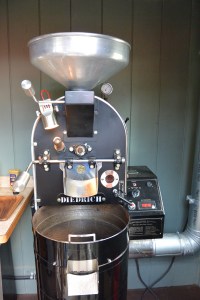
Unto the roaster it goes.  This is a small roaster for the visitors.

Unto the roaster it goes. This is a small roaster for the visitors.

It doesn't take long to get the beans to the proper temperature.  There is a very narrow range between not roasted enough, and over done.

It doesn’t take long to get the beans to the proper temperature. There is a very narrow range between not roasted enough, and over done.
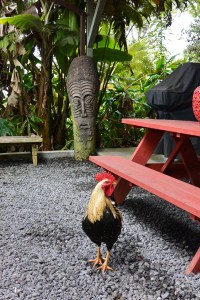
A wandering rooster with a tiki statue in the background, at the coffee plantation

A wandering rooster with a tiki statue in the background, at the coffee plantation

We found that growing and roasting coffee, at least here, is a very “hands-on” job.  The trees are very productive but take a lot of care and feeding, and as we discovered, donkey dung and the outer skins of the beans make for good fertilizer. The beans are picked by hand, since on one branch there can be many beans in different stages of ripeness.  The roasting, too, requires close attention to get the degree of roasting exactly right.  I’m sure at big operations this is all done without human intervention, but here, it was all done by well-trained and obsessive people.  In fact, we detected a note of competitiveness among the roasters, regarding who gets it exactly right.  Five pounds of raw coffee made four pounds and a bit of roasted coffee.  No doubt it’s the most expensive coffee we’ll ever buy, but looked at from the standpoint of price per cup, it still beats the local higher end coffee shop.

That afternoon, our next adventure was to head up to Mauna Kea, to go to the visitor’s center of the Mauna Kea (means “white mountain”, because it gets snow!) observatories.  The visitors’ center is at 9200 feet elevation, while the summit, with the telescopes, is at 13,796 feet.  We stopped at the visitors’ center and did not go to the summit, the drive for which a four wheel vehicle is recommended.  There are summit tours on weekends, when one can go inside one of the observatories, but during the week they are closed to visitors.  Many people do go up to the summit for the view of the sunset, but we decided to listen to the ranger’s talk at the center, and then do some viewing through the many telescopes they had set up.
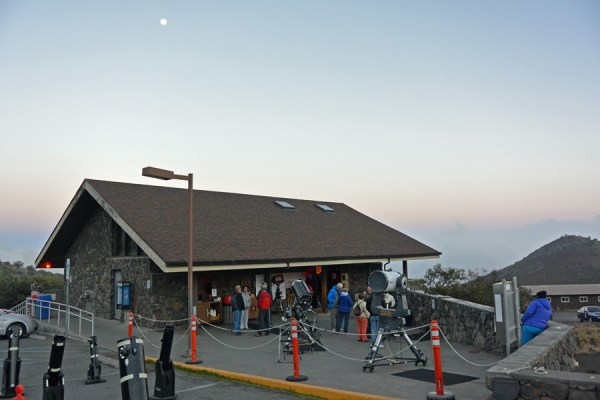
Visitor's Information Center at the Mauna Kea Observatories.

Visitor’s Information Center at the Mauna Kea Observatories.  Note the winter coats.  It gets cold up here.

The ranger gave a laser guided sky tour once it got dark enough, and we saw the Southern Cross, alpha and beta centauri, and many other constellations.  We were able to get amazing views of Saturn and Jupiter through the telescopes, and a view of a star cluster called omega centauri, or “the jewel box”, because of the different colored stars.  After about two hours of viewing, and getting thoroughly chilled, we headed back to Kona.  The road to Mauna Kea is an adventure itself.  It is called Saddle Road, because it goes between Mauna Kea and Mauna Lea.  It is a very narrow, twisting, rising and falling road over bleak and dangerous looking lava fields, often with no shoulder, and with the occasional one-lane bridge.  There are signs posted regarding which car should yield when two approach these bridges.  It was challenging on the way to the mountain when it was still light out.  In the dark, it was scary.  We were told later that this road was built this way on purpose by the army, as a way to foil an enemy that might try to use it.  But, I have serious doubts about that story.

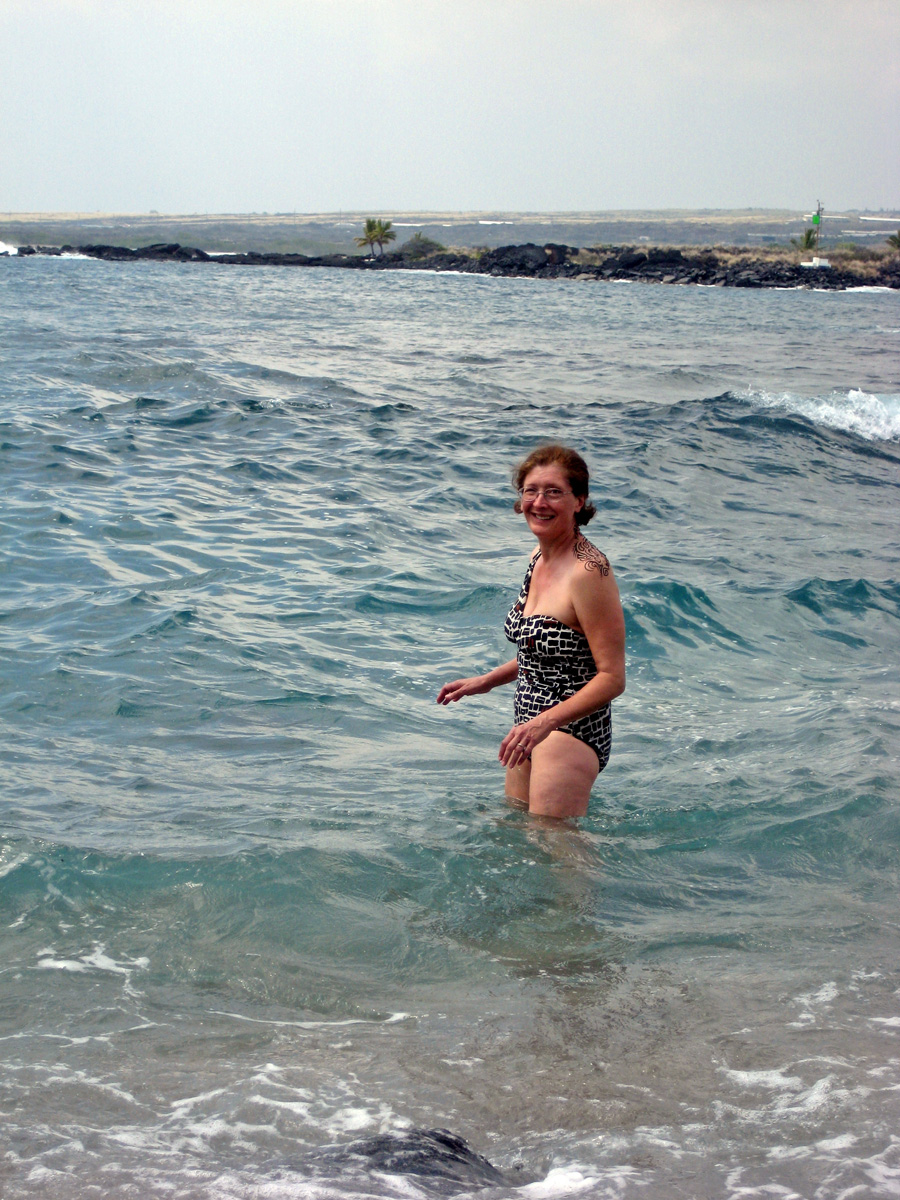
The next morning we planned to get in some snorkeling.  After another scrumptious breakfast at Honu’s (which is the Hawaiian word for sea turtle), we walked into town to rent some masks and snorkels.  Also, Kat was very interested in getting a henna tattoo.  She stopped in at Kona Henna Studio, where a delightful and artistic young woman put a very nice, temporary tattoo on her left shoulder.  I’m not sure if the side has any meaning, but it did look nice, and included a honu, which I requested.  Meanwhile, I went across the street to Boss Frog’s Dive, Surf and Bike shop to rent the gear.
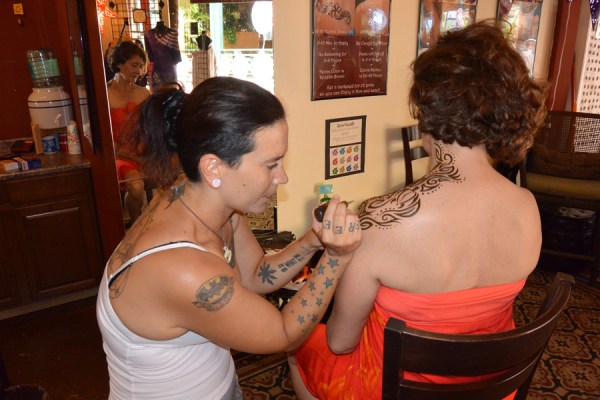
The henna goes on at Kona Henna Tattoo.

The henna goes on at Kona Henna Tattoo.

Kat needed to let the henna paste dry, so she couldn’t go in the water right away.  But after a few hours she would be able to get it wet, once the paste fell off, as long as it was not in the swimming pool, since the chlorine would bleach it out.

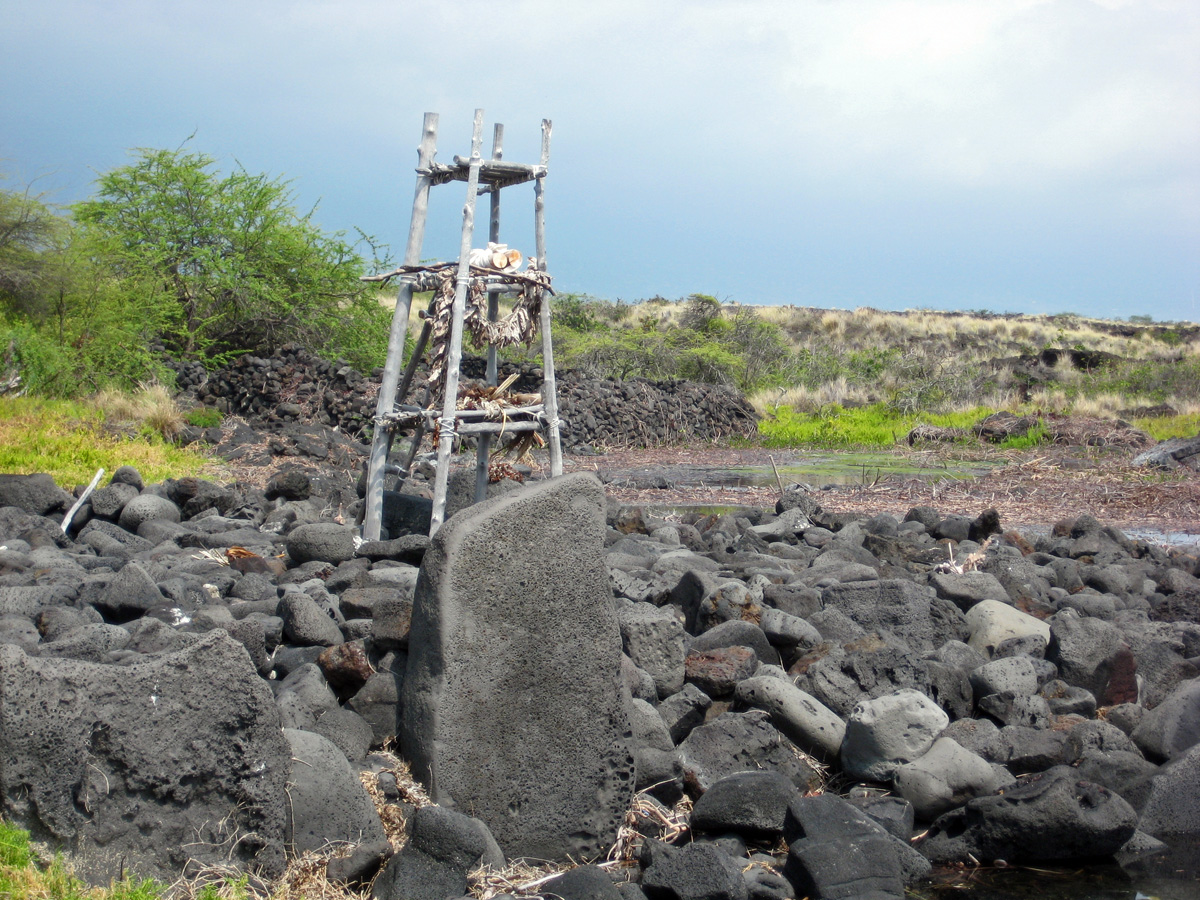
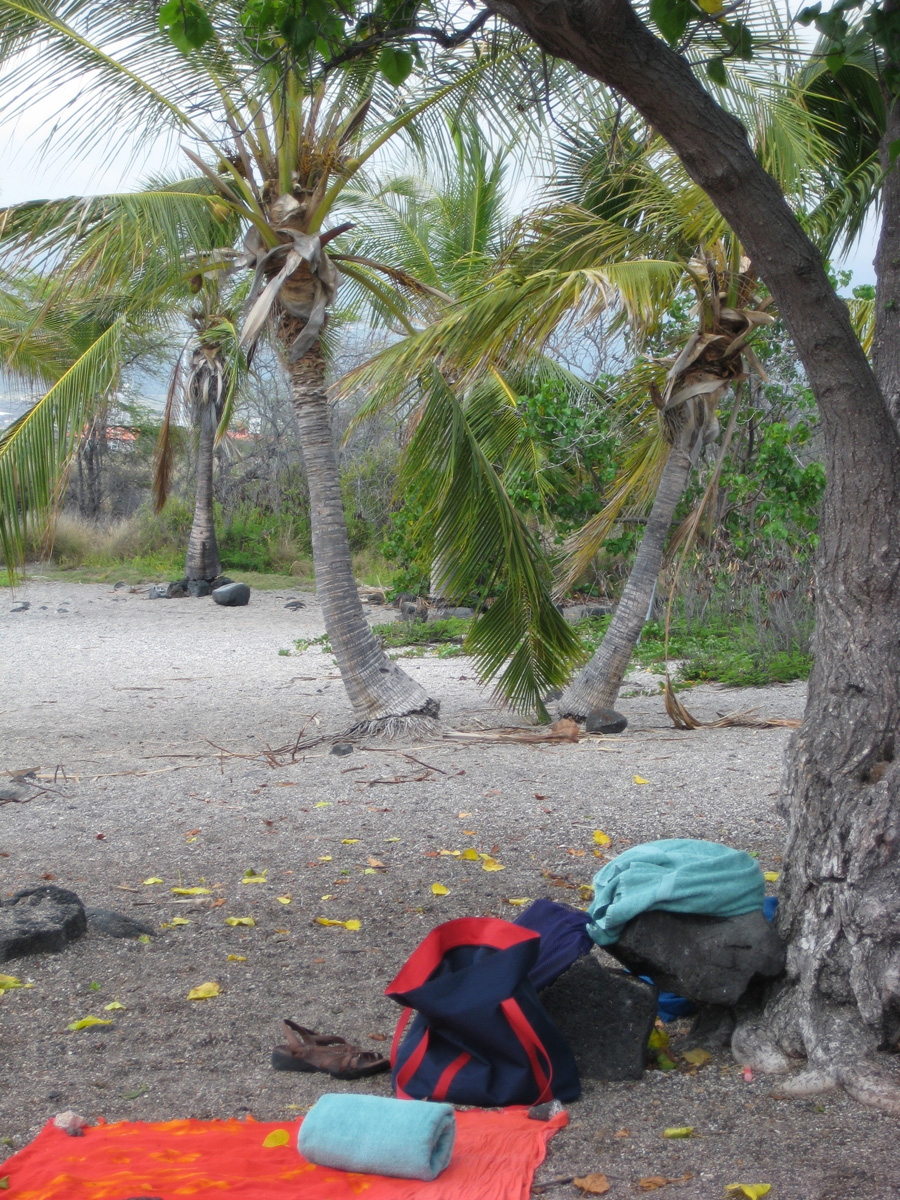
We drove along the coast, looking for the passageways to the best snorkeling beaches as recommended by Boss Frog’s.  About thirty minutes drive down the coast we headed for Honaunau Bay.  We found our way to the bay, but wound up in a National Historic Park, where snorkeling was not allowed.  We were directed back to the road we came in on, but missed the turn for the cove.  Instead, we wound up on City of Refuge Road, a four mile long, single lane (that’s right, just one lane, not two, and traffic goes both ways), road along another bleak, sharp-rocked lava field.  Turning around was not an option.  I was starting to think that, aside from a few main roads, driving in Hawai’i is a huge driving challenge.  We finally reached the end of the road, where it joined with another which took us back up (about a thousand feet up) to the main highway.  It took looking back at the map later to realize where we had gone wrong.  Instead, we headed north, to check out other possibilities.  The walkways to the beaches are marked as public access walkways, but often there are no areas to park, and the hike out to the water can be a few miles.  We finally found our way to a beach near the Honokohau Marina, north of Kona.  The walk to the beach was a challenge, and the beach itself was tiny and rocky.  But, I was able to get in and see some beautiful fish.  No turtles, though, even though this beach is known for them.  The water was uncharacteristically pretty rough.  Getting in the water was no problem, but getting out, I needed to find my way to the least rocky egress in order not to get hurt.

Formerly known as a lifeguard tower, at Honokohau beach.  I think this was put up with tongue in cheek.

Formerly known as a lifeguard tower, at Honokohau beach. I think this was put up with tongue in cheek.
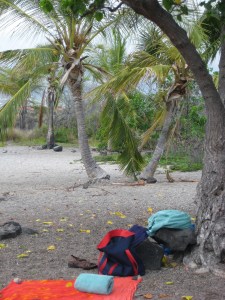
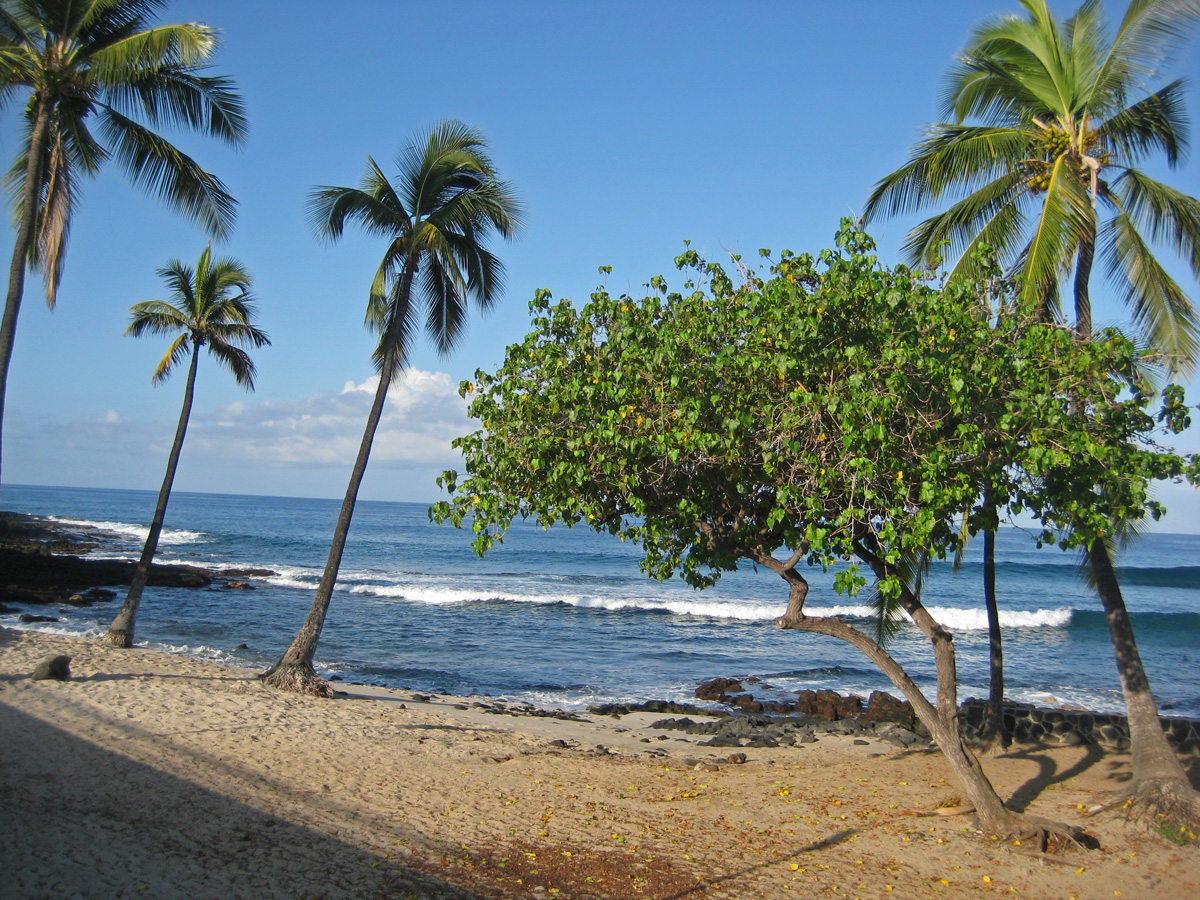
The sand and palms at the little Honokohau beach.
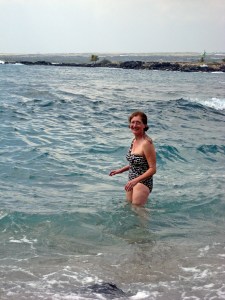
The sand and palms at the little Honokohau beach.

Testing the water, in a sandy spot.

Testing the water, in a sandy spot.

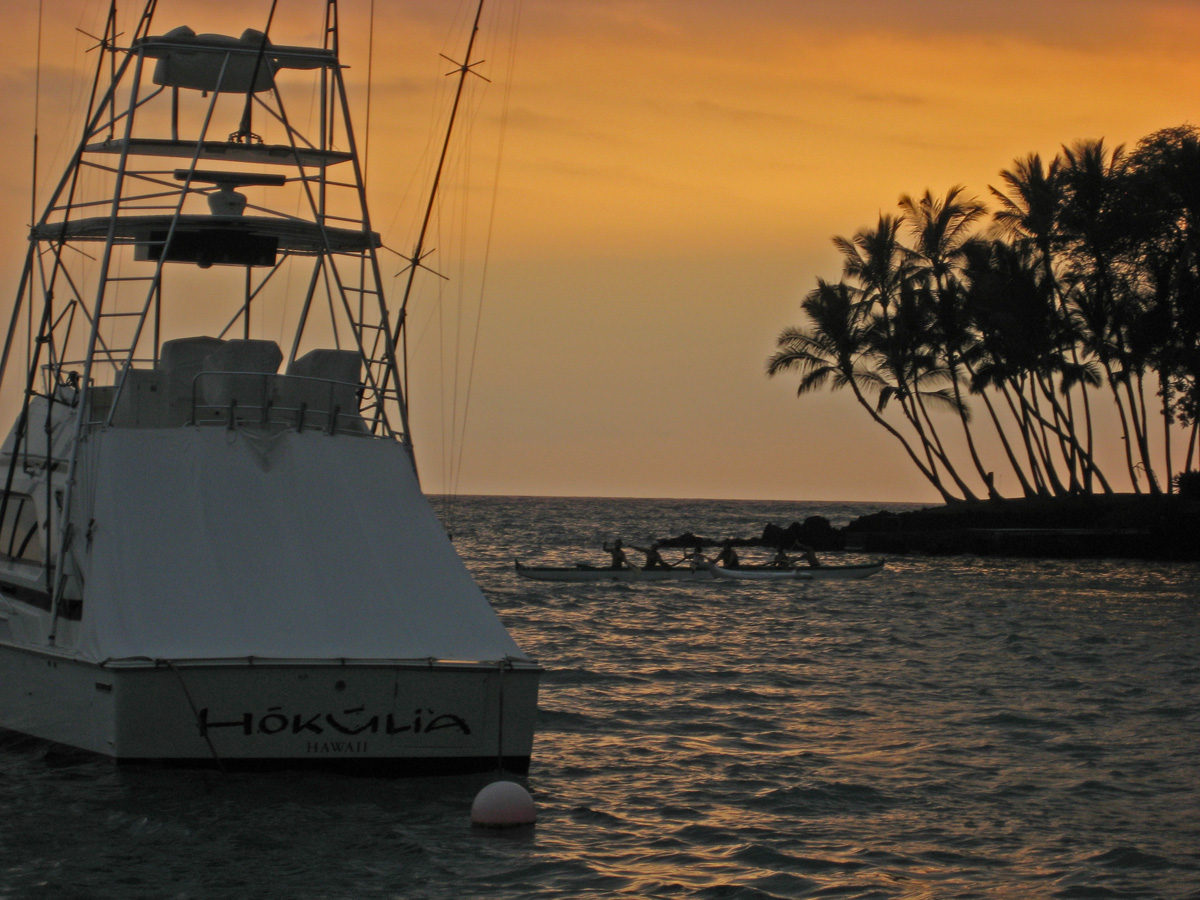
Our search for an ideal snorkeling experience did not turn out as we hoped.  The next time we are in Kona, we’ll know how to get to the “two step” beach at Honaunau Bay.  That evening, though, we had plans for another expedition.  Kona is well known for night time viewing of manta rays.  In fact, the guy at Boss Frog’s said if we see the Mauna Kea, see lava, and see manta rays, we’ve done the big three items on his list of the best of Hawai’i.  We arranged to go out with Sea Paradise tours, for the boat ride out to what they call “Manta Ray Village”, out of Keauhou Bay.

Awaiting darkness in Keauhoa Bay, before boarding the Hokuhele for our trip to see mantas.

Awaiting darkness in Keauhoa Bay, before boarding the Hokuhele for our trip to see mantas.

The boat trip is a short one, only about 20 minutes.  One checks in at their office about an hour before the trip, to sign the inevitable legal release and get fitted with a wet suit.  Everyone shucks their shoes before getting on the boat.  As they motor out to the spot, one of the hands on the boat gives a brief lecture about manta rays.  It turns out they eat only plankton, can be quite large in size with wing spans up to 14 feet, and will often turn flips as they eat up the plankton.  The plankton are attracted to the lights attached to a boom, similar to moths being attracted to light, which then pull in the mantas  The boom is a long contraption with floats and attached lights.  The thirty or so members of our party were provided  masks and snorkels, and led down a stair into the water.  We were directed to line up along the boom, with our hands outstretched on the boom and a “noodle” float under our feet to keep us suspended, so we wouldn’t touch the mantas.  It was a bit eery being out in the dark water, with only the light from the boom shining down.  True to our captain’s word, the plankton massed under us, their tiny bodies in constant motion as their cilia propelled them.  After watching and waiting for about thirty minutes, while all those delicious plankton cavorted like a Vegas stage show, no hungry manta rays wanted to show up.  We gave it another twenty minutes.  A woman opposite me on the boom had a very large underwater camera, the type professional divers use, but it was of no use that night.  Before the hour was up, we were all back on board the boat, stripping out of our wet suits, and trying not to be upset that we had not seen a single manta ray.  The captain and crew were very nice, and assured us that this is a rarity.  In fact, they had just seen several mantas the night before.  One let slip that their hit rate for mantas was 88%, so one in eight trips is a dud.  No matter.  Kat and I realized that these are wild animals and cannot be commanded to show up.  The company did allow us to sign up for another trip, which would be two days later.

After disembarking, we headed back to our hotel, then went out for a late supper.  We wound up at a Thai restaurant which was okay, not great, but did know how to make a passable green papaya salad, although the papaya was not really green, more ripe.  We then walked back to our hotel, passing along the sea wall where the waves splash over onto the sidewalk, tired from a very active, if not so productive, day.  The next morning, we needed to get up very early for the trip to the other side of the island, and our first encounter with a zip line, which will be covered in part two.  Stay tuned….
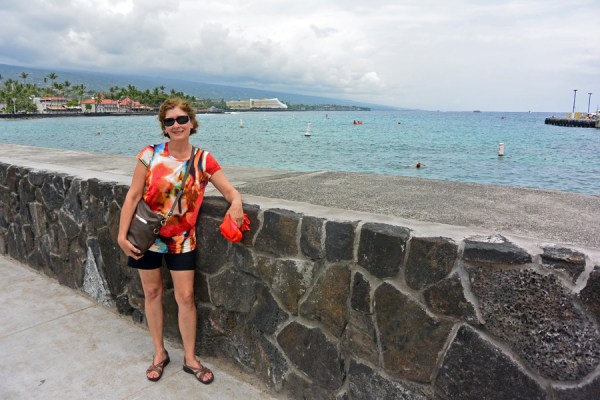
Daytime view of the sea wall and the Kamakahonu Bay
Daytime view of the sea wall and the Kamakahonu Bay

There’s Better Days A-comin’

Been through some rough times lately.  Things were going okay, in fact I was looking forward back in April to running Phillie’s famous Broad Street Run on May 5 .  With only a week before the race, I was coming off a week of hospital call.  That always requires some recovery time.  But this week, which ended April 21, was particularly rough.  In a short phrase, there were a lot of sick folk.  The following week, I seemed to be coming down with a virus.  I developed shaking chills, fever, muscle aches, in other words all the typical viral symptoms.  Oddly, though, they also seemed to come and go.  One half of a day I would be in the grip of the ague, then a few hours later, I’d feel back to my normal self.  By the end of that week, it seemed to have passed.
That was just hopeful thinking.  The following week, the virus changed it’s tactics and decided to attack my intestinal tract.  While I no longer had the shakes and chills, I couldn’t eat anything without it seeming to pass through me in two hours, and not stop to get absorbed.  So, I stopped eating, took only tea, and managed to make it through the next few work days without cancelling anything.  At the same time, my trial was about to start.  As a physician, I was being sued by one of my patients for allegedly going outside the standard of care and causing her harm.  This trial had been scheduled originally last September, then October, then November, and then February.  Each time I was told I needed to cancel all my usual clinical duties and be present at the courthouse.  I would need to testify, but also be present to listen to all the other testimony of expert witnesses.  A colleague of mine was also named in the suit and would likewise need to suspend all his activities.  Each time the trial was scheduled it was cancelled for the lawyers’ or judge’s conflicts with other trials.  This time, starting Thursday of the week when I’m in the throws of my GI hullabaloo, I was told it was definitely going ahead, since it was the oldest case on the judge’s docket.  Thursday was jury selection day.  I presented to the courtroom as instructed, and jury selection commenced.  It took a full day, but a jury of eight was chosen.  Meanwhile, I was getting a bit weak, having no real food for two days.  Not wanting to run in and out of the courtroom, I didn’t dare try to eat something that day.  The actual trial was not to start until the following Tuesday.

By Friday, the evil GI virus seemed to have run it’s course.  I was able to take in solid food again, and start to rebuild my strength, which had taken a real dive.  By Saturday, I was still feeling a bit dizzy and washed out.  But the Broad Street 10 miler was coming up Sunday, and I really wanted to run it.  It’s a big event in Philadelphia, with over 40,000 registered.  It’s the largest 10 miler in the country, and a big celebration.  This year, it would also stand as a tribute to the Boston Marathon and the awful events that took place there a few weeks earlier.  So, Saturday morning I went to the expo to pick up my number.  Sunday, I joined my fellow club members at 5:45 AM to carpool to the race.  It is a point to point race starting at North Broad Street, and heading straight down 10 miles to the end of Broad Street at the Philadelphia Naval Yard.  The only turns are around the Philadelphia City Hall, which sits in the middle of Broad Street between the five and six mile points of the race.  It’s known for being a fast course, and many of the speedier, younger runners look for a sub-one hour time.  We parked near the end of the race in the sports arena parking lot, and joined our fellow runners on the Broad Street subway heading north to the start.  It is an interesting site to see several thousand runners cramming the subway trains in their running shorts and singlets, numbers on.  It is not the usual workday subway scene.

The organization of the race was superb.  It went off on time, the corals were well organized, and even the increased police presence was organized and really not intrusive.  I could tell though, that this was not going to be a record setting year for me.  I probably should have listened to my body, as they say, and not run, because of being so ill the week before.  I was never really able to get into gear and push myself, and as I was coming up to mile nine, one of my friends from another club passed me and said I looked like I was “hurtin’.”  I made it across the line in 1’23”, much slower than I predicted.  But it was a nice day for a race, and I joined my club members afterwards on the grounds of the naval yard, to drink water and have a nice, fat Philly pretzel.  Our goody bag after the race also included a couple of Tastykake bars and some Peanut Chews (designed to pull fillings and destroy dental caps), all products of Philadelphia.

Some of our SJAC club members at the Naval Yard after the Broad Street Ten Miler, 5/5/13

Some of our SJAC club members at the Naval Yard after the Broad Street Ten Miler, 5/5/13

The following day, Monday, was not a trial day, so I had cases scheduled all day in the OR.  At the end of the day that day, I noticed my hands and ankles seemed to be swollen.  I woke up the next morning with the swelling even worse, and I seemed to be having a hard time walking.  I went to our usual Tuesday morning conference at the hospital, then headed to the courthouse for the trial to start.  Everything felt tight.  My watch, which usually dangles a bit on my wrist, was stuck in one spot and making an impression on the skin.  My shoes felt tight.  When I made a fist, my skin looked taught over the tendons, and I couldn’t see them clearly as I usually would.  My co-defendant and I sat through the first day of testimony, paying attention to the plaintiff, taking notes, and discussing things with our lawyer.  That afternoon, though, after court adjourned for the day, I headed back to the hospital to make rounds.  I found my own physician on rounds, and told him about my week of GI bug, the race, and now the swelling.  He thought it could be some acute kidney injury, or a post-viral syndrome, and had me get a few blood tests.  I actually carried through with the tests, although as a doc, one must write one’s own prescription for these things.  The following morning I found out that my BUN and creatinine, measures of kidney function, were above normal, and my CPK, a measure of muscle breakdown, was on the high side of normal.  Texting this info to my physician, I was told it looked like I had suffered a bit of acute kidney injury, probably from racing after a week of little or no food, and that with proper hydration and time I would recover.  This is very scary.  I should have known better, and not run the past Sunday.  I was definitely foolish, but had gotten drawn in because of the commitment to run and the nature of the race.  I did as told, stayed well hydrated, and slowly recovered.  By Friday we had heard most of the experts testify, and it was now our turn to take the stand.  My co-defendant went first and did a good job answering sometimes difficult and lengthy, convoluted questions.  I looked forward to being able to give my story.  I hoped the jury would not only believe me, but feel I had done the best for the patient.  This is an anxiety producing position to be in as a surgeon.  I feel perfectly comfortable in the OR, but not in the courtroom.

That weekend was Mother’s day weekend.  My wife and I took a short trip to visit a friend in Mt. Kisco who is leaving for the West Coast, and a new job in Silicon Valley.  It was a very relaxing two days.  I got in a run on Sunday, in the hills near the Hudson River. We visited my younger daughter and son on the way back home, and drank a happy Mother’s day beer.

Kat and Dan at his house in Mt. Kisco.

Kat and Dan at his house in Mt. Kisco.

We were back in court Monday for the last of the expert witnesses.  Tuesday was the day for the attorneys to give their final arguments.  It took the judge about two and a half hours to give the jury their instructions, which were fairly complex.  They had to consider whether they thought my co-defendant and I had deviated from the standard of care, each of us separately.  If so, they would need to decide to what percent her pre-existing conditions contributed, how much her pain and suffering were worth in dollars, to what degree we had contributed to that, and several other issues of reward should we be found at fault.  As it turned out, they took about an hour to decide that both my co-defendant and myself had, in fact, done the right thing, and were not guilty of negligence or failure to perform according to standard of care.  I had already left the court because I needed to get back to the hospital.  When I got the call from my lawyer that we had won, I was elated.  I was not happy because we had beaten the other side.  I was very disappointed the patient felt we had not done well by her and that she needed to sue.  I was happy because we had successfully shown to a lay jury that we had done, at the very least, an acceptable job within the standards of care.  Was this a Pyrrhic victory?  This comes from the Greek King Pyrrhus of Epirus, whose army suffered considerable losses in defeating the Romans in 279 BC.  He felt that if he had to fight another battle, he could not, as the toll extracted would be too great.  For me, taking the two weeks away from my usual work does not really harm me, other than the anxiety it produces.  The patients that depend on me have to wait, a number of surgeries needed to be postponed, and it’s not possible to make up for that lost time.

With a strange virus that took a long time to run it’s course, causing mayhem in the process, to a “touch” of acute kidney injury perhaps brought on by my own foolishness, to having to defend myself in court, it has been a tough few weeks.  I know I’ve learned a lot from the experiences of the last several weeks, I just haven’t figured out what I’ve learned so far.  Now, though, I can return to my usual schedule, get back to work and get things done.  That is, after I return from a trip San Diego to see my oldest daughter graduate from her MBA program.

Frank K.


Rocky Run

h-rockyprofile

Haddonfield Rocky Run profile.

Who, according to the Philadelphia Commerce Director, did more for Philadelphia than anyone since Ben Franklin?  Who put South Philly on the map?  And, who ran up the art museum steps in one of the most recognizable movie scenes of all time?  Right, Rocky Balboa!  So, to dedicate a run to our Philadelphia (fictional) hero, we came up with a Sunday run which would celebrate Rocky.

This was to be a point to point run, starting in our home base of Haddonfield, NJ and finishing up the steps of the art museum, with a total distance of 14 miles.  Our choice of this weekend was a bit of a problem for a few of our usual Sunday runners.  Some are running Boston next Monday, and didn’t want to do a challenging long run this close to their marathon.  Some felt they weren’t ready for that distance.  And some were doing a longer run readying for a May marathon, wanted to get in 20 plus mile runs, and finish close to home.  That left seven runners ready to take on the Haddonfield-Rocky Run challenge.

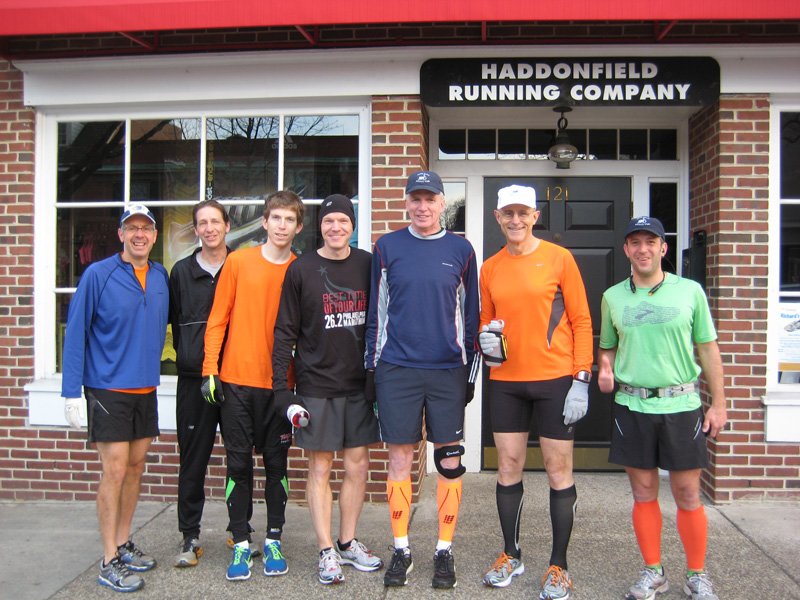
Steve, Dave, Dan Brian, Rich, Frank and Keith, at the start of the Rocky Run.

Steve, Dave, Dan Brian, Rich, Frank and Keith, at the start of the Haddonfield-Rocky Run.

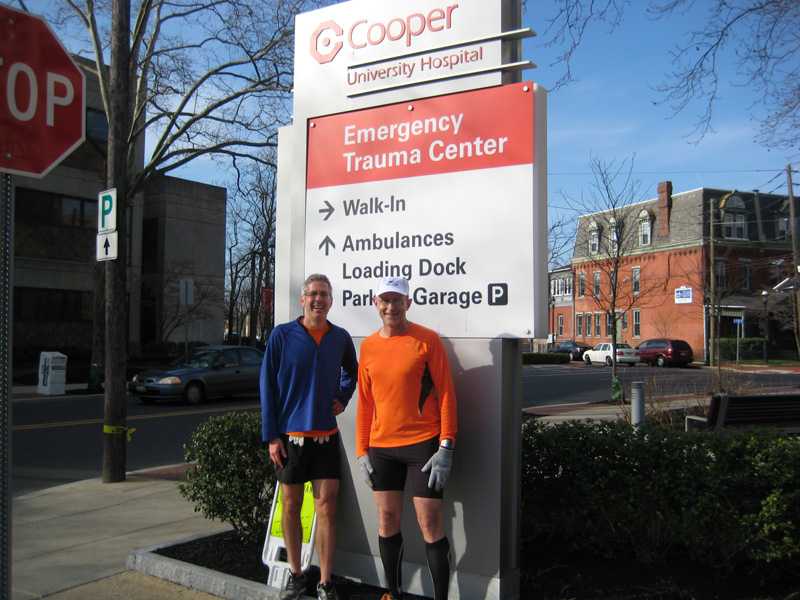
The route started off as our usual Sunday run does, heading west to the Cooper River park.  Then, though, we kept heading west.  Crossing route 130 may have been the most dangerous part of the run.  It’s a busy highway with the crosswalk shut down for construction.  In a marvel of broken field running, we all managed to cross without a single loss of life.  Then, we headed down Admiral Wilson Boulevard.  This road once was home to several notorious stripper bars and hourly rate motels.  When the Republican National Convention came to Philadelphia in 2000, then Governor Christie Whitman had the buildings demolished and the whole area turned into parkland.  While this returned the good name of Admiral Wilson to honor, it also removed sorely needed tax paying businesses from Camden’s base.  We ran down the curvy, paved, path along the Cooper River on one side, and Admiral Wilson Boulevard on the other, towards the City of Camden.  We then headed into the center of Camden, and to Cooper Hospital.  Two of us, Steve and myself, work at Cooper.

Steve and Frank at the entrance drive to Cooper Hospital.

Steve and Frank at the entrance drive to Cooper Hospital.

We had the audacity to run right through the hospital, starting at one entrance, heading through the lobby to our new Pavilion building and out the other entrance, with a quick restroom stop in the middle.  From there, the route went past Rutgers in Camden and on to the Ben Franklin Bridge.

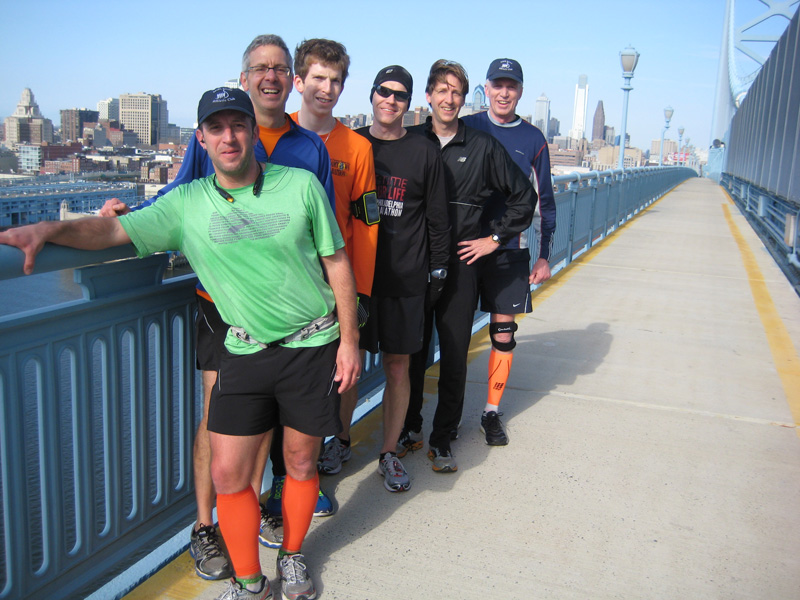
At the high point of the walkway on the south side of the Ben Franklin Bridge, with Philadelphia in the background.

At the high point of the walkway on the south side of the Ben Franklin Bridge, with Philadelphia in the background.

After crossing over the bridge, we headed south down to the Italian Market.  This is where a local shopper tossed an orange to Sylvester Stallone as he ran through the market in an unscripted moment in the first Rocky movie.  The scene was Rocky on his famous run, and was kept in the movie.

Did the orange come from this vegetable market?  Maybe.

Did the orange come from this vegetable market? Maybe.

Alas, there were no fans cheering us on through the streets of what was once called The 9th Street Curb Market.  It is by no means only Italian, although the Italian immigrant presence is strongly felt, in places like D’Angelo Bros.’, purveyors of meats and game, and Lorenzo’s Pizza, my personal favorite for a Philly cheese steak.  There are Chinese, Vietnamese, Korean, and Mexican foods, stores selling every kitchen utensil and appliance one could imagine, and a fine cubbyhole of a shop selling all manner of spices from around the world.  As much as I would have loved hanging out here and visiting my favorite shops, we shot off farther west across Broad Street to 15th.  We then headed north to the Ben Franklin Parkway, and the last stretch of our run.  By this time, the group had splintered a bit.  Steve, Keith and I hit the beginning of the BFP first.

Keith and Frank in front of the Swann fountain in Logan Circle, symbolizing the three major rivers of Philadelphia.

Keith and Frank in front of the Swann fountain in Logan Circle, symbolizing the three major rivers of Philadelphia. The art museum is in the distant background.

From here we shot right down the middle of the Ben Franklin Parkway, and made it to our goal, the steps of the Philadelphia Museum of Art.  This is a hot spot for tourists, and this beautiful Sunday morning was perfect for the run up the steps.  There were several tour buses in front of the museum, and as we approached we could see a couple of hundred enthusiastic visitors vicariously living Rocky’s finishing sprint up the steps.  Rocky collapsed on his first run, but these enthusiastic young people jetted up the steps like they were in a Red Bull commercial.  For us, we were at the end of a long run, but still had a nice adrenaline kick to make it possible to hit every other step on the way to the top.

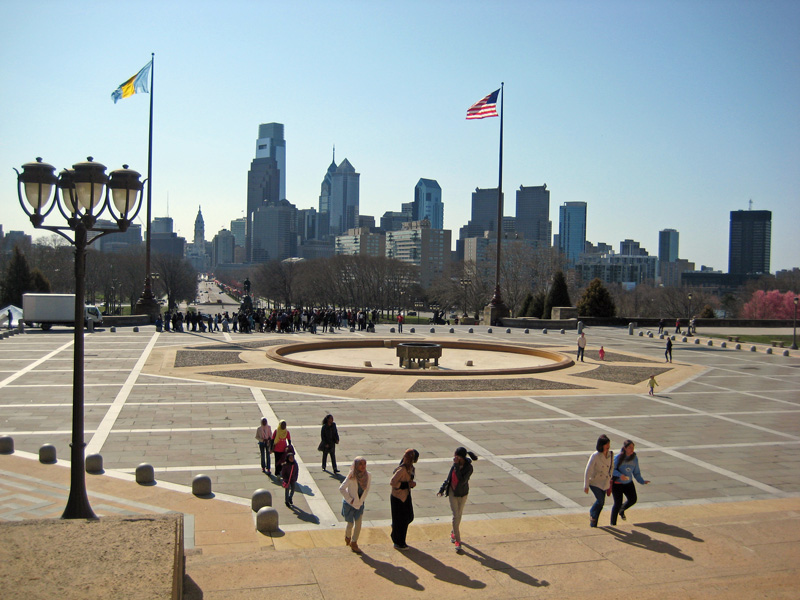
Looking back at Philly from the top of the Art Museum steps.

Looking back at Philly from the top of the uppermost Art Museum steps.

It did seem a little anticlimactic once we had hit the top.  Now what, was my thought.  Partly, the day was so nice that we didn’t have the cold, the heat, the rain or the wind that I thought would make this extra tough.  But then, as I looked around and saw the city, it felt we had accomplished something.

Keith, amidst the columns of the museum entrance, rehydrating.

Keith, amidst the columns of the museum entrance, rehydrating.

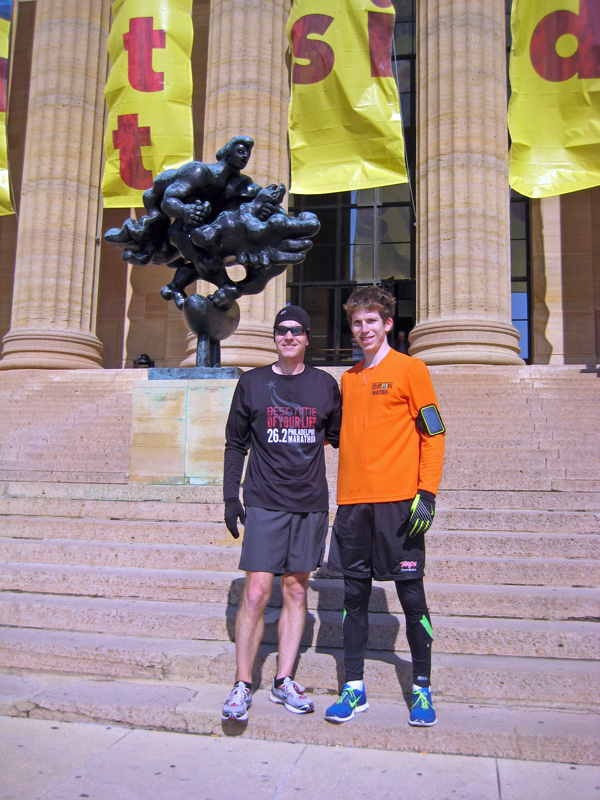
Brothers Brian and Dan on the steps.  The statue behind is Prometheus strangling a Vulture, by Jacques Lipchitz, his take on Hercules taking on the Eagle.  It represents conquering adversity.

Brothers Brian and Dan on the steps. The statue behind them is Prometheus strangling a Vulture, by Jacques Lipchitz, his take on Hercules taking on the Eagle. It represents conquering adversity.

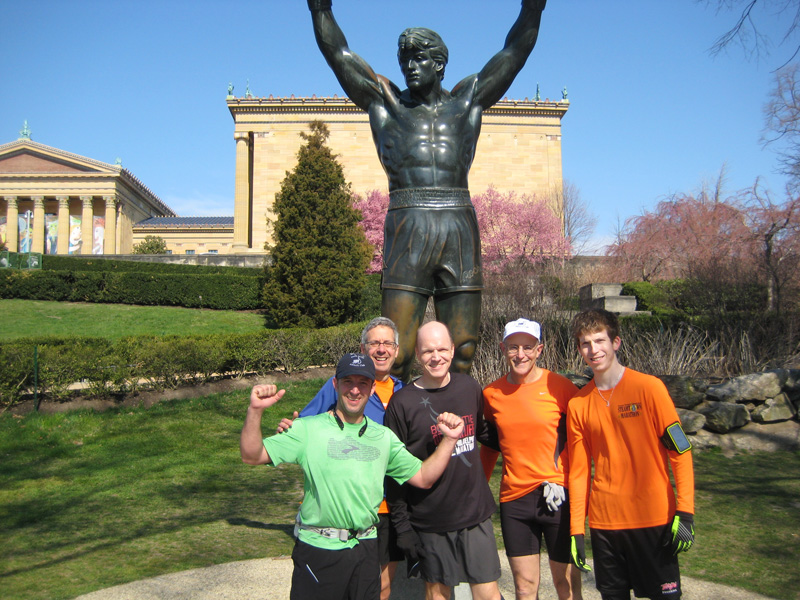
Having reached our goal, we had one more, very necessary task to complete.  We needed a photo with Rocky, the statue, that is.  The statue was commissioned by Sylvester Stallone for Rocky III and initially placed at the top of the “Rocky Steps” in 1982.  But museum folks objected and it was relocated to the Spectrum sports arena.  It was brought back to the museum again in 1990 and 2006, and finally found it’s permanent spot on the grounds outside the museum.  It is one of the most photographed sights in Philadelphia.

Keith, Steve, Brian, Frank and Dan with Rocky.  Dave helped Rich get to the finish a bit behind the rest of us.

Keith, Steve, Brian, Frank and Dan with Rocky. Dave helped Rich get to the finish a bit behind the rest of us.

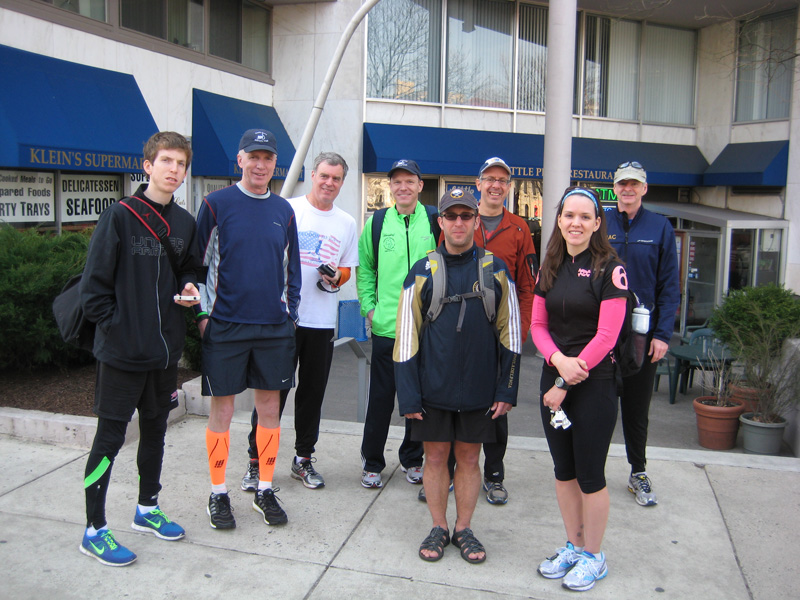
After a good run, what could be better than a good breakfast.  We all headed over to Little Pete’s on Fairmont Avenue, to scarf down some pancakes, eggs, sausage and coffee.  We were joined by a few of the others in the club who had gone cycling this morning or run a shorter distance.  Now, we are planning for Rocky II.

Outside Little Pete's, a fine place for a delicious breakfast.

Outside Little Pete’s, a fine place for a delicious breakfast.

Route of the Haddonfield Rocky Run.

Route of the Haddonfield Rocky Run.

A Winter Trip to Vermont

Sunrise in the Green Mountains

Sunrise in the Green Mountains

Our family took a nice break from work and headed north to Vermont. There are plenty of big, industrial northern cities, in the US, Europe, Russia, and Asia where they deal with cold and snow very well. Take Minneapolis, for example. Subzero temperatures, cold fronts, snow drifts, and frozen lakes and rivers just means you use an electric warmer for your car’s engine block, you have a snow blower, the streets are regularly cleared, and the tough UPS guys still wear shorts, although they wear snow boots. Russians almost don’t know what warm weather is like. Swedes and Norwegians, and particularly Finns act completely nonplussed going about their lives in the cold north. But in Vermont, snow, ice and a long, protracted winter are somehow different, in my mind, probably because I go there to enjoy myself, not to work.

There are more dairy cows per people in Vermont than any other state. So, naturally, milk, cream, butter, cheese and of course, Ben and Jerry’s ice cream taste wonderful. We once visited a dairy farm in northern Vermont in February. The farmer’s son showed us around, taking great pride in pointing out how happy the cows were in the long dairy barn, how clean the milking equipment was, and how equally clean the cows were. And he was quite right. His cows’ milk was used to make Cabot cheese, produced in Cabot, VT, as you might have guessed.  One of the pleasures of visiting Vermont is enjoying the local products such as artisinal cheeses which are hard to get outside the state.  Each year we go to Vermont, we are sure to bring home a gallon of Vermont maple syrup.  Kept in our basement, it lasts for a year, and is very tasty.  It is fun, knowing it came from the trees in the woods where we were staying.

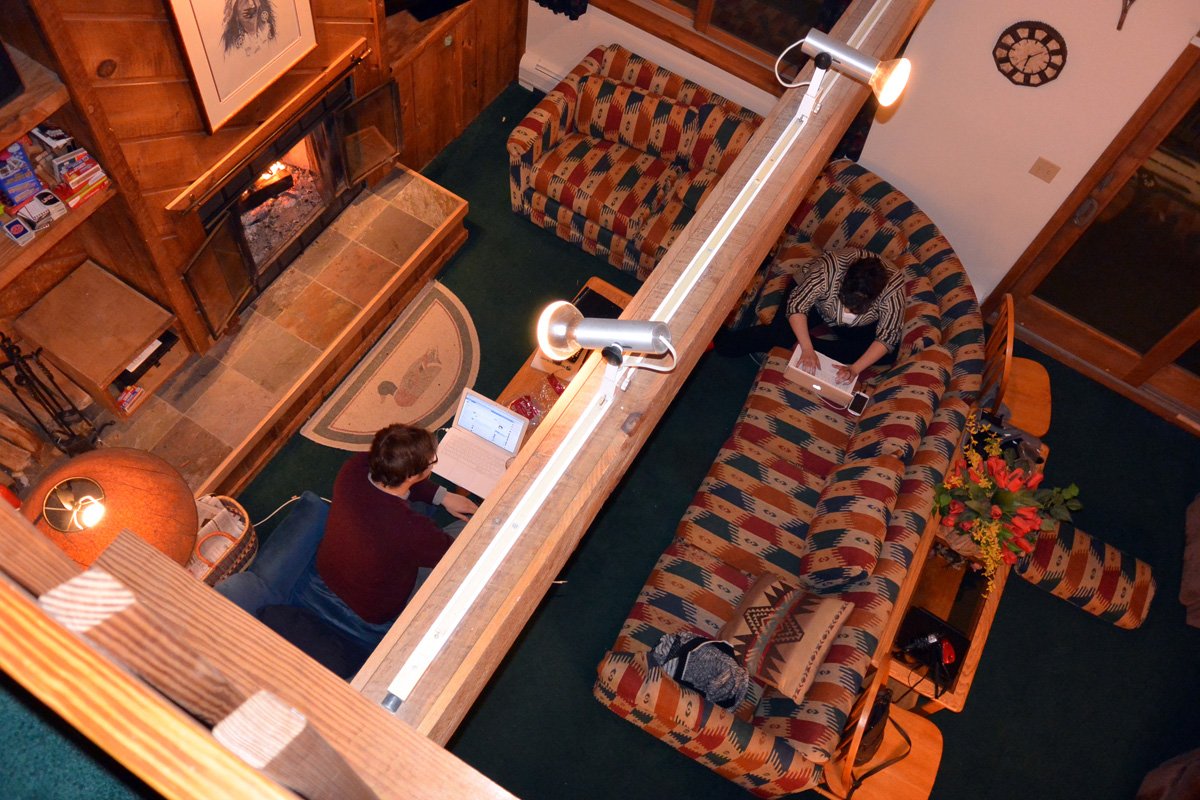
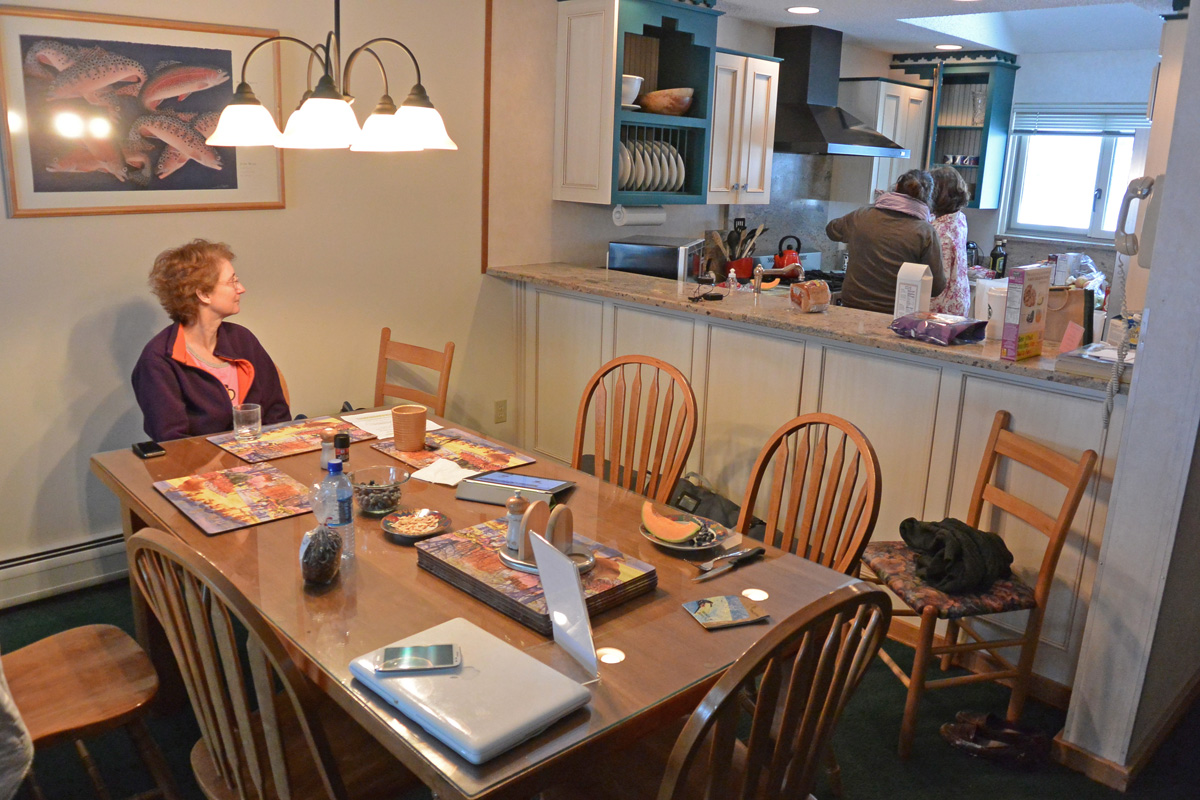
Interior of condo in Okemo.

Warm and comfortable condo high up Okemo Mountain.

We stayed in a lovely four bedroom condo high up Okemo Mountain, along the Sachem Trail. Two of our three grown children, a friend of ours, Lynn, from Philadelphia, and my college friend Keith and his wife Lisa stayed with my wife and me. We made some truly great meals, had some very nice Vermont beers, some excellent wines we brought with us, and thoroughly enjoyed the condo, especially the fireplace.

Eating area and kitchen.

Lynn, who cooked the first dinner, a delicious chicken stew, observes breakfast in the making.

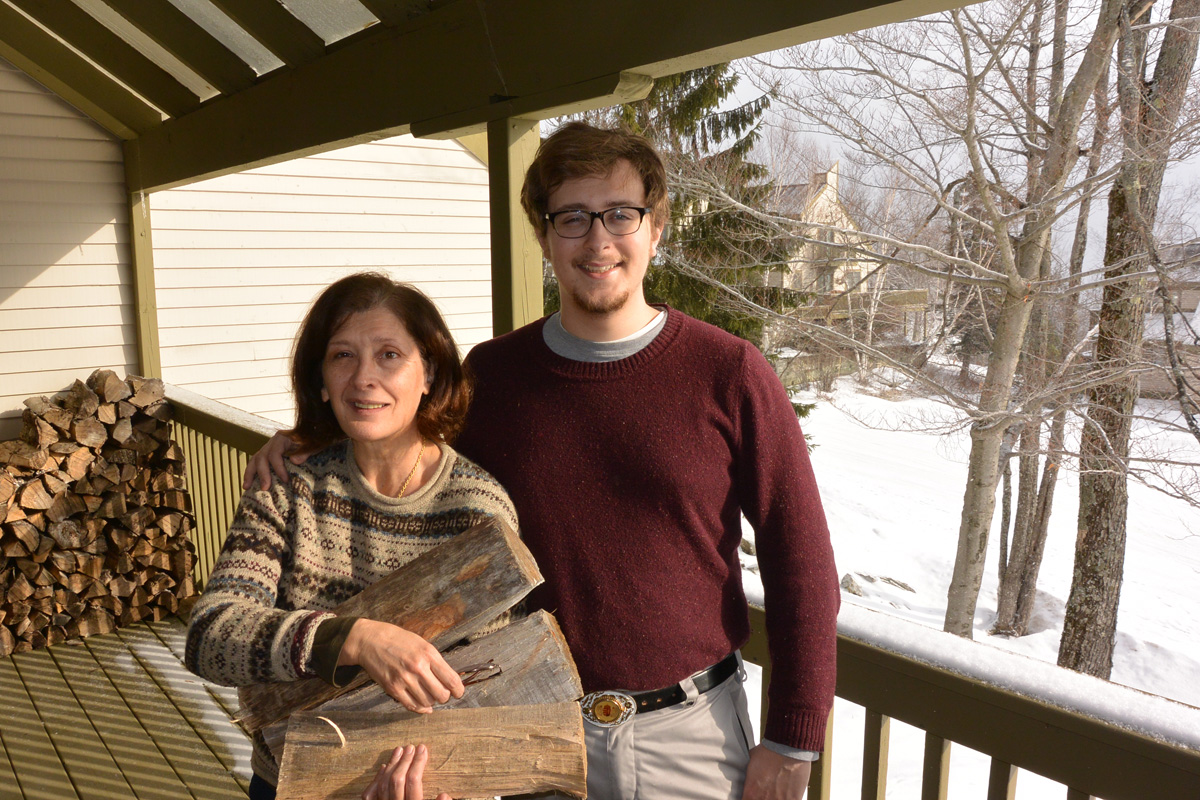
Carrying wood in for the fire.

To be fair, my son did offer to carry the wood. On the other hand, my wife does Brazilian Jiujitsu, so this was her opportunity to get a little lifting in.

This year, fortunately, the snow gods smiled on Vermont, and laid down some real snow. It’s just not the same skiing on the man-made snow, although it will do if necessary. Recognizing that it is not, perhaps, as eco-friendly as one would like, to make snow so skiers can ski on it, the resorts do their best to adhere to ecologically sound practices. Without snow to ski on, the skiers would stay away, which would seriously affect the economy of the communities who rely on the ski resorts for their livelihoods.

Getting out to the ski slopes was very convenient.  We walked about one hundred yards, climbed up a little hill, clipped in and skied.  My kids, Craig and Katie, snowboarded.  While conditions were not the greatest, they were far from the worst, and we were able to get in several days of fine shushing and carving.

At the top of Sachem Trail.

Craig and Katie pose at the top of Sachem trail, were we got on the slopes from our condo.

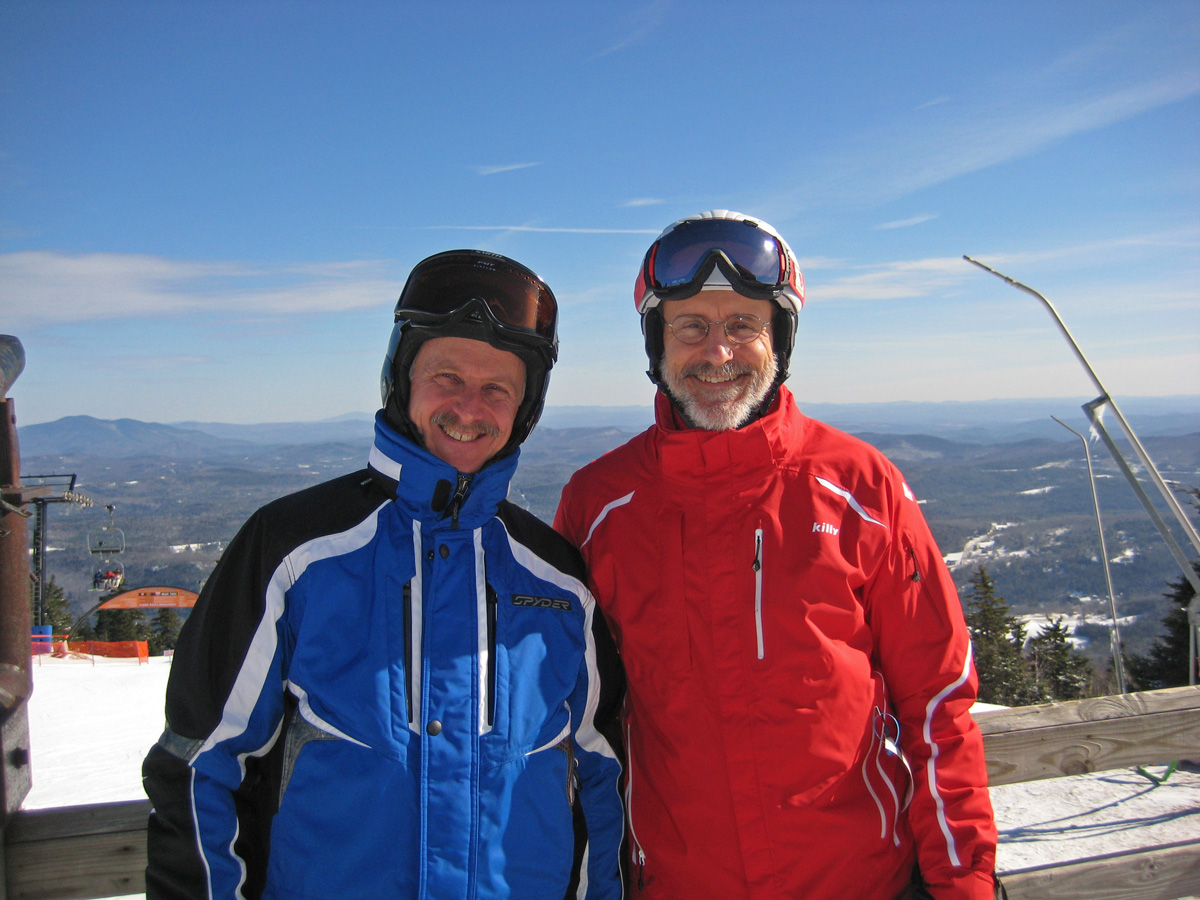
Something that made this trip particularly special was getting to ski with Keith, my friend from college.  Keith introduced me to skiing about forty years ago, when we were at UCSD.  We went on a long bus ride from San Diego, to UCLA to pick up their ski club members, then on to Telluride, Colorado.  It was a memorable trip, not least for being able to learn how to ski.  My one prior experience was a weekend at Heavenly, at Lake Tahoe.  With too few funds to pay for lessons, and not knowing what I was doing, that was a big challenge.  But at Telluride, I was able to pick up some pointers from Keith, and with the fact of being young and able, I managed to learn to ski.  Since then, while never achieving the kind of graceful and skilled skiing of someone who learns as a child, I have become a devoted skier.  Keith and I don’t get to ski together too often, the last time being some time in the 1980’s.

Frank and his friend Keith at Okemo.

Keith and Frank at Okemo, Feb. 2013.

Skiing is an activity that the whole family can enjoy, no matter one’s age.  It is a little tough at first with young children, carrying their skis, supplying them with mittens, scarves and face protectors, and dealing with the frequent wintertime illnesses which always seem to hit the day one leaves for the mountains.  But, once they learn and become more independent, they love it.  Since they are grown, the family ski trip continues to be a way for us to get together and enjoy each others company.  My oldest daughter, away at graduate school, could not join us for this trip, but would have in a flash had her schedule allowed.

At the Waffle Cabin on the slopes at Okemo

Craig, awaiting a bit of sustenance in the form of a Belgian waffle.

Skiing is a way to embrace the cold and snowy days of winter, get outside and revel in it and work up an appetite for good winter food.  The dark comes quickly in the winter in the mountains, and that means gathering around the fire, reading, playing Scrabble, and even playing a little music, with chords and lyrics courtesy of the internet.

Craig and Frank playing guitar

Playing some Velvet Underground, Craig and Frank.  Photo by Katie.

Relating this all to running, I did bring my running shoes, and had planned to get in a run or two in the later afternoon.  What I found, though, was the road to our condo was narrow and icy, so it would have been dangerous to try running along it.  Instead, I just relaxed, knowing I wouldn’t miss a few days running, and just enjoyed being in Vermont.

Wherefore Pasta?

Pasta is known as runners food.  The discovery of the benefits of carbohydrate loading  gave runners the reason to load up on something with a lot of carbs the days before a big race.  What could be better than pasta?  Yes, rice or potatoes could easily fill the role, but pasta is sexy.  It’s delicious.  It’s fun to eat.  Over the last two decades, the benefits of carbohydrate loading have come into question, particularly the traditional method of starving your carbohydrate stores for a few days, then feeding them maximally for three days before a marathon.  This loads up glycogen stores in the muscles and liver, to provide a source of energy for the marathon.

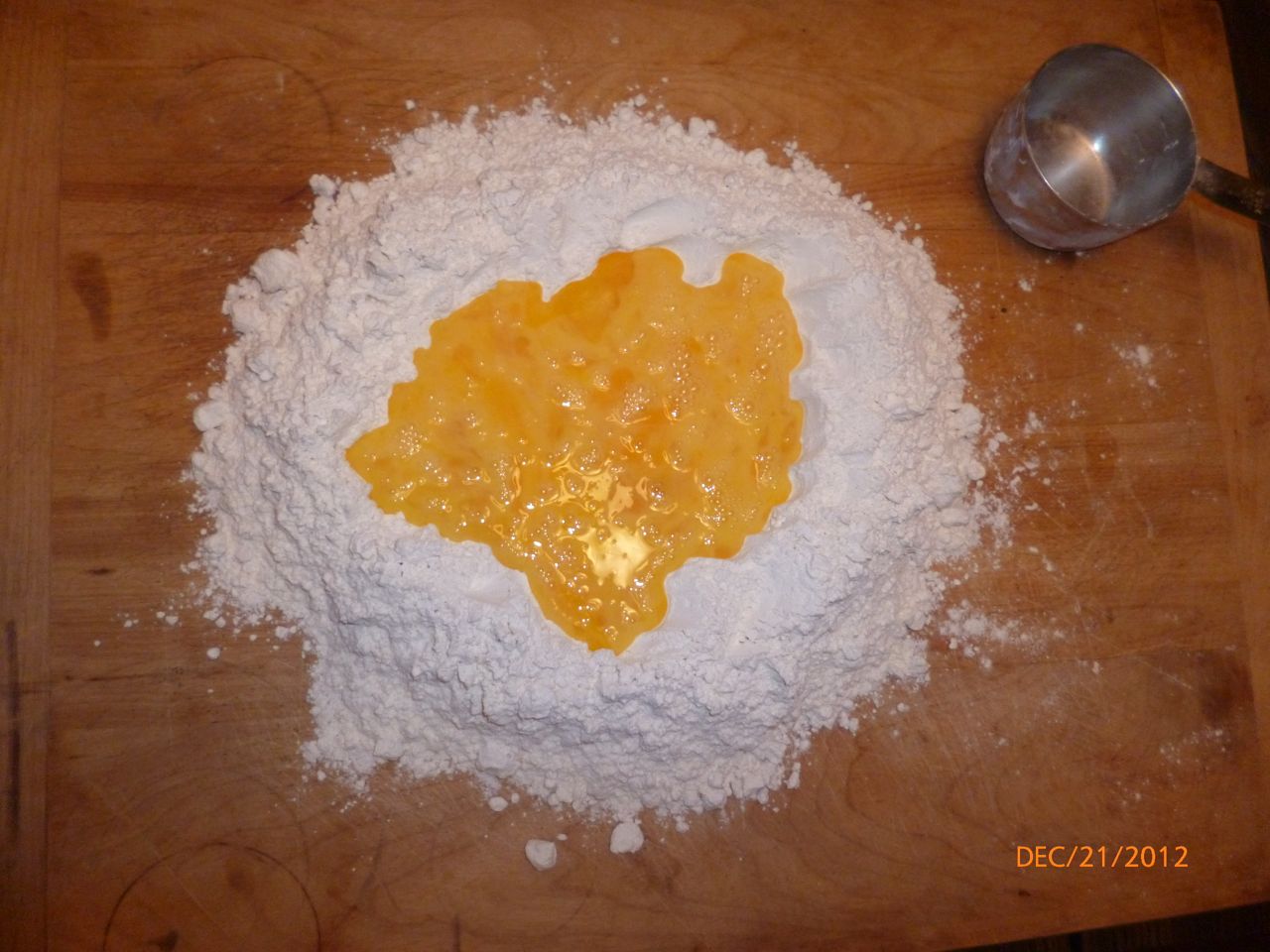
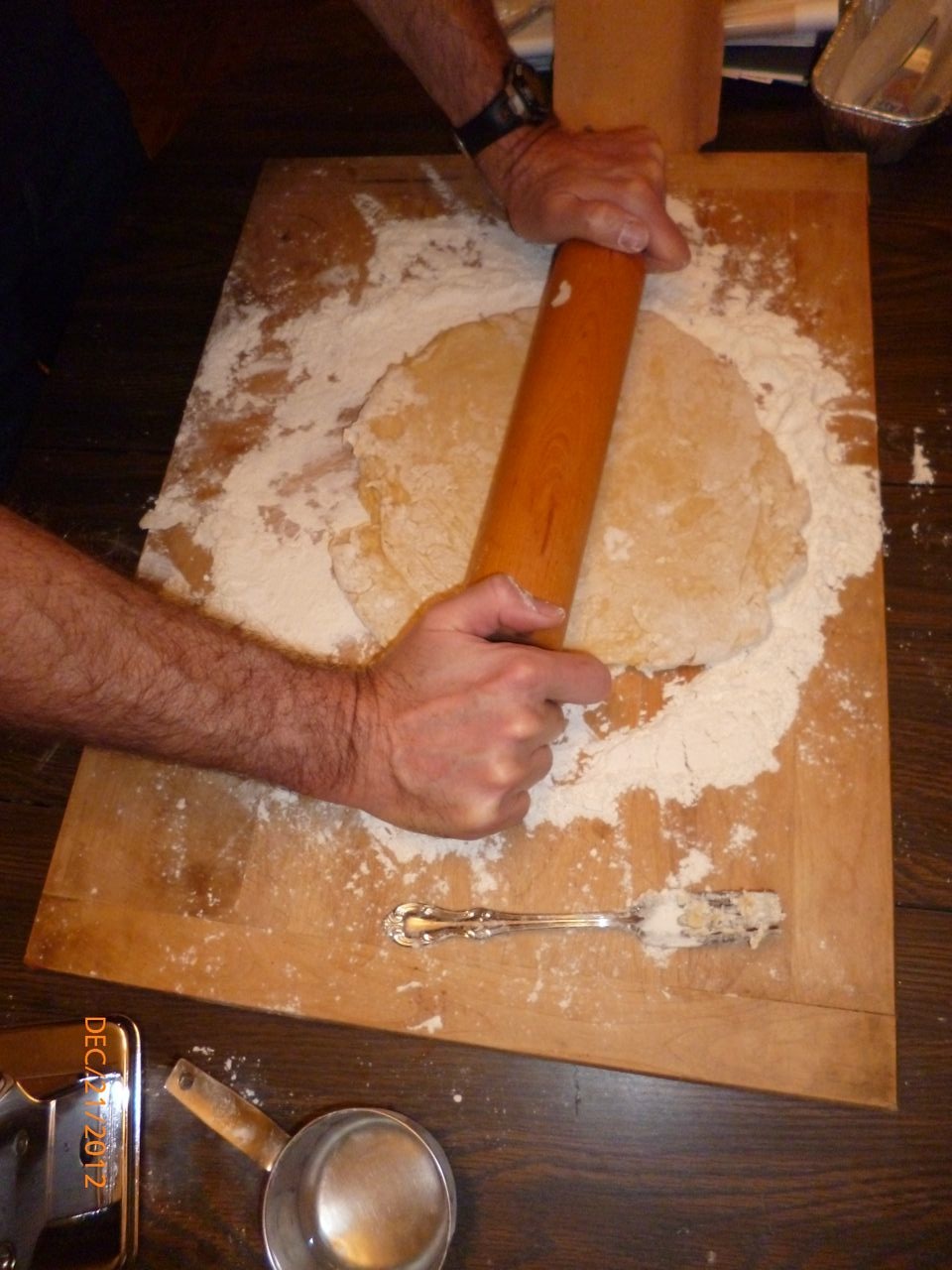
Making pasta is simple, but takes muscles.  It consists of flour with either water or eggs.

Making pasta is simple, but takes muscles. It consists of flour with either water or eggs. Then, blend.

Athletes, ever looking for an edge, were eager to use carbohydrate loading techniques, but were not very happy about starving themselves of carbohydrates for several days during the last week or so before a marathon.  Researchers, seeking ways to keep the benefits of carb loading without the starvation element found it was not as critical to starve the cells as once thought, and that carb loading could still work.

P1000027

The pasta dough is thick and hard to roll. It may need a bit of water to make it workable.

One paper I studied, “Metabolic Factors Limiting Performance in Marathon Runners”, by Benjamin I. Rapoport, published in PLOS Computational Biology, 10/21/2010, examined and explained some very interesting numbers in marathon running.  He gave a formula for calculating the number of calories used in running a marathon, based on one’s weight in kilograms and the distance of the marathon.  The amount of calories consumed is based on the distance run, and is approximately 1kcal per kilogram per kilometer.  This calculation includes the basal metabolic rate and the energy expenditure from running on top of that.  For me, weighing about 81kg, my total calories consumed during a marathon is 1kcal/kg/km x 81kg x 42.195km, or 3418kcal.  He estimates the available energy for muscle activity to be on average, about 1800 kcal in the leg muscles and about 600 kcal in the liver, assuming one has carbohydrate loaded.  So, that is 2400 kcals available but a need of 3400.  He points out if we could use fat as our energy source, we could do five marathons without a problem, since we have plenty of energy stored as fat.  But, the faster we go, and the harder we push, the more our bodies want to use glycogen, i.e., carbohydrates, and less fat.


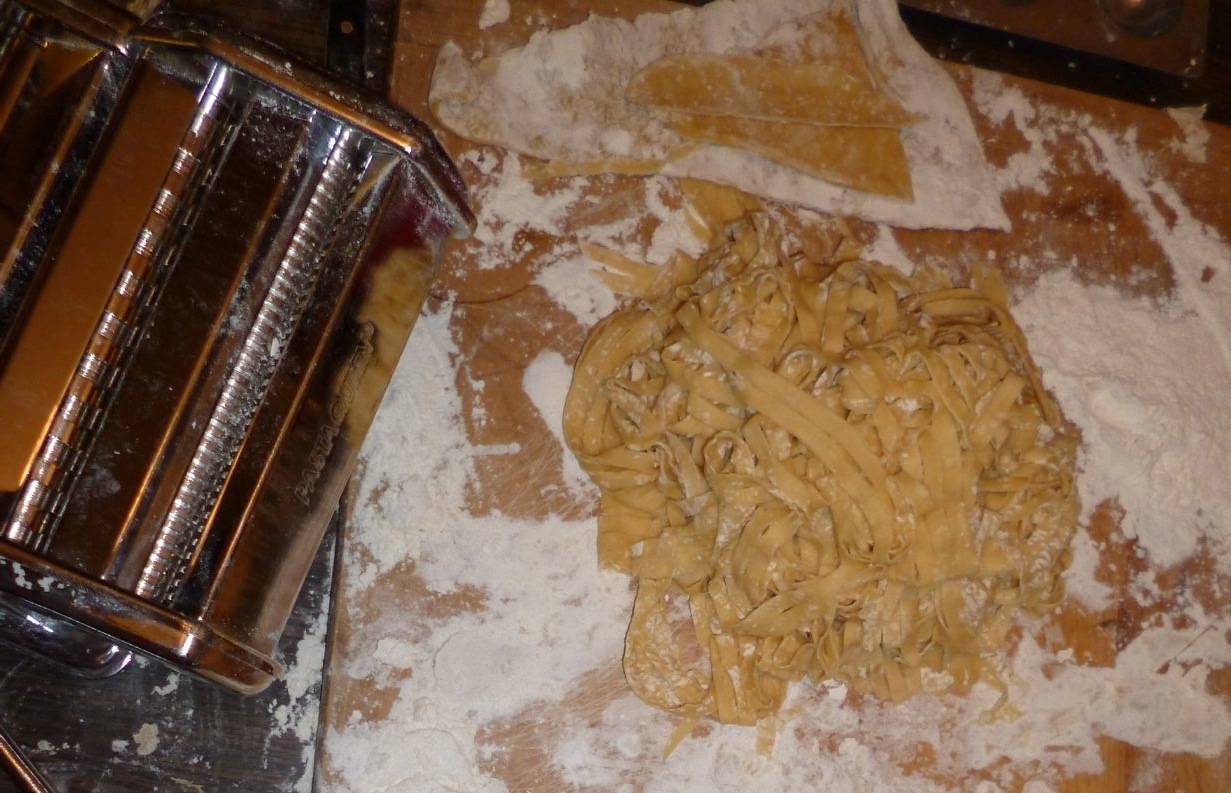
The pasta machine works very well.  It can be used to roll the pasta progressively thinner and thinner, and then cut it for the style desired, in this case, fettuccine.

The pasta machine works very well. It can be used to roll the pasta progressively thinner and thinner, and then cut it for the style desired, in this case, fettuccine.

The article mentioned above makes a strong case for average runners running a marathon to carbohydrate load and to take on extra carbohydrate in the form of easily digestible gel during the race, in order to avoid running out of carbs, and therefore hitting the “wall”.  It attempts to show mathematically how to calculate carbohydrate needs during a marathon, according to body build, conditioning and weight.  It gets very technical, though, and should one be interested in studying it, it can be found here.

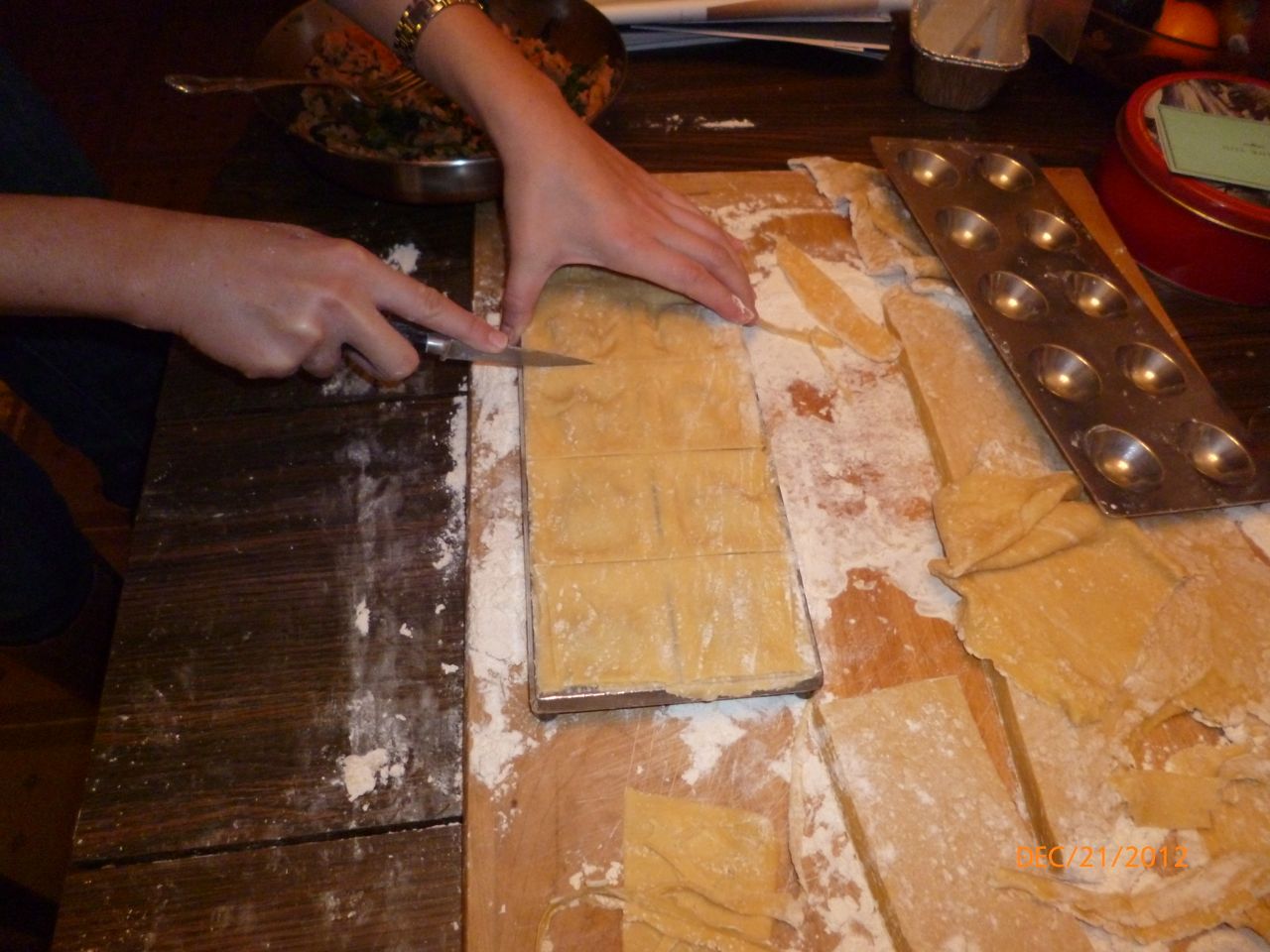
Stamping out ravioli.

Ravioli can be made using a molding form. We took the rolled dough, added a filling of spicy Italian chicken sausage and spinach, and stamped out some delicious ravioli.  Other tools are available for other ways of making ravioli.

I’ve now run seven marathons, and have definitely hit the wall in six.  It is a miserable feeling, when suddenly the legs won’t work, they are in pain, and walking is the only option. I certainly don’t think there is one formula of feeding the muscles that will avoid this.  But, one very helpful point Rapoport makes in his article is that a steady pace, or steady effort, is the most efficient way to run a marathon, and that working harder at the beginning, or pushing harder up hills, is counterproductive.

Raw Fettuccine

Fresh, raw fettuccine, ready to drop into boiling water. It cooks very quickly when it is fresh.

In the past, I had my doubts about carbohydrate loading and how and whether to do it.  Most of my running partners know about it, but don’t really know how it is applied.  From what I’ve read, it still makes sense to deprive the muscles of carbohydrates before the three day loading, but this step is not as critical to the overall effect as once thought.  Also, current research suggests that a single short, intense effort the day before a marathon, followed by a high carbohydrate meal, can be almost as effective as the longer plans.  Generally, though, a low carbohydrate meal means about 10% of calories in the form of carbohydrates, and a high carbohydrate meal contains 70%-90% carbohydrates.  Note that the number of calories does not increase.

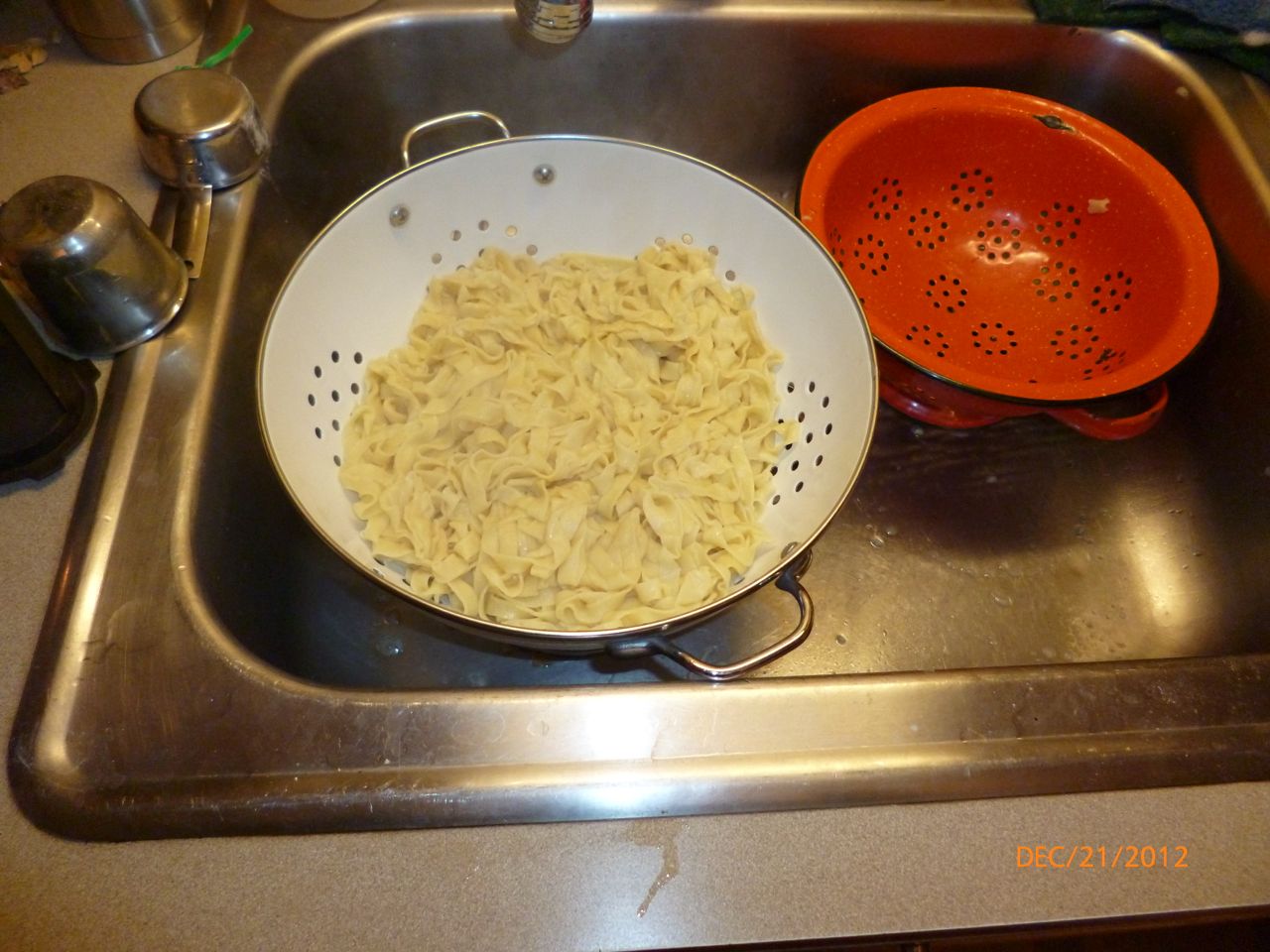
Cooked ravioli.

Ravioli cooked and ready to eat. A little olive oil and parmigiano, or some simple tomato sauce goes well with this.

Also, if one takes on carbs in the form of gels or glucose-containing sports drink during a race, it makes up for a lack of carbohydrate loading.  Important here is that sufficient glucose is consumed, and able to get into the blood stream, to make a difference to the muscles.  Given that runners may not consume enough during a race, or their systems won’t allow digestion while running, it certainly is a good idea to maximize muscle glycogen before the race.

Cooked fettuccine

Fettuccine, cooked and ready to eat. We made a sauce of chopped tomatoes, onions, peppers, mushrooms, tomato paste and spices which tasted great.

Matt Fitzgerald wrote a very nice, short description of carbohydrate loading for Active.com, “The Evolving Art of Carbo-Loading”.  I will be carbohydrate loading for my next marathon, and will write about the experience.  Meanwhile, I intend to revisit pasta making, as it was a lot of fun, tasted great, and was a very nice way to share an experience with my daughter, Audrey, who did at least half the work.

Frank

On a Saturday in January

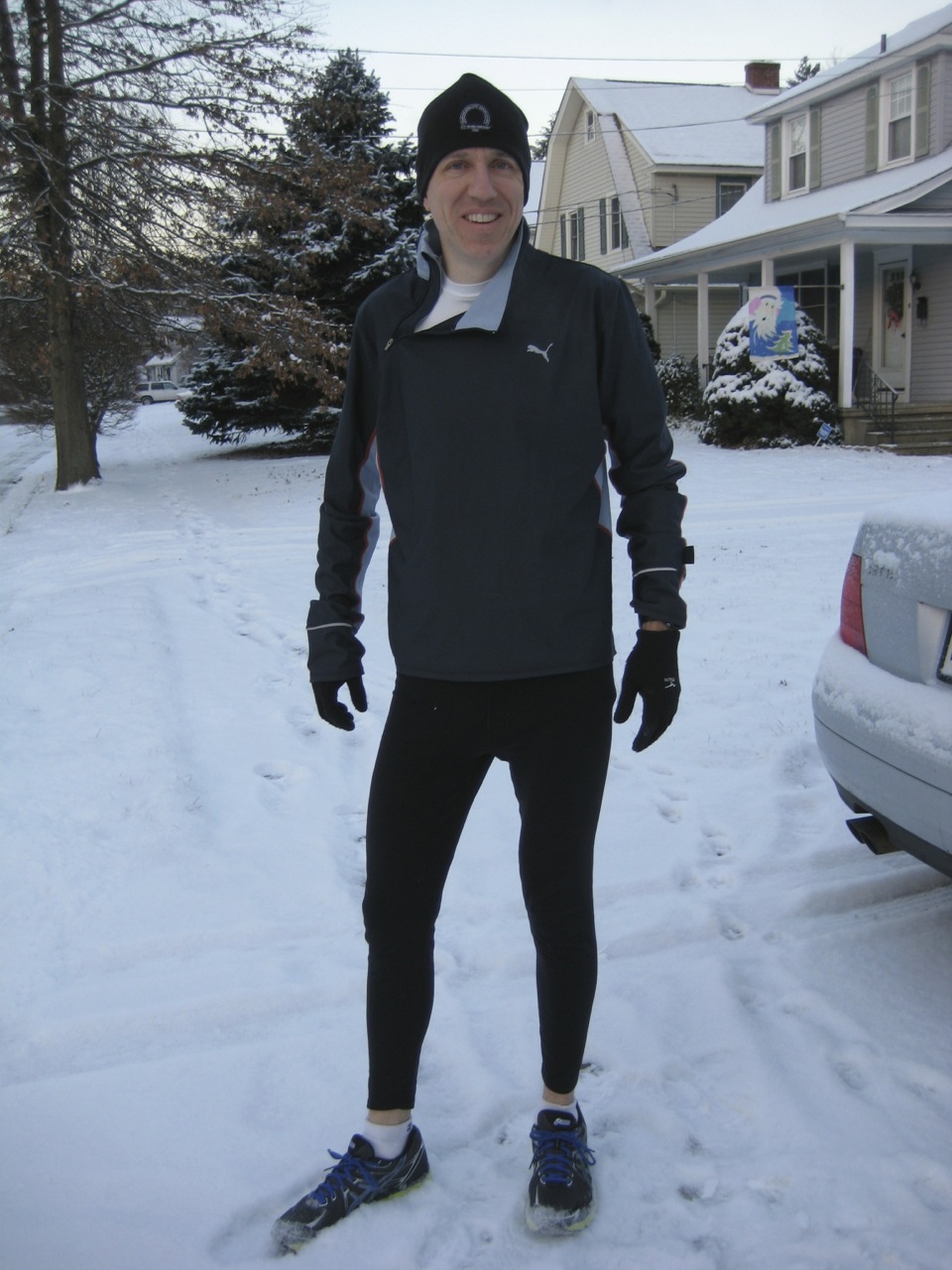
Yesterday started out as a cold, slightly breezy morning.  After waking early enough for a bowl of cereal, Special K Cinnamon Pecan if you must know (a crunchy mix of rice and wheat flakes, sprinkled with cinnamon and pecans), and a cup of coffee (Starbucks, Italian Roast), I dressed for a morning run.  The first challenge on a cold morning such as this is to convince yourself to leave that warm comfortable bed, knowing you will be facing sub-freezing temperatures.  The second challenge is to pick the right combination of layers so you are warm enough at the start, but not overheated after the first mile.  Donning long tights, an undershirt I usually use for cycling, a long-sleeve thickly woven running top, a knit cap, and cheap knit gloves, I headed out the back door.

About sixteen degrees, a bit of snow on the leaves.

About sixteen degrees, a bit of snow on the leaves.

Checking the thermometer, I saw it was about 16 degrees, but the sun was starting to rise, and with it the temperature.  I pulled my backpack over my shoulders and headed out for my run, the pack carrying clothing for a change once the run was over.  I did a nice warmup 2 mile run to my friend Brandon’s house.  It was still quite cold, though, and my fingers, the parts I could feel, were stinging inside my gloves.  But, the rest of me felt comfortable.  Only an inch or two of snow had fallen the night before, and it was light enough that a few folks were out early sweeping it off their sidewalks with a broom rather than shoveling.  The street was patchy with spots of snow and ice, but mostly clear.

Meeting up with Brandon, I could see he had the same idea about dressing.  Don’t dress too heavy, since one will warm up and start to sweat no matter how cold.  I dropped my backpack in his living room.

Brandon, ready to run our usual Saturday loop.

Brandon, ready to run our usual Saturday loop.

We started our run, heading down to the Cooper River, for a loop around the park.  The breeze was still in our faces, and it did sting, but as we got into the run, we warmed up.  Sharing our own news of the week, discussing philosophical issues, talking about current events, with the occasional mention of beer, we proceeded around the park, staying on the road rather than the path, which was snow covered.

The Cooper Yacht Club, with the snow covered boats overlooking a snow covered frozen river.

The Cooper Yacht Club, with the snow covered boats overlooking a snow covered frozen river.

The sun still hadn’t quite made it over the trees yet, so we were still running in the shadows, but the air felt crisp and clean.  I thought about the reports of the thick smog in Beijing, glad we could run where the air is clean.

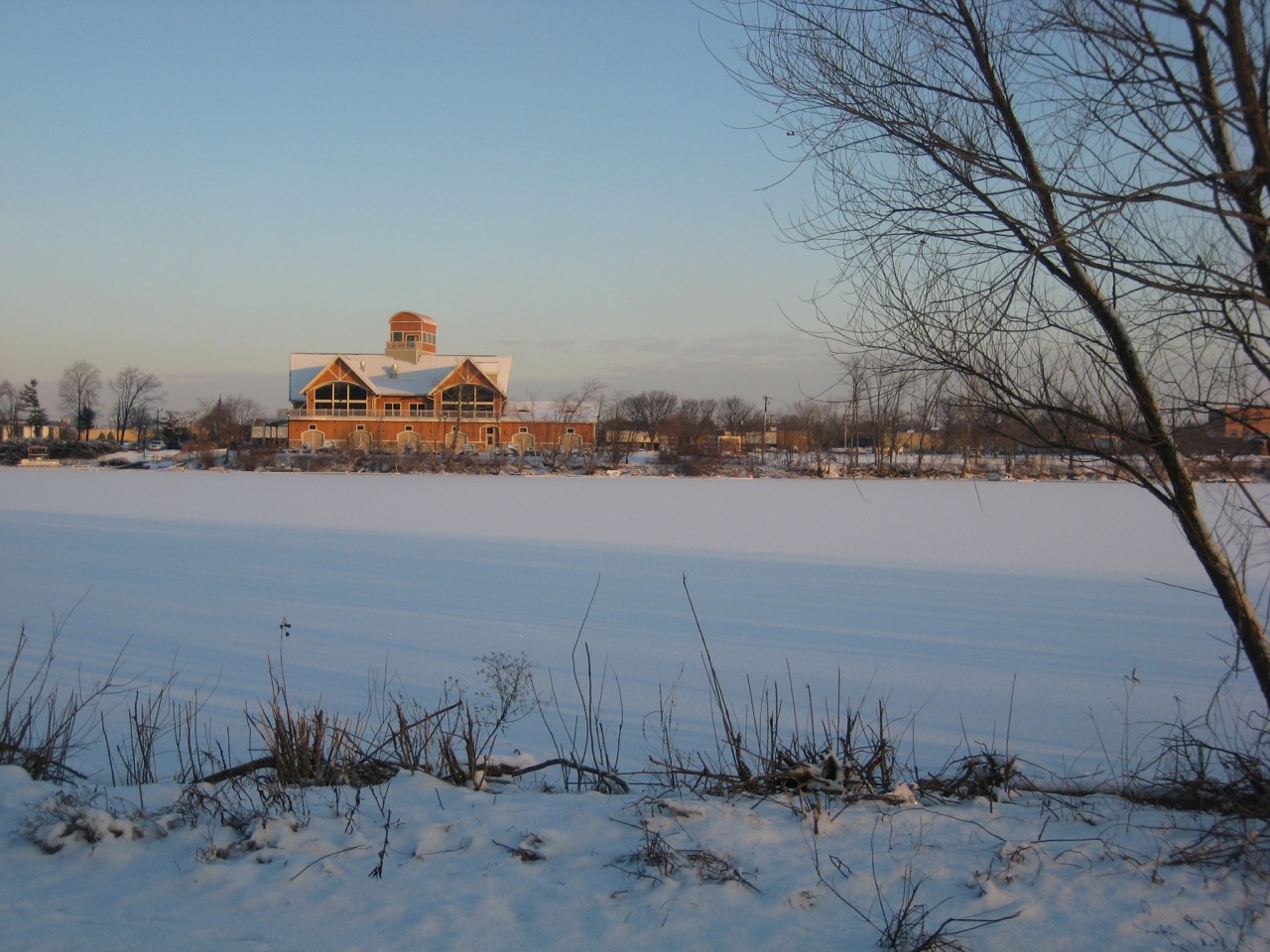
Cooper River Boat House on a snowy January morning.

Cooper River Boat House on a snowy January morning.

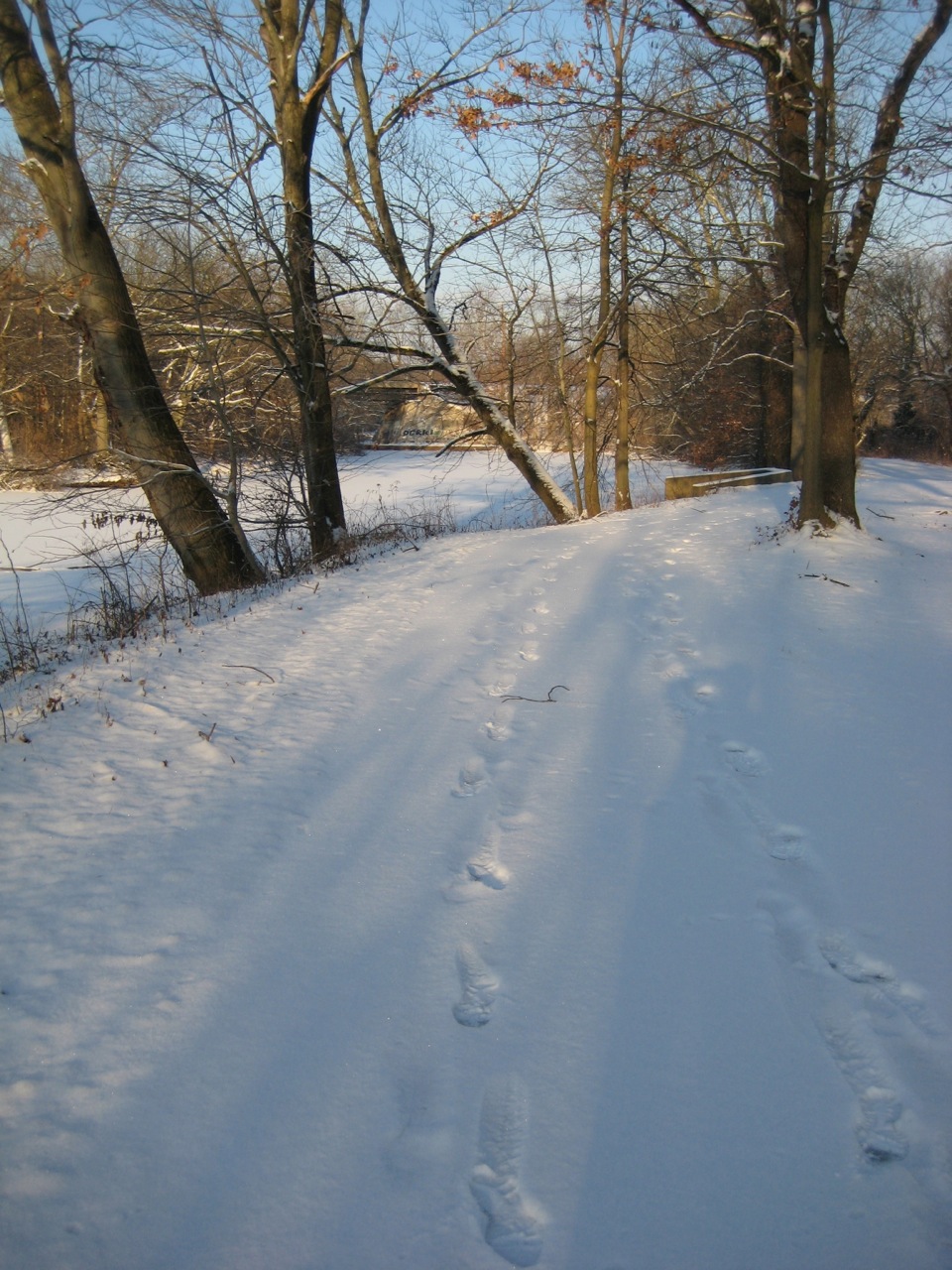
Across the Cooper River, frozen, and with a layer of snow atop the ice, the Cooper River Boat House stood out, with no rowers planning a workout on the river today.  The rowing machines indoors will, no doubt, get used this day.  We continued our run around the river, over the newly constructed pedestrian bridge along Route 130, to the other side.  We’ve heard this bridge is temporary, but the consensus is we, being the runners who use it, rather like it and hope it achieves permanent status.  Farther down the run, we got into a trail in the woods.  We seem to have been the first to come this way this morning, judging by our tracks.

Tracks in the woods on a snowy day.

Tracks in the woods on a snowy day.

The geese, whose original home as I understand it is Canada, but who have made a permanent home of South Jersey, were closely gathered in the remaining unfrozen water, jostling for position and making a racket.

Geese in the remaining unfrozen water.

Geese in the remaining unfrozen water.

The last part of the run heads back up a hill to the streets of Brandon’s neighborhood.  The sun had finally come out.  My glasses had taken on their usual fog, my hat was moist with sweat, and it was a good run of seven miles.  We headed indoors for a cup of tea (Taylor’s of Harrowgate, breakfast tea).

Frank

Uncorking Croatia

The Blog of WINES OF CROATIA

RunnersOnTheGo.com

To help enrich the lives of others, we developed RunnersOnTheGo.com to help runners save money on races, running stores, and much more. We also provide the specific local information that makes your travel for business, vacation, or racing as rewarding as possible.

getsetandgo

Travel Blog of a Budget Traveler sharing stories on travel, books & Vegetarian Food

Marc Hemingway

Trying to keep track of my life (and my life on track)

Mid-Life, Mid-Level, Masters Running

Exploring ideas about running to contribute to a more enjoyable pursuit for the mid-level masters runner

therunningtherapist

"One foot in front of the other and one thought at a time"

WordPress.com News

The latest news on WordPress.com and the WordPress community.

retireediary

The Diary of a Retiree