Rudolph’s Red Nose Ale, the tasting

For those of you following my blog, you may be aware I put together a Christmas Ale I named “Rudolph’s Red Nose Ale“.  This was a play on words, since I designed it to be a Christmas spiced ale, but with a red tint and styled after Belgian Christmas ales.  It’s not a typical Belgian Red Ale, in that it is not aged in wood, and so doesn’t have the sour characteristic of that style, but it comes fairly close.  The red color comes from a certain type of “crystal” malt, Caramel 80, which gives the beer a slightly sweet flavor and brick red color.  The Belgian Abbey yeast was used to give it a fruity flavor, not too pronounced, but not requiring the actual addition of fruit.  The hops were meant to be in the background, providing bitterness and a bit of aromatic hop flavor, but this is a malty brew and so not meant to taste hoppy like an IPA.  So starting from this:

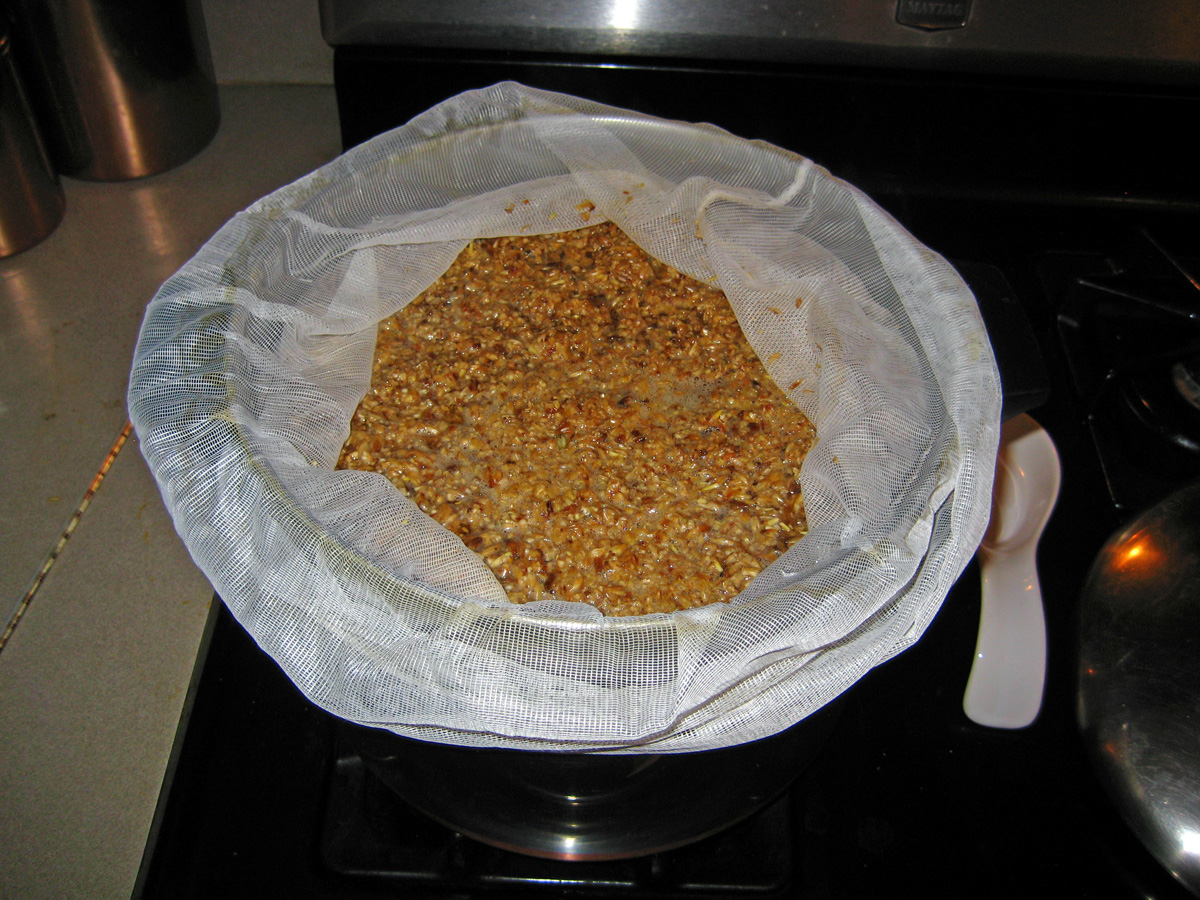
IMG_1836a

Partial Mash for Rudolph’s Red Nose Ale

We made it to this:

A Bottle of Rudolph's Red Nose Ale

A Bottle of Rudolph’s Red Nose Ale

The label was cleverly created by my daughter Katie, who seems to have a knack for design.

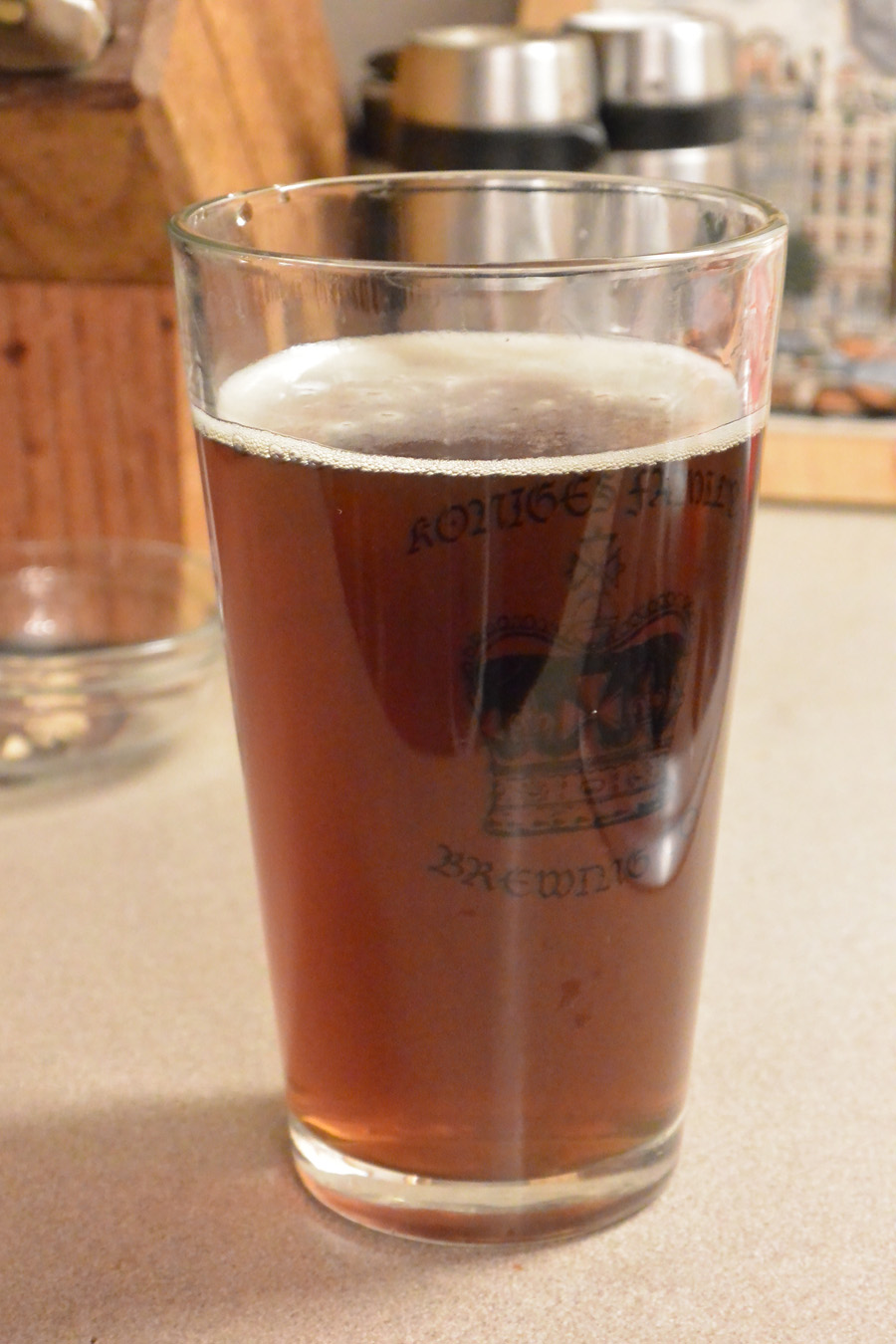
In the glass:

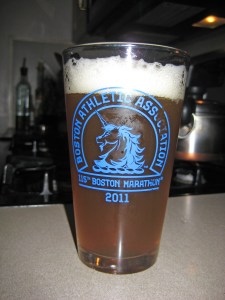
Glass of Rudolph's Red Nose Ale

Glass of Rudolph’s Red Nose Ale

The pour was very nice, a bit underwhelming for the head, which was thinner than I was expecting.  The final alcohol content was 7.35 % ABV, which is around where I was shooting, and appropriate for a Christmas Ale meant to dull the abrasive edges of family get-togethers.  It has a nice slightly fruity and slightly sweet taste, and the spices are also there but in the background.  Reading further, I could have added spices to the secondary fermentation to make them more pronounced, but alas, didn’t think of this or know I could until after it was already bottled.  It’s part of the learning process.  I like the way the reddish hue comes through.

It got a true test on New Year’s Eve.  A group of about fifteen from my running club went for a late afternoon run, then gathered at my house for a pre-New Year’s Eve celebration.  We had a real fire going in the fireplace, and a warm spinach and feta dip accompanied by thin slices of crusty french bread.  There were clementine oranges and some Manchego cheese.  Many of the gathered runners sampled the Rudolph’s, and reports from this discerning crowd were very favorable.

So now I have a great brew to keep me warm the next couple of months, while I come up with a recipe for a spring beer.

Frank

Resolutions versus Goals

Yes, 2013 has arrived, the ball in Times Square with a crystal remembrance of Dick Clark has dropped, and now what?  Did something change?  Have we arrived in a new time and place?  Not from what I’ve been reading in the press, and yes, I am one of those who still reads a newspaper.  I admit to reading a lot of it online, but still get the old fashioned paper delivered to my house.  Today, that feels like such an anachronism.  So, perhaps that is something that has changed.  From what I have read and listened to on TV, and also read in blogs, the latest message for the new year is that “I don’t make resolutions, I make goals”.  TV personalities have stated this as if they made up the phrase, although it has been everywhere of late.  What is the difference, and can one, or should one, have both?

From reading about the history of resolutions, it appears the first record of this practice was from the Babylonians, who celebrated the start of the new year around the time of the vernal equinox.  They had an eleven day celebration, and promised to return borrowed goods and repay debts.  The Romans moved the celebration of the new year to January 1, which was to honor the god Janus, whose two faces looked backwards and forwards and symbolized remembering the past but looking forward to the future.  Over time, resolutions have taken on religious and personal health themes, betterment of mankind and other noble features, but generally are intended to make things better in the new year, an erasing of the errors of the past.  A resolution starts at the time it is made.  We all know the most common resolutions.  Lose weight, go to the gym regularly, stop smoking, cut back on drinking, have better study habits, be more attentive to others, learn a new language, laugh more, stress less, attend church regularly, and one which is almost always successful, stop making resolutions.

It is well known that resolutions frequently are not kept.  This is  where goals come in to play.  Goals go hand in hand with resolutions.  If your resolution is to lose weight, set simple, attainable goals which can be kept.  For example: ” I resolve to lose weight, and I will lose one pound in two weeks”.  There!  Not too hard, but not insignificant.  Then you can build on your successes as they come.  Didn’t make your goal?  Not to fear, reset it and keep going.  If you made your goal, picture it going forward for twelve more weeks.  At a pound every two weeks, that amounts to six pounds.

But keeping resolutions is so difficult because we like the ruts we fall into.  The comfort of an extra helping of mac and cheese.  The calming effect of the draw on the cigarette.  The buzz from the second beer.  It takes, yes, resolve, to keep a resolution.

While the recidivism rate for new year’s resolutions is spectacularly high, it is definitely worth trying.  Otherwise, we wind up living exactly the same life year after year.  The calendar may as well have only months, no years listed.  How do we increase the chance that we will keep our resolutions?  One way is to inform your family or close friends of your resolution.  Then, you know they will be watching to see if you meant what you said.  This can backfire, though, if you didn’t really mean what you said, it just sounded good, and now your family is harping on you to put down the Xbox controller and go out for a jog.  Another method is to share a resolution with a group.  The group dynamic can work very well since everyone is working towards the same goals.  For something like learning a new language, this might mean joining a group lesson.  Even if you are the worst student in the group, you are going to learn something.

This leads nicely into running, and why it is good to join a running club.  It certainly is easy to go out and run by yourself.  It takes little in the way of equipment, you can set your time to run whenever you wish, and you are not beholden to someone else’s pace, schedule, or tendency to argue politics while running.  But a running club gives much more than it takes.  First, you are able to meet like-minded people with very similar goals in mind.  You will be introduced to activities you may not have thought you could do, such as running a half marathon, or doing a trail run.  Runners in my club are generally quite upbeat individuals with lots of personal goals in mind.  Once you feel part of the group, which really only takes being willing to show up, you will get a lot of encouragement from the other runners who will smile on your successes and share their own stories of setbacks.  You will have access to meetings where training plans are shared and speakers come to talk about coaching, stretching, yoga, racing experiences, avoiding injuries, and other topics.  You may find yourself taking on more challenging goals as you meet the first few easier ones, which will lead to other resolutions being met, such as weight loss, getting fit, and lessening the stress in your life.  You are not likely to learn a foreign language or attend church more regularly, if those are your resolutions, so those will need to be addressed in another forum.

I feel making resolutions is a good thing, and setting goals makes resolutions happen.  If one is not successful at keeping a resolution, here’s a tip:  many cultures around the world celebrate the new year at different times than January 1.  So, there are plenty of opportunities to re-declare resolutions throughout the year.  My personal resolutions I am willing to share with my close friends reading this blog.  I would like to eat more nutritiously, primarily by making meals from scratch rather than buying anything pre-processed, with the exception of Greek yogurt, which I think is pretty healthy.  I already started, by making pasta from scratch with my daughter the week after Christmas.  It was fun, was a bit of hard work, but tasted great.  I also resolve to read the books piling up on my bedside table, most of which I’ve started but not gotten very far into.  And finally, in the tradition of the Babylonians, I’m going to return books I borrowed from a friend about a year ago and are still on my shelf.

Frank

Chasing Reindeer

December is a hectic time of the year.  The sudden realization of how many days left before Christmas makes us a desperate lot, and then there’s all the great traditions of the season which must be carried out.  One, the annual hauling up out of the basement of the lights, ornaments, tree stand, fake garlands of spruce and pine, the statue of Father Christmas looking resplendent in fur collar and slightly scraggly white beard, sleigh bells to hang on the front door, and the stockings to hang over the fireplace.  I always seem to miss the mild days of opportunity to hang the lights outside, and wind up trying to get my hands to work on a cold, windy day, dangling dangerously under the eave of the porch to string the icicle lights.  First is the challenge of untangling the strings, which I was sure I put away last year in an orderly coil, but somehow, I suppose due to their boredom in the basement, become intricately woven together in a free=form, almost spiteful, version of macrame.  Having laid them out, finally, on the porch, tested them to be sure I have a live string, I pick out the working strands to hang.  Of course, I’ll spend thirty minutes with a strand that won’t work, trying to figure out which of the one thousand bulbs is out and needs replacing, only to fail completely, throw out that strand, and move on.  The “icicles” of the new replacement strand, fresh out of the box, are contracted up and won’t hang down naturally no matter how much I tug on them.  Hmmm…., anyway, I proceed to get them up on last years’ nails, starting at one side of the porch and making my way around the perimeter.  Then, there’s the moment I bring them to life, ala Chevy Chase in Christmas Vacation, with a little drum roll in my head, as I plug in the extension cord.  Yes!, I say to myself, they’re all working!  Not to last, though, as sure as reindeer can fly, one or more of those strands will fail, creating a dark space in the icicle light line up, giving the house a certain trailer park chic appeal.  Of special note, this year my son and daughter did the work, and somehow, they managed to get the lights up and working better than I’ve ever  been able.

The next major task involves finding a tree.  We can usually find a tree to our liking at any one of many spots selling them in our area.  We like  a nice, full spruce, tall to look proportional in our old house with the high ceilings.  I am amazed at how that tree can be forced through the chute with branches held in by the web of plastic around it, but it makes for easy transport.  We prepare a space for the tree in our parlor, rearranging the furniture to allow for this gargantuan icon of the season.  Getting it up in it’s stand is a bit of difficulty, although not too hard.  We then cut open the binding web and watch as the branches unfurl.  Hopefully, we’ve given adequate space to those branches, and they don’t take out any eyes or things hanging on the wall.  My wife is particularly good at taking out branches and trimming up the edges, to make it look just right without having been obviously altered.  If I were to try that, I know it would come out looking like a victim.  Putting up the lights and ornaments is certainly one of the most pleasurable things to do, although it doesn’t hurt to have some Christmas music playing and a steady flow of beer or enhanced eggnog to allow us to appreciate the moment.

Our gift buying is a combination of guesswork and direct grilling of the subject to see what we should wrap and put under the tree.  I’ve certainly turned to more on-line buying these last few years.  Nothing satisfies me more than to be able to avoid the mall parking lot.  I had the opportunity to visit a high-end purveyor of home goods a week ago, in Philadelphia, to return an unfortunate on-line purchase.  I thought I was getting a steal, paying $40 for a coffee maker of good name, good pedigree.  It turned out it made weak coffee much less flavorful than our old, ugly Mr. Coffee, so I took it to the “bricks and mortar” store to return it.  The store was filled with high-end Christmas shoppers, examining carefully a $35 set of ice tongs, or listening to a slick presentation of why they really need to spend upwards of $1200 to get that perfect cup of coffee Christmas morning.  No wonder my purchase was so incredibly wrong.  I misplaced the decimal point by two positions.  Regardless, and without shame, I brought that machine to the counter asked to return it.  “Had it been used?” the woman behind the counter asked.  “Yes, that’s how I know it makes bad coffee,” I replied.  With a dour look, and without even asking if everything was in the box, she took it back and gave me a refund.  I suspect it is going in the trash, as it can’t possibly be worthy of repackaging.  My favorite real shopping experience at Christmas time, though, is visiting Barnes and Noble.  It’s busy, but not so busy one can’t move about in the store, see what the new novels and biographies look like, pick up a real book and thumb through it, get a few laughs in the humor section, examine the games and puzzles, and look through the calendars.  I went yesterday, and was quite pleased to not only find the books I was looking for, but to have had an uplifting time doing so.

Another tradition is the annual office gift carousel.  I always give my secretary a nice, large spiral cut ham.  While this may seem a throwback to some industrial age era of Dickensian mindset, I see it as a true thank you for all she’s done for me this year.  She has my back, so to speak, and anticipates my daily struggles.  She fends off attacks from the flanks and calms worried callers.  There are a thousand things she does to make my life better, and I’d like her and her family to have a nice, tasty meal to show for it.  Perhaps originating with the writer Dorothy Parker, the definition of eternity is two people and a ham.  So that’s the best part of office gift giving.  We also give the rest of the office staff home-baked small cakes, lemon-poppy, pumpkin, pecan and apple, and they all seem to like them very much.  This year my daughter did the baking, and word at the office was, they couldn’t tell the difference from the ones my wife made in years past, so that is high praise.  For my partners, there is a tradition of trading wine bottles.  Not fancy wine, not special wine, just whatever is convenient to grab a case of at the moment.  It has become an obligatory, drab exercise, made slightly better by the underlying humor of seeing your name on a sticky note attached to the bottle in place of a real gift card.  Personally, I can’t just buy a cheap, mass produced bottle with a kangaroo on the label, so I do look for something unique and special, without spending a lot, but I’m not sure whether that translates to appreciation of the wine.

With all the rushing around trying to get things done in time to settle down and truly enjoy the holiday season, when do we run?  Well, there’s nothing wrong with backing off some of the intensity of training at this time of year to let the old bones and joints recover.  Yet, we still need to keep up with the base.  Running in the dark is challenging and dangerous, but there’s little daylight when one can run, especially since work doesn’t stop.  Dressed up for a run, I look like a miner, with my headlamp and reflective chest-wear.  When I see the rest of the runners in our Wednesday night run heading down the street, and see the reflection off the gear from a car’s headlight, they do stand out, though, as they should.

As this year closes, I’d like to thank my family for all their support in keeping me going in running and all my pursuits.  I’d like to thank the members of my running  club, South Jersey Athletic Club, for their terrific motivational support and companionship.  And, I’d like to thank my fellow bloggers, whose blogs I have been following, for their posts with clever writing, beautiful photos, and inspiration.  I hope you all have a wonderful holiday and we’ll catch up in the new year, when plans for our next marathon adventure will be laid out.

Frank

Rudolph’s Red Nose Ale

“To alcohol!  The cause of–and solution to–of all of life’s problems”  Homer Simpson

I did a quick check on Google, asking the question, “Why do runners like beer?”  Not too surprisingly, there are plenty of comments, articles and pseudo-scientific research about how running and beer go together.  There is an entry in a Runner’s World forum asking why runners like Craft (Craft is capitalized in the entry) beers more than the general populace.  This query, posted in March, 2012, got answers ranging from “that’s because runners are snobs” (I’m paraphrasing here), to runners are craft beer fans who like the quality over the Bud/Miller/Coors brews.  There were a few comments on why Michelob Ultra might be marketed to athletes, or at least, to sedentary slugs who see drinking that beer as a first step towards fitness.  Little mention though, at least in the first several pages of hits on Google, on home brewing and running.  So, that’s where I step in.

Last spring I made a beer of my own recipe which I called “Long Run Ale”.  The idea was to make a beer dedicated to my running friends about to run the Boston Marathon.  In order to make it special for runners, I investigated how to make home-made energy gel.  It turned out that two primary ingredients were honey and molasses.  I made the brew as a very hoppy American pale ale, with Cascade and Willamette hops, and honey and molasses as part of the sugar source.  It turned out it was a real hit.  My running friends loved it.

When I wanted to make a Christmas Spiced Ale this winter, I decided to include the “Gu” in the recipe in order to keep it runner oriented.  Not that including honey and molasses makes it sweet.  The yeast convert all the sugar to alcohol and CO2, and the honey and molasses add to the color and impart a bit of flavor.  This is my version of a Christmas or Winter seasonal ale.  It is a partial mash recipe, which means part of the sugar for fermenting comes directly from steeped grains, and partly from malt extract.

Partial Mash:

  • Belgian 2-Row Pale Malt  5 lbs.
  • Caramel 80    0.5 lbs. (for the red color)

Boil 60 minutes

  • Grain extract from partial mash
  • Amber Dry Malt Extract   4 lbs
  • Honey  1 lb
  • Molasses  0.5 lbs
  • Spices:  Nutmeg, Ginger and Clove (I intended to use Allspice, too, but the stores were all out, every one I tried).

Hops:

  • Centennial                0.5 oz. at 60 min.
  • Northern Brewer     0.5 oz. at 30 min.
  • Sterling                      0.5 oz. at 10 min.

Yeast:  Wyeast 1214 Belgian Abbey

The first step in the brewing is the partial mash. The crushed Belgian 2-Row malt and the Crystal malt are put in a nylon bag and suspended in water heated to 154 degrees Fahrenheit. This extracts the sugar from the crushed grain, dissolving it in the water. The grain is then sparged (rinsed) a couple of times with hot water to extract as much sugar as possible. The grains are then discarded, although they can be saved and used as an addition to bread, for animal feed, or as mulch.

Malted crushed barley

Combined and crushed malted barley and caramel 80 grains.

Partial Mash

The crushed grains being steeped in 154º F water for one hour.


The sweet liquid which is left is called the wort, not yet beer, but that is its destiny.  Water is added to bring the volume to about 2.5 gallons, and the wort is brought to a boil.  The additional malt extract, which is sugar extracted from malted grain, just like in the mash, above, but prepared and pre-packaged either in liquid (LME) or dry (DME) form, is added to the boil.  Now, all the wort needs is the hops.  Hops are a wonderful aromatic flower which grows on vines, and add bitterness and aroma to beer.  Hops added early in the boil are the bittering hops, in the middle, flavoring, and those added at the end are the aromatic hops.

Wort on the stove.

The wort is boiled and the hops added according to a time schedule.

Once the boil is finished, the wort must be cooled to approximately 70 degrees F as quickly as possible.  There is equipment for this, but I use a very basic method known as putting the brew pot in the sink and swirling cold water around it.  It takes about 30 minutes to bring the temperature down this way.

Brew pot being cooled with cold water.

At the end of the boil, the wort is chilled as quickly as possible to 70ºF.

After the wort is chilled to room temperature, it is ready to pour in to the fermenter.  This is done fairly vigorously, to aerate the wort in preparation for the yeast.  Water is added to bring the volume up to five gallons, and the mix is again aerated to supply oxygen.  Also, a measurement of the specific gravity of the wort is taken, which will be used later to estimate the percent alcohol in the beer.  For this recipe, the O.G. (original gravity) was 1.066.

Package of yeast

The yeast comes packaged with nutrients, and is activated before adding to the fermenter.

Then comes the almost ceremonial “pitching” of the yeast.  This is truly how the magic happens.  In the days before the microscope, beer was made with barley, water and hops (or other spices before hops were used).  The yeast was there, but no one knew it.  Then, Louis Pasteur discovered what was happening at the microbe level.  Now, we have the remarkable choice of numerous strains of yeast, each with their own behavior, which is how beers get certain fruity, spicy or caramel flavors, achieve higher alcohol levels if provided enough sugar from the malt, and may also contribute undesirable flavors.  I chose this particular yeast because it is often used for Belgian style spiced seasonal ales.  Once the yeast is pitched in, the fermenter carboy is sealed with a lid with an escape airlock.  As the yeast go to work, producing alcohol, carbon dioxide is also created which is released through the airlock.  It takes a day or so for the yeast to start converting the sugar to alcohol, and there is nothing more satisfying at this stage than seeing the bubbles merrily making their way through the air lock.  Ales are fermented between 65 and 75 degrees F.  Lagers are fermented at lower temperatures (45-55 degrees F) for longer times (weeks to months) using yeast which are active at those temperatures.

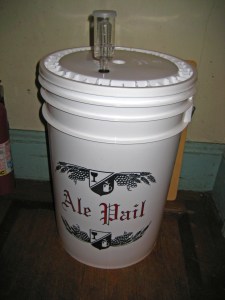
Fermenter.

The fermenter, with lid on and airlock up and ready.

There’s nothing left to do at this point except wait for those marvelous little yeasts to do their job.  After about a week, the beer is transferred, this time with a siphon to prevent aeration, to a secondary fermenter.  The first week is for the major conversion of sugar to alcohol.  The secondary phase is for conditioning, when the yeast are still active, but taking on more complex sugars and initial byproducts of fermentation.

After another week or two in the secondary fermenter, the beer is ready to be bottled.  Bottling day can be busy.  One needs all the bottles cleaned, sterilized and ready to go.  The bottling equipment, including a bottling carboy, siphon and tubing, bottle filler and tubing, and bottle caps all need sterilizing.  I find the first step in this process is to pour a homebrew from the last batch, and then set about tackling all these steps.

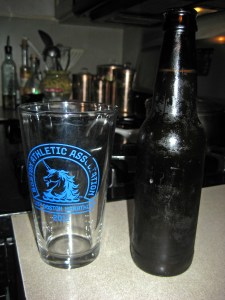
Bottle of beer and glass.

A bottle of my last brew, a German Hefeweizen.

IMG_1895

Nice head, nice color, this should augment the bottling day activities nicely.

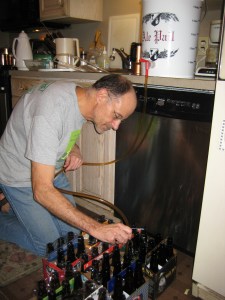
Bottling is best done with a helper.  It is possible to do it by yourself, but a whole lot tougher, and it is not easy to keep all those parts I mentioned clean and sterile without an extra pair of hands.

The beer is decanted into the carboy used for bottling, which has a spigot at the bottom, and doesn’t require a lid.  Priming sugar, which has been dissolved in boiling water to sterilize it, then cooled, is added to the mix.  This provides the additional amount of sugar needed to allow carbonation to occur in the bottle.  The yeast are still there, and will convert this small amount of sugar to additional alcohol and carbon dioxide, not enough to change the alcohol content significantly, and just enough to provide carbonation in the sealed bottle.  Many tales of exploding bottles are told by home brewers of their early attempts at getting this right.  The amount of sugar needed is readily available in homebrewing books and online.  A final gravity (F.G.) measurement is taken, with my brew having a F.G. of 1.010, which indicates the yeast did their job.  This should be about 7.3 percent A.B.V.   The spigot is then opened and the bottling begins.

Filling the bottles

Filling the bottles takes a bit of concentration and assistance.

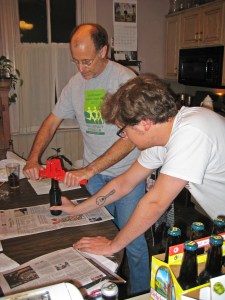
Finally, the bottles need to be capped.  My son and I worked together on this, with him holding the bottles so they wouldn’t tilt, and with me working the capping device.

Bottle capping.

Capping the bottles.

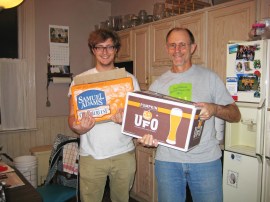
The yield from five gallons of beer is about 50 twelve ounce bottles, plus or minus a bottle.  We eked out forty eight and three quarters.  The beer is now ready to be bottle conditioned, which means storing it in the cellar for about four weeks.

Two cases of beer.

The beer is in the bottles, and they are capped and ready to go to the cellar.

IMG_1901

On the shelf in the basement, they will sit and condition, adding flavor and carbonation over the next several weeks.


At this stage I just need to forget they are down in the cellar, and let the weeks roll by.  While I can get an idea of how the finished product will taste, from various whiffs and sips of the dregs, I won’t really know the outcome until it is ready to drink.  We’ll probably uncap a bottle at Christmas time, since the family will be around, but it will be a bit early yet.  Also, higher alcohol beers like this can use a much longer bottle conditioning time before they reach their best flavor, mouth feel and overall presentation.  It is mentioned, the time a homebrew is ready to drink is when you are opening the last remaining bottle from the batch.

Is beer good for runners?  That’s not an easy question to answer.  I do believe in the relaxing and socializing qualities of beer, and nearly all of my running friends like it.  It turns out Ben Franklin was speaking of wine, not beer, in the quote attributed to him about how god loves us and wants us to be happy, but it applies to beer, too.   Pro-temperance zealots have their own reasons for disliking all alcohol, and some trainers will come out strongly against it for their athletes.  On the other hand, there is tremendous support in the running community for beer.  It’s freely distributed at the end of many marathons.  The international group known as the Hash House Harriers is based on the combination of beer and running, and they admit that they are a drinking club with a running problem.  Our neighbor, Philadelphia, has a great group of runners known as the Fishtown Beer Runners, who hold weekly runs which end at the selected pub of the week.  I think the combination of running and beer is here to stay, and I couldn’t be happier.

Frank

Sweat

Sweat: it is a natural product of running. In the summer we ran in such warm and humid conditions, the sweat would not dry, but flowed down into our socks and running shoes, causing a squishing noise to emanate with every footfall. At the end of our runs, especially the long Sunday runs, I could wring a cup of sweat out of my socks and shorts.

Sweat has great symbolism. It is the symbol of hard work. Picture a steelworker, sweat dripping from his face and staining his shirt as he moves a plate of steel destined for the side plating on a tanker ship. There is the sweat of the farmer as he runs his tractor up and down rows of sorghum, the sun unobstructed by clouds in the summer in Oklahoma. In the stifling air of a clothing factory in Bangladesh, the sweat of the woman in the tenth hour of a twelve hour day threatens to ruin her work.

Sweat represents fear. This is the sweat fueled by a flood of adrenaline. It is triggered by the flight or fight response which, somewhere in our past got built into our DNA to give us a jolt of strength to fight off an attacker. The alternative, running away, I imagine was an even better survival plan. Now, though, this sweat comes out in awkward ways, discoloring the armpits of a nervous lecturer, or both of a couple out on a first date. It comes from apocrine glands, different from the eccrine glands of the sweat that drips off our foreheads which is mainly water with a bit of salt in it. The sweat of fear is thicker and has in it protein and debris which bacteria seem to like. They are what cause this sweat to smell. Interesting, though, that this odor is thought to have strong pheromone effects for the opposite sex. Makes sense, one’s nervousness about that first date might be just the thing to get her strangely attracted without really knowing why.

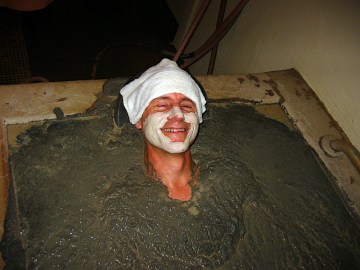
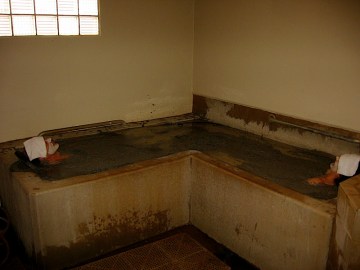
Sweat can be cleansing. Who doesn’t like the idea of sitting in a sauna, allowing the pores to open up and be an exit for stress? For the ultimate experience of sweating out the bad stuff, try a hot mud bath. I had the opportunity to do this with my wife in Calistoga, at the upper end of the Napa Valley.  Water from a natural hot spring, full of minerals, is pumped into a large tub containing a peat-like substance. The tub looks like a relic from ancient Rome. My wife and I got the couple’s room, with two tubs, which I suppose you could share with a stranger, but you would really need to stow your inhibitions in the bag they give you for your clothes.  In an interesting maneuver, we both shimmied ourselves into the peat, with naturally prominent parts still peaking above the level of the mud. It’s hard to get deep into the mud as your body’s buoyancy keeps you close to the surface. Good thing, too, since it gets hotter the deeper you go. You can only take about ten minutes of this immersion before you would start to get cooked like an egg. But, the pores open and the sweat flows. From the tubs, we stepped into a very powerful and hot shower, to get rid of the peat, which clings particularly well to hairy parts. From there, it’s into the Jacuzzi, for another sweat fest. Then, finally, donning striped terry robes we were escorted to the cool-down room, a dark place with cots where we were wrapped in clean white sheets and allowed to recover under the glow of a five watt bulb, listening to “ambient” music.

Frank, in the Hot Mud Bath in Calistoga.

Frank, in the Hot Mud Bath in Calistoga.

Frank and Kat in the couples room at the mud baths.  Note the Romanesque tubs.

Frank and Kat in the couples room at the mud baths. Note the Romanesque tubs.


Now that the cold weather is here, we still sweat. Running just turns up the heat in our bodies, which try to get rid of it by sweating. Starting out in sub-freezing temperatures, we need the warmth of tights and, for me, usually two layers on top, plus gloves and a hat. Soon, the gloves are off and I’m turning up the sides on my knit hat so my ears can radiate away some of the heat. At the end of the run, my face is streaked with salt from the sweat which dried as I ran, and my two shirts are wet. If I don’t change to a dry shirt rather quickly, the sweat starts to cool and I start to shiver. At the finish of the Philly marathon, a friend pointed out that I had a “bit of salt” on my face. When I got to the hotel and looked in the bathroom mirror, I looked like I was being preserved, the salt was so thick.

This is my homage to sweat. I know what it can mean, and I don’t pretend my recreation has the seriousness of what sweat can symbolize. But, I’ve experienced all those types of sweat, from hard work, to fear, to sheer indulgence, (and that pheromone thing, too!). I like the sweat of running. At times, it can be all of these.

Frank K.

Philadelphia Marathon #5

This was an experiment for me, to try to run two marathons in a six week period.  To give away the ending, it worked out okay, and I would do it again.  But, to get back to the details about Philly,  it is a small marathon by big city standards.  There were about 14,500 signed up to run the marathon, which is a sellout number, and also included about 1500 runners signed up for New York City, which was cancelled due to hurricane Sandy.  This compares with NYC, registering 47,000, and Chicago, 51,000.  Even Boston, which has qualifying times, runs 21,500.  Philadelphia runs a half marathon alongside the marathon, starting at the same time, with 12,500 entrants.  So, the start is fairly crowded, totaling 27,000 runners.

I headed over to Philadelphia Saturday, to the expo to pick up my number, and to browse the various booths.  Along the way, I stopped a few times to admire the city, its architecture, public works of art, and general scene.
Dropped off on Broad Street

I was dropped off by my son on Broad Street, and made my way over to the convention center.

I’m always pleased to see what a vibrant city Philadelphia is.  People live all throughout the city, and its businesses and public spaces are always busy.  It’s also a destination city for tourists, with the historical nature of the city, its museums, parks, and local flavor.
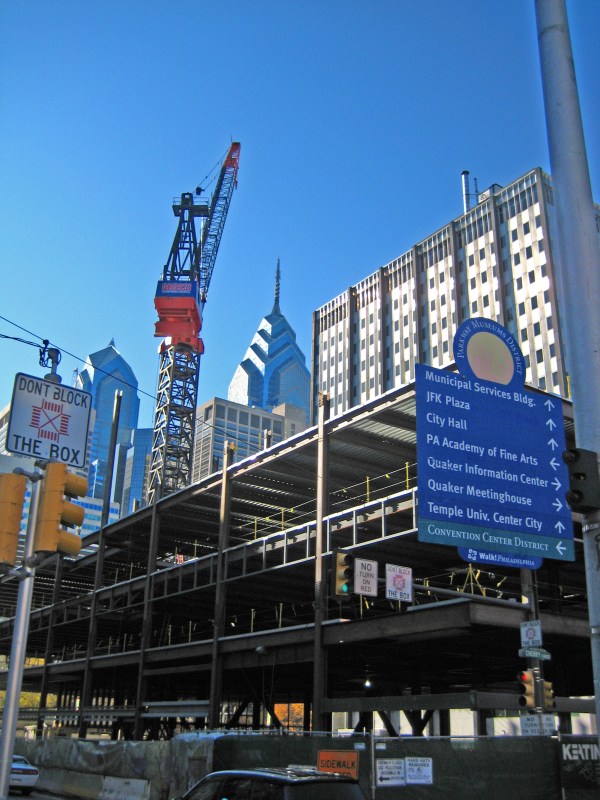
Cunstruction in center city.

Philly is building, and there are many construction sites such as this.

I like the way the old and the new blend together in Philly.  The Quaker Meetinghouse has been around since the city was founded, and is still active today.  The dramatic Chrysler Building-like tower is One Liberty Place, the first building to tower taller than William Penn’s hat atop city hall.  The building to its left is Two Liberty Place, a conglomerate of hotel, condo and commercial space.
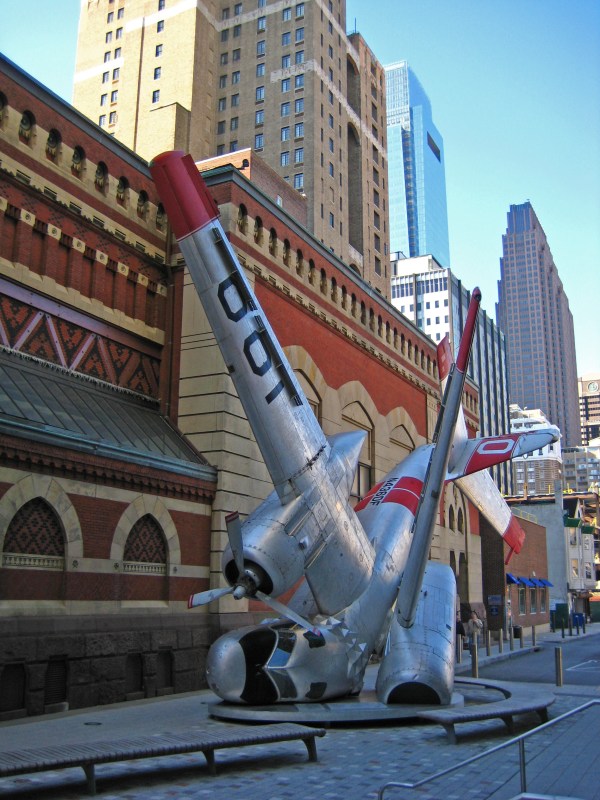
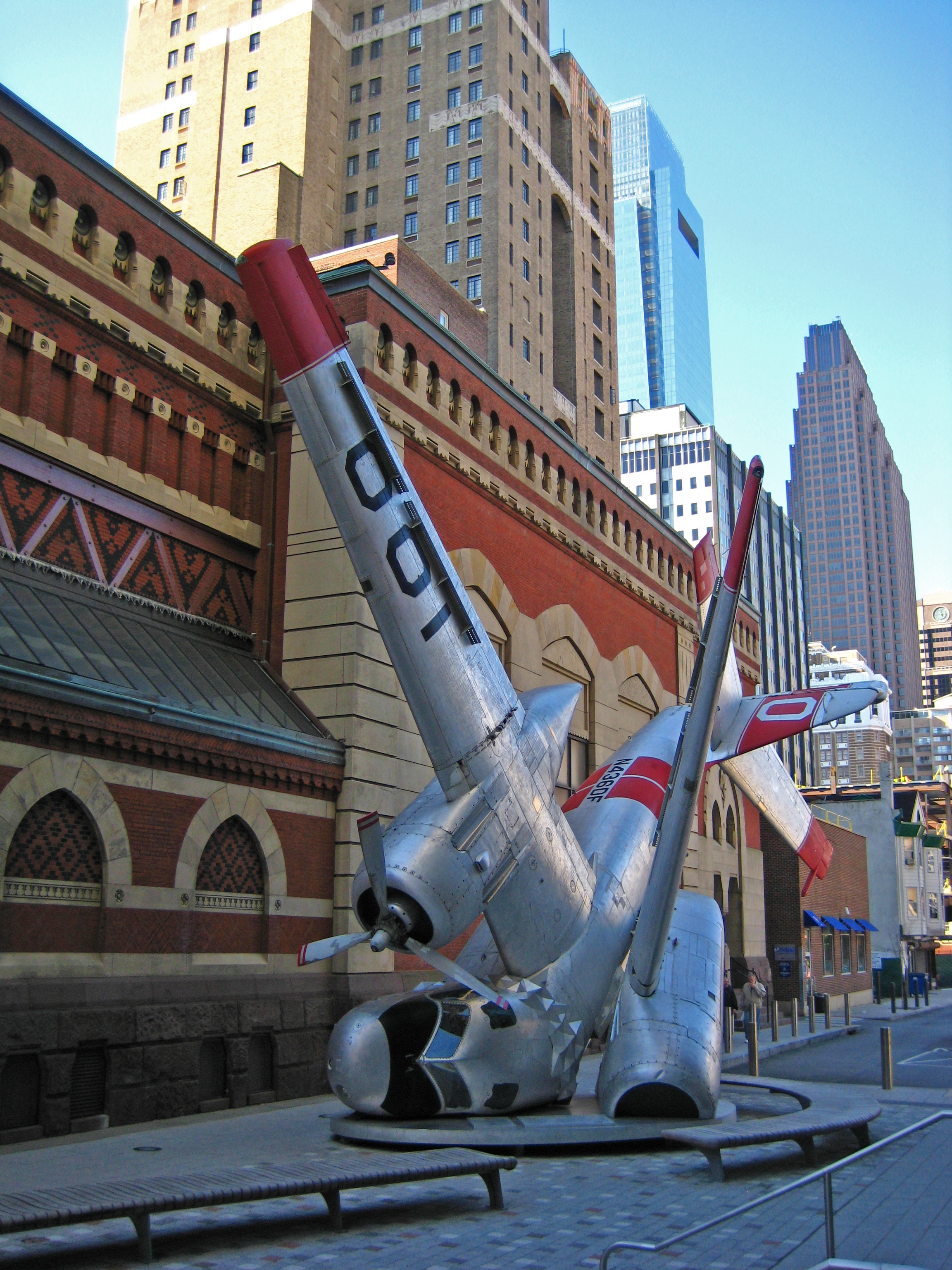
Sculpture in front of the Philadelphia Academy of Fine Arts

The Pennsylvania Academy of Fine Arts public sculpture.

The Pennsylvania Academy of Fine Arts is the oldest art museum and art school in the US, founded in 1805.  It is still teaching budding artists today, allied with the University of Pennsylvania.  This particular public spectacle, a real Grumman SE-2 Tracker, originally on an aircraft carrier, later used to fight fires in California, was installed by artist Jordon Griska, as if the plane hit the ground nose-first.  It is symbolic of swords being turned into plowshares, according to the director of PAFA, and will have a greenhouse built in to the fuselage (from Newsworks.org, a website of WHYY public broadcasting).
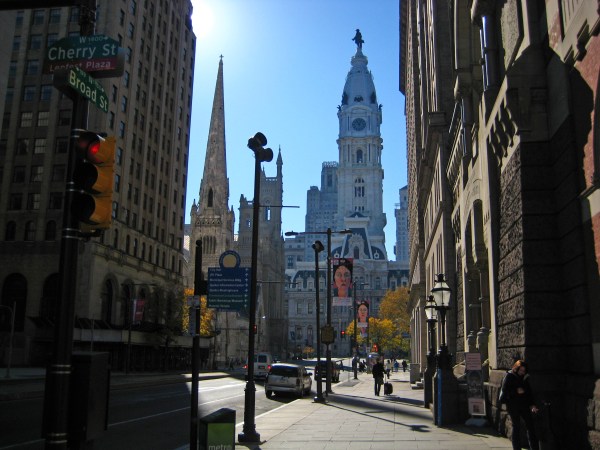
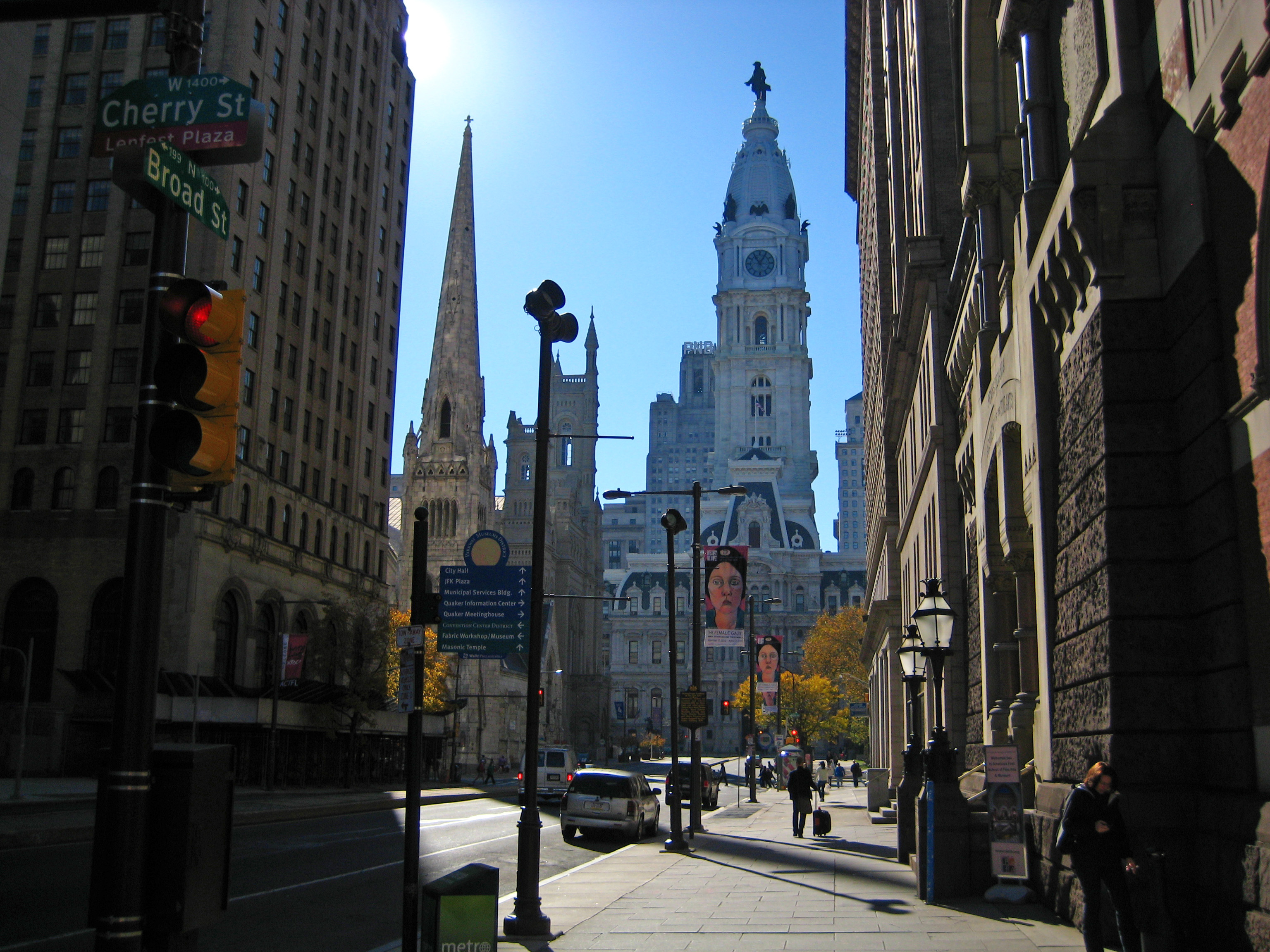
City Hall, Philadelphia

A glimpse of City Hall, with the statue of William (Billy) Penn on high.

The ornate City Hall building in Philadelphia is a much photographed building  Here, it is seen from the darkened byway at Broad  and Cherry.

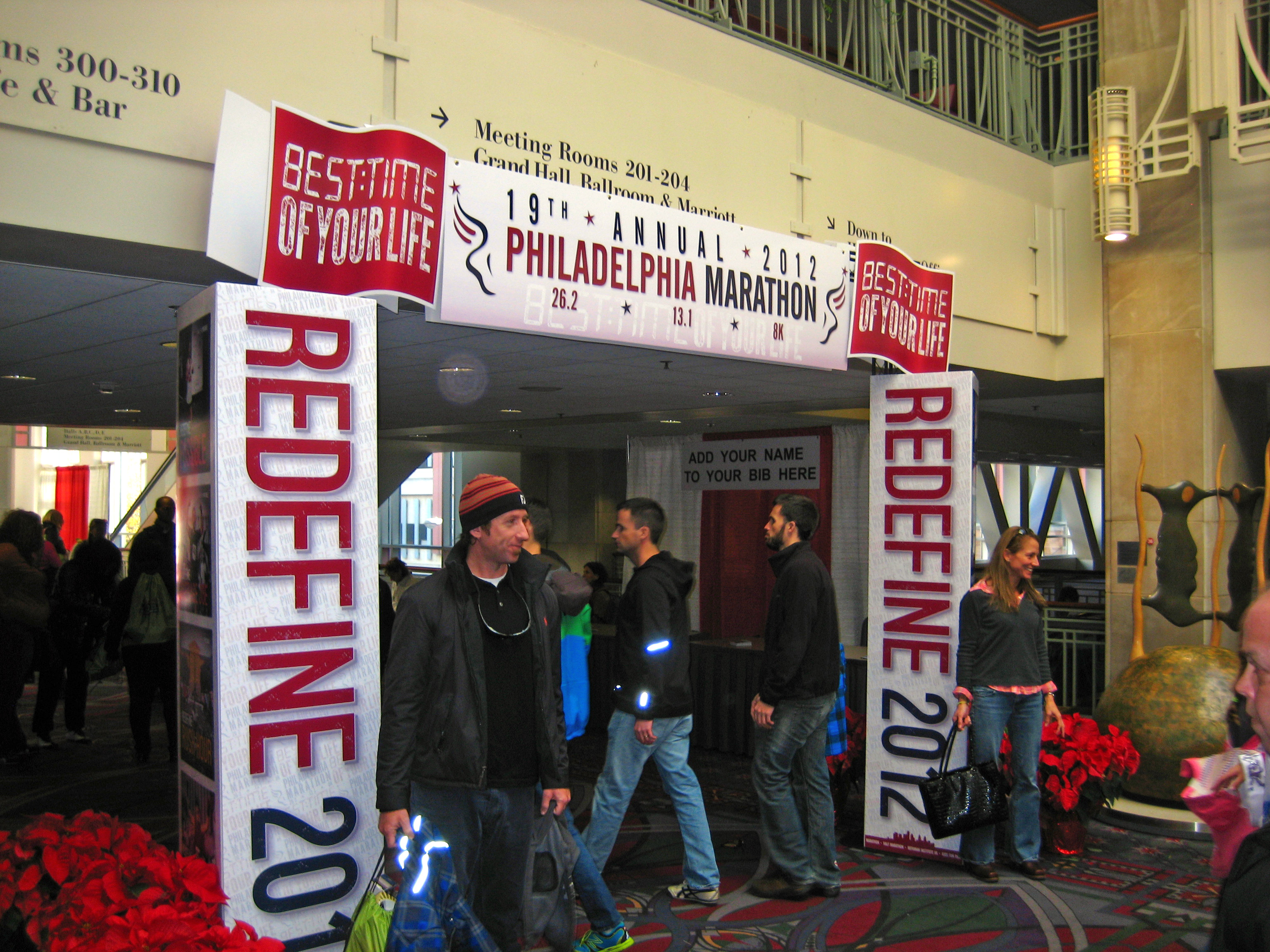
Not much farther, I reached the convention center where the marathon expo was being held.  The clue that you are in the right place is all the thin bodied individuals leaving the building carrying the same minimalist backpack, the kind made of nylon, with shoestrings for straps.  Entering the convention center, one is greeted by this banner.
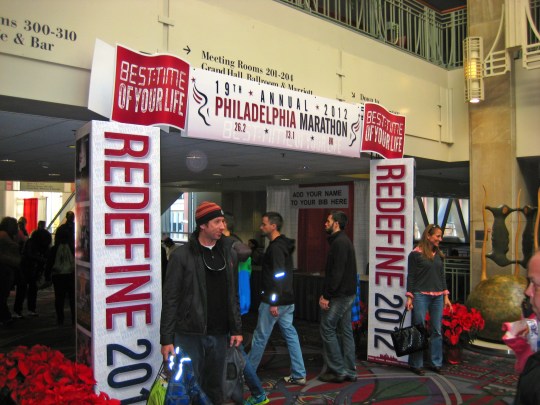
Entrance to the Philadelphia Marathon Expo

A mock-up of the finish line at the entrance to the expo.

Inside, the first stop is the packet pickup, for your number and your bag with the t-shirt and other little goodies they throw in.  Mine had a refrigerator magnet with clip, a Philadelphia Marathon ball point pen, and a bunch of flyers advertising other marathons as well as a coupon for a complimentary ticket to a Philadelphia 76ers game.
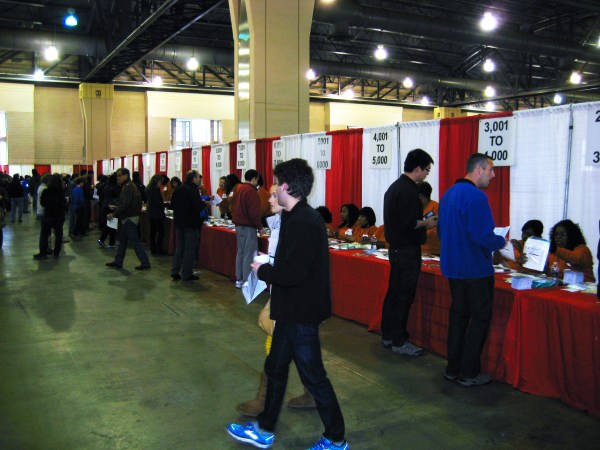
Packet Pickup

Packet pickup, where it all becomes official.

I headed over to the section where official marathon clothing and gear were for sale.  Most of the items were severely picked over, with all the good stuff in the popular sizes taken.  Plus, the check out line looked to be at least an hour wait to pay for your goods.  I had plans to buy a jacket in commemoration of my fifth Philly marathon in a row, but the jacket I wanted was sold out in men’s large.   They had a different jacket with a giant “Philadelphia Marathon” emblazoned on the back, but it lacked the subtlety I was going for.  Leaving the official wear area, I headed out to wander through the aisles of the other booths.

Philadelphia Marathon expo.

Booths at the Philadelphia Marathon Expo.

I came across a booth by Sigvaris, a company which makes compression stockings, mainly for medical use.  I had a nice chat with a saleswoman there, explaining I often wear their stockings at work, having to stand for hours on end.  I was looking for something to run in.

Sigvaris saleswoman who helped me get my compression socks.


Many of the compression garments for runners either don’t have sufficient compression, or cover only part of your leg, or your knee, and act more like a tourniquet than a useful support.  She had just the thing, a knee high sock built for running, 20-30 mm Hg gradient, knee high.  For me, it serves two purposes.  One is to provide compression for my broken down veins, the other is warmth for running in the raw, cooler and windier days of fall and winter.  I bought a pair on the spot.  I was so pleased, I got a photo.


There were many booths selling all sorts of other goods, gels, arm warmers, t-shirts, “The Stick”, ear buds guaranteed to stay in your ears while running, Clif Bars, Power Bars, Snyder’s Pretzels, custom running shoes, and myriad other items.  One display I did not fully explore were the two real buses, one Greyhound, one some other company.  I’m not sure what they were there for, perhaps to take your club to their next big race?

Leaving the expo, I crossed the street to one of my favorite spots in Philadelphia, the Reading Terminal Market.

Reading Terminal Market

Entrance sign for the Reading Terminal Market

This market, which opened in 1892 as part of the Reading Railroad terminal, with tracks over the market space, has survived many economic downturns, and is currently a vibrant, packed, hectic market selling produce, poultry, meats, cheeses, bread, coffees roasted on the spot, cook books, spices, and in short, anything that’s delicious.  The Pennsylvania Dutch have a prominent presence here, and can be identified by their typical garb.  Yes, I dropped a few bucks here, picking up some bread from Metropolitan Bakery (Pain au Levain, and a chocolate cherry loaf), some house-roasted coffee, the Balzac blend, from Old City Coffee, and some fine cheeses from Downtown Cheese.

Leaving the market, I walked to the Ben Franklin Parkway, to check in to our hotel room.  Our club rents a room close to the start and finish of the race, to have a spot for our runners to stay warm and stow their bags before the race, and have a comfortable place to change afterwards.  Along the way, I passed some more iconic symbols of Philadelphia.
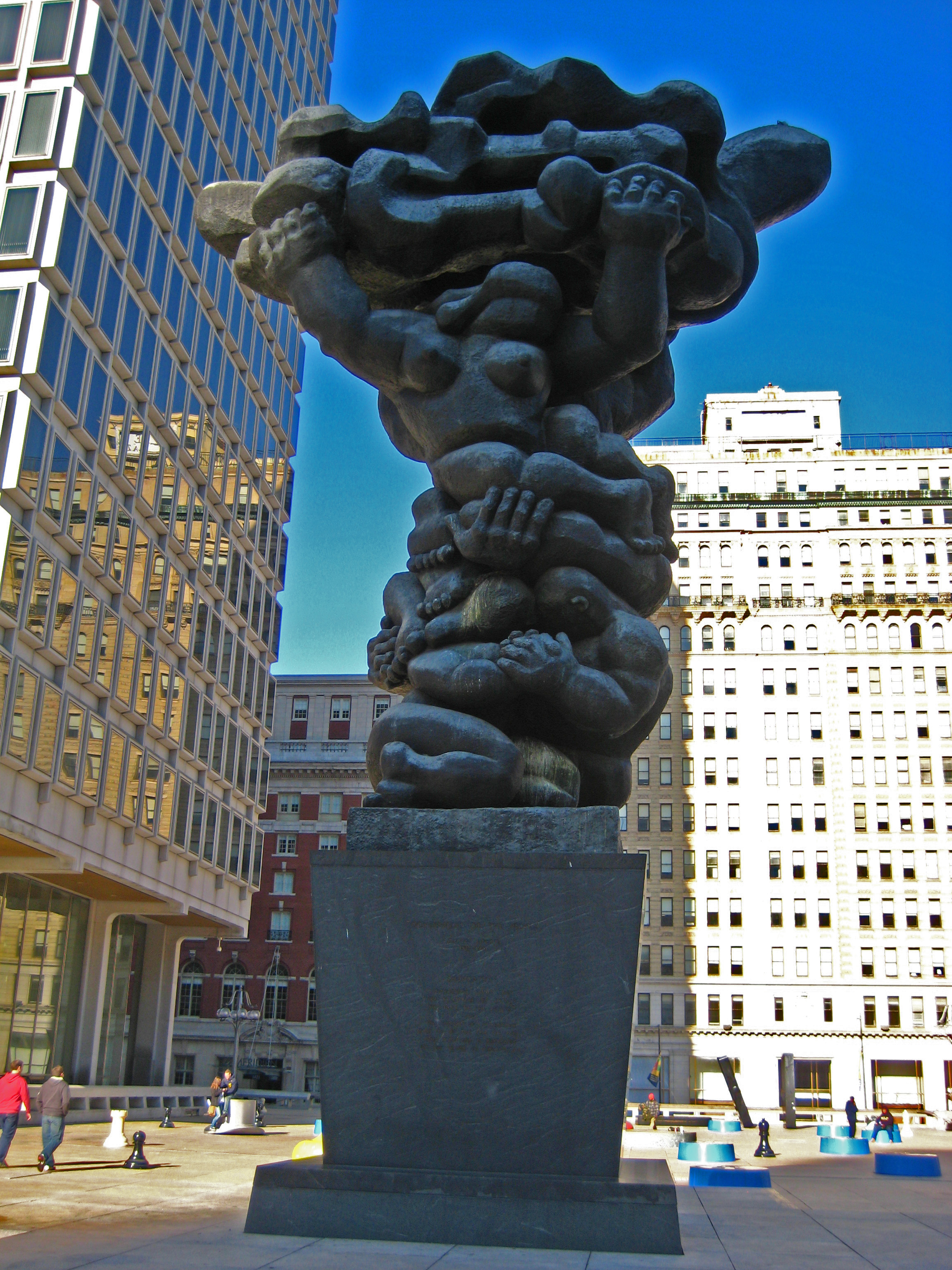
Jacques Lipchitz, artist, Government of the People, in front of the Municipal Services Building
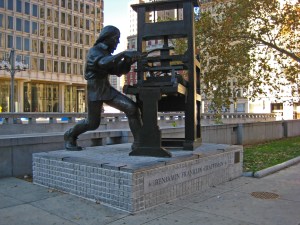
Ben Franklin and the printing press.

Ben Franklin and the printing press.

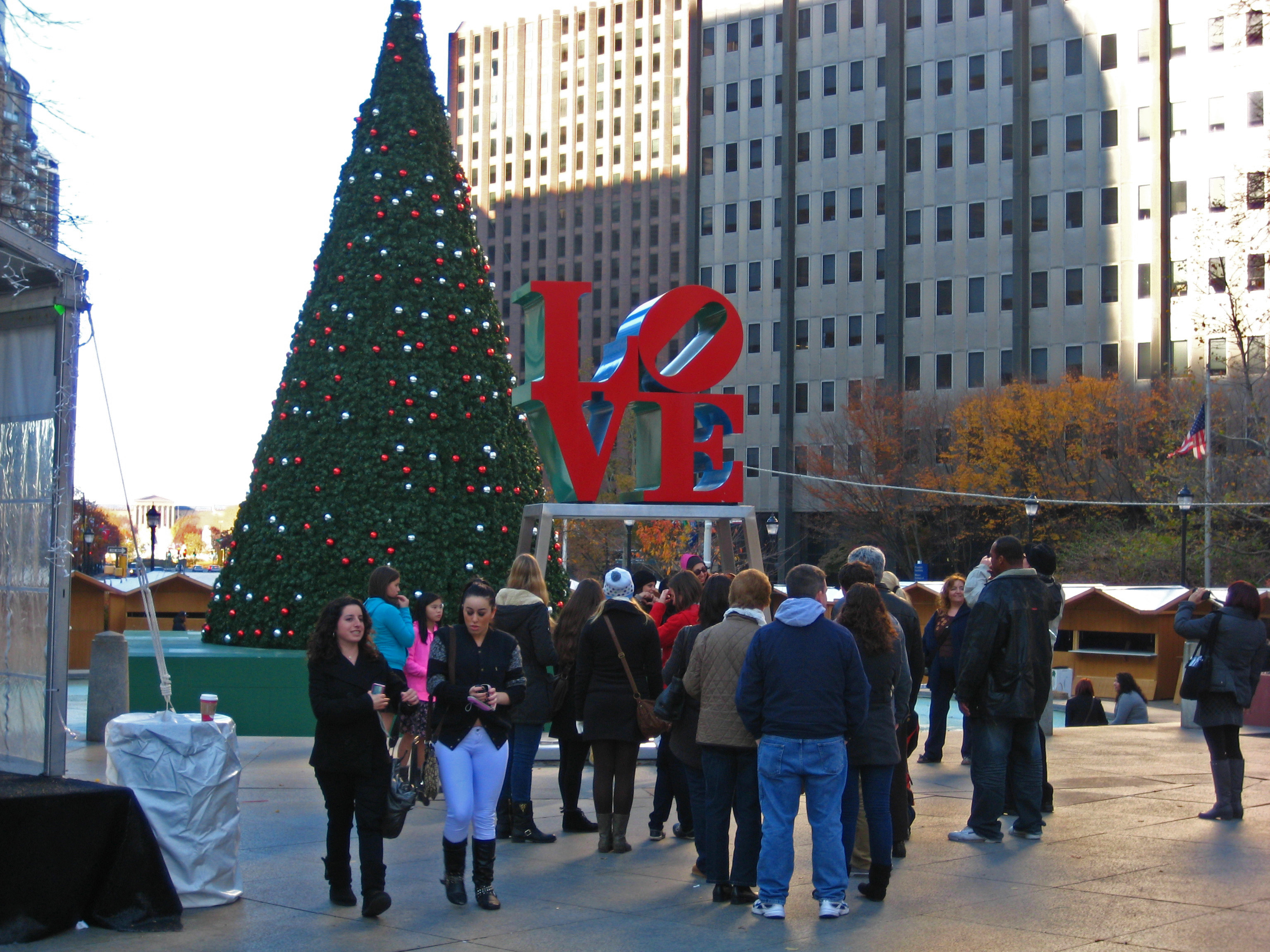
Crossing the street you arrive at the start of the Ben Franklin Parkway, and the nicknamed Love Park, so named for the famous LOVE statue.
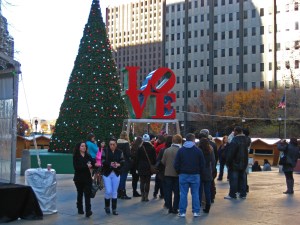
Love Statue

LOVE Statue, famous symbol of Philadelphia, is constantly surrounded by people taking photos.

Love Park

LOVE from behind.

I checked in to the hotel, but wasn’t assigned a room yet.  So, coming back later that evening, I finally got in to our room, which was, coincidentally, room 2012.  I had to argue a bit to get the promised view of the parkway from the balcony, but it was definitely worth it.

Ben Franklin Parkway

View of the Ben Franklin Parkway at night from our hotel balcony.

The large circle is Logan Circle, and the fountain in the center is the Swann Memorial Fountain, named for Wilson Cary Swann, the founder of the Philadelphia Fountain Society.  I suppose that’s one way to get your name on a fountain.  It is an incredibly beautiful fountain, though, representing the three rivers of Philadelphia, the Delaware, Schuykill, and Wissahickon, using native American symbolism to portray them.  The marathon starts at the far end of the parkway, and runs down and around this circle as it heads down to Columbus Boulevard along the Delaware.  Later in the race we cross both the Schuykill and the Wissahickon, so in a way, this fountain is a good representation of the marathon.  I didn’t stay over in the hotel, wanting to sleep in my own bed, and have access to my usual breakfast.

On the morning of the marathon, I met up with a few other club members at the train station at 5 AM.  We took the train in to Philly and got to the hotel in time to do a little stretching.  A good number of other club members showed up, and come 6:20, we headed down to the lobby and walked up to the start line.  The crowds of runners and spectators were busily getting to either their corrals or to prime viewing areas for the start of the race.  As with every marathon, there’s an edgy tension, people adjusting clothing and retying shoes, starting of Garmin’s, stretching in the limited space available in the corral, and nervously chatting.  Then comes the national anthem, and the start of the race.  Throw away t-shirts get pitched to the side, and the corrals move up as first the wheel chair racers, then the elites, then the rest of us make our way to the start.  As we got close to the start, the walk broke into a trot, then a run, and we were over the start line, heading for the first of 26.2 miles.  This year we had a special group in their own corral, the runners from the New York marathon, who started after my green corral.  They were heartily welcomed to the race from the runners and the spectators, and I saw many signs along the route in support.  The route is a great tour of Philly, going through old town, down to South Philly, with onlookers in bathrobes standing on their porches, up Chestnut Street, with the street filled to capacity with cheering fans, over the bridge to the Drexel University area, past the fraternity houses where frat boys were out banging on pots, making noise for us, and looking like they hadn’t gone to bed the night before.   From there we head to the Belmont plateau, past the Zoo and the Please Touch Museum, down on to West River Drive.  A quick switchback along the drive, then we head back along West River Drive to where we started, in front of the Philadelphia Museum of Art, and the halfway point.  Large signs, much more visible than years past, show the way for the half marathoners to peel off to their finish line, and the marathoners to continue on to Kelly Drive.  Then, it’s out along another Philly landmark, boat house row, out to the Falls Bridge, over the bridge and down on to West River Drive again for another (and very annoying) switchback.  I don’t like this part because the road heads down hill and you need, of course, to come back uphill again at a time when the legs are starting to feel the fatigue set in.  The last outward bound stretch is along Main Street in Manayunk, with its young and hip fans lining the streets, offering home baked brownies and cups of beer to the runners.  At the end of Main Street, another switch back for the last 6.5 miles to the finish line.  My legs were pretty well cooked by the time I made the turn in Manayunk, and I lost a lot of time having to slow down.  On the bright side, I didn’t have to stop and walk for leg cramps like I have in my other marathons.  I got a big boost from two club members, Rich and Joy, who were waiting for me around mile 23 and ran with me to mile 25.  Their encouragement helped me speed up the last few miles, and really push to the end.  Fellow Steamtown runners Tony and Brian, watching from the sidelines, said that I looked totally focused the last mile.  It was either that, or I had completely lost the ability to think and could only run on basic instincts.  My final time of 3:57:18 was not what I was shooting for, but it is now in the books.  I was pleased to run under 4 hours, pleased to have done two marathons in 6 weeks, and pleased to have completed my fifth Philadelphia Marathon in five years.
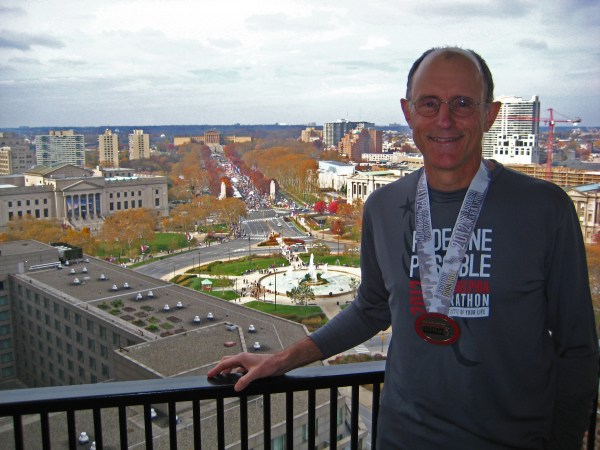
Vies from the balcony, Nov. 18, 2012

Frank finishes his fifth Philly Marathon in five years.

Ben Franklin Parkway and the Philly Marathon

View of the Parkway, with the crowd of runners and spectators, the beautiful trees, and the art museum in the background.

That’s how it went, Sunday, November 18, 2012.  Of note, our club, the South Jersey Athletic Club had many runners in the marathon and half marathon, and they all put in great performances.

Frank


iambic pentameter

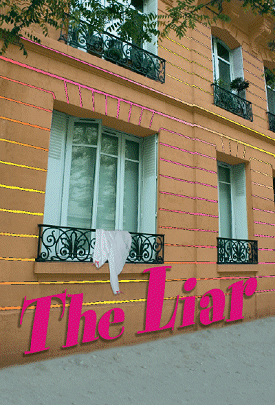
Cover for "The Liar"

The Lantern Theater Company’s production of “The Liar”.

Is this not a blog ’bout running a race,

not a mere review of timing and pace?

Does inclusion of such other affection

demand an answer to this reflection?

To race or not to race, is that the question?

Nay, said Armstrong, not about the bike, then

what for the road runner would be the like?

For me and Kathleen, a night on the town!

It’s PATCO to Philly, with that we’re down.

Met with some friends at the Westmont station,

Then on to the Lantern, first, a conversation.

Sat with the director, down in “the lab”

of this tiny theater, for, (you guessed it), a confab.

Kate MacMillan, resident director,

there explained iambic pentameter.

She then went on, yawn in voice,

(must I put on a good face for this bunch)

no, she really was full of spice.

(The well hid strain to explain, just a hunch).

We then ascended the metal stairs

in this theater posterior to the

large cathedral, St. Stephen’s Basilica,

but, of faith, Episcopilica,

to find our way to unassigned chairs.

A bit like boarding a Southwest Airline,

One sits in any seat that one can find.

I like this form of letting patrons choose,

it lets us join together with our group,

worry not ’bout the ticket’s assigned spot,

select the seats that work best for our lot.

We settled in awaiting expectantly

a “translapted” Corneille French comedy.

Translapted, David Ives, the translaptor

created this word, a portmanteau (look it up)

of how he changed this play from long ago

about the time of Louis XIII and Richelieu,

a clever farce with parts a bit taboo.

David Ives adapted the translation,

changed the text to match our generation.

Hence the cunning linguist term, translaptation.

The actors all were brilliant in their parts;

timing’s crucial when throwing verbal darts.

The play’s about a liar, bet you guessed,

a young lawyer who seeks the fairer sex,

but is convinced the only way to score

is to lie, and lie, and to lie some more.

He takes on a servant, who can naught but tell the truth,

the plot, based on mistaken names, forsooth.

Dorante, the lead, relies on his glib gift

to prevent a nearly deadly rift,

while he woos a willing young coquette,

but whose name he misses on a bet.

Clarice, Lucrece, Isabelle, Sabine are

randy and ready for a love affair.

Or rather, seeking marriage, they are looking

for a soldier worth their hand they’re hoping.

Swords come out and in, a bit provoking.

Scenes change quickly, stage hands work like lightning.

The upshot this, a play most entertaining,

Well done by cast and crew, really, outstanding!

Borrowed photo of Caribou Cafe, from the internet.

The six in our party, (you thought four?)

departed Lantern Theater, heading for

Caribou Cafe, 12th and Walnut,

for a late dinner, beer, wine and more.

We were delighted to find music, live

sax and guitar, a jazz duo, good vibes.

A bit of dawdle, headed home late

At that hour, certainly a wait.

On to the PATCO concourse headed we

back to our beds, at home, ’twas two, not three.
But hark, what cry is that, what run did I?

Okay, eleven miles, marathon pace, feeling strong for Philly in one week.

Does this destroy the rhyming scheme I wrote?

Even Shakespeare sometimes got off note.
Frank K.

Two Weeks to Philly! And a little diversion over the bridge.

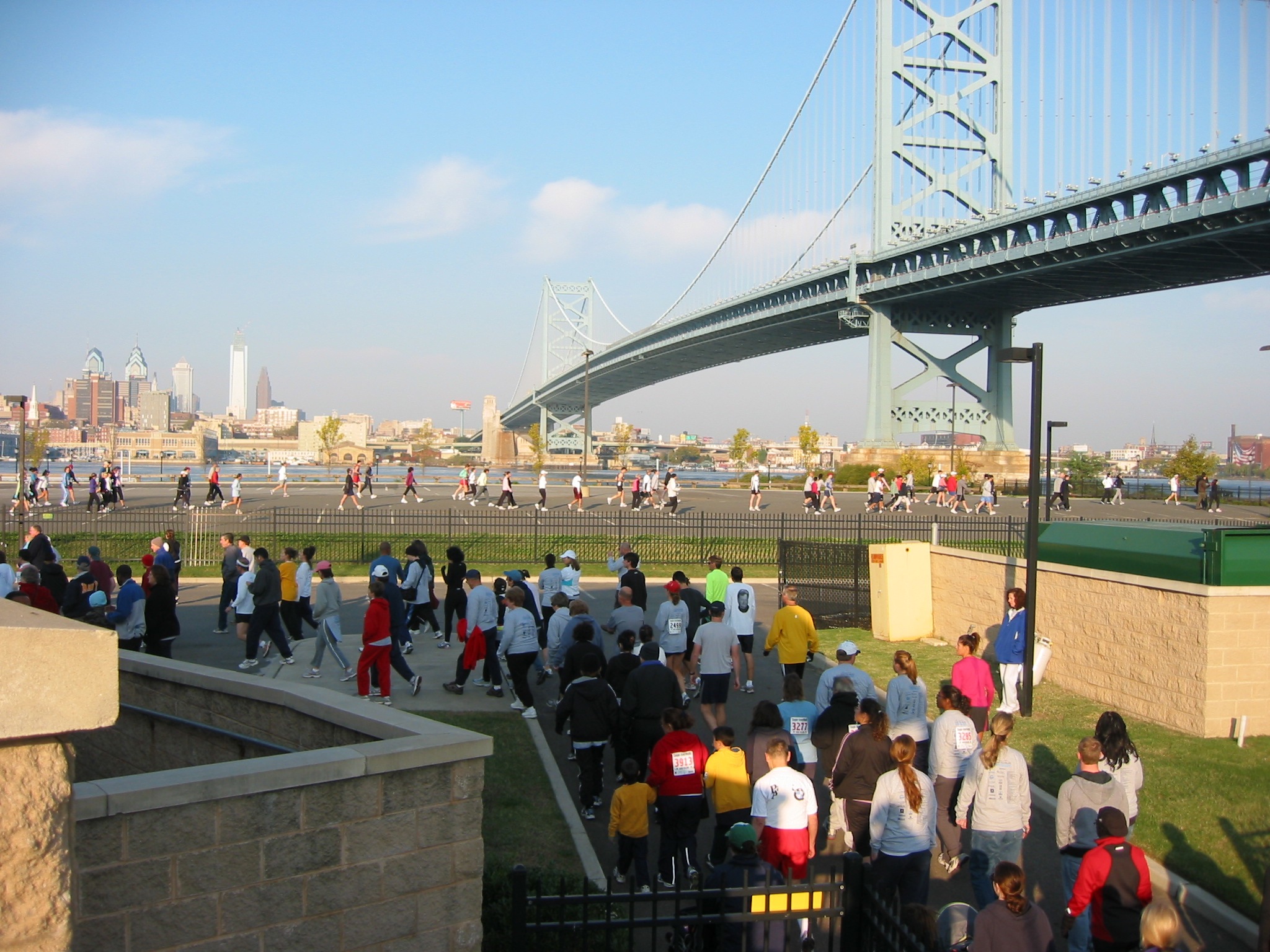
Ben Franklin Bridge

Photo from 2007 Cooper Norcross Run the Bridge.  Our race 11/4/12 was just as bright and sunny.

There has been a lot going on this past week.  The week started out with a storm unlike any we’ve seen for decades hitting the east coast.  Hurricane Sandy and it’s aftermath has been devastating for so many, particularly in New Jersey and New York.  It was a wide ranging storm, without terribly high winds, but the flooding, downed trees, loss of power, and then the difficulty of getting life back to normal has effected millions, and is still a major problem for many.  My son described watching transformers on telephone poles in New Brunswick creating an eerie light show Monday night as they blew up all over the city.  The New York City marathon, scheduled for Nov. 4, was initially planned to go as scheduled.  Then, it was cancelled, after 40,000 runners had already arrived in the city.  But, the fact that so many New Yorkers still had no power, were living in shelters, were lining up at gas stations to receive a ration of gasoline, and were huddled around power strips in order to charge their cell phones, plus many other hardships, made a compelling argument to cancel the marathon.  Brandon, a friend of mine who was planning to run New York, found an alternative marathon the same day, the Delaware and Lehigh Heritage Marathon, in Northampton, Pennsylvania, along the upper Lehigh River.  Apparently, they got a big influx of runners from New York, with their numbers swelling from 500 last year, their inaugural year, to 850 this year, before they closed registration.  Quite a difference from the 47,000 scheduled to run NYC.

In my town, fortunately, the hurricane left very few without power, and life got back to normal quickly.  There were some intense controversies.  Halloween was postponed by mandate from Governor Christie to Nov. 5.  But, our mayor decided to override the governor, and held Halloween on Friday, Nov. 2.  I admit to some surprise, driving home from work, expecting to be able to go to the grocery store and pick up some heavily discounted bags of M&M’s and mini Milky Ways in preparation for Monday, only to see droves of costumed kiddies and their into-it parents already making the house to house rounds.  In our two neighboring towns, Halloween was to be held Saturday and Monday respectively.  How confusing.

Meanwhile, my training for Philadelphia went on.  My second taper in six weeks, and I’m feeling fairly confident that I’ll at least finish the marathon.  The last two weeks were my last long runs, first a 22.8 miler two weeks ago, then last week, I joined up with about 30 other runners planning to do Philly for a 20 mile training run put on by CitySports in Philadelphia.  They organized us into pace groups, provided pace runners, had a water station set up at the Philadelphia Sports Club on 18th and Market, and provided water, Philadelphia pretzels (for the salt?)  and a bit of swag, with a nice CitySports bag and coupon.  It was fun getting together with other runners not part of my usual group, all training for the same race.

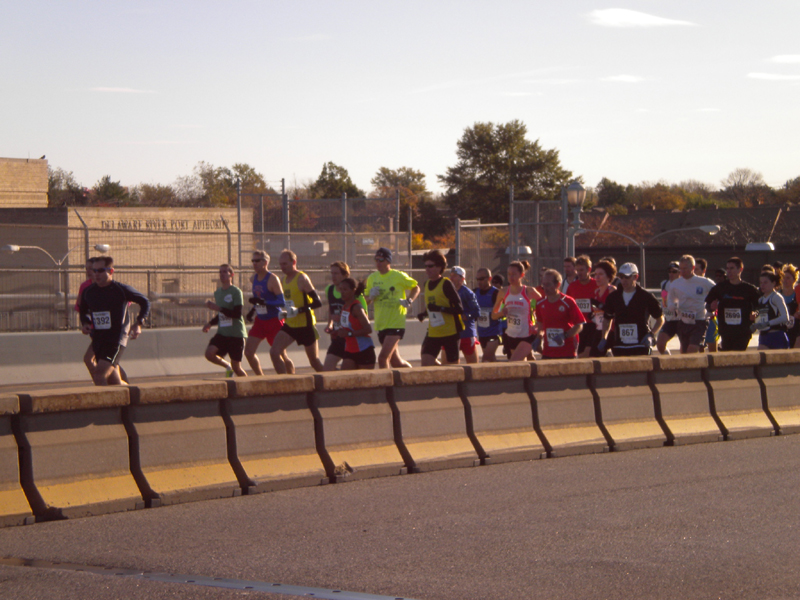
This past Sunday was the annual running of the Cooper Norcross Run the Bridge 10k, which starts on the Camden side of the Ben Franklin Bridge, goes across the bridge to Philadelphia and back, then runs through the streets of Camden, past the battleship USS New Jersey, then back along the Delaware to the finish line in Campbell’s Field, home of the Atlantic League Camden Riversharks.

Start of Run the Bridge

Among the early leaders heading uphill at the start, out of 4500 total runners, are Dave Stewart and Rich Wright of the SJAC.

The first mile of the race makes you humble as it heads up the bridge.  But then you head down the other side of the bridge, making the turn in front of the whimsical statue of a kite in the air and  a key on the string, an homage to Ben.  Then, it’s back up the bridge again then down, then finally, for the last 3 miles or so, the route is almost completely flat.

Dave Stewart, SJAC

Dave Stewart of SJAC, still way ahead of the pack, coming back from the Philadelphia side of the bridge.

My race was a bit less speedy than Dave (okay, a lot!), but still respectable.  I wasn’t sure how hard to push, given that I’m planning to run a marathon in two weeks.  I decided to just run it as I would any race, and let the chips fall as they may.

Frank caught in a surprisingly decent shot by Ed, on the Ben Franklin Bridge.

Frank (yours truly) heading down the second leg of the Ben Franklin Bridge, and waving, naturally, to the camera.

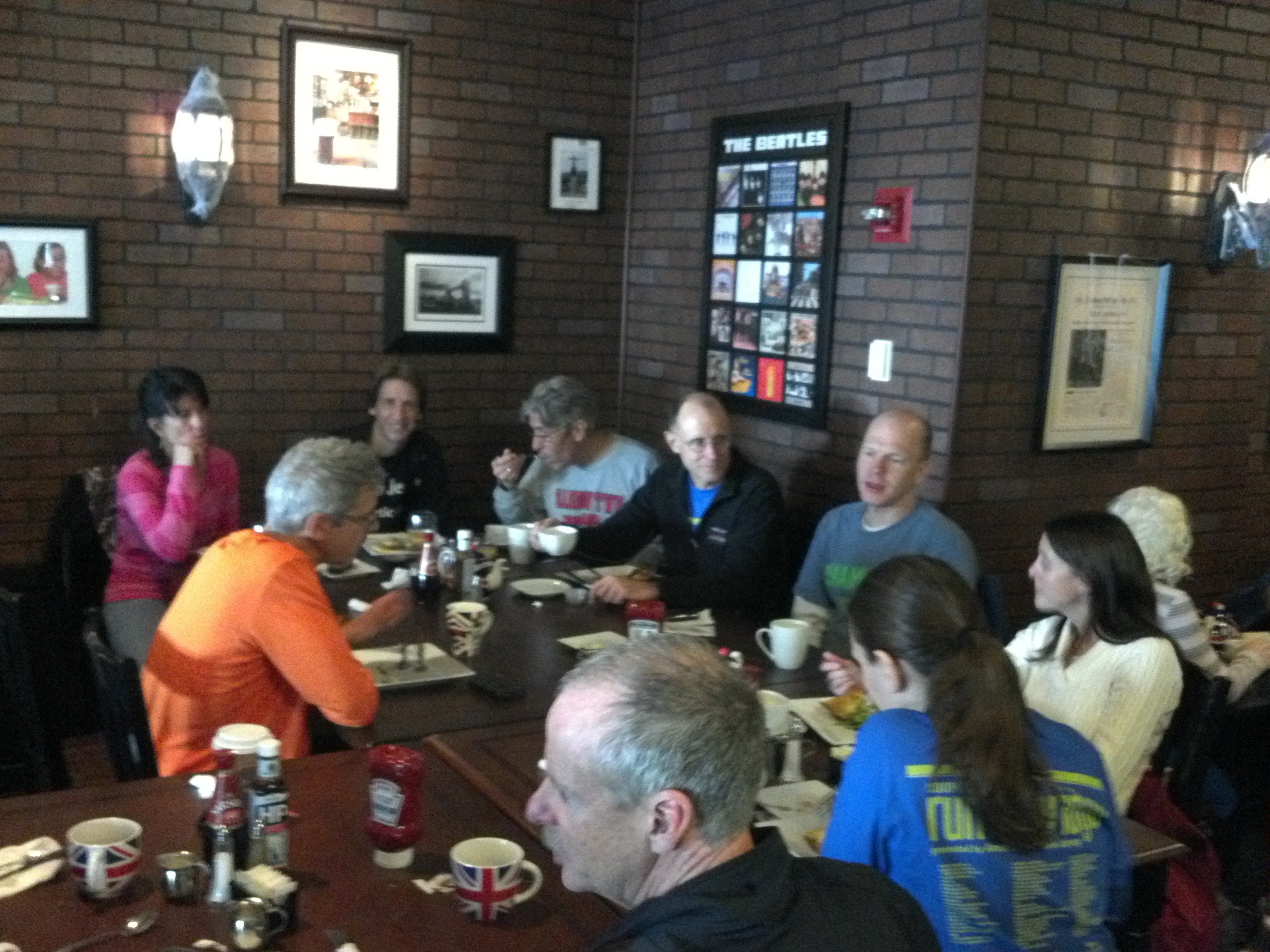
It turned out to be a great day for a race.  While a little chilly at the start, especially waiting in the shaded part of Campbell’s Field before heading out to the start, once we started out, with the bright sun the 40 degree temperature wasn’t bad at all.  Just about everyone I spoke with after the race agreed that it was a great day for a 10K.  After the race, a group of us from the SJAC got together for breakfast at the British Chip Shop in Haddonfield.  Our initial intention was to watch the New York City Marathon, but after it was cancelled, we decided we could have breakfast anyway, and enjoy talking about our race, eat bubble and squeak or an Irish omelet, and have a spot of tea.

The SJACers have brunch after the Run the Bridge 10K at the British Chip Shop.

This restaurant shows live coverage of the English football matches,  but our crowd was oblivious to the TV, and had a great time chatting and talking of upcoming races.

Frank

The Heart of Fall

Golden leaves.

The bright golden colors of fall.

Here we are in the middle of fall, with the bright but fleeting colors of the leaves creating a beautiful backdrop for  our runs.  Right now, the weather doesn’t quite know if 75 or 45 is the correct temperature.  One day it’s tights, long sleeve shirt, and light gloves, then its back to shorts and short sleeves.  One thing is constant, though, evening runs are in the dark.  I equip myself with a headlamp and reflectors for these runs.  The headlamp is annoying, but necessary.  Some areas are well lit by streetlights, but our town is notorious for potholes, especially in areas where the streets are dark.  Potholes seem to congregate in the dark.

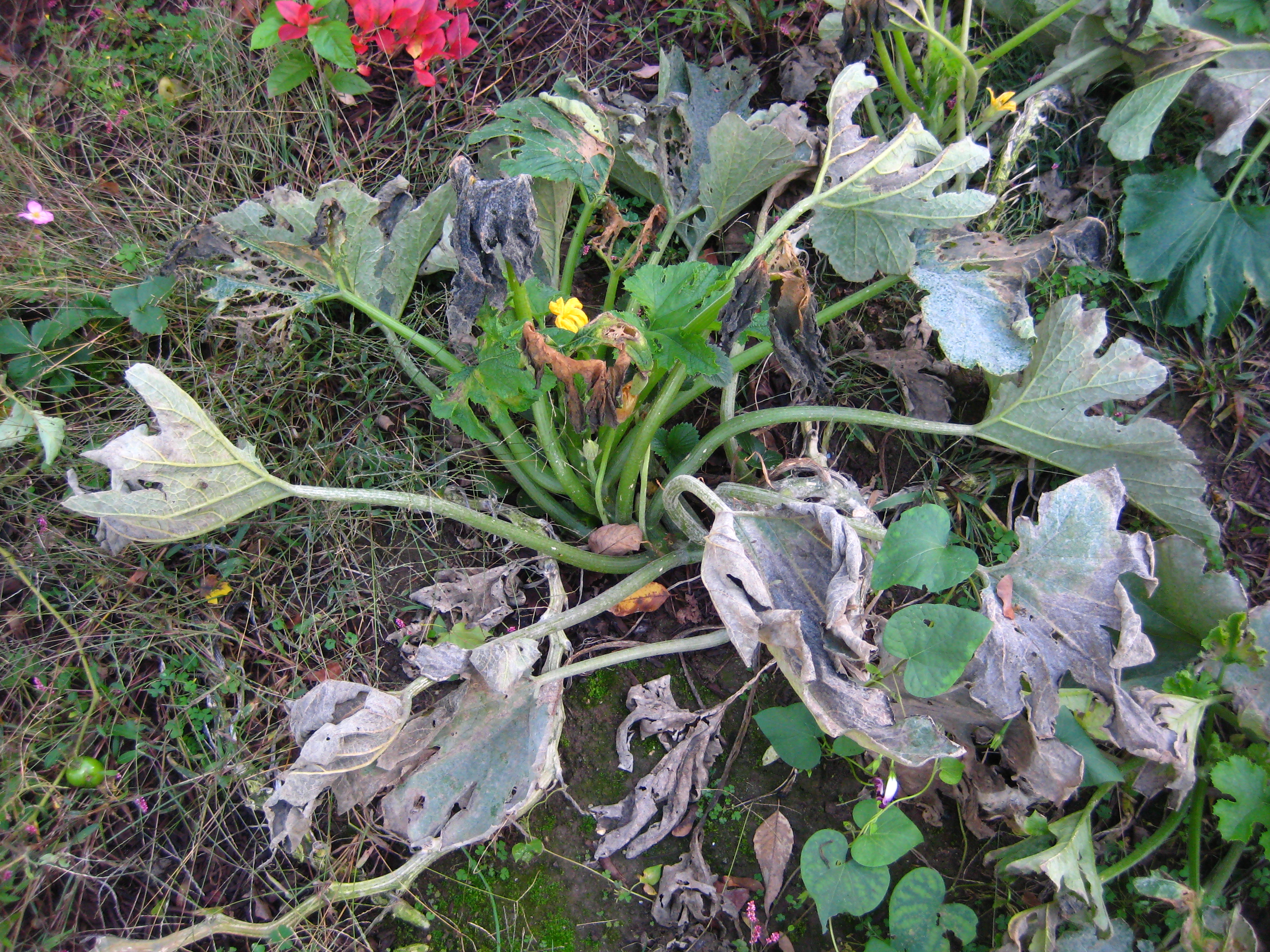
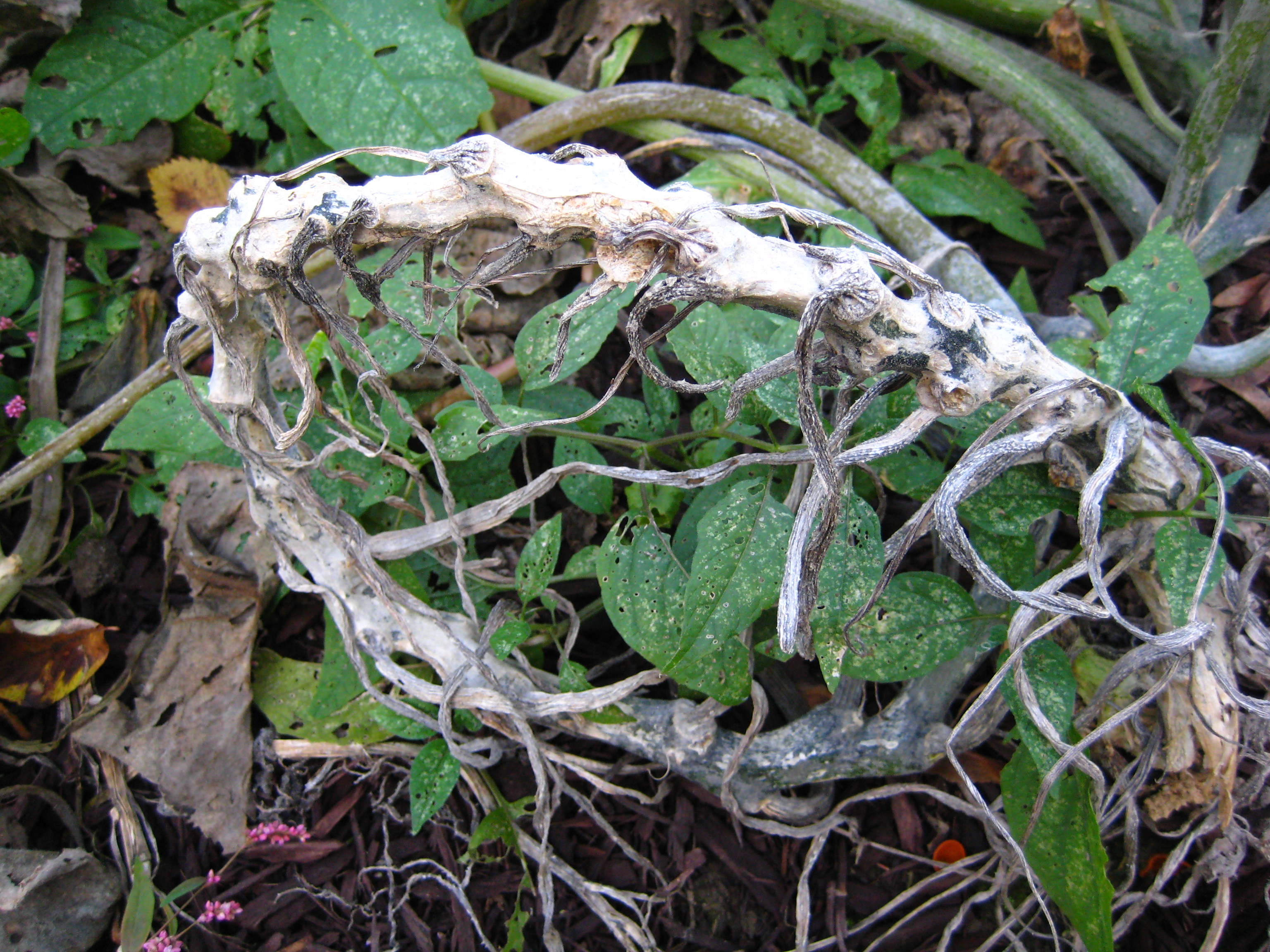
Spent yellow squash plant.

This yellow squash plant was very productive over the summer, providing us with a dozen or so squash, and we ate some of the blossoms, too.

Running in the dark, I feel a bit like a fugitive, darting among the shadows, and aware the drivers are not necessarily aware of me.  It is a bit of a survival game.

Stem of a zucchini plant.

The wizened stem of a zucchini plant.

Unlike the plants in these photos, I am planning to reach a peak in the next few weeks as I take on the Philly Marathon, November 18.  This will be my fifth year in a row running Philly.  If someone told me back in 2008, that by the end of 2012 I’d have seven marathons in the books, I’d have thought they were crazy.  But, as long as I finish it, this will be my seventh, with one Boston and one Steamtown in the mix.

Tomatoes still green in October.

Green tomatoes still hanging on the vine in late October.

Many of my friends, about my age of 58, are looking ahead to retirement and discussing their bucket lists.  Don’t speak to me of bucket lists.  It’s not that I believe that somehow I am less mortal than my non-running friends.  Quite the contrary.  I seem to take on some risks for which life afterwards is not a given.  I don’t think I’m adding years to my existence by running, or eating right.  But, running, and competing are a great deal of fun, an endless challenge, and a great reason to get together with like minded folks and have a good time…often with good beer involved.  The list of interesting things I would like to do keeps expanding.

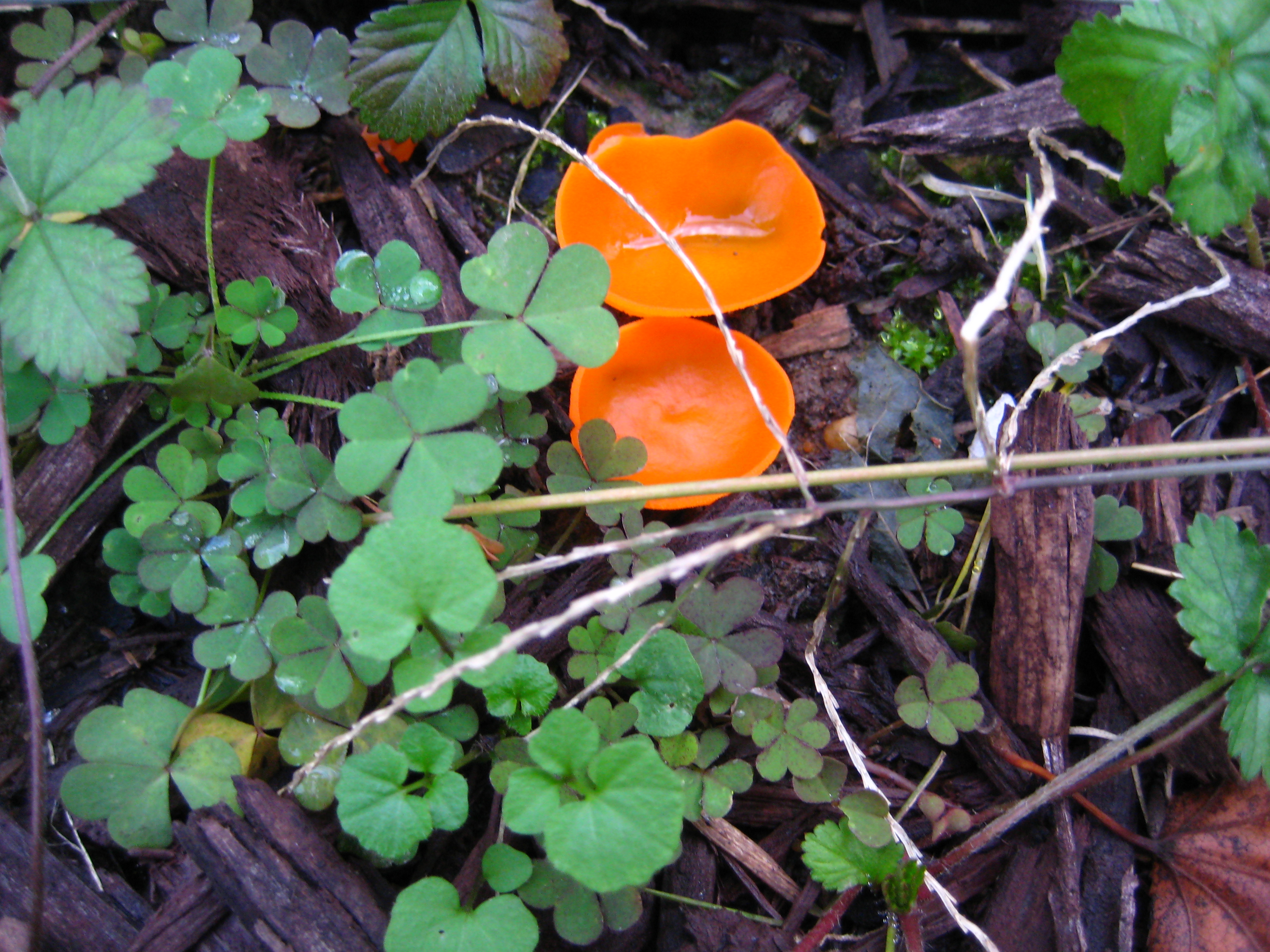
Orange Peel Fungus

I believe these are Orange Peel Fungus, a type of mushroom which bloomed in our garden.

Running Philly so soon after running Steamtown is a bit of an experiment for me.  Collective wisdom says that it takes about as many days as miles in a race to recover properly.  But after the first week following Steamtown of sore quads and an awkward gate, I got back into the training process.  Last Sunday was a 22 miler.  The legs felt very tired around mile 19 and 20, and I wound up slowing considerably, only to get a second wind and run the last two miles in decent form.  Tuesday and Wednesday were good training runs at close to marathon pace.  Running in the dark slows me down a bit, as I mentioned, having to pick my way through in some areas.  After an eleven mile run last night, Steve and Tony, my friends from Steamtown, and I headed out for some good ales and dinner at a local pub called the Pour House.  The talk covered how best to run an upcoming 10K bridge run, a zombie run (lots of zombies out on the course, since Halloween is coming), the Giants and Tigers first world series game, extremely thin waitresses at the Pour House, the difference between ales and lagers, American vs India Pale Ale, and all sorts of other topics.

Poison Ivy along our fence.

Here’s the poison ivy along our fence which gets me every time I trim along the fence line.

This poison ivy gets me every time.  As I wrote in a previous entry, I got the rash everywhere my last encounter with it, and I’m glad to see it turn colors and drop it’s leaves.  It is an attractive vine.  But this winter, after Philly, and with gloves and long sleeves, I will get in to this area and dig out every bit of it.  That is, I hope I will, since finding it after the leaves are gone might be tricky.  Meanwhile, I’m heading for a 50 plus mile week, I am not particularly sore, and I hope my experiment goes well.
Frank

Report from Steamtown, USA

We made our way up the northeast extension of the Pennsylvania Turnpike, often a difficult drive, with tractor-trailer trucks being driven like Miatas, and never ending construction zones.  This Friday evening, though, it wasn’t so bad, and my wife and I made good time.  We were heading up to Kingston, to spend a night with friends, and to shorten the trip to Scranton the next morning.  I sent a “Glympse” email to my friend, Ivan, with whom we’d be staying.  This clever app allows your host to follow your progress in real time along the road, know how fast you are going, whether you’ve made a wrong turn, and know when you will arrive.  It was nice to spend the evening enjoying a delicious spinach quiche made by Ivan’s wife Cheri, have a beer, and sit outside with an outdoor fireplace going in complete relaxation mode.

The next morning, I went for a really slow 3 mile run with Ivan, which was a good way to keep the muscles warm and working.  The weather, which had been predicted to be rain the whole weekend, was starting to look less monsoon-like, and more like scattered showers, especially on Sunday.  After some pancakes, we left and headed up the last half hour of driving to Scranton, and to the pre-race expo.  This is held in the Scranton High School gym.  For a small marathon, which is capped at 3000 entries, the expo was well organized, and had all the necessary elements:  a line to pick up your number and T-shirt, commemorative shirts, hats and other Steamtown branded items for sale, vendors for gels, sports drinks, and accessories, and a nice wall-sized map of the course.  I got the feeling this was a “runners” marathon, since I saw an awful lot of Boston Marathon jackets on the people picking up numbers, and no-one looked like they were just there to take an easy jog from Forest City to Scranton.

After buying a couple of T’s, some gels for me, a hat, and, oh yes, picking up my number, we left and headed up to Clarks Summit, about five miles north of Scranton, and checked into our hotel.

Tony, Frank and Lisa

Tony, Frank and Lisa, outside the Hampton Inn, Clarks Summit, with the fall colors in the background.

We took some time to relax in the hotel, then headed out to dinner, at Bellissimo Pizzeria and Ristorante, with the others in our group.

Welcome to Marathoners

Bellissimo Sign welcoming the runners.

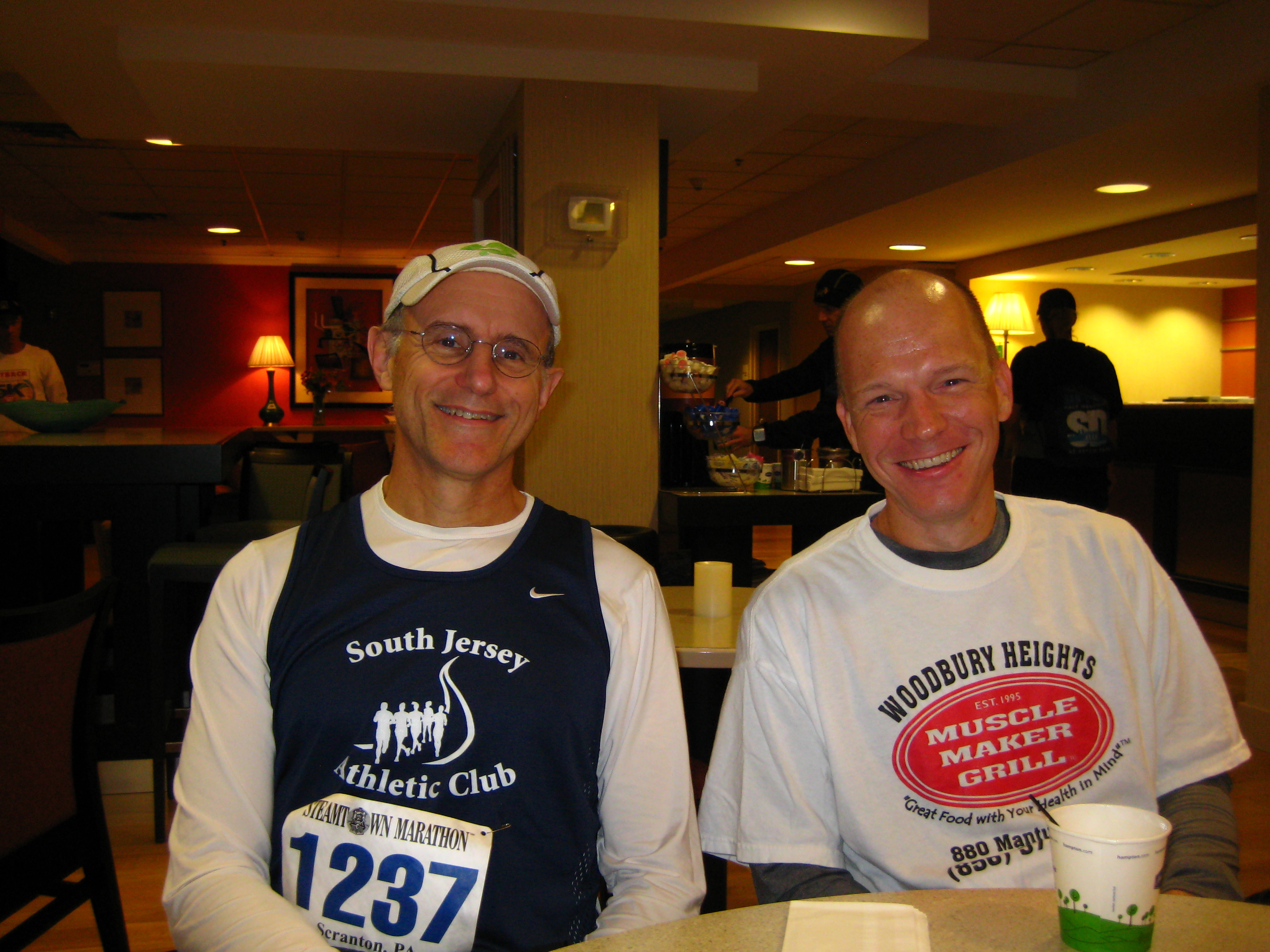
At the restaurant, we had a large group, Lisa, Tony Brian, his wife Sarah and their two kids, Dan and his girlfriend Ashley, Steve and his wife Caren, and my wife Kathleen and me.

Lisa, Tony, Carin, Brian, and his daughter.

One half of the table, Lisa, Tony Caren and Brian with daughter.

Frank, Steve and Dan

The other half of the table, Frank, Steve and Dan.

Pretty much everyone stuck to the rule of pasta before the race.  There was ziti, ravioli, penne, spaghetti, and a few others which I don’t recall.  Tony drank a Bud, and Lisa had a Yuengling.  It seems that’s a sure way to do well in a marathon the next day.
We called it a night pretty early and headed back to the hotel.  The staff at the hotel was very accommodating, and told us they would have breakfast ready to go at five AM the next morning, so we would be well fed heading our for our race.  True to their word, the waffle maker, and the whole rest of the breakfast buffet, was ready to go when we came down the next morning.  Thank you, staff at the Clarks Summit Hampton Inn!

Brian and Frank at Breakfast

Frank and Brian at Breakfast
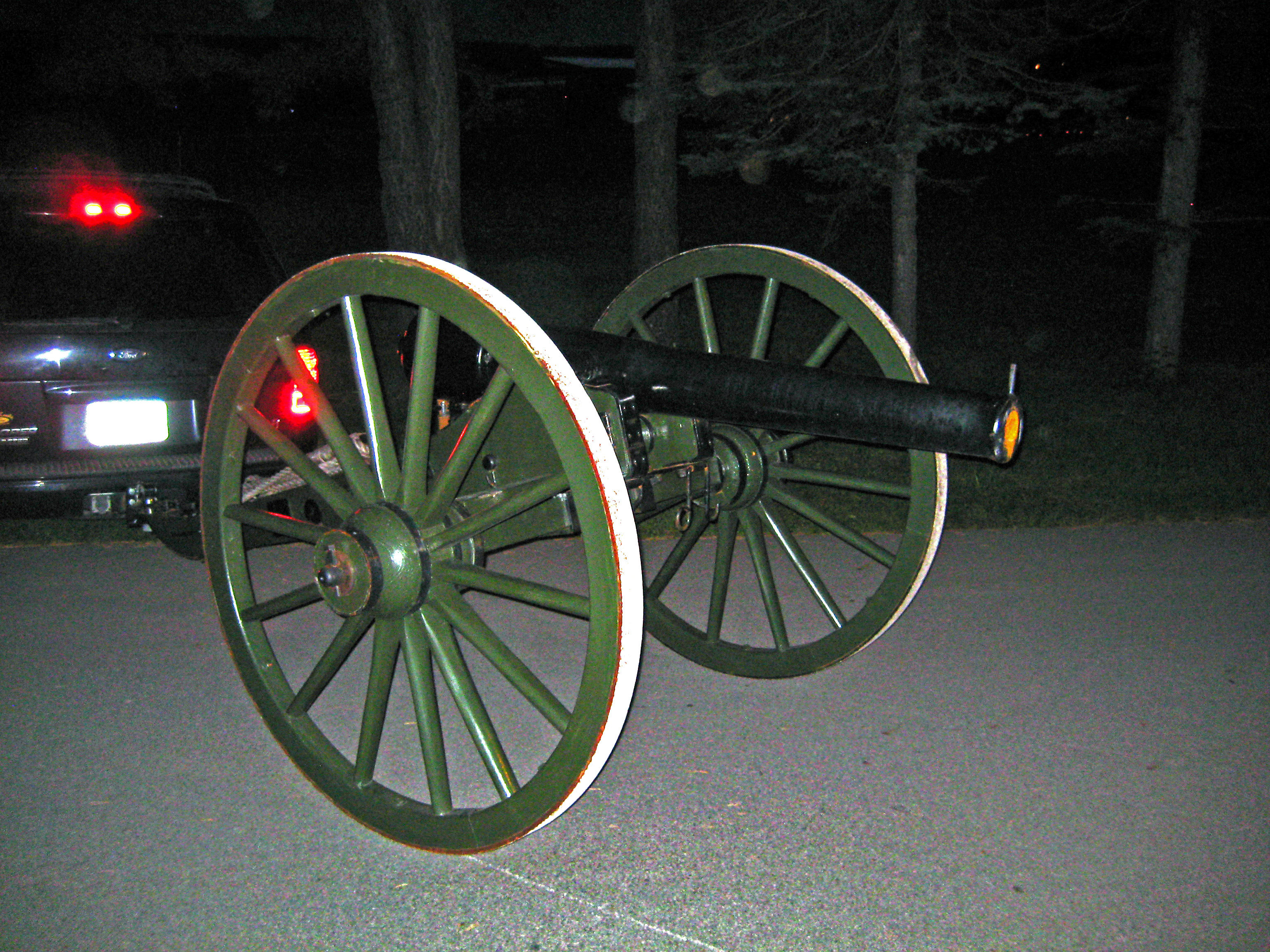
It took some work, a degree in logical thinking would have come in handy, in order to figure out the car arrangements for getting to the start of the race in Forest City.  Our final plan was for Caren, Steve’s wife to drive Steve, Tony, and me to Forest City, then Caren would head to the first support zone.  Lisa would drive Brian and Dan to Scranton and then they would take the bus up to Forest City.  Sarah, Ashley, and Brian’s kids would arrive in Scranton in time for the finish, and Kathleen, likewise would drive to Scranton and find her way to the finish line.  On the way to Forest City, we got to see the starting gun being towed to the start, the “gun” being a civil war canon.

Starting "gun".

The Starting “Gun”. It really sends out a shock wave when fired.

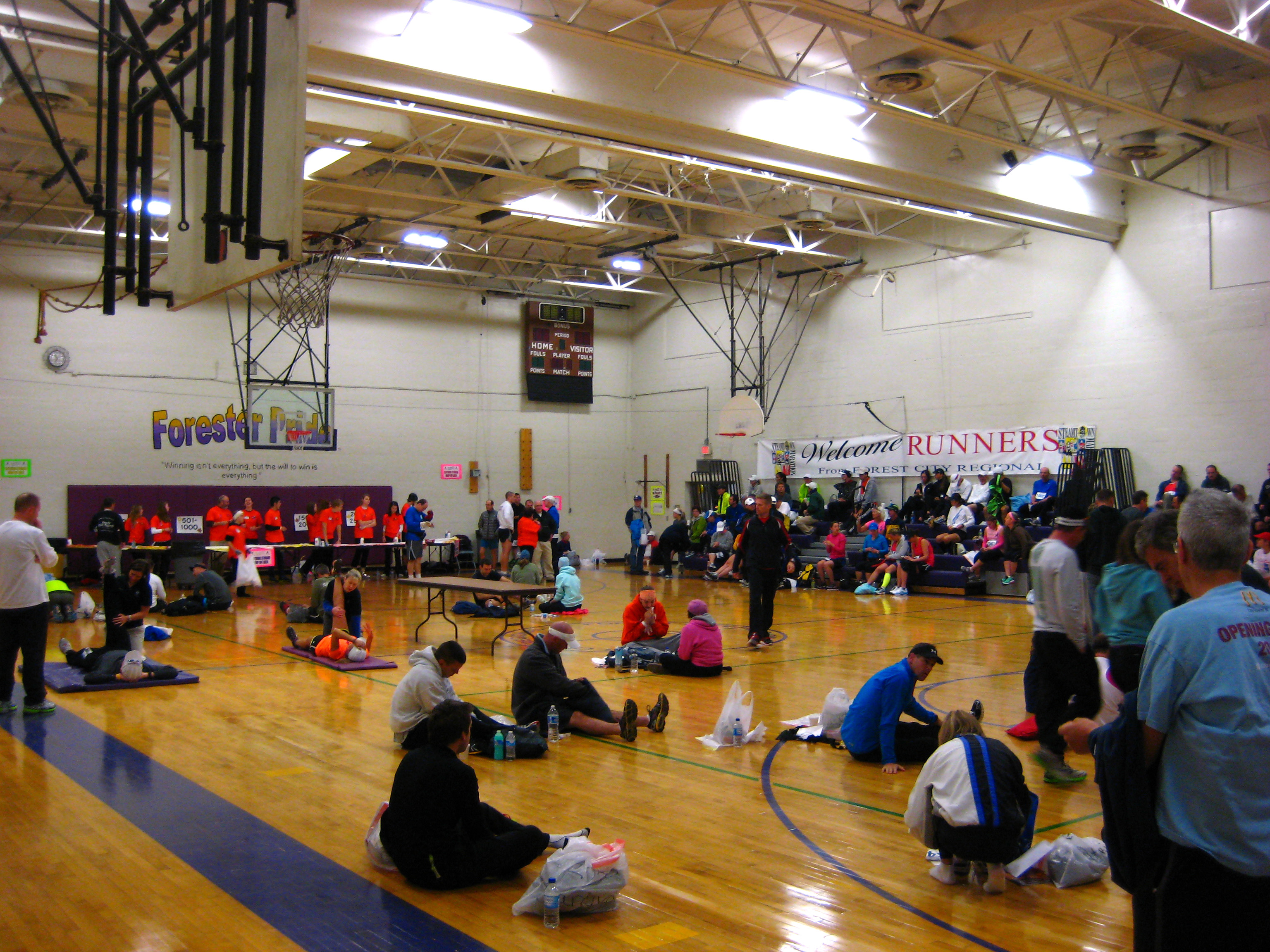
In the gym at the Forest City High School, we took care of last minute details, including, of course, a trip or two to the porta-john.  Interestingly, they had separate units for men and women, which, I’m sure, made the women very happy, since we guys are not exactly neat and tidy.  The runners were filing in, past the cheerleader brigade out front, the friendly students handing out coffee and hot chocolate, and the busy looking officials.  For a smaller marathon, they do know how to make us comfortable.  My impression at the expo was again confirmed, that everyone of the assembling runners looked like they were fit and ready.

Gym at Forest City H.S.

The gym at Forest City H.S. starts to fill up.

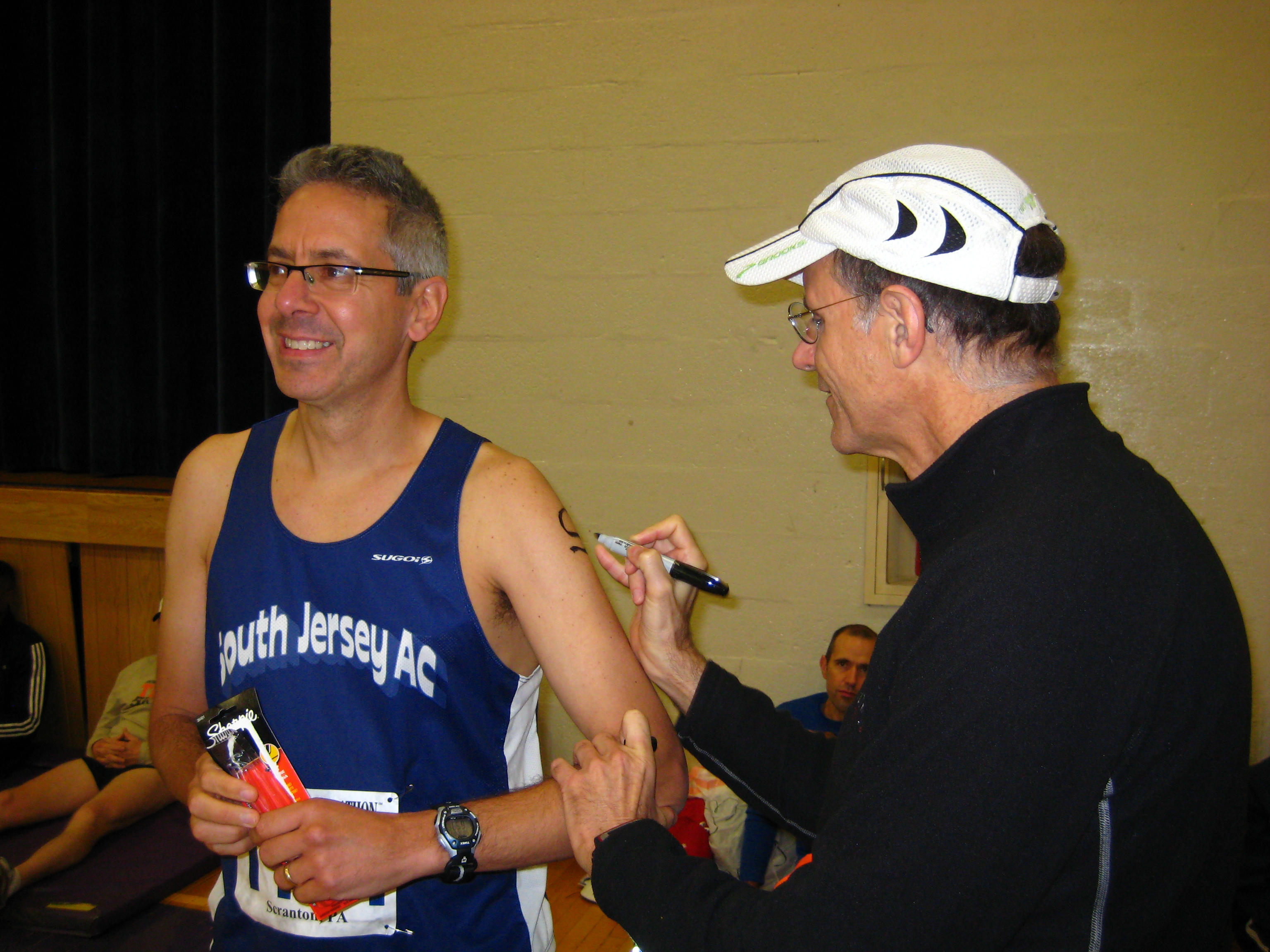
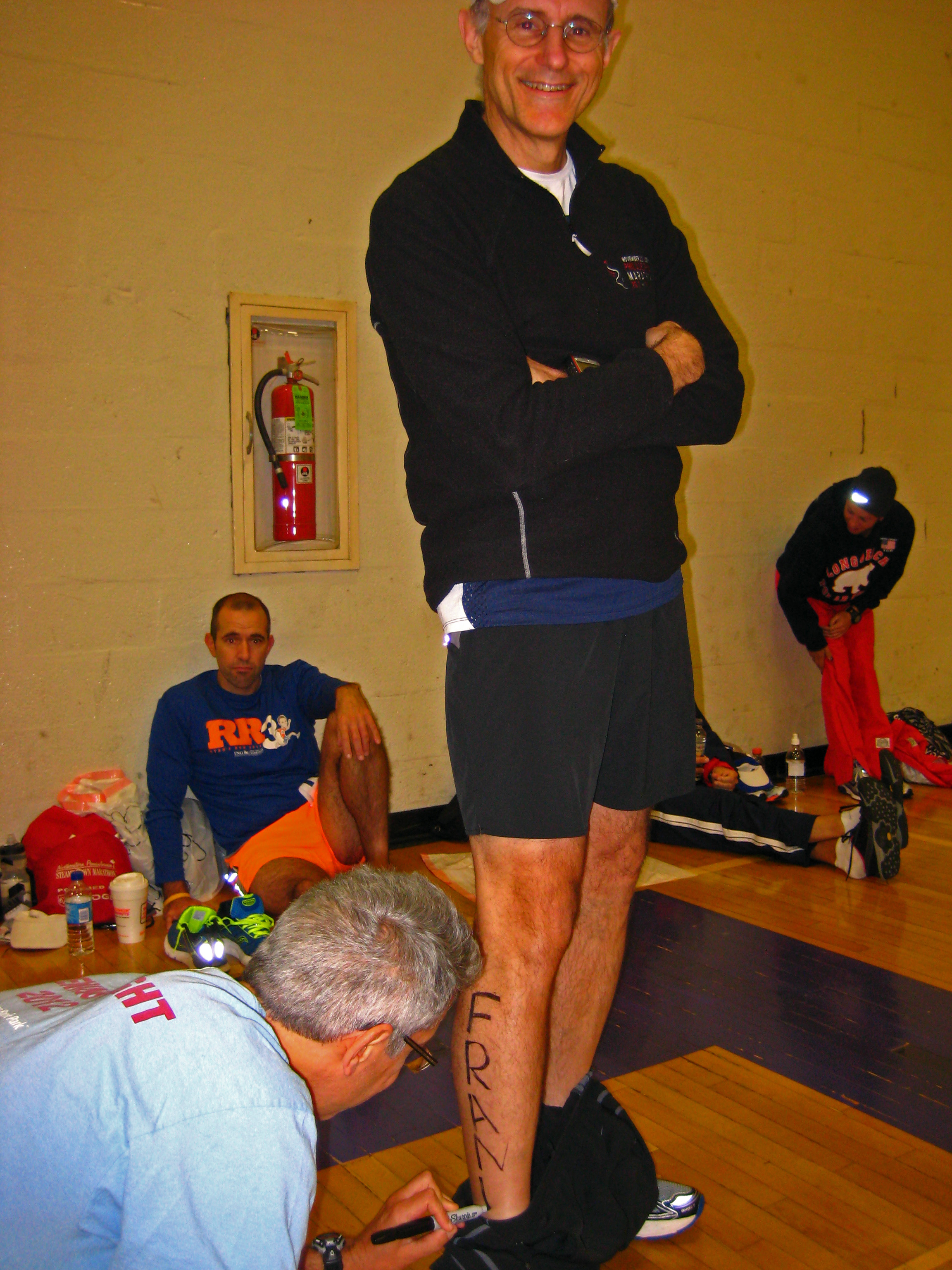
Steve came up with the idea of writing our names on our bodies, so the fans would know who to yell for.

Steve gets a name.

Let’s see, that’s S…..T….E…, don’t want to make a mistake!

STEVE!

Nailed it! STEVE : )

Frank and the magic marker.

They’ll need to look at my legs to see my name. I wonder if that will work.

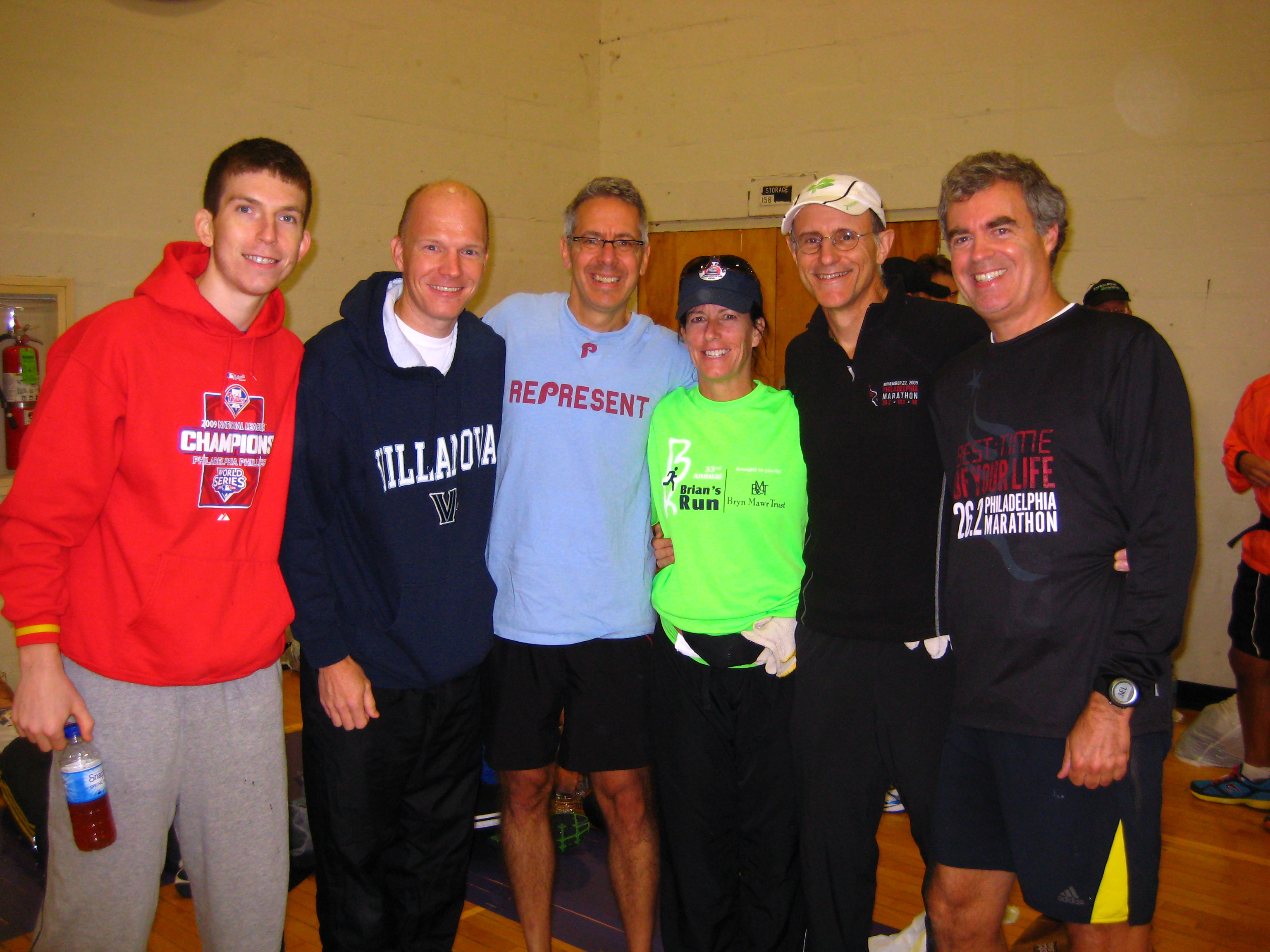
And here’s the group all together, getting a bit nervous, and wanting to get the show on the road.

The group from SJAC

SJAC Marathoners wait in the gym at Forest City, H.S. Dan, Brian, Steve, Lisa, Frank and Tony.

The race started off close to the planned start of 8 AM.  Fortunately for us all, the rain stayed away for the entire race.  The temperature at the start was about 40 deg., and it warmed up to about 50 by the end.  True to all the stories we had heard from former runners, the start is a very steep drop down hill.  The net drop in the first 10 miles is about 900 feet, and one really gets sucked in to the speed one gets from letting it rip down hill.  I noticed that at the halfway mark, while I was still hanging with Tony, my half marathon time was faster than any half marathon I’ve run, just under 1:45.  Ed, from SJAC, warned us about going out too fast.  My feeling was that to slow down also takes a big toll on the muscles, from the braking action, so you are damned either way.  Just past the half marathon mark, the run gets into a rolling hill, up and down, mode.  It heads into the woods over graveled trails, which I found hurt my feet.  By sixteen miles, I had given up all my time savings and started to really slow down.  My legs were in pain, and I was starting to get some twitches  in my calf muscles.  Between the pain building in my muscles and the twitches turning in to real cramps, I could see my time goal not just slipping away, but having left the station a long time ago.  So, what to salvage?  By the way, Tony had steadily moved forward at the halfway mark and it was the last I saw of him until the finish line.  Leaving the last of the trails in the woods, we continued on rolling roads as we headed toward Scranton.  I had the honor of running beside  “Hizzoner” Mayor Chris and his wife Donna, of Scranton, who were both looking very good over the last several miles.  As we ran along, the crowds grew large, and their support for their mayor was tremendous.  I got energized by their loud cheers for their mayor, pretending it was for me, which really helped drive me to the finish.  Over the last two miles I was getting some very strange cramps in my left leg causing my foot to twist almost sideways.  I’m sure I had a bit of a Quasimodo look as I headed up the remaining climb to the finish line.  Crossing the finish line, I was barely able to lift my arms to shoulder height, trying unsuccessfully to look good for the camera.  I finished in 3 hours, 57 minutes and 11 seconds.  My personal best is 3:44:14, so I didn’t make a PR, and I certainly didn’t make my Boston Qualifier.  But, I finished under four hours, and I was happy to have done so.  Tony was brilliant, finishing in 3:39:06, under the Boston standard of 3:40 for his (and my) age group.  He was very depleted at the end of the race, as were we all, although I think he was worse off than the rest of us.  Steve finished in a very respectable 3:45:34, not what he wanted, but then, it’s a tough race.

Tony at the finish.

Tony, wearing the smile of his best marathon ever, and a Boston Qualifier!

Steve, at the finish

Steve, happy to be finished.

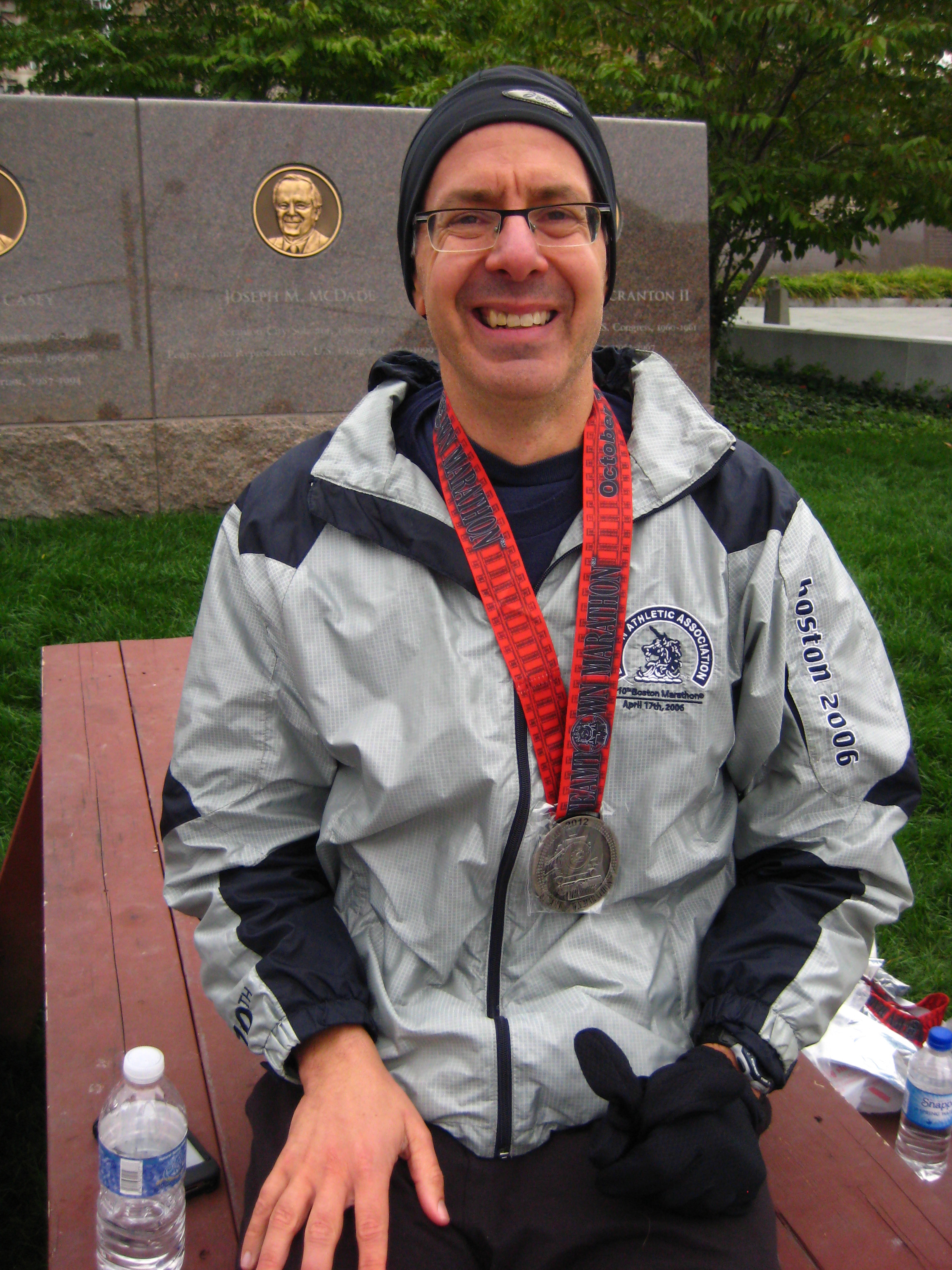
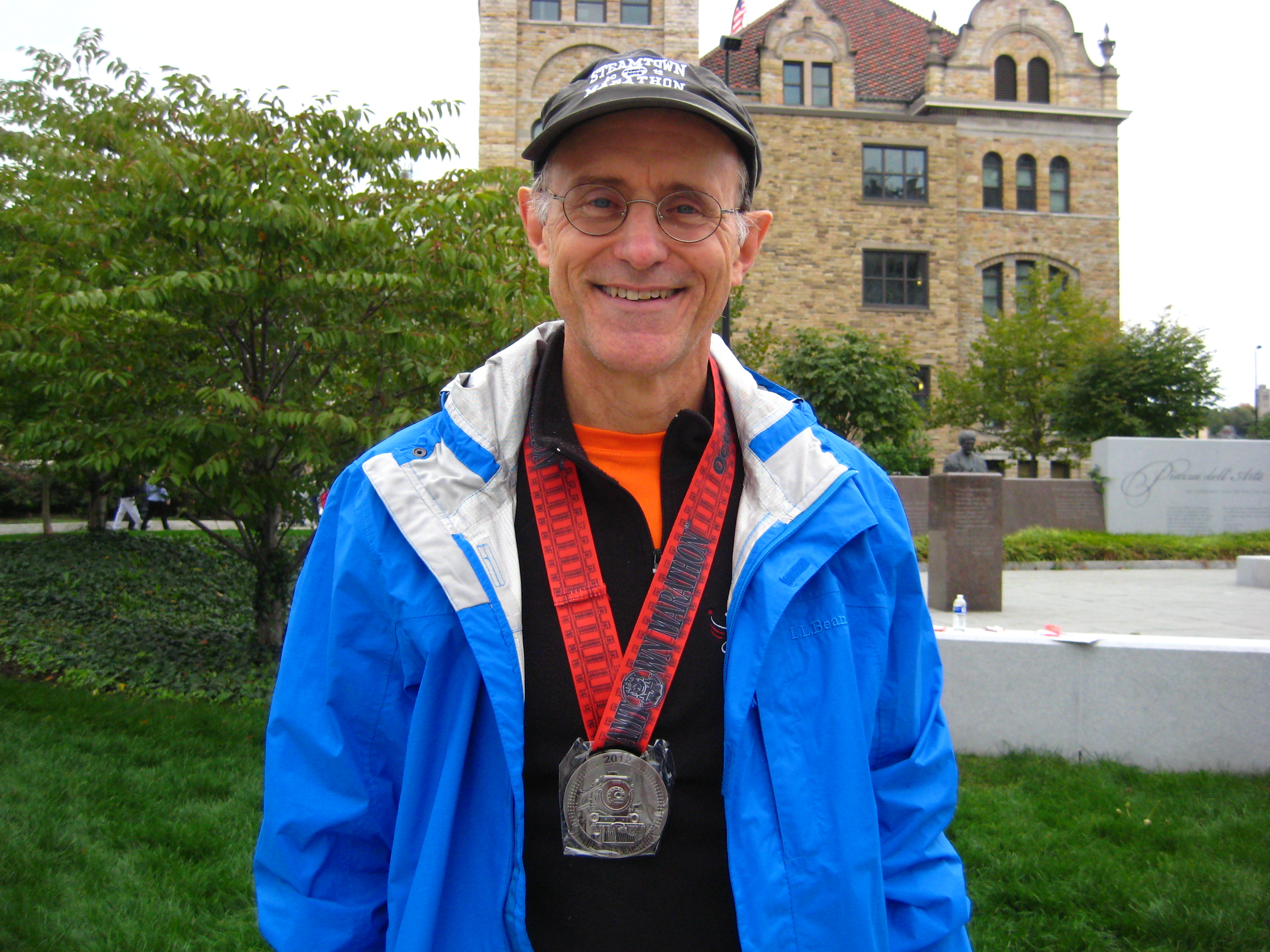
Frank, in front of the Scranton court house.

Frank, glad to have warm clothing on, and happy to have survived.

Caren and Kathleen

Caren, Steve’s wife, and Kathleen, my wife, provided invaluable support and cheer in our efforts to prove ourselves on the marathon course, and we thank them from the bottom of our hearts.

After we had a chance to warm up, replenish some fluids and let the muscles stop twitching, Tony, Steve, Lisa, and I, along with our support crew of Caren and Kathleen, headed back up to Clarks Summit for lunch.  We ate at a surprisingly good Mexican restaurant across the street from our hotel, called La Tonalteca, a chain, but with very authentic food.  Poor Tony found it hard to face eating anything at this point, leaving a beautiful bowl of tortilla soup untouched, but the rest of us found it in ourselves to chow down.

I find each marathon I run to be tremendously challenging, often painful, and mostly discouraging.  As soon as I’m done, why am I thinking about the next one?  I think I really love this sport, greatly respect the runners who run with me, and want to keep pushing to get better.

Frank

Uncorking Croatia

The Blog of WINES OF CROATIA

RunnersOnTheGo.com

To help enrich the lives of others, we developed RunnersOnTheGo.com to help runners save money on races, running stores, and much more. We also provide the specific local information that makes your travel for business, vacation, or racing as rewarding as possible.

getsetandgo

Travel Blog of a Budget Traveler sharing stories on travel, books & Vegetarian Food

Marc Hemingway

Trying to keep track of my life (and my life on track)

Mid-Life, Mid-Level, Masters Running

Exploring ideas about running to contribute to a more enjoyable pursuit for the mid-level masters runner

therunningtherapist

"One foot in front of the other and one thought at a time"

WordPress.com News

The latest news on WordPress.com and the WordPress community.

retireediary

The Diary of a Retiree