This Was Not The Plan

Camping at Trap Pond, Delmarva Peninsula.

i jumped into the pool as I always do, backside first, to start my first swim workout in a few weeks, having just returned from a very enjoyable two weeks in Italy. I positioned my goggles and pushed off, clicking my Garmin as I did. After a mere two 400’s, I noticed my left arm had become swollen and tense. But this is the most recent part of the story. Allow me to go back a few years.

Around the new year in 2021, while I was still busily working as a general surgeon, I went for a run with my friend Pat. We had run about a mile and a half when I was hit by a shearing pain in my right calf. Pat helped me hobble back to his house. I was able to drive my car home. The pain slowly eased, and I went back to work as usual, but had a noticeable limp. I sought out one of my orthopedic colleagues who examined me. He said I ruptured a Baker’s cyst, which is a cyst of the knee’s joint capsule. There was no treatment for it, just had to wait for it to improve. He ordered an MRI of my knee, which confirmed the cyst rupture, but also showed I completely tore off my medial meniscus on that side. He did not say I could not run, but suggested it may increase the wear on my knee.
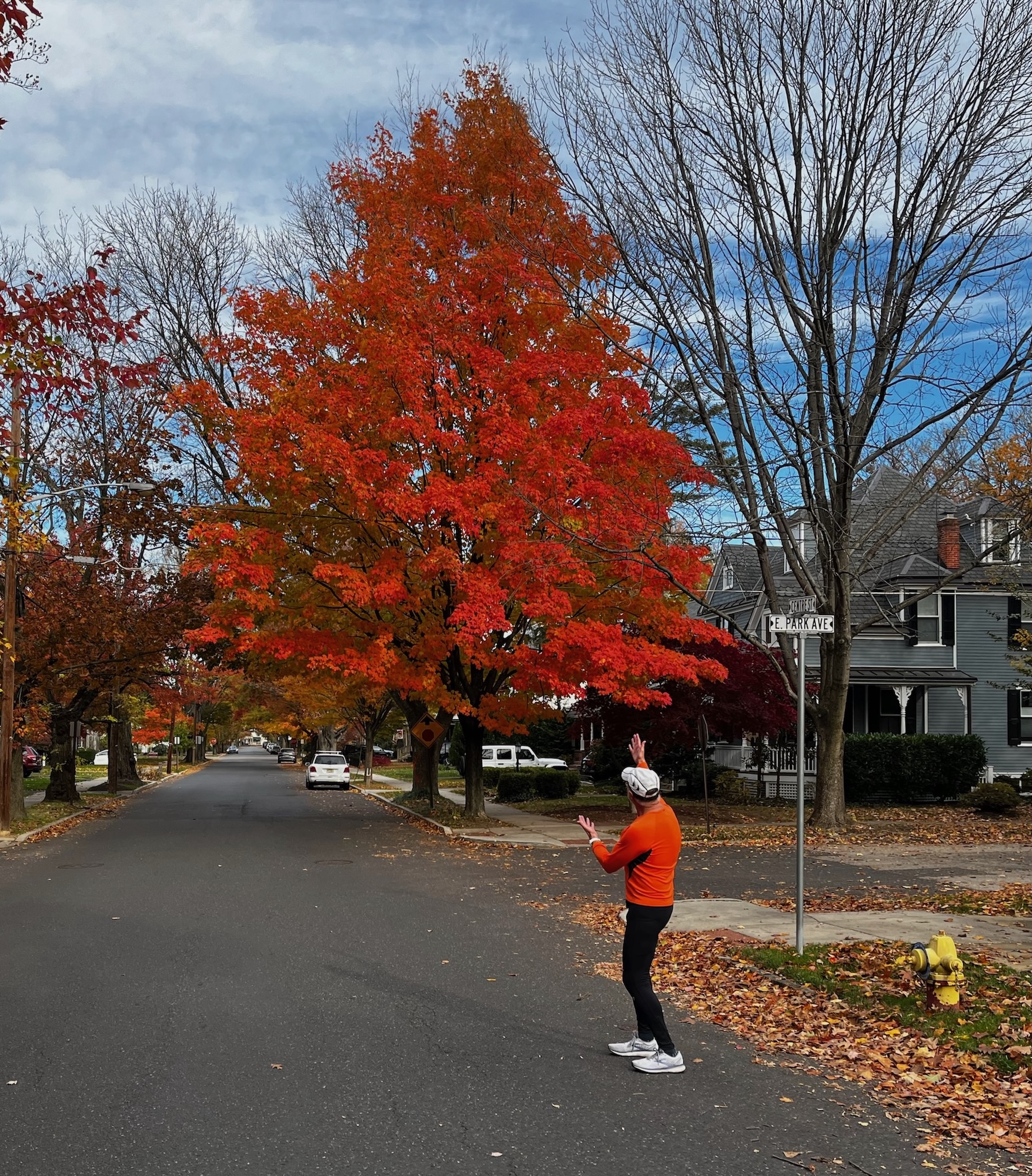
Running in Haddonfield, Fall Colors

So, naturally, after the pain got better, I started running again, although it took a few months of downtime. I started getting in some longer runs, cycling, and some rowing machine workouts. On a Friday in early November, 2023, I went for a run at the end of a long day at work. Oddly, I got about a tenth of a mile and developed pain in my left thigh. I stopped my run and the pain disappeared, so I started up again. But the pain consistently came back at each tenth of a mile. Being bullheaded I kept this up for a couple of miles. When I got home I rested, then felt back to normal the next morning. I went out for a run, thinking everything was back to normal. The same pattern happened again, and looking down at my left leg, it appeared swollen and blue. I know the signs of a deep vein thrombosis, so I hobbled home and took an aspirin. My wife was out, but when she returned she drove me to my hospital’s ER. It is strange as a well-known surgeon walking into one’s own ER, and explaining I am not there to see a patient, I am the patient. I received very nice care from all the ER personnel, and I recognize that because I work there they looked out for me. But I know from my patients’ experiences they have received the same considerate care. At first, an ultrasound of the veins of my left leg and thigh was done which showed no blockage. But a CT scan of my pelvis followed, which showed a complete obstruction of my left common iliac vein, a major vein leading to my vena cava. This condition has a name, May-Thurner syndrome. I was admitted to the hospital and the next day I was operated on by one of my former trainees who used a catheter to remove the blood clot. I’m thankful she turned out to be such an excellent vascular surgeon. I was discharged the following day, Sunday, and back at work on Monday. But my days operating were coming to an end, as I had planned to retire on January 1, 2024. I did just that, and felt it was good timing. I took up teaching at our medical school, and started running again about six weeks after the surgery.

I noticed early on in 2024 that when. I put a push on at the end of a run, I would get a strange feeling in the front of my chest. I attributed it to a fall I had skiing that February, when I hit the snow hard. The feeling came and went. I had a stress test ordered by my physician which was normal. In fact, while on the treadmill the nurse asked if I was a runner, since they had the pace cranked up pretty high. The chest discomfort persisted, though, and by late October it had become predictable. I would run about half a mile when the squeezing sensation started, I’d stop for a minute or two, then it would occur again at another half mile. I called my physician who spoke with a cardiologist. The decision was to have a cardiac catheterization done as a precaution.
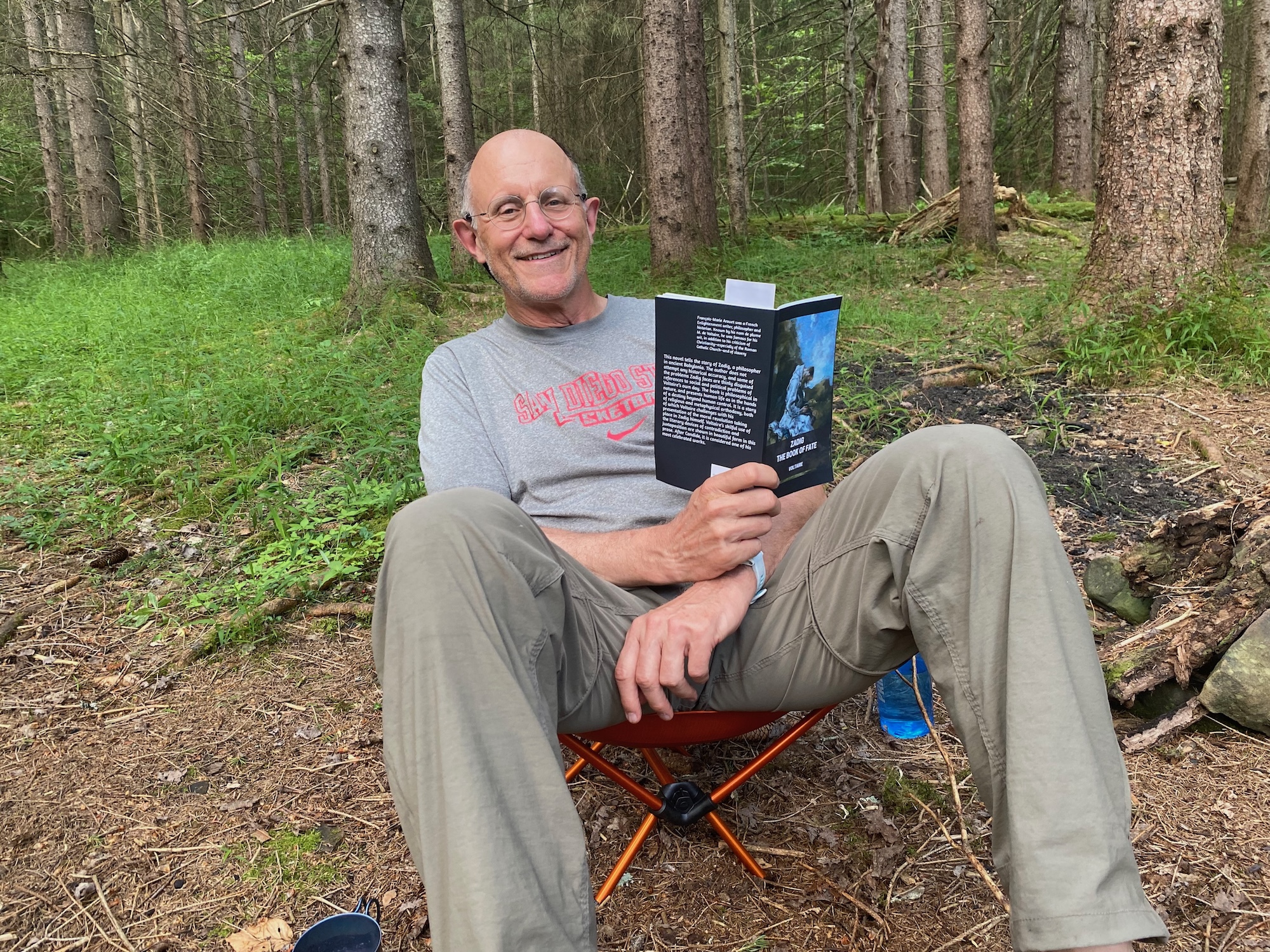
Backpacking the West Rim Trail

A few days later I was in the cath lab. I was awake as the cardiologist snaked a catheter up my right radial artery, through my aorta and into my coronary arteries. He only made a few technical comments as he did this. When he finished the study, but with the catheter still in, he pulled up the video screen and showed my what he found. There was an area of significant narrowing from plaque in one of my major coronary arteries, the left anterior descending. He had taken pressure measurements across the area showing a drop in pressure. He said I could have surgery or a stent, but recommended the stent. While I’m partial to surgery, the stent seemed the best choice. First, a narrow balloon is used to dilate the blockage, then a stent is expanded at the site. As this was happening I notice feeling the same squeezing sensation I had experienced while running. That confirmed that I needed this dilation and stent.

Six weeks later, I took my first run after the stent. I got to a half mile and kept going. I didn’t feel great, but there was no chest pain. I got back to my usual activities, went skiing, running, cycling and swimming, and felt pretty good. My backpacking friends and I tackled the “Grand Canyon of Pennsylvania” in June of 2024. We decided it was along a canyon, but perhaps not so grand. It was also very warm, and as we backpacked we had to be sure to keep enough clean water with us, as we were losing a lot to sweat. By the one year anniversary of my stent, in November, I was very thankful for the skill of the cardiologist and that I spoke up about my chest pain.

Things continued. on an even keel through February of this year when I went skiing again. I felt pretty good on the slopes, although had another fall when Sierra cement-like snow stuck to the bottom of my boot causing a ski to come off as I was flying down hill. I hit the ground hard on my left shoulder. Nothing broken, but the shoulder sure hurt. In mid-March, I noticed something peculiar. My normal resting heart rate had gone from its usual 48 to the low to mid thirties. I again saw my physician, although it was just for a routine visit. The nurse mentioned my slow heart rate which my physician, who happens to be a friend and fellow cyclist, attributed it to my fine athletic conditioning (he he). However, on a trip with my wife to Ireland, I noticed she could march right up a trail on a hill while I struggled and got short of breath. After returning from Ireland, I went backpacking for a weekend. While my companions had no trouble climbing hills with their packs, I had to stop every ten feet to catch my breath. I survived the backpacking trip, but on return had an appointment, routine, to see my cardiologist. I mentioned the shortness of breath. An EKG was done. The doctor stepped in to see me, but got a phone call. So he stepped out the door to take the call. On coming back in the room, he said “that call was about you”. That perked my ears up. He explained that my EKG showed complete, or third degree, heart block.

A little explanation may be needed here. The heart has a natural pacemaker located in the right atrium where the normal rhythm of the heart is set. This pacemaker causes an electrical signal to progress through fibers from the atrium to the ventricles, causing each to contract in turn. This is why a lub-dub rhythm is heard when listening to the heart with a stethoscope. Third degree heart block occurs when that electrical signal does not flow to the ventricles from the right atrium. This leaves the ventricle on its own. It fires at its own rate, which is called an escape rhythm, and at rest is normally in the mid thirties per minute. I was told by the cardiologist I would need a pacemaker inserted.

I was, around the same time, referred to an infectious disease (ID) specialist. Along with the abnormal heart rhythm I had developed a frequent cough. I told my story to the ID doctor, who also happens to be a colleague. He said I would need to be tested for Lyme disease. It turns out that heart block can be caused by Lyme disease, but I could not recall ever having the classic target rash or getting bitten by a deer tick. I got tested, first a screening test which was positive, then more definitive tests. These showed I had Lyme disease, although not within the last few months. He started me on a six week course of doxycycline. Meanwhile, I had a few more tests which showed evidence of congestive heart failure.

So, I was back in the same cath lab again, this time for a pacemaker insertion. The cardiologist was an electrophysiologist, different from the one who did my stent. I received a pacemaker with two leads, one to my right atrium and the other to my right ventricle. The atrial lead picks up my natural pacemaker’s rhythm, and the ventricle lead fires at an appropriate interval to cause the ventricles to contract. I recall saying to my wife as I lay in the hospital bed after the procedure, “wow, I feel so much better already!”.
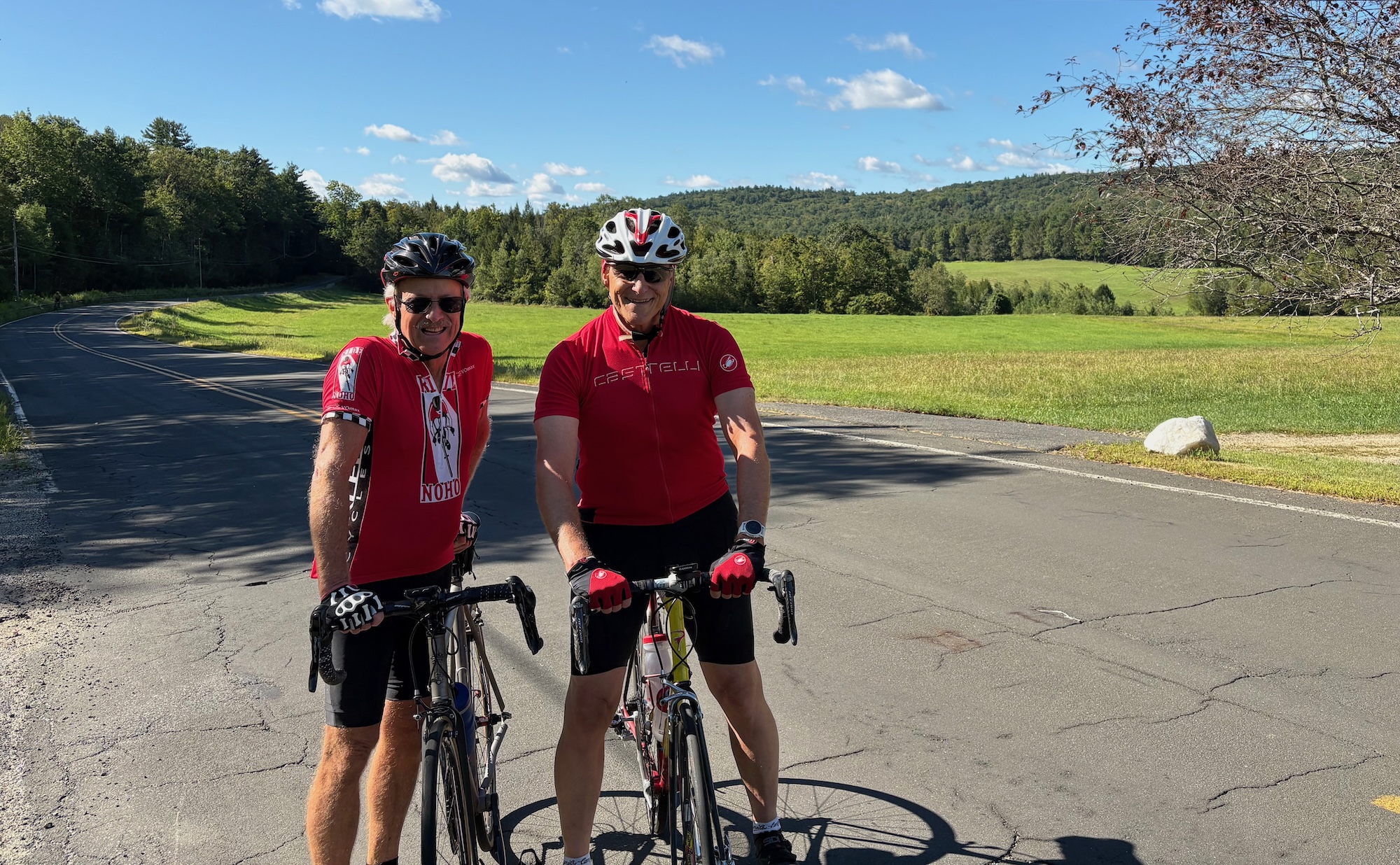
Cycling in Western Massachusetts

That was at the end of April of this year. I recuperated a few weeks, then at the end of May was able to do a thirty three mile bike ride in Delaware, the “Medio-Fondo”. My knee has gotten a little worse, but I still get in a short run or two, and I got back to swim workouts. In August, I spent a week riding with friends in Western Massachusetts. So, it appears the new pacemaker is doing its job. It is definitely odd feeling the device in my upper left chest and knowing I am dependent on it for my heart to beat properly.

In London, enjoying life.

But about that swelling in my arm. Things were going well. We had a very nice trip to Italy, walking all over Rome, Pompeii, Naples, Venice and Florence. We took very interesting and illuminating side trips to Padua and Siena. We even stopped over in London to visit friends on our return trip. When I got back, I went for a swim workout a few days later. I had not swum very far when I noticed my left arm tightening up a bit. After a second 400 yards, my left arm was quite stiff and the veins were bulging and tense. I got worried that I had developed a blood clot causing a major vein to be obstructed, possibly due to the leads from the pacemaker. I stopped my workout, got dressed and made some calls. First, I called the cardiologist who inserted the pacemaker. He was also concerned and recommended I get a venous ultrasound. My next call was to my vascular surgeon who helped me schedule the ultrasound for that day. The good news is that there was no blood clot. However, the arm was still a bit swollen. It appears I’ve developed some restriction of blood flow out of my arm, and when I stress the muscles, increased blood flow to the arm cannot leave easily. My hope is that with use, other veins will dilate to accommodate the increased blood flow thus reducing the swelling.

I did not anticipate any of this, and am telling the story as a reminder to myself that things like this happen as one gets older. This is both from aging, but also just chance. I must change my ideas about “getting fit”, and setting goals.

Given this is the Christmas season, the end of the year and start of a new year, I hope you all have a very pleasant and safe holiday time and keep going for another adventure.
Start off Slow…

And then ease off.

That was our joke with each other on Sunday morning runs ten years ago when I was almost always training for a marathon, or half, or the Broad Street 10 miler. Now, I have settled into running slower, cycling slower and skiing with more care.

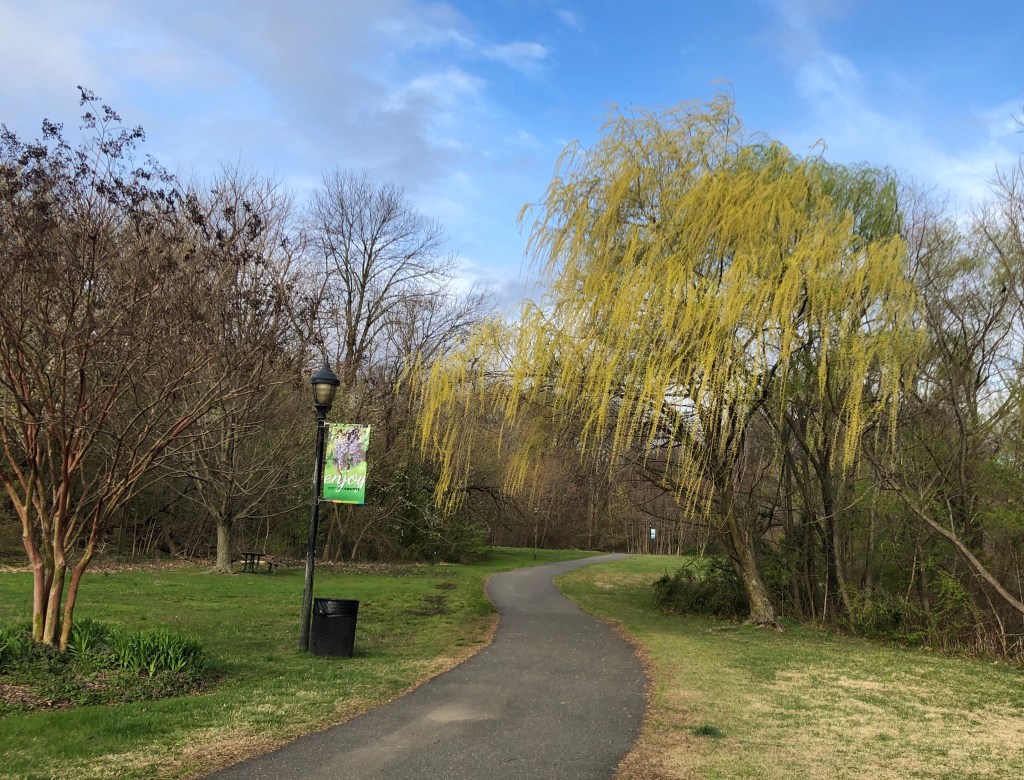
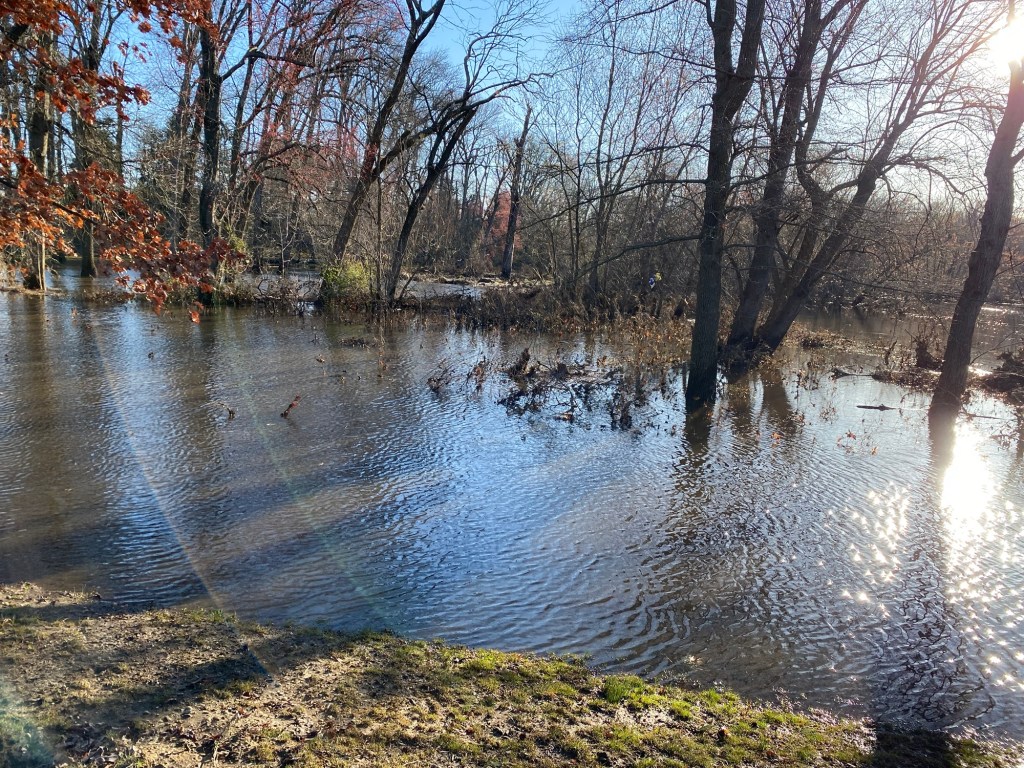
Here is the view from the back of the pack. It is odd to start running with the group Sunday morning only to have them blithely move ahead while I trot a respectful distance to the rear. I am adjusting, though, and there is a calmness to my runs I didn’t have before. I pause every now and then to catch a breather, and even stop to take a photo, as I did last Sunday, a day after heavy rains, when our local park was flooded.

Flooding along the Cooper River.

Regarding cycling, I still am pushing it to keep up with the other guys I ride with. They are mostly around my age and so I can’t pull that “I’m older than you guys” stuff with them. Fortunately several of them have dropped down from their peak a decade or more ago, but some of the guys were not listening, and continue to be beasts on two wheels. So right now I’m using the smart trainer to get the early spring training needed to look respectable in May. I signed up again for the Delaware Gran Fondo, a 100 km ride through the hills around Wilmington. It’s a fun ride with a nice party afterwards.

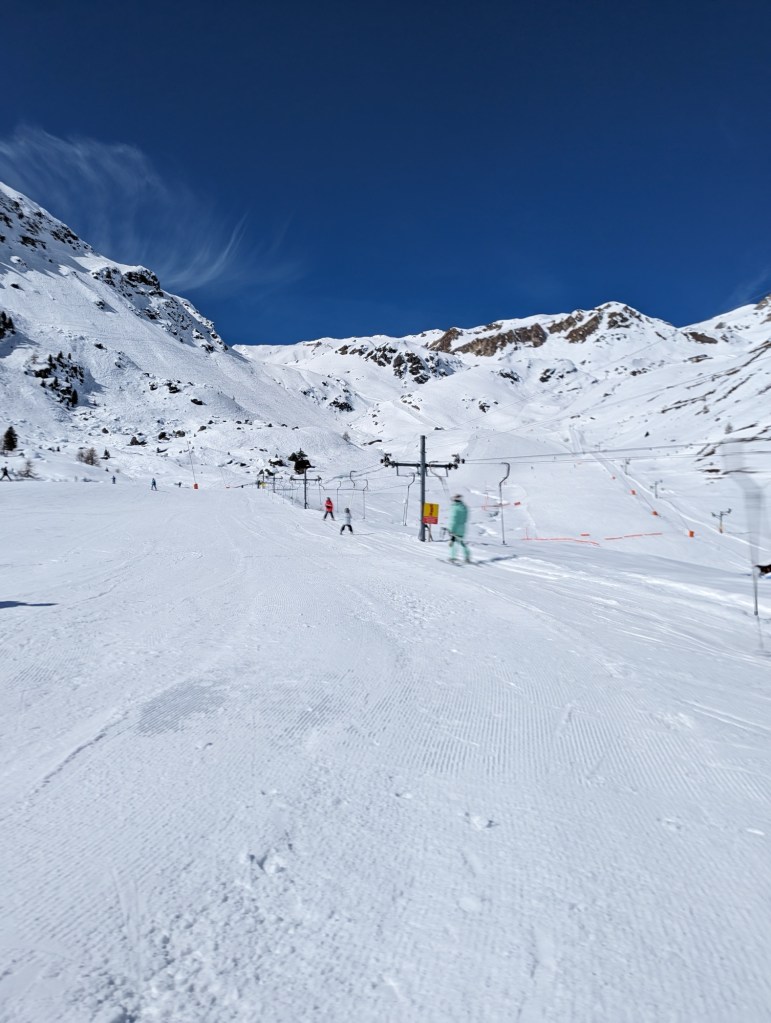
And skiing? I decided to improve my form. A friend of mine who is a ski instructor at Killington in Vermont suggested I try the “Carv” system. It consists of thin plates with sensors one inserts under the lining of the ski boot, inside the boot. They connect with electronic transmitters to my cell phone. I also got Bluetooth speakers for my helmet. I realize this sounds like a lot of gadgetry. But while skiing, a lovely English-accented Samantha gives me tips and encouragement on how to carve better. I actually feel it is improving my form! But the best part of skiing right now is seeing my two granddaughters, aged 7 and 4, learning how to ski. We took a trip to Switzerland and they had a great time with their ski instructors and also skiing with mom, dad and me after their lessons were finished. We were in a small village high in the alps called Grimentz.

So that’s the plan: start slow and then ease off. It seems to be working. Adapting to slower also means keeping one’s pride in check and not obsessing about time, pace or how many runs I got in.

But by all means keep going!

Trees, Running and Viruses

Trees on the Run

Trees can get sick, too. Since the descent into quarantine, isolation, social distancing, buying weeks’ worth of groceries at a time, and many other anti-communal activities, I have run solo a lot. In doing so, since conversation is limited to my occasional Tourette’s outbreak, I find myself admiring the scenery. Looking at trees along a run, one cannot help but be amazed at the way they grow, spreading branches, leafing out, producing flowers and tons of pollen. Yet they, too, are often victims of infection. Diseases that infect trees include bacteria, mycoplasmas, fungi, viruses, insects and other plants, like mistletoe or ivy. Some of the names of these diseases are whimsical, such as Drippy Nut of of Oak, Crown Gall, and Lucidus Root and Butt Rot. The American Chestnut has been completely wiped out by Chestnut Blight, a fungus. Dutch Elm Disease, another fungus, has killed a large percentage of Elms in the U.S., by obliterating the tree’s vasculature. My purpose here is not to do a treatise on tree diseases, but to appreciate these tall, sappy plants that provide awe and shade as we run.

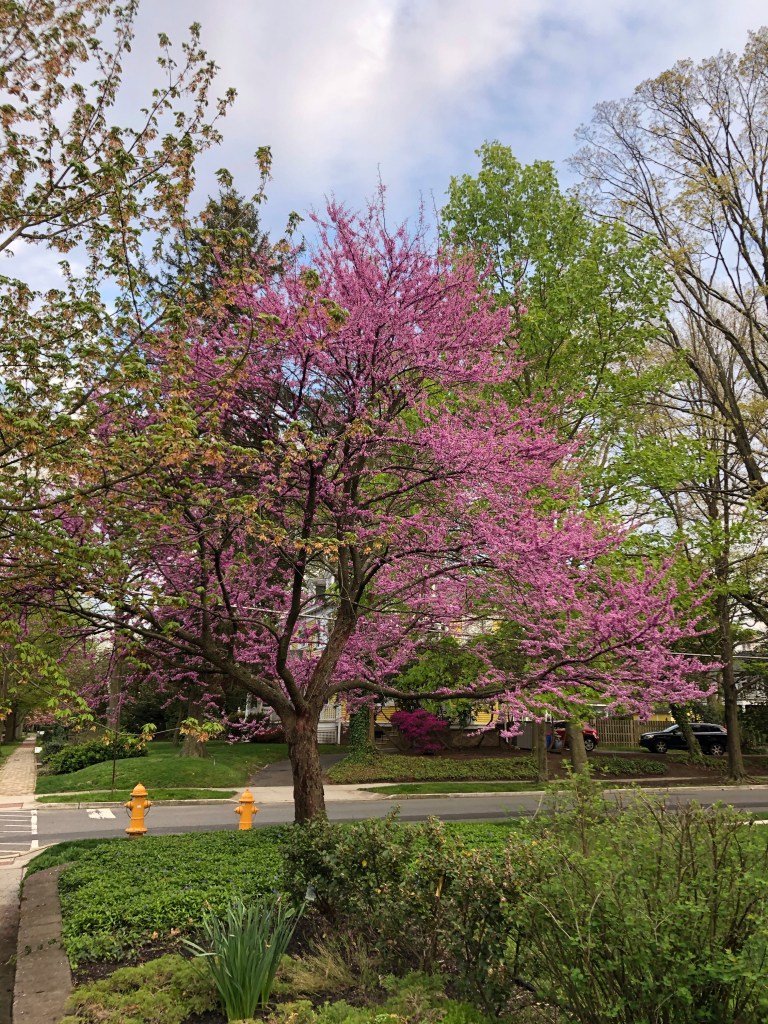
Redbud in Bloom

Trees have nowhere to go, nowhere to hide. But they have developed amazing defenses against nature’s tree enemies, allowing them to survive, some for centuries.

Sugar Maple leafing out, with a fig just beginning to leaf out in the foreground.

Some can be old and massive.

On Bancroft School Grounds, Haddonfield, New Jersey.
Some get modified to fit our environment, and manage to thrive.
Some modify themselves. Here the trees are reaching for sunshine.
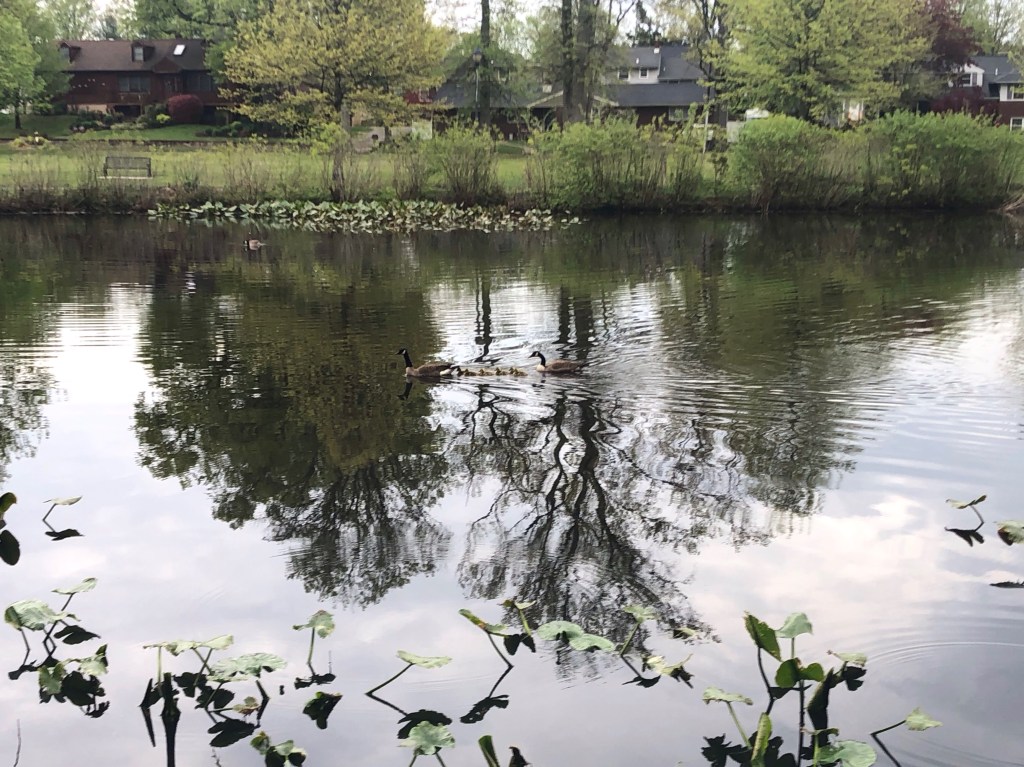
Reflected trees with a family of geese, goose, gander and goslings, in Newton Lake Park.
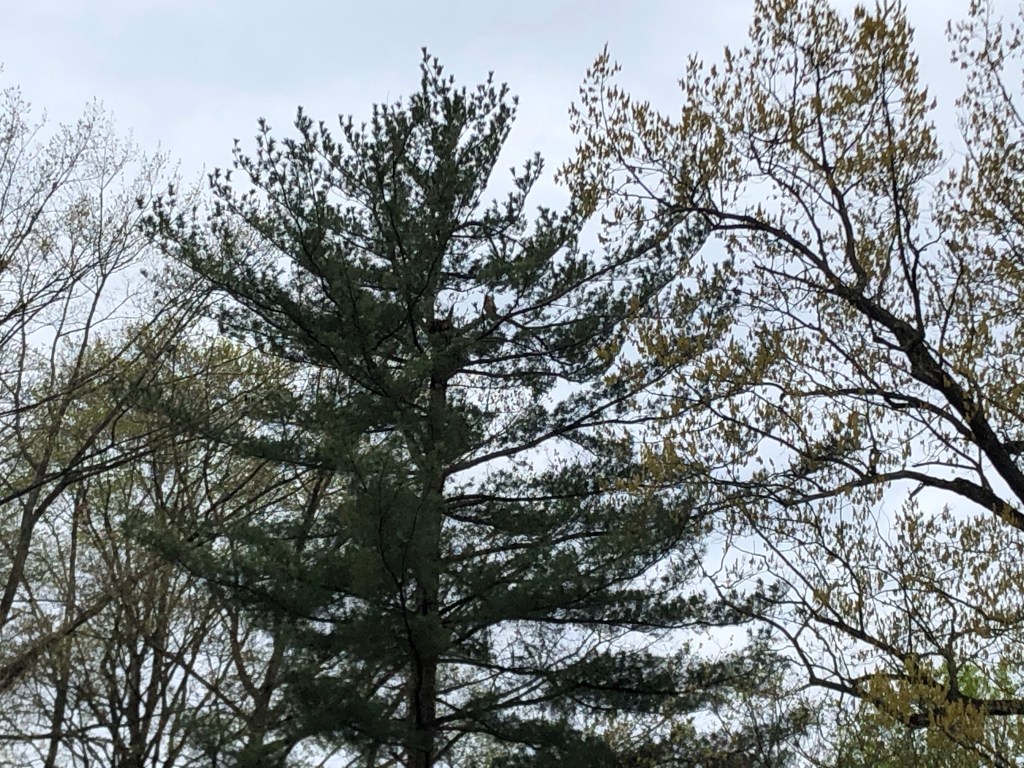
Some are home to birds; see the horned owl?
Or provide an egret a roost.
Not all trees have green leaves.
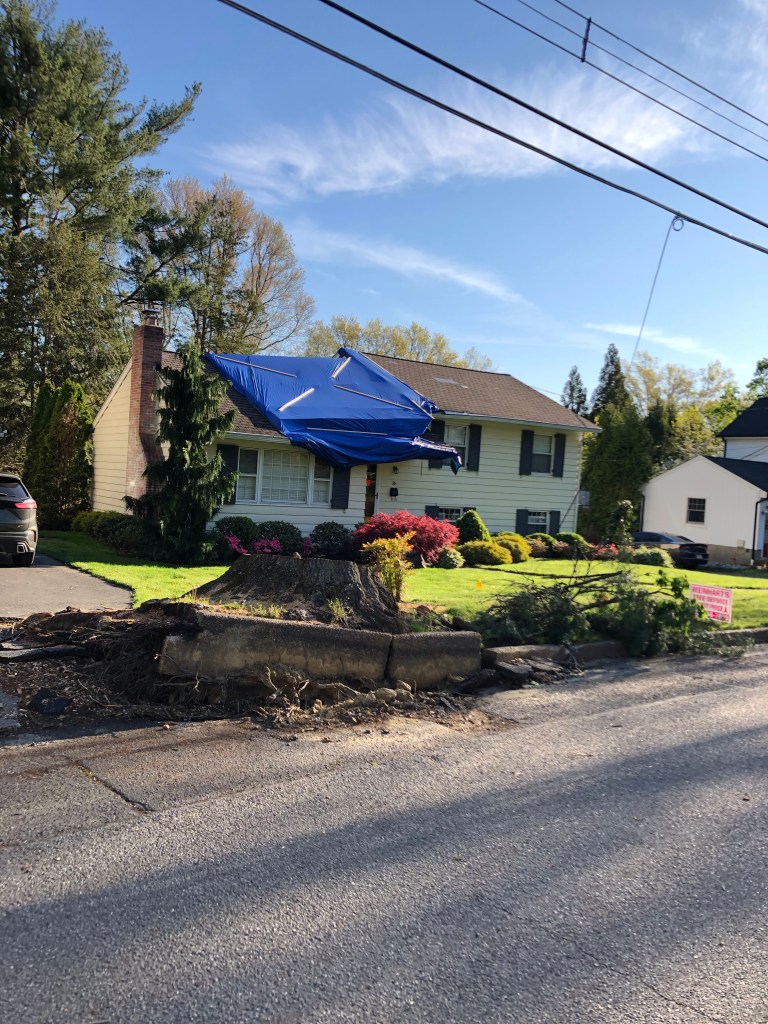
A domesticated tree turned wild, uprooting a sidewalk and caving in a roof.
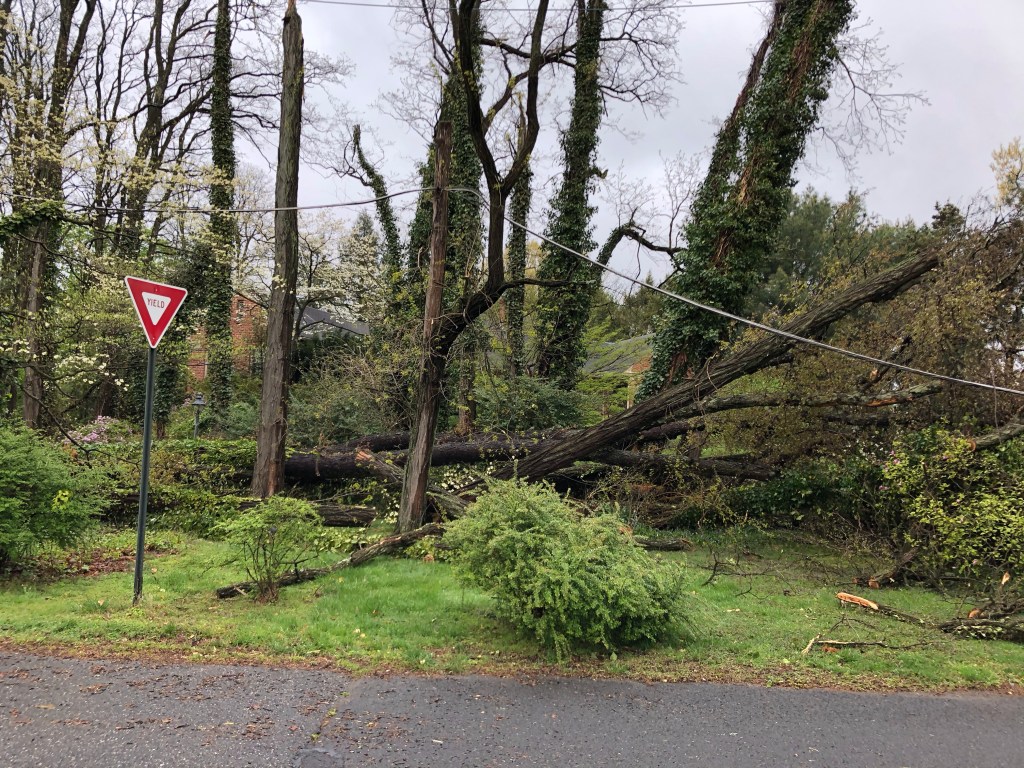
The same storm took down many trees in our neighborhood.
Some just collapse. Perhaps this was a sick tree that died.
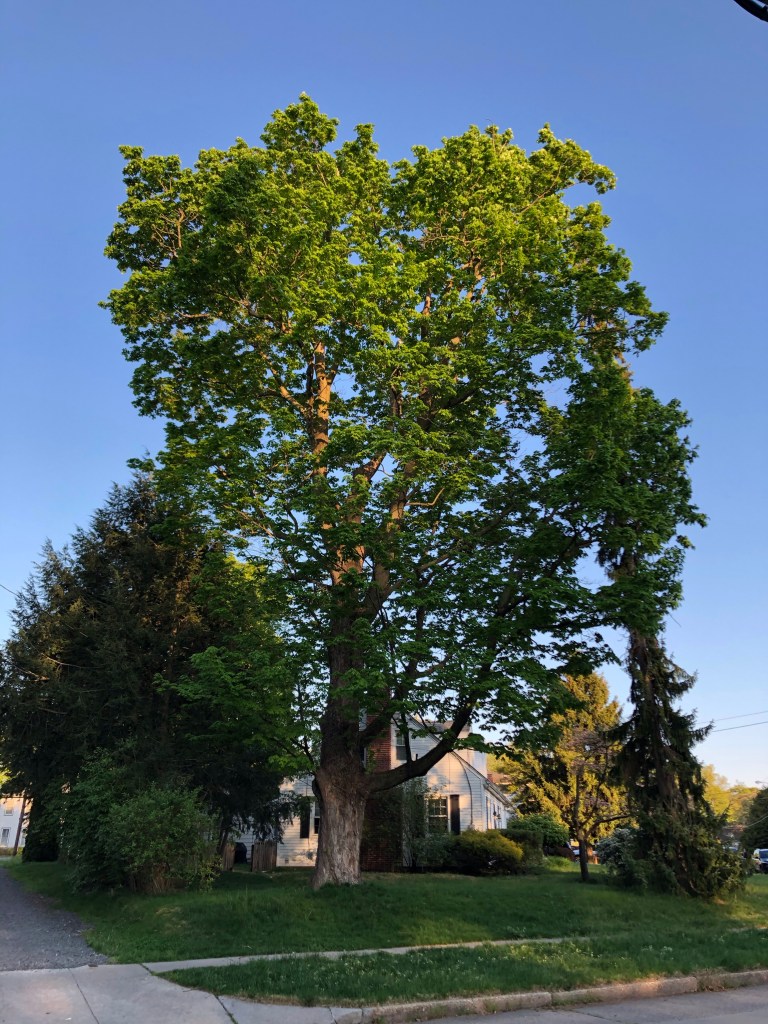
Trees grow where they’re planted, and some, like this one, are awe inspiring.
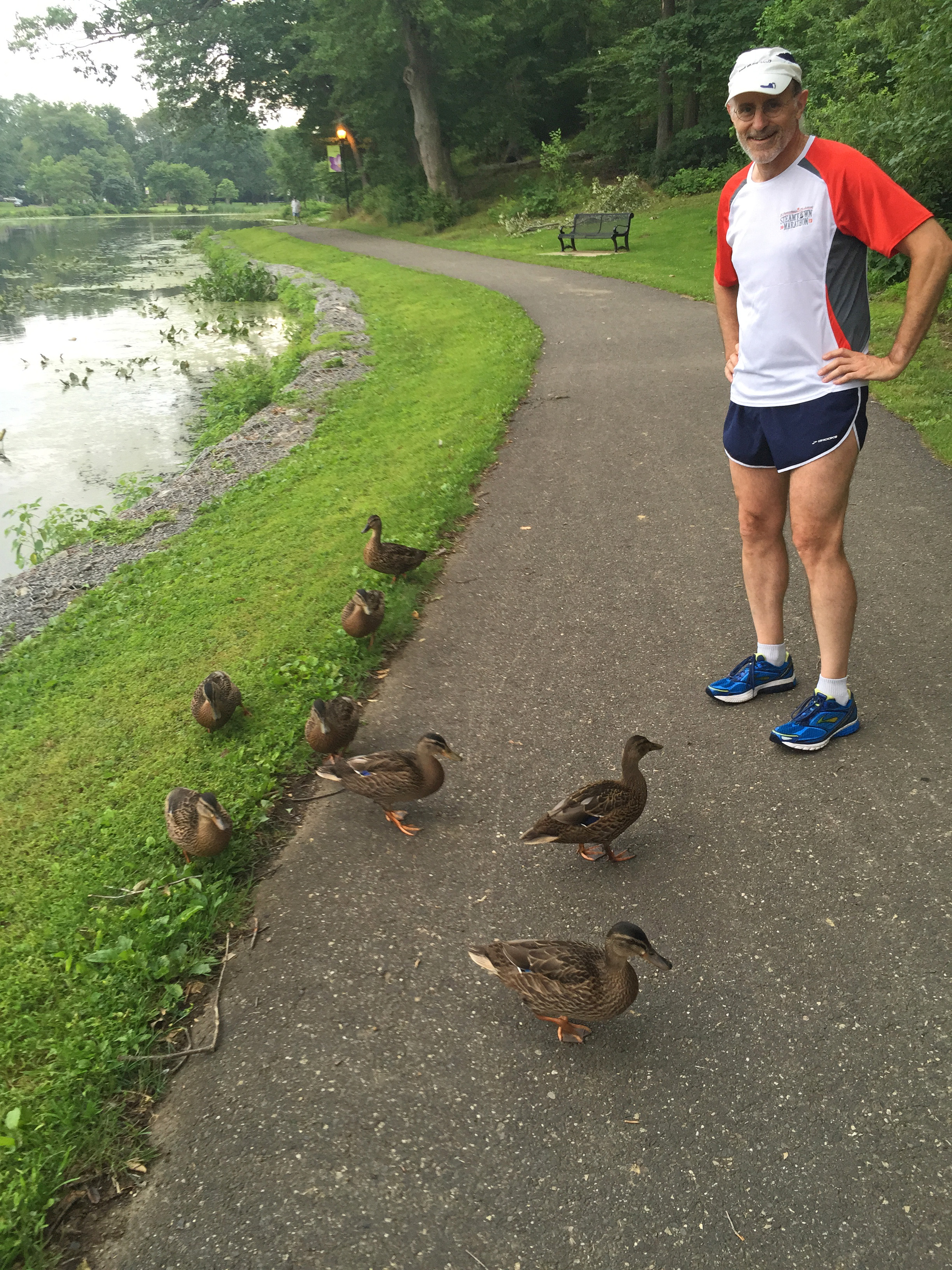
The ducks and I share the path.

Admiring the trees, their hardiness, beauty, longevity, and variety are inspiring as I run alone, waiting for Covid to be gone.

The Aging Carrot

Process

Process

As I  was digging up our carrots from our garden, having left them to grow the whole summer, I was pleasantly surprised to find the above carrot couplet you see on your left.  Why, it looked like an adoring couple, snuggling together, spooning.  I was quite taken by this natural representation of love, so I set the carrots on our counter in the kitchen.  There they stayed for some time.  When I again discovered them, hiding out behind other stuff that got piled around them, they had changed.  Yes, they were still in that loving, gentle embrace, but they lost their hair.  They became shriveled.  Their bright orange color was gone.  The embrace had lost some vital turgor.  In a matter of a few weeks, they went from being youthful and attractive, to stereotypes of the aged.

I am feeling this way, struck by the evil vicissitudes of my aging body.  It seems to have come on rather suddenly, as if a switch was turned.  I was still able to manage a decent marathon in 2015.  But this past year, my times for various races rose like hot air balloons.  What happened to the speed?  Also, I’m feeling pains I used to only feel the day after the marathon.  Now, when I wake in the morning and head downstairs to make coffee, I find myself relying on the banister, as my thigh muscles put out little protest yelps of pain.

I suspect some of this has come about due to my daily schedule and obligations leaving less time for training.  I know, people say, “you have to make the time.”  “There’s no excuse.”  But long work days and, during the winter months, short daylight hours, make challenges to getting out there and maintaining the fitness.  The other aspect, though, is what to expect as we get older.  Listening to the broadcasts of the Australian Open tennis tournament, the announcers stated over and over how shocking it was that the finalists, men and women, were all older than 30(!), and some over 35 (shocking!).  One can only imagine the losses in strength and ability to recover when one is over 60.  One estimate I read is that one loses about 0.6% of one’s overall strength and fitness for each year over 30.  I think that percentage applies to the previous year’s fitness, so that the 0.6% is subtracted not from the level at 30 each year, but from the last year’s level.

When I was 48 I got a book by Joel Friel, called “Cycling Past 50”.  While published in 1998, I think it has a lot of excellent information and advice which can be used in any sport, and certainly beyond 50.  He starts with some graphs showing how our bodies lose muscle, strength, and aerobic capacity as we grow older.  He also shows, in graph form, what happens if one allows extra body fat to accumulate, and it is not a pretty picture.   V̇O2max drops much more by the age of 70 if the percent body fat is 30% as opposed to 15%.  He addresses “task creep”, which he states refers to accumulating more work and responsibility as one hits the peak of one’s professional years in the 50-65 age group.  Beyond cycling specific information, he addresses recovery, nutrition and injury avoidance, all taking on greater importance as we get older but still wish to train and compete.  I also just ordered “Running Until You’re 100”, by Jeff Galloway.  That’s the way to take the long view….

While I feel like that carrot on the right in the top photo, I believe I can persevere and even get a few good races in, in the coming years.  At the same time, I want to continue to enjoy the benefits of aging, such as more freedom to travel, offspring who have become successful in their own lives, and an appreciation for life in general.  Anyway, see you out on the road.


Looking out; Looking Back

Way back in college, one of my professors, in a class in which I was a bit lost, talked about “signifier and signified”.  Hang with me on this, because it gets confusing before it gets clearer.  This professor, who was French and had an accent, said something about signifier and signified which has stuck with me, and seemed important.  He referred to these concepts as someone looking at another image, whether in a mirror, or another person or thing, and that the image changes the originator of the interaction.  That was probably a misinterpretation on my part.

It turns out, these terms, signifier and signified, are concepts in the large field known as “semiotics”.  Also, the signifier is not a person, it is a form that refers to something else, together making a meaningful sign.  An example would be a written word, like tree, referring to the object which we know as a tree.  But these signifiers are not limited to letters, or words.  They can be body language, facial expressions, clothing, grunts, color coding, and so on.

What the professor meant, and what I took from it, are too far removed from today, for me to say whether he knew what he was talking about (I bet he did), or if I just took from it what I wanted.  But I liked the idea that the message, whether a word, an expression, a gasp, a groan, a sneer, is reflected back and alters the sender, which is where I begin.

I look out from my own eyes, and if there is no one watching, I feel a certain way.  Trees, rocks, the road, my environment, will affect the way I feel or act, but they are not actively answering my message that I am either consciously or unconsciously sending out.  Still, the reflection of that message, say a groan when I see a hill coming up, or a sideways glance at a tree just starting to blossom, will reflect back at me and alter my course.  How we feel starting out on a run is almost never how we feel at the end, likely due to these interactions which change us as we run along.

Adding another person running with me is another complexity altogether in this analysis.  Now, I have someone actively receiving my message, interpreting it, and sending back a reflection with that person’s own message included.  I suppose this can happen with an animal as well, say, if one encounters a deer on the run who gets startled by one’s presence.  Or, if one happens upon a snarling dog in the road.  Or, as happened to me on a run in Wyoming, along the road bordering the National Elk Refuge, a ram in a group of big horn sheep standing in the roadway staring me down.  That was a definite direction changer.  Having a person run with me means keeping up, slowing down, talking, looking strong, looking beat, changing posture, and many other changes in direction, attitude, and feeling based on the reflection from the running partner.  This is not to include direct communication, but rather the meaning of the message sent and the reflection received.  We have these interactions with others throughout the day, but in running they take on a certain impact.

One of the most insidious, and dangerous interactions between messages sent and received, is from our own reflection.  As I mentioned earlier, when I am looking out through my own eyes at things around me, I feel a certain way.  But, seeing my own reflection is a message which can really go deep.  As I run, I can feel athletic, strong, tired, wet, dry, sore, fast, slow, or tough.  I can be distracted, angered, calm, happy, gritty or simply wondering at nature.  Almost never am I depressed or lonely, even when running alone.  One glance in a shop window, though, can change my perception immensely.  Almost always, I feel that I look younger  and more athletic than my reflection in the window.  How does one respond to that message, that you are older than you feel.  For me, it’s a great reminder to pull in the abs, straighten the shoulders, head up, and look more like I’m enjoying myself than look like I’m on a forced march.  Then there is the core of feeling, a sense of inner strength but also a minor sense of inner weakness.  These messages confront one’s sense of self, of ability, and of vulnerability.  All that from a simple reflection, one glance which may take less than a tenth of a second.

In sum, these are all messages and reflections over which we have no direct control.  They are ingrained in the way we interact with our surroundings, and we don’t take too much time to think about them or formulate a reaction.  Recognizing them, though, allows us to consider how we think and act on a basic, reflexive level, and use parts of our brain which are in the realm of the subconscious.

Seizing up the Muscles

Christine, one of our Sunday morning regulars, asked this morning, “How do I get rid of muscle cramps?”  Sounds simple, and surely there is a scientific explanation and answer, right?

No one knows.

That’s the answer.  At least, no one who has done the research and looked for a cause, and has evidence to support their conclusions has an answer.  In an excellent article by Kevin Miller, Marcus Stone, Kellie Huxel, and Jeffrey Edwards, sports physiology scientists, titled “Exercise-Associated Muscle Cramps,” (Sports Health. 2010 Jul; 2(4): 279–283), and provided through the National Institutes of Health, the subject of muscle cramps in athletes is reviewed in depth.

There are myriad theories and cures for this vexing problem.  Most of the theories and suggested cures are based on hunches, anecdotes and guesses.  The most common thoughts about why muscle cramps occur in athletes have to do with dehydration and loss of electrolytes.  The thinking goes that if one is dehydrated, meaning a loss of free water in the body, and loss of electrolytes such as sodium, potassium and magnesium, the nerve terminals to muscles are over-sensitized leading to cramps.

Another leading theory is based on neuromuscular interactions.  This theory states that, in overworked muscles, excitatory impulses and inhibitory impulses are not in balance, and the excitation of muscle fibers wins out.

The report mentioned above goes into detail about these theories, looks at the research that has been done in these areas, and the reasons that these theories are not clearly supported by the research.

Most muscle cramps in athletes occur well into a workout or race, or occur after the end of the event.  There is a period during which muscle cramps occur after the event is finished called the “cramp prone state”, and until this period is finished, which may be eight hours or longer, the athlete is still susceptible.  While some cramps may be minor, and not interfere with performance, often the cramps can be debilitating.  Many cures have been tried over and over, with only anecdotal evidence to back them up.  Sports drinks containing (minimal) electrolytes, pickle juice, mustard, bananas, oranges, cold therapy, hot therapy, massage and TENS (trans-cutaneous nerve stimulation) have all been used.  But studies looking at hydration status, electrolyte status and all the above mentioned cures have failed to show statistical improvement in study groups.  Known to work to relieve a cramp, but not for prevention, stretching will stop the cramp.  However, that is a temporary solution, and not one that will prevent a cramp the moment activity is resumed.

I have been plagued with cramps, mostly of the legs and thighs, throughout my athletic career, starting from when I swam as an eight year old.  In my experience, the cramps are less likely to occur the better condition I am in.  When I was a competitive swimmer, the early part of the season was the worst, but as my training went on, they were less and less a problem.  Now, as a runner, and mostly with long distances, I find the muscle cramps hit me very consistently during a marathon, usually around the sixteen to eighteen mile mark.  This is in spite of maintaining good hydration, using salt or drinking electrolyte drinks, and supports the contention that these factors don’t play a role.  My best marathon performance, in which cramps definitely played a very minor roll, was the one where I had trained the best and most consistently.  There are plenty of good reasons to stay well hydrated of course, which have to do with other body systems.  Running in the heat and humidity causes excessive fluid losses, raises core body temperature as the body has trouble getting rid of excess heat, and can lead to hyperthermia and affect kidney function.  Overhydration by consuming too much water to replace losses, can cause hyponatremia, meaning too low sodium levels, which is equally serious.

Kevin Miller, the lead author of the article mentioned above, wrote a simplified version of myths regarding muscle cramps and what to do about them, called “Exercise-Associated Muscle Cramps: Debunking Five Myths”.

While research into the reason for muscle cramps and the treatment has not provided an answer, he makes sound suggestions on how best to avoid them.  If you wish to have a more complete understanding of the research and conclusions, his paper is a good source, and provides many references on which it is based.  I hope your runs are as cramp free as possible.  Happy running.

Animals on the Run

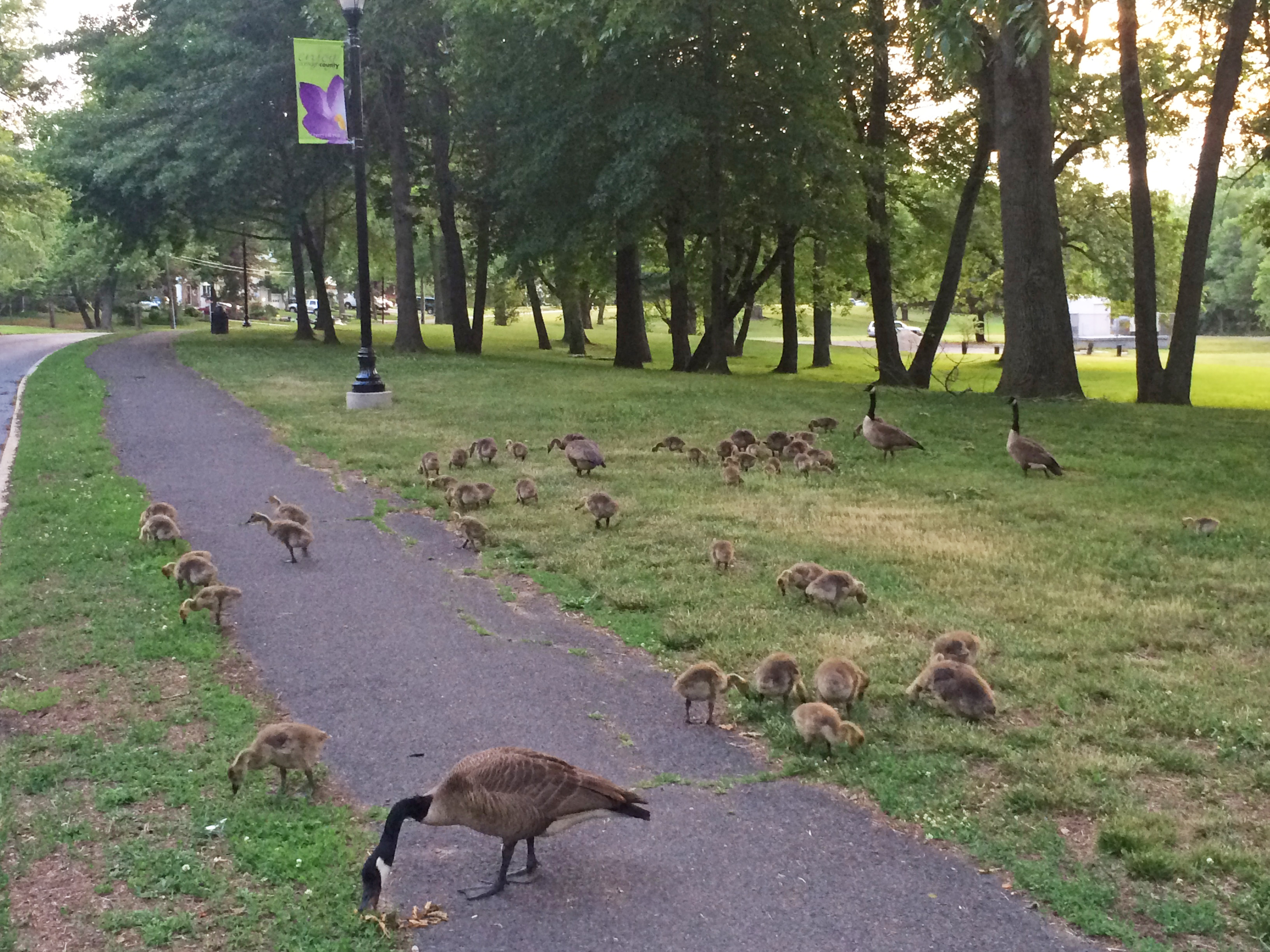
Saturday mornings, my friend Brandon and I usually head out from his house for an early morning run around our local park, the Cooper River Park in Camden County, New Jersey.  We don’t have to go too far before we run into the most populous animals in the region, the so called Giant Canadian Goose.  These animals have learned to call New Jersey home, and long ago gave up their instinctive migratory pattern.  The reason they stay is that life here is pretty good for them.  According to state biologists and naturalists, they thrive on fresh water, grazing areas of tender, mowed grasses, and areas where they have a wide view of potential predators.  They like safe areas to make nests, which they make on the ground, with the goose laying five or six eggs, nesting for 30-35 days in April, and with the gander keeping guard.  All the eggs begin to develop the same day, and hatch the same day.  Once the goslings are out of the shell, they are taken right to the water.  The geese gather multiple nests-full of goslings together, making a very attractive grouping of thirty or forty goslings being watched over by the multiple parent geese of the broods.  It is sort of like how it takes a village to raise a child.  Apparently, our parks and lawns have created ideal places for these formerly migratory birds never to want to leave.  This is just one of numerous species we encounter on our runs.

Non-plussed geese and gosslings along the trail. (courtesy Sue Hamilton)

Non-plussed geese and gosslings along the trail. (courtesy Sue Hamilton)

Geese can be annoying.  They are crowding our parks, cover the trails with goose droppings, and hiss at us as we run by, indicating it’s their park now.  Counter to the geese, much fewer in number, and generally a pleasant natural site are our local ducks.

Ducks looking for a handout at Newton Lake Park

Ducks looking for a handout at Newton Lake Park (courtesy Brandon Hamilton)

I’m not sure of the particular species of these ducks, but I believe they are American Black ducks, common throughout the greater northeast.  Known as a dabbling duck species, meaning they tip bottom side up in the water to find food, they are fun to watch as they feed in the ponds.

Another very common site is the squirrel.  Now, everyone knows squirrels, and they do seem to be everywhere.  Our particular South Jersey squirrels are the Eastern Grey Squirrel, known by their genus Sciurus, a portmanteau of Greek, skia (shadow) and oura (tail), meaning that it is in the shadow of its tail, per the Wikipedia article.  They have adapted very well over a large geographic area, and even have pushed out other squirrel types in places such as the United Kingdom and Australia.  Closely related, but much harder to see for more than a few tenths of a second, are our local Eastern Chipmunks.

Chipmunk gathering seeds.

Chipmunk gathering seeds.


I see them mainly along heavily wooded trails in the local parks, darting across the trail to hide in dense roots and ivy.  They live in extensive burrow systems underground, where they store food, and have many entrances and exits.  I also see them darting out from overgrown ivy in my backyard to gather seeds that have fallen from our bird feeder.

A variety of turtles and frogs occasionally poke their heads out, or send a croak out along our lake side trails.

A little larger in the animal kingdom, and certainly more rare as a sighting, is the local red fox.  There are two species of fox in New Jersey, the red and the grey.  I’ve never seen a grey fox, probably because they live in the woods and rarely show themselves.  The red fox we see every now and then, early in the morning, trotting along the side of the water in our local park, looking for rodents.

Red fox.  Wonder what he is thinking....

Red fox. Wonder what he is thinking….

White Tailed Deer have become extremely common around us, which is a bit puzzling to me.  Living where I do in New Jersey, these animals had to cross some major highways, such as the New Jersey turnpike, I295 and US 130 to get to us.  I guess we are seeing the deer that got pushed out from the more desirable locations, or just a population that enjoys suburban living.

Some does have antlers, but this looks like a buck to me, with a fawn.

Some does have antlers, but this looks like a buck to me, with a fawn.  (from Rutgers website)

On a run through a local park not long ago, early in the morning, I was startled by a small herd of six deer bounding across my trail in a wooded area.  According to Rutgers School of Environmental and Biological Sciences, the deer population in much of the northeast was almost gone around 1900.  This was due to a combination of hunting and natural predators.  Since then, there has been an explosion in the population, due to lack of predators such as wolves and cougars, lack of space for hunting, and increasing habitat in populated areas.  As with any part of an ecosystem, balance is important.  An acceptable herd size is good for forest edge regions.  Too many deer, though, can cause a spiral of decline of forests, as the underbrush is eaten out, leading to lack of saplings, lack of cover for birds and many small animals, and lack of leaves falling from the decreased tree population.  For runners, I’ve yet to hear of someone hit by a deer, but deer also carry the scourge known as the deer tick, a tiny biter which can pass on Lyme disease as well as other illnesses.  Watch your legs in grassy areas.

Looking up, one of the hardest birds to spot is the woodpecker.  In our area, we frequently hear these birds rat-a-tat sound from high in the trees along the trail.  But, the sound is tough to locate, so without spending some time standing still, not what we usually do on a run, we usually don’t spot these birds.  Most likely, we are hearing the tap of the red-bellied woodpecker, the most common in our area, or we could be hearing the marvelously named yellow-bellied sapsucker.

Red-bellied woodpecker (not red-headed, that's another type which is much rarer)

Red-bellied woodpecker (not red-headed, that’s another type which is much rarer) (from NJ Audobon Soc.)


Yellow-bellied sapsucker.

Yellow-bellied sapsucker. (from NJ Audubon Soc.)


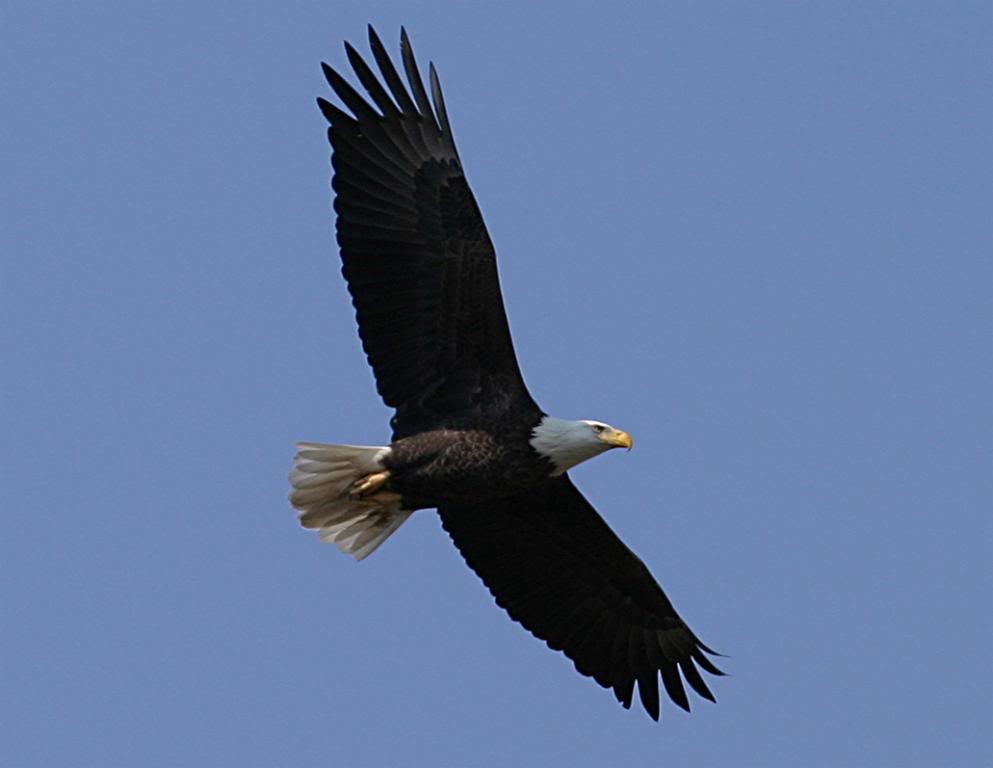
The ultimate wildlife spotting while on a run, in my opinion, was when I was running early Sunday morning a few months ago.  What first appeared to be a large hawk took off from the high branches of a sycamore tree.  As it made a wide, arcing turn, though, we could see it was no hawk.  It was a bald eagle.  I had heard there was a bald eagle nest in this area, but this was the first and only time I have seen one.  It was a beautiful sight, and we followed it with our eyes as it headed along the park lake.

Bald eagle photo (taken from free photos from photobucket)

Bald eagle photo (taken from free photos from photobucket)

There are many other birds and land animals we encounter on our runs.  There are blue herons, red-winged blackbirds, groundhogs and an occasional snake.  On runs outside my own territory, there have been many animals I have spotted, including beavers, skunks, and others.  No bears, fortunately.  I enjoy spotting these animals on the run, and it’s part of the joy of running outdoors.  Very few animals, other than homo-sapiens, are spotted running on a treadmill.

It’s all about that pace.

It’s all about that pace, ’bout that pace, no hustle.

It’s taken a little time for me to settle after my last marathon experience.  The short of it is, I cramped up at mile 16.5, and after a brief rest and another half mile, I wasn’t able to continue.  This was to be my tenth marathon, and I hadn’t quit any before, even when suffering mightily.  So what was different this time, and what went wrong?

There are many marathon training programs out there.  Runner’s World Magazine, Jack Daniels, Hanson, Hal Higdon, and others specify when to start training, how often to run, how far to run, and at what pace for one’s abilities.  Generally, one starts about sixteen weeks ahead of M-day, progressing in miles and longest run as the weeks progress.  The basis for this is the way our muscles and heart accommodate to the demand of steady running for three to four hours.  That kind of endurance, unless one is particularly exceptional, requires a long build-up.  Things can go wrong the day of the marathon.  Weather can be awful, a virus can lay out a runner, but if one has not put in the training, a perfect day will not make up for that lack.

For me, the training for my latest marathon, Philadelphia, November 23, 2014, started on time and rather well.  I had a good base, coming off a half marathon in Nice, France, at decent time in late April, and the 10 mile Broad Street run in early May in Philadelphia.  I’ve always designed my own training program, since sticking with one of the popular plans is just impossible due to my work schedule.  I also was working with a new marathoner, helping her train for her first marathon.  We had our long runs planned out for every Sunday, a mid-week ten mile run, and other training runs in between.  Paces were mixed up, and routes changed so that we would not fall into automaton behavior that comes with repetition.  My first slip up came about seven weeks before the marathon.  We were doing one of my favorite long runs, 9 minutes at a 9 minute per mile pace, then 1 minute at a fast pace, generally about 7’45” per mile, for a total of 14 miles.  One does need to keep an eye on the watch, and the pace, to get things right.  Done well, the miles fly by, and the run is energizing.  I think my eyes were too closely focused on the watch.  At about eleven miles, along a dirt path being graded for paving, I hit a rock with my toe and fell hard and fast.  I came down on my right side, connecting my chest, shoulder and head to the ground.  Fortunately, nothing was broken…I think.  I may have broken a rib but it wasn’t displaced and so since nothing would be done about it, I didn’t have it x-rayed.  That little incident slowed my training down, and made the next couple of weeks a little difficult due to soreness.  About five weeks before the marathon, we had a 20 mile run planned. It actually went very well, and I think if I had to run the marathon that very day, it would have been a good run.  After that, two weeks of very busy late nights at work completely blew apart my final weeks of training.  With two weeks to go, we went out for a 21 miler.  The conditions were nearly perfect.  The temperature started in the mid 40’s (F) as we headed out in the pre-dawn light.  The first bothersome event was that my new Adidas shoe was causing a great deal of pain where the tongue of the shoe meets the foot.  The tongue on these shoes is minimal, and the underlying tendon in my foot was being rubbed, causing the pain.  At around the 10 mile mark, I ran to my house to change shoes, while my ingenue marathon training partner waited a few minutes.  That done, my foot felt better.  We continued on, but at 17 miles a familiar and very annoying feeling sprang up in my calves and quads.  I was starting to get cramps in my leg muscles.  I am quite a sight when this happens, taking on the stride of John Cleese of Monty Python fame doing his silly walks sketch.  Not so funny for me, though, and I could not continue.  My training partner was doing well, and continued on to finish her 21 miler, the longest she had ever gone in one run.  I, on the other hand, hobbled back to our home base, unable to run, and in pain.  After walking the mile back, my legs did start to calm down, but the day and the run was shot.  I was very concerned that this might be my fate at the marathon in two weeks time, and I seriously considered not starting.  I had a chat with one of my marathon advisers, an experienced marathoner named Brandon, with whom I regularly run Saturday mornings.  With one week to go, I really didn’t get in the usual taper, because the three weeks before were so poor.  Brandon said he felt I could slow the pace and make it through the race.  He said it would be a shame to not run after putting in the many weeks of preparation.  With that encouragement, I started the marathon the following Sunday.

I thought about just doing half.  The official half marathon had closed weeks earlier, so I couldn’t drop down as a registered runner.  I felt if I kept my pace reasonable, around a 9 minute mile, things would be okay.  I did feel quite fine through the first half, and the Philadelphia marathon route is a very nice one.  It starts along Ben Franklin Parkway, with thousands of spectators lining the start, and Mayor Nutter giving hi-fives to runners as they pass the start line.  The route goes through Old City to Delaware Avenue, down to South Philly, then up along South Street to Chestnut and through Center City.  Crowds with clever (or not-so-clever) signs cheer on the runners.  The frat boys at Drexel bang on pots and shout out to the runners.  The route winds along to the Belmont Plateau, and past the Please Touch museum, then down hill to West River Drive along the Schuykill river and back to the Philadelphia Art Museum at the half.  At this point, the runners doing the half peel off and head to their finish line along the Ben Franklin Parkway, which is where I should have headed.  Thinking I could muster on, and not feeling bad, plus averaging around 8’45” to that point, I kept going, making the turn around the front of the museum to head out Kelly Drive towards Manayunk.  It is a route I have done six times before, sometimes suffering with leg cramps and having to walk, sometimes cruising through, and once, doing well enough to make my Boston qualifier.  This time, at mile 16.5, the cramps set in.  I tried to slow down and keep running, but it was just impossible.  I moved off the course, and like some soldier going AWOL in an old movie, removed my number from my chest.  I started walking back towards the start line, which was about 3 miles away.  I should have quit as I turned in front of the museum, so the walk would have been much shorter.  After walking for 5 minutes, my legs felt better, and seeing all those other runners streaming by me I put on my number again, got back on the course, and started to run.  Well, that didn’t last very long.  I got about a half mile when my legs seized up again.  This time I decided to quit for good.  I moved off the course, this time leaving my number on, and walked back towards the start.  Shortly, a volunteer driving a golf cart-like vehicle, already carrying two other runners, stopped to pick me up.  I got in, and the young man next to me offered me the Mylar blanket he had around his shoulders.  He was very thin and fit-looking, not the kind to quit a marathon I thought.  But he had a similar problem to mine, and had to stop.  He insisted I take the blanket against my protests, as he appeared to have far less insulation than me.  He wouldn’t take it back, so I kept it.  Shortly after getting in the cart, I had to get right back out.  My legs were seizing up, and there was no way to stretch them out in the cramped seat.  So I was resigned to the long walk back.  Along the way, I passed another fellow DNFer, about my age, who had quit due to ankle pain.  As I walked I thought about my justification for stopping and not mustering on.  I felt that I had made the right decision, to not hurt myself further, recover, and live to run another marathon another day.

I got back to the art museum, and made my way around the outside of the course to the bag pickup.  Several people told me “way to go”, and “good job” as I made my way through the crowd, giving me the feeling of a complete charlatan.  It was crowded, and I didn’t want to take the time to explain, but I simply put my head down and decided it would be best to not recognize these well wishers.  I made it into the bag area having to enter through an exit guarded by police, since the security around marathons is way up these days.  Once I picked up my bag, I had my cell phone.  I phoned my wife, who had been monitoring my progress on her phone.  Up to that point, I was pretty calm and collected.  As I spoke to her, though, I completely broke down, as the emotion of quitting hit me.  The rational me had left as the feeling of failure overcame.  I like to be seen as the invincible warrior, not the vulnerable person I am.

Since then, I have recovered, both my body and my senses.  I have heard many stories from my experienced marathoner friends of times they, too, have had to quit for various reasons.  I have plans for a half marathon in March, my annual shot at Caesar Rodney in Wilmington, and I am trying to decide which marathon to sign up for in the fall.  I think I want to do an early October marathon, since the training doesn’t run into the problem with short days and the conversion to standard time.  Of course, I may piggy back Philadelphia onto that, since I will have done the training after all….  In the end, it really wasn’t about the pace, it was about the training, and getting it right.  Yes, the pace is important, but not if the training is missing.


Enlightenment versus Romanticism and Marathon Training

Is marathon training a product of the Enlightenment, the age of reason, or is it more a result of romanticism, seeking nature and intuitive feeling?  In the era of the Enlightenment, men, well almost only men due to the circumstances of the time, were not likely to be out running for sport or athleticism.  Descartes did not write, “curro, ergo sum”, or “I run, therefore I am.”  He did write “Cogito, ergo sum”, or “I think, therefore I am.”  Who were the famous people of the Enlightenment?  Sir Isaac Newton stands out.  His laws of motion laid the basis for centuries of physics study and they may say something about running.  A body in motion tends to stay in motion, while a body at rest tends to stay at rest.  A lot can be read into that statement, beyond the mere physics.  One pictures a runner who needs to get out daily and run or his or her day is not complete, versus the person lying on the divan waiting for divine intervention to get moving.  The second law states that the force exerted on an object is equal to its mass times acceleration.  Another way to look at that is the acceleration equals the force divided by the mass, meaning the lower the mass, the greater the acceleration.  So, when you lose weight, and get into running trim, less force is needed to get up to speed.  His third law about equal and opposite actions may be more applicable to ice hockey than running.  Other famous individuals include Baruch Spinoza, Immanuel Kant and John Locke.  They wrote about individual liberties, blending logic, reason and empirical knowledge, and religious freedom.  They represented those who felt selling indulgences was not the way to heaven, which began with Martin Luther nailing his ninety-five theses to the door of the Castle Church in Wittenberg.  I read this as one cannot buy himself into anything that takes dedication, work and time, never mind the implications to organized religion.  Our own Ben Franklin was a great thinker, inventor, writer, politician and leader.  He was not a runner, as far as I can tell.  He was part of the Enlightenment, and his words and works had great impact in his time and forward.  A reading of famous quotes from Poor Richard’s Almanac provides the curious with plenty of sayings to thinku about while running solo on a 20 miler.  Here’s a taste:  “The noblest question in the world is:  What good can I do in it?”  We’ll return to that thought.

How do romanticism and running relate?  Romanticism followed the age of reason, as a reaction to the scientific and industrial advances which seemed to obliterate the beautiful, natural and emotional.  To a scientist, Maxwell’s equations were beautiful, but to Lord Byron, beauty was found in nature, love, turmoil, adventure, and pleasure.  George Gordon Byron, called “Lord” because at age 10 he inherited the lordship of Byron, was born of a profligate father named Captain John “Mad Jack” Byron, a rogue and scoundrel who apparently had anger problems.  Lord Byron, a most famous figure of the romantic era, who wrote “She walks in beauty”, and a wealth of other poems, long poems, satires and tales, was an athlete and warrior.  This was in addition to being a lover, adventurer, cad, and debtor.  He was known for boxing and equestrian skills, and played cricket.  Many other authors, poets, musicians, and artists, including Jane Austen, Delacroix, Wordsworth, and Mary Shelley, who penned “Frankenstein”, defined this era.  Romanticism meant defying order, industrial progress, rigid attachment to religion and social norms, and seeking the whole of natural and human experience.  Does this sound like a marathon runner?  In many ways, I think it fits.  We train under all sorts of adverse conditions, from the sweltering heat of summer to the icy roads of winter.  We train in the dark, and in the rain.  We gather at the local pub to swap running stories while downing pints of beer.  Our goals may be ephemeral, enjoying the training as much as the racing.  We are smitten by the beauty of our co-runners, their form and grace.

When training for a marathon, we are drawn in by plans which prescribe the length, the pace and the frequency of our runs.  There are competing programs, and some swear by one while others will follow a different program.  Some, like scientists in a lab, will try different programs and measure success by the outcome of their latest race.  We use the latest technology of the day, GPS, Garmins, heart rate monitors, and smartphone apps.

Counter to this is the marathoner who just wants to finish the race and is not so concerned about a Boston Qualifier.  This is the runner who gets in the zone, and is focussed on the Zen of the run.  He or she is still facing the great challenge of 26.2 miles, a long run, but who eschews technology and goes for the feel.

Regardless of one’s perspective, what good can we do?  Does running a marathon help mankind or is it a personal indulgence so inwardly focussed to be useless to society?   This question could be fodder for pages of argument, but not here.  I would say it is both a personal indulgence and a way to enhance life experiences for many.  It keeps us fit.  It engages us socially, away from the desk and computer.  With the enormous growth in popularity of marathon running, it has become an economic boon for many cities.  I’ve been impressed and amazed by the support given by the crowds lining the course.  I think marathon runners set a great example of dedication to the supporters, who in turn provide us with encouraging cheers and clever signs to make it across the finish line.  My readers can let me know whether Enlightenment or Romanticism best represents the marathon runner, but ultimately, it is a noble effort.

Note 1:  Lord Byron’s daughter, Ada Lovelace, was an example of Enlightenment wrapped in Romanticism, designing the first type of algorithm used in an early type of computing machine.

Note 2:  the header photo shows Lord Byron’s scrawled name in a pillar in the dungeon of the Chateau de Chillon, where he was inspired to write “The Prisoner of Chillon”, photo by the author.

Un détournement de Chamonix.

Chamonix

Chamonix, and a view of Mont Blanc

On my return from Chamonix, the most common question asked of me was how I was treated by the French.  I said very well, but my friends weren’t buying it.  Weren’t they rude and dismissive? Or, do I speak French, and so had an easier time.  Or, if one just makes an attempt to speak French, is that enough?  Until one travels to a foreign country (foreign to the traveler, not so foreign to the people living there), it is difficult to understand the experience.   In the case of Chamonix, it is an international resort, welcoming adventuresome people from all over the world throughout the year. French is the native language, but English, German, Italian, Japanese, Arabic, Russian, Turkish, and Polish, were among the languages I heard while there. There is no doubt about it’s French nature, though. This is evident in the super marché, or super market.  Generally, ski towns have very nice super markets, and here is no exception.  But the meats and cheeses were the best, the wines excellent for about $7-10, the alpine butter delicious, and the choices of fresh vegetables, superb.  It was a very busy place, and typically, around 4 to 5 PM, the locals were crowding the store to buy food for dinner.  It is not customary there, to stock up for a week or more.  How would the food be fresh?  There were boulangeries (bakeries) on every street, and the image of a person carrying a baguette or two sticking out of the bag or backpack is real.  The bread is devine, crusty, yeasty and just the right texture.  Pâtisseries, the pastry shops selling incredible raspberry tarts, eclairs, and other sweets are also common, their wares displayed in windows to lure in the customers.
I don’t speak French, at least not well enough to engage in a conversation, and I may never, but I took the time to learn a little, and have picked up some over the years. While this is an international town, not everyone speaks English, so it helps to know a bit of the native tongue.  Whenever I am in France, I am reminded of the brilliant essay by David Sedaris, “Me talk pretty one day” , in which he describes his attempts to get conversant in French. It is so funny and true, and dangerous to read in company. You’ll embarrass yourself.

I was in Chamonix for a ski trip with friends from Pennsylvania and the UK.  We are an interesting mixed group, thrown together by chance and acquaintanceship, and of varying abilities on the slopes.  Yet we invariably have a great time, and plenty of adventure to boast about.

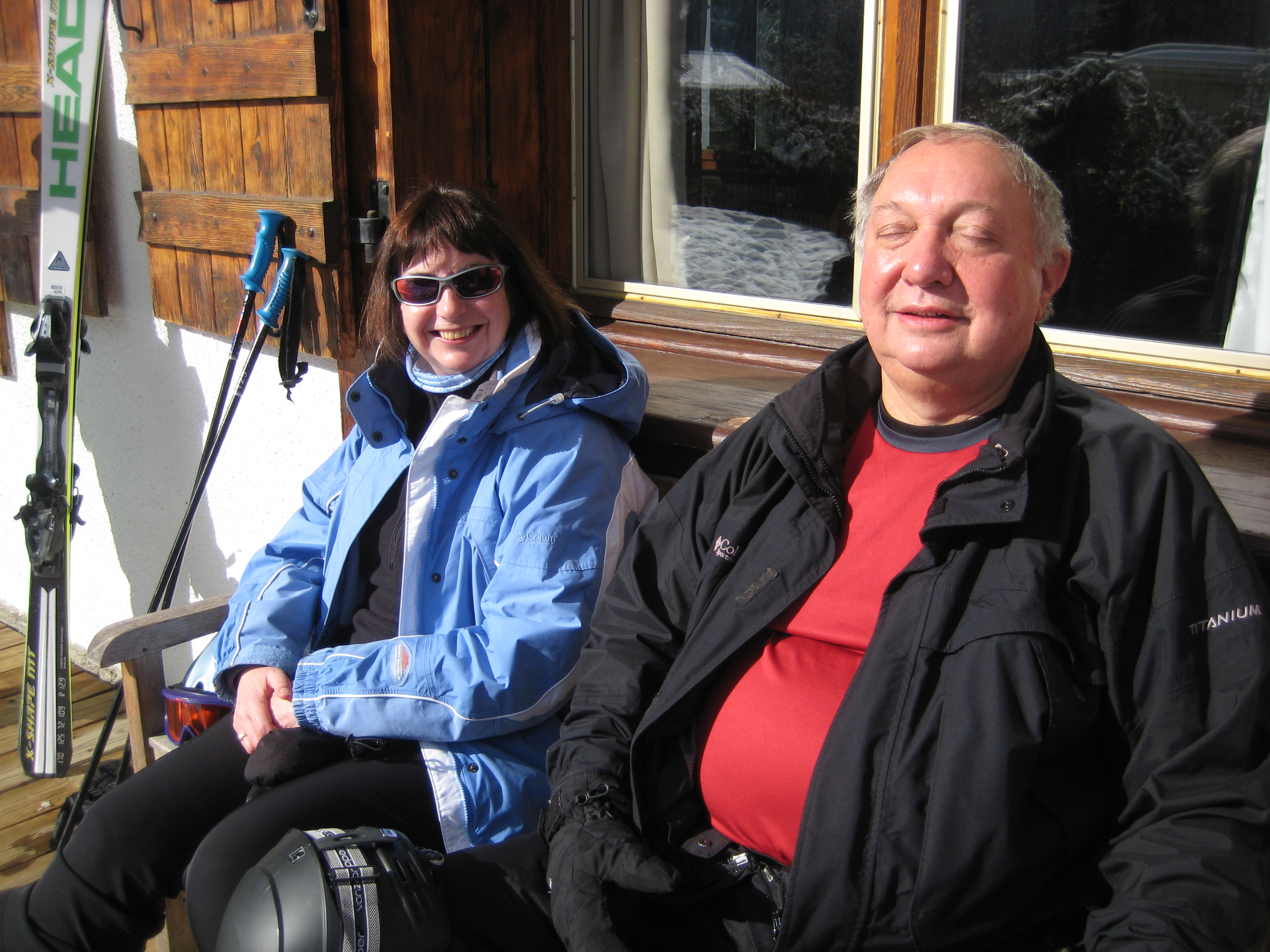
Teresa and AJ, among the UK set, enjoying the alpine sun.

Teresa and AJ, among the UK set, enjoying the alpine sun.

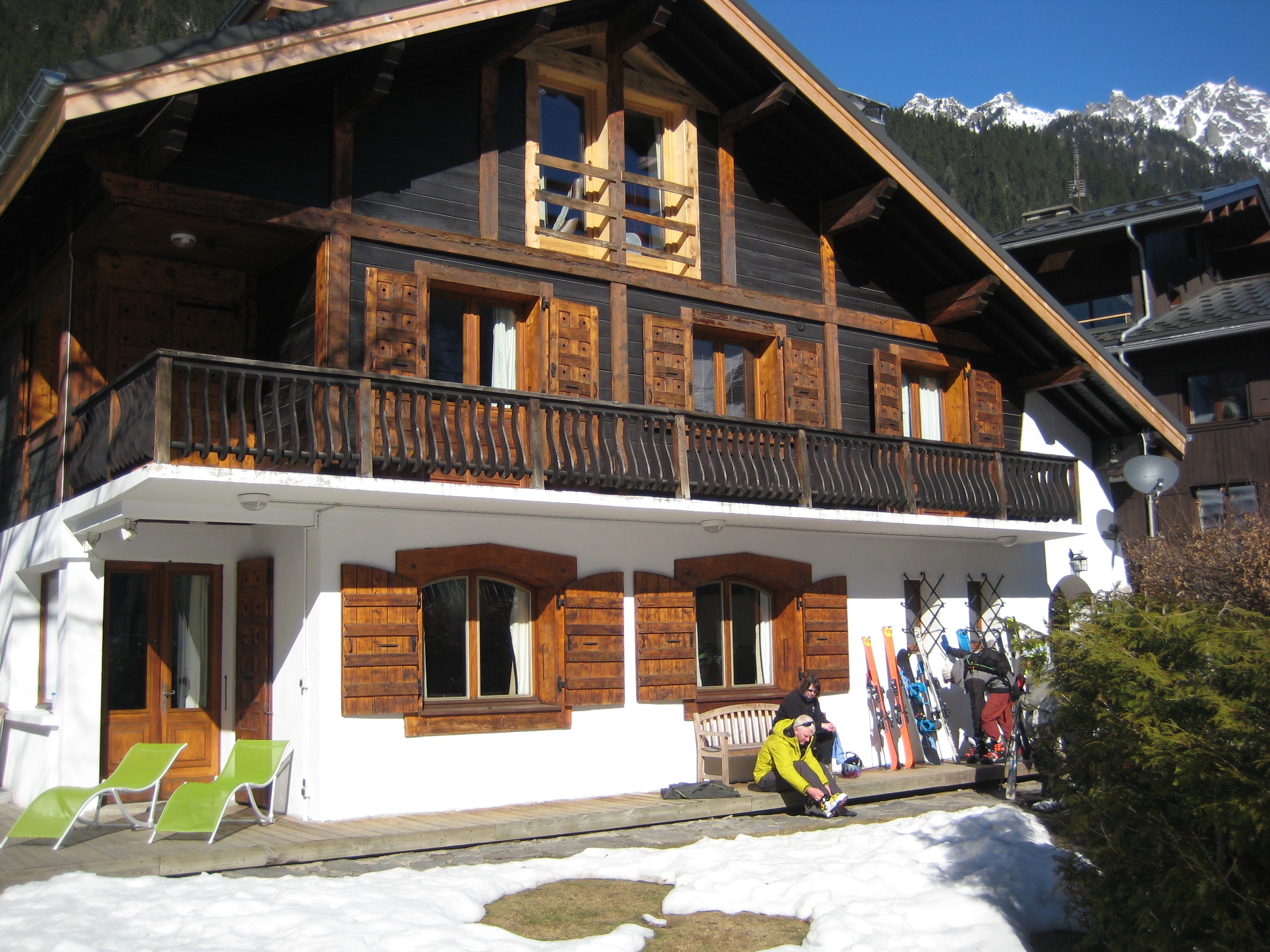
We arrived in Geneva on Sunday, March 2, and took a van to Chamonix.  We were dropped off at our elegant Chalet close to the center of town.  One advantage of going with a sizable group, there were eleven in ours, is that we can rent a whole chalet together, and get the benefits of a kitchen, nice rooms, and comfortable living areas.

Our chalet, Chalet Arkle, on Rue Joseph Vallot in Chamonix.

Our chalet, Chalet Arkle, on Rue Joseph Vallot in Chamonix.

Our chalet was, according to the “bible” left for our perusal by the owners, originally a home built for a physician in Chamonix, over 100 years ago.  It was solidly built, and the current owners upgraded everything to modern standards, with bathrooms in all the bedrooms, a huge, modern kitchen with an industrial stove, and even an outdoor hot tub, which we certainly did make use of.  A few peculiarities of local life:  recycling is done, but one must carry the trash and recyclables to receptacles in town, where there are big bins for trash, glass, plastic and paper.  Bags are not free in grocery stores.  They do sell reusable shopping bags, though.  Vegetables and fruits are weighed by the customer on a scale near the produce section, which spits out a label with the weight and cost.  Without this, one is sent back by the check-out person to fulfill one’s responsibility.

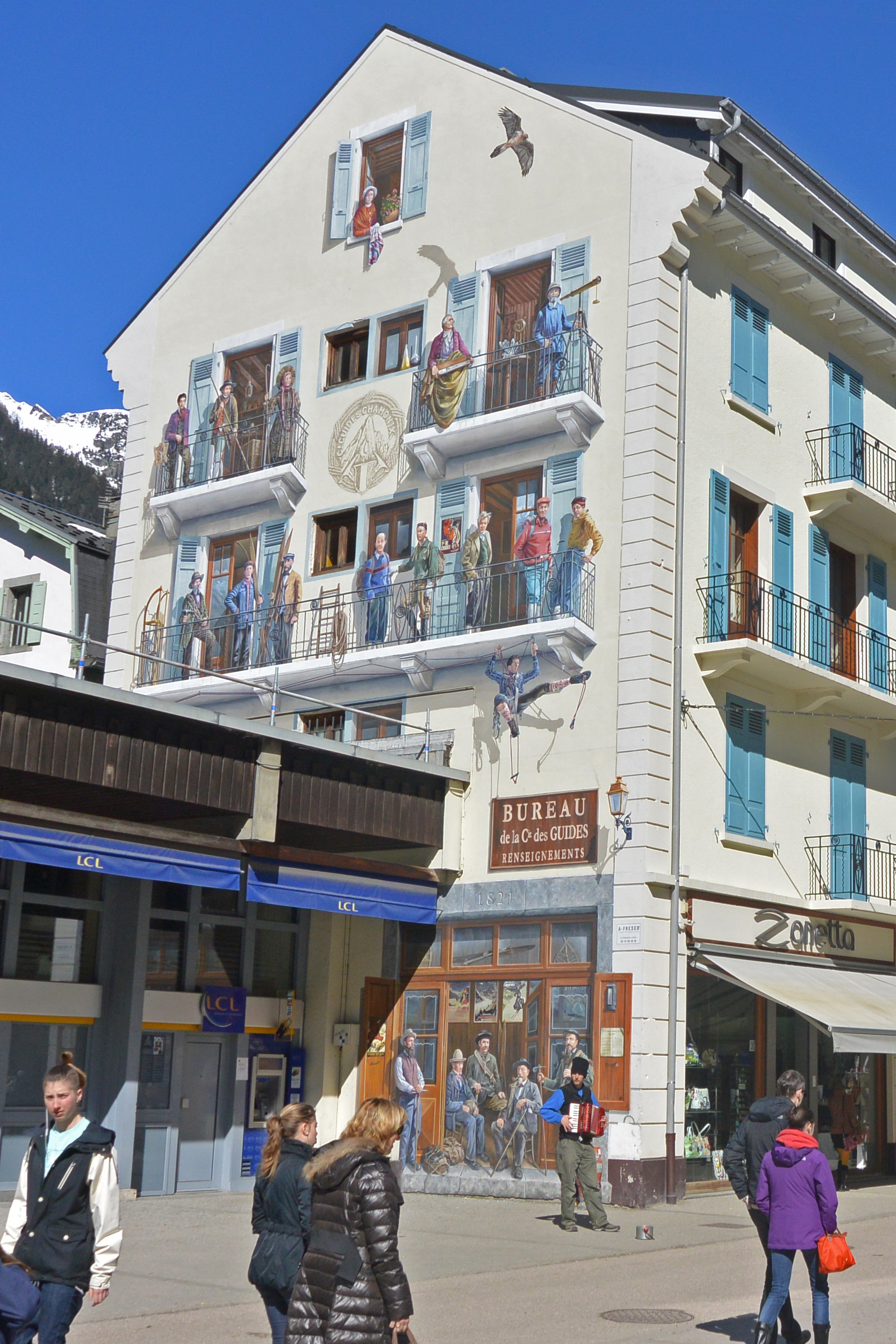
Famous early members of Le Compagnie des Guides de Chamonix

Famous early members of Le Compagnie des Guides de Chamonix

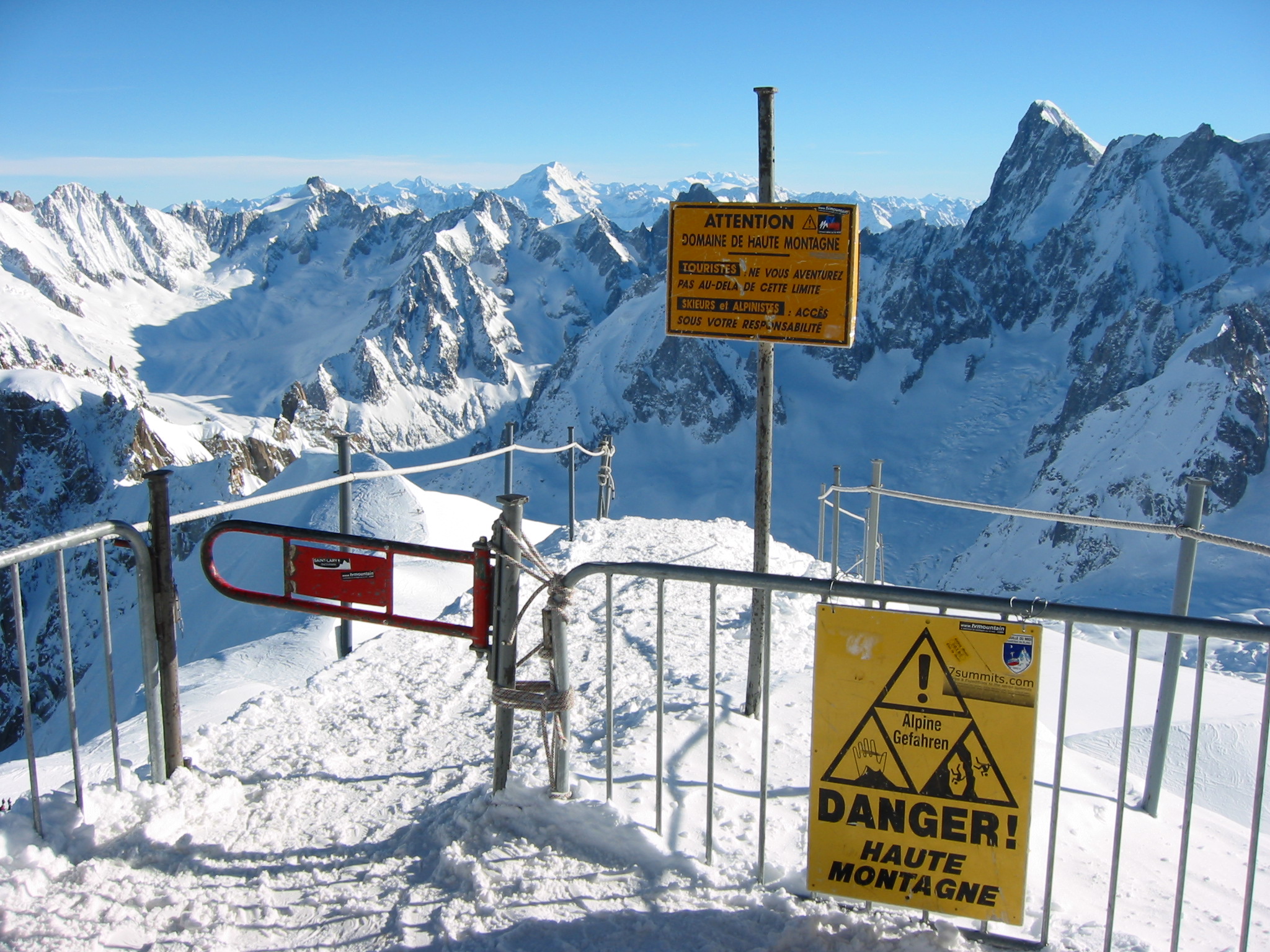
Chamonix is famous for extreme sports, winter sports, and mountain climbing.  The mural above shows early, formative members of the Compagnie des Guides de Chamonix, an association for the guides in this region.  The woman depicted at the top, Marie Paradis, at the time a worker in a hotel, was the first woman to climb to the summit of Mont Blanc, in 1808.  Chamonix was the home of the first Winter Olympics, in 1924.  Mont Blanc, the tallest mountain in Europe, can be seen clearly from the town, and is a primary attraction here.  The Vallée Blanche is the ski route off of Mont Blanc, accessible from L’Aiguille du Midi, the highest reaching cable car in the valley.  It is unmarked, unpatrolled and quite a challenging run.  I did this run in 2003, with a group from Philadelphia, led by a guide named Christian.

Entrance to the Vallée Blanche

Entrance to the Vallée Blanche

The trek down to the start of the ski run, Vallée Blanche

The trek down to the start of the ski run, Vallée Blanche

Our guide, Christian.

Our guide, Christian.

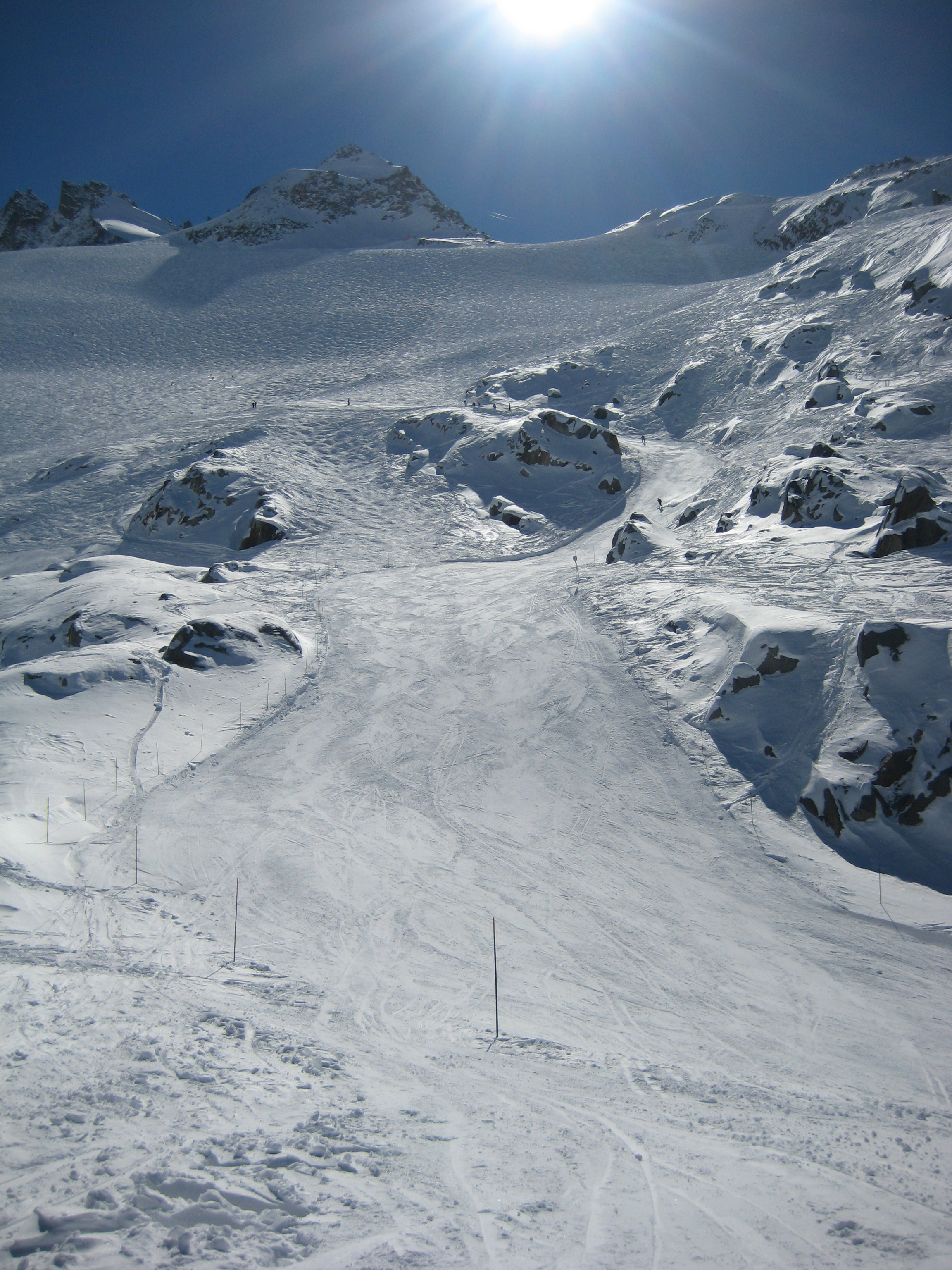
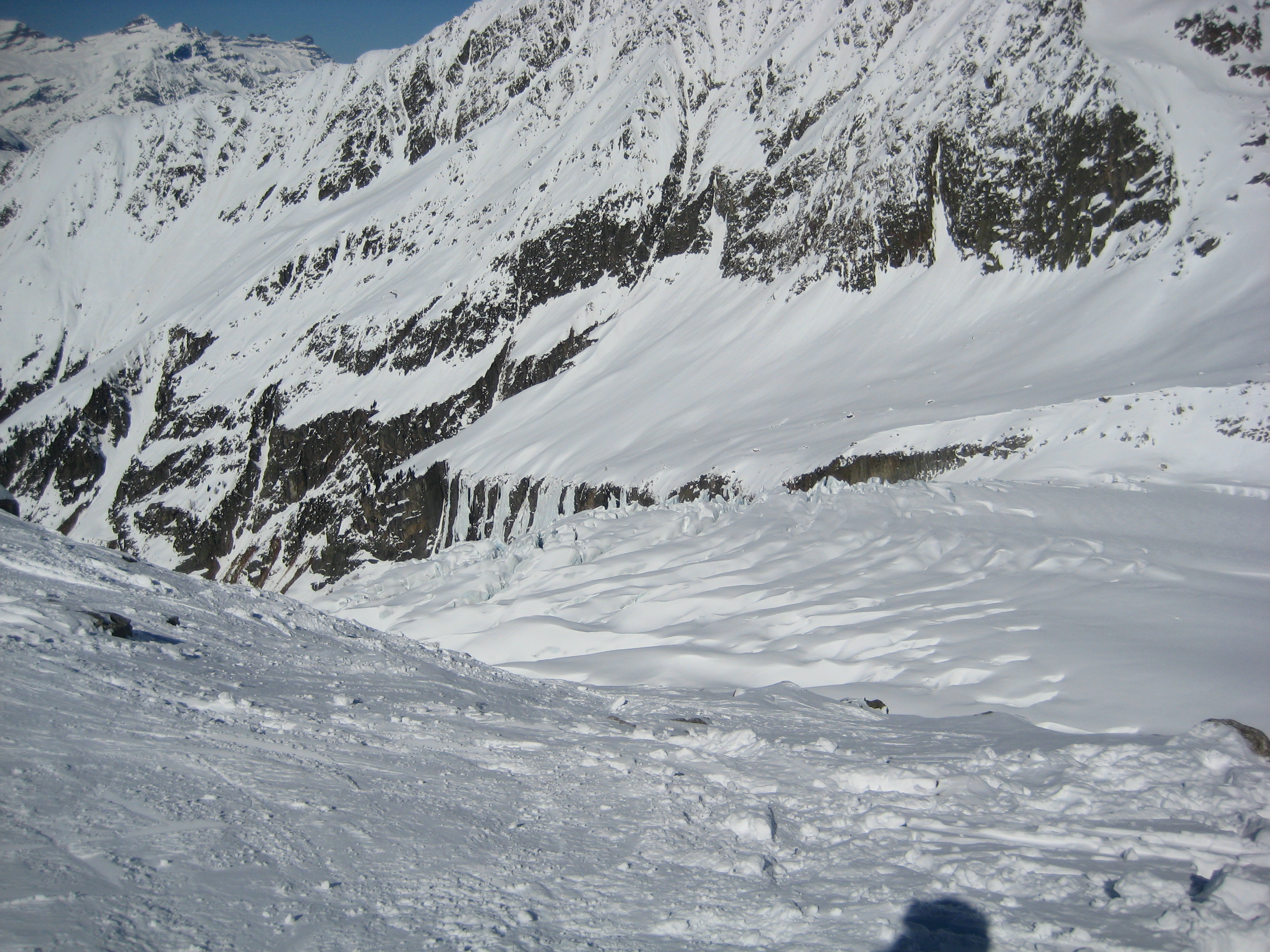
Some of our group did this same run this year.  I decided not to go, having done it once and survived.  The skiing, though, in this region is not easy.  While there are slopes meant for beginners and intermediates, they are pretty tough due to their steepness and iciness.  Up high at the top of the multiple ski areas which surround the valley, the snow is good and the views amazing.  But the runs at that height are steep, ungroomed, and mainly moguls.  My friends Teresa and Kristine and I took on the second most challenging descent, off the top of Grand Montets, the Point de Vue run along the Argentière glacier.

Frank and Kristine at the top of Grands Montets

Frank and Kristine at the top of Grands Montets

Point de Vue run off Grands Montets

Point de Vue run off Grands Montets

The Argentière glacier along the Point de Vue run.

The Argentière glacier along the Point de Vue run.

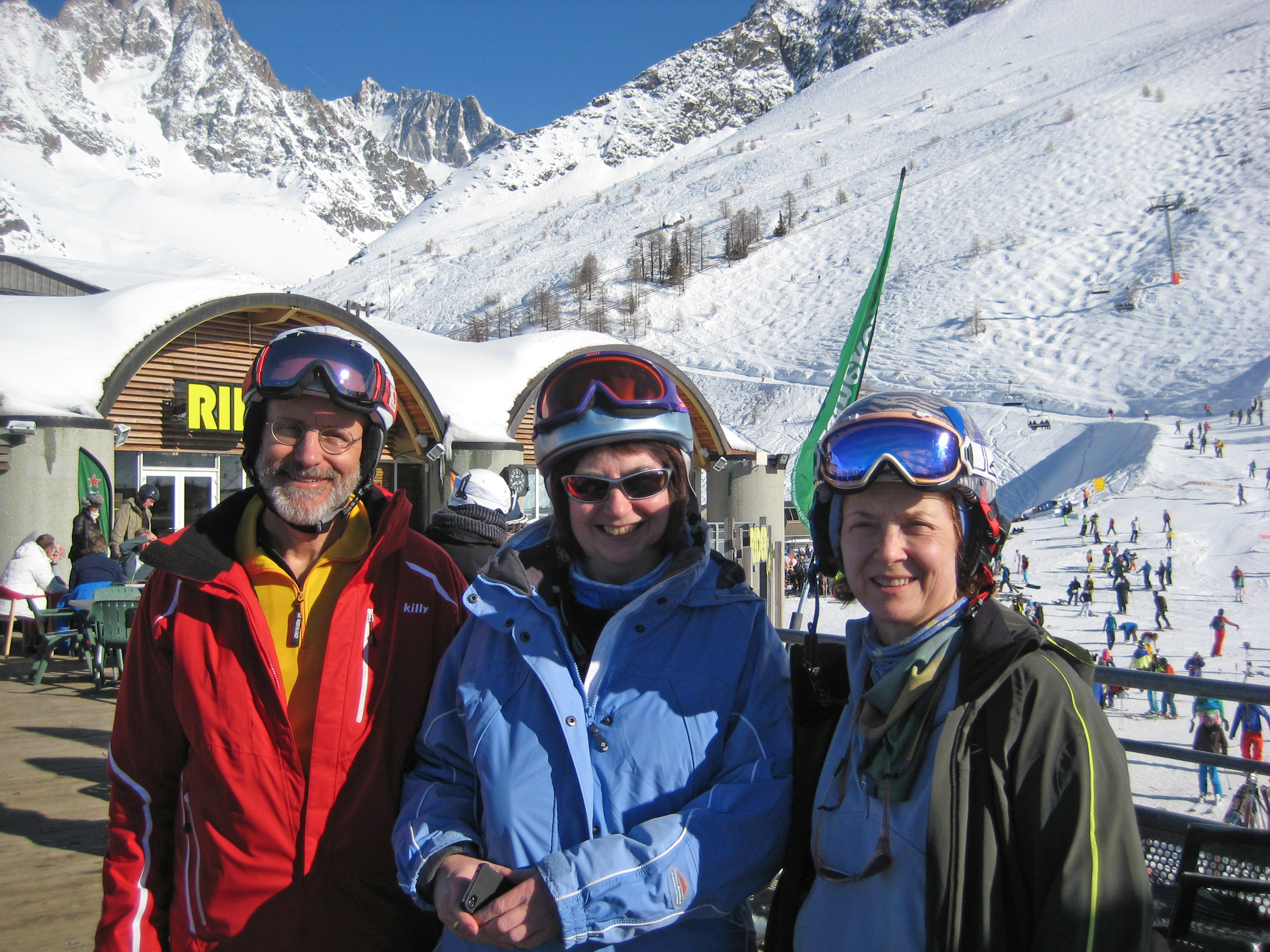
Frank, Teresa and Kristine after successfully descending off the top of Les Grands Montets summit.

Frank, Teresa and Kristine after successfully descending off the top of Les Grands Montets summit.

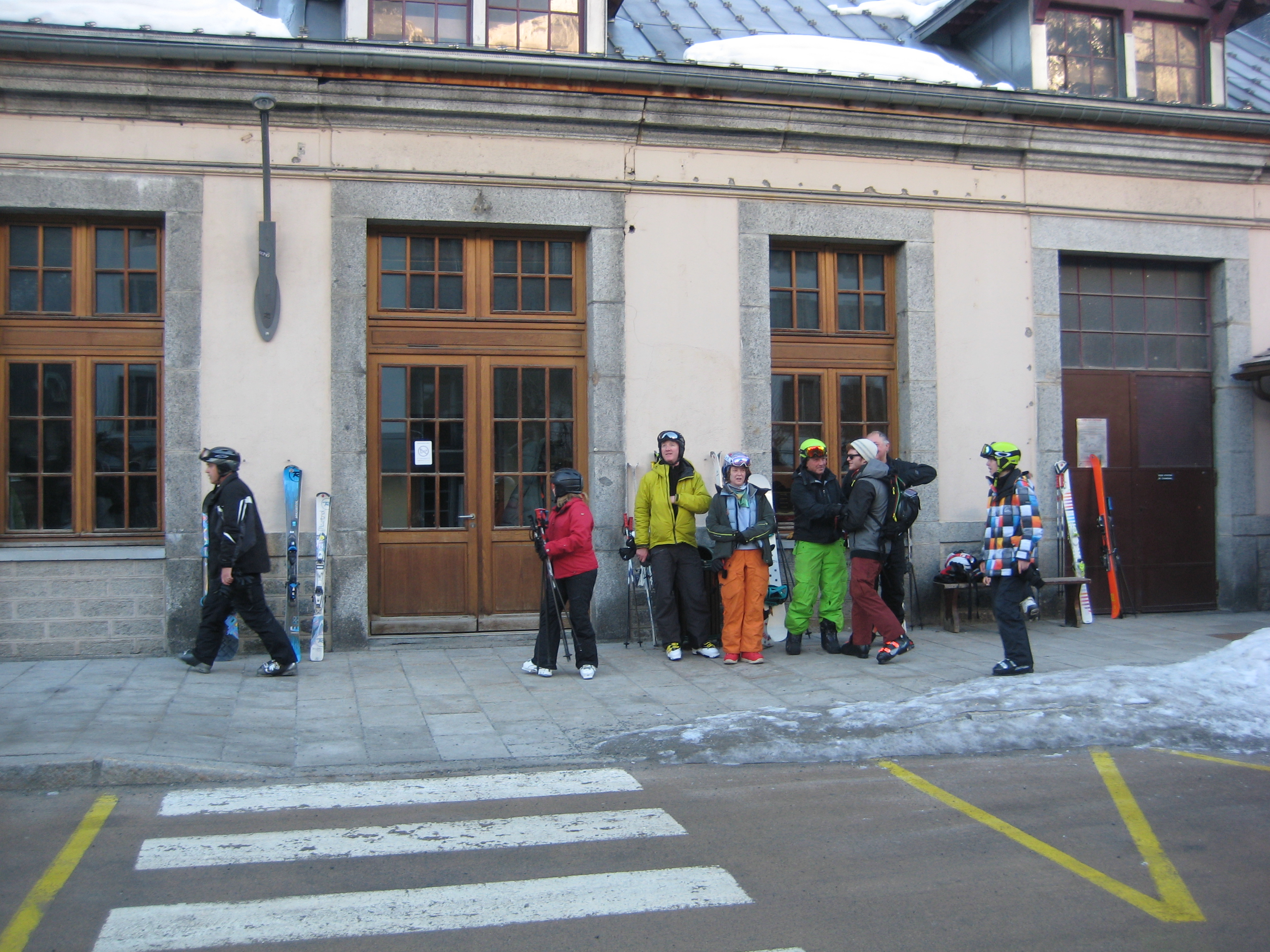
During this trip we also spent a day on the Italian side of Mont Blanc, the Monte Bianco side, in Courmayeur.  To get there, we took a bus from Chamonix through the famous Mont Blanc tunnel.  This eleven kilometer long tunnel runs under Mont Blanc, and was the site of a fire in 1999, due to a truck catching fire which was carrying flour and margarine.  Thirty-nine people died, and the tunnel was closed for three years after that for repairs and improvements.  Our bus left from the Chamonix train station and took us directly to the ski resort on the other side of the mountain, with no problems to report.

Our group, waiting for the bus to Courmayeur.

Our group, waiting for the bus to Courmayeur.

Skiing in Italy seemed a bit more fun and lighthearted than skiing on the French side.

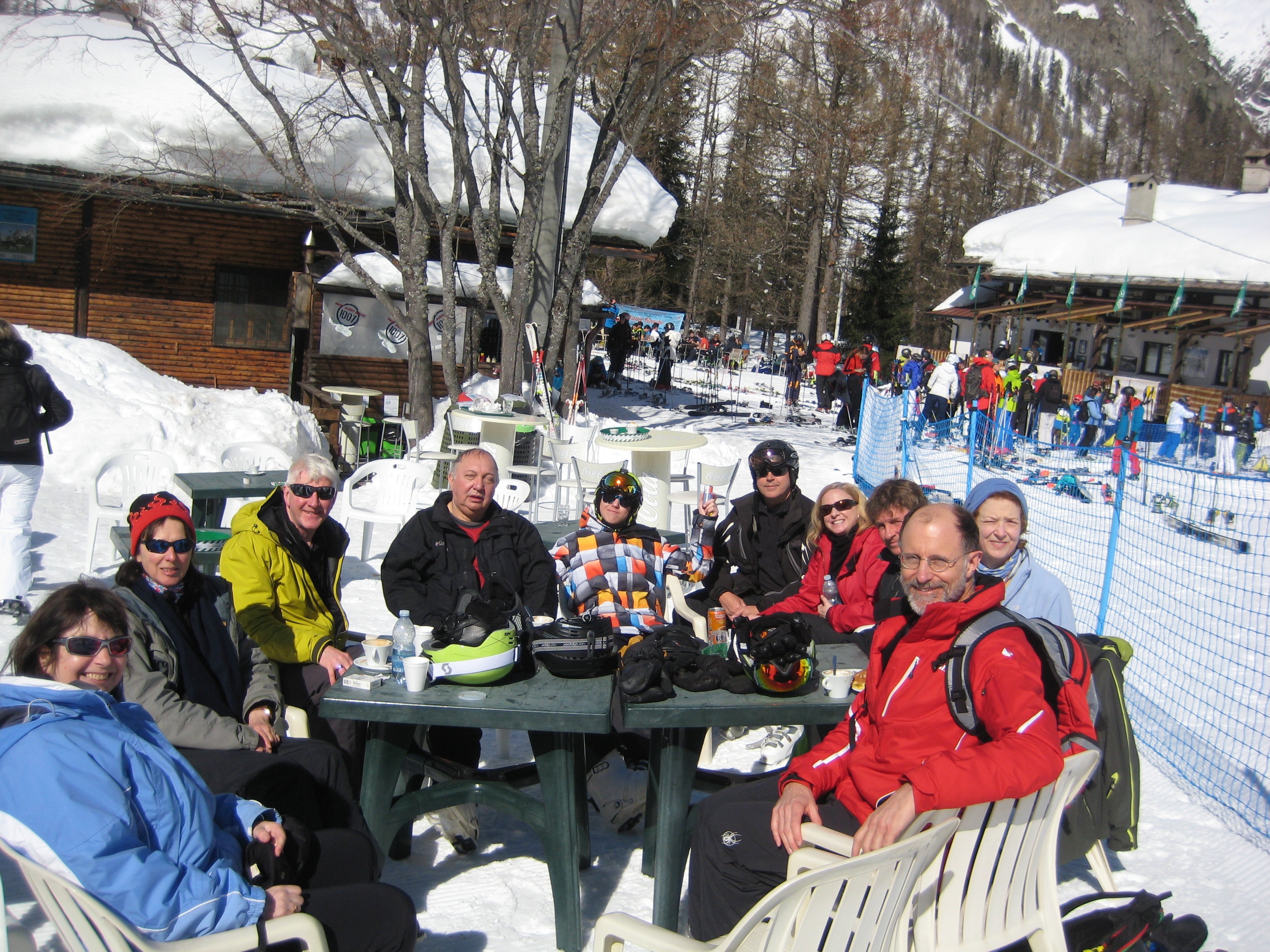
Enjoying a break in Courmayeur.

Teresa, Christine, Simon, AJ, Drew, Eric, Jen, Paul, Kristine and Frank enjoying a break in Courmayeur.  Thanks, Will, for taking the photo.

The challenges were there, too, as we learned ascending to the top of the Youla gondola.

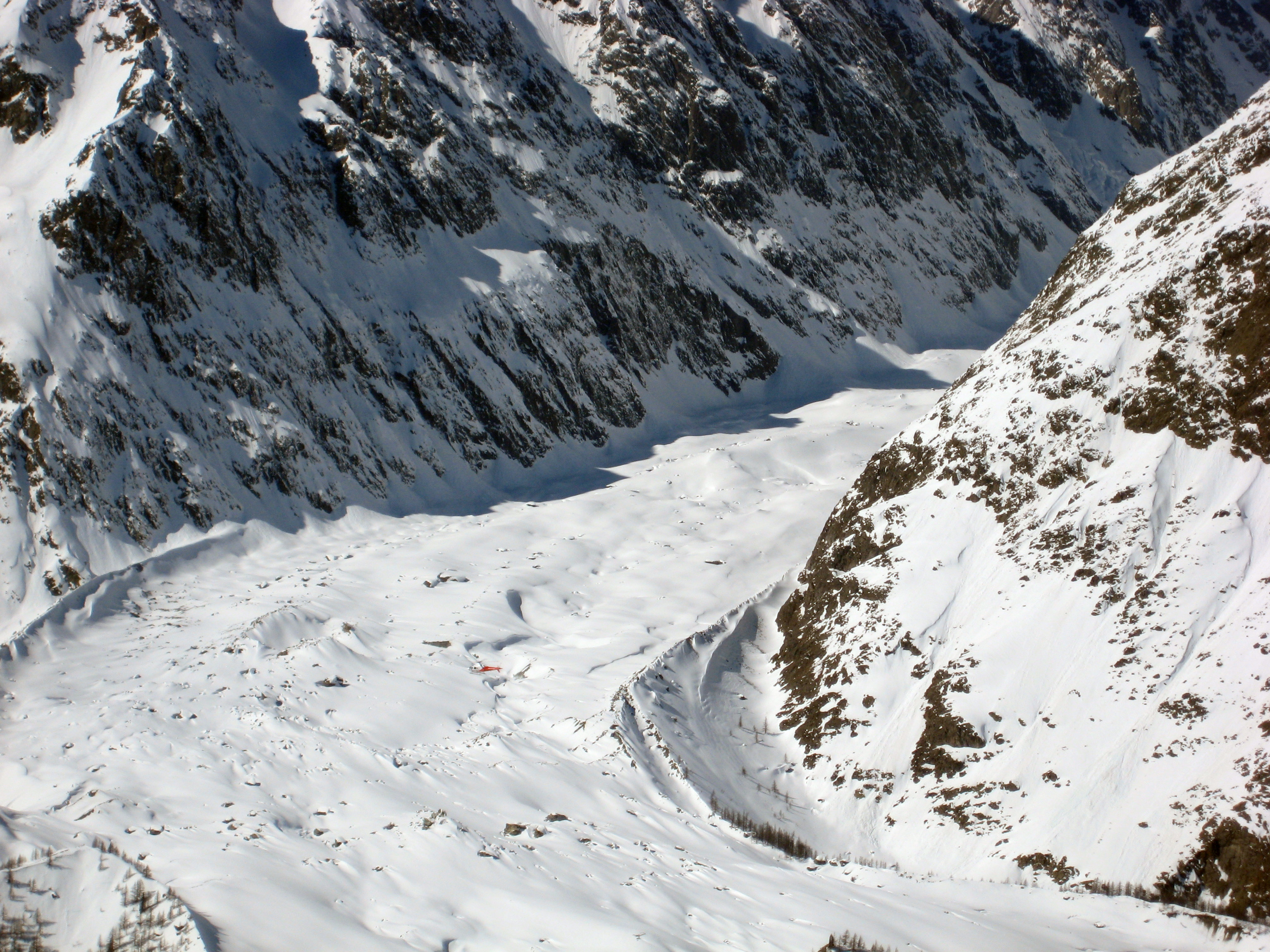
Looking down from the top of the Youla gondola station, see if you can spot the helicopter.

Looking down from the top of the Youla gondola station, see if you can spot the helicopter.

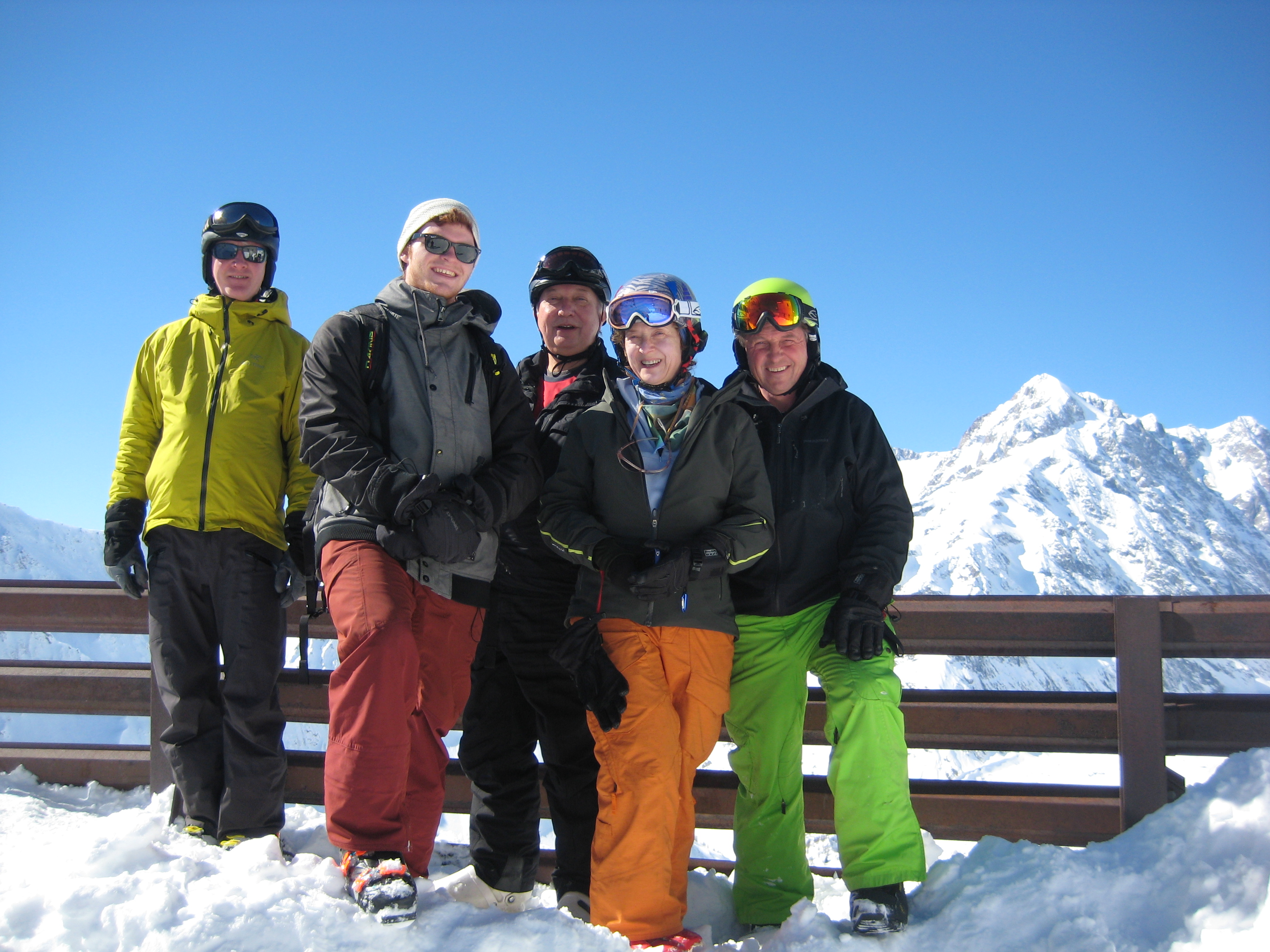
Simon, Will, AJ, Kristine and Paul at the top of the Youla gondola.

Simon, Will, AJ, Kristine and Paul at the top of the Youla gondola.

Drew, Jen and Eric, part of our Pennsylvania contingent, with Monte Bianco looming over us.

Drew, Jen and Eric, part of our Pennsylvania contingent, with Monte Bianco looming over us.

Traveling to really get away, to have an adventure, take some risks, and be out of range of work allows one’s batteries to recharge.  We had great food, some cooked by our chalet’s caretaker named Abdel.  He is Algerian by birth, with a Moroccan passport, and he loves to cook.  He prepared several dinners for us, including a Moroccan style dinner, and a fondue dinner.  Always he would include fresh salads and lots of vegetables, unlike what a restaurant meal might provide.  We played a truly bawdy card game called “Cards against Humanity”, which we learned from our UK representatives, was heavily weighted toward Americanisms.  Nevertheless, it had us rolling with laughter.  We drank plenty of beer and wine, and completely enjoyed ourselves.

I arrived home late Sunday night and had to be at work the following morning at 6:30.  It was a jarring reminder that I don’t live the holiday, jet-set life full time, only on special occasions.  I also have a half-marathon coming up, and the week of skiing is hardly preparation for a run.  I did run a couple of times in Chamonix, with Will, the eighteen year old who needs to stay in shape for lacrosse.  Good that I was able to keep up with him, although he did carry a backpack on our runs.  By the way, the French people I met were very friendly and forgiving of my grade-school French.  It was a great get-away, and I am looking forward to the next big adventure.
Uncorking Croatia

The Blog of WINES OF CROATIA

RunnersOnTheGo.com

To help enrich the lives of others, we developed RunnersOnTheGo.com to help runners save money on races, running stores, and much more. We also provide the specific local information that makes your travel for business, vacation, or racing as rewarding as possible.
getsetandgo

Travel Blog of a Budget Traveler sharing stories on travel, books & Vegetarian Food

Marc Hemingway

Trying to keep track of my life (and my life on track)

Mid-Life, Mid-Level, Masters Running

Exploring ideas about running to contribute to a more enjoyable pursuit for the mid-level masters runner

therunningtherapist

"One foot in front of the other and one thought at a time"

WordPress.com News

The latest news on WordPress.com and the WordPress community.
retireediary

The Diary of a Retiree