A Slog through the Slush

Here’s how the conversation, via text, went:

It’s all slush and big puddles out there do you think we should run?  And it is raining, too.

Sorry, just saw this.  Let’s go for it.  We won’t know till we try

Okay.  I am just getting ready now.

Take your time driving over.

That was at 6:45 this morning.  The snow, rain, freezing rain, and sleet had started the night before.  I was out with friends in Philly, and late at night, heading for the train, we marveled at the enormous size of the snow flakes falling steadily.  With the temperature close to freezing, they turned to slush as they hit the ground.  This morning, I stayed in bed as late as I could but still make a 7:00 AM start to my morning run.  My running partner and I had the above conversation and so I was committed to the run.  I was relieved, since I didn’t want to be the one to make the call, knowing this would not be our best run of the year.

We had to gingerly pick our way from his front door out to the street, not wanting to start running with cold, wet feet.  The road had not been plowed, and while the “inches” of snow were not that much, it was all wet and forming large pools of ice slurry.  We started off very slowly, running along areas cleared by tire tracks, being careful not to slip as we went downhill towards our loop around the park.  We had to run in the street rather than the multi-use path, which was completely covered by this slurry.  As we ran, we picked up the pace a bit.  Along the Cooper River, the geese were out in force, coping with the conditions without a problem, as far as I could see.  Approaching the far end of the loop around the park, the path was one large slush puddle, which we muddled through.  Now my shoes were wet, and my feet cold.  On the far side of the park, the road was narrowed by construction.  We had to run along on the road, with cars passing us closely and spraying ice and frozen water on our legs.  I think it was partially on purpose, since not all the cars came that close.  We moved over to the construction zone, running in ruts created by a truck that had gone through recently.  As we ran we were able to have a nice conversation, since the forced slow pace made talking that much easier.  We talked about running in the winter, and also about the play I saw last night at the Lantern Theater.  The play, called “Doubt, A Parable”, by John Patrick Shanley, takes place in a Catholic School in the Bronx, in 1964.  The story is that of an older nun, the principal of the school, suspecting the priest of having sexual relations with one of the boy students.  The story gets complicated when one hears the boy’s mother’s side of her son’s life.  The play takes only ninety minutes with a single act, and seems to leave out some crucial inner thoughts of the four characters.  One critic I read afterwards suggested the second act was when the audience discussed their feelings about the play.

Our run finished with a long uphill climb and then a flat last mile, still with the skies gray, and our feet cold and wet.  But accomplishing our seven miles, and then warming up with a change to dry socks and shoes, a dry shirt, and a hot cup of coffee was very satisfying.

A parable is a short narrative about individuals meant to be an example of a larger truth.  So, this narrative I relate to you shall also be short, and meant to convey that even when nature is uncooperative, getting out and doing is better than holing up and not doing.


It’s all about that pace.

It’s all about that pace, ’bout that pace, no hustle.

It’s taken a little time for me to settle after my last marathon experience.  The short of it is, I cramped up at mile 16.5, and after a brief rest and another half mile, I wasn’t able to continue.  This was to be my tenth marathon, and I hadn’t quit any before, even when suffering mightily.  So what was different this time, and what went wrong?

There are many marathon training programs out there.  Runner’s World Magazine, Jack Daniels, Hanson, Hal Higdon, and others specify when to start training, how often to run, how far to run, and at what pace for one’s abilities.  Generally, one starts about sixteen weeks ahead of M-day, progressing in miles and longest run as the weeks progress.  The basis for this is the way our muscles and heart accommodate to the demand of steady running for three to four hours.  That kind of endurance, unless one is particularly exceptional, requires a long build-up.  Things can go wrong the day of the marathon.  Weather can be awful, a virus can lay out a runner, but if one has not put in the training, a perfect day will not make up for that lack.

For me, the training for my latest marathon, Philadelphia, November 23, 2014, started on time and rather well.  I had a good base, coming off a half marathon in Nice, France, at decent time in late April, and the 10 mile Broad Street run in early May in Philadelphia.  I’ve always designed my own training program, since sticking with one of the popular plans is just impossible due to my work schedule.  I also was working with a new marathoner, helping her train for her first marathon.  We had our long runs planned out for every Sunday, a mid-week ten mile run, and other training runs in between.  Paces were mixed up, and routes changed so that we would not fall into automaton behavior that comes with repetition.  My first slip up came about seven weeks before the marathon.  We were doing one of my favorite long runs, 9 minutes at a 9 minute per mile pace, then 1 minute at a fast pace, generally about 7’45” per mile, for a total of 14 miles.  One does need to keep an eye on the watch, and the pace, to get things right.  Done well, the miles fly by, and the run is energizing.  I think my eyes were too closely focused on the watch.  At about eleven miles, along a dirt path being graded for paving, I hit a rock with my toe and fell hard and fast.  I came down on my right side, connecting my chest, shoulder and head to the ground.  Fortunately, nothing was broken…I think.  I may have broken a rib but it wasn’t displaced and so since nothing would be done about it, I didn’t have it x-rayed.  That little incident slowed my training down, and made the next couple of weeks a little difficult due to soreness.  About five weeks before the marathon, we had a 20 mile run planned. It actually went very well, and I think if I had to run the marathon that very day, it would have been a good run.  After that, two weeks of very busy late nights at work completely blew apart my final weeks of training.  With two weeks to go, we went out for a 21 miler.  The conditions were nearly perfect.  The temperature started in the mid 40’s (F) as we headed out in the pre-dawn light.  The first bothersome event was that my new Adidas shoe was causing a great deal of pain where the tongue of the shoe meets the foot.  The tongue on these shoes is minimal, and the underlying tendon in my foot was being rubbed, causing the pain.  At around the 10 mile mark, I ran to my house to change shoes, while my ingenue marathon training partner waited a few minutes.  That done, my foot felt better.  We continued on, but at 17 miles a familiar and very annoying feeling sprang up in my calves and quads.  I was starting to get cramps in my leg muscles.  I am quite a sight when this happens, taking on the stride of John Cleese of Monty Python fame doing his silly walks sketch.  Not so funny for me, though, and I could not continue.  My training partner was doing well, and continued on to finish her 21 miler, the longest she had ever gone in one run.  I, on the other hand, hobbled back to our home base, unable to run, and in pain.  After walking the mile back, my legs did start to calm down, but the day and the run was shot.  I was very concerned that this might be my fate at the marathon in two weeks time, and I seriously considered not starting.  I had a chat with one of my marathon advisers, an experienced marathoner named Brandon, with whom I regularly run Saturday mornings.  With one week to go, I really didn’t get in the usual taper, because the three weeks before were so poor.  Brandon said he felt I could slow the pace and make it through the race.  He said it would be a shame to not run after putting in the many weeks of preparation.  With that encouragement, I started the marathon the following Sunday.

I thought about just doing half.  The official half marathon had closed weeks earlier, so I couldn’t drop down as a registered runner.  I felt if I kept my pace reasonable, around a 9 minute mile, things would be okay.  I did feel quite fine through the first half, and the Philadelphia marathon route is a very nice one.  It starts along Ben Franklin Parkway, with thousands of spectators lining the start, and Mayor Nutter giving hi-fives to runners as they pass the start line.  The route goes through Old City to Delaware Avenue, down to South Philly, then up along South Street to Chestnut and through Center City.  Crowds with clever (or not-so-clever) signs cheer on the runners.  The frat boys at Drexel bang on pots and shout out to the runners.  The route winds along to the Belmont Plateau, and past the Please Touch museum, then down hill to West River Drive along the Schuykill river and back to the Philadelphia Art Museum at the half.  At this point, the runners doing the half peel off and head to their finish line along the Ben Franklin Parkway, which is where I should have headed.  Thinking I could muster on, and not feeling bad, plus averaging around 8’45” to that point, I kept going, making the turn around the front of the museum to head out Kelly Drive towards Manayunk.  It is a route I have done six times before, sometimes suffering with leg cramps and having to walk, sometimes cruising through, and once, doing well enough to make my Boston qualifier.  This time, at mile 16.5, the cramps set in.  I tried to slow down and keep running, but it was just impossible.  I moved off the course, and like some soldier going AWOL in an old movie, removed my number from my chest.  I started walking back towards the start line, which was about 3 miles away.  I should have quit as I turned in front of the museum, so the walk would have been much shorter.  After walking for 5 minutes, my legs felt better, and seeing all those other runners streaming by me I put on my number again, got back on the course, and started to run.  Well, that didn’t last very long.  I got about a half mile when my legs seized up again.  This time I decided to quit for good.  I moved off the course, this time leaving my number on, and walked back towards the start.  Shortly, a volunteer driving a golf cart-like vehicle, already carrying two other runners, stopped to pick me up.  I got in, and the young man next to me offered me the Mylar blanket he had around his shoulders.  He was very thin and fit-looking, not the kind to quit a marathon I thought.  But he had a similar problem to mine, and had to stop.  He insisted I take the blanket against my protests, as he appeared to have far less insulation than me.  He wouldn’t take it back, so I kept it.  Shortly after getting in the cart, I had to get right back out.  My legs were seizing up, and there was no way to stretch them out in the cramped seat.  So I was resigned to the long walk back.  Along the way, I passed another fellow DNFer, about my age, who had quit due to ankle pain.  As I walked I thought about my justification for stopping and not mustering on.  I felt that I had made the right decision, to not hurt myself further, recover, and live to run another marathon another day.

I got back to the art museum, and made my way around the outside of the course to the bag pickup.  Several people told me “way to go”, and “good job” as I made my way through the crowd, giving me the feeling of a complete charlatan.  It was crowded, and I didn’t want to take the time to explain, but I simply put my head down and decided it would be best to not recognize these well wishers.  I made it into the bag area having to enter through an exit guarded by police, since the security around marathons is way up these days.  Once I picked up my bag, I had my cell phone.  I phoned my wife, who had been monitoring my progress on her phone.  Up to that point, I was pretty calm and collected.  As I spoke to her, though, I completely broke down, as the emotion of quitting hit me.  The rational me had left as the feeling of failure overcame.  I like to be seen as the invincible warrior, not the vulnerable person I am.

Since then, I have recovered, both my body and my senses.  I have heard many stories from my experienced marathoner friends of times they, too, have had to quit for various reasons.  I have plans for a half marathon in March, my annual shot at Caesar Rodney in Wilmington, and I am trying to decide which marathon to sign up for in the fall.  I think I want to do an early October marathon, since the training doesn’t run into the problem with short days and the conversion to standard time.  Of course, I may piggy back Philadelphia onto that, since I will have done the training after all….  In the end, it really wasn’t about the pace, it was about the training, and getting it right.  Yes, the pace is important, but not if the training is missing.


Enlightenment versus Romanticism and Marathon Training

Is marathon training a product of the Enlightenment, the age of reason, or is it more a result of romanticism, seeking nature and intuitive feeling?  In the era of the Enlightenment, men, well almost only men due to the circumstances of the time, were not likely to be out running for sport or athleticism.  Descartes did not write, “curro, ergo sum”, or “I run, therefore I am.”  He did write “Cogito, ergo sum”, or “I think, therefore I am.”  Who were the famous people of the Enlightenment?  Sir Isaac Newton stands out.  His laws of motion laid the basis for centuries of physics study and they may say something about running.  A body in motion tends to stay in motion, while a body at rest tends to stay at rest.  A lot can be read into that statement, beyond the mere physics.  One pictures a runner who needs to get out daily and run or his or her day is not complete, versus the person lying on the divan waiting for divine intervention to get moving.  The second law states that the force exerted on an object is equal to its mass times acceleration.  Another way to look at that is the acceleration equals the force divided by the mass, meaning the lower the mass, the greater the acceleration.  So, when you lose weight, and get into running trim, less force is needed to get up to speed.  His third law about equal and opposite actions may be more applicable to ice hockey than running.  Other famous individuals include Baruch Spinoza, Immanuel Kant and John Locke.  They wrote about individual liberties, blending logic, reason and empirical knowledge, and religious freedom.  They represented those who felt selling indulgences was not the way to heaven, which began with Martin Luther nailing his ninety-five theses to the door of the Castle Church in Wittenberg.  I read this as one cannot buy himself into anything that takes dedication, work and time, never mind the implications to organized religion.  Our own Ben Franklin was a great thinker, inventor, writer, politician and leader.  He was not a runner, as far as I can tell.  He was part of the Enlightenment, and his words and works had great impact in his time and forward.  A reading of famous quotes from Poor Richard’s Almanac provides the curious with plenty of sayings to thinku about while running solo on a 20 miler.  Here’s a taste:  “The noblest question in the world is:  What good can I do in it?”  We’ll return to that thought.

How do romanticism and running relate?  Romanticism followed the age of reason, as a reaction to the scientific and industrial advances which seemed to obliterate the beautiful, natural and emotional.  To a scientist, Maxwell’s equations were beautiful, but to Lord Byron, beauty was found in nature, love, turmoil, adventure, and pleasure.  George Gordon Byron, called “Lord” because at age 10 he inherited the lordship of Byron, was born of a profligate father named Captain John “Mad Jack” Byron, a rogue and scoundrel who apparently had anger problems.  Lord Byron, a most famous figure of the romantic era, who wrote “She walks in beauty”, and a wealth of other poems, long poems, satires and tales, was an athlete and warrior.  This was in addition to being a lover, adventurer, cad, and debtor.  He was known for boxing and equestrian skills, and played cricket.  Many other authors, poets, musicians, and artists, including Jane Austen, Delacroix, Wordsworth, and Mary Shelley, who penned “Frankenstein”, defined this era.  Romanticism meant defying order, industrial progress, rigid attachment to religion and social norms, and seeking the whole of natural and human experience.  Does this sound like a marathon runner?  In many ways, I think it fits.  We train under all sorts of adverse conditions, from the sweltering heat of summer to the icy roads of winter.  We train in the dark, and in the rain.  We gather at the local pub to swap running stories while downing pints of beer.  Our goals may be ephemeral, enjoying the training as much as the racing.  We are smitten by the beauty of our co-runners, their form and grace.

When training for a marathon, we are drawn in by plans which prescribe the length, the pace and the frequency of our runs.  There are competing programs, and some swear by one while others will follow a different program.  Some, like scientists in a lab, will try different programs and measure success by the outcome of their latest race.  We use the latest technology of the day, GPS, Garmins, heart rate monitors, and smartphone apps.

Counter to this is the marathoner who just wants to finish the race and is not so concerned about a Boston Qualifier.  This is the runner who gets in the zone, and is focussed on the Zen of the run.  He or she is still facing the great challenge of 26.2 miles, a long run, but who eschews technology and goes for the feel.

Regardless of one’s perspective, what good can we do?  Does running a marathon help mankind or is it a personal indulgence so inwardly focussed to be useless to society?   This question could be fodder for pages of argument, but not here.  I would say it is both a personal indulgence and a way to enhance life experiences for many.  It keeps us fit.  It engages us socially, away from the desk and computer.  With the enormous growth in popularity of marathon running, it has become an economic boon for many cities.  I’ve been impressed and amazed by the support given by the crowds lining the course.  I think marathon runners set a great example of dedication to the supporters, who in turn provide us with encouraging cheers and clever signs to make it across the finish line.  My readers can let me know whether Enlightenment or Romanticism best represents the marathon runner, but ultimately, it is a noble effort.

Note 1:  Lord Byron’s daughter, Ada Lovelace, was an example of Enlightenment wrapped in Romanticism, designing the first type of algorithm used in an early type of computing machine.

Note 2:  the header photo shows Lord Byron’s scrawled name in a pillar in the dungeon of the Chateau de Chillon, where he was inspired to write “The Prisoner of Chillon”, photo by the author.

A Gibbous Moon Doth Shine

As I ran this evening along the path beside the lovely Cooper River, a shining gibbous moon was on the rise.  It seemed to pull me on, moving with me as I ran, never getting closer nor farther.  More than half, but less than full, it presented a beautiful picture in the sky. I got spellbound as I ran, but coming up to a busy intersection, I was snapped back to full alert state.  It was a subtle reminder, though, how the seasons are changing. There I was at 7:30 in the evening, and already the sun had set and the moon was clearly visible.   It has been warm this week, the warmest week of the summer.  I’ve been finishing my runs soaking wet from sweat.  When I take off my socks I can wring out a cup of sweat between the two of them.

The sound of cicadas would be impossible to describe to someone who had never heard one.  It is an unmistakable sound, though, and so typical for this time of year.  It is never one cicada, it is a crowd of male cicadas sending their messages to females that they are present and ready to mate.  The loudness of the song, and its constancy are remarkable.  As I ran along I listened for the much more delightful sound of a cricket chirping, but my search was unsuccessful.  If there was one it was drowned out by the blaring cicadas.

We are in the last throws of summer.  As the evening sky comes earlier, I am reminded that soon I will need to wear a head lamp.  While a definite safety feature, there is not much that is fun about wearing a headlamp.  It creates a sharply demarcated cone of visibility around my feet and a few yards in front of me, but shuts out the rest of the view.  Early morning runs on the weekends, also, will be dark, although made more pleasant by the lack of traffic compared with the evening weekday run.

Eating in the summer is always fun.  The fresh vegetables from local farms, the peaches, the tomatoes, and the small but significant harvest from our backyard garden make summer meals a festival.  My favorite, the blueberries, seemed to last particularly long this year.  I admit to being a blueberry addict.  I bought several ten pound boxes of them at the height of summer, and washed and froze them for my habit year round.

With colder days and longer nights, there is also an urge to indulge.  Football games with beer and nachos, colder temperatures driving up the appestat, and the diminishing supply of fresh garden produce yielding to potatoes, squash and other filling foods makes for a challenge against fitness.  With a marathon coming up in November, and my desire to be fit into the New Year, I must redouble my efforts at this time to stay the course, get in the runs, watch the calories, and not yield to temptations.  On the positive side, though, my hops are ready to harvest, and there will be another good Backyard Homebrew in the making in the near future.

Skyline Trail Ride, with Ride Noho

The brilliance of Aldo, is that he knows just how much to challenge his cycling guests without pushing them over the precipice.  He forewarned us that this ride was hard, but that we would have no trouble completing it.  Of course, this is all relative.  If you ride every day, and have a good climbing physique, well, it’s no hill for a climber, as they say.

We started the day as every day starts at this cycling camp, with breakfast at Sylvester’s in Northampton.  Keith, Dan and I walked down from our motel, the Quality Inn on the outskirts of Noho, and joined Aldo, Elaine and Jan at the restaurant.  Aldo and Elaine run Ride Noho.  Jan was a guest, who is a regular and one of the few who have ridden with Aldo every year since he started his cycling camp.  Jan is an automobile design engineer and a superb cyclist who races cyclocross, among other events.  Keith, my friend from college, is a primary care physician in the Boston area who cycles regularly and had recently completed the Pan-Mass challenge.  Dan, who flew in from San Francisco, is a researcher at the world’s most famous search engine, and besides riding regularly also races.  In fact, he has competed in the Green Mountain Stage Race.  These were the boys I was to join on this long, arduous ride through the Berkshires.  We engaged in our usual breakfast banter, talking about the ride, but also just chatting about the news of the day.  I had a single pancake for breakfast, loaded with blueberries, although the pancake was plate filling size.  After breakfast it was back to the motel to don our cycling clothes and meet up for the ride.

We met in the parking lot of the Hotel Northampton, also an option for camp riders.  Joining us was Bob Johnson, the ex-marine I mentioned in my previous blog.  He is a combination ride leader and tour guide, with detailed knowledge of the area in which we would be riding.  It’s basically his backyard, where he rides regularly.  Bob always shows great compassion for those of us who can’t ride like he can, which is everyone else.  This ride was to be a supported ride.  Either Aldo or Elaine would be driving the van while the other rode, to provide water and food as needed.  There were few options otherwise for us along the way.   It was also going to be a hot and steamy day, with temperatures into the high eighties and high humidity.  It’s not like running, though.  For one thing, it’s no problem to take a water bottle or two on the bike.  Also, after every climb, with the sun bearing down and sweat dripping into one’s eyes, there’s the marvelous relief of the fast downhill, with a cooling breeze in the face.

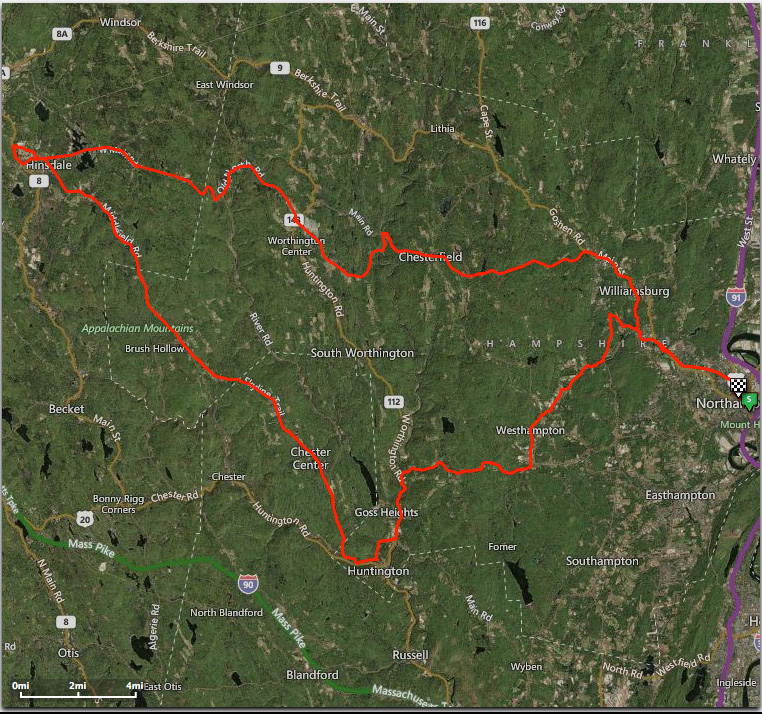
The route, from Northampton to Skyline Trail and back.

The route, from Northampton to Skyline Trail and back.

We checked tires and equipment, then hopped upon the bikes and headed out.  First thing I noticed was that my backside was still terribly sore, as it had not yet gotten used to the saddle.  This would be a problem the whole ride, but one I was willing to endure.  As we left Northampton, we traveled a familiar route for the first few miles, then started in to the mountains.  There really was no flat riding for most of the ride.  We were either climbing or descending.  Mostly we were climbing the first half, and some of the climbs were fairly challenging, getting over 10% grade in spots.  The descents proved to be fast and fun, with good pavement and no sharp turns.  Elaine rode the first half with Aldo driving the van.  They switched at midway along the route.

One of the remarkable aspects to Western Massachusetts is the number of small farms throughout the area.  One often hears how small farms are dying, that the cost of running the farm exceeds the returns, that big supermarkets and clubs like Costco have ruined things for the small farmer.  Running contrary to those trends, the small farmers of Western Massachusetts have strong support among people living in this area, who enjoy the benefits of locally grown, seasonal farm produce.  This is according to articles on the U Mass website and agriculture associations in the area.  One issue raised by a number of articles, that of the average age of farmers, and whether young people are willing to go into farming, seems to rely on the profitability of the farms.  For the last twenty years, the profits have been good, and young, sometimes inexperienced, farmers are willing to take over.  This is aided by government support, in terms of tax benefits if land is committed long-term to farming.  During our ride in this decidedly rural part of the state, we passed dozens of farms which, by appearance, seemed quite productive.  We also passed a unique instillation along Skyline Trail in Chester, a solar farm.  Doing a little research, it seems this very large instillation of solar panels covering many acres and capable of several megawatts of electricity production, is a project of Solectria Corporation, a subsidiary of Yaskawa America.  It is a subsidiary of Yaskawa Electric Company of Japan, a giant company started one hundred years ago as a motor manufacturer, and expanded globally into many businesses.  Apparently, they think it is a good idea to own solar electric production in rural areas.

Back to the ride, though.  As we tooled along Skyline Trail, the riding was very enjoyable, with rolling hills and a temperature definitely cooler at around 1800 feet elevation, than back in Northampton.

Beautiful view along the Skyline Trail in Western Massachusetts.

Beautiful view along the Skyline Trail in Western Massachusetts.

We got to the end of Skyline Trail and plummeted back down to Hinsdale, where we stopped for a bite and some water.  We then set out, at around mile 45, for the big climb of the day.  Starting in Hinsdale we rode up to Peru, a tiny postage stamp of a place along the road.  The climb was 4.8 miles long, started fairly steep, in the 12-14 % range the first half, then eased a bit to around 5% the rest of the way.  Since my climbing skills had suffered being off the bike for so long (since last year at this time), I was being given encouraging words, such as “you want a ride up in the van?”, and “shall I push you as we hit the steepest part?”.  Needless to say, this kind of encouragement, while said in earnest, can only be taken as reverse psychology.  No, I didn’t want to get in the van or have a hand on my back, but thanks anyway, I can handle it.  So, off we went.  The faster riders ascended quickly and I have no idea if they suffered a bit or a lot.  Any climb can be a killer if one races up.  I took my time and made it up very nicely, and was pleased to have done so.  I did stand a good part of the way, due to those old ischial tuberosities making themselves known.  We still had another 3o miles to go before getting back to Noho, including a few lesser climbs, but the hardest part was over.  In total, we went 79 miles and climbed around 6800 feet.

After our return, we all congratulated ourselves for a ride well done, and very enjoyable.  The van support was critical given the heat and humidity, although on a cooler, dryer day in the fall this would be doable without the van.  In fact, it would be quite stunning as the leaves turned colors.  Aldo, Elaine and Bob did a great job leading us.

Our group headed back to our respective hotel rooms for some rest and a shower.   That night we celebrated, not just this ride, but having the opportunity to enjoy escaping from work for four days and go cycling with good friends.  We went to the Sierra Grille in Northampton, had a fine meal, and after dinner and desert, even went to Herrel’s Ice Cream Parlor, ranked as the #1 restaurant in Northampton on TripAdvisor.com.  They don’t serve dinner, but they do desert very well.

Sit Bones

Ischial tuberosities.  Yes, that’s what they’re called.  Mine have had an awakening the last two days.  In past years, cycling had been my major sport and recreation.  Almost daily, from early spring to late fall, I would gather all the accoutrements needed to mount up and ride, getting in anywhere from a weekday twenty miler to a long 60 to 100 mile ride on the weekend.  Lately, since I grew in my devotion to running, cycling has shifted from prime sport to an event reserved for one week during the summer.  That is when I make my way up to Northampton,Massachusetts, and join my friends for four days of intense cycling with Ride Noho.  Ride Noho is a cycling camp run by Aldo Tiboni and his wife, Elaine.  They find beautiful routes around the back roads of western Massachusetts, and lead their guests on rides suitable to their abilities.  Accompanying them, and providing a cycling engine of enormous power, is Bob, ex-marine, and now a super-fit, white-haired, pony-tailed, vegan who is a ride co-leader.

I make this trek annually because I still have a love of cycling, even though I’ve essentially given it up for running, I may want to get more into triathlon, and it makes for a great get-away when I can spend four days with friends, pretending I have no way to check work e-mails.  One little downside of not cycling regularly, though, is one must break in the ischial tuberosities, among other bones and muscle groups peculiar to the cycling experience.


Jan, Bob, and Dan in Deerfield, Massachusetts.

Jan, Bob, and Dan in Deerfield, Massachusetts.

The seat on a road bike is designed the way it is to provide unfettered motion of the legs and thighs as they turn the pedals, and at the same time, support one’s backside.  The points at which this support is provided are the ischial tuberosities, or the “sit bones”, as they are called in some reference journals, like Bicycling Magazine.  Our first day on the road, Monday, we did a 57 mile ride including 4,000 feet of climbing.  Since it was the first day, the old ischial tuberosities were in a naive state, hence did not announce their presence very loudly.  Yesterday, we did a more modest 46 mile ride with only 2000 feet of climbing, the idea being to go easy before our herculean effort of today, a planned 70+ mile ride (closer to 80 I hear), with over 7000 feet of climbing.  Well, yesterday, those tuberosities made it clear they were not going to take this kind of punishment sitting down.  Yes, they announced to me in a very clear message that they were sore and swollen, and what right did I have to punish them in that manner?  Right from the start of yesterday’s ride I received this feedback as I gingerly set my butt upon the saddle as we were heading out, but it was not until the last ten miles of the ride, as Bob pulled us along at a steady clip in a pace line, requiring concentration and steady pedaling, that the message really came through, my ischial tuberosities were in revolt.

Rewards of the ride include a great lunch at Elizabeth and Paul's in Noho, including their modest version of blueberry pie.

Rewards of the ride include a great lunch at Elizabeth and Paul’s in Noho, including their modest version of blueberry pie.

Perhaps today the bones will have backed off on their message of pain.  I hope so.  This ride we have planned today is a huge challenge.  Maybe all my other parts will complain loudly enough to drown out the whimper from where the chamois meets the leather.

The Salt Flats of San Francisco Bay

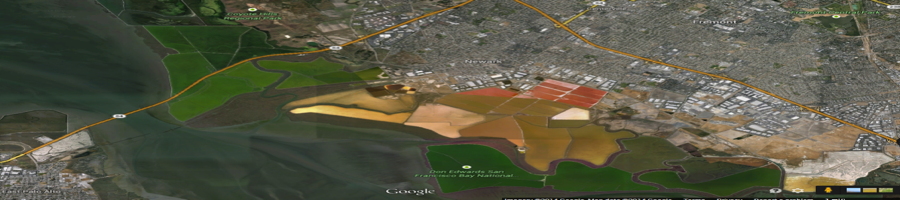
newarksalt


In 1850 in San Francisco, there was a commodity almost as valuable as gold, and it was plentiful. Not that it brought in the same reward, ounce for ounce, but it made a few individuals very rich. That commodity was salt. It was in easy reach, wherever the briny water of the bay lay very shallow, lapping on the littoral edge and drying in the sun. A white crust of salt on the sand and dirt was the result. The gold rush brought thousands to this mecca of fortune, but they needed to be fed, and salt was in high demand. To get it to the boarding house kitchens, though, took some ingenuity and very tough men. The southern and eastern part of the bay is a large flat expanse, and creating drying ponds for the salt crystals to grow was a natural for this area. Acres of space was available, and the early inhabitants of the area, the Ohlone tribe, had harvested salt here for centuries.  Former sea captain and failed gold miner John Johnson started commercial mining of salt in this area in 1854, selling it for $50 a ton, according to a Wikimapia article on the subject.  Competition developed, bringing the price down to $2 a ton, but still it was a profitable venture. Eventually, the ownership of the salt production passed through the Leslie Salt Company, and finally to Cargill, Inc., the largest, privately-held corporation in the U.S.

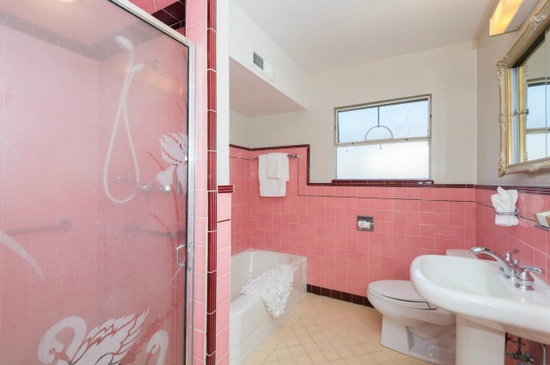
Why bring this up on a blog purportedly about running?  I had the opportunity to attend my nephew’s wedding two weeks ago, in Newark, California, located in the heart of the salt flats.  The San Francisco Bay area is an amazing mix of have and have-not, beauty and ugly, ultra-high tech and grunt labor, old and new, the arts and sport, and academic and common knowledge.  I flew in from Philadelphia to San Francisco and headed for the car rental area.  This is reached from the terminal by a very modern, automated rail line.  On arrival in the car rental pavilion, where all the rental companies have counters, I was amazed at the huge number of people waiting in line to get a car.  Clearly, this would be a major week for tourism in the bay area.  I was impressed how the lines moved, and the rental process was very streamlined.  Thousands of people were renting cars while I was there.  Once one’s contract is complete, a walkway leads to the garage where, on multiple levels, the cars are parked.  I waited in another line until a young man escorted me to my car.  We took the usual tour of the car to note scratches and dents, he gave me his card and told me to call him if I had any problems (a nice touch, Enterprise), and I was off.  Instead of heading north into San Francisco, I headed south on Highway 101.  This is a famous road, known in the early Spanish settler times as El Camino Real.  Today, it passes through Silicon Valley, home to such major corporations as Oracle, Apple, Google and Adobe, to name but a few.  Silicon is an element.  It is the basis, due to its semiconductor properties, of transistors, diodes, and integrated circuits.  From these came computers, and thus, eBay.  The companies in this area have been enormously successful in recent years, and their employees are very well paid.  The homes in this area are absurdly expensive.  For example, a two bedroom, two bath ranch style house in Mountain View, 1953 sq. ft., with very little style on a quarter acre lot, is listed at $1,875,000.

Bathroom in the 1.875 million dollar rancher in Mountain View.

Bathroom in the 1.875 million dollar rancher in Mountain View. (from the Zillow listing)

Heading down route 101, I made a turn onto route 84, which becomes the Dumbarton Bridge over the southern end of the San Francisco Bay.  Along this road I could see the salt drying along the roadside as the east bay area is reached.  This took me into Newark, home of Cargill’s salt headquarters and the site of the wedding.  I checked in to the Courtyard Marriot Silicon Valley.  They refer to it as Silicon Valley, but it is really on the wrong side of the bay.  It is hard by the salt ponds.  I arrived later in the afternoon and needed to get to the pre-wedding family dinner at my sister’s house in Livermore.  This was a very pleasant dinner with lots of wine and good food.  For the most part, everyone was in a good mood.

The next day, Saturday, was wedding day.  Since the wedding was not until 6:30 P.M., I had plenty of time to get a run in that morning.  Newark does not seem to be a runner’s town.  I asked at the hotel desk for advice where to run, and the desk person suggested a loop around the Lakeshore Park.  I asked how long the loop was and was told it was about 2 miles.  I went back to my room to check this out on the map.  It turned out the loop was a bit under a mile, and was about a mile from the hotel, so I needed a little bit longer run.  I put on my running clothes and headed out, trusty Garmin on my wrist.  My route took me past the park and over a freeway to the wedding venue, a very pretty park called Ardenwood Historic Farm.  It was where George Patterson, another unsuccessful gold seeker in 1849, was able to buy property in 1856 after working as a farm hand.  He had a house built on the property, and started his own farm.  Apparently, it was a very productive farm, as he was able by 1889 to rebuild the original humble farm house into an elegant Queen Anne style mansion.  Today, the farm continues as a working museum, owned by the city of Freemont, and host to many weddings, day trips and farm experiences for students.  Unfortunately, on my run, the whole park was locked up tight, and I couldn’t progress through it’s dirt roads.  Turning back, I made my way to the Lakeshore Park, a man-made doughnut shaped pond with a paved path around it.  I ran two laps around the pond, and marveled at the variety of birds that were attracted by this small body of water.  Many different breeds of ducks, geese, herons, snowy egrets and numerous other species had made a home here, and it made for an entertaining couple of laps.  On my way back to the hotel, along Cedar Boulevard, I made note of the homes along the road.  Again, they were small, ranch-style houses with car ports.  A number had for-sale signs.  The last leg of my run was through a very long strip mall of shops, which seemed to be not the original intent for the stores.  There were karate studios, hair salons, and a Chinese diner, to name a few, with empty shops between.

After I got back in my hotel room, I was again curious about the houses for sale in this area.  Looking up some prices, here the prices are much more reasonable.  Offered for $899,000 was a five bedroom, three bath house with 2500 square feet.

5 BR, 3 BA house in Newark.

5 BR, 3 BA house in Newark. (from the Zillow listing)

Still no bargain, but more living space than in the highly desired parts of Silicon Valley.

Of course, I was there for the wedding, and it went off without a hitch.  Well, not exactly, as my nephew and his new bride really did get hitched.  The wedding venue was just beautiful, the outdoor ceremony was quite nice, and the after-wedding party was very enjoyable.

My nephew and niece-in-law say their vows.

My nephew and niece-in-law say their vows.

George Patterson house at Ardenwood Farms.

George Patterson house at Ardenwood Farms.

On my way back to the airport the next morning, I again passed the salt encrusted shoreline, then passed a very large building being built along Route 101 with a Facebook sign in front.  I stopped for gas and turned around in front of Oracle headquarters, a collection of rounded steel and glass tall buildings aside another man-made lake.  I see it is thanks to these pioneers of computing and the internet that I am able to express myself on a WordPress blog.  We’ve certainly come a long way from George Patterson building a farm.


P.S.  Robert, from Zillow, Mountain View, can provide more information on the surrounding area properties:

http://www.zillow.com/mountain-view-ca/

Three Times the Fun

NFL news today is not about the game, but about lawsuits, contracts and other off-season minutia. Baseball is now mid-season, and in the hot days of summer, it really is a pastime. NHL hockey is done for the year, after the LA Kings won the Stanley Cup. Los Angeles is a real natural for a top hockey team, with its long tradition of ice sports. The NBA finished its season last month with the San Antonio Spurs taking the top spot, another city known as a hot spot for development of its winning team’s future players.

If like me, you are not a big fan of these big sports, this may be your weekend. We have the quarter finals of World Cup Soccer (or football), the finals of Wimbledon, and the start of the Tour de France. For me, its an opportunity to spend some serious couch potato time glued to the set, ignoring the lawn, and watching my favorite professional athletes battle it out.

World Cup play began Thursday, June 12, when Brazil took on Croatia, beating them 3-1 in a game that showed the Brazilian team’s typical style of play, non-linear, dance-like and taking advantage of their ability to confuse the other team.  The World Cup has exceeded all expectations so far.  The threats of protests melted as play got under way, and the matches got under the locals’ skin.  The venues, while some had Amazonian jungle conditions, were all in good shape and seemingly prepared for the crowds.  The fans have come from around the globe to cheer on their teams, and it appears that Brazil has played excellent host to the visitors.  My USA team rose to the challenges facing them and managed to win one, tie one and lose one in the first round, making out to the knockout round.  There, they got knocked out by an organized and efficient Belgian squad, but they performed admirably, gave us some thrilling moments, and showed that the USA team can play soccer in the world’s stadium.  Other matches of the first round have been equally exciting, with strong showings by such teams as Costa Rica, Mexico, Colombia, Nigeria, and Greece.  I love the fact that World Cup Football brings together such widely placed teams from around the globe, along with their cheering fans, in the same stadium.  No other sport does this, and its a great boost for mankind.

At the same time, Wimbledon started play Monday, June 23, and we are now in the last two days.  While the women’s singles play is finished as I write this, the men’s singles will be tomorrow, and should be a real classic battle.  Roger Federer, who has been struggling lately, and did not make it out of the second round at Wimbledon last year, will take on Novak Djokovic.  Federer first played Wimbledon 15 years ago, and has taken the top prize seven times.  He has mastered every aspect of singles tennis, can prevail on any surface, and has a style of play that is efficient and surprising, when he whips out a passing shot that does something that seems physically impossible.  His opponent in the finals tomorrow, Djokavic, is also an all-around player, currently rated number one in the world.  He is younger (32 vs 27) and possibly fitter than Federer, and he has proven himself able to beat Federer.  The record favors Federer, though, with Federer leading 18-16 in head-to-head matches with Djokavic.  The match starts at 9:00 AM EDT, and should be very exciting to watch.

The third of the three big sports this weekend is cycling, and the opening stage of the Tour de France.  While one might expect this race to take place in France, and mostly it does, it starts this year in Leeds, England with the riders doing a 45 minute slow paced tour through the town before heading out to the countryside as they race to Harrogate.  Usually, the tour starts the first day with a short time trial, but this year the race starts with a 190.5 km stage made for the sprinters.  As I write, the finish is unfolding with the teams of the sprinters driving the race at unreal speeds, with the pace line of the teams straining to carry their sprinter to the line first.  Heart in throat I watch, seeing if the riders can hold their lines, go through turns fearlessly, not touch the brakes or the wheel of the rider in front.   As it happened, Mark Cavendish was not able to hold things together and wound up hitting the pavement in a high speed crash, denying him the thrill of winning this stage in his hometown in front of the royal family.  Instead, the honor went to German Marcel Kittel of team Giant-Shimano.  In the odd world of cycling teams, this team is a Dutch team sponsored by Giant bicycles, a Chinese company which does have a manufacturing facility in the Netherlands, and Shimano, a Japanese maker of bicycle components.  The race will continue two more days in England before moving across the English Channel to the French mainland.  Watching the tour can be rewarding even if you are not a cycling fan, since the coverage from the helicopters and motorcycles shows the amazing and beautiful scenery of the route.

So, it’s time for me to go watch Argentina take on Belgium.  Maybe Messi will show us some of his brilliant moves and score a goal.  Happy watching, sports fans.

Waiting for the Dawn

I’m here.        Are you there?

I’m here.         I’m here.        I’m here.       Are you there?          Are you there?

I’m here.  I’m here.  I hear you.  I’m here.  Are you there?  I’m here.  Are you there?

I’m herAreyouthere?I’mhereAreyouthereI’mhereAreyouthere?I’mhereAreyouI’mhereArethere.

I am an habitual early riser.  I get up before the dawn.  Even in the late spring as we approach the summer solstice I am up when it is still dark, and hearing is very acute.  I can hear a train very far off making it’s way down tracks.  But as the dawn nears, the birds start to sing.  First only a single bird sounds a few chirps, then another starts to answer, and another, and another until there is a cacophony of bird noises filling the early morning air.  This is the best time of the morning.  The air is still cool, the scent of the air coming through the open window is fresh, and I am by myself, able to think about plans for the day, the week, and the coming months.

There is a clarity of thought early in the morning that does not carry through to the end of the day.  As the day progresses, the surrounding noises get louder, people talk over one another, conversations are rapid fire and brief, and one tends to react rather than think things through.  So, it is a real pleasure to have the early morning to pour a bowl of cereal, grind some beans and make coffee, and then sit by myself, listening as the birds sing, and think about my plans.

I like to read the NY Times on my iPad early in the morning.  I’ll go through the headlines, and read the latest from Gail Collins who always makes me laugh as she points out absurdities in politics.  I’m amazed and depressed by all the news of the nightmares some people are living in places like Syria, Pakistan, Afghanistan, Nigeria, Somalia, Eastern Ukraine, and on and on.

I think about my day and try to remember the things I must do, the things I want to do and the things which would be good to do.  It’s especially important to remember the things which didn’t make it to all my various forms of calendars, whether the Outlook calendar for work, or my phone calendar which I’ll often set to remind me a day or a couple of hours ahead of time of something which needs doing.  But things like car repairs, bill paying and other activities don’t make it to the calendar and must be remembered.  I also have several presentations for work to prepare, which I know need doing but for which I don’t have any reminders.

As for running, I have done with my spring races, two half marathons and a ten miler.  I signed up for the Philadelphia marathon November 23, and I plan to start the training process sixteen weeks earlier, Sunday, August 3.  As my friend Tony pointed out, looking at the usual training plans, I’ll have to back off on my running to fit into the plan.  Not that I would do that, of course.  My thoughts at present center on how to remain pain free and get into good condition for the marathon.  I have some nagging pain in my right knee which I have had before but always makes me worried.  It is nice, though, to get a break from the buildup to races, and just enjoy the running now for running’s sake.

For now, I will enjoy the pre-dawn time as the sun begins to light the sky, the birds awake and sing, and my ears have dropped their defenses and can pick up the slightest sounds of the early morning.

Frank


Semi-Marathon International de Nice


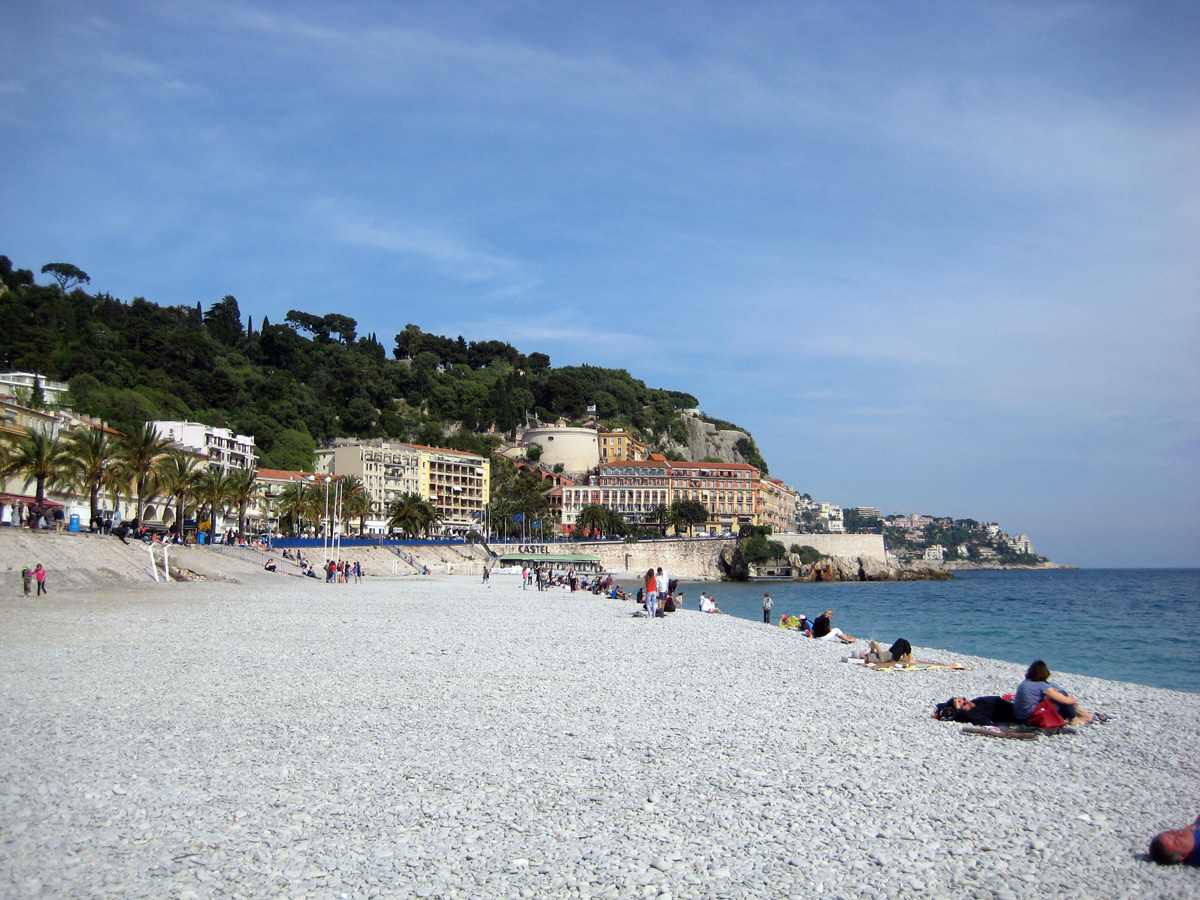
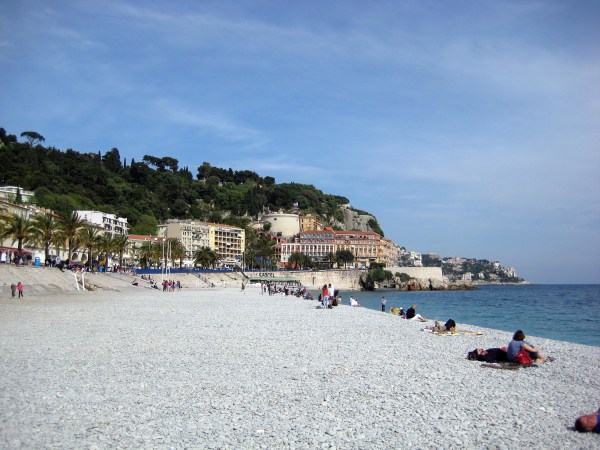
A beautiful day in Nice, France, 25 April 2014.

A beautiful day in Nice, France, 25 April 2014.

I got the idea to run this race about three years ago. I was looking for a way to have a travel adventure combined with a race. I thought it would be nicer to my wife to pick a half marathon so she would not bear the burden of my recovery from a marathon, which is not always pretty. After searching on-line, I found this race, which seemed ideal. It is run right around the time of my birthday, is in a beautiful location, and it bills itself as international. Perfect! So, what took me three years to do it, and how did it finally go?

The race is run late in April, and when I got the idea, I was also signed up for Boston. So that year was out. Then it took another year to really decide to do it. Finally, it took about six months of planning for the time off, to figure out what was needed to sign up, and make plans for the whole trip. The website for the race, http://www.nicesemimarathon.com/v14/ did not have an updated site until around October of 2013, and then it was still French only. About a month later, the English version was up, although the instructions for filling out the registration were only in French. Not too challenging, though, as they were quite clear. The race required a doctor’s certificate stating I was fit to run, but none was provided on the website. If you are a French runner and belong to a running club, apparently this is required for the club, and only your membership is needed. If you are a foreigner, you need the certificate. I was able to find one on the Paris Marathon website, had my friend, an internist, certify me, and sent it in by email. Voila, I got confirmation I was registered. The cost was 17€ plus 2€ service fee.

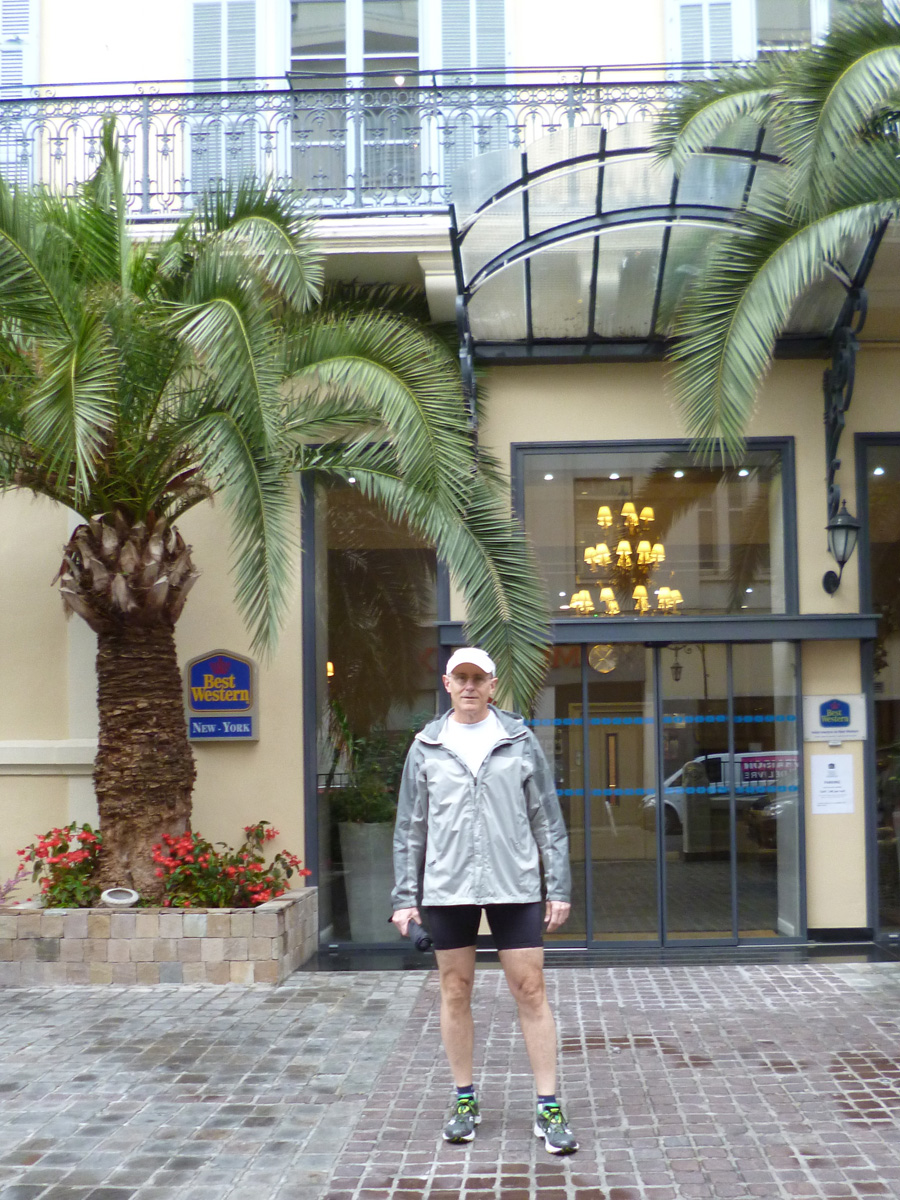
As it turned out, this year’s version fell one day after my birthday, my 60th, so it could not have come at a better moment. Yes, an age bracket change. We booked tickets to Nice planning to arrive on the 25th of April, to give a day for orientation before the race. Never having been to Nice, we did not know the city layout, or where would be best to stay. After a bit of a search on line, and finding out a couple of hotels we tried first were sold out, we reserved a room for three nights in the Best Western Hotel New York Nice, a long name I know, but centrally located and not far from the start of the race.

Today, finding out information about how to get from place to place is relatively easy. On-line sources are plentiful, and one can usually tell the reliable sources. Keys to look for are good grammar, a recent date, and a reliable blog or website devoted to travel. We were able to discover the bus from the airport at Nice into town cost 6€, and there are two buses depending on where you want to wind up, the 98 and the 99. More interesting is that with the help of Google maps, one can plot the walk to the hotel, know exactly how far it is, and even see street views so the landmarks are recognizable. This is all part of the fun of planning a trip to unknown places. We easily got through airport customs, made our way to the bus station at the airport, got tickets, and were delivered to Gare Central, the main train station in the center of Nice. From there we were able to walk to our hotel, which took about 20 minutes, along the Av. Jean Médecin. We were pleasantly greeted at the hotel by a desk clerk named Nella, who registered us and help us get further oriented. Our hotel room was very attractive, and had large glass doors leading out onto a small balcony. Across from us was a Monoprix supermarket, and caddy corner was a very large outdoor café and bar.

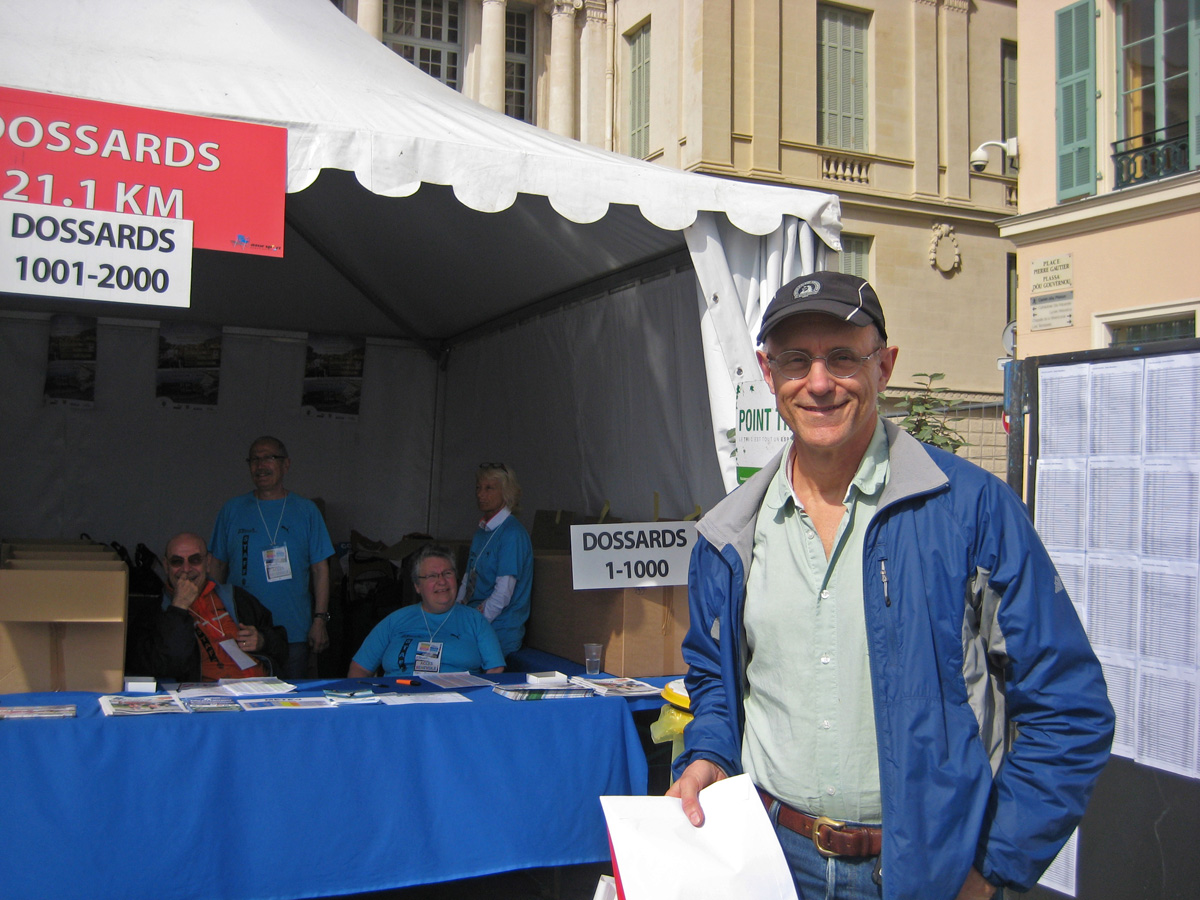
After getting situated in the room, we walked towards the old part of Nice where the expo was, in order to pick up my number. The expo was small, and outdoors under tents, in the oldest part of Nice. This is now a spot for shops and restaurants. A large flower mart took up the center of the main pedestrian street, and restaurants and bars with plenty of outdoor seating occupied either side. There were also many small shops selling local specialties. One was entirely devoted to sardines in cans, with many variations.
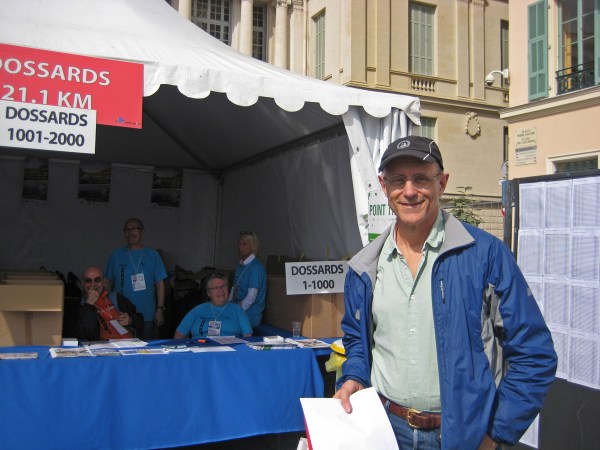
Picking up my number.  Dossard is French for bib.

Picking up my number. Dossard is French for bib.

The people manning the tents for the expo were extraordinarily pleasant and helpful, and it was no problem to find my number.  I then went to the next tent to pick up my goodie bag with my T-shirt and the usual things they add, like advertisements for other races, and samples of sports bars and drink.  One odd standout, though, was a large jar of Tikka Masala, which is an Indian sauce of tomatoes, lemon, coriander, and other spices used to make curry.  While this may not be typical pre-race food, and I certainly wouldn’t recommend it, it does point out that the sponsors do get to show their wares.  We planned to enjoy it after we returned home.

After picking up my bib and Tee, we wandered through the old part of Nice.  We were hungry, and while late in the day in Nice, we were still on eastern standard time.  So, we stopped at a fish restaurant called “La Grande Voile”.  Our dinner there was just satisfactory.  I cannot recommend this restaurant, based on the fact that the waitstaff made themselves very scarce even though we were one of only a few couples dining at the time, and also they brought the wrong fish.  But, my appetizer, a bowl of mussels, was quite good.

Mussels at La Grande Voile.

Mussels at La Grande Voile.

When we returned to our hotel that evening we were just amazed that our children had arranged for a bottle of Champagne to be brought to our room. Accompanying it was a card wishing me happy birthday and good luck.  It seems we have taught our children well!
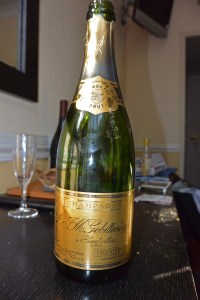
A very nice bottle of Champagne delivered to our room.

A very nice bottle of Champagne delivered to our room.

We went across the street to the grocery store, bought some strawberries, and sat out on our little balcony, enjoying the view, and our bottle of Champagne.  I am aware that eating mussels and drinking Champagne before a race may seem foolhardy, but I thought I would at least have a day to recover before actually running.

The following day, Saturday, we awoke to warm sunshine streaking through our window.  Since this was the day before the race I wanted to get in an easy run to keep the muscles toned.  I put on my shorts, a shirt, and my running shoes and headed out to the large path along the ocean for a practice run.  It seems I was not the only one.  About a dozen or so other runners, some with Semi-marathon shirts on, were doing the same.  We ran along the Promenade des Anglais, the last half of the semi-marathon to be run the next day, where signs were being set up for the race, portable toilets were being set in place, and meanwhile the usual beach activity was still going on.  Artists were setting up their stands to display their scenes of Nice, beach denizens were hanging out chatting with each other, and, along the surf, many surf-casting fishermen and women had their lines in the water.

The day of the race came fairly quickly, although the race starts at a very reasonable 9:30 AM.  Our hotel had breakfast for twelve euro, not a small sum for cereal, pastries, ham and slices of cheese.  Normally, my wife and I would buy the same from the market, and have breakfast in our room, but for various reasons we didn’t get set, so I had the hotel breakfast.  Then, it was time to do the usual pre-race preparation.  I got on my shorts and singlet, pinned my number to the singlet, and got on my socks and running shoes.  In addition, I put on my rain jacket, since it had already started drizzling under heavy clouds.

In front of our hotel, ready to head down to the start.

In front of our hotel, ready to head down to the start.

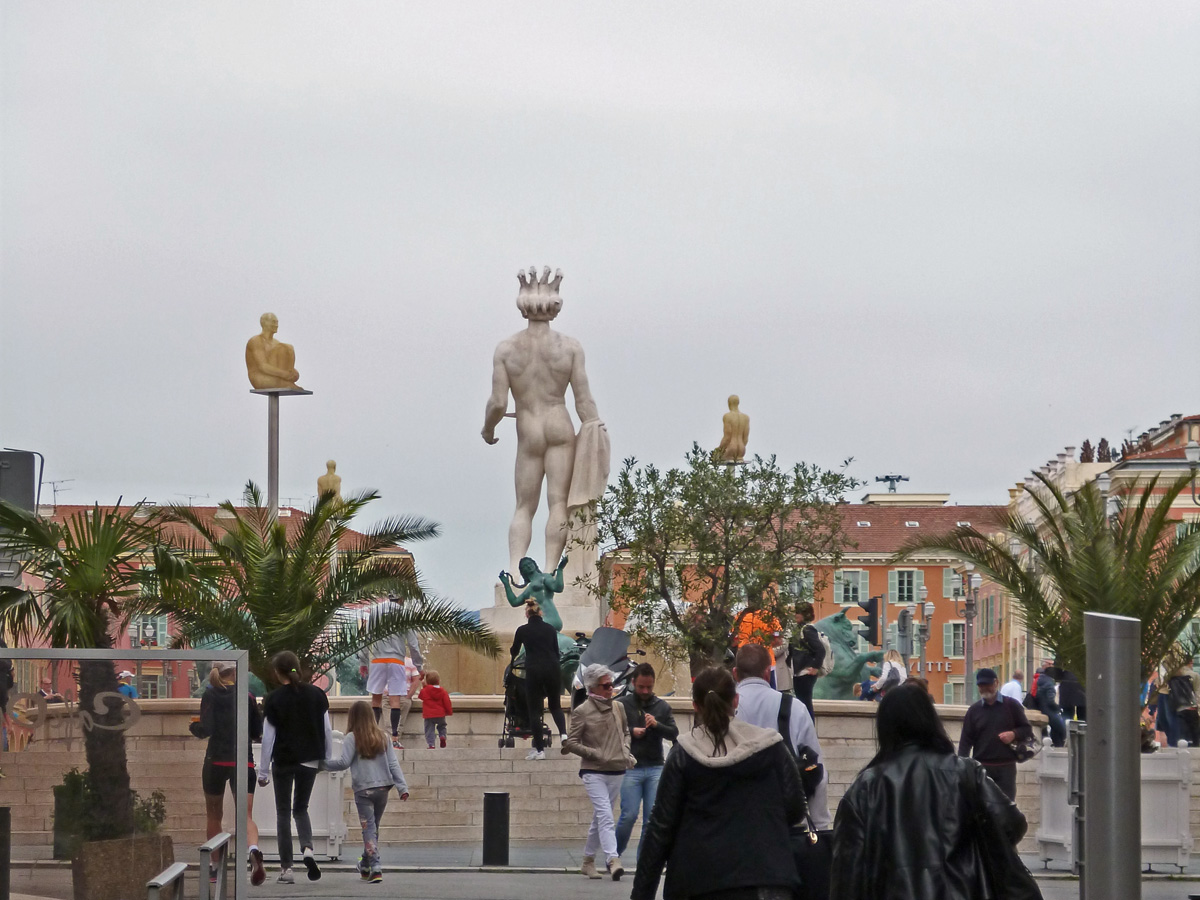
Walking down to the start, we passed through the beautiful Place Massena, bordered on both sides with spouting fountains from large rectangular paved areas.  Seven tall poles holding up sitting figures represent seven continents which are lit from inside with colors that change, representing conversations.  The centerpiece, a very large (7 meter tall)  nude statue of Apollo surrounded by his planetary helpers, was a controversial piece when first displayed and spent some time on the outskirts of town until it was moved back in 2011.  Finally, the buildings behind the statue are elegant, stately and make a striking backdrop.
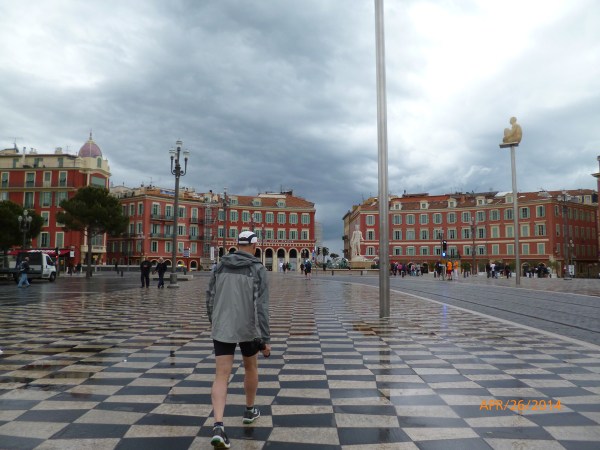
Place Masséna in Nice.

Place Masséna in Nice.

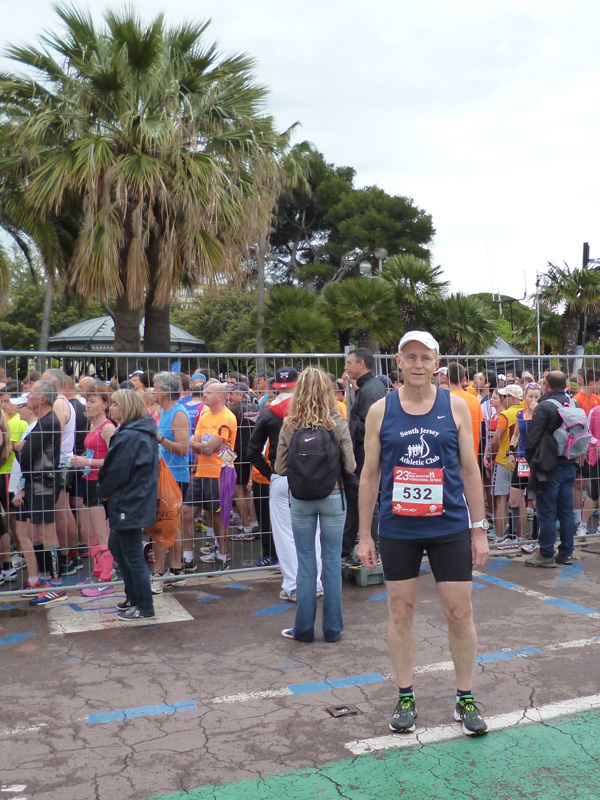
We got to the start area, and got oriented.  With some time left before the start, I went for a brief warmup run.  The crowd grew, as the runners and their families gathered.  It was a typical pre-race scene, with lines at the portable toilets, lots of milling around, and at one end of the area, a couple of trainer types were leading an exercise routine to music.
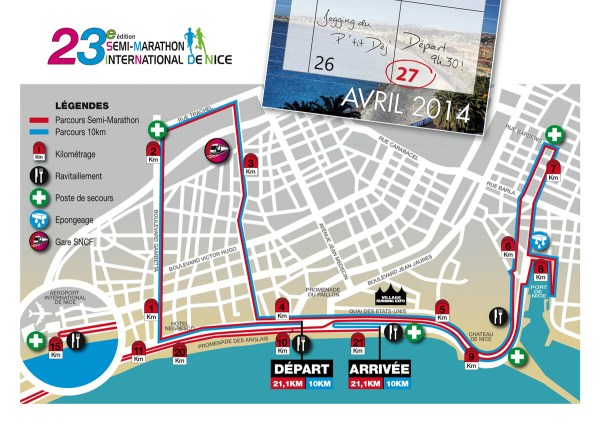
The parcours of the race.

The parcours of the race.

The total starting the race, including both the semi-marathon and the 10K, which started together, was about 5,300.  The 10K runners ran the first half of the semi-marathon course which circled through the streets of Nice.  Then the semi-marathon course continued out along the Promenade des Anglais to the Nice airport, turned and headed back along the same route to the finish line.
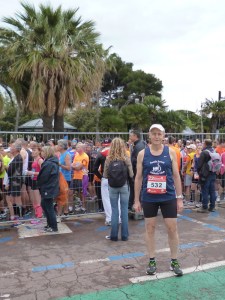
At the start, getting ready to join the throng.

At the start, getting ready to join the throng.

The race got underway in typical fashion, with the blast of a horn.  I made a small tactical error in not moving closer to the front for the start.  As with many popular races, the crowd toward the back is not really going for time.  With the narrow streets and large number of runners, that meant the pace when I crossed the start line was slow, and with a tightly packed group it was difficult to move ahead. Along with a number of other runners in the same predicament, I had to move to the sidewalks to get my pace up and move ahead of the crowd. This presented a problem with light poles, onlookers, and a few other obstructions. The runners were enjoying themselves, though, and as we went through the tunnel under the central train station, there were a lot of hoots and yells which echoed back. The first five kilometers passed back close to the start, then the second five were a loop through the eastern part of town, again heading back to the start. At this point, the 10 K runners peeled off to their finish, as the rest of us 21.1 K runners headed out the Promenade des Anglais for the second half of our race, a flat run out to the Nice airport and back. The finish was deceptive. As one got closer to the end, a large, inflated arch over the road looked like the end, but it was just an advertising banner. The real finish line was on a slight turn toward the ocean then along a carpeted finish over the line.

The stars of this race were the Kenyans.  A group of six Kenyan men finished in 1:01:31, 1:01:32, 1:01:33, 1:01:34, 1:01:36 and 1:01:38, the first of whom was Kennedy Kipyego.  The first woman to finish was also Kenyan, Janet Kisya, in 1:10:59.  Both of these runners ran personal bests in this race.

Of course, I didn’t see much of them, although the out-and-back nature of the second half of the race did give us commoners a glimpse of the front runners as they whizzed by heading toward the finish line.  All the other runners cheered these champions on as they sped by.

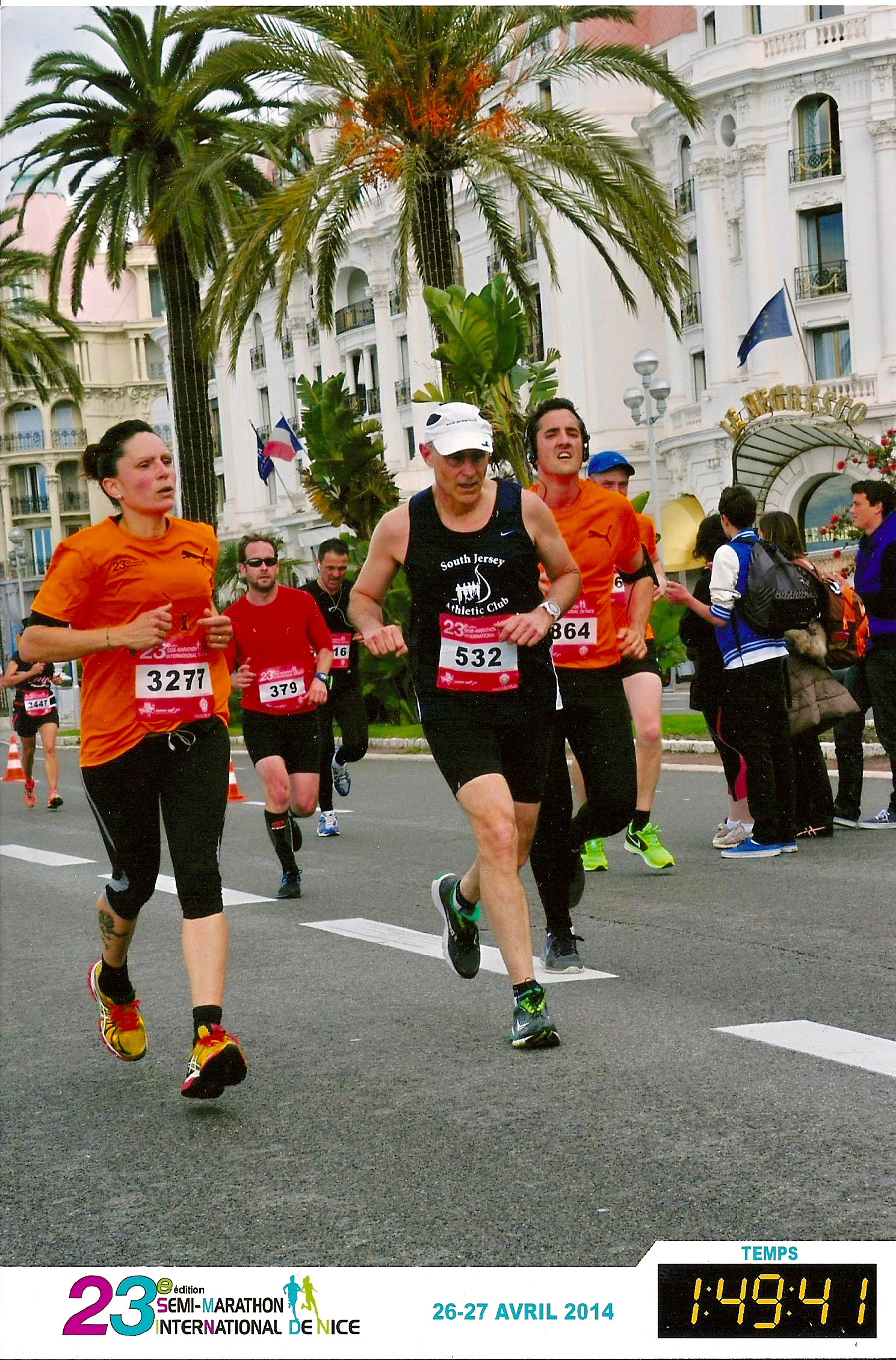
The last power surge, heading toward the finish line.

The last power surge, heading toward the finish line.

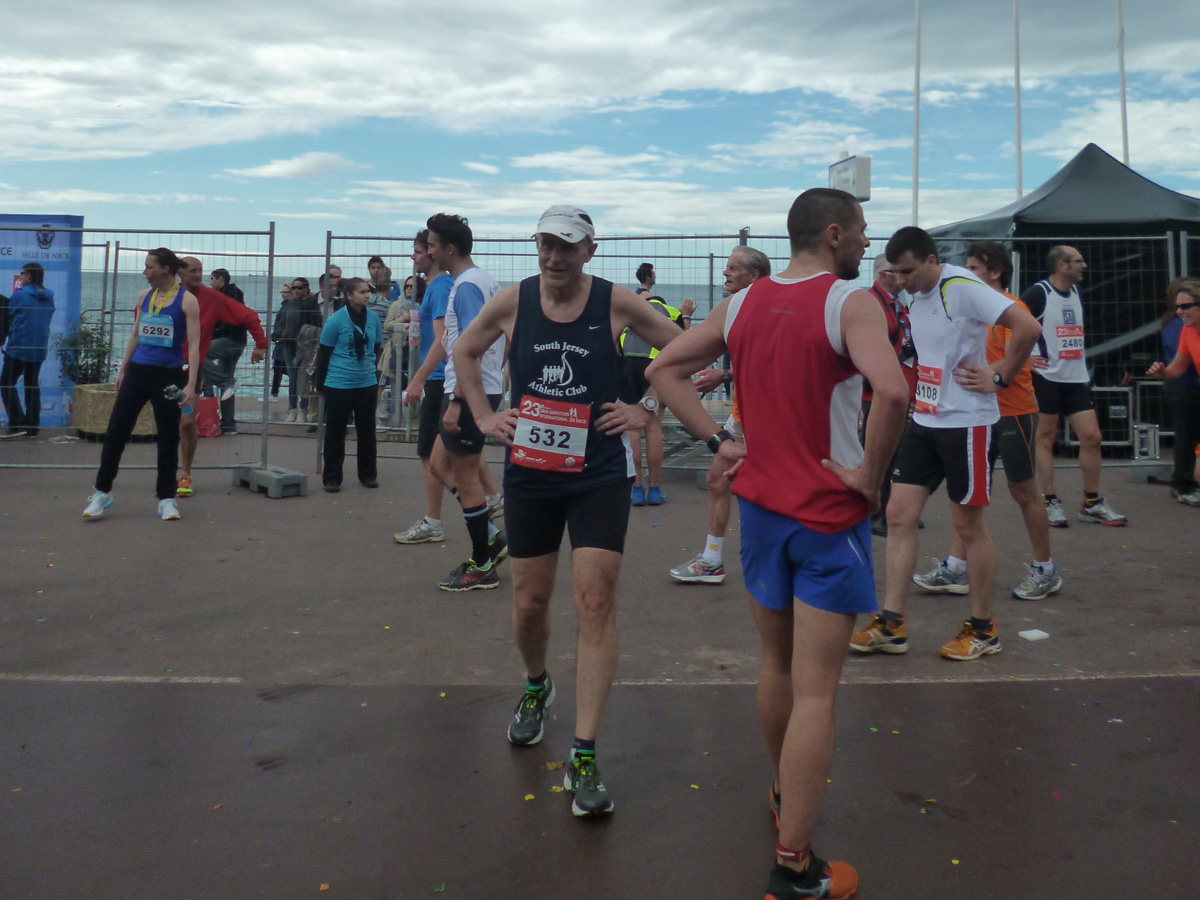
As races often go, the last few miles, or in this case, kilometers, seemed to never end.  Finally, I could see the 20 K marker and new the line was near.  Racing in kilometers is great; the last kilometer is shorter than a mile!  As I crossed the line, I heard the announcer call out “États-Unis”, and I knew it was for me, since there were no others of my countrymen around me.  I raised my arms as I crossed the line, pleased to have made my goal of running this race.  My finishing time was a bit slow, which I justified by the slow start and the long plane trip to get here.  Never mind, though, I was quite happy and satisfied.  My ever-supportive wife, Kathleen, caught me right at the finish.
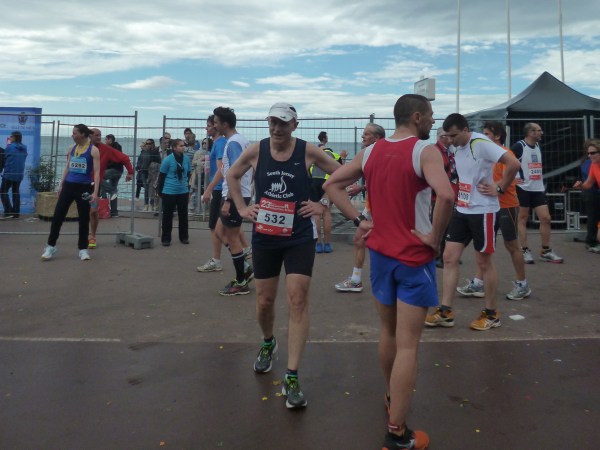
Just after finishing, catching my breath.

Just after finishing, catching my breath, arms akimbo apparently in the style of the race.

I was a bit dehydrated, dripping with sweat, and a little shaky.  I drank down one bottle of water and most of a second as I passed through the finish area and collected my medal.  I think the medals mean a lot for a marathon, perhaps a little less for a half marathon, but I was quite pleased to have this memento.
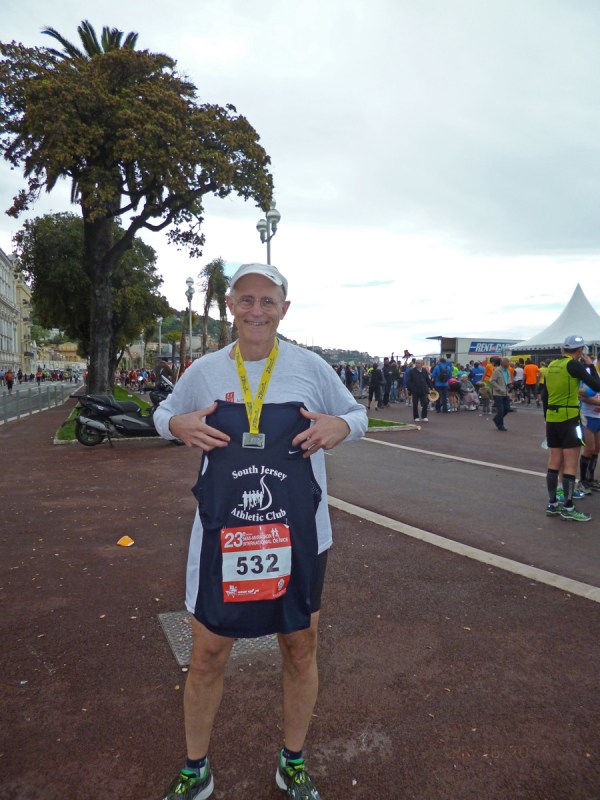
Representing my home club at the Semi-marathon International de Nice 2014.

Representing my home club at the Semi-marathon International de Nice 2014.

As my wife and I walked together out of the race area and back to our hotel,  I told her all about the race course, the challenges and the beauty of the course.  We then started to plan our afternoon of sightseeing.  We headed back to the Place Masséna and on to our hotel, saying au revoir to monsieur Apollo as we left the area.
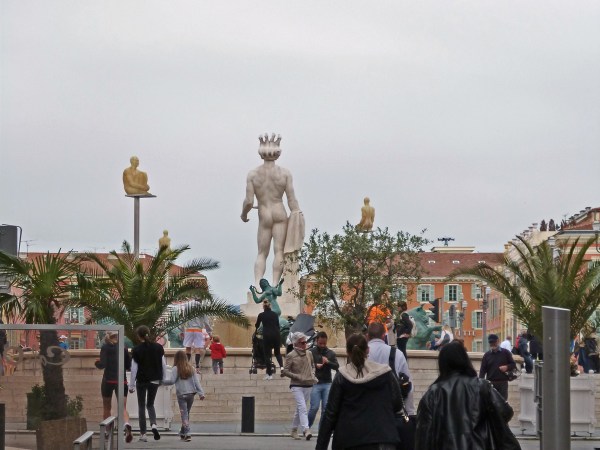
Apollo's back, passing on our way back to the hotel.

Apollo’s back, on our way back to the hotel.
Uncorking Croatia

The Blog of WINES OF CROATIA

RunnersOnTheGo.com

To help enrich the lives of others, we developed RunnersOnTheGo.com to help runners save money on races, running stores, and much more. We also provide the specific local information that makes your travel for business, vacation, or racing as rewarding as possible.

getsetandgo

Travel Blog of a Budget Traveler sharing stories on travel, books & Vegetarian Food

Marc Hemingway

Trying to keep track of my life (and my life on track)

Mid-Life, Mid-Level, Masters Running

Exploring ideas about running to contribute to a more enjoyable pursuit for the mid-level masters runner

therunningtherapist

"One foot in front of the other and one thought at a time"

WordPress.com News

The latest news on WordPress.com and the WordPress community.

retireediary

The Diary of a Retiree